Crypto Exchange Fees & Sign-Up Requirements Compared (2026): 9 Markets
An honest, data-backed comparison of standard spot trading fees across the major crypto exchanges — MEXC, OKX, Binance, Bybit, KuCoin, Bitget, Gate, Kraken and Coinbase — plus the real KYC sign-up requirements and a market-by-market availability matrix across nine countries/regions. Figures as of June 2026, with sources, method and caveats.
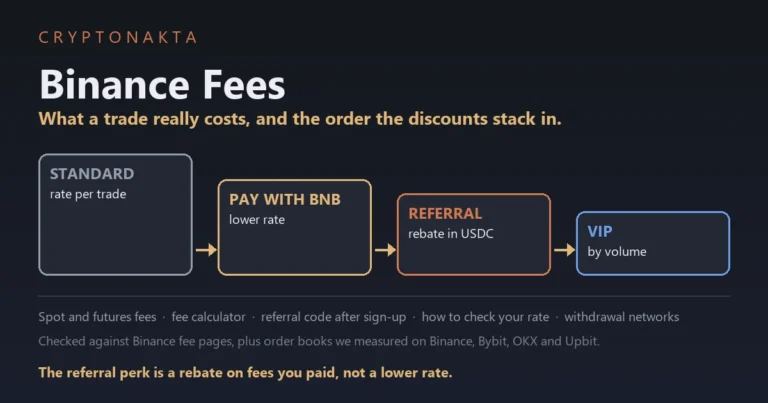
- Standard-tier spot fees cluster low for the global-first exchanges and run several times higher for US-regulated and one-click buys. As of June 2026: MEXC ≈ 0%/0.05%, OKX ≈ 0.08%/0.10%, Binance/Bybit/KuCoin/Bitget ≈ 0.10%/0.10%, Gate ≈ 0.10–0.20%, Kraken Pro ≈ 0.16%/0.26%, Coinbase Advanced up to ~0.40%/0.60%.
- Native-token discounts cut fees further: BNB −25% (0.075%), KCS −20% (0.08%), with OKB, GT and BGB lowering OKX, Gate and Bitget.
- The biggest fee saving isn’t a referral or token — it’s using the spot market with a limit order instead of the one-click “buy” button, which carries a much wider spread.
- KYC is mandatory for full access on every regulated major (government ID + selfie, ~minutes); a platform that skips it for real size is a red flag, not a perk.
- The decisive variable is your country. Global Binance is closed to US and Japanese residents; in Turkey, MEXC was access-blocked and barred from new customers while Bybit/Gate/KuCoin appear on the SPK operating list (list ≠ licence — verify). Crypto deposits work from anywhere; it’s the fiat on-ramp that’s gated.
- This page gives the full fee table, sign-up requirements, a 9-market availability matrix, the method and sources, and honest caveats. Not investment advice.
1. The finding: fees cluster low — but country decides access
2. Exchange fees & access at a glance
3. Full comparison: standard spot fees & sign-up basics (2026)
4. Sign-up requirements: what every regulated exchange asks
5. Availability by market: the 9-region reality matrix
6. The caveats: what this data does and doesn’t capture
7. Where to sign up (verified referral benefits)
8. Next steps
1. The finding: fees cluster low — but country decides access
Two numbers decide what a crypto exchange really costs you: the spot trading fee, and whether you can legally sign up where you live at all. The first is easy to compare; the second is where most “best exchange” lists go quiet. This page puts both in one place — standard spot fees for the major global exchanges, the real sign-up requirements, and an honest market-by-market availability matrix across the nine countries/regions we cover.
Here is the core fee finding, standard tier (no VIP volume, no token discount), as of June 2026:
| Exchange | Spot maker | Spot taker | With native token |
|---|---|---|---|
| MEXC | ~0% | ~0.05% | — |
| OKX | ~0.08% | ~0.10% | Lower with OKB |
| Binance | ~0.10% | ~0.10% | ~0.075% with BNB (−25%) |
| Bybit | ~0.10% | ~0.10% | — |
| KuCoin | ~0.10% | ~0.10% | ~0.08% with KCS (−20%) |
| Bitget | ~0.10% | ~0.10% | Lower with BGB |
| Gate | ~0.10–0.20% | ~0.10–0.20% | Lower with GT |
| Kraken (Pro) | ~0.16% | ~0.26% | 0% / 0.10% at high volume |
| Coinbase (Advanced) | up to ~0.40% | ~0.05–0.60% | — |
2. Exchange fees & access at a glance
The headline numbers at a glance:
| Lowest standard spot fee | MEXC ≈ 0% maker / 0.05% taker |
| Typical standard fee | 0.10% maker / 0.10% taker (Binance, Bybit, KuCoin, Bitget) |
| Highest of the majors | Coinbase & Kraken instant-buy (up to ~0.6%+) |
| Native-token discount | BNB −25%, KCS −20%, OKB/GT lower |
| KYC | Required for full access on every regulated major |
| Biggest variable | Your country — availability & legality differ widely |
| As of | June 2026 (fees & rules change — verify officially) |
Two honest caveats up front. First, these are standard-tier spot fees — your rate drops with 30-day volume and with holding the exchange’s token, and it rises sharply if you use a one-click “buy now” button instead of the spot market. Second, a low fee means nothing if you can’t open an account: availability, fiat on-ramps and legality vary enormously by country, which is the part this page treats most carefully.
3. Full comparison: standard spot fees & sign-up basics (2026)
The full standard-tier comparison, with the sign-up basics. All figures as of June 2026, base tier, spot market — verify on each official fee page before trading.
| Exchange | Maker / Taker | Token discount | KYC for full use | Fiat on-ramp |
|---|---|---|---|---|
| MEXC | ~0% / 0.05% | — | Yes (full limits) | P2P, card (region-dependent) |
| OKX | ~0.08% / 0.10% | OKB | Yes | Card, bank, P2P |
| Binance | ~0.10% / 0.10% | BNB (−25%) | Yes | Card, bank, P2P |
| Bybit | ~0.10% / 0.10% | — | Yes | Card, bank, P2P |
| KuCoin | ~0.10% / 0.10% | KCS (−20%) | Yes | P2P, card, third-party |
| Bitget | ~0.10% / 0.10% | BGB | Yes | Card, P2P |
| Gate | ~0.10–0.20% / 0.10–0.20% | GT | Yes | Card, P2P |
| Kraken | ~0.16% / 0.26% (Pro) | — | Yes | Bank (ACH/wire/SEPA), card |
| Coinbase | up to ~0.40% / 0.05–0.60% (Advanced) | — | Yes | Bank, card, PayPal (region) |
Sources & method: standard/base-tier spot fees compiled June 2026 from each exchange’s public fee page and independent fee trackers (e.g. fee-comparison roundups). “Token discount” = the reduction for paying fees in the exchange’s native token (BNB, KCS, OKB, GT, BGB). Coinbase and Kraken figures are their pro/advanced interfaces; their simple “buy” flows cost more. Ranges are illustrative, not a quote — verify live before trading.
4. Sign-up requirements: what every regulated exchange asks
Fees aside, the sign-up process is near-identical across the regulated majors — and the requirements are non-negotiable on any exchange that complies with the law.
| Requirement | Detail |
|---|---|
| Identity verification (KYC) | A government ID (passport, national ID or driver’s licence) plus a selfie/liveness check. Mandatory for full deposit, trade and withdrawal limits on every regulated major. Usually approved in minutes. |
| Minimum age | 18 (or your country’s age of majority), confirmed during KYC. |
| Email or phone | To create the account and receive verification codes. |
| Two-factor authentication (2FA) | Not required to register, but the single most important security step — use an authenticator app, not SMS, before depositing. |
| Minimum deposit | Effectively none to open; you can start with a very small amount. Card buys have higher fees than bank transfer. |
| Time to first trade | ~10–15 minutes end to end when your ID is ready. |
5. Availability by market: the 9-region reality matrix
This is the part most fee tables skip — and the part that actually decides which exchange you can use. Availability, fiat on-ramps and legality differ sharply by country. Below is an honest snapshot across the nine markets we cover, as of June 2026. Rules change frequently; always confirm with your local regulator and the exchange’s official site.
| Market | Local / regulated route | Global exchanges — reality |
|---|---|---|
| United States | Coinbase, Kraken (US-regulated, USD on-ramp) | Global Binance not available (Binance.US is a separate entity); Bybit, KuCoin, Gate, MEXC restrict US users. |
| South Korea | Upbit, Bithumb, Coinone, Korbit (KRW via real-name bank accounts) | Global Binance is usable; KRW on-ramp generally goes through domestic exchanges first, then transfer. |
| Japan | bitFlyer, Coincheck, bitbank (FSA-registered, JPY) | Global Binance is not open to residents (Binance Japan is a separate entity); MEXC is FSA-unregistered — own-risk. |
| EU (incl. Spain) | MiCA-licensed exchanges; local options like Bit2Me | Most majors operate under MiCA registration; product availability shifts as MiCA rolls out. |
| Brazil | Mercado Bitcoin, Foxbit (BRL via PIX) | Global exchanges increasingly localize (PIX on-ramp); broadly accessible. |
| Turkey | BTCTurk, Paribu (local, TRY) | SPK “operating list” includes Bybit, Gate, KuCoin (being on the list ≠ licensed — verify at spk.gov.tr). MEXC was access-blocked (Dec 2024) and barred from taking new Turkish customers (2025). Global Binance is marketing-restricted under Law 7518. |
| Vietnam | Local P2P and platforms (ONUS, Remitano) | A 2026 legal framework is forming; global exchanges widely used via P2P. |
| UAE / MENA | VARA-regulated (e.g. local desks); 0% personal crypto tax in UAE | International brokers and major exchanges broadly accessible; rules vary by country across MENA. |
| Taiwan | MAX, BitoPro (FSC AML-compliant, TWD) | Global exchanges accessible; TWD on-ramp typically via local platforms. |
Method: availability and regulatory status compiled June 2026 from each market’s regulator (e.g. Turkey’s SPK, Japan’s FSA) and exchange announcements. This is a directional snapshot for orientation, not legal advice — crypto regulation changes quickly and varies within regions. Verify the current position with your local regulator and the exchange’s official site before signing up.
6. The caveats: what this data does and doesn’t capture
A fair comparison names its limits. Here is what this data does and doesn’t capture.
| Caveat | Detail |
|---|---|
| Standard tier only | The fees here are base-tier spot rates. Your real rate falls with 30-day volume and native-token discounts, and rises with one-click buys. VIP/market-maker tiers can reach near-zero. |
| Fees change constantly | Exchanges run promotions (zero-fee pairs, maker rebates) and adjust schedules. These are June 2026 snapshots, not quotes — always check the live official fee page. |
| Spread & withdrawal costs | The trading fee isn’t the whole cost. Spreads on “instant buy,” card-purchase surcharges, and network withdrawal fees often matter more for small beginners than the headline maker/taker rate. |
| Availability is directional | The market matrix is a snapshot for orientation. Sub-regional rules, account-level restrictions and rapid regulatory change mean you must verify your own eligibility officially. |
| Lowest fee ≠ best choice | MEXC’s ~0% is attractive, but a regulated exchange that legally serves your country, supports your currency, and you can secure properly beats a marginally cheaper one you can’t safely use. |
7. Where to sign up (verified referral benefits)
If you’ve settled on an exchange, sign up through the spot market and secure the account before depositing. These are the exchanges we keep dashboard-verified sign-up guides for, with the referral benefit we could actually confirm stated honestly (no invented percentages):
Gate.io
KuCoin
Binance
OKX
MEXC
Affiliate disclosure: some links are partner links. We may earn a commission at no extra cost to you. This is not investment advice.
8. Next steps
The honest summary: standard spot fees are low and fairly similar across the global-first exchanges (0–0.10%), higher on the US-regulated pair and on any one-click buy — but the fee is the second question. The first is whether an exchange can legally serve your country and your currency, which varies sharply: closed for global Binance in the US and Japan, access-blocked for MEXC in Turkey, and shaped by MiCA, VARA, the FSA, the FSC and Korea’s real-name banking elsewhere. Pick on legal availability and security first, then minimize fees by trading on the spot market, using a token/volume discount, and a verified referral. Build the rest of your foundation with our best exchanges guide, the step-by-step buying guide, and how to set up a wallet; learn to spot traps in the scams guide; and if you’re new to all of it, start at the complete beginner’s guide. Verify every fee and rule on the official source before acting — they change constantly.