What Is Chainlink (LINK)? The Oracle Network Behind DeFi and Tokenized Assets — 2026 Guide
Blockchains can’t see the outside world; Chainlink is the network that fixes that. This is the deep, honest profile: what an oracle actually is, how Data Feeds and CCIP work, why Chainlink sits at the centre of the 2026 real-world-asset and institutional story (Swift, DTCC, ASX), how the LINK token captures value — and the real risks, from un-circulated supply to faster rivals like Pyth. As of June 2026.
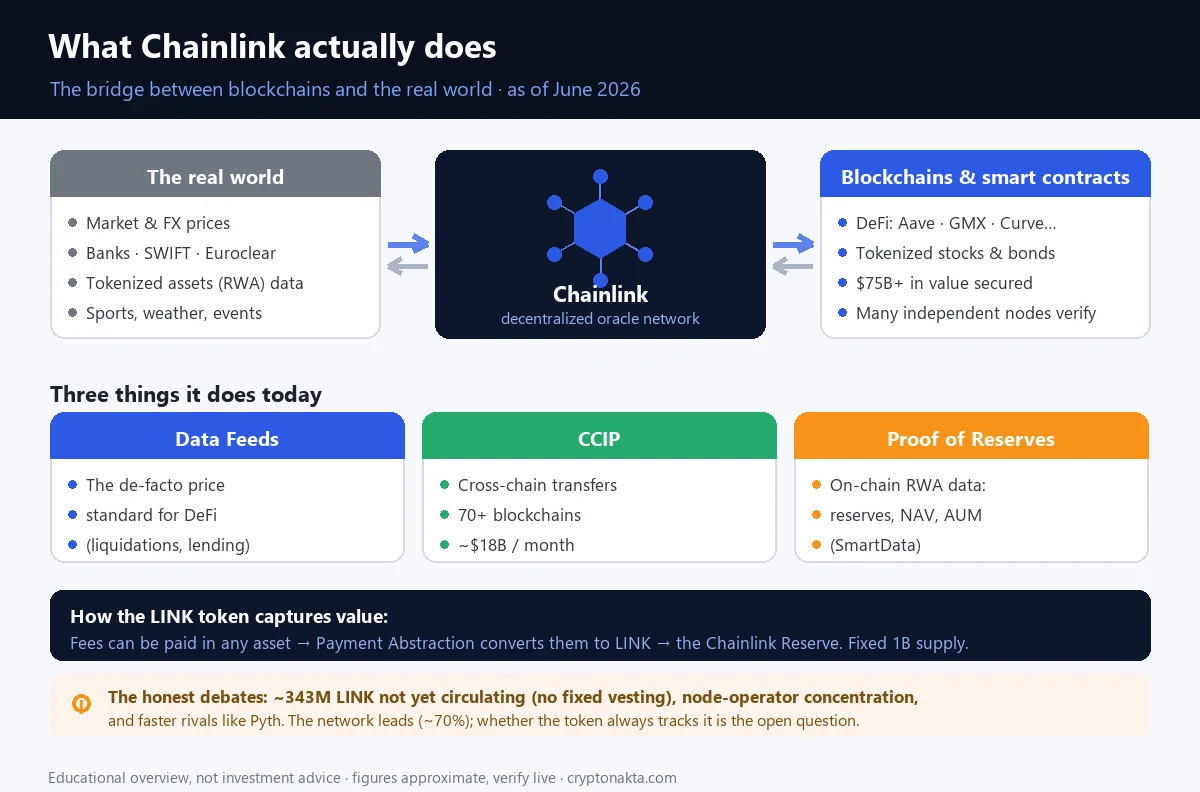
- Chainlink is the leading decentralized oracle network — it feeds real-world data (prices, bank systems, tokenized-asset data) into blockchains, which otherwise can’t see any of it. It holds roughly 70% of the oracle market, and its price feeds are DeFi’s de-facto standard (Aave, GMX, Curve and more).
- It does three big things: Data Feeds (the price standard for DeFi), CCIP (secure cross-chain transfers across 70+ blockchains, ~$18B/month), and Proof of Reserves / SmartData (on-chain data for tokenized real-world assets). It secures $75B+ across DeFi.
- 2026 is its institutional moment: Swift (tokenized bonds via CCIP), DTCC (collateral management), ASX and others are building on it. That’s why it’s seen as a flagship “RWA coin.” But a partnership headline isn’t recurring revenue — treat each as a step, not a guarantee.
- The LINK token: fixed 1B supply, ~727M circulating (so ~343M not yet in circulation), staking ~4.3–4.75% APY with a 28-day unbond. Value capture works via Payment Abstraction and the Chainlink Reserve — fees paid in any asset are converted into LINK.
- The honest risks: ~343M LINK isn’t circulating yet and has no fixed vesting (potential sell pressure), top node operators are concentrated, faster rivals like Pyth compete, and “fees will grow into the valuation” is still a bet. LINK is volatile.
- This guide covers the oracle problem, how it works, CCIP, the RWA/institutional story, the token and value capture, the risks, Chainlink vs Pyth, where to buy, and a glossary. Not investment advice.
1. What Chainlink is, and the oracle problem
2. How it works: decentralized data feeds
3. CCIP: connecting the blockchains
4. Why 2026 is Chainlink’s institutional & RWA moment
5. The LINK token: supply, staking, and value capture
6. The honest risks
7. Chainlink vs Pyth: the oracle competition
8. Where and how to buy LINK
9. Key terms (glossary)
1. What Chainlink is, and the oracle problem
A blockchain is brilliant at one thing and hopeless at another. It can settle transactions and run code that nobody can tamper with — but it’s completely blind to the outside world. A smart contract on Ethereum has no idea what the price of Bitcoin is, whether a bond paid out, or who won a match. By design, it can only see data already on its own chain. That gap is called the oracle problem, and it’s the single thing standing between blockchains and almost every serious real-world use.
Chainlink is the network that solves it. It’s a decentralized oracle network: a system of independent operators that fetch data from the real world, agree on it, and deliver it onto a blockchain in a form smart contracts can trust. If a lending app needs to know the price of ETH to decide whether to liquidate a loan, it asks Chainlink. By 2026 it has become the default plumbing for this — roughly 70% of the oracle market — and its price feeds are used by the biggest names in DeFi, including Aave, Compound, GMX, Synthetix and Curve.
2. How it works: decentralized data feeds
Why not just have one company post the data? Because that would hand a single point of failure — and a single point of corruption — control over billions of dollars in contracts. A bad or hacked price feed can trigger wrongful liquidations and drain a protocol in seconds. Chainlink’s answer is decentralization: instead of one source, many independent node operators each pull the data, and the network aggregates their answers into a single value, discarding outliers. To feed bad data, you’d have to corrupt many operators at once, which is expensive and hard.
The most-used product built on this is Data Feeds (also called Price Feeds). These have quietly become the de-facto price standard for DeFi: hundreds of protocols across Ethereum, BNB Chain, Avalanche, Polygon and dozens of others rely on them for liquidations, lending rates and synthetic-asset pricing. When you hear that Chainlink “secures $75 billion,” this is mostly what that means — that’s the total value sitting in contracts that depend on Chainlink data being right.
3. CCIP: connecting the blockchains
Chainlink’s second pillar is CCIP — the Cross-Chain Interoperability Protocol. The blockchain world is fragmented across dozens of separate networks that can’t natively talk to each other, and moving value between them has historically meant bridges, which have been hacked for billions. CCIP is Chainlink’s standardized, security-first way for smart contracts on different chains to send messages and transfer tokens to one another.
By 2026 it connects 70+ public and private blockchains through a single integration and moves on the order of $18 billion per month in cross-chain volume. Crucially, it’s being adopted as the preferred standard for institutional cross-chain applications — the kind of banks and asset managers that won’t touch an unaudited bridge but will build on infrastructure with formal security guarantees.
4. Why 2026 is Chainlink’s institutional & RWA moment
If you only understand one thing about why Chainlink matters in 2026, make it this: the dominant story of the year is real-world assets (RWA) — tokenizing bonds, funds, stocks and collateral and moving them on-chain — and that story runs through oracles. Tokenized assets are useless without reliable, automated data: what is this bond worth, are the reserves really there, what’s the fund’s NAV? That is exactly what Chainlink provides, and it has spent years positioning for this moment.
| 2026 milestone | What it signals |
|---|---|
| Swift completed tokenized-bond transactions across blockchains and traditional banking via CCIP | The backbone of global bank messaging is testing Chainlink as the bridge to tokenized finance |
| DTCC integrating Chainlink for 24/7 collateral management (via the Chainlink Runtime Environment) | The plumbing behind US securities settlement is building on it |
| ASX (Australia’s exchange) planning Chainlink oracles for its DLT infrastructure | A traditional exchange adopting decentralized oracle tech |
| SmartData / Proof of Reserves | On-chain reserves, NAV and AUM data — the machinery tokenized RWAs need |
This is also why Chainlink is treated, in markets like Korea, as a flagship “RWA coin.” If you want the broader RWA picture, the guide to ONDO covers the asset-issuance side; Chainlink is the data-and-connectivity side underneath it.
5. The LINK token: supply, staking, and value capture
Now the token. LINK has a fixed maximum supply of 1 billion — there is no mining or staking inflation creating new coins forever. Of that, roughly 727 million is in circulation, which leaves around 343 million not yet circulating (held by Chainlink Labs and ecosystem reserves). That non-circulating portion is the most important number for any honest LINK analysis, and we’ll return to it in the risks.
Staking. Through Chainlink’s staking program (Economics 2.0), holders can lock LINK to help secure the network and earn rewards — by 2026 an estimated 35–42% of circulating supply is staked, at roughly 4.3–4.75% variable APY, with a ~28-day unbonding cooldown. That cooldown matters: it means a large slice of supply can’t be sold instantly.
The value-capture question — the oldest debate about LINK. For years, the criticism was sharp: Chainlink the network is clearly essential, but does the LINK token actually capture that value, or could the network thrive while the token languishes? Chainlink’s 2026 answer is Payment Abstraction and the Chainlink Reserve: customers can pay for services in whatever asset they like (USDC, ETH, etc.), but that revenue is programmatically converted into LINK and routed into an on-chain reserve. In theory, this means the token captures the value of all that oracle and CCIP activity even when nobody pays in LINK directly.
6. The honest risks
A serious profile has to give the bear case as clearly as the bull case. Here are the real risks, not the marketing ones:
| Risk | Why it’s real |
|---|---|
| Supply not yet circulating | ~343M LINK (worth billions) sits outside circulation with no fixed, enforced vesting schedule. If Labs releases tokens faster than adoption grows, that’s sell pressure with no matching catalyst. People literally watch known wallet addresses as an early warning. |
| Node-operator concentration | A handful of top operators still handle a large share of query volume. That cuts against the decentralization story — and it’s exactly what institutions will scrutinize as the network scales. |
| Competition (Pyth, RedStone) | Rivals offer faster, cheaper price updates, especially on Solana. If they capture enough DeFi integrations, Chainlink’s network effects and fees could erode faster than bulls assume. |
| Value capture is a thesis | The Reserve mechanism is promising but young; today’s fees are modest. The token’s price largely reflects expected future adoption, which may or may not arrive on schedule. |
| It’s still crypto | LINK is volatile and trades with the whole market’s mood. Strong fundamentals don’t prevent deep drawdowns. |
7. Chainlink vs Pyth: the oracle competition
The clearest way to understand Chainlink’s competitive position is the oracle trilemma: you can optimise for decentralization, speed, or cost, but it’s hard to max out all three at once. Chainlink and its main challenger, Pyth Network, made opposite bets.
| Chainlink | Pyth | |
|---|---|---|
| Approach | Many independent nodes aggregate data from many sources | First-party data published directly by exchanges/market makers |
| Strength | Decentralization, security, breadth (DeFi + institutions + cross-chain) | Speed and low cost, strong on Solana and high-frequency use |
| Trade-off | Higher cost; node concentration questions | More centralized — a smaller set of publishers control feeds |
In short: Chainlink prioritises being the trustworthy, institution-grade standard, which costs more; Pyth prioritises being fast and cheap, which concentrates trust in fewer hands. They can both win different niches — but for the RWA-and-institutions story that defines 2026, Chainlink’s decentralization-first design is its core selling point.
8. Where and how to buy LINK
LINK is one of the most widely listed altcoins in existence — you’ll find it on essentially every major global exchange and, in markets like Korea, on the won-market exchanges too. To buy it: open an account, complete verification (KYC), and buy LINK on the spot market (cheaper than the one-click “buy” button — see the how-to-buy walkthrough). These are the exchanges we keep dashboard-verified sign-up guides for; a referral code at sign-up applies fee perks:
Binance

Bybit

OKX

Gate.io

KuCoin

Affiliate disclosure: some links are partner links. We may earn a commission at no extra cost to you. This is not investment advice.
9. Key terms (glossary)
A few terms worth knowing — useful whether you buy LINK or not:
| Term | Meaning |
|---|---|
| Oracle | A service that delivers real-world data (prices, events) to a blockchain, which otherwise can’t access it. |
| Decentralized oracle network | Many independent operators providing and agreeing on that data, so no single party can corrupt it. |
| Data / Price Feed | A continuously updated on-chain price (e.g. ETH/USD) that DeFi apps use for liquidations and lending. |
| CCIP | Chainlink’s cross-chain protocol for sending messages and moving tokens securely between blockchains. |
| RWA (real-world asset) | A traditional asset — bond, fund, stock, collateral — represented (“tokenized”) on a blockchain. |
| Proof of Reserves | On-chain data verifying that a tokenized asset is actually backed by the reserves it claims. |
| Payment Abstraction / Chainlink Reserve | Mechanism converting fees paid in any asset into LINK and holding it in an on-chain reserve. |
| Total Value Secured (TVS) | The total value in contracts that rely on Chainlink data being correct. |
| Staking / unbonding | Locking LINK to help secure the network and earn rewards; unbonding is the waiting period to unlock it. |