TRON (TRX): More USDT Sits Here Than on Any Other Chain, and Your Fee Keeps Changing
Bandwidth and energy, staking your way to free transfers, the freeze switch the issuer holds, and the value-capture problem behind the cheapest dollar rail in crypto.
| Question | Short answer |
|---|---|
| Where will I actually run into Tron? | On the network dropdown when you withdraw USDT. TRC-20 on that menu means Tron, and it is usually the cheapest line there, which is how most people end up on this chain without deciding to |
| What is TRX for, if the thing I am sending is dollars? | USDT is the dollar; TRX is the fuel that moves it and the vote that elects the validators. A wallet holding USDT and no TRX cannot send at all |
| Will my exchange even offer TRC-20? | Open your own withdrawal screen and check. A US account runs through the domestic regulated venues, principally Coinbase and Kraken, and which networks they support is a compliance decision that differs from what the same brand offers abroad. The large global exchanges list TRX spot and TRC-20 withdrawals as standard |
| Why did the same transfer cost more this time? | A USDT send draws about 65,000 energy, and roughly double that when the recipient has never held USDT, because a fresh balance record has to be created. Your exchange’s flat withdrawal fee sits on top and is set separately |
| How do I stop burning TRX on every send? | Stake TRX from your own wallet for a daily energy allocation, or rent energy for an occasional batch. Doing nothing destroys a slice of TRX each time, which is tolerable at a few sends a month |
| I already stake TRX on an exchange. Does that cover my transfers? | No. The exchange keeps the keys and the resource allocation, so what reaches you is the yield. Free sends require staking from a wallet you control, and exchange staking also parks your TRX with a counterparty |
| Do I owe tax on staking rewards before I sell anything? | Under IRS Revenue Ruling 2023-14, rewards are ordinary income the moment you gain dominion and control, at fair market value then. Tron pays continuously, so the position generates taxable events all year. Log amounts and dates as they land. General information, not tax advice |
| What if USDT I was paid traces back to a flagged address? | OFAC sanctions designations get reflected in the issuer’s blacklist, and regulated exchanges screen deposits against the same commercial labelling data. The realistic outcome is a hold for review, a source-of-funds request, or a returned deposit |
| How do people pick up a marked coin in the first place? | Most often in a peer-to-peer trade with a stranger. Keep the address you hand out separate from the one you withdraw to your exchange from; a second Tron wallet costs nothing to create |
| Can my USDT here be frozen outright? | Yes. The issuer can blacklist an address, after which the balance stays visible and permanently immobile, with no appeal to the chain. The T3 unit, a Tether, TRON and TRM Labs effort, coordinates these here. TRX has no issuer and no equivalent switch |
| Is all this volume a reason to hold TRX? | Only partly. Reserve interest goes to the issuer and withdrawal fees to the exchanges, while TRX captures transaction fees through burn. There is no supply cap, and 27 validators with a 19-vote threshold set the fee parameters |
1. How Tron ended up as the default rail for moving dollars
2. The dollars on this rail come with a switch, and the issuer holds it
3. Cheap and fast attracts everyone, so this is the rail that gets watched
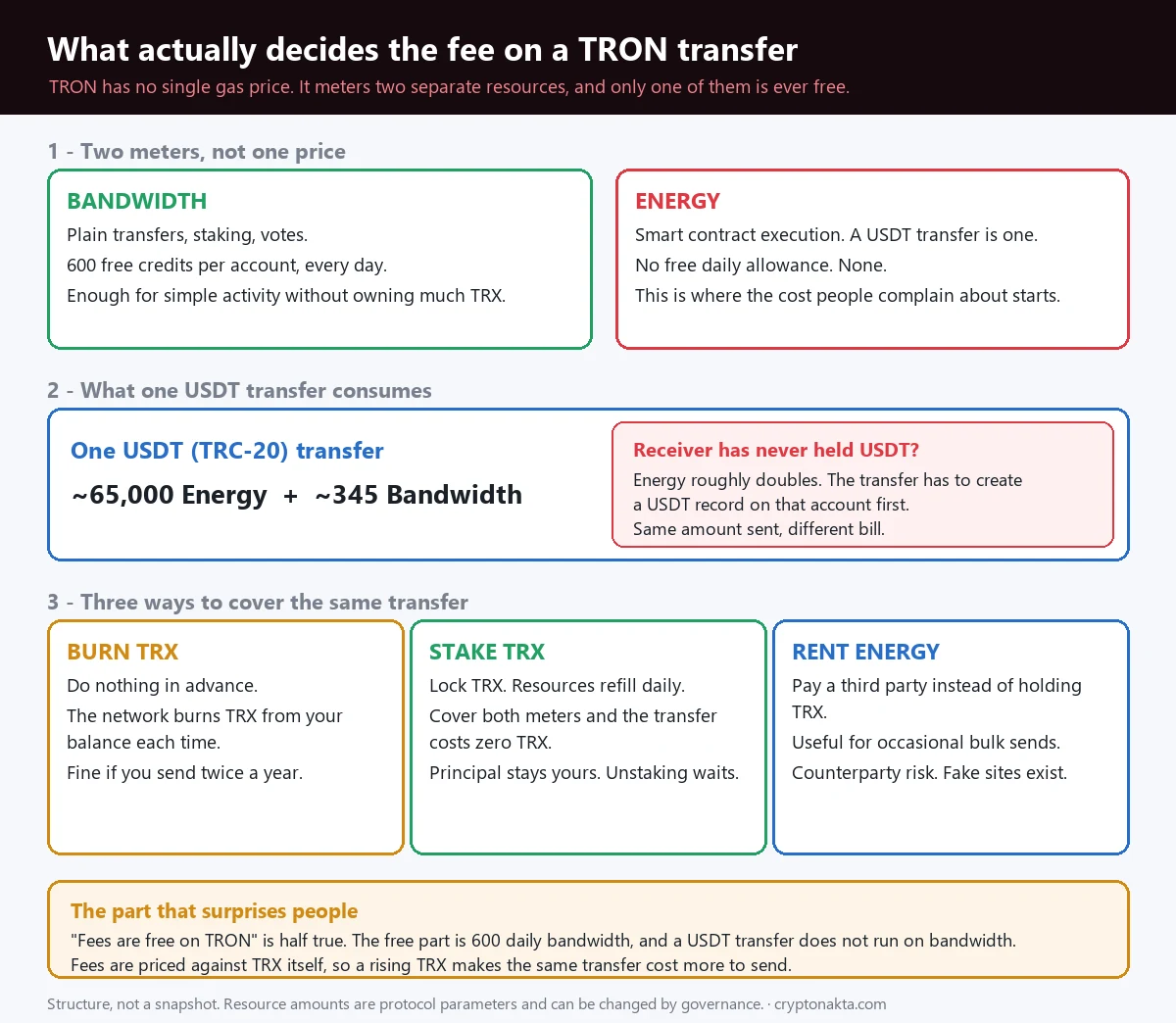
4. Tron runs two meters, and only one of them is free
5. What a single USDT transfer consumes, and why the same transfer sometimes costs double
6. Burn it, stake it, or rent it: three ways to cover the same transfer
7. Choosing TRC-20 without losing the money
8. What staking TRX gives you, and where the yield comes from
9. Twenty-seven people can change what your transfer costs
10. Why a busy chain does not lift its own token
11. Nothing caps the supply of TRX
12. The numbers that drift, and the date they were taken
13. Tron vocabulary you will meet in a wallet or on a withdrawal screen
14. Half-truths about Tron worth correcting
15. Where to buy TRX, how to move it, and where to keep it
Most people meet Tron without meaning to. You go to move stablecoins between two places, the network dropdown offers TRC-20 with the cheapest fee attached, you pick it, and it works. Then one day the same transfer costs twice as much, or a headline mentions frozen USDT on this chain, and it turns out there was a system under that dropdown all along. It decides what you pay, who is allowed to change that, and what the issuer of those dollars can still do to them.
1. How Tron ended up as the default rail for moving dollars
More USDT has been issued and held on Tron than on any other single chain, and it has been
that way for years. Which is an odd outcome if you follow how Tether grew up. It began on a
Bitcoin side layer,
became an Ethereum token, and Ethereum still holds the deepest
institutional balances and the collateral that DeFi lending runs on. Yet the everyday dollar,
the one a freelancer invoices in and a trader shunts between two venues at two in the morning,
gravitates to Tron.
Two unglamorous properties did that. Blocks arrive roughly every three seconds, so a transfer
confirms while you are still looking at the confirmation screen. And a send draws a small,
predictable amount of resource, with no gas auction to bid against when something popular launches.
The two chains ended up splitting the job: Tron carries remittances, small payments and
over-the-counter settlement, Ethereum carries institutional settlement and collateral.
The two tokens in every transfer
USDT is a
stablecoin issued by a company, and it exists as a token contract
sitting on top of Tron. TRX is the network’s own asset. When you send USDT over Tron, the
dollars are USDT and the fuel is TRX. You need the first to have something to send and the
second (or a substitute for it, which is most of what this article is about) to move it.
Tron launched its own mainnet in 2018 after starting out as an ERC-20 token, and it runs a
delegated proof-of-stake design where TRX holders vote for 27 block producers called super
representatives.
2. The dollars on this rail come with a switch, and the issuer holds it
Putting that much transactional dollar volume onto one cheap chain came with a consequence
most users never hear about until it lands on somebody they know.
USDT is issued by a company. The token contract that company deployed includes a blacklist
function. When an address is added to that list, the balance stays visible on the chain forever
and becomes permanently immobile. The holder can see it. Explorers show it. The holder cannot
move a cent of it. This is true of USDT everywhere it exists, and USDT on Tron is not an
exception to it.
Who controls the freeze
The switch sits inside the token contract, and the token contract belongs to Tether. Tron’s
validators have no comparable power over balances, and a TRX balance has no issuer that could
blacklist it in the first place. So the phrase “my crypto got frozen on Tron” describes a
company switching off its own token on a chain that had no say in the decision. Which asset you
hold decides whether you are exposed to that switch at all.
The machinery for doing it is public. The T3 Financial Crime Unit, a joint effort between
Tether, TRON and the analytics firm TRM Labs, exists to coordinate exactly these freezes on
this chain. Running totals sit in the snapshot table further down, because the amount climbs
while the switch producing it stays where it is.
What you can do and what you cannot
You can choose venues that screen deposits, which reduces the chance of being handed tainted
funds at all. You can avoid taking payments from people you cannot identify into an address you
also use for exchange deposits. You can keep records of where funds came from; a compliance
team will ask for them. You can hold part of your reserves in an asset with no issuer switch,
if the risk bothers you enough.
You cannot appeal a freeze to the chain. You cannot ask a
super representative to reverse it, and you cannot move, split or swap the balance. There is no
user-side recovery path, and the handful of cases that get unwound were driven by law
enforcement. Funds stuck on the exchange side are a different problem
with different options: what to do when an exchange freezes a
withdrawal.
3. Cheap and fast attracts everyone, so this is the rail that gets watched
A rail that settles in seconds for almost nothing is useful to a construction worker sending
money home. It is equally useful to a fraud operation moving proceeds. This chain draws closer
monitoring than almost any other as a result.
That monitoring is not abstract for ordinary users. Blockchain analytics firms maintain
detailed labelling of Tron addresses. Sanctions designations from the US Office of Foreign
Assets Control get reflected in issuer blacklists, so an address that appears on a sanctions
list can find its USDT immobilised without any separate court process. Exchanges screen
incoming deposits against the same data.
What happens if the USDT you received came from somewhere dirty
Receiving funds that trace back through a sanctioned or flagged address does not
automatically freeze your wallet. What it does is raise your risk score in the systems that
exchanges use. The realistic outcome, in ascending order of unpleasantness, is that your
deposit gets held for review, that you are asked for source-of-funds documentation, that the
deposit is rejected and returned, or that your account is restricted while a compliance team
works through it. Actual issuer-level blacklisting of a retail address that simply received
something is uncommon, and generally involves a much stronger connection than one hop.
strangers separate from the address you withdraw to your exchange from. A payments address and
a savings address do not need to be the same address, and a Tron wallet costs nothing to
create.
What you control is the venue. A licensed exchange screens deposits against that same
commercial labelling data before crediting them. Waiting a day for a review is annoying; having
a flagged coin stopped before it lands in your balance is worth the wait. The screening weighs
how many hops separate your deposit from a flagged cluster and how much of the amount traces
back to one, so a single distant hop rarely triggers anything while a direct transfer out of a
mixer or a sanctioned exchange usually does. An unregulated venue credits everything, and that
feels frictionless right up to the point where its own banking partner asks the question and the
platform has no process for answering it.
Retail users most often pick up a marked coin in a peer-to-peer trade with a stranger. Our
checklist for telling a legitimate exchange from a dressed-up one covers
what to look for, and if a deposit has simply vanished with no flag attached, the causes are
usually mechanical: why a crypto deposit does not show up.
4. Tron runs two meters, and only one of them is free
If your mental model of blockchain fees came from Ethereum, you are used to one number.
There is a gas price, your transaction has a gas amount, you multiply them and that is what you
paid. Tron runs two separate meters instead. They measure different things, and only one of
them gives you anything for free.
Bandwidth: the byte budget
Bandwidth measures the size of your transaction in bytes. Plain TRX sends, staking
operations, votes and other ordinary account activity consume bandwidth and nothing else.
Every account on the network receives 600 bandwidth per day at no cost, and the
allowance refreshes daily. For a light user who sends TRX to a friend once a week, that free
allowance covers the activity and the wallet reports a fee of zero. Within that narrow scope,
the reputation for free transfers holds up.
Energy: the compute budget
Energy measures smart-contract execution. Anything that calls a contract burns energy in
proportion to the work the contract does. There is no free daily energy allowance at
all, and new accounts get no starter portion either. The figure is zero.
USDT on Tron is a TRC-20 token, so moving it is contract execution, and every USDT transfer
you make consumes energy that nobody handed you. With no energy arranged in advance, your
wallet covers the shortfall by destroying some of your TRX on the spot.
| Resource | What consumes it | Free allowance | How to get it | If you run short |
|---|---|---|---|---|
| Bandwidth | Ordinary transactions: TRX sends, staking, voting | 600 per account per day, refreshing | Stake TRX | TRX is burned to cover the gap |
| Energy | Smart-contract execution, which includes every TRC-20 USDT transfer | None | Stake TRX, or rent energy from a provider | TRX is burned to cover the gap |
The fallback is the same in both rows. Tron never refuses a transaction for lack of resources
if you hold enough TRX; it converts TRX into the missing resource by burning it.
5. What a single USDT transfer consumes, and why the same transfer sometimes costs double
A standard TRC-20 USDT transfer consumes roughly 65,000 energy and about 345
bandwidth. The daily free allowance usually covers the bandwidth part. Nothing covers the
energy part, and essentially all of your cost lives there.
Send the same amount of USDT to two different people on the same afternoon and the two
transfers can cost noticeably different amounts.
A first-time recipient costs about double
When you send USDT to a wallet that has never held USDT before, the token contract cannot
simply update a balance, because there is no balance record for that address yet. It has to
create one. Writing a new entry into contract storage is more expensive than changing an
existing entry, and the practical effect is that the energy cost of that transfer runs to
roughly twice the normal amount.
That works in reverse too. If a counterparty says their fee was higher than yours
for an identical send, the likely explanation is who they sent to. And if you are about to make
a small test transfer to a brand-new wallet before sending the real amount, budget for the
expensive version, because the test is precisely the transfer that creates the record. The real
one afterwards is cheaper.
exchange triggers a flat withdrawal fee that the exchange sets and keeps, on top of the
on-chain resource cost described here. Venues typically price their TRC-20 withdrawal fee at a
round number and pocket the difference. Compare that fee across venues before you assume the
network is what is charging you, and see our breakdown of
where exchange fees come from.
The other thing that has to be paid for once
A Tron address that has never received anything is not yet a record on the chain. The first
transaction that touches it has to bring it into existence, which carries its own one-time
cost, typically paid by whoever sends the first asset to it. Combine that with the USDT record
creation above and the first-ever payment to a fresh wallet is the most expensive one that
wallet will ever receive. Every payment after that lands in the cheap tier.
The absolute amounts stay small, and they vary from send to send, so budget for the
expensive version when the destination is new. The side-by-side against sending the same
dollars over Ethereum is in USDT on ERC-20 versus TRC-20.
6. Burn it, stake it, or rent it: three ways to cover the same transfer
Everyone sending USDT on Tron pays for the same 65,000 energy. What differs is the method,
and the three methods have genuinely different economics depending on how often you send.
| Approach | What it costs you | Who it suits | The catch |
|---|---|---|---|
| Do nothing, let it burn | A slice of TRX destroyed on every transfer | Anyone who sends occasionally | You pay again every single time, and the cost tracks the TRX price |
| Stake TRX for resources | TRX locked up; the principal stays yours | Regular senders, businesses, anyone with recurring payouts | An unbonding wait when you unlock, and full exposure to TRX price moves meanwhile |
| Rent energy | A rental fee, usually a fraction of the burn cost | Occasional bulk senders who do not want to hold TRX | Third-party counterparty risk, and a thick layer of impersonation sites |
The default nobody chooses
Hold USDT and a little TRX in a wallet, press send, and the wallet notices you are short on
energy, destroys enough TRX to cover the gap, and the transfer goes through. For someone moving
money a few times a month the annual cost is small enough that optimising it is not worth an
afternoon. It does mean your TRX balance quietly shrinks, so top it up before it empties. A
wallet holding USDT and no TRX cannot send at all.
Where transfers cost nothing
Locking TRX through the network’s staking mechanism (the current generation is commonly
called Stake 2.0, and the underlying operation in wallets is labelled freeze or
freezebalancev2) allocates you a share of the network’s daily resource pool. You
choose whether that share arrives as energy or as bandwidth. The resources regenerate every
day, so if your allocation covers your typical volume, your transfers consume no TRX at all.
The locked TRX stays yours throughout and comes back when you unstake it.
How much TRX you need to stake for a given amount of energy is not a fixed number, and
anyone quoting you one is quoting a snapshot. Resources are distributed as a share of a
network-wide pool, so the ratio moves as total staking rises and falls. Check the current ratio
in a wallet or explorer before deciding how much to lock, and expect it to drift.
Cheap, effective, and crawling with fakes
A market exists for short-term energy leases. Providers hold large staked positions and
delegate energy to your address for a period, charging a fee that typically comes in well under
what burning the equivalent TRX would cost. For someone running a payout batch once a quarter,
this is often the rational choice. It is also the corner of the Tron ecosystem with the most
fake storefronts, because the service inherently involves sending money to an address in
exchange for a promise. Treat any energy-rental site you found through a search advert or a
Telegram message as hostile until proven otherwise, and read our guide to the
scam patterns that recur across crypto before you use one.
7. Choosing TRC-20 without losing the money
The expensive mistakes on this chain happen one step before the fee, on the network dropdown
that takes two seconds to fill in.
What the network selector is asking
When you pick TRC-20, you are telling the exchange to send the asset over Tron, to a Tron
address. Tron addresses start with a capital T and are 34 characters long, which is visually
distinct from the 0x-prefixed addresses used by Ethereum and other EVM chains. That distinct
format is a small piece of protection, because pasting an Ethereum address into a Tron
withdrawal field will usually be rejected outright by the interface.
The dangerous case is subtler. USDT exists on many chains and the address formats for some
of those chains are identical to each other. Choosing the wrong network while pasting an
address that looks perfectly valid is how funds end up somewhere the receiving platform does
not monitor. What happens next depends entirely on whether the receiving side controls that
address on the destination chain and whether it is willing to run a manual recovery at its own
discretion. We covered the recovery paths, such as they are, in
what to do after sending crypto on the wrong network.
The five-second check before every withdrawal
- Confirm the receiving side supports TRC-20 for that specific asset. Support is decided
asset by asset. A venue can accept TRC-20 USDT and refuse TRC-20 anything else.
Look at the deposit page on the receiving end. - Copy the deposit address fresh from the receiving platform, then check the first four and
last four characters after pasting. Never reuse an address from a note, a chat history or a
previous withdrawal. Clipboard-hijacking malware that swaps a copied address for an attacker’s
is one of the oldest and most effective attacks in this space, and that character check is what
catches it. - Check whether the asset needs a memo or tag. USDT on Tron does not use one, which is
part of why it is forgiving. Plenty of other assets and chains do, and omitting one sends funds
into a shared address with nothing identifying you. That failure mode is covered in
sending crypto without the memo or tag. - Send a test amount to any new counterparty. It carries the fresh-address surcharge
described earlier, and that extra is the price of not losing the full amount.
transaction is included in a block, roughly three seconds after you press send, no exchange,
wallet, validator or support team can pull it back. Every recovery story you read involves the
receiving party voluntarily cooperating.
8. What staking TRX gives you, and where the yield comes from
Staking on Tron does two jobs at once, and mixing them up leads to bad decisions. The first
job is the resource allocation covered earlier. The second is governance: staked TRX carries
voting power for super representative elections, and casting those votes is what earns you a
share of the network’s reward emissions.
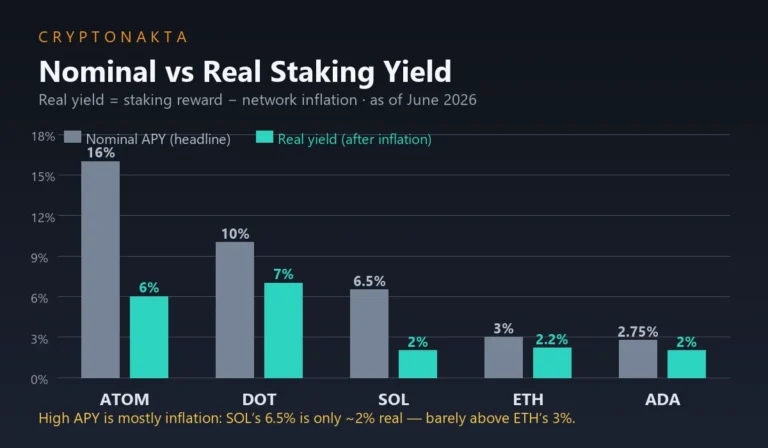
The reward rate is not a fixed promise. It moves with how much of the supply is staked and
how the emissions are split, so it drifts down as participation rises. The current rate and the
participation figure behind it sit in the snapshot table further down, and a wallet or explorer
will show you today’s version.
Where the yield comes from matters more than the number
These rewards are paid out of new issuance. The network mints TRX for block production and
for voting, and stakers receive a portion of that. Those tokens are newly created supply handed
to the people who participate, and they dilute everyone who does not. If every holder staked,
the headline rate would still exist on paper while meaning very little in real terms.
A yield funded by issuance behaves differently from one funded by fees or by an underlying
business. We separated the two in
where staking yield comes from, and the general mechanics are
in what staking is.
denominated in TRX. If TRX falls further than the rate over your holding period, you are down
in dollar terms while your TRX count went up. Staking changes the number of tokens you hold,
not what those tokens are worth.
The US tax wrinkle nobody mentions in the marketing
If you are filing in the United States, IRS Revenue Ruling 2023-14 treats staking rewards as
ordinary income at the moment you gain dominion and control over them, valued at fair market
value at that time. Tron pays rewards continuously, which means a position generating a
mid-single-digit yield is generating taxable events all year, long before you sell anything.
If the price falls after you recognised that income, the income stays recognised. Practically,
that means logging reward amounts and their timing as they land, because an explorer is a
miserable place to reconstruct a year of them. Rules differ everywhere else, and this is
general information, not tax advice; talk to someone qualified in your jurisdiction.
Staking through an exchange versus doing it yourself
Most large exchanges offer TRX staking as a product. It is simpler and the exchange handles
the voting, at the cost of your TRX sitting with the exchange and you carrying its counterparty
risk. Platforms in this business have failed abruptly and without warning.
Staking from a self-custody wallet keeps the keys with you and gives you the resource
allocation, which the exchange version generally does not pass through in a form you can spend
on your own transfers. If your reason for staking is free USDT sends, exchange staking does not
achieve it.
9. Twenty-seven people can change what your transfer costs
Tron uses delegated proof-of-stake. TRX holders stake and vote, the top 27 vote-getters
become super representatives, and those 27 produce the blocks. Governance proposals require 19
of the 27 to pass.
The parameters those 27 vote on include the energy price, the bandwidth price and the size
of the free daily bandwidth allowance. The toll schedule for the largest dollar rail in crypto is a governance variable
held by a body small enough to fit in a conference room. Those parameters have been changed by
proposal before, and the energy price is one of them.
Both sides of the centralisation argument, fairly
The critique is straightforward. Twenty-seven validators is a small number by any
comparison. Analyses of on-chain holdings have argued that a very large share of circulating
TRX, one widely cited figure putting it above sixty percent, sits with or is influenced by the
founder and affiliated entities. If voting power concentrates, the composition of the 27 is
determined by whoever holds the stake, and the independence of the validator set then rests on
trusting one party.
The rebuttal is also straightforward. Passing anything requires a supermajority of 19 seats
out of 27, so no single holder controls the parameter set alone, however large the stake.
Delegated proof-of-stake was designed for throughput, and
trading validator count for speed was an explicit engineering choice. Users who wanted maximal
decentralisation had other chains available and chose this one for its performance.
Both arguments are live and neither has been settled. Undisputed on either side are the
number 27, the 19-vote threshold, and the fact that fee parameters sit inside that scope. For
context on how other consensus designs distribute this power, see
how blockchains work.
Founder risk is not separable here
Justin Sun founded Tron and has remained a highly visible, frequently litigated and
regularly controversial figure, with entanglements across exchanges and other ventures. For an
asset where an analysis credibly argues that one party’s holdings dominate the vote, personal
legal exposure and asset risk collapse into a single line on the risk list. Look up who
currently holds the 27 seats in a block explorer before you weigh the argument either way.
10. Why a busy chain does not lift its own token
This chain moves an enormous volume of dollars, and that volume does not translate cleanly
into value for the people holding the chain’s token. The mechanism by which it partially does
translate works against the people using the chain.
Follow the money in a stablecoin transfer
When a business moves a million dollars of USDT from one exchange to another, three parties
earn something. The issuer earns interest on the reserve assets backing that million, which is
where the bulk of stablecoin revenue comes from and goes entirely to the issuer. The exchange
earns its withdrawal fee, which it set
and keeps. The chain collects a resource cost from the sender, which is small by design.
TRX holders have a claim on the third bucket only, and an indirect one at that. Resource
costs paid in burned TRX reduce the supply, and holders benefit from that tightening. Nobody
receives a payment. There is no protocol mechanism that routes stablecoin economics to TRX
holders. A chain can host trillions of dollars in annual transfer volume and pass through only
the transaction fees, because transfer fees are the only thing it charges for.
Usage growth is a weak argument for buying an infrastructure token. The connection between
usage and token value here is partial, runs through fee burn, and sits inside the fee parameters
those 27 seats control.
The part that runs backwards
Network costs on Tron are denominated in TRX. The energy price is a parameter expressed in
TRX units, so the dollar cost of moving USDT is a function of the TRX price. When TRX rises,
the same transfer becomes more expensive in dollar terms, unless governance intervenes to lower
the parameter.
Holders and users end up on opposite sides of the same variable. A holder wants TRX
higher. A user wants transfers cheap. A payments business choosing which chain to build on
wants predictability, and a fee schedule that floats with a volatile asset is the opposite of
predictable. The network has resolved this tension before by voting to cut fee parameters
substantially, and network revenue dropped sharply afterwards, taking the burn down with it.
11. Nothing caps the supply of TRX
TRX has no maximum supply. There is no cap written into the protocol, no halving schedule,
and no terminal issuance number. Anyone pitching TRX with a scarcity narrative borrowed from
Bitcoin is describing a different asset.
Two flows run against each other every day.
What creates TRX
The network mints new TRX for block production and for voting rewards, on the order of
several million tokens a day under current parameters. That issuance is the source of the
staking yield discussed earlier. Issuance is a governance parameter like the others, and it has
been changed by proposal before.
What destroys TRX
Transaction fees paid in TRX are burned; validators never see them. Every transfer made
without pre-arranged resources therefore removes supply permanently. Minting the chain’s own
stablecoin burns TRX as well, so issuance there adds to the destruction. The total burn scales
with network activity.
The net result flips
Neither flow dominates permanently. There have been quarters where burn exceeded issuance
by enough to shrink the supply outright, and later periods where the balance reversed into net
expansion. Check which way the balance currently runs before you accept either description of
the asset.
are effectively the same number on Tron. There is no large vesting schedule, no team cliff
years out, no venture allocation waiting to unlock into the market. Whatever else you conclude
about TRX, you are not holding it against an overhang of unlocks. In newer tokens that overhang
is a real and common risk. The trade-off is that there is no cap either.
12. The numbers that drift, and the date they were taken
Every figure below moves. Each was accurate on the date beside it, and each will have drifted
by some amount since. Treat the whole table as a snapshot.
| Figure | Value | As of | Why it moves |
|---|---|---|---|
| Share of USDT supply on Tron | Around 45% | 2026 | Issuance and redemption move between chains as fee conditions and exchange defaults change |
| Share of USDT supply on Ethereum | Around 40% | 2026 | Institutional and DeFi demand for on-chain dollars |
| Share on other chains combined | Around 15% | 2026 | BNB Chain, Solana and others compete for the same flows |
| USDT frozen on Tron | 328 addresses, around $506 million immobilised, cumulative | May 2026 | Only ever increases. Includes cases coordinated by the T3 unit, such as $344 million linked to Iran’s central bank in April 2026 |
| Addresses frozen from OFAC list reflection | 131 | 2026 | Tracks sanctions designations |
| Share of eligible supply staked | Around 47% | Q1 2026 | Rises when the reward rate looks attractive, falls when holders want liquidity |
| Annualised staking reward rate | Roughly 4% to 5% | 2026 | Inversely related to participation; more stakers split the same emissions |
| Circulating supply | Around 94.7 billion TRX, effectively equal to total supply | 2026 | Net of daily issuance against burn |
| Daily new issuance | Around 3.9 million TRX | 2026 | A governance parameter, adjustable by proposal |
Read the share figures as a ranking. The exact split moves in slow percentage-point steps.
The freeze total is cumulative, so a larger figure later does not by itself indicate an
acceleration.
If a decision of yours depends on any of these, look them up. A block explorer, the
issuer’s own transparency page and the staking dashboard in any major wallet will all give you
current values in under a minute, and none of them require trusting an article’s snapshot.
13. Tron vocabulary you will meet in a wallet or on a withdrawal screen
These are the words you will meet in a wallet, an explorer or a withdrawal screen, in the
sense Tron uses them.
Bandwidth
The resource consumed by ordinary transactions, measured against transaction size in bytes.
Every account receives 600 per day at no cost, refreshing daily. Additional bandwidth comes
from staking TRX.
Energy
The resource consumed by smart-contract execution, which includes every TRC-20 token
transfer. There is no free allowance. A standard USDT transfer needs roughly 65,000 energy, and
more than that when the recipient has never held USDT.
TRC-20
Tron’s token standard, the counterpart to Ethereum’s ERC-20. USDT on Tron is a TRC-20 token.
When an exchange asks which network you want, TRC-20 means Tron.
Super representative
One of the 27 block producers elected by TRX holder votes. Super representatives produce
blocks and vote on governance proposals, which require 19 of 27 to pass. Those proposals include
the network’s fee parameters.
Freeze / Stake 2.0 / freezebalancev2
Locking TRX to receive a daily-refreshing allocation of bandwidth or energy, plus voting
power. The TRX stays yours throughout and can be unlocked after a waiting period set by network
parameters. Wallets label this operation inconsistently, so expect to see all three of these
names for the same thing.
Burn
Permanent destruction of TRX. When a transaction needs more resources than you have, the
shortfall is covered by burning your TRX, which removes it from supply entirely. No validator
receives it.
Energy rental
A third-party service that delegates energy from its own staked position to your address for
a period, in exchange for a fee that is usually well below the equivalent burn cost. Useful and
also heavily impersonated by fake sites.
Blacklist (issuer freeze)
A function inside the USDT contract that permanently immobilises a specific address’s
balance. The issuer holds this switch. There is no user-side reversal.
Account activation
The one-time cost of bringing a never-used Tron address into existence on the chain,
normally borne by whoever sends it something first. It is part of why the first payment to a
fresh wallet is the most expensive one it will ever receive.
14. Half-truths about Tron worth correcting
These come up constantly, in comment threads and in the marketing of people who want you to
transact on this chain. Each one carries enough truth to survive being repeated.
| What you hear | What is actually the case |
|---|---|
| Tron transfers are free | Free covers 600 bandwidth per account per day, and USDT transfers consume energy, which has no free allowance. With nothing arranged in advance, every send burns TRX |
| USDT in my own wallet is beyond anyone’s reach | The issuer can blacklist the address, after which the balance stays visible and permanently immobile, with no user-side reversal at any level |
| The network is used heavily, so TRX goes up | The largest revenue in stablecoins goes to the issuer’s reserve interest and to exchange fees. TRX captures transaction fees through burn, so the link is partial |
| A higher TRX price is good news all round | Fees are denominated in TRX, so a higher price raises the dollar cost of every transfer. Holders and users want opposite things from the same number |
| 27 elected validators means it is decentralised | The number 27 is exactly what the argument is about. The 19-vote supermajority requirement is a genuine constraint; the concentration-of-stake critique is a genuine concern. Both are true at once |
| TRX is scarce like Bitcoin | There is no supply cap. Burn has outpaced issuance in some quarters and lagged it in others |
| My fee was different from yours, so someone is charging extra | The recipient’s history changes the energy a transfer needs, and your exchange’s withdrawal fee is a separate charge on top of it |
One more claim sits outside the table: that Tron and Ethereum are racing to replace each
other. Both have carried a large share of USDT supply for years, in the different roles
described earlier.
15. Where to buy TRX, how to move it, and where to keep it
TRX is a large, widely listed asset, so buying it is straightforward almost anywhere. The
question with real consequences is whether the venue you use will show you TRC-20 as an option
when you go to move something.
Availability depends on where your account lives
If you are opening an account in the United States, your realistic options are the domestic
regulated venues, principally Coinbase and Kraken. Which assets those platforms list, and which
networks they support for withdrawals, is a compliance decision that changes and that differs
from what the same brand offers elsewhere. Outside the US, the large global exchanges below all
run TRX spot markets and TRC-20 withdrawals.
Two people can hold USDT on the same brand-name exchange and see different network menus,
because the account jurisdictions differ. Before planning a transfer route that depends on
TRC-20, open the withdrawal screen on your own account and confirm it is offered there.
Exchanges that list TRX spot
Binance

Bybit

OKX

Gate.io

MEXC

KuCoin

Affiliate disclosure: some links are partner links. We may earn a commission at no extra cost to you. This is not investment advice.
Listings and supported networks change without much notice, so confirm on the exchange’s own
announcement or asset page before you commit. If you are choosing a venue from scratch
rather than adding one, our comparison of the
major exchanges and what they are each good at covers fees, coverage and
the things that only matter once something goes wrong.
Where to keep it
A position you are actively trading belongs on the exchange. Anything you intend to hold, and
any TRX you are staking specifically to make your own transfers free, belongs in self-custody.
Tron is supported by the mainstream hardware wallets and the well-known software wallets, and
the freeze operation that allocates resources is available directly in most of them.
Two warnings specific to this ecosystem. Fake wallet applications imitating popular Tron
wallets appear regularly in app stores and search results, and installing one hands over your
seed phrase at setup, so download from the developer’s own site. And the energy-rental services
mentioned earlier are a persistent impersonation target. If key management is new to you, start
with choosing and using a crypto wallet.