Dogecoin (DOGE), a Deep Dive: From Meme to Whether You Should Buy
Dogecoin explained from zero — how a 2013 internet joke became a top cryptocurrency, how it actually works, why it has no supply cap, the real role Elon Musk plays, what the 2026 spot ETFs mean, and the honest case for and against owning it. Facts as of June 2026.
- Dogecoin is a cryptocurrency that began in 2013 as a joke based on the “Doge” Shiba Inu meme — and grew into one of the most recognized coins in the world. It’s the original “meme coin.”
- It’s a real, working coin built for tipping and fast, cheap payments (~1-minute transactions, tiny fees), secured by proof-of-work and merge-mined with Litecoin.
- The key difference from Bitcoin: Dogecoin has no maximum supply. About 5 billion new DOGE are created every year, forever — so there’s no scarcity story, and ~168 billion already circulate.
- Its price is driven far more by hype, community and celebrities (notably Elon Musk) than by fundamentals, which makes it extremely volatile.
- New in 2025–2026: US spot Dogecoin ETFs (e.g. DOJE, TDOG) and an early roadmap toward programmability — real maturity signals, but DOGE remains a high-risk, speculative asset.
- This guide explains, from the ground up, what Dogecoin is, how it works, and how to buy and store it safely — without the hype. Not investment advice.
1. What is Dogecoin? (the quick answer)
2. Dogecoin at a glance (Quick Facts)
3. The origin story: a joke that wouldn’t die
4. How Dogecoin actually works (no smart contracts)
5. Dogecoin’s unlimited supply: why it has no cap
6. What Dogecoin is actually used for
7. The Elon Musk factor (an honest look)
8. Dogecoin in 2026: ETFs and a real roadmap
9. Is Dogecoin a good investment? (the honest case both ways)
10. Dogecoin vs Bitcoin vs Ethereum
11. Common myths about Dogecoin, debunked
12. How to buy Dogecoin (safely, step by step)
13. ETF vs buying DOGE directly
14. How to store Dogecoin
15. Can you buy Dogecoin in your country?
16. Dogecoin risks, ranked honestly
17. Common beginner mistakes with Dogecoin
18. Dogecoin glossary
19. Next steps
1. What is Dogecoin? (the quick answer)
Dogecoin is a cryptocurrency that started in 2013 as an internet joke — based on the “Doge” Shiba Inu meme — and accidentally grew into one of the most recognized and widely held coins in the world. It is a fast, low-cost coin built for tipping and small payments, with a friendly community and, famously, the backing of Elon Musk. It is also a meme coin: it has no supply cap, no grand technical mission, and a price driven far more by hype than by fundamentals.
Here is Dogecoin next to the two coins people compare it with most:
| Dogecoin | Bitcoin | Ethereum | |
|---|---|---|---|
| Origin | A 2013 joke/meme | 2009 “digital gold” experiment | 2015 programmable blockchain |
| Main purpose | Tipping, small payments, fun | Scarce store of value | Smart contracts, apps (DeFi/NFTs) |
| Supply | Unlimited (~5B new/year) | Capped at 21 million | No fixed cap (low net issuance) |
| Speed | ~1 minute, very low fees | ~10–60 minutes | ~12 seconds |
| Price driver | Hype, celebrities, community | Scarcity, adoption, macro | Network usage, ETFs, upgrades |
This guide explains Dogecoin honestly, from zero: where it came from, how it actually works, why “no supply cap” matters, the real role Elon Musk plays, what the 2026 spot ETFs mean, and the genuine case for and against owning it — without the hype. Facts as of June 2026.
2. Dogecoin at a glance (Quick Facts)
Before the deep dives, here are the core facts at a glance:
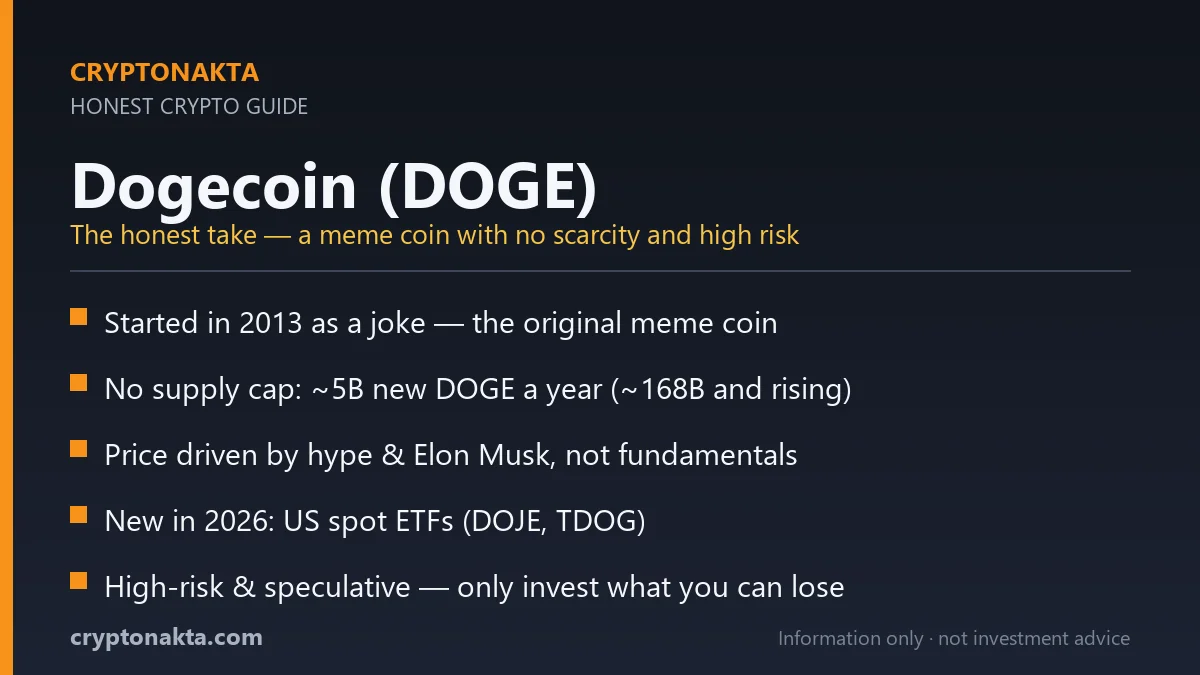
| Launched | December 2013 |
| Created by | Billy Markus & Jackson Palmer (as a joke) |
| Type | Proof-of-Work (Scrypt), merge-mined with Litecoin |
| Max supply | None — unlimited, ~5 billion new DOGE/year |
| Circulating | ~168 billion (early 2026) |
| Block time | ~1 minute (fast, low fees) |
| Built for | Tipping, small payments, internet community |
| 2026 | US spot DOGE ETFs live (DOJE, TDOG) |
Two things define Dogecoin and confuse most beginners: it was literally created as a joke in a couple of hours, and unlike Bitcoin it has no maximum supply — about 5 billion new DOGE are created every year, forever. Both facts are central to understanding it honestly, and we cover them head-on below.
3. The origin story: a joke that wouldn’t die
Dogecoin’s story is one of the strangest in crypto — and knowing it explains everything about the coin.
In December 2013, two software engineers — Billy Markus (in the US) and Jackson Palmer (in Australia) — created Dogecoin as a parody of the wild cryptocurrency speculation of the time. They combined two popular internet jokes: the “Doge” Shiba Inu dog meme, and the speculative crypto mania. Palmer registered the name; Markus built the coin in a few hours by forking existing code (Luckycoin, itself derived from Litecoin‘s lineage).
| Moment | What happened |
|---|---|
| Dec 2013 | Dogecoin launches as a joke. It unexpectedly goes viral within days. |
| 2014 | The community raises money for charity and famously funds the Jamaican bobsled team’s Olympic trip and a NASCAR sponsorship. Merge-mining with Litecoin is added for security. |
| 2015 | Co-founder Jackson Palmer leaves crypto, later becoming a vocal critic of the industry. |
| 2019–2021 | Elon Musk begins tweeting about DOGE; it surges to an all-time high in 2021’s bull market. |
| 2021 | The Dogecoin Foundation is revived to support development, with advisors linked to Ethereum’s Vitalik Buterin and Musk. |
| 2025–2026 | US spot Dogecoin ETFs launch; a developer roadmap (Layer-2, programmability) takes shape. |
4. How Dogecoin actually works (no smart contracts)
Under the meme, Dogecoin is real, working technology — and it’s simpler than most coins.
| How it works | Detail |
|---|---|
| Proof-of-Work (Scrypt) | Like Bitcoin, Dogecoin is secured by miners solving puzzles — but using the “Scrypt” algorithm (the same as Litecoin), not Bitcoin’s SHA-256. |
| Merge-mined with Litecoin | Since 2014, miners can secure Dogecoin and Litecoin at the same time (“auxiliary proof-of-work”). This borrows Litecoin’s mining power, making DOGE far more secure than it could be alone. |
| ~1-minute blocks | A new block roughly every minute, so transactions confirm quickly and fees are tiny (typically a fraction of a cent) — which is why DOGE works well for tipping and small payments. |
| Fixed block reward | Every block creates 10,000 new DOGE, paid to miners. This never halves (unlike Bitcoin), which is the source of Dogecoin’s unlimited supply. |
5. Dogecoin’s unlimited supply: why it has no cap
This is the single most important number to understand about Dogecoin, because it’s the opposite of Bitcoin’s headline feature.
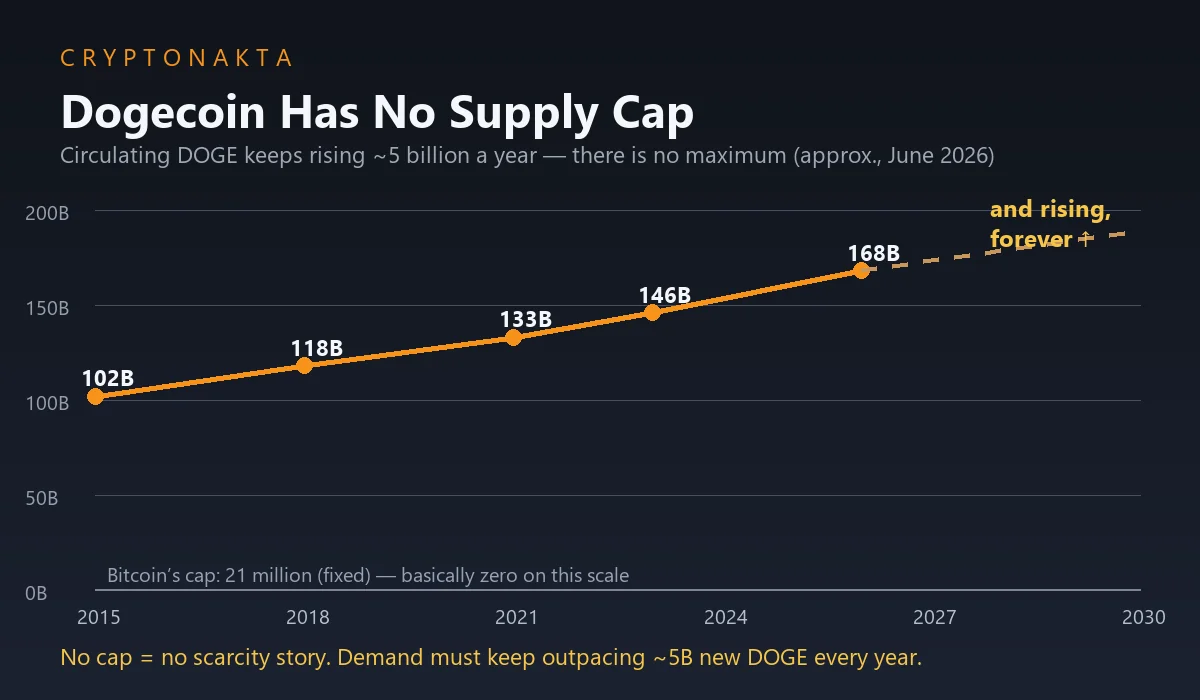
Dogecoin has no maximum supply. About 10,000 new DOGE are minted every block (~1 minute), which works out to roughly 5 billion new DOGE every year — forever. As of early 2026 there are about 168 billion DOGE in circulation, and that number only grows.
| Supply fact | Why it matters |
|---|---|
| No cap (unlimited) | There is no scarcity story. Bitcoin’s pitch is “only 21 million ever” — Dogecoin’s supply rises every minute, with no end. |
| ~5 billion added/year | A fixed amount of new DOGE enters circulation annually. This is permanent, mild inflation. |
| Inflation rate falls over time | Because ~5B is added to an ever-larger base, the percentage inflation slowly declines (roughly 3–4% a year now, drifting lower) — but it never reaches zero. |
| Whale concentration | A large share of DOGE sits in a small number of very large wallets, so big holders can move the market. This is a real, often-ignored risk. |
6. What Dogecoin is actually used for
Despite being a joke, Dogecoin found a genuine niche — and it’s a useful one.
| Use | How DOGE fits |
|---|---|
| Tipping | Its original killer use: sending someone a few DOGE to say “thanks” online. Fast, near-free, and friendly. |
| Small, fast payments | ~1-minute confirmations and tiny fees make it practical for low-value transfers where Bitcoin’s fees would be too high. |
| Charity & community | The Dogecoin community is known for charity drives and a famously upbeat, low-toxicity culture (“do only good every day”). |
| Merchant acceptance | Some merchants accept DOGE; Tesla has accepted it for certain merchandise. Acceptance is real but limited. |
7. The Elon Musk factor (an honest look)
You cannot understand Dogecoin’s price without understanding Elon Musk — and being honest about it.
Musk has promoted Dogecoin for years: calling himself the “Dogefather,” mentioning it on Saturday Night Live, having Tesla accept it for merchandise, and launching a SpaceX mission (“DOGE-1”) paid for in DOGE. His tweets have repeatedly sent the price up — and, when sentiment turned, down. In 2025, Musk led a US government cost-cutting initiative named the “Department of Government Efficiency” (a nod to the D.O.G.E. acronym), which renewed mainstream attention even though it had nothing to do with the coin itself.
8. Dogecoin in 2026: ETFs and a real roadmap
Here’s what’s genuinely new — and it’s why Dogecoin in 2026 is more than just a meme.
| 2025–2026 development | What it means |
|---|---|
| US spot Dogecoin ETFs | The first US spot DOGE exchange-traded funds launched (including REX-Osprey’s DOJE and 21Shares’ TDOG on Nasdaq, the latter receiving SEC approval in early 2026 and endorsed by the Dogecoin Foundation). They let people get DOGE price exposure through a normal brokerage account. |
| A real developer roadmap | The Dogecoin Foundation and projects like DogeOS are building toward programmability — a Layer-2 roadmap, and a proposed soft-fork (OP_CHECKZKP, 2025) to enable zero-knowledge proofs and rollup-style apps, plus bridges to smart-contract chains. |
| Institutional narrative | The story is shifting from “Elon’s tweets” toward ETFs, custody and network utility — a sign of maturing infrastructure, though DOGE remains highly speculative. |
9. Is Dogecoin a good investment? (the honest case both ways)
The question everyone asks. The honest answer: nobody can tell you whether Dogecoin will go up, and anyone promising a specific price (“DOGE to $1!”) is guessing or selling something. What we can do is lay out the real case both ways so you decide with open eyes.
| The case for 👍 | The case against 👎 |
|---|---|
| Huge brand recognition and a large, loyal community | No supply cap — permanent new issuance, no scarcity story |
| Fast, cheap, genuinely working payment tech | Price driven by hype and celebrities, not fundamentals — extreme volatility |
| New: US spot ETFs and a programmability roadmap | Limited real-world payment use relative to its market size |
| One of the most liquid, widely listed coins | Whale concentration — a few large holders can move the market |
10. Dogecoin vs Bitcoin vs Ethereum
Dogecoin, Bitcoin and Ethereum are often lumped together as “crypto,” but they’re built for completely different things:
| Dogecoin | Bitcoin | Ethereum | |
|---|---|---|---|
| Core idea | Fun, fast, cheap “people’s” coin | Scarce digital store of value | World computer for apps |
| Supply | Unlimited (~5B/year) | Capped at 21 million | No cap, low net issuance |
| Security | PoW (merge-mined with Litecoin) | PoW (largest network) | Proof-of-Stake |
| Smart contracts | Not yet (roadmap aims to add) | Limited | Yes — the core feature |
| Main risk | Hype-driven, inflationary | Volatility, slow tech | Complexity, competition |
11. Common myths about Dogecoin, debunked
Dogecoin attracts as many myths as any coin. Here are the big ones, debunked honestly.
| Myth | Reality |
|---|---|
| “DOGE will definitely hit $1 (or $10).” | Nobody knows. At ~168 billion coins, even $1 would be a ~$168B market cap — possible but not guaranteed, and viral targets are memes, not analysis. |
| “It’s just like Bitcoin but cheaper per coin.” | No. A low price per coin means nothing — what matters is total supply and market cap. DOGE has billions of coins and no supply cap; Bitcoin has 21 million. |
| “Elon Musk controls Dogecoin.” | No. Musk promotes it and influences sentiment, but Dogecoin is an open, decentralized network he doesn’t own or run. |
| “It’s a scam / has no technology.” | Also no. DOGE is real, working, merge-mined software with over a decade of uptime. It’s speculative, but it isn’t fake. |
12. How to buy Dogecoin (safely, step by step)
If, after the honest picture above, you decide to buy some Dogecoin, here’s how to do it safely. (New to exchanges entirely? Start with our how to buy your first crypto walkthrough — the steps are identical.)
- Choose a reputable, regulated exchange that serves your country. DOGE is one of the most widely listed coins, so almost every major exchange has it.
- Create your account and verify your identity (KYC). A government ID and a few minutes; it’s a legal requirement on regulated platforms.
- Secure the account first — turn on app-based two-factor authentication (2FA) before depositing. This matters more than which coin you buy.
- Deposit and buy DOGE — use the spot market and a limit order rather than the pricier one-click “buy” button. Start with a tiny test amount.
- Decide where to store it — keep only trading-size amounts on the exchange; move larger holdings to a wallet you control (see below).
These are exchanges we keep dashboard-verified sign-up guides for, with the referral benefit we could confirm stated honestly:
Binance

Gate.io

KuCoin

Bybit

MEXC

Affiliate disclosure: some links are partner links. We may earn a commission at no extra cost to you. This is not investment advice.
13. ETF vs buying DOGE directly
Since 2025–2026 you have two different ways to get Dogecoin exposure. Neither is “better” — they suit different goals.
| Buying DOGE directly | A spot DOGE ETF | |
|---|---|---|
| What you own | Actual DOGE you can send and spend | Shares in a fund that holds DOGE |
| Where | A crypto exchange | A regular brokerage/stock account |
| Custody | You can self-custody (your keys) | The fund custodies it for you |
| Can you spend it? | Yes — tip, pay, transfer | No — it’s an investment wrapper only |
| Best for | Using DOGE, self-custody, smaller amounts | Investors who want exposure inside a brokerage/retirement account |
14. How to store Dogecoin
If you hold DOGE directly, storage follows the same rules as any crypto.
| Option | Best for | Notes |
|---|---|---|
| Exchange account | Small amounts you’re actively trading | Convenient, but “not your keys, not your coins” — secure it with 2FA. |
| Software wallet | Spending/tipping DOGE | The official Dogecoin Core wallet or reputable multi-coin apps. Back up your seed phrase. |
| Hardware wallet | Larger or long-term holdings | Ledger, Trezor and others support DOGE — the safest option. Buy the device only from the official manufacturer. |
15. Can you buy Dogecoin in your country?
Whether and how you can buy Dogecoin depends on where you live — but DOGE is one of the most widely listed coins on Earth, so in most countries the answer is simply “yes, through a licensed local exchange.”
- Most countries: DOGE is available on major global and local exchanges; buying and holding it is legal in most places, though tax rules vary — check yours before you buy.
- United States: widely available on regulated exchanges, plus spot DOGE ETFs through brokerages.
- Restricted regions: a few jurisdictions limit crypto access generally. If your country restricts it, our exchange guide lists reputable options by region — and because crypto deposits work from anywhere, you can also fund an exchange by sending coins from another wallet.
16. Dogecoin risks, ranked honestly
To keep it honest, here is every meaningful Dogecoin risk, ranked — not buried in fine print.
| Risk | Why it matters |
|---|---|
| 1. Hype-driven volatility | DOGE’s price moves on sentiment, memes and celebrity posts — it can fall 50%+ fast. This is the single biggest risk. |
| 2. No supply cap (inflation) | ~5 billion new DOGE every year, forever. Demand must keep outpacing steady new supply just to hold the price. |
| 3. Whale concentration | A few very large wallets hold a big share of DOGE; their moves can swing the market and disadvantage small holders. |
| 4. Speculation over fundamentals | Real payment use is modest versus market size — much of the value is belief, which can evaporate. |
| 5. Scams in its name | “Doge” giveaways, fake Elon livestreams and “send 1 DOGE get 2 back” are classic crypto scams that target DOGE fans. |
17. Common beginner mistakes with Dogecoin
Avoid the traps that catch Dogecoin beginners specifically:
| Mistake | Do this instead |
|---|---|
| Buying because a celebrity just tweeted | Never chase hype — that’s how people buy the top. Decide calmly, in advance. |
| Thinking a “cheap” price per coin means it’s undervalued | Judge by market cap and supply, not the price of one coin. |
| Going all-in expecting “$1 soon” | Size it as a small, losable position; ignore viral price targets. |
| Falling for a “DOGE giveaway” / “2x your Dogecoin” | It’s always a scam. No one doubles your crypto for free. |
| Leaving a large amount on an exchange | Use 2FA and move larger holdings to a wallet you control. |
18. Dogecoin glossary
The key Dogecoin terms, in plain English:
| Term | Meaning |
|---|---|
| Meme coin | A cryptocurrency whose value comes mostly from internet culture, community and hype rather than a technical use case. DOGE is the original. |
| Scrypt | The proof-of-work algorithm Dogecoin uses (shared with Litecoin), different from Bitcoin’s SHA-256. |
| Merge mining (AuxPoW) | Mining Dogecoin and Litecoin together, so DOGE borrows Litecoin’s security. |
| No supply cap | There’s no maximum number of DOGE — about 5 billion new coins are created each year, forever. |
| Shibetoshi Nakamoto | The online alias of co-founder Billy Markus (a playful nod to Bitcoin’s Satoshi Nakamoto). |
| Spot ETF | A regulated fund holding actual DOGE, traded on a stock exchange, giving price exposure without holding the coin. |
| Whale | A holder of a very large amount of DOGE, big enough to move the market. |
19. Next steps
You now understand Dogecoin honestly: a 2013 joke that became a real, working, fast-and-cheap payment coin with a huge community — but also an unlimited-supply, hype-driven, highly speculative meme asset, newly accessible via spot ETFs and inching toward programmability. The smart next move is small and grounded — if you buy, treat it as a tiny position you can afford to lose, secure the account with 2FA, start with a test amount, and never act on a celebrity tweet or a viral price target. Build the rest of your foundation with our deep dives on Bitcoin, Ethereum and how blockchains work; learn to spot traps in our scams guide; and when you’re ready, compare licensed exchanges or follow a step-by-step sign-up guide. New to all of it? Start at the complete beginner’s guide. Start small, stay skeptical, and never invest more than you can afford to lose.