What Is Monero (XMR)? The Privacy Coin That Won’t Compromise
A clear, honest guide to Monero (XMR) — the cryptocurrency where privacy is on by default, for everyone, with no off switch. How ring signatures, stealth addresses and RingCT hide a payment (and what the 2026 FCMP++ upgrade changes), why it has no supply cap, why exchanges keep delisting it, where you can realistically still buy it, and how it differs from Zcash. As of July 2026.
- Monero (XMR) is a privacy cryptocurrency where every payment is hidden automatically — sender, receiver and amount. The key difference from other privacy coins: privacy is always on for everyone, with no public mode to switch to. That is why supporters trust it and why regulators target it.
- How it works: three layers stacked together — ring signatures (hide the sender), stealth addresses (hide the receiver) and RingCT (hide the amount), plus Dandelion++ for your IP. In 2026 the FCMP++ upgrade replaces ring signatures with a proof spanning the entire chain, moving Monero from very-hard-to-trace toward provably untraceable.
- Supply: unlike Bitcoin and Zcash, Monero has no cap. About 18.4M circulate, plus a permanent tail emission of 0.6 XMR per block to keep paying miners — a deliberate security choice, with a small and falling inflation rate. Mining uses CPU-friendly RandomX.
- The big risk is regulation. Because it has no compliant transparent version, Monero gets delisted first: Binance dropped it in 2024, Kraken pulled it in the EU, the EU bans privacy coins in 2027, and Korea, Japan and the UAE block it domestically. There is no US spot ETF path. Access keeps shrinking.
- Where to buy it now: a smaller set of exchanges still list XMR (Kraken outside the EU, MEXC, Gate, KuCoin), and decentralised routes — atomic swaps, THORChain, Haveno — have become the main way to acquire it. Check it is legal where you live first, and keep long-term holdings in self-custody.
- Monero vs Zcash: Monero is private by default with no company behind it; Zcash offers optional privacy, a 21M cap and a 2026 US ETF filing. Same problem, opposite philosophies — see the companion Zcash guide.
- This guide covers how Monero works, the 2026 FCMP++ upgrade, the no-cap tail emission, the delisting picture, how to buy it, price drivers and risks. Not investment advice.
1. What is Monero (XMR)?
2. Why “private by default” is the whole point (and fungibility)
3. How Monero actually hides a payment — and the 2026 FCMP++ upgrade
4. No supply cap: the tail emission, explained
5. The delisting era: why Monero gets hit hardest
6. So where do you actually buy XMR in 2026?
7. Monero vs Zcash: two philosophies of privacy
8. What moves Monero’s price
9. Strengths, risks, and who it’s really for
10. Next steps
1. What is Monero (XMR)?
Most crypto is the opposite of private. Every Bitcoin payment you have ever made sits on a public ledger that anyone can read forever, and a whole industry exists just to trace those trails back to real names. Monero (XMR) was built to break that. It is a cryptocurrency where the sender, the receiver and the amount are hidden on every single transaction, automatically, whether you ask for it or not.
That last part is the thing to hold onto. Plenty of coins let you opt in to privacy. Monero does not have a setting to turn it off. There’s no “public Monero” and “private Monero.” There’s just Monero, and everyone uses it the same private way. That single design choice explains almost everything about Monero: why its supporters love it, why regulators single it out, and why buying it in 2026 looks nothing like buying Bitcoin.
Here is the honest snapshot, as of July 2026:
| Ticker | XMR |
| What it is | A privacy cryptocurrency where every payment is hidden automatically, not on request |
| The one big difference | Privacy is always on, for everyone. There is no “public mode” to switch to. |
| How it hides you | Ring signatures, stealth (one-time) addresses and RingCT, upgrading to FCMP++ in 2026 |
| Born | April 2014, as a community fork of Bytecoin. No company, no founder premine, no dev tax. |
| Supply | No cap. About 18.4M in circulation, plus a permanent “tail emission” of 0.6 XMR per block |
| Mining | RandomX proof-of-work, tuned for ordinary CPUs so it resists specialised mining hardware |
| Price | Around $305 (July 2026). It set a fresh all-time high near $795 on Jan 14, 2026, then fell ~60%. Volatile; Zcash overtook it as the biggest privacy coin in late 2025. |
| Where to get it | Delisted by Binance and by Kraken in the EU. Survives on Kraken (outside the EU), MEXC, Gate, KuCoin, and decentralised routes like atomic swaps |
| Biggest risk | It is the privacy coin regulators target first, because it cannot offer a “compliant” transparent version |
The rest of this guide is plain-English and honest about both sides: how Monero actually hides a payment, why it has no supply limit (on purpose), why exchanges keep dropping it, where you can realistically still buy it today, and who this coin is genuinely for. It is also the sister piece to our Zcash (ZEC) guide — the other big privacy coin, which took a very different road.
2. Why “private by default” is the whole point (and fungibility)
Before the cryptography, understand the philosophy, because it is what makes Monero Monero.
Monero started in April 2014 as a community project — a fork of an earlier coin called Bytecoin, built on the CryptoNote protocol. There is no company behind it, no CEO, no headquarters, and no founder who quietly kept a big slice of coins. Development is done in the open by volunteers and funded by community donations. If Bitcoin’s origin story is “anonymous cypherpunk,” Monero’s is “the cypherpunks who thought Bitcoin gave up too much privacy and went to fix it.”
The practical payoff of always-on privacy is a word you will hear Monero people repeat: fungibility. It sounds academic; it is simple. One dollar is worth exactly one dollar no matter whose wallet it came from. Bitcoin can fail that test — coins that passed through a hack or a sanctioned address can get “tainted,” flagged, or even frozen by an exchange, so not every bitcoin is treated as equal. Because every Monero looks identical and carries no visible history, one XMR is always just one XMR. No clean coins, no dirty coins.
| Monero’s approach | What it means for you |
|---|---|
| Privacy is the default | You do not configure anything. Send XMR and the details are hidden the same way for everyone, every time. |
| No company, no premine | Nobody owns a controlling stash and no firm can be pressured to change the rules. That is a strength for censorship-resistance and a weakness for anyone wanting a “throat to choke.” |
| Every coin is equal | Fungibility. No exchange can look at your XMR and decide it is “tainted” and refuse it based on where it has been. |
3. How Monero actually hides a payment — and the 2026 FCMP++ upgrade
So how does a public blockchain hide a payment from the public? Monero stacks three techniques, each covering a different part of the transaction, plus a network trick for your internet connection.
| Layer | What it hides | How, in one line |
|---|---|---|
| Ring signatures | The sender | Your real signature is mixed in with a set of decoys, so an outsider cannot tell which of the group actually spent the coins. |
| Stealth addresses | The receiver | Every payment is sent to a fresh one-time address, so nobody can link multiple payments to the same person by watching one public address. |
| RingCT | The amount | Ring Confidential Transactions encrypt how much was sent while still letting the network verify no money was created out of thin air. |
| Dandelion++ | Your IP / location | Transactions take a randomised path before broadcasting, making it much harder to trace which computer first sent them. |
Together those turn “everyone can read everything” into “the network can confirm the payment is valid without learning who, whom, or how much.” And in 2026 Monero is upgrading the sender-hiding part in a big way.
4. No supply cap: the tail emission, explained
This is where Monero parts ways with both Bitcoin and its sister coin Zcash. Bitcoin has a famous hard cap of 21 million. Zcash copied it. Monero has no cap at all. That surprises people, and it sounds like a red flag until you see the reasoning.
Roughly 18.4 million XMR are in circulation as of 2026. The bulk of issuance is already done, but the supply never fully stops: Monero pays a small, fixed tail emission of 0.6 XMR per block, forever, a rule that kicked in back in 2022. That is a permanent trickle of new coins.
| Item | Detail (July 2026) |
|---|---|
| Maximum supply | None. Unlike Bitcoin and Zcash, there is no 21M ceiling. |
| Circulating | About 18.4 million XMR, growing slowly via the tail emission. |
| Tail emission | A flat 0.6 XMR per block paid to miners, permanently. As a percentage of total supply it keeps shrinking over time, so the inflation rate is small and falling — not a runaway printer. |
| Why on purpose | Miners are what keep the network secure. If block rewards ever hit zero, security would depend entirely on transaction fees — a gamble Monero’s designers refused to take. The tail emission guarantees miners always get paid to protect the chain. |
One more piece: Monero mines with an algorithm called RandomX, tuned to run well on ordinary computer processors and badly on the specialised mining machines (ASICs) that dominate Bitcoin. The goal is to keep mining spread across many everyday participants rather than a few industrial farms. Monero also hard-forks on a schedule roughly twice a year to ship upgrades and shake off any hardware that starts to centralise mining.
5. The delisting era: why Monero gets hit hardest
Now the hard part, told straight. Monero is the privacy coin that regulators come for first, and the reason follows directly from that always-on design. An exchange can technically list Zcash and only support its transparent addresses to stay on the right side of anti-money-laundering rules. Monero gives them no such option. There is no compliant, see-through version to offer. So when the regulatory heat rises, Monero is the easiest coin to simply drop.
And drop it they have. The last few years read like a steady retreat:
| Where | What happened |
|---|---|
| Binance | Removed all XMR spot pairs in February 2024 — the single biggest blow to Monero’s mainstream liquidity. |
| Kraken (EU) | Halted Monero for European clients at the end of October 2024 under MiCA pressure. Kraken still serves XMR outside the EEA, including the US. |
| European Union | MiCA rules phase out privacy coins entirely, with a full ban scheduled for 2027. |
| South Korea, Japan, UAE | Privacy coins are banned from domestic exchanges. Owning or trading them abroad can still be legal depending on local rules. |
| United States | No path to a spot ETF. While Zcash got a Grayscale spot-ETF filing in 2026, there is no comparable institutional on-ramp for Monero. |
The scale is real: something like 73 exchange delistings hit privacy coins in 2025 alone, and Monero absorbed the brunt. The real risk with XMR isn’t a bug or a price crash. It’s that access keeps narrowing, year after year, and that’s the thing you have to live with if you hold it for the long haul.
6. So where do you actually buy XMR in 2026?
So after all of that, the practical question shifts. For most people in 2026 it’s no longer whether to buy Monero. It’s whether you can even get hold of it where you live, and the delistings rewrote that answer. The convenient one-click venues most people know are largely gone for XMR. What is left splits into two lanes.
Lane 1 — the exchanges that still list it. A shrinking set of centralised exchanges kept XMR through the delisting wave. As of 2026 that includes Kraken (outside the EU), MEXC, Gate and KuCoin. Expect stricter rules than for other coins: some require higher verification tiers before you can withdraw a privacy coin. Note the big absences — Binance delisted XMR in 2024, Coinbase never really offered it, and Kraken pulled it inside the EU. These are the venues we keep dashboard-verified sign-up guides for, and a referral code at sign-up can unlock a fee perk where available:
Gate.io

MEXC

KuCoin

Affiliate disclosure: some links are partner links. We may earn a commission at no extra cost to you. This is not investment advice.
Lane 2 — the decentralised routes, which have quietly become the main way large amounts of XMR change hands. These need no company’s permission and no central listing, which is exactly why Monero people trust them:
| Route | What it is |
|---|---|
| Atomic swaps (BTC ↔ XMR) | A trustless, cross-chain trade using time-locked contracts. You swap Bitcoin for Monero directly, with no custodian holding your funds. It has become the dominant route for buying XMR in size. |
| THORChain | A decentralised network that lets you swap other assets into native XMR without an intermediary holding your coins. |
| Haveno | A decentralised, peer-to-peer exchange built specifically for Monero — the community’s answer after older P2P marketplaces shut down. |
7. Monero vs Zcash: two philosophies of privacy
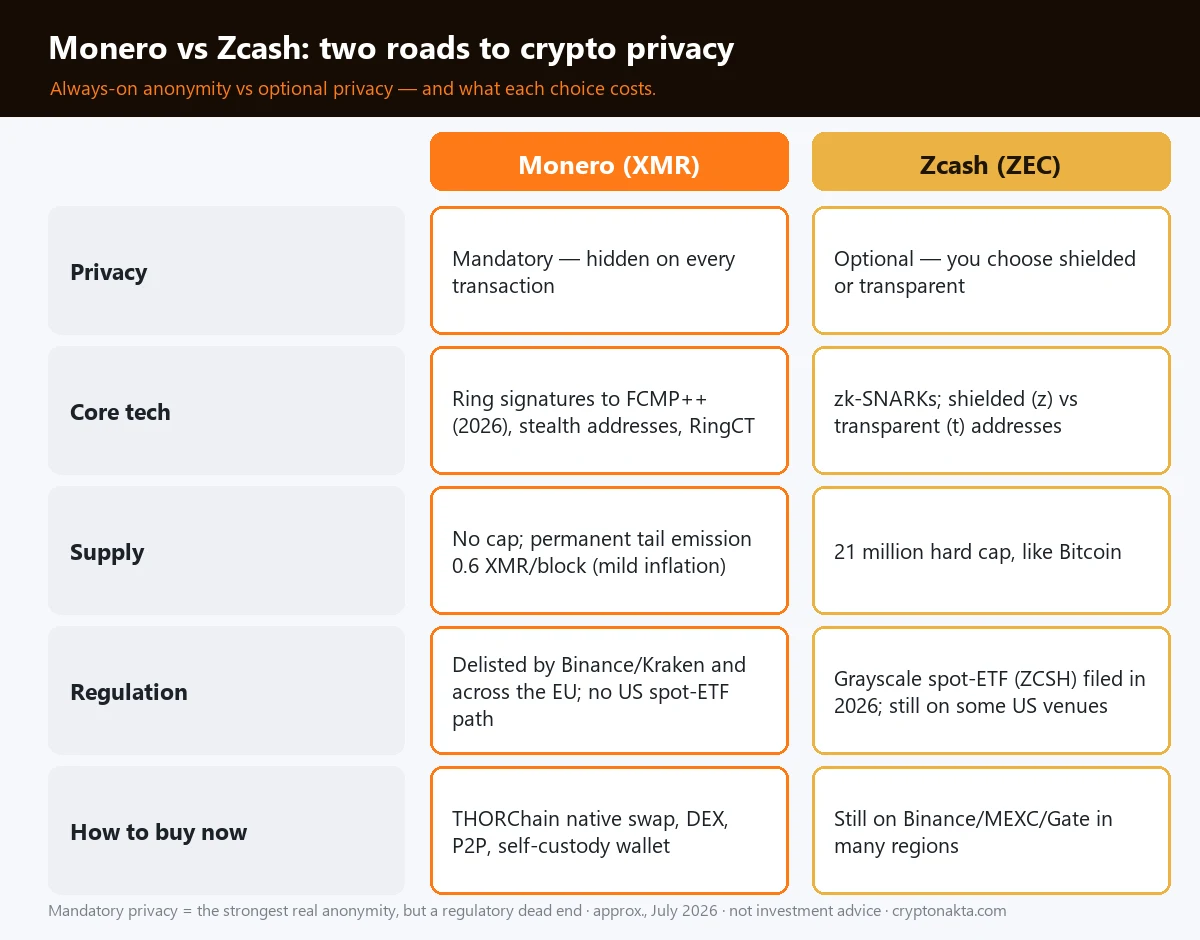
People constantly ask which one is the “real” privacy coin. Neither, really. Monero and Zcash chase the same goal from opposite directions, and the table below is the quickest way to see how each one gets there.
| Monero (XMR) | Zcash (ZEC) | |
|---|---|---|
| Privacy | Always on, for everyone | Optional — you choose to shield |
| Core tech | Ring signatures, stealth addresses, RingCT → FCMP++ (2026) | zk-SNARK zero-knowledge proofs |
| Supply | No cap; permanent 0.6 XMR/block tail emission | 21 million cap, like Bitcoin |
| Structure | Community project, no company, no premine | Backed by Electric Coin Co.; early dev fund |
| Institutional access | None — no US spot-ETF path | Grayscale filed a US spot ETF (ZCSH) in 2026 |
| 2026 headline | FCMP++ upgrade toward provable untraceability | A record rally, an ETF filing, and a serious shielded-pool bug |
The short version: Monero is the purist’s choice, private by design with nowhere to hide from that fact, which is why it is both the most trusted privacy coin among its fans and the most delisted. Zcash is the pragmatist’s choice, offering privacy that can be switched on when needed and off when a compliance department is watching, which is why it clung to mainstream exchanges and an ETF filing while Monero got pushed to the edges.
8. What moves Monero’s price
Beyond the general tide of Bitcoin and the wider market, a handful of forces move XMR specifically:
| Driver | Why it matters |
|---|---|
| Regulation and delistings | The single biggest lever. A new delisting or ban is bearish; renewed listings or a friendlier stance is bullish. Monero trades on access above almost anything else. |
| The privacy narrative | XMR tends to catch a bid when surveillance, data breaches or central-bank digital currency (CBDC) fears hit the headlines, and to fade when attention drifts. |
| Technical upgrades | A clean FCMP++ rollout that strengthens privacy is a confidence builder; delays or flaws would do the reverse. |
| Liquidity and swap routes | With fewer big exchanges, how easily XMR flows through atomic swaps, THORChain and remaining venues affects how smoothly large trades happen — and therefore volatility. |
| The rest of the privacy sector | Monero and Zcash often move as a theme. XMR itself set a new all-time high near $795 in January 2026 before giving back around 60% by mid-year, and Zcash’s 2026 rally briefly pushed ZEC past XMR in market cap — a reminder that the privacy trade rotates between them and swings hard. |
9. Strengths, risks, and who it’s really for
No hype and no doom — just the trade-off, laid out.
Strengths
- The strongest, always-on privacy in crypto, with FCMP++ pushing it toward provable untraceability in 2026
- True fungibility — every XMR is interchangeable, with no “tainted-coin” problem
- Genuinely decentralised: no company, no premine, no single point of pressure
- Battle-tested since 2014 and still actively developed, with CPU-friendly RandomX mining
Risks
- Delisting and regulation — the defining risk; it is the coin authorities target first, with access shrinking
- Harder to buy and sell — fewer exchanges, stricter rules, more reliance on decentralised routes
- No cap — a permanent tail emission means slight, endless inflation (by design, but not for everyone)
- Reputation and volatility — real illicit-use stigma, and sharp price swings
10. Next steps
The honest summary: Monero is the most uncompromising bet on financial privacy in crypto. Its privacy is always on, its coins are truly interchangeable, and no company sits behind it to be leaned on — and in 2026 the FCMP++ upgrade pushes its privacy from very strong toward provably untraceable. The flip side is inseparable from that strength: because it cannot offer a see-through, compliant version, Monero is the coin regulators drop first, so exchanges keep delisting it and buying it increasingly means decentralised routes like atomic swaps. If you believe private digital cash matters and you can handle shrinking access, self-custody and volatility, XMR is the purest way to hold that conviction — bought where it is legal and available for you, and moved to a wallet you control rather than left on an exchange. Compare venues on our best exchanges page, weigh it against optional-privacy Zcash and fixed-cap Bitcoin, learn the fraud patterns in the scams guide, and if you are new, start at the complete beginner’s guide. Not investment advice — verify current figures and legality on official sources first.