Getting Started with Crypto: Take Your First Step Without Getting Scammed
Choose a trusted exchange, secure your account, buy your first crypto, and store it safely — without the hype.
New to crypto? It’s simpler than it looks. It’s digital money you send over the internet without a bank, and this guide walks you through the first safe steps in order. Short on time? Read this table; the detail is below.
| Item | The gist |
|---|---|
| What it is | Digital money verified by computers worldwide, not a bank or government. Bitcoin was the first. |
| Where to start | Use a regulated, reputable exchange that supports deposits in your currency. |
| How much | You can buy a fraction of a coin (e.g. ~$15). Keep it small while you learn. |
| Security | Right after sign-up: app-based 2FA (not SMS) + anti-phishing code. Account security beats coin picking. |
| Storage | Small on the exchange, larger in a wallet you control (hardware). Recovery phrase on paper, offline. |
| The real risk | Most beginner losses come from scams and FOMO, not the market. Transfers can’t be reversed. |
1. What is cryptocurrency, and how does a blockchain work?
2. Coin types you must know (BTC, ETH, stablecoins, altcoins)
3. Before you start: risks every beginner should know
4. Step 1 — Choose a trusted exchange
5. Step 2 — Create your account and lock it down
6. Step 3 — Make your first purchase (orders, DCA, fees)
7. Step 4 — Store your crypto safely (wallets & recovery phrase)
8. Step 5 — Avoid the common mistakes and scams
9. Why prices move the way they do (volatility & market cap)
10. Understanding fees
11. Taxes and the law
12. Your first-month action plan
13. Key terms glossary
14. Your next steps
1. What is cryptocurrency, and how does a blockchain work?
In one sentence, cryptocurrency is digital money you can send over the internet without going through a bank. There’s no central bank issuing or backing it. Instead, thousands of computers around the world verify every transaction and record it on a shared public ledger called a blockchain. That’s why no single company or government can simply mint more of it or block someone’s payment. Bitcoin launched in 2009; today there are thousands of coins.
How a blockchain works
When a transaction happens, it goes into a “block,” and blocks link together in time order like a chain. To add a new block, a majority of the network has to agree “this is valid,” and once it’s recorded it’s effectively impossible to change. Anyone can inspect the ledger, and forging it would mean seizing most of the world’s computers at once — so it doesn’t happen. This “tamper-proof + public + distributed” nature is what lets strangers trust a transaction without a middleman like a bank.
Wallet addresses and private keys
Each coin is tied to a wallet address (a long string of letters and numbers). A transfer goes “my address → their address,” and it only executes when signed with my private key. In other words, whoever holds the private key owns the coin. That’s why security is everything — if you lose it or get tricked into handing it over, there’s often no “support desk” to claw it back.
Why people use it
| Feature | What it means |
|---|---|
| 24/7, borderless | Weekends, late nights, or overseas — you can send regardless of bank hours. |
| You hold it yourself | You can manage your own assets without a bank. The responsibility is yours too. |
| Fixed supply | Bitcoin is capped at 21 million in code, which is why it’s sometimes called “digital gold.” |
| Programmable money | Chains like Ethereum let you run smart contracts that execute automatically when conditions are met — the base for finance, gaming and art apps. |
2. Coin types you must know (BTC, ETH, stablecoins, altcoins)
There are thousands of coins, but at the start you only need four broad buckets. Just knowing these lets you roughly place any coin you stumble across.
| Type | Example | In one line | Risk |
|---|---|---|---|
| Bitcoin (BTC) | Bitcoin | First and largest. Widely seen as a store of value (digital gold). | Relatively lower (still volatile) |
| Ethereum (ETH) | Ethereum | The “platform” coin that hosts apps and smart contracts. Base of DeFi and NFTs. | Medium |
| Stablecoins | USDT·USDC | Aim to hold a $1 peg. Used to dodge volatility or as a trading bridge. | Issuer / collateral risk |
| Altcoins | Everything else | Wildly varied in purpose, size and risk. Many new ones are very risky or scams. | High to very high |
The “cheap-looking coin” trap
“A coin at $0.01 is cheaper than Bitcoin at $60,000” is a common beginner mistake. What matters isn’t the price but the market cap (price × supply). A coin with a trillion units can have a low per-coin price yet a huge total size. The belief “it’s cheap, so 10x is easy” is what leads to big losses.
3. Before you start: risks every beginner should know
Before you start, let’s lay out the risks of this market — not to scare you off, but so you go in knowing where money leaks. The ways beginners actually lose money are often not falling prices.
| Risk | What it is |
|---|---|
| High volatility | Prices swinging 10–20% in a day is common, and an individual coin can go to zero. Handle only an amount you can stomach. |
| Irreversible transfers | Unlike a bank transfer, a blockchain send can’t be cancelled or refunded. One wrong character in the address, or the wrong network, and it can be gone for good. |
| Scams (the #1 beginner loss) | Much of beginner loss comes from scams, not the market — “guaranteed returns,” signal groups, fake exchanges and apps (detailed in Step 5). |
| Changing rules & tax | Regulation and tax differ by country and keep changing. Even where it’s legal, reporting and tax duties can apply, so check the latest rules. |
| Emotion (FOMO) & overconfidence | Buying in a hurry out of “fear of missing out,” or sizing up after a win or two, are the most common causes of loss. |
None of this means “crypto = scam.” It means go slowly, verify, and don’t get swept up by hype or pressure. Knowing the risks and starting small, you can learn safely.
4. Step 1 — Choose a trusted exchange
An exchange is where you buy, sell and (at first) store coins — so which one you pick is the most important early decision. Don’t decide on ads or a friend’s tip alone; check these five things yourself.
| Check | Why it matters |
|---|---|
| Regulation / registration | A legally run exchange carries less risk of frozen funds, sudden closure or an exit scam. Confirm it’s registered/licensed in your country. |
| Security record | No major hack history, customer assets held separately, and proof-of-reserves published — those are safer signs. |
| Fees | Trading and withdrawal fees differ by exchange (typically 0.05–0.5%). The more you trade, the more they add up. |
| Liquidity / coins listed | High volume means your order fills near the price you see, and the coin you want is actually listed. |
| Deposit / withdrawal | Local-currency deposit (bank link), card or stablecoin routes — and smooth withdrawals — matter. |
Local vs global exchanges
A regulated local exchange usually makes the easiest start: deposits in your own currency and a familiar bank link. Global exchanges (Binance, Bybit, MEXC, etc.) list far more coins and features, but local-currency deposits are harder (often via stablecoins or P2P) and you handle your own country’s reporting. Many people learn the basics on a regulated exchange first, then add a global one when they need more.
💡 Perk: signing up via the links below can apply a fee discount or sign-up bonus (varies by exchange, region and conditions).
Open a Binance account · get the fee perk →Open a Bybit account · get the sign-up perk →Sign up for MEXC · get the bonus →
Affiliate disclosure: some links are partner links. We may earn a commission at no extra cost to you. This is not investment advice.
5. Step 2 — Create your account and lock it down
Account security matters far more than picking the “perfect coin.” Exchange and wallet accounts are a hacker’s top target, and stolen funds are almost never recovered. Finish these four right after sign-up.
| Setting | Why · how |
|---|---|
| A strong, unique password | Reusing a password from another site means that site’s breach can open your exchange. Make a long, unique password per exchange and keep it in a password manager (e.g. Bitwarden). |
| Two-factor auth (2FA) via app | 2FA blocks a login even if your password leaks. But SMS can be defeated by “SIM-swapping” (hijacking your number), so an authenticator app (Google Authenticator, Authy) is safer. |
| Anti-phishing code | Real emails from the exchange include a phrase you set. An email without it is instantly recognisable as fake. |
| Withdrawal whitelist | Lock withdrawals to pre-registered addresses only, so even a hacker can’t send funds to their own wallet. |
6. Step 3 — Make your first purchase (orders, DCA, fees)
You can start small — there’s no need to buy a whole coin. Instead of one Bitcoin (tens of thousands of dollars), about $15 is fine (you can buy fractions). That keeps risk low while you get used to the screens.
Two order types
| Type | What it does |
|---|---|
| Market order | Buys or sells at the current price right away. Simplest and fastest. |
| Limit order | Sets “buy/sell if it hits this price” in advance. You get your price, but if it never reaches it, nothing fills. |
Dollar-cost averaging (DCA)
Instead of buying everything at once, buying a fixed small amount on a schedule (say $15 a week) is called dollar-cost averaging (DCA). It reduces the risk of going all-in at a top and saves you from trying to time the price. That said, it’s just a method — it doesn’t guarantee a profit.
Common patterns right after buying
Buying more in a rush after a small rise (overconfidence), panic-selling on a small dip only to be hit by the bounce (emotional trading), and racking up fees from frequent trades are all common. At first, buy and then leave it alone and observe — that’s the best practice.
※ Nothing here is a recommendation to buy any specific coin; buy/sell decisions and their outcomes are your own.
7. Step 4 — Store your crypto safely (wallets & recovery phrase)
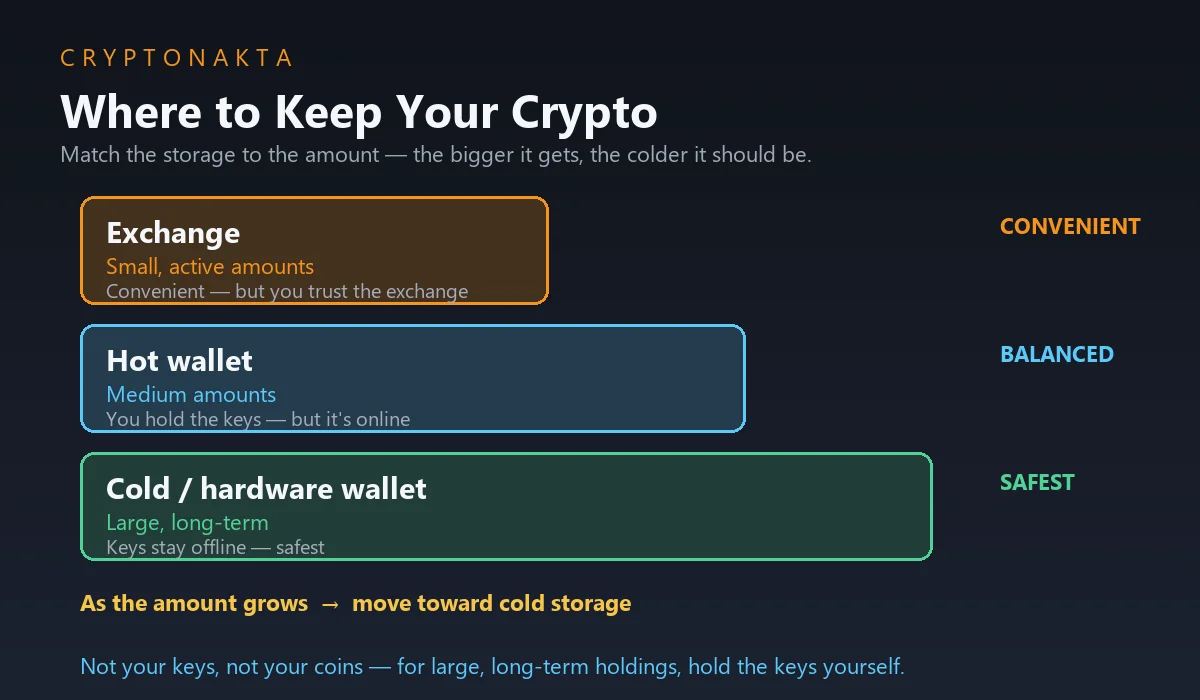
If you hold more than pocket change, consider moving it off the exchange into a wallet where you hold the keys. As the saying goes, “not your keys, not your coins” — if an exchange goes bankrupt or gets hacked, funds left there are at risk. Large exchanges have collapsed and locked up customer funds more than once.
| Storage | Pros | Cons | Best for |
|---|---|---|---|
| On the exchange | Easiest, trade instantly | You must trust the exchange (bankruptcy/hack risk) | Small amounts, active trading |
| Hot wallet (app/extension) | You hold the keys, convenient | Online = exposed to hacks/malware | Medium amounts, DeFi use |
| Cold wallet (hardware) | Keys offline, safest | Device cost, slight learning curve | Large amounts, long-term |
Your recovery phrase is the real password
When you make a wallet, you get a recovery phrase of 12–24 words. It can restore the wallet on any device, so it’s effectively the master key to your coins. The rules are simple:
| Do | Don’t |
|---|---|
| Write it on paper, stored offline (ideally split across two places) | Save it as a photo, screenshot, in the cloud, a notes app or email — one breach and it’s over |
| Use a hardware wallet (Ledger, Trezor) for large amounts | Type or share it on any site, app or with any person — “enter your phrase for an airdrop” is 100% a scam |
A hardware wallet keeps the private key off the device, so your coins stay safe even if your computer is hacked.
8. Step 5 — Avoid the common mistakes and scams
Again: most beginner losses come from scams and emotion, not the market. Memorise the signals and types below and you’ll dodge most of them.
| Common scam types | What it is |
|---|---|
| Phishing | Fake login pages, emails and texts that look identical to the real thing. Check the address character by character and reach exchanges only via a bookmark. Search-ad links are often fake. |
| Fake support / DMs | Impersonators on X, Telegram or Discord posing as “support” to ask for your password, recovery phrase or remote access. Real support never asks. |
| Fake exchanges / apps | Impersonator apps even reach app stores. Install only from the official site link. |
| Rug pulls / pump-and-dumps | Anonymous teams hype a new coin then vanish with the funds, or insiders pump a coin they pre-bought and dump it. |
| High leverage | High-leverage futures get liquidated on small moves and usually end in loss. It’s an area to judge only after you fully understand it. |
| Romance / investment lure | A long con (pig butchering) where someone befriends you on social or dating apps, then steers you to a “great investment.” Treat investment tips from strangers with suspicion. |
9. Why prices move the way they do (volatility & market cap)
Knowing just the basics of why prices move keeps you from being whipsawed by news and fear.
Volatility — the market’s nature
Crypto swings far more than stocks. A 10–20% day is common, and something can halve or double in a month. That’s not a “malfunction” — it’s because the market is small, trades 24/7 and is sensitive to emotion. So the key is to add only an amount whose swings you can stand.
Market cap — a coin’s true size
Market cap = price × supply. A low per-coin price can still mean a big total if supply is huge. “It’s cheap, so it’ll soon reach Bitcoin’s level” is a fallacy. Compare coins by market cap, volume and real use — not price.
What moves prices
| Driver | Detail |
|---|---|
| Supply, demand & sentiment | Greed and fear swing short-term prices hard. |
| Macro | Interest rates, the dollar, risk-asset mood. |
| Regulatory news | National policy, ETF approvals, crackdowns. |
| Tech & ecosystem | Upgrades, adoption, hacks. |
10. Understanding fees
Fees are the “hidden cost” that quietly eats your returns. Knowing what’s charged before you trade cuts needless losses.
| Fee | What it is |
|---|---|
| Trading fee | Charged on every buy/sell (typically 0.05–0.5%). It adds up the more you trade, and varies by exchange, tier and payment method. |
| Deposit/withdrawal (network) fee | The blockchain fee when you send a coin elsewhere. It varies a lot by coin and network congestion, so the same transfer can be pricey at busy times. |
| Spread | The gap between the buy and sell price. “Instant buy (one-click)” menus are convenient but often carry a big spread (a hidden fee). The regular trading screen is usually cheaper. |
11. Taxes and the law
Holding and trading crypto is taxable and reportable in many countries, and the rules keep changing — so check your national tax authority’s latest guidance. Selling, swapping or earning crypto can be a taxable event, and using a foreign exchange or larger amounts can make reporting more complex, where consulting a professional is the safe move.
On the exchange side, prefer a registered, regulated platform in your country and avoid unregistered or shady sites. Legality ranges from legal in many places, to restricted in some, to banned in a few — so confirm your local status before depositing.
Record-keeping helps too. Logging when and at what price you bought and sold, plus deposits and withdrawals, makes tax filing and tracking profit and loss far easier later. This article is educational, not tax or legal advice.
12. Your first-month action plan
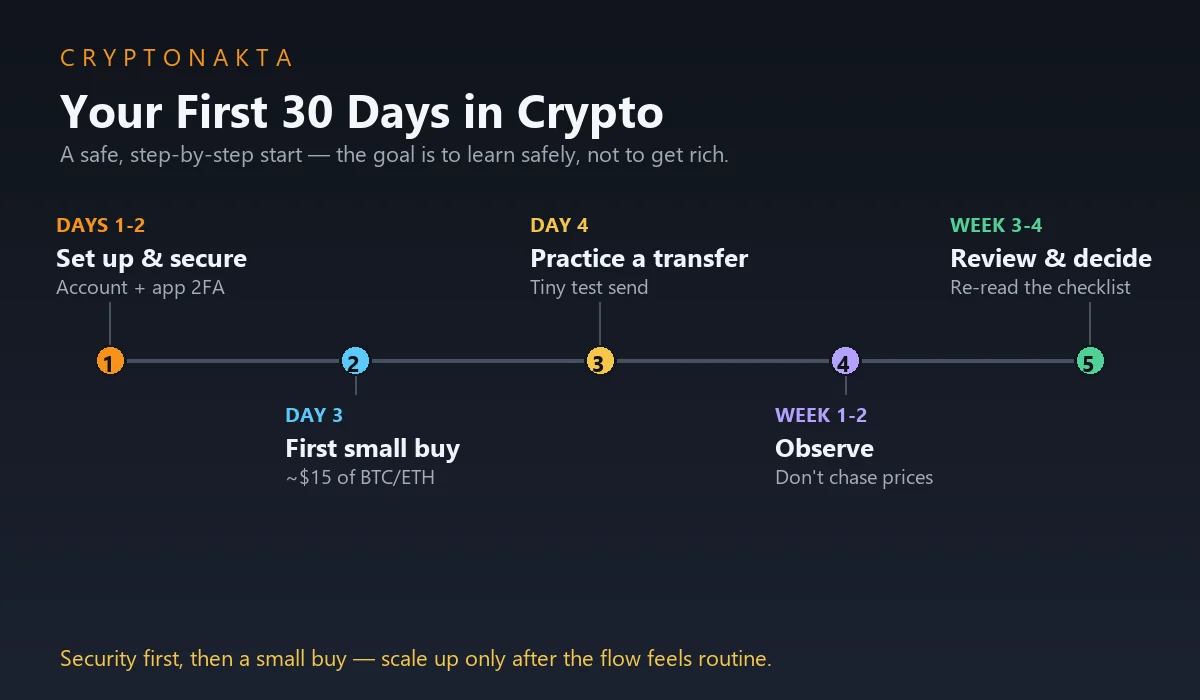
Reading alone fades fast. Doing it yourself, “small,” in the order below is the fastest and safest way to learn. The goal isn’t to make money — it’s to learn safely.
| When | What to do |
|---|---|
| Days 1–2 — set up | Open one trusted exchange + ID verification + 2FA (authenticator app) + anti-phishing code. Finish security first. |
| Day 3 — first buy | Deposit a tiny amount (e.g. $15) → make a small market buy of Bitcoin or Ethereum. Learn the screen flow by doing. |
| Day 4 — practice a transfer | Make a free wallet app and send a tiny test amount from the exchange to your wallet. Feel “irreversible” and address-checking firsthand. |
| Weeks 1–2 — observe | Five minutes a day: what Bitcoin and Ethereum are, how news moves price. Don’t chase pumps. |
| Weeks 3–4 — review | Try DCA with a small amount, and re-read this guide’s safety checklist before adding more. Large amounts go to a hardware wallet. |
Your learning path — read in this order. Every guide below goes far deeper than this overview, and each builds on the last:
- How blockchains actually work — the foundation everything else sits on.
- Bitcoin explained — the original asset and why it matters.
- Ethereum explained — smart contracts and everything built on them.
- Stablecoins — the “digital dollars” you’ll actually use for deposits and trades.
- Choosing an exchange — fees, security and country availability compared.
- Buying your first Bitcoin, step by step — the full purchase walkthrough.
- Wallets & self-custody — where your crypto should live long-term.
- Crypto scams — the traps that cause most real-world losses. Read before depositing.
13. Key terms glossary
Here are the terms that confuse beginners, in one place.
| Term | Plain meaning |
|---|---|
| Blockchain | The public, tamper-proof, distributed ledger transactions are recorded on. |
| Private key / recovery phrase (seed) | The real password to your coins. Whoever holds it is the owner. Never share. |
| Wallet | A tool to store and send coins. Hot (online) / cold (offline). |
| 2FA | A second login factor (authenticator app recommended, SMS not). |
| Stablecoin | A coin aiming to hold a fixed value like $1 (USDT·USDC). |
| Altcoin | Any coin other than Bitcoin. |
| Market cap | Price × supply. A coin’s “size.” |
| DeFi | Borrowing and lending on a blockchain without a bank. As much risk as yield. |
| NFT | A digital asset whose ownership is proven on a blockchain. |
| Gas | The network fee for a blockchain transaction (notably on Ethereum). |
| Rug pull | A scam where the team vanishes with the funds. |
| FOMO | Buying in a rush for fear of missing out. A prime cause of loss. |
| Leverage | Betting bigger with borrowed money — losses grow to match, a top cause of beginner liquidations. |
14. Your next steps
Once you’ve safely bought and stored a small amount, keep learning before you add more. Good next topics: how to read a crypto chart, the differences between exchanges and wallets in depth, the risks of DeFi and staking, and how to evaluate a coin beyond the hype. Bookmark this guide and revisit the safety checklist before any bigger move. In crypto, your biggest enemy isn’t the market — it’s impatience and scams. Start small, get your security right, and learn slowly, and anyone can begin safely.