What Is Zcash (ZEC)? The Privacy Coin, the 2026 Bug, and the Honest Risks
A clear, sourced guide to Zcash (ZEC) — the privacy cryptocurrency built on zk-SNARKs. How its shielded privacy works, the 650%+ 2026 rally and the first US spot privacy-coin ETF filing (Grayscale ZCSH), the four-year Orchard bug that nearly let unlimited fake ZEC be minted, the Bitcoin-style 21M supply, the regulatory delisting risk, and how to buy it safely. As of July 2026.
- Zcash (ZEC) is a privacy cryptocurrency that uses zk-SNARK zero-knowledge proofs to let you hide the sender, receiver and amount of a payment. Privacy is optional: ZEC has transparent (public) and shielded (private) addresses.
- The 2026 bull run: ZEC rallied 650%+ from under $50 to a ~$700 peak, briefly becoming the largest privacy coin by market cap (overtaking Monero). Grayscale filed to convert its Zcash Trust into a spot ETF (ZCSH) — the first US spot privacy-coin ETF — and the SEC closed its Zcash investigation in January 2026. As of July 2026, ZEC trades around $520.
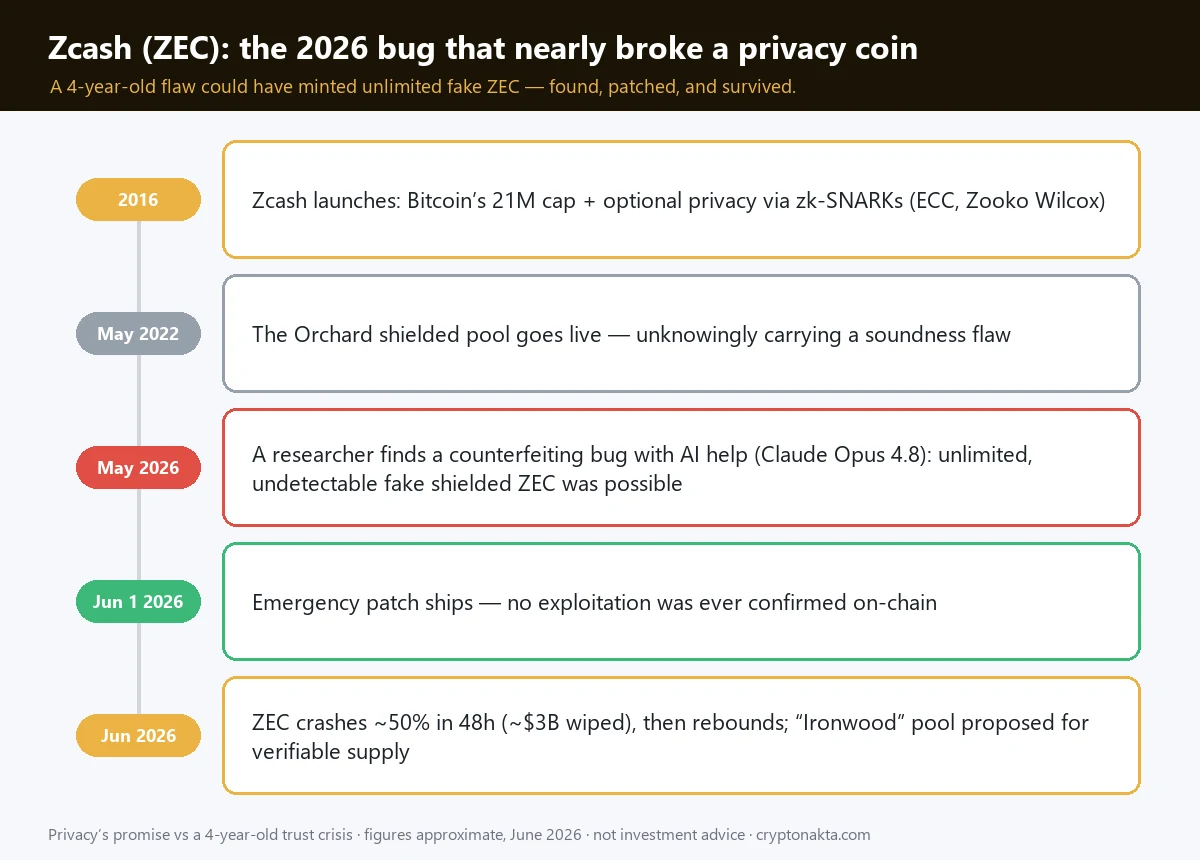
- The 2026 shock: a four-year-old “soundness” bug in the Orchard shielded pool could, in theory, have minted unlimited, undetectable counterfeit ZEC. It was found (reportedly with AI help, Anthropic’s Claude Opus 4.8), patched by June 1, and — as far as anyone can verify — never exploited. ZEC still crashed ~50% in 48h, then rebounded.
- Tokenomics: a Bitcoin-style 21 million cap, Proof-of-Work mining, halvings (~every 4 years, next ~Nov 2028). Highly volatile.
- The honest risks: privacy coins face regulation and delisting (some exchanges restrict shielded withdrawals), and the bug raised a real trust question — though the team responded fast and proposed “Ironwood” to make supply independently verifiable.
- Where you can buy it depends on your country. ZEC still trades globally on Binance, MEXC and Gate, but it’s delisted on US exchanges, being phased out in the EU (full ban 2027), and blocked domestically in Korea, Japan and the UAE. Check your local rules first; keep only trading-size balances on an exchange and move long-term holdings to self-custody.
- This guide covers how Zcash works, the 2026 bug in full, tokenomics, the regulatory picture, price drivers, risks, and how to buy. Not investment advice.
1. What is Zcash (ZEC)?
2. How Zcash privacy works (zk-SNARKs, shielded vs transparent)
3. The 2026 Orchard bug, explained honestly
4. The other half of 2026: a record rally and the first privacy-coin ETF
5. Tokenomics: Bitcoin-style scarcity, with a twist
6. The privacy-coin question: regulation & delisting
7. What moves ZEC’s price
8. Strengths vs risks
9. How to buy ZEC safely
10. Next steps
1. What is Zcash (ZEC)?
Picture money built to keep your payments private — then imagine learning that, for four straight years, a hidden flaw could have let someone secretly print an unlimited amount of it, with no one able to tell. That is the scare Zcash (ZEC) just lived through in 2026. The twist: the flaw was caught by an AI before anyone (publicly) abused it.
Zcash is a privacy cryptocurrency — digital money that can hide who paid whom and how much, using advanced cryptography instead of trust. Where Bitcoin writes every transaction in the open, Zcash lets you choose to shield the details. That privacy is its entire reason to exist — which is exactly why a bug that struck at the supply itself shook the coin so hard.
And yet 2026 was also Zcash’s best year in ages: a 650%+ rally that briefly crowned it the biggest privacy coin, plus the first-ever US spot ETF filing for a privacy coin. Two opposite stories in one — that tension is the whole point.
Here is the honest snapshot, as of July 2026:
| Ticker | ZEC |
| What it is | A privacy cryptocurrency: optional, math-based anonymous payments |
| Tech | zk-SNARKs zero-knowledge proofs (shielded vs transparent addresses) |
| Born | 2016, by Electric Coin Co. (founder Zooko Wilcox) |
| Supply | 21 million cap (like Bitcoin) · Proof-of-Work mining · halvings |
| 2026 rally & ETF | 650%+ run to a ~$700 peak — briefly the largest privacy coin; Grayscale filed the first US spot privacy-coin ETF (ZCSH) |
| 2026 shock | A 4-year-old Orchard bug could have minted unlimited fake shielded ZEC — patched June 2026, no exploit confirmed |
| Price | ~$520 (July 2026 — very volatile; ran from under $50 to ~$700, then pulled back) |
| Where you can buy it | Banned/delisted in EU (full ban 2027), Korea, Japan, UAE & on US exchanges — still on Binance/MEXC/Gate globally |
| Biggest risks | Privacy-coin delistings/regulation + the post-bug trust question |
Below, in plain English: how Zcash’s privacy actually works, the record rally and ETF filing, what the bug really was and how it was found, why the price is so volatile — and the bigger question that outlives any single headline: whether privacy coins can survive the regulators at all.
2. How Zcash privacy works (zk-SNARKs, shielded vs transparent)
Zcash’s superpower is a piece of cryptography called a zk-SNARK — a “zero-knowledge proof.” In plain terms, it lets the network confirm a transaction is valid (the money exists, isn’t double-spent) without revealing the sender, receiver or amount. It’s the difference between proving “I’m old enough to enter” and handing over your full ID.
| Piece | What it means |
|---|---|
| Two address types | ZEC has transparent addresses (public, like Bitcoin, start with “t”) and shielded addresses (private, start with “z”). Privacy is optional — you choose per transaction. |
| Shielded pool | When you move ZEC into shielded addresses, it joins a private “pool.” The latest is the Orchard pool, live since May 2022 — the same pool at the centre of the 2026 bug. |
| Proof-of-Work | Like Bitcoin, ZEC is mined. Miners secure the chain and earn newly issued ZEC. |
| Same scarcity as Bitcoin | A hard cap of 21 million coins, with the block reward halving roughly every four years. |
3. The 2026 Orchard bug, explained honestly
This is the story everyone is searching for, so let’s tell it straight. In late May 2026, a security researcher disclosed a “soundness” bug in the Orchard shielded pool — the cryptographic circuit that makes private transactions possible. The flaw, present since Orchard launched in May 2022, meant that in theory someone could have created unlimited, undetectable counterfeit shielded ZEC. For a coin whose privacy hides the total supply, that is close to the worst possible bug.
| What happened | Detail |
|---|---|
| The flaw | A soundness gap in Orchard’s zero-knowledge circuit, live and unnoticed for ~4 years (since May 2022). |
| How it was found | By a security researcher who, according to reporting, used an AI assistant — Anthropic’s Claude Opus 4.8 — to help analyse the circuit. A working exploit was demonstrated only in a local test environment. |
| The fix | An emergency patch shipped by June 1, 2026. Crucially, no exploitation was ever confirmed on-chain — the bug was caught before anyone (publicly) abused it. |
| The market | ZEC crashed ~50% in 48 hours, wiping ~$3 billion in value and falling from around $630 toward the low $300s/$260s — then rebounded sharply as the patch held and recovery plans emerged. |
| The plan | Founder Zooko Wilcox proposed “Ironwood,” a new shielded pool designed so anyone can independently verify the true circulating supply — turning the scare into a long-term hardening. |
4. The other half of 2026: a record rally and the first privacy-coin ETF
Tell only the bug half and you’d badly mislead someone, because 2026 was also the year Zcash broke out. From under $50 at its 2024 lows, ZEC climbed to a 2026 peak in the ~$700 range — a 650%+ move that, at its height, briefly made it the largest privacy coin by market cap, overtaking long-time leader Monero. As of July 2026 it has cooled to roughly $520, consolidating in the $500–560 band.
| 2026 bull catalyst | Why it mattered |
|---|---|
| First privacy-coin ETF filing | Grayscale moved to convert its Zcash Trust into a spot ETF (ticker ZCSH) on NYSE Arca — the first US spot ETF for any privacy coin. A decision is pending in 2026; approval would open regulated, institutional access to ZEC. |
| Regulatory overhang lifted | In January 2026 the SEC closed its long-running Zcash-related investigation with no action — clearing a cloud that had kept institutions on the sidelines for years. |
| Institutional accumulation | Funds including Multicoin Capital disclosed sizeable ZEC positions, framing it as a “return to crypto’s cypherpunk roots.” |
| NU7 / Project Tachyon | Network Upgrade 7, targeted for late July 2026, aims to scale shielded throughput (~300% faster, block times cut from ~75s toward ~25s) — alongside the “Ironwood” work on independently verifiable supply. |
5. Tokenomics: Bitcoin-style scarcity, with a twist
On the money side, ZEC is modelled closely on Bitcoin — which is part of its appeal.
| Item | Detail (July 2026) |
|---|---|
| Maximum supply | 21 million ZEC — the same hard cap as Bitcoin (fixed scarcity, unlike inflationary coins). |
| Issuance | Proof-of-Work mining, with the block reward halving roughly every four years (next halving expected around November 2028). |
| History note | Early on, a portion of the block reward funded the founders/development (“dev fund”) — a common criticism versus Bitcoin’s pure miner issuance. |
| Supply verifiability | Because shielded coins are hidden, verifying the exact total supply is harder than on a transparent chain — exactly the gap the 2026 bug exploited and the “Ironwood” upgrade aims to close. |
6. The privacy-coin question: regulation & delisting
Privacy coins live under a regulatory cloud, and pretending otherwise would be dishonest. This is arguably ZEC’s biggest long-term risk — bigger than any single bug — and it looks very different depending on where you live:
| Region | Privacy-coin status (2026) |
|---|---|
| United States | Legal to own, but Coinbase, Kraken and Gemini delisted privacy coins (2020–2023). Binance.US notably added a ZEC/USD pair in June 2026. |
| European Union | Under MiCA, exchanges are dropping privacy coins, and a full EU ban is set for July 2027. |
| South Korea & Japan | Banned from domestic exchanges (Korea ~2021, Japan since 2018). Owning and trading abroad can still be legal. |
| UAE | Privacy coins prohibited under the VARA framework since 2023. |
So the global trend is one of tightening access — over 70 exchanges delisted privacy coins in 2025 alone. Underneath that, the deeper trade-off looks like this:
| The case for ZEC | The case against |
|---|---|
| Real, respected privacy. Financial privacy is a legitimate need; ZEC’s zk-SNARK tech is genuinely cutting-edge and influential across crypto. | Delisting risk. Some exchanges and entire jurisdictions have removed privacy coins to avoid regulatory heat; some that keep ZEC restrict shielded withdrawals. |
| Optional privacy. You can use ZEC transparently like Bitcoin, which helps exchanges and compliance. | Regulatory targeting. Privacy coins are a recurring focus for regulators worried about money laundering — a structural overhang on demand. |
| Bitcoin-style scarcity + an active team turning the 2026 scare into stronger guarantees (Ironwood). | Trust question. A four-year hidden flaw, however well handled, is a reminder that bleeding-edge cryptography carries bleeding-edge risk. |
7. What moves ZEC’s price
Beyond the whole-market tide of Bitcoin and macro, a few clear levers move ZEC:
| Driver | Why it matters |
|---|---|
| Privacy-coin regulation & listings | News of delistings (bearish) or renewed exchange/wallet support (bullish) hits ZEC directly — privacy coins trade on access. |
| The Grayscale ETF & institutional demand | The pending spot ETF (ZCSH) is a swing factor: progress or approval draws regulated inflows, while a rejection or delay can unwind rally premium. Fund accumulation (e.g. Multicoin) works the same way. |
| Security & upgrades | The 2026 bug, the Ironwood proposal and the NU7/Tachyon upgrade show how much trust drives price. Clean audits and successful upgrades rebuild confidence; new flaws would do the opposite. |
| Shielded adoption | How much ZEC actually flows through shielded pools signals whether people use the privacy — the coin’s core value proposition. |
| Narrative cycles | ZEC tends to surge when “financial privacy” returns to the headlines (surveillance fears, CBDC debates) and fade when attention moves on. |
8. Strengths vs risks
No hype, no doom — just the trade-off, laid out.
Strengths
- Best-in-class, genuinely respected privacy tech (zk-SNARKs)
- Bitcoin-style fixed scarcity (21M cap, halvings)
- Optional privacy — usable transparently for compliance
- Active team turning the 2026 scare into stronger supply guarantees (Ironwood)
Risks
- Regulation/delisting — the defining long-term risk for privacy coins
- Trust after the bug — a 4-year hidden flaw, however well handled
- Supply verifiability — harder to confirm on a shielded chain
- High volatility — ~50% swings in days during the 2026 crisis
9. How to buy ZEC safely
Because of the regulation above, where you can buy ZEC depends heavily on your country — that is the first thing to check, not an afterthought. As of mid-2026 ZEC still trades on global exchanges like Binance, MEXC and Gate (Binance.US even added a ZEC/USD pair in June 2026), but Coinbase/Kraken/Gemini dropped it in the US, the EU is phasing it out under MiCA, and Korea, Japan and the UAE block it domestically. Where it is available, buying is the usual flow: open an account, complete verification (KYC), and buy ZEC — and note that some exchanges also restrict shielded withdrawals. These are the exchanges we keep dashboard-verified sign-up guides for; a referral code at sign-up can unlock a fee perk:
Binance

Bybit
Gate.io
MEXC
KuCoin
Affiliate disclosure: some links are partner links. We may earn a commission at no extra cost to you. This is not investment advice.
10. Next steps
The honest summary: Zcash is the purest, most respected bet on financial privacy in crypto, built on genuinely cutting-edge zk-SNARK cryptography and a Bitcoin-style 21M cap. The 2026 Orchard bug was a real scare — a four-year-old flaw that could have minted unlimited fake shielded ZEC — but it was caught, patched fast, apparently never exploited, and is prompting a stronger design (Ironwood). The bigger, lasting risk isn’t a single bug; it’s regulation: privacy coins get delisted and restricted, and that limits access and demand. If you believe private digital cash matters and can handle that risk, ZEC is the clearest way to express it — bought on a major exchange, kept in trading size there, and moved to a wallet you control for the long term. Learn the fraud patterns in the scams guide, see how scarcity compares with Bitcoin, and if you’re new, start at the complete beginner’s guide. Not investment advice — verify current figures on official sources.