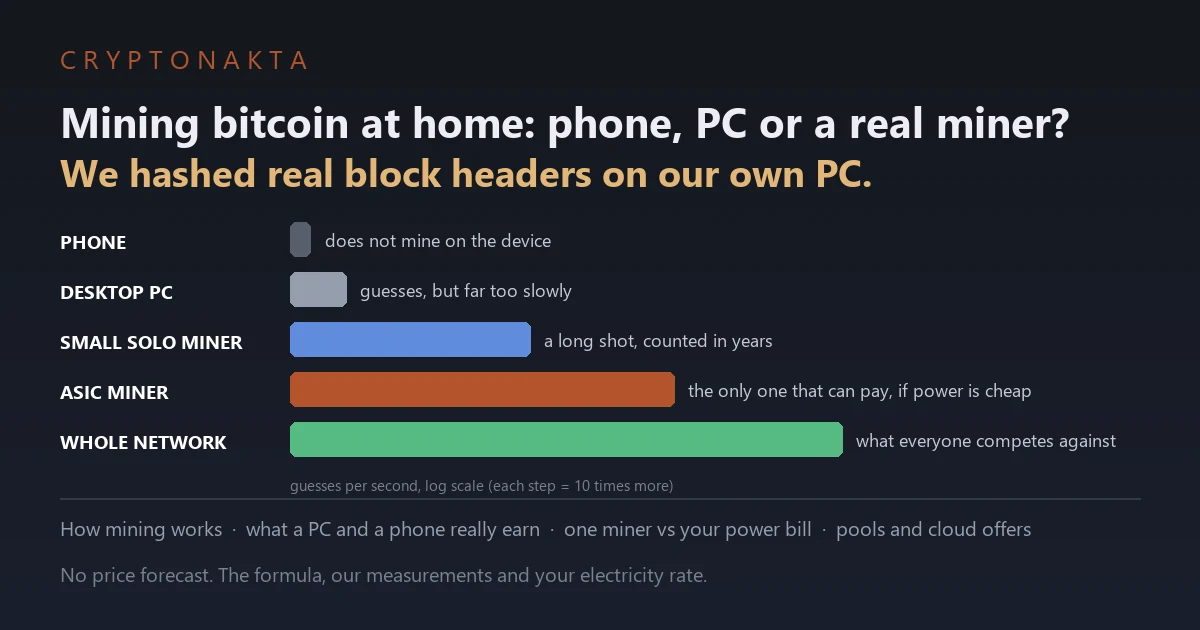
Bitcoin Mining: How Long to Mine 1 Bitcoin, Miner Profit, Electricity Cost, Phone Mining
Can you mine bitcoin on the phone or PC you already own? And if you bought a real mining machine, would it pay for itself? Both questions come up again and again in search, so I tested them.
I ran real bitcoin block headers through my own computer and counted its guesses per second. Then I pulled the network’s difficulty, block rewards and a full year of mining pool records from mempool.space. Everything below comes from those numbers, and each one carries the date I measured it.
In this article (14)
How to mine bitcoin on a PC, and what mine actually earnedHow does bitcoin mining work, in simple terms?Can you really mine bitcoin on your phone?PC, graphics card, Bitaxe, ASIC: how fast each one guessesSolo mining odds, mining pools and pool feesThe one formula behind every bitcoin mining calculatorHow much one ASIC miner earns, and how long it takes to mine 1 bitcoinRunning a miner at home: outlets, noise and heatIs bitcoin mining profitable right now?Is bitcoin mining profitable with free electricity or solar panels?Is cloud mining legit? How the contracts work and what to checkWhy the same miner earns less every yearMining or buying, and other coins you can still mineMy take: what measuring it myself taught me
 View full size ↗
How to mine bitcoin on a PC, and what mine actually earned
Yes, a PC can mine bitcoin. The math is simple, and any computer can run it. What a PC can’t do is run it fast enough to matter. I wanted a real number instead of a guess, so on September 27, 2026 I tested my own desktop.
My PC has an Intel Core i5-11400. It’s a six-core chip with 12 threads, released in early 2021 and rated at 65 watts. I pulled the newest block header from the bitcoin network. Then I wrote a short Python program that hashes it the way miners do, changing one small number each time. To check my code, I hashed the header as-is and got the real block’s hash.
Python is slow, so I also measured the same PC with OpenSSL. It’s a heavily optimized crypto library, and one thread of it did 3.20 million SHA-256 hashes per second. Six cores at that speed give a best-case estimate for this chip. The number of guesses a machine makes per second is its hashrate.
| What I measured on September 27, 2026 | Result |
|---|---|
| Python, one core | 558,434 hashes per second |
| Python, all cores | 2.44 million hashes per second (2.44 MH/s) |
| Best case (OpenSSL speed × 6 cores) | 19.2 MH/s, about 7.9 times the Python speed |
| Average wait to find a block alone | 7.4 billion years (Python) · 941.9 million years (best case) |
| Earnings per day in a mining pool | 0.000116 sats (Python) · 0.000915 sats (best case) |
| Time to earn one satoshi in a pool | 23.5 years (Python) · 3.0 years (best case) |
| Power at full load | About 1.56 kWh a day |
A satoshi is the smallest unit of bitcoin. It’s one hundred-millionth of a coin, and people call them sats. At Python speed my PC would need 23.5 years to earn a single one. On the day I measured, one satoshi was worth about $0.00084.
A mining pool is a group of miners who add up their guesses and split the rewards. My PC’s power at full load costs about $0.29 a day at the average US residential rate. Over those 23.5 years, that adds up to about $2,455 of electricity for one satoshi.
Mining alone, my PC would find a block about once every 7.4 billion years. The universe is about 13.8 billion years old. Even the best-case figure is close to a billion years. The whole network was about 389 trillion times faster than my PC’s Python test.
So what does mining bitcoin on a PC look like in practice? You install mining software, connect it to a pool and give it a bitcoin address for payouts. It runs fine. It just earns next to nothing while your power bill grows.
How does bitcoin mining work, in simple terms?
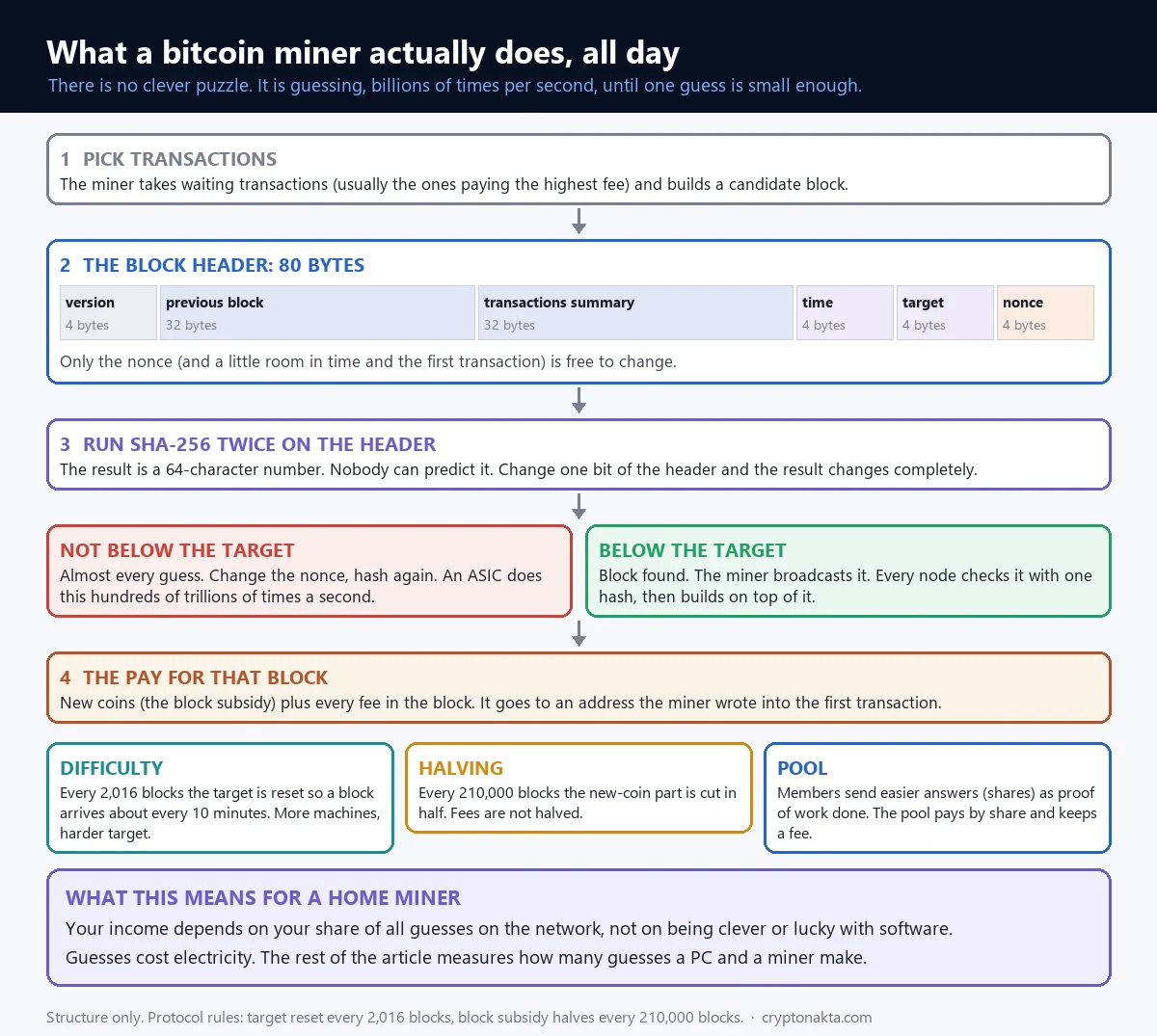
Bitcoin mining is guessing. It’s very fast, very repetitive guessing. There’s no clever puzzle to crack. The miner that makes the most guesses wins most often, and here is what one guess involves.
- The miner collects waiting transactions and puts them into a candidate block.
- It writes a short summary of that block, called the block header. The header is exactly 80 bytes.
- It runs the header through SHA-256, a standard hash function, twice in a row. Out comes a long number, the hash.
- It checks whether that hash is smaller than the network’s target. Almost every time, it isn’t.
- It changes the nonce, a small counter inside the header, and tries again.
- When a hash finally comes out below the target, the miner has found a block. It sends the block out, and the rest of the network checks it.
| Part of the header | Size | What it holds |
|---|---|---|
| Version | 4 bytes | Which set of rules the block follows |
| Previous block hash | 32 bytes | The hash of the block before, which links the chain together |
| Merkle root | 32 bytes | One hash that sums up every transaction in the block |
| Time | 4 bytes | When the miner built the block |
| nBits | 4 bytes | The target, written in a compact form |
| Nonce | 4 bytes | The counter the miner keeps changing |
The nonce is 32 bits, so it has about 4.3 billion possible values. An Antminer S21 runs through all of them in about 21 millionths of a second. Then it changes something else in the block, such as the time.
Checking a finished block is the easy part. Any node on the network hashes the header once and compares the result with the target. At the difficulty I measured, finding a block took about 570 sextillion guesses on average. Checking one takes a single hash. Our guide on what bitcoin is covers blocks and nodes.
The winner collects the block reward. It’s newly created bitcoin, called the block subsidy, plus the fees from every transaction in the block. The subsidy is currently 3.125 BTC. Over the last 1,008 blocks before September 27, 2026 the average reward was 3.1468 BTC. Fees made up only 0.69% of it.
The difficulty sets how low the target is. A lower target means fewer winning hashes, so blocks get harder to find. Every 2,016 blocks the network checks how long those blocks took. If they came faster than two weeks, difficulty goes up. If they came slower, it goes down.
The goal is one block every ten minutes on average. One adjustment can move difficulty by a factor of four at most, up or down. On the day I measured, the difficulty was 132.76 trillion.
One more rule sets the supply. Every 210,000 blocks the new-coin part of the reward is cut in half. That event is the halving. The subsidy began at 50 BTC in 2009. Total supply stops just under 21 million coins, and the last tiny fraction is expected around the year 2140.
Can you really mine bitcoin on your phone?
No. A phone app does not mine bitcoin on your phone. The two big app stores don’t allow it. “We don’t allow apps that mine cryptocurrency on devices,” says Google Play’s developer policy. It only allows apps that remotely manage mining done somewhere else.
Apple’s App Review Guidelines say the same in guideline 3.1.5(ii). Mining is allowed only if “the processing is performed off device,” such as cloud-based mining. Guideline 2.4.2 also bars apps, and the ads inside them, from running unrelated background work such as crypto mining.
So what’s the number ticking up in a bitcoin mining app? It’s one of three things. It can be points the app hands out for watching ads or checking in. It can be a small reward paid from ad money. Or it can be your slice of a cloud mining contract, where the hashing happens in someone else’s building.
None of those numbers comes from your phone’s chip. I didn’t measure a phone, so I won’t invent a speed for one. Say a phone matched my desktop exactly. It would still need about 23.5 years to earn one satoshi in a pool.
What about mining apps that actually pay?
Some apps do send small payouts. Before you trust one, ask where the money comes from. If the app earns from ads, your payout is a small cut of ad revenue. If it sells you a faster “miner” or a “boost,” you’re buying a contract. If it pays extra for inviting friends, new users may be funding old ones.
Pi Network’s mining button works on the same idea. Tapping it does no computing at all. We looked at how Pi works and where it trades in our Pi Network guide.
PC, graphics card, Bitaxe, ASIC: how fast each one guesses
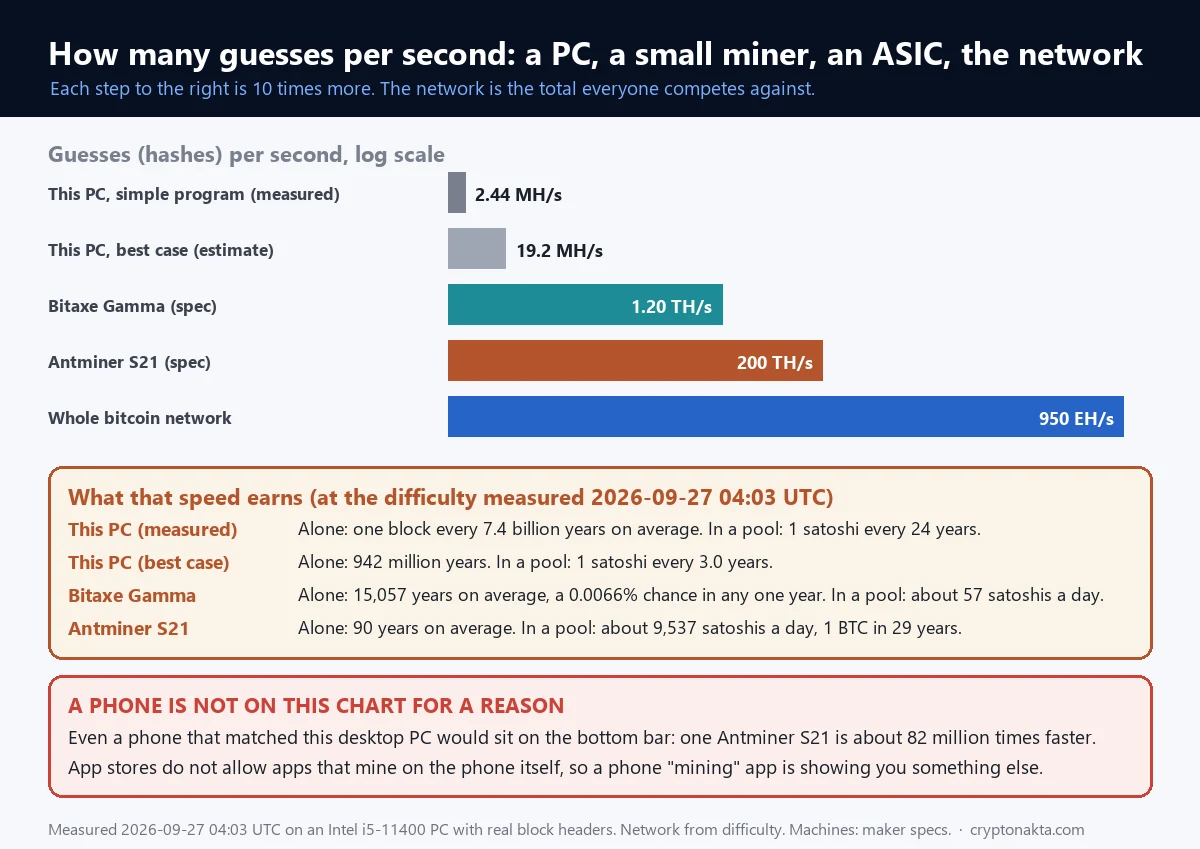
Hashrate numbers get big quickly, so here are the units. MH/s means a million hashes per second. GH/s is a billion, and TH/s is a trillion. After that come PH/s and EH/s. Each step is a thousand times the one before.
Graphics cards used to be the upgrade from a CPU. An RTX 4090 does about 22 GH/s of SHA-256 in the hashcat benchmark. Bitcoin hashes each header twice, so I estimate its mining speed at about 11 GH/s. That divide-by-two step is my own estimate. Even so, one Antminer S21 XP is roughly 24,500 times faster.
An ASIC miner is a machine built for one job. It runs SHA-256 for bitcoin and does nothing else. ASIC stands for application-specific integrated circuit. It can’t browse the web or play a game. It only guesses, and that focus makes it millions of times faster than a desktop CPU.
The table uses the network numbers I pulled on September 27, 2026. “In a pool” means your share of the rewards before pool fees. “Alone” means the average wait to find a whole block by yourself.
| Device | Hashrate | Sats per day in a pool | Years to 1 BTC in a pool | Average wait to find a block alone |
|---|---|---|---|---|
| My PC, Python test (measured) | 2.44 MH/s | 0.000116 | 2.4 billion | 7.4 billion years |
| My PC, best case (estimate) | 19.2 MH/s | 0.000915 | 299.3 million | 941.9 million years |
| RTX 4090 graphics card (estimate) | 11 GH/s | 0.525 | 521,975 | 1,642,559 years |
| Bitaxe Gamma | 1.2 TH/s | 57 | 4,784.8 | 15,056.8 years |
| NerdQAxe++ | 4.8 TH/s | 229 | 1,196.2 | 3,764.2 years |
| Antminer S21 | 200 TH/s | 9,537 | 28.7 | 90.3 years |
| Antminer S21 XP | 270 TH/s | 12,875 | 21.3 | 66.9 years |
| The whole bitcoin network | 950.3 EH/s | Every block | n/a | One block about every 10.3 minutes |
Look at the jumps between rows. A top gaming graphics card still needs over half a million years to reach one bitcoin. A single S21 needs 28.7 years. The whole network finds a block every ten minutes or so.
A phone isn’t in the table because I didn’t measure one. The chart below shows the same gaps on a log scale, from my PC up to the whole network.
Solo mining odds, mining pools and pool fees
Each block reward goes to one miner. With small hardware you could wait longer than a lifetime for one. In the year of pool records I pulled, pools found nearly every block.
A pool gives each member a much easier target. Each hash that beats the easy target counts as a share, and shares prove how much work you did. When anyone in the pool finds a real block, the reward is split by shares. You get small, steady payments instead of one big one you may never see.
Pools pay out under four common schemes.
- PPS pays a fixed amount for each valid share. Transaction fees are not included.
- PPS+ pays the subsidy per share at a fixed rate. The fee part follows the blocks the pool actually finds.
- FPPS pays per share for both the subsidy and the network’s average fees.
- PPLNS pays only when the pool finds a block. The reward is split across the last N shares.
I checked the fee pages of three pools. Binance Pool charges 4% on FPPS and has no minimum payout. It pays once a day between 02:00 and 10:00 UTC into your Binance account. F2Pool charges 4% on FPPS or 2% on PPLNS. Its default payout threshold is 0.005 BTC. ViaBTC charges 4% on PPS+ or 2% on PPLNS, with automatic withdrawals from 0.001 BTC.
Here is who found the blocks. The window covers 52,216 blocks in the year up to September 27, 2026.
| Pool | Blocks found | Share of all blocks |
|---|---|---|
| Foundry USA | 14,802 | 28.35% |
| AntPool | 9,395 | 17.99% |
| F2Pool | 6,460 | 12.37% |
| ViaBTC | 5,124 | 9.81% |
| SpiderPool | 4,640 | 8.89% |
| MARA Pool | 2,593 | 4.97% |
| SECPOOL | 2,173 | 4.16% |
| Luxor | 1,632 | 3.13% |
| Binance Pool | 1,099 | 2.10% |
| Solo mining pools (Solo CK, Public Pool, Parasite) | 22 | 0.042% |
| Unknown miner | 289 | 0.55% |
The top two pools found 46.3% of all blocks. The top five found 77.4%. In total, 32 pools found at least one block.
Solo mining odds, with a Bitaxe as the example
Solo mining means you keep the whole reward if you find a block, and get nothing until then. Small open-source machines such as the Bitaxe Gamma are built for this. It uses the same BM1370 chip as the Antminer S21 Pro. Its official page says it does about 1.2 TH/s, and one seller lists its draw at about 18 watts.
The odds are easy to work out. At the difficulty I measured, a Bitaxe Gamma alone would find a block about once every 15,056.8 years. Its chance in any single year is about 0.0066%. A NerdQAxe++ at 4.8 TH/s raises that to 0.0266%. Even a full-size Antminer S21 has only a 1.1% chance per year.
And yet solo blocks do happen. In that year of data, solo mining pools found 22 blocks. Solo CK found 10, Public Pool 7 and Parasite 5. I can’t see what hardware found them, and some may have been large machines mining solo. Each one paid the full reward of about 3.15 BTC, around $266,000 at that day’s price.
 View full size ↗
The one formula behind every bitcoin mining calculator
Every online bitcoin mining calculator does the same simple math. You need three numbers to do it yourself.
- How much 1 TH/s of hashrate earns in a day.
- How many watts your miner uses.
- What you pay for 1 kWh of electricity.
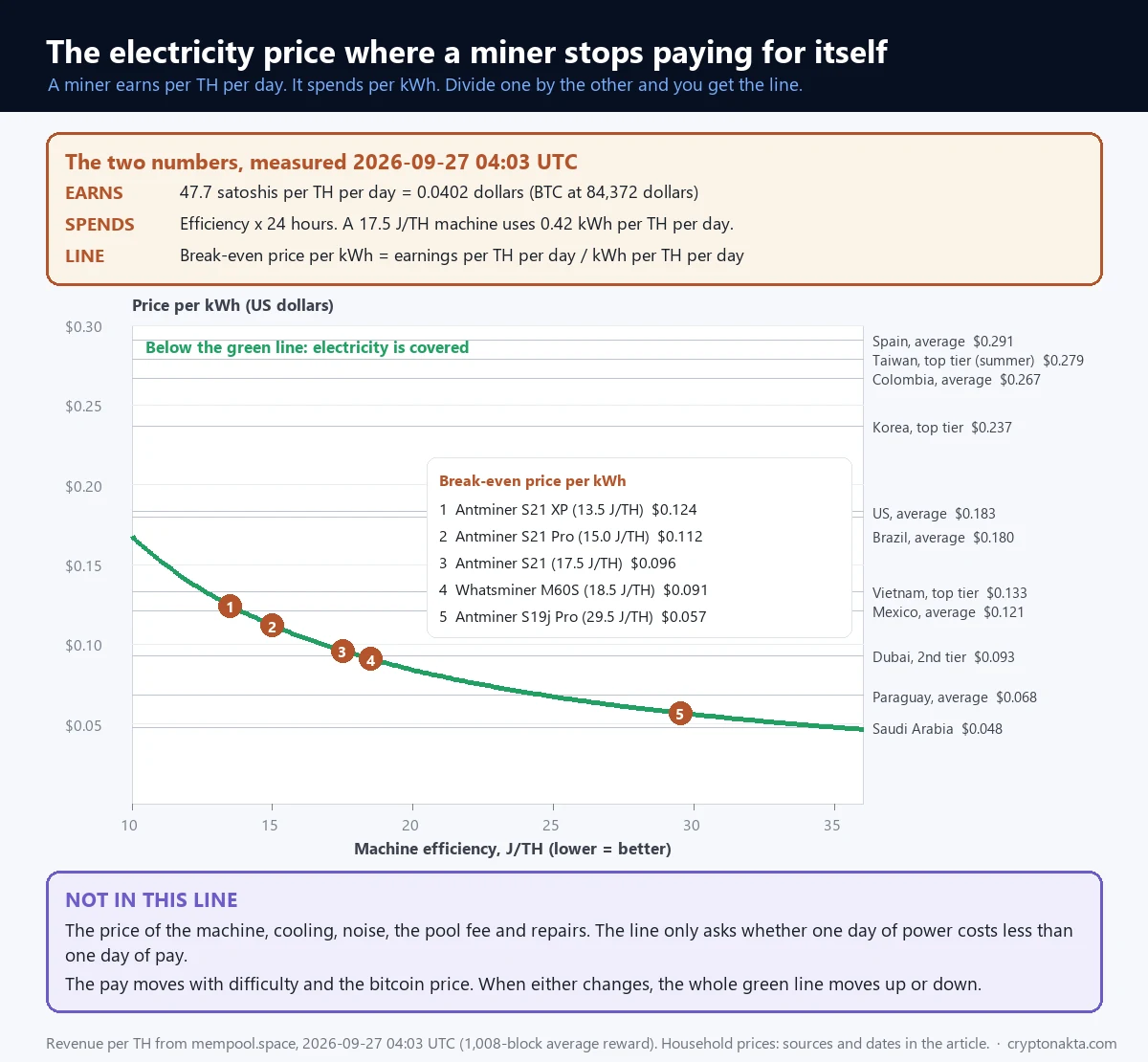
The first number has a name. Miners call it hashprice, the daily income from 1 TH/s. It moves with the block reward, the difficulty and the bitcoin price. I measured it at 47.68 sats per TH/s per day. That was about $0.0402 on September 27, 2026.
Without transaction fees, hashprice would have been 47.35 sats. One PH/s equals 1,000 TH/s. It earned about $40.23 a day.
Daily profit = hashprice × your TH/s − (watts × 24 ÷ 1000 × your price per kWh)
Break-even power price = daily income ÷ daily kWh
Here’s the math for an Antminer S21. It does 200 TH/s, so it earned about 9,537 sats a day. That was worth $8.05. It draws 3,500 watts, which is 84 kWh over 24 hours.
At the average US residential rate of 18.31¢, those 84 kWh cost $15.38. So the machine lost $7.33 a day before anything else. Divide $8.05 by 84 kWh and you get 9.58¢ per kWh. That’s the highest power price at which this machine still covers its electricity.
If your miner’s power costs more per day than it earns, you lose money every day it runs. The decision comes down to your own price per kWh. Look at your bill and compare.
That’s why miners compare machines in J/TH, or joules per terahash. It’s the watts a machine needs for each TH/s. Lower J/TH means less power per guess and a higher break-even price. The S21 is 17.5 J/TH. The S21 XP is 13.5 J/TH, and its break-even is 12.42¢.
One warning about hashprice. Mining income is not a fixed paycheck. When more machines join the network, difficulty goes up at the next adjustment. Then the same miner earns less. My figures are a snapshot from one day.
How much one ASIC miner earns, and how long it takes to mine 1 bitcoin
Here are five current ASIC models run through that formula. The specs come from each maker’s official pages. The earnings use my measurements from September 27, 2026. Pool fees are not taken out.
| Model | Hashrate | Sats per day | Dollars per day | kWh per day | Break-even price per kWh | Time to 1 BTC |
|---|---|---|---|---|---|---|
| Antminer S21 XP | 270 TH/s | 12,875 | $10.86 | 87.5 | 12.42¢ | 21.3 years |
| Antminer S21 Pro | 234 TH/s | 11,158 | $9.41 | 84.2 | 11.18¢ | 24.5 years |
| Antminer S21 | 200 TH/s | 9,537 | $8.05 | 84.0 | 9.58¢ | 28.7 years |
| Whatsminer M60S | 188 TH/s | 8,964 | $7.56 | 83.5 | 9.06¢ | 30.5 years |
| Antminer S19j Pro | 104 TH/s | 4,959 | $4.18 | 73.6 | 5.68¢ | 55.2 years |
The S21 XP earns the most here. It makes about 12,875 sats a day. At that pace it needs 21.3 years to reach one bitcoin. The older S19j Pro needs 55.2 years.
Those times assume difficulty stays where it was on that day. It never does. Over bitcoin’s history it has mostly gone up.
So how long does it take to mine 1 bitcoin? With one of the newest air-cooled ASICs, about two decades at that day’s difficulty. With a Bitaxe, about 4,784.8 years. With my PC’s Python test, about 2.4 billion years.
New machines keep coming. MicroBT makes the Whatsminer line, and it announced the M70 series in December 2025. Hashrate Index reported the air-cooled M70S at 13.5 J/TH. When newer machines come online, total hashrate climbs and difficulty follows. Older models then earn less and need cheaper power to break even.
What about the price of the machine? MicroBT’s official store listed the Whatsminer M60S at $1,692 when I checked. I couldn’t find official prices for the Bitmain models. Resellers set their own, and they change often.
Running a miner at home: outlets, noise and heat
An Antminer S21 draws about 3,500 watts, all day and all night. Before the money question, there’s a wiring question.
| Model | Power | J/TH | Input voltage | Noise |
|---|---|---|---|---|
| Antminer S21 XP | 3,645 W | 13.5 | 220 to 277V | 76 dBA (fans at max) |
| Antminer S21 Pro | 3,510 W | 15.0 | 220 to 277V | 76 dBA |
| Antminer S21 | 3,500 W | 17.5 | 220 to 277V | Not listed |
| Whatsminer M60S | 3,478 W | 18.5 | 220 to 240V | Not listed |
| Antminer S19j Pro | 3,068 W | 29.5 | 200 to 240V | Not listed |
| Bitaxe Gamma | 18 W | 15.0 | 5V DC | About 35 to 40 dB (seller figure) |
| NerdQAxe++ | 70 W | 14.5 | 12V DC | Not listed |
All five large machines need 200 to 220 volts or more. They can’t run from a standard 110V outlet in a US home. You’d need a dedicated 240V circuit that can carry the load. At 240 volts, a 3,500 W machine pulls about 14.6 amps around the clock.
Then there’s the noise. Bitmain lists the S21 Pro and the S21 XP at 76 dBA, which rules out a bedroom or a home office. Bitmain’s own page on using Antminers at home tells owners to check what current their wiring can carry. It also warns that the sound “can get very loud” and advises against staying in the same room while a miner runs.
Can a bitcoin miner heat your home?
Almost all the electricity a miner uses turns into heat. That’s basic physics. An S21 gives off about as much heat as a 3,500 W electric heater. So the idea of a bitcoin mining home heater makes some sense.
Here’s the heater math at the US average price. The S21’s power cost $15.38 a day on September 27, 2026. It earned $8.05. If you’d run an electric heater of the same size anyway, the mining income covers about 52% of that heating bill.
The comparison changes with your heating. A heat pump moves more than one unit of heat for each unit of electricity. Next to a heat pump, the miner’s heat is expensive heat. And in summer the same heat works against you. You pay for the power, then pay again to cool the room.
A Bitaxe at about 18 watts avoids all of this. It runs on a 5V supply and stays fairly quiet. It also gives off very little heat and earns very little.
Is bitcoin mining profitable right now?
At average US home electricity prices, no. None of the five ASICs in this article covers its own power. The best break-even price among them is 12.42¢ per kWh, for the S21 XP. The EIA’s average US residential rate for July 2026 was 18.31¢, published in September 2026. Prices differ a lot from state to state, so use the number on your own bill.
Here’s a full month for one Antminer S21, running 24 hours a day for 30 days. That’s 2,520 kWh. At 18.31¢ the power bill comes to about $461. The coins it mines were worth about $241 at the price on September 27, 2026.
That’s a $220 loss each month, before the machine, the wiring or pool fees. I assumed no other household use and no taxes on the bill.
Here’s the same S21 day at average residential rates elsewhere. Country averages come from GlobalPetrolPrices, collected in December 2025. The income side uses my measurements from September 27, 2026.
| Place | Average residential rate per kWh | S21 power cost per day | Result against $8.05 of income | Sats that power money buys |
|---|---|---|---|---|
| United States (EIA, July 2026) | 18.31¢ | $15.38 | Loses $7.33 a day | 18,229 |
| United States (GlobalPetrolPrices) | 20.3¢ | $17.05 | Loses $9.00 a day | 20,210 |
| Spain | 29.1¢ | $24.44 | Loses $16.39 a day | 28,972 |
| Brazil | 18.0¢ | $15.12 | Loses $7.07 a day | 17,921 |
| South Korea | 13.0¢ | $10.92 | Loses $2.87 a day | 12,943 |
| Mexico | 12.1¢ | $10.16 | Loses $2.11 a day | 12,047 |
| Vietnam | 7.9¢ | $6.64 | Covers power, $1.41 a day | 7,865 |
| United Arab Emirates | 8.0¢ | $6.72 | Covers power, $1.33 a day | 7,965 |
| Paraguay | 6.8¢ | $5.71 | Covers power, $2.34 a day | 6,770 |
| Saudi Arabia | 5.3¢ | $4.45 | Covers power, $3.60 a day | 5,277 |
These are averages. Where prices rise in tiers, a miner’s usage lands in the top tier, which costs more. Power prices and plan terms vary by area, so check your own utility’s rate table.
How much electricity does it take to mine 1 bitcoin?
With an S21 at the difficulty I measured, it takes about 880,824 kWh. At the US average price that’s about $161,279 worth of power. One bitcoin was selling for $84,372 that day. At that price, the electricity alone costs about 1.9 times what the coin is worth.
The break-even math leaves out the price of the machine. It also skips cooling, repairs and pool fees. Newer, more efficient models keep lowering the break-even price of older ones. The S19j Pro in the table above only covers its power below 5.68¢ per kWh.
Is bitcoin mining profitable with free electricity or solar panels?
Free power changes the math a lot. With power at zero, the only cost left is the machine itself, which my break-even numbers didn’t include.
I can only run this for one model. MicroBT’s store listed the Whatsminer M60S at $1,692, and that’s the only official price I found. The M60S earned about $7.56 a day at my measured numbers. With free electricity it would pay for itself in about 224 days.
That assumes difficulty and the bitcoin price stay where they were on September 27, 2026. They never stay put for that long. The table shows the same machine at a few real household rates.
| Power price | Price per kWh | M60S power cost per day | Left over per day | Days to pay back $1,692 |
|---|---|---|---|---|
| Free electricity | 0¢ | $0.00 | $7.56 | 224 |
| Saudi Arabia household rate | 5.5¢ | $4.61 | $2.95 | 573 |
| Dubai household rate | 8.6¢ | $7.17 | $0.39 | 4,293 |
| US average | 18.31¢ | $15.28 | −$7.72 | Never |
The Saudi row uses the national utility’s household rate plus 15% VAT, without the meter fee. The Dubai row uses the utility’s tiers, the July 2026 fuel surcharge and 5% VAT. Both come from secondary sources, not the original rate sheets.
What about solar panels?
Solar panels cost nothing to run, yet the power they make still has a value. You could use it in your home instead of buying from the grid. Some plans also pay for power you send back. Whatever a kWh is worth to you, that’s the price to put in the formula.
Timing matters too. An M60S uses about 83.5 kWh a day, around the clock. Panels only produce in daylight. At night the miner either stops or runs on grid power at the full price. And panels have their own cost, so their power only becomes free once they’re paid off.
The case where free power can work is power that would otherwise go to waste. That means surplus electricity nobody can use or sell. There the numbers can come out positive. If your power has a price, the payback table above is the fair comparison.
 View full size ↗
Is cloud mining legit? How the contracts work and what to check
With cloud mining you buy a contract, not a machine. You pay a company for an amount of hashrate over a set time. The company says its machines mine for you and sends you a share of the output. You never see or touch those machines.
Even when the company is honest, three things work against the buyer. Maintenance and power fees come out first, before your share. When difficulty rises, the same hashrate earns less. Yet the contract price was fixed on day one.
The third problem is proof. You usually can’t check that the machines you paid for exist. You can’t see where they are, either.
Here is how one large exchange describes its product. Binance’s official FAQ on cloud mining was posted in October 2022. You pay a hashrate rental fee and an electricity fee, both per TH/s per day. The full amount comes out of your spot wallet upfront, when you place the order.
Earnings are credited daily to your funding wallet. The pool fee is 4%. I couldn’t confirm whether Binance still sells it. Check the Binance Pool page for availability and current terms.
These are the signs of a cloud mining scam. They also show up in phone mining apps.
- A promise of fixed daily profit, whatever happens to difficulty or price.
- Bonuses for bringing in new users, often paid across several levels.
- A “fee” or “tax” you have to pay before you can withdraw.
- “Free mining” that turns into a paid upgrade to mine faster.
- Sign-up and support that happen only through a Telegram bot.
- No way to see the machines, where they are or what they produce.
A company that really owned cheap hashrate could mine for itself and keep everything. When a seller promises you a fixed daily profit, ask why they’d share it. We keep a list of common patterns in our crypto scams guide.
If you’ve already paid into one of these, read whether scammed crypto can be recovered. It covers the “recovery” offers that often follow a scam. Read it before paying anyone who says they can get your money back.
Why the same miner earns less every year
A miner’s income falls over time for two reasons. More machines join the network, so difficulty rises. And every 210,000 blocks the subsidy halves. The table shows the average daily income of 1 TH/s in each year.
I worked these out from each block’s difficulty and the average reward at the time. The dollar column uses the bitcoin price of those days.
| Year | Sats per TH/s per day | Dollars per TH/s per day |
|---|---|---|
| 2016 | 218,571.9 | $1.1285 |
| 2017 | 42,953.0 | $1.2870 |
| 2018 | 6,153.2 | $0.4913 |
| 2019 | 3,183.5 | $0.2239 |
| 2020 | 1,125.2 | $0.1216 |
| 2021 | 674.7 | $0.3187 |
| 2022 | 426.3 | $0.1231 |
| 2023 | 265.6 | $0.0748 |
| 2024 | 104.0 | $0.0646 |
| 2025 | 50.0 | $0.0507 |
| 2026 (to Sep 27) | 47.1 | $0.0343 |
Five years before my measurement, 1 TH/s earned 672.1 sats a day. On September 27, 2026 it earned 47.68. That’s about 14 times less in bitcoin. In dollars it fell from $0.3535 to $0.0402.
The dollar peak came in late December 2017. On December 22 of that year, 1 TH/s earned $3.613 a day.
The halvings show up clearly in the data. At the 2020 halving (block 630,000) the subsidy fell from 12.5 to 6.25 BTC. The 30-day average for 1 TH/s dropped from 1,647.5 sats before to 935.0 after. At the 2024 halving (block 840,000) it went from 158.3 to 92.7 sats.
The subsidy halves again at block 1,050,000. When I measured, that was 81,222 blocks away.
Can fees fill the gap? Not on the numbers I saw. Fees were 0.69% of the reward over the last 1,008 blocks. They can jump when the network gets busy. Still, nothing guarantees they’ll make up for a halving.
It all started on regular computers. The genesis block was mined on January 3, 2009, at difficulty 1. Satoshi Nakamoto and the first users mined with ordinary CPUs. By 2010 people were mining with graphics cards. Laszlo Hanyecz was one of them, and in May 2010 he paid 10,000 BTC for two pizzas.
The first open-source FPGA miner came out in May 2011. Avalon shipped the first 300 ASIC miners in January 2013, each doing 60 GH/s for $1,299. Since the genesis block, difficulty has been adjusted 465 times, from 1 to 132.76 trillion. Each wave of faster machines pushed it up, and older machines earned less every time.
Mining or buying, and other coins you can still mine
This comparison surprised me. An Antminer S21 spent $15.38 on power in one day at the US average price. At that day’s bitcoin price, the same money bought about 18,229 sats. The S21 mined 9,537. Buying got about 1.9 times as many sats, with no machine to pay off.
A whole month shows the same gap. The $461 power bill would buy about 546,878 sats, while the machine mines about 286,110. Where the S21 covers its power, such as at Paraguay’s average price, mining comes out ahead.
If buying fits you better, our guide on how to buy bitcoin walks through it step by step. We compare exchanges in our best crypto exchanges guide. These are the exchanges we link to.
Binance

Bybit

OKX

Gate.io

Affiliate disclosure: some links are partner links. We may earn a commission at no extra cost to you. This is not investment advice.
Whether you mine or buy, you need somewhere to keep the coins. Pool payouts often land in an exchange account first. You can move them to a crypto wallet you control. For larger amounts, read what a hardware wallet protects against.
Coins other than bitcoin that you can mine
Some coins can’t be mined at all, and others use a different hash function than bitcoin.
- Ethereum mining ended on September 15, 2022. That day the Merge switched it from proof of work to proof of stake, and GPU mining of Ethereum ended. Holders now earn through staking instead.
- Litecoin and Dogecoin use a different hash function called Scrypt. They can be merge-mined, which means one machine mines both at once.
- Kaspa is another proof-of-work coin, with its own hash function.
A graphics card still can’t mine bitcoin at a useful speed. The RTX 4090 row in the device table shows why.
My take: what measuring it myself taught me
Measuring it myself settled a few things. For a phone or a PC, the math isn’t even close. My desktop would need 23.5 years to earn one satoshi. For a real ASIC, the power price decides everything.
At US average prices, none of the five models I checked covered its own electricity. And yet solo miners did find 22 blocks in one year. The odds are tiny, but they’re real.
This article should help three kinds of readers. Some are about to install a phone mining app, and now know what its number really is. Some are thinking about buying a miner, and now have a formula to test against their own bill. Others just wanted to know how mining works under the hood.
What I trust least are apps and cloud products that promise free mining or a daily profit. Hashrate is the thing they sell. A seller with cheap hashrate could simply mine for itself. So why promise a fixed profit to strangers? I haven’t found a good answer to that.
There are real cases where my math flips. Very cheap power, surplus electricity or solar you can’t sell can push a machine past break-even. In winter the heat has value if you’d use electric heat anyway. Some people also run a small solo miner to support the network, knowing the odds. For them, daily profit isn’t the goal.
How mining income is taxed differs from country to country, so check your own situation. One more thing you should know. This site uses affiliate links for some exchanges, including the cards in this article. If you sign up through them, we may earn a commission. The numbers above come from my own measurements and public data either way.