Everything About Bittensor (TAO): The Market for AI — How It Works, Tokenomics, Risks
What TAO is, who built it, how it works, and the risks — subnets, dTAO and Alpha tokens, the 21M halving cap, and the value-capture question, without the hype.
| Item | The gist |
|---|---|
| What | Settlement token of a ‘machine-intelligence market’ where AI models compete for rewards — not a typical coin |
| Who | Opentensor Foundation (Jacob Steeves · Ala Shaabana, 2021). ※Founders stepping back from CEO roles |
| How | Across ~128 subnets, miners do AI work → validators score it → TAO is paid by performance |
| Biggest strength | Leader of decentralized AI + real revenue (~$43M Q1) and a live subnet ecosystem |
| Biggest risk | Does TAO capture the AI value? + dTAO complexity + inflation dilution |
| Tokenomics | 21M cap (Bitcoin-style) · halvings (7,200→3,600→1,800/day) · ~12.5%/yr inflation now |
| ⚠️ Staking | Subnet staking = an ‘Alpha-token swap’ → not a deposit, carries Alpha price risk |
| One line | The most serious AI coin, but complex and volatile. A hypothesis, not a conviction — small, diversified |
1. What is Bittensor (TAO)? — the token of a ‘market for AI’
2. Who built it — the Opentensor Foundation and founders
3. How it works — subnets, miners, validators
4. ⚠️ dTAO and Alpha tokens — staking is not a simple deposit
5. Tokenomics — 21M cap, halvings, and the inflation that remains
6. Real traction vs skepticism
7. What moves TAO’s price
8. Strengths vs risks at a glance
9. How to buy TAO + exchanges (vs staking)
10. Who it suits — and who it doesn’t
11. Common myths, corrected
1. What is Bittensor (TAO)? — the token of a ‘market for AI’
| Ticker | TAO |
| Project | Bittensor (Opentensor Foundation) |
| Founders | Jacob Steeves · Ala Shaabana (2021) |
| Price · cap | ~$190 · ~$2.1B cap (volatile) |
| Max supply | 21M TAO (Bitcoin-style cap) |
| Core | AI marketplace — subnets · dTAO |
| Emissions | Supply-based halving · ~12.5%/yr now |
| Top risk | Value-capture doubt · complexity · dilution |
In one line, Bittensor (TAO) is the token that runs a marketplace for buying and selling AI. That makes it different from a typical payment or platform coin. Bittensor tries to build an open market where AI models, data and compute from around the world compete and get paid based on performance. Instead of a company deciding which model wins, the network scores them and pays out TAO. So TAO is the settlement token that makes this ‘machine-intelligence market’ work.
So to understand TAO, look past price at two things: ① the huge ‘decentralized AI’ vision and its real traction (subnets, revenue), and ② what comes with it — structural complexity and the question of whether TAO actually captures that value. This guide covers both, without hype.
2. Who built it — the Opentensor Foundation and founders
Bittensor was started in 2021 by the Opentensor Foundation, co-founded by Jacob Steeves and Ala Shaabana — both from machine-learning / distributed-systems backgrounds (ex-Google engineer; a computer-science PhD). The premise: don’t let one company monopolize AI; let a network run the market.
Both founders recently said they’re stepping back from executive (CEO) roles at the foundation, while stating they’re not leaving the ecosystem. In a decentralized project, less founder control can read as a positive (‘more decentralized’) or as leadership uncertainty. Which one it is remains to be seen.
3. How it works — subnets, miners, validators
Bittensor’s core unit is the subnet. Each subnet is a small market specialized in one AI task — text generation, images, financial forecasting, protein folding, and so on. Around 128 run today, with expansion to 256 flagged for 2026.
| Role | What it does |
|---|---|
| Miners | Do the actual AI work (inference, prediction, etc.) in a subnet and submit results. |
| Validators | Score the quality of miners’ results, steering more reward toward better performance. |
| TAO rewards | TAO is emitted and distributed by score — a ‘better performance, more reward’ incentive. |
In short, Bittensor is closer to an ‘AI version of a mining network.’ Where Bitcoin rewards compute, Bittensor tries to reward useful machine intelligence. The crux is whether the network can actually measure that ‘usefulness’ well.
4. ⚠️ dTAO and Alpha tokens — staking is not a simple deposit
This is the most misunderstood and most important part of TAO. Introduced in 2025, dTAO (Dynamic TAO) lets the market decide how much TAO emission each subnet gets. Every subnet runs an automated market (AMM) between ‘TAO ↔ that subnet’s Alpha token.’
The intent is to pull funds out of useless ‘zombie subnets’ and toward good ones (market selection). By March 2026 the total market cap of all subnet Alpha tokens reached about $1.12 billion (~27% of TAO’s own market cap). The upside is real — but you must be clear this is a very complex area, not something to handle on intuition as a beginner.
5. Tokenomics — 21M cap, halvings, and the inflation that remains
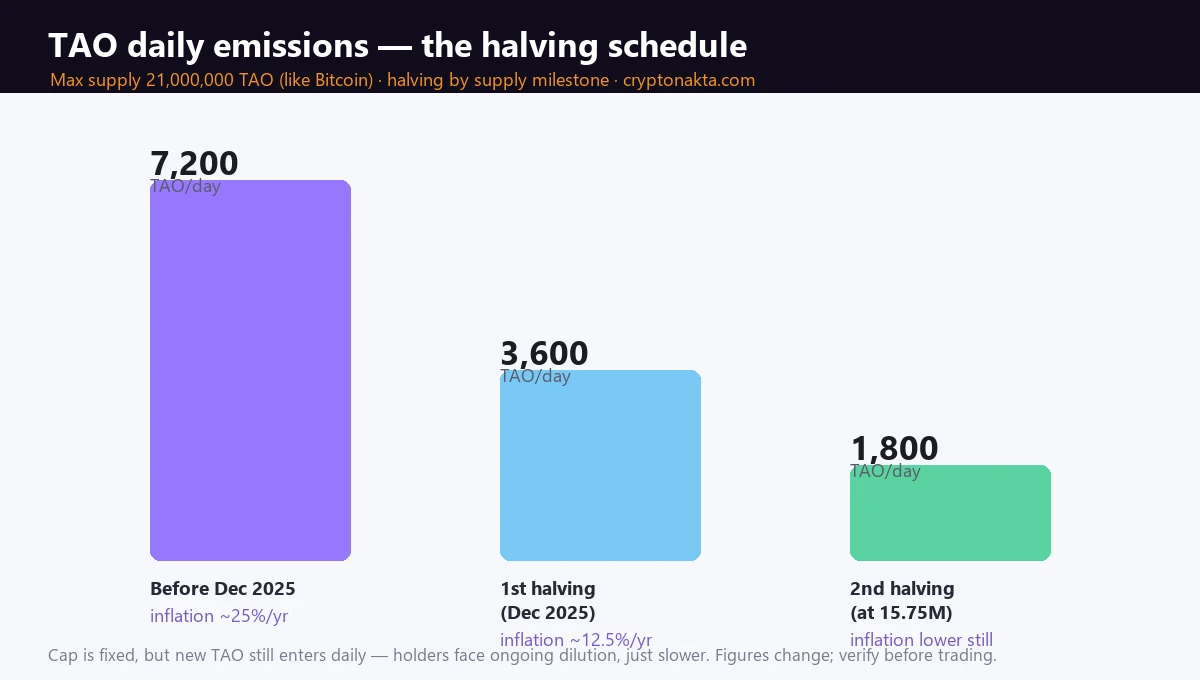
The supply design resembles Bitcoin. TAO is capped at 21 million, and emissions fall via halvings. Unlike Bitcoin, though, the halving triggers when total issuance hits a supply milestone, not by block count.
| Phase | Daily emission · inflation |
|---|---|
| Before Dec 2025 | ~7,200 TAO/day · ~25%/yr |
| 1st halving (Dec 2025) | ~3,600 TAO/day · ~12.5%/yr |
| 2nd halving (at 15.75M) | ~1,800 TAO/day · lower still |
6. Real traction vs skepticism
To stay balanced, real traction and skepticism side by side.
| Real traction (strengths) | Skepticism (weaknesses) |
|---|---|
| Reported about $43M in AI-service revenue in Q1 2026 — real income, not just a whitepaper. | Value-capture doubt: even if subnets grow AI markets, there’s no guarantee TAO absorbs that economic value. |
| 128 subnets; subnet Alpha tokens total ~$1.12B — a real, functioning ecosystem. | Broad market skepticism about whether AI-crypto ships genuinely useful apps. |
| Bitcoin-style cap and halvings give a ‘digital scarcity’ story. | Right after the 1st halving, a ‘sell the news’ drop took it down 20%+ in a week; ~-50% over a year at points. |
| The leading name in the huge decentralized-AI theme (a top-cap altcoin). | Complex structure (dTAO, Alpha) raises the barrier and the risk of misunderstanding. |
7. What moves TAO’s price
TAO’s price moves on a tug-of-war between the ‘AI narrative’ and ‘supply/structure skepticism.’
| Pushes up | Pushes down |
|---|---|
| Strong AI theme; correlation with Nvidia/big-tech AI news | Halving ‘sell the news’; macro risk-off |
| Real subnet usage and revenue, notable new subnets | Value-capture doubt; ‘AI coin bubble’ debate |
| Institutional / ETF interest | Ongoing inflation (dilution); zombie-subnet noise |
| Exchange listings and liquidity | Governance uncertainty (e.g., founder leadership changes) |
8. Strengths vs risks at a glance
| Strengths | Risks |
|---|---|
| Leader of a huge, real theme — decentralized AI — with actual revenue | Value capture is uncertain — a bigger AI market may not translate to TAO’s price |
| Bitcoin-style 21M cap and halvings give a scarcity story | Still diluting at ~12.5%/yr (a cap is not zero inflation) |
| Subnets and dTAO are a novel ‘performance-based reward’ design | Very complex — staking is an Alpha-token swap, adding risk |
| Top-cap, listed on major exchanges for easy access | Exposed to the broad ‘substance vs bubble’ doubt over AI-crypto |
9. How to buy TAO + exchanges (vs staking)
TAO is listed on most major exchanges, so buying is straightforward: open an account, complete ID verification (KYC), and buy TAO on the exchange. Below are exchanges that list TAO; entering a referral code at sign-up applies fee perks.
Binance

Bybit

OKX

Gate.io

MEXC

KuCoin

Bitget

Affiliate disclosure: some links are partner links. We may earn a commission at no extra cost to you. This is not investment advice.
⚠️ Buying TAO on an exchange and ‘staking into a Bittensor subnet (an Alpha-token swap)’ are very different risks — the latter is complex and can lose money. New to this? Picking an exchange is in our exchange-picking hub, the buy flow is in how to buy Bitcoin, and move larger amounts to your own wallet.
10. Who it suits — and who it doesn’t
| Might suit you if… | Probably avoid if… |
|---|---|
| You want a long-term bet on ‘decentralized AI infrastructure’ and will stomach and study the volatility and complexity | You don’t have time to understand the structure (subnets, dTAO, Alpha), or you’d buy on ‘it’s AI, so up’ |
| You’ll track fundamentals like real subnet usage and revenue | You’d mistake staking for a ‘safe deposit’ and put TAO into a subnet |
| You’ll diversify with an amount you can afford to lose | You won’t check the inflation/halving schedule or the value-capture question |
11. Common myths, corrected
| Myth | Fact |
|---|---|
| “TAO is a company that builds AI” | No. Bittensor is a market (protocol) where AI models/compute compete and get paid; TAO is its settlement token. |
| “Staking TAO is a safe deposit” | No. Under dTAO, staking into a subnet swaps your TAO into that subnet’s Alpha token — if its price falls, you lose. |
| “21M cap, so no inflation like Bitcoin” | Same cap, but new TAO still enters at ~12.5%/yr today; halvings only slow it. |
| “It’s an AI coin, so it only goes up” | Even if the AI market grows, there’s no guarantee TAO captures that value. |