What Is Copy Trading? Can You Really Profit Following the Pros — Fees, Risks & Platforms
Copy trading mirrors an expert’s trades into your account — but does it actually pay? How it works, the hidden fees, the real risks, how to pick a lead trader, and the best exchanges, no hype.
| Item | The gist |
|---|---|
| What | A feature that auto-mirrors a public, expert trader’s trades into your account |
| Who for | People without time/knowledge to trade · strategy diversification — only if you accept high risk |
| How | Pick lead → allocate → proportional copy → performance fee (~10%) on profits |
| ⚠️ Biggest trap | Mostly leveraged futures → liquidation risk + past returns ≠ future |
| Hidden costs | Performance + trading fees + funding + slippage (you keep less than the displayed return) |
| How to pick | Not the #1 return → track length · MDD · win rate vs win/loss · leverage · copiers |
| Exchanges | Bybit · Binance · OKX · Bitget · MEXC · Gate (different strengths) |
| One line | No ‘one-tap rich’ fantasy. A high-risk way that trades control & fees. Small, diversified |
1. What is copy trading? — auto-mirroring an expert’s trades
2. How it works — from follow to performance fee
3. Spot copy vs futures copy — worlds apart in risk
4. Fee structure — performance, trading fees, funding, slippage
5. ⚠️ The real risks — past≠future, over-leverage, liquidation
6. How to pick a lead trader — 5 checks (most important)
7. How to start, step by step
8. Which exchange? — Bybit, Binance, OKX, Bitget compared
9. Common mistakes and the fix
10. Is copy trading actually profitable?
11. Who it suits — and who it doesn’t
12. Common myths, corrected
13. Copy-trading safety rules
1. What is copy trading? — auto-mirroring an expert’s trades
In one line, copy trading is a feature that automatically mirrors the trades of an expert (a “lead trader”) into your own account, in real time. You don’t need to read charts or watch the market all day — you delegate a pro’s strategy and timing. That’s why it’s popular with beginners, time-pressed people, and anyone wanting to diversify across strategies.
It sounds great, but copy trading is not a one-tap money machine. This guide lays out how it actually works (mechanics and fees), what the real risks are, how to pick a good lead trader, and which exchanges to use — all without the hype.
2. How it works — from follow to performance fee
The structure is simpler than it sounds — a “master” (lead trader) is linked to “followers” (you).
| Step | What happens |
|---|---|
| ① Pick a lead trader | On the exchange’s copy-trading screen, choose a trader whose performance and stats are public. |
| ② Allocate funds & follow | Set how much to copy with and follow. From then on, their trades are mirrored into your account. |
| ③ Proportional copy | If the lead buys with 5% of their capital, 5% of your allocation goes into the same position (exchanges differ — proportional vs fixed amount). |
| ④ Performance fee | On profits, the lead takes a slice (commonly ~10%) as a performance fee. No fee on losses. |
| ⑤ Stop anytime | Turn following off and copying stops; you can close any open positions. |
So copy trading layers your money on someone else’s skill. Convenient when you choose well — but it also means a lead trader’s mistake becomes your loss (this is “counterparty risk”).
3. Spot copy vs futures copy — worlds apart in risk
There are two kinds of copy trading, and their risk levels are worlds apart. Before you start, check whether what you’re copying is spot or futures.
| Type | What it is | Risk |
|---|---|---|
| Spot copy | Mirrors the lead actually buying/selling coins. No leverage, no liquidation. Moves only with the coin’s price. | Relatively lower (still volatile) |
| Futures copy | Mirrors leveraged derivative positions. Most copy trading on the market is this kind. | 🔴 Very high — liquidation wipes that capital |
4. Fee structure — performance, trading fees, funding, slippage
“Looks free, right?” — but copy trading layers on several costs. Know the hidden ones that eat your returns.
| Cost | Explanation |
|---|---|
| Performance fee | A slice of profits (commonly ~10%) to the lead trader. Only charged on gains, but it adds up across choppy win/loss stretches. |
| Trading fees | Every mirrored trade pays normal trading fees. If the lead trades often, it piles up. |
| Funding (futures) | Holding a futures position drains funding every 8 hours. In a strong trend this can be sizable. |
| Slippage | Small differences in your fill time/price vs the lead’s. Bigger when volatility is high. |
That’s why you get “the lead is +50% but I’m +30%.” Don’t expect the displayed return to be your return.
5. ⚠️ The real risks — past≠future, over-leverage, liquidation
Copy trading’s risk is more than “the coin price drops.” Be clear on these before you follow.
| Risk | What it means |
|---|---|
| Past ≠ future | Flashy past returns guarantee nothing. Traders who got lucky for months often blow up an account in one go. |
| Counterparty risk | The lead trader’s judgment, mistakes, or rash moves become your loss — a variable you can’t control. |
| Over-leverage & liquidation | If the lead uses reckless leverage, a small move against them liquidates your position too. |
| Sudden strategy change | A steady trader who suddenly sizes up or changes style drags you along. |
| Fee & funding drag | Performance + trading fees + funding stack up; you can be at breakeven on price yet down overall. |
| Emotion & overconfidence | Switching traders after a small dip, or sizing up after one win, is a common path to losses. |
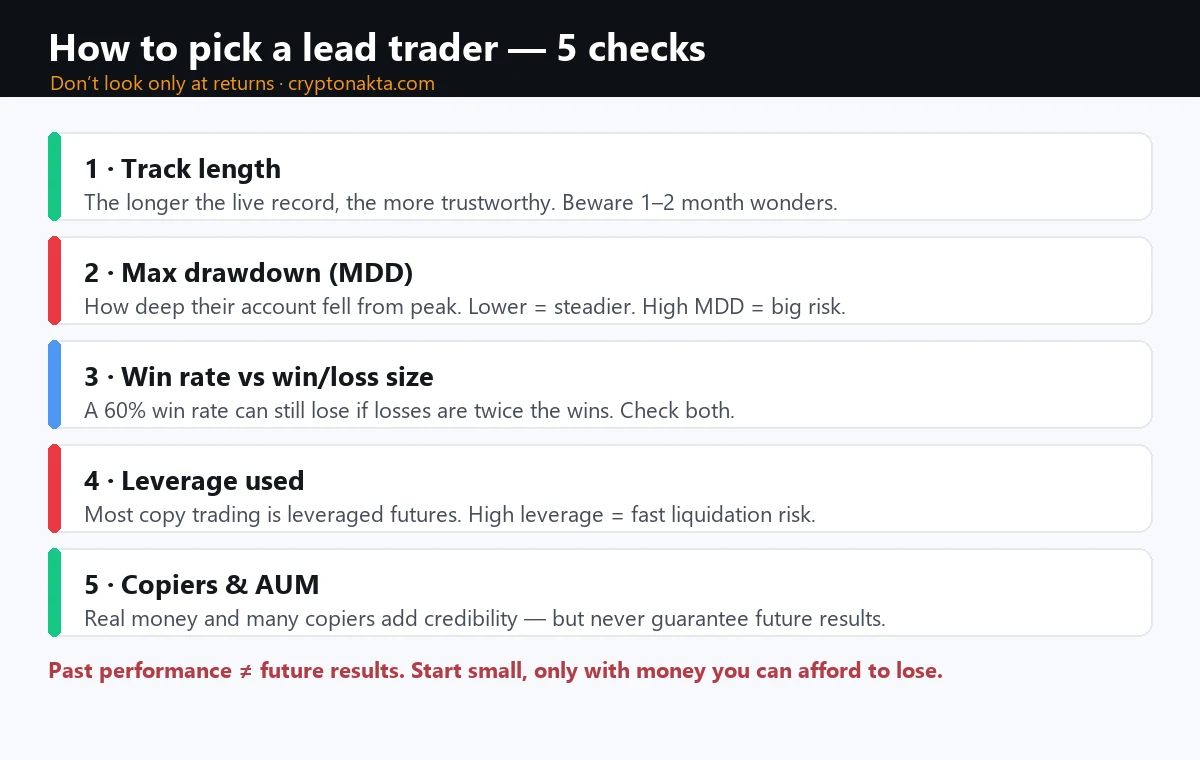
6. How to pick a lead trader — 5 checks (most important)
Copy trading mostly comes down to how you pick the lead trader. Look only at the return number and you’ll lose. Weigh these five together.
| Check | Why it matters |
|---|---|
| ① Track length | The longer the live record, the more trustworthy. “1–2 months, +hundreds of %” is likely luck. |
| ② Max drawdown (MDD) | How deep the account fell from peak. Lower is steadier; a high MDD means a style that takes big risk. |
| ③ Win rate vs win/loss size | A 60% win rate still loses if losses are twice the wins. Check the win rate and the size of wins vs losses. |
| ④ Leverage used | Higher leverage = higher liquidation risk. “Slow and steady” is usually healthier. |
| ⑤ Copiers & AUM | Real money and many followers are a supporting signal of credibility — but still no guarantee of the future. |
7. How to start, step by step
If you’re starting out, this order is safest.
| Step | Do this |
|---|---|
| 1 · Sign up & secure | Open an account (KYC) on an exchange with copy trading + app-based 2FA. (See the exchange section below.) |
| 2 · Deposit small | Only an amount you can fully afford to lose (“tuition”). No big money up front. |
| 3 · Shortlist lead traders | Use the five checks (track length, MDD, win/loss, leverage, copiers) to shortlist 2–3. |
| 4 · Follow, diversified | Don’t go all-in on one. Spread it, and use isolated margin / stop-loss to box the risk where possible. |
| 5 · Watch & review | Give it weeks of patience. Don’t switch after a small dip; close only when the strategy/MDD breaks down. |
💡 Perk: signing up via the links below to a strong copy-trading exchange applies a trading-fee discount (referral). For the full feature picture see every exchange feature explained, and for picking an exchange see our exchange hub.
8. Which exchange? — Bybit, Binance, OKX, Bitget compared
Most major exchanges offer copy trading, but their strengths differ. Before you follow, check whether performance/stats are transparent and whether there are risk-management tools.
| Exchange | Copy-trading strength |
|---|---|
| Bybit | Built around copy trading — fast execution, performance-based trader rankings, and risk tools that lower the barrier to entry. |
| Binance | World’s deepest liquidity and a wide pool of futures traders; deep liquidity means less slippage. |
| OKX | The strongest analytics dashboard — filter lead traders by Sharpe ratio, drawdown (MDD) and more. |
| Bitget | An early, well-known copy-trading venue with a broad trader pool. |
| MEXC · Gate | Offer copy trading too; access to newer traders and varied markets. |
Signing up via the links below applies a referral code that discounts your trading fees (which still apply on every copied trade, so it helps).
Bybit

Binance

OKX

Bitget

MEXC

Gate.io

Affiliate disclosure: some links are partner links. We may earn a commission at no extra cost to you. This is not investment advice.
9. Common mistakes and the fix
| Common mistake | Do this instead |
|---|---|
| Following only the #1 by return | Weigh track length, MDD, leverage and win/loss together |
| All-in on one trader | Diversify across 2–3 with different styles |
| Switching traders after a small dip | Be patient until the strategy/MDD breaks (frequent switching just stacks fees and losses) |
| Not checking leverage / spot vs futures | Always confirm spot or futures, and the leverage, before following |
| Expecting the displayed return = your return | Account for performance fees, trading fees, funding and slippage shrinking it |
10. Is copy trading actually profitable?
The honest answer: you can profit, and you can lose. Some exchanges tout stats like “most futures copy trades were profitable,” but those numbers are period-specific, marketing-flavored, and past performance guarantees nothing. In reality many copiers lose to over-leverage, frequent switching, and stacked fees.
A realistic expectation: copy trading isn’t a get-rich-quick scheme — it’s a high-risk approach where you trade away control and fees in exchange for less study. Choose well, diversify and box the risk, and it can be a tool; “press a button and get rich” is a fantasy.
11. Who it suits — and who it doesn’t
| Might suit you if… | Probably avoid if… |
|---|---|
| You lack the time/knowledge to trade yourself but will accept high risk and try a small amount | You expect “safe,” principal-protected returns (copy trading is not safe) |
| You’ll check lead-trader metrics (MDD, leverage) yourself and diversify | You’d go all-in on the #1 by return |
| You approach it as “tuition” you can afford to lose | You’d use money you can’t lose (rent, loans) |
12. Common myths, corrected
| Myth | Fact |
|---|---|
| “A pro does it, so it’s safe” | Pros are wrong too. Past returns guarantee nothing, and their loss is your loss. |
| “There are no fees” | Performance + trading fees + funding + slippage apply. Your real return is less than the displayed one. |
| “I’ll earn the +hundreds-of-% shown” | Entry timing, copy ratio and fees change the result. The liquidation risk is copied too. |
| “It grows on its own, hands-off” | Left alone, you’re exposed to sudden strategy changes and over-leverage. Review it regularly. |
13. Copy-trading safety rules
- Only a small amount you can afford to lose. No rent or loan money.
- Before following, always confirm spot vs futures and the leverage.
- No all-in on one trader → diversify across 2–3, use isolated margin / stop-loss where possible.
- Pick by MDD, track length and win/loss, not by the #1 return.
- Don’t switch after a small dip (it just stacks fees and losses).
- Anyone demanding money via outside Telegram/DMs to “trade for you” is a 100% scam — see crypto scams.