Bitcoin Explained in Full: How It Works, How to Buy, and How to Store It Safely
Bitcoin explained in plain language — its history, how the blockchain and mining work, ETFs and the Lightning Network, how to buy and store it safely, and the risks and scams to avoid.
Bitcoin is digital money you can send to anyone, anywhere, without a bank. It’s the first and largest cryptocurrency, created in 2009. In a hurry? The table below is the gist — the details are further down.
| Item | The gist |
|---|---|
| What it is | Money no bank or government controls. Supply is capped at 21 million coins, which is why it’s called ‘digital gold’. |
| How little | Each coin splits into 100 million ‘satoshis’, so you can start with about $10 — no need to buy a whole coin. |
| How to buy | On a regulated exchange, with your local currency. Secure the account with app-based 2FA and start small. |
| Where to keep it | Small amounts on the exchange; larger or long-term holdings in a wallet you control (hardware is safest). |
| ETF | Spot Bitcoin ETFs (since 2024) give price exposure through a brokerage — but you don’t hold the actual coins. |
| Tax | In most countries, selling or spending BTC is a taxable event; simply buying and holding usually isn’t. |
| Watch out | Very volatile · transactions can’t be reversed · self-custody mistakes can’t be undone. |
1. What is Bitcoin?
2. The story of Bitcoin: a short history & timeline
3. How Bitcoin works: blockchain, mining & the halving
4. How Bitcoin transactions work: addresses, confirmations & fees
5. Why does Bitcoin have value?
6. Bitcoin vs gold vs traditional money
7. The Lightning Network: making Bitcoin fast & cheap
8. Bitcoin ETFs & institutional adoption
9. How to buy Bitcoin safely (step by step)
10. How to store Bitcoin: exchange vs your own wallet
11. Risks every beginner should know
12. Common beginner mistakes to avoid
13. Bitcoin scams to avoid
14. Bitcoin and taxes (the basics)
15. Key Bitcoin terms (a quick glossary)
16. Next steps
1. What is Bitcoin?
Bitcoin is digital money you can send to anyone, anywhere, without a bank — secured by a worldwide network of computers instead of any government or company. It was created in 2009 by the pseudonymous Satoshi Nakamoto, and it was the first cryptocurrency. Today it is the largest by value and the one almost every newcomer hears about first.
What makes Bitcoin different from the money in your bank app is three things working together:
| Property | What it means for you |
|---|---|
| Decentralized | No single bank or country controls it. Tens of thousands of independent computers (nodes) verify every transaction together, so no one can freeze it, censor it, or print more at will. |
| Scarce (21 million cap) | The code limits Bitcoin to a maximum of 21 million coins — ever. This fixed supply is why it’s often called “digital gold.” |
| Permissionless | Anyone with a phone and internet can hold and send it, 24/7, without asking permission — no bank account, paperwork, or approval needed. |
Each bitcoin can be divided into 100 million tiny units called satoshis (or “sats”), so you never have to buy a whole coin — you can own $10 worth just as easily.
2. The story of Bitcoin: a short history & timeline
Bitcoin didn’t appear overnight. Understanding its short history helps you separate the real story from the hype — and see why so much has been built on it.
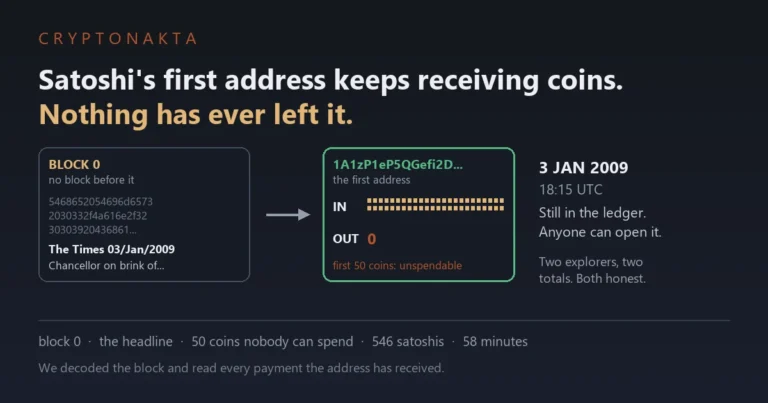
It was born out of the 2008 financial crisis. On 31 October 2008, an unknown person or group using the name Satoshi Nakamoto published a nine-page paper, the Bitcoin Whitepaper, describing “a peer-to-peer electronic cash system” that needed no bank. On 3 January 2009, the first block (the “genesis block”) was mined, with a hidden message referencing a newspaper headline about bank bailouts — a quiet statement of intent.
| Year | Milestone |
|---|---|
| 2008 | Satoshi Nakamoto publishes the Bitcoin whitepaper. |
| 2009 | The network goes live; the first bitcoins are mined. |
| 2010 | The famous “Bitcoin pizza”: 10,000 BTC paid for two pizzas — the first real-world purchase. |
| 2012 / 2016 / 2020 / 2024 | The four “halvings” so far, each cutting the new-coin reward in half (see below). |
| 2017 & 2021 | Major bull runs bring Bitcoin into the mainstream — followed by sharp crashes. |
| 2024 | U.S. regulators approve the first spot Bitcoin ETFs, opening the door to large institutions (see §8). |
The pattern to notice: Bitcoin has gone through several boom-and-bust cycles, each with eye-watering gains and brutal drops. That history is exactly why this guide stresses buying small and holding for the long term.
3. How Bitcoin works: blockchain, mining & the halving
You don’t need to be technical to use Bitcoin, but understanding the basics makes you much harder to scam. Here’s how it works in plain language.
The blockchain is a public shared ledger — a giant record book that every computer in the network keeps a copy of. When you send Bitcoin, the transaction is grouped with others into a “block,” and that block is linked to the previous ones in a chain (about one new block every 10 minutes). Once recorded, it’s practically impossible to change, because you’d have to rewrite the record on most computers in the world at once.
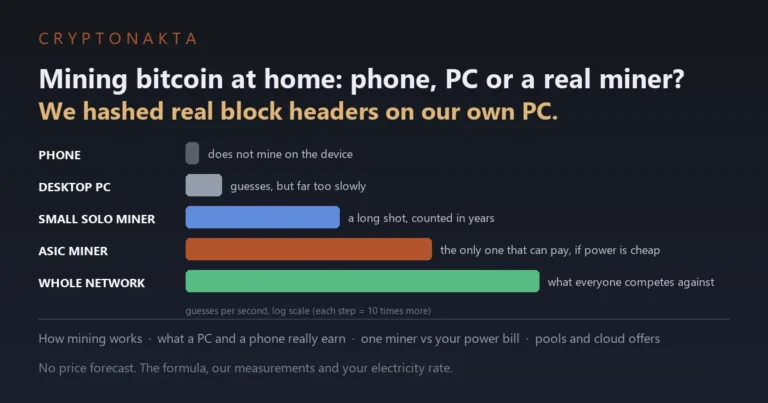
Mining is how new transactions get confirmed and new bitcoins are created. Specialized computers around the world compete to solve a hard math puzzle (“proof of work”); the winner adds the next block and earns newly minted bitcoin plus transaction fees. This competition is what keeps the network honest and secure — rewriting history would cost an attacker more than it could ever be worth.
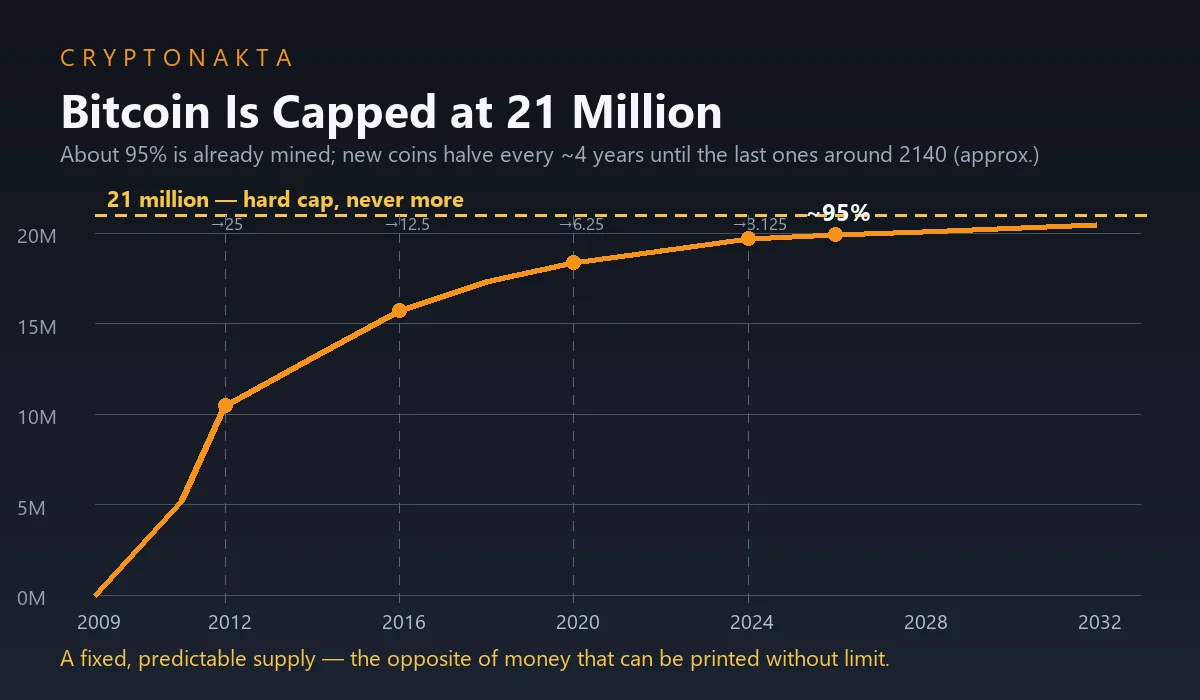
The halving cuts the mining reward in half roughly every four years, slowing the creation of new coins until the 21-million cap is reached (around the year 2140). The reward started at 50 BTC per block, and after the 2024 halving it is 3.125 BTC. This built-in, predictable scarcity is central to Bitcoin’s “digital gold” story.
4. How Bitcoin transactions work: addresses, confirmations & fees
When you “send Bitcoin,” what actually happens? You don’t move a file or an object — you broadcast a signed message that updates the shared ledger. Knowing the basics here removes a lot of beginner fear.
- Addresses. A Bitcoin address is like an account number you can share to receive funds (it usually starts with
bc1,1, or3). Anyone can send to it, but only the matching private key can spend from it. - Signing. Your wallet uses your private key to “sign” a transaction, proving you own the coins — without ever revealing the key itself.
- The mempool. Your transaction first sits in a waiting area called the mempool until a miner includes it in a block.
- Confirmations. Once your transaction is in a block, it has one “confirmation.” Each new block on top adds another. Most services treat 2–6 confirmations (roughly 20–60 minutes) as final.
- Network fees. You pay a small fee (in sats) to incentivize miners to include your transaction. When the network is busy, fees rise; when it’s quiet, they fall. This fee goes to miners, not to us or any exchange.
5. Why does Bitcoin have value?
People value Bitcoin for different reasons — and it’s important to separate the honest case from the hype.
- Fixed scarcity. Unlike government money, no one can print more Bitcoin. The 21-million cap is why many treat it as a hedge against inflation and currency debasement.
- Self-custody. You can hold your own wealth without a bank — useful where banks are unstable, or for sending money across borders quickly.
- Censorship resistance. No central party can easily block your transaction or freeze your funds.
- Network effect. It’s the oldest, most recognized, most liquid crypto, with the longest security track record — and now the asset large institutions buy first.
6. Bitcoin vs gold vs traditional money
Bitcoin is often called “digital gold,” so it helps to see exactly how it compares to gold and to the money in your bank account. Each has trade-offs.
| Bitcoin | Gold | Bank money (fiat) | |
|---|---|---|---|
| Supply | Fixed at 21 million | Scarce, but grows with mining | Can be printed without limit |
| Portability | Send globally in minutes | Heavy, hard to move | Easy domestically, slow across borders |
| Divisibility | To 100-millionth (a sat) | Hard to split | To cents |
| Custody | You can hold it yourself | Vault or home safe | Held by a bank |
| Volatility | Very high | Moderate | Low (but loses value to inflation) |
| Track record | Since 2009 | Thousands of years | Centuries |
The honest takeaway: Bitcoin combines gold’s scarcity with the portability of digital money, but it’s far younger and far more volatile. That’s why many beginners treat it as a small, long-term part of a diversified portfolio — not a replacement for savings or a get-rich-quick bet.
7. The Lightning Network: making Bitcoin fast & cheap
Bitcoin’s base network is built for security, not speed — about seven transactions per second. That’s fine for storing value, but not for buying coffee. The Lightning Network is the main solution.
Lightning is a “layer 2” built on top of Bitcoin. It lets people open payment channels and send bitcoin instantly and for almost no fee, settling back to the main blockchain only when needed. It’s how Bitcoin can work for tiny, everyday payments — for example, it’s widely used in El Salvador (where Bitcoin is legal tender) and by apps that pay creators in sats.
8. Bitcoin ETFs & institutional adoption
For years, big institutions couldn’t easily own Bitcoin. That changed in January 2024, when U.S. regulators approved the first spot Bitcoin ETFs (exchange-traded funds) — including products from giants like BlackRock and Fidelity.
A spot Bitcoin ETF holds real bitcoin and trades on the stock market like any share. This matters for two reasons:
- It opened the floodgates for institutions. Pension funds, advisors, and big investors who can’t hold crypto directly can now get Bitcoin exposure through a regulated, familiar product. Tens of billions of dollars flowed in.
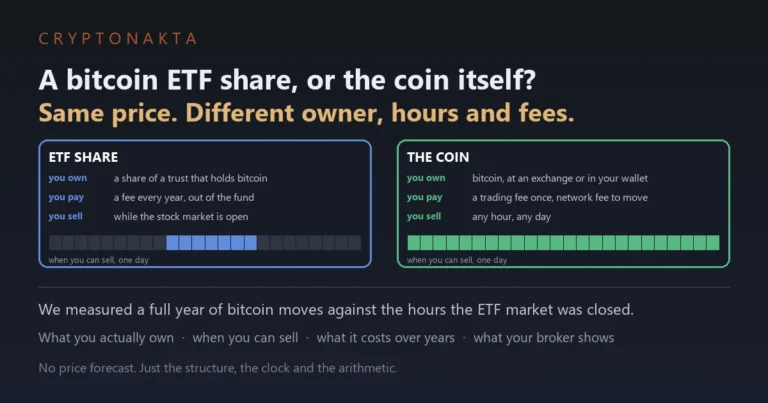
- It gives beginners another option. If you already have a brokerage account and don’t want to manage a wallet, you can get price exposure to Bitcoin through an ETF — though you won’t hold the actual coins or be able to send them.
| Buying Bitcoin (on an exchange) | A Bitcoin ETF (brokerage) | |
|---|---|---|
| You own | Actual bitcoin you can withdraw | A share that tracks the price |
| Can self-custody? | Yes — move it to your own wallet | No |
| Trades | 24/7 | Stock-market hours only |
| Best for | Using, holding, and controlling bitcoin | Simple price exposure in an existing brokerage |
9. How to buy Bitcoin safely (step by step)
You buy Bitcoin on a crypto exchange — a regulated platform where you deposit your local currency and swap it for BTC. The safe path for a beginner is: choose one trustworthy, regulated exchange, secure it with app-based 2FA, then buy a small amount to start.
- Pick a reputable, regulated exchange available in your country (see our full comparison of the best crypto exchanges).
- Verify your identity (KYC) and turn on two-factor authentication with an app — never SMS.
- Deposit your local currency (bank transfer or card) and buy BTC on the normal “trade” screen, not the pricier one-click “instant buy.”
- Consider buying gradually (a fixed amount each week — “dollar-cost averaging”) instead of trying to time the market.
💡 About these links: they go to the exchange’s official site with our referral applied (a sign-up benefit such as a fee discount; confirm on the sign-up page). Using them costs you nothing extra. Signing up in the app? Scan the QR or type the code shown — that’s how the discount attaches.
Binance

Gate.io

KuCoin

Bybit

MEXC

Affiliate disclosure: some links are partner links. We may earn a commission at no extra cost to you. This is not investment advice.
10. How to store Bitcoin: exchange vs your own wallet
Once you own Bitcoin, the next question is where to keep it. You have two main options:
| On the exchange (custodial) | Your own wallet (self-custody) | |
|---|---|---|
| Who holds the keys | The exchange | You |
| Ease | Easiest — nothing extra to set up | You manage a recovery phrase carefully |
| Best for | Small amounts you trade often | Larger or long-term holdings |
| Main risk | Exchange hack or failure | You losing your recovery phrase |
A wallet can be “hot” (connected to the internet — a phone app like a software wallet, convenient for small amounts) or “cold” (offline — a hardware wallet, safest for larger sums). For meaningful amounts, move your Bitcoin to a wallet you control, ideally a hardware (cold) wallet, where the private key never touches the internet.
When you set up a wallet, it gives you a recovery phrase (usually 12 or 24 words). Whoever has those words controls the coins. Write them on paper, store them offline in more than one place, and never type them into a website, photograph them, or share them with anyone — no legitimate service will ever ask for them.
New to wallets? Our complete crypto wallet guide explains private keys, seed phrases, hot vs cold storage, and how to set one up safely.
11. Risks every beginner should know
Bitcoin can be part of a portfolio, but it is a high-risk asset. Go in with clear eyes:
- Volatility. Large price swings are normal for Bitcoin. Leverage (borrowed-money trading) can be liquidated by a small move against you, which is where many beginners lose money.
- No safety net. Transactions are irreversible and self-custody mistakes can’t be undone. Double-check addresses; send a tiny test amount first.
- Regulation changes. Rules and taxes vary by country and evolve — stay informed about your local situation.
- Emotional decisions. Most beginners lose money by panic-selling lows and FOMO-buying highs. A small, steady, long-term approach beats frantic trading.
12. Common beginner mistakes to avoid
Most people who lose money in Bitcoin do so through avoidable mistakes, not bad luck. Steer clear of these and you’re ahead of most beginners:
- Investing money you’ll need soon. Bitcoin can drop 50%+ and stay down for a year or more. Rent and emergency funds don’t belong here.
- Using leverage or “futures” early. Borrowed-money trading can be liquidated by a small adverse move — it’s where many beginners lose the most.
- Chasing pumps and “the next Bitcoin.” Buying after a coin has already soared, on hype, is how most people get burned.
- Keeping everything on an exchange forever. Exchanges can be hacked or fail. Self-custody meaningful amounts.
- Screenshotting or cloud-storing your recovery phrase. That defeats the whole point. Keep it offline, on paper.
- Panic-selling and FOMO-buying. Reacting emotionally to price swings is the single most expensive habit in crypto.
None of these require technical skill to avoid — just patience and discipline.
13. Bitcoin scams to avoid
Scammers love Bitcoin because transactions are irreversible. Treat these as instant red flags:
- “Send 1 BTC, get 2 back.” Every “giveaway,” “doubling,” or guaranteed-return scheme is a scam — including fake celebrity (Elon Musk) livestreams.
- Fake exchanges and apps. Check the web address letter by letter, avoid sponsored search ads, and download apps only from official links.
- “Investment managers” and romance contacts. Anyone in your DMs steering you to a platform and promising profits is running a scam (“pig butchering”).
- Anyone asking for your recovery phrase or password. No real service ever needs it. Sharing it = handing over your coins.
- Urgency and pressure. “Act now or miss out” is a manipulation tactic. Real opportunities don’t vanish in five minutes.
When unsure, slow down. Stick to large, established, regulated exchanges and self-custody — and never send Bitcoin to someone you don’t know based on a promise.
14. Bitcoin and taxes (the basics)
In most countries, Bitcoin is treated as property, not currency — so selling, swapping, or spending it can be a taxable event (a capital gain or loss), while simply buying and holding usually is not. Rules vary widely by country, so this is general information, not tax advice.
- Keep records of every buy, sell, and transfer (date, amount, price) — exchanges can export this, and tax tools (e.g., Koinly) can help.
- Selling or swapping BTC (even crypto-to-crypto) is typically when tax applies, based on your gain.
- Spending bitcoin on goods counts as disposing of it, and can be taxable too.
- Check your local rules — thresholds, rates, and reporting differ by country and change over time.
Consult your local tax authority or a professional for your specific situation.
15. Key Bitcoin terms (a quick glossary)
A few terms come up again and again. Keep this mini-glossary handy:
| Term | Plain meaning |
|---|---|
| Satoshi (sat) | The smallest unit of Bitcoin — 0.00000001 BTC. Named after its creator. |
| Blockchain | The public ledger of all transactions, copied across thousands of computers. |
| Private key | The secret that controls your coins. Whoever has it owns the bitcoin. |
| Recovery (seed) phrase | 12–24 words that back up your wallet. Guard them like the keys to a vault. |
| Cold / hot wallet | Cold = offline (hardware), safest. Hot = online (app), convenient. |
| Halving | The ~4-year event that cuts the new-coin reward in half. |
| HODL | Crypto slang for holding long-term instead of trading on every swing. |
| FOMO | “Fear of missing out” — the emotion that makes people buy tops. Avoid it. |
| DCA | Dollar-cost averaging — buying a fixed amount on a schedule. |
16. Next steps
Now you know what Bitcoin is, where it came from, and how to buy and store it safely. The best next move is small and practical: choose a regulated exchange (see our best crypto exchanges comparison), secure it with app-based 2FA, and make a small first purchase. As your holdings grow, learn to move them to a wallet you control. Curious about the #2 cryptocurrency and the world of smart contracts? Read our complete guide to Ethereum. And our complete beginner’s guide to crypto walks through your first buy, wallets and recovery phrases, scams, and fees — step by step. In Bitcoin, the patient, security-first approach usually wins.