Spot vs Futures in Crypto: Same Coin, Two Completely Different Trades
What you actually own on one tab, what can be closed out from under you on the other, and how to tell which one fits you.
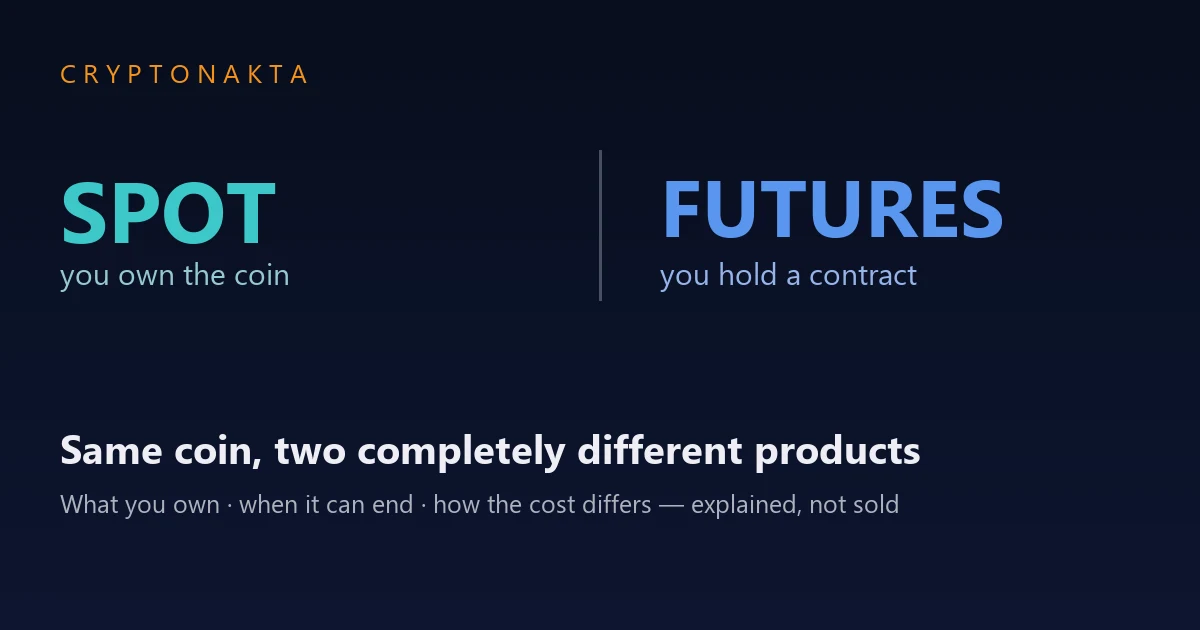
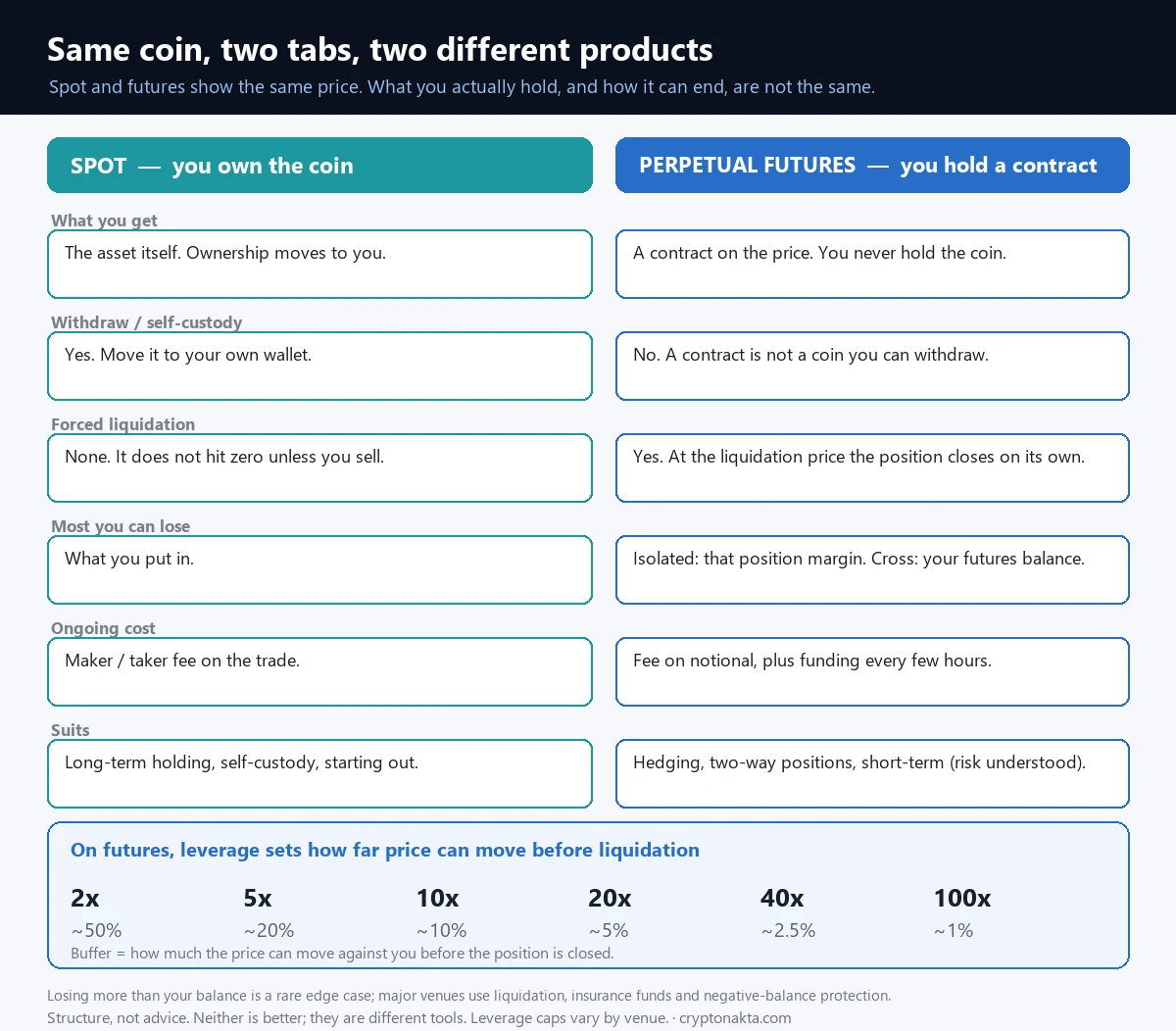
Same coin, same price chart, two tabs that behave nothing alike. The whole comparison sits in the table below, and each row gets its own section further down.
| Question | Spot tab | Futures tab (perpetual) |
|---|---|---|
| What you actually buy | The coin itself (ownership transfers to you) | A contract on the price (you own nothing) |
| Can you withdraw it to a wallet? | Yes, you can self-custody it | No, there is no coin to send |
| Expiry | None | None (that is what “perpetual” means) |
| Leverage | None by default | Yes, up to high multiples (varies by venue) |
| Forced liquidation | None (nothing closes it but you) | Yes, at your liquidation price |
| Worst case | You lose what you put in | Isolated: the margin on that trade; cross: your futures balance |
| Ongoing cost | Trading fee only | Fee on notional plus funding |
| Fits | Long-term holding, self-custody, beginners | Hedging and short-term trading for risk-aware users |
Bottom line: neither tab is the “better” trade. They are two different tools, and tapping one when you meant the other is the mix-up this guide is built to clear up.
1. Same ticker, two tabs: why Spot and Futures are not the same trade
2. The Spot tab: you own the coin, and nobody can close it at a price for you
3. The Futures tab: you’re holding a contract, not the coin itself
4. Why crypto futures are almost always ‘perpetuals’ with no expiry
5. Leverage and the liquidation price: getting closed out without your say-so
6. The funding rate: the cost that keeps ticking even when you touch nothing
7. Isolated vs cross margin: how much of the account one trade can reach
8. Why the ‘lower’ futures fee can quietly cost more than spot
9. Which tab actually fits what you’re trying to do
10. Where a US or global reader can actually trade each one
11. How four ordinary settings compound on a futures position
12. Plain-English glossary of the terms both tabs throw at you
Open almost any crypto exchange app, search for Bitcoin, and you will see two little tabs sitting right next to each other: Spot and Futures. The price chart above them looks identical. The ticker is the same. So most people tap into whichever one loaded first and assume they are doing the same thing with the same coin. They are not. On one tab you are buying the coin and it becomes yours. On the other you are taking out a contract on its price, and that contract can be closed out from under you at a number you may never have looked at. This guide walks through what you own on each tab, when a position can vanish without your permission, and how the costs quietly differ, so that whichever tab you tap, you tapped it on purpose. By the end you should be able to look at both tabs and say what each one puts in your account, what can close a position, and what it costs to keep one open.
1. Same ticker, two tabs: why Spot and Futures are not the same trade
Here is the moment this whole topic lives in. You install an app, verify your ID, and go to buy your first Bitcoin. The Spot tab is one tap away, and buying there feels like buying anything online. But when you tap Futures, something different happens. Many venues make you pass a short quiz, or flip a switch that says something like “I understand the risks,” or acknowledge a warning screen before the tab even opens. That friction is deliberate. The exchange is telling you, in the clumsy language of a pop-up, that you are about to leave one product and enter another.
The confusion is understandable, because the surface looks the same. Both tabs show “BTC.” Both show a green-and-red candle chart. Both let you type in a dollar amount and press a big button. What the interface does not shout is that the two buttons create completely different things: on Spot you end up holding an asset, and on Futures you end up holding an agreement about that asset’s price.
Three questions separate them, and the rest of this guide is built around those three:
- What do you actually own? A coin you can move, or a contract you can only close?
- When can it disappear? Only when you choose to sell, or automatically at a price the system picks?
- What does it cost to hold? A one-time trading fee, or a fee plus a charge that keeps ticking while you sleep?
Get those three straight and you will never again tap the wrong tab by accident. Blur them, and you can do everything “right” on the chart and still have a position close at a liquidation price you never looked at.
2. The Spot tab: you own the coin, and nobody can close it at a price for you
When you buy on the Spot tab, you are buying the coin. Ownership moves to you. In practical terms that means three things follow, and all three matter more than they sound.
You can take it off the exchange
Because the coin is genuinely yours, you can withdraw it to a wallet you control and hold the keys yourself. That is the whole idea behind self-custody with a crypto wallet: the asset does not have to live on the platform where you bought it. A futures position has no equivalent of this, and that single fact is the cleanest way to tell the two apart. If you can send it to a wallet, it was spot.
Nobody can close it for you
This is the part beginners underrate. A spot holding has no liquidation. There is no price at which the exchange steps in and sells your coin against your will. If the market drops 40%, your coin is worth 40% less, but you still hold the same number of coins, and it recovers if and when the market does. The only person who can turn your spot position into cash is you, by pressing sell. Your worst case is bounded: you can lose what you put in if the asset goes to zero, but you cannot be forced out at the bottom of a wick, and you can never owe more than you spent.
No expiry, no built-in leverage
A spot coin does not expire. You can hold it for a week or a decade with nothing ticking against you. By default there is no leverage either, so a dollar buys a dollar’s worth. That makes the math boring in the best way: the amount you see is the amount at risk. This is exactly why spot is the natural home for long-term holders and for anyone still learning. It pairs cleanly with slow, low-drama approaches like dollar-cost averaging, and with yield options such as staking or an exchange Earn product, where the coin you own does something while you hold it. None of those require a contract, a margin balance, or a liquidation price.
Keep this baseline in mind, because the Futures tab removes every one of these comforts and adds machinery in their place.
3. The Futures tab: you’re holding a contract, not the coin itself
Tap over to Futures and the ground shifts under the same ticker. You are no longer buying the coin. You are opening a contract whose value tracks the coin’s price. If you go “long,” you profit when the price rises and lose when it falls. If you go “short,” it is the mirror image. Either way, there is no coin sitting in your account, because you never bought one.
This trips up almost everyone at least once. Picture someone who “buys” what looks like a Bitcoin position on the Futures tab, watches it go up, and then tries to withdraw their Bitcoin to a wallet. There is nothing to send. The account holds margin (usually a stablecoin balance) and an open position, not coins. When they close the position, they get back their margin adjusted for profit or loss, in the same stablecoin. At no point did they own Bitcoin they could move. That is simply how a derivative works: what you buy and sell is the price, while the coin itself stays somewhere else entirely.
Because you are holding a contract rather than an asset, a whole set of features bolts on that spot simply does not have:
- Margin: the money you post as collateral to open and keep the position.
- Leverage: the ability to control a position larger than that collateral.
- Liquidation: a price at which the exchange force-closes the position to protect the collateral.
- Funding: a recurring payment that flows between the two sides of the contract.
Every one of those exists because a contract needs rules about collateral and settlement that an outright purchase never does. None of them are flaws, and traders use them deliberately for hedging and short-term positioning. They do change what “holding” means, though, so treating the Futures tab like a faster version of the Spot tab is the misunderstanding that this whole topic turns on.
4. Why crypto futures are almost always ‘perpetuals’ with no expiry
In traditional markets, a futures contract has an expiry date. You agree today to settle at a set price on, say, the last Friday of next quarter, and when that date arrives the contract closes and cashes out. Crypto borrowed the idea and then removed the date. The overwhelming majority of crypto futures are perpetual contracts, usually shortened to “perps,” and a perpetual has no expiry at all. You can hold it open indefinitely.
That raises an obvious problem. If a contract never settles against a real delivery date, what stops its price from drifting away from the actual coin? A perp on Bitcoin is supposed to track Bitcoin, but if buyers get excited the contract could float well above the real market, with nothing forcing it back. The mechanism that solves this is the funding rate. In short, funding is a small payment exchanged between longs and shorts on a schedule, tuned so that whenever the perp drifts above or below spot, one side has to pay the other, which nudges the price back in line. The catch for you is that this correction is not free: hold through several funding windows on a crowded day and it can quietly subtract a real slice of your balance even if the price itself never moves.
Perps dominate crypto futures for a practical reason: traders wanted leverage and the option to hold either a long or a short without rolling a contract over every quarter. A perpetual gives them exactly that. What the name does not spell out is that dropping the expiry date does not remove timing from the position; it swaps one kind of timing for two. “Perpetual” reads as though there is no clock at all. There is a clock. It is just built differently. In place of a settlement date on the calendar, the position carries a liquidation price that closes it if a volatile candle reaches that level, and a funding charge that moves your balance up or down every few hours whether or not you are watching the screen. Where a quarterly contract gave you one known settlement day to plan around, a perpetual spreads that timing across every hour the position stays open. The next two sections take those two pieces apart one at a time, starting with the liquidation price and the leverage setting that decides where it sits.
5. Leverage and the liquidation price: getting closed out without your say-so
Leverage is the feature that most changes how the Futures tab behaves next to spot, so it is worth walking through with actual numbers rather than adjectives. It lets you control a position larger than the collateral you post. Put up 100 dollars of margin at 10x and you control a 1,000-dollar position. A 5%% move on 1,000 dollars is 50 dollars, which on your 100 dollars of margin is a 50%% swing. The point to hold onto is that the swing runs both ways by the same factor: 10x multiplies a gain and a loss equally, and a fast loss can burn through the full margin backing the position. What backs the position is what caps the loss: in isolated mode it is the margin you put on that trade, and in cross mode it is your futures account balance. Losing more than that, actually owing the exchange, is theoretical and exceptional, because forced liquidation closes the position before your balance reaches zero, an insurance fund absorbs any overshoot, and major venues apply negative balance protection, so a normal market does not push a retail trader past what they put in.
Why a position gets closed without your say-so
Your margin is a cushion against losses. As the price moves against you, that cushion shrinks. Every position has a maintenance margin, a minimum amount of collateral the exchange requires you to keep, typically somewhere around 0.5%% to 1%% of the position’s notional value (it varies by venue and contract). The moment your losses eat the cushion down to that floor, the exchange force-closes the position to stop the loss from going further. The price where that happens is your liquidation price. You do not press anything. The system does it for you, and it does it fast.
One important detail keeps liquidations fairer than they would otherwise be: they are judged on the mark price, a smoothed reference based on the wider market, not on the last trade on that one exchange. Without it, a single manipulated tick on a thin order book could liquidate thousands of people unjustly. The mark price is the guardrail against that. It does not save you from a real move, only from a fake one.
The higher the leverage, the closer the liquidation price sits to your entry
The mechanism here is worth stating plainly: the more leverage you use, the smaller the price move it takes to reach your liquidation price. It is simple arithmetic. Your margin is a percentage of the position, and once the loss equals that percentage, the cushion is gone. The numbers do not go out of date, which is why they are a useful reference:
| Leverage | Approx. move to liquidation | What that means mechanically |
|---|---|---|
| 2x | ~50%% | Survives most ordinary corrections before the level is reached |
| 5x | ~20%% | Holds through a normal correction of the underlying |
| 20x | ~5%% | An everyday daily swing can reach the level |
| 40x | ~2.5%% | A single volatile candle can reach the level |
| 100x | ~1%% | A move of roughly 1%% against the position reaches the level and closes it |
This is what the leverage slider is actually setting. The multiplier you choose sets how large the position is relative to your margin, and by the same arithmetic it sets how close the liquidation price sits to your entry. At 100x, a move of roughly 1%% against the position, the kind of move Bitcoin can make in a few minutes, reaches the liquidation price and closes the position. The buffer column reads exactly how much room the position has at each setting.
How “hundreds of millions liquidated in an hour” happens to people who never sold
You have probably seen the headline: some huge sum “got liquidated” in a single hour after a sharp move. It sounds impossible if you think of it in spot terms, because in spot nobody sells unless they choose to. In futures it is mechanical. A price drop pushes a wave of leveraged longs to their liquidation prices. The exchange force-closes them, which means selling into the market, which pushes the price down further, which trips the next cluster of liquidation prices, and so on. None of those people pressed sell. Their positions sold themselves, in order, because each one had a preset liquidation price and the falling move reached one cluster after another. That cascade is a native property of leverage, and it shows concretely why the Futures tab behaves differently from the Spot tab, where a 20%% drop simply means your coins are worth 20%% less until the price recovers.
Experienced and active traders use leverage deliberately, with position sizing and risk controls chosen to match it, and that is a normal, legitimate use of the tool. The honest framing is plain arithmetic: a higher multiplier does not change how often you read the market correctly, and it reduces the room the position has to move against you before the liquidation price is reached. The number tells you the size of that room, and the choice of multiplier is yours.
6. The funding rate: the cost that keeps ticking even when you touch nothing
The funding rate is the cost that surprises people the most, because it comes out of your balance while you are doing absolutely nothing. You can open a position, set no orders, touch no buttons, and still watch the number drift up or down every few hours. That is funding at work, and understanding it removes a lot of the mystery from “I was right about the direction and still lost money.”
It is a payment between traders, not a fee to the house
First, a correction of the most common misconception. Funding is not a fee the exchange charges and keeps, like a trading commission. It is a payment that flows between the two sides of the contract, longs and shorts, directly. The exchange just administers the transfer. On most venues it settles on a schedule, commonly every eight hours, though the interval and the size vary by platform and contract.
Why it exists, and which way it flows
Recall that a perpetual has no expiry to force its price back toward spot. Funding is the tool that does that job. When the perp trades above the spot price, it usually means longs are crowding in and are willing to pay to keep betting up, so funding turns positive and longs pay shorts. That cost gently discourages piling into longs and pulls the perp price back down toward spot. When the perp trades below spot, it flips: funding turns negative and shorts pay longs. The rate is the pressure valve that keeps a date-less contract honest about the real market.
Why funding can cost more than a slow move in your favor
You can call the direction correctly and still close in the red, and funding is usually the reason. Suppose you go long, the price grinds slowly in your favor, and you feel good about the call. But the market is heavily long, so funding is positive, and every eight hours a slice of your balance goes to the shorts. If your position moves up slowly enough, the funding you pay can outrun the profit you make, and you can close a “correct” trade at a loss. This weighs more heavily on leveraged positions, because funding is charged on the full position size rather than on the smaller amount of margin you actually posted. It is one of the reasons the Futures tab can cost far more to sit in than the Spot tab, where holding a coin overnight costs you nothing at all. Get in the habit of checking the current funding rate before you hold a position for more than a few hours, because a rate that looks tiny per window adds up quickly across a day or a week.
7. Isolated vs cross margin: how much of the account one trade can reach
Once you are dealing with margin, the exchange asks you a question that sounds technical and is actually about how much of your money one bad trade is allowed to touch. You choose between isolated margin and cross margin, and the difference decides whether a single mistake stays contained or spreads to your entire account.
Isolated: the risk is fenced in
With isolated margin, only the collateral you assign to that specific position is on the line. If you put 100 dollars of margin on a trade in isolated mode and it gets liquidated, you lose that 100 dollars and nothing else. The rest of your account balance is untouched, sitting outside the fence. The trade-off is that because the position has less collateral backing it, it can be liquidated sooner. For most people who are still learning, that is a feature, not a drawback, because it makes the worst case obvious and small before you open the trade.
Cross: the whole account is collateral
With cross margin, your entire account balance acts as backing for the position. This can keep a trade alive longer through a dip, because there is more collateral to draw on before liquidation. That reach cuts both ways. If the market keeps moving against you, the position can draw on your whole balance to stay open, so a single losing trade can reduce the entire account rather than only the amount you assigned to that trade. The same setting that carries a position through a dip one week can spend the whole account the next, because in both cases the trade is allowed to use everything you have before it closes.
| Mode | What backs the position | Worst case | Beginner fit |
|---|---|---|---|
| Isolated | Only the margin you assign to it | You lose that position’s margin, nothing more | 🟢 Risk is clear and capped |
| Cross | Your entire account balance | One position can reach the whole account | 🔴 The whole balance backs each trade |
When you open a futures position, isolated is the mode that caps the loss at the margin you assigned to that trade, a figure you set before you enter. Cross margin is built for someone actively managing several positions at once, and it leaves less separate collateral standing between any one position and the rest of the balance.
8. Why the ‘lower’ futures fee can quietly cost more than spot
Look at the fee schedules and the Futures tab appears cheaper. A spot trade might cost around a tenth of a percent, while a futures trade often shows an even smaller number. Beginners see the lower figure and assume futures is the economical choice. The number is real, but what it is charged on is the catch.
Spot fees are charged on what you actually spend
On the Spot tab, the maker or taker fee applies to the value of your trade. Buy 500 dollars of Bitcoin at a 0.1% taker fee and you pay 50 cents. Simple, one time, on the amount you actually put in. If you want to squeeze this down, that is what our guides on exchange fees and the cheapest way to buy Bitcoin are about, and the savings there are straightforward.
Futures fees are charged on the leveraged notional, then funding stacks on top
On the Futures tab, that smaller-looking fee is charged on the notional value of the position, meaning the full leveraged size, not the margin you posted. Post 100 dollars at 10x and your notional is 1,000 dollars, so even a 0.05% fee is charged on 1,000, not on your 100. Open and close and you have paid it twice. Then remember funding from the last section, which also charges on the full position size every few hours you hold. Add it up and a “cheaper” futures trade held for a day or two can cost several times what the same exposure would have cost on spot. The lower rate is genuine; it is just multiplied by a much bigger base and joined by a cost that spot does not have at all.
A side-by-side that makes the gap visible
Put real numbers on it. Say you want 1,000 dollars of Bitcoin exposure for two days. On spot, you buy 1,000 dollars of coin at a 0.1% taker fee, which is one dollar, and you sell later for another dollar or so. Total cost to hold: roughly two dollars, and nothing accrues in between. On futures, you get the same 1,000 dollars of exposure by posting, say, 100 dollars of margin at 10x. A 0.05% fee on the 1,000-dollar notional is 50 cents to open and 50 cents to close, which already looks cheaper. But hold it for two days with funding settling every eight hours, and even a modest positive funding rate charged on the full 1,000 can add up to several dollars over six funding windows. The “cheaper” trade quietly became the more expensive one, and that is before a single thing went wrong with the direction.
None of this makes futures fees unreasonable. The point is narrower: the headline fee rate is the wrong number to line the two tabs up by. Spot cost scales with what you spend. Futures cost scales with the position you control and the time you hold it.
9. Which tab actually fits what you’re trying to do
By now the split should feel less like “which is better” and more like “which is the right tool for what I am trying to do.” They are built for different jobs, and each one is a poor substitute for the other.
Spot fits ownership and patience
If your goal is to own an asset, hold it through time, possibly move it into your own wallet, and sleep without a liquidation price hanging over you, spot is the tool. Your maximum loss is capped at what you put in, there is nothing to roll over, and you can pair it with slow methods like dollar-cost averaging or put idle coins to work through staking and Earn products. This is the path that suits nearly everyone who is starting out, and it is a complete strategy on its own. Plenty of long-term participants never open the Futures tab at all, and they are not missing a required step.
Futures fits hedging and short-term, two-way positioning
Futures earns its place when you need something spot cannot do: profit from a falling price by going short, hedge a spot holding you do not want to sell, or take a defined short-term position with deliberate risk controls. These are legitimate uses, and someone hedging an exposure is managing risk with a purpose. The tab is built for someone who is already comfortable with margin, liquidation, and funding, and who sizes positions with those mechanics in mind. Those are the components the earlier sections laid out, and they are what the tab assumes you already read the way you read a price chart.
Speed is the wrong reason to pick either one. Holding a coin is a way to own an asset over time; a futures contract is a short-term, two-way instrument with its own machinery. They answer to different goals, and speed is beside the point. If you are curious about mirroring experienced traders instead of managing positions yourself, read our separate piece on copy trading with clear eyes, because it carries the same leverage risks under the hood. And if you are still choosing where to do any of this, our overview of the best crypto exchanges and how to check that an exchange is legit comes first, before either tab.
10. Where a US or global reader can actually trade each one
Where you can actually use each tab depends heavily on where you live and what kind of account you hold, and this is one place the two products genuinely diverge in access, not just in mechanics.
Spot is usually the easy door
Regulated, mainstream exchanges tend to hand you spot trading right away once you have verified your identity. In the United States, platforms like Coinbase and Kraken let you buy and hold coins with very little friction, and in most countries there is a licensed local venue that does the same in your currency. Spot is the product regulators are most comfortable with, so it is typically the first thing available and the last thing restricted.
Derivatives are the restricted door
Futures is a different story. Because it is a leveraged derivative, access is gated by jurisdiction, and a US person in particular often runs straight into a “not available in your region” wall on the derivatives section of a global exchange, even while the spot side works fine. The same app can hand you the Spot tab instantly and block the Futures tab entirely. That is regulation showing through the interface. Where derivatives are available to you at all, the venue and the maximum leverage depend on your account status and local rules, which change, so treat any specific number you see as provisional and check the platform itself.
Several large exchanges offer both spot and perpetual futures under one roof, subject to those regional limits. If you are opening an account for either purpose, these are common starting points. The angle here is not “go trade futures.” It is simply “here is where you would start, and here is the sign-up code,” and it applies whether you only ever touch the Spot tab or eventually use both.
Binance

Bybit

OKX

Gate.io

MEXC

KuCoin

Availability, product access, and leverage limits differ by country and account. Confirm what is offered to you on the exchange itself before funding anything. Affiliate disclosure: some links are partner links. We may earn a commission at no extra cost to you. This is not investment advice.
11. How four ordinary settings compound on a futures position
Futures accounts that empty out tend to do so in a recognizable order, and the same settings show up again and again in the same sequence. Describing it is not a comment on anyone using the tab. It is a description of how four ordinary settings compound, so you can read your own order screen against it.
- High leverage sets the liquidation price near entry. A large multiplier places the liquidation price close to the entry, as the table earlier showed. At 40x that is roughly 2.5%% of room, and at 100x roughly 1%%, so an ordinary swing is already within reach of the level before anything unusual happens.
- Cross margin points the loss at the whole balance. With cross selected instead of isolated, the whole account backs the position rather than a walled-off amount, sometimes because it is the default. A single position can then draw on every dollar in the account to stay open.
- No stop-loss leaves only the liquidation price as the exit. A stop-loss is an order that closes the trade at a level you pick. Without one, the only remaining exit is the liquidation price, which is the level the exchange uses rather than one you chose.
- Funding thins the cushion while the position waits. While the trade sits open, funding is charged on the full position size every settlement, reducing the collateral cushion even when the price is flat, so the liquidation price moves closer over time.
- A volatile candle reaches the liquidation price. A normal sharp move, the kind crypto produces routinely, touches the level. The position force-closes, and with cross margin on it can reach the rest of the balance. This is frequently part of the cascade described earlier, where many positions liquidate together and add to the very move that reaches them.
Any one of these on its own is manageable and part of normal futures use. The buffer runs thin when they stack: a high multiplier sets the exit near entry, cross margin points the loss at the whole balance, no stop-loss removes the earlier exit, and funding erodes the cushion while it all sits. You do not need to memorize a rule from this. You need to be able to look at a position and count how many of the four are switched on, since the buffer is widest at the opposite settings. It is also why, for someone learning, spot sits outside the whole sequence: there is no leverage to set, no margin mode to pick, no funding, and no liquidation price at all.
12. Plain-English glossary of the terms both tabs throw at you
The two tabs throw a lot of jargon at you, often without definitions. Here are the terms that actually matter, in plain language, so none of the sections above rely on a word you had to guess at.
- Spot: buying the coin itself, with ownership transferred to you. You can withdraw it, hold it indefinitely, and there is no liquidation.
- Perpetual (perp): a futures contract with no expiry date, kept in line with the spot price by funding. The dominant form of crypto futures.
- Leverage: controlling a position larger than your collateral by a multiple, for example 10x. It scales gains and losses equally, and a losing trade can burn through the full margin backing it (isolated: that position’s margin; cross: your futures balance).
- Margin: the collateral you post to open and maintain a futures position. On the Futures tab your balance is margin, not coins.
- Maintenance margin: the minimum collateral you must keep for the position to stay open, roughly 0.5%% to 1%% of notional depending on the venue. Fall below it and you are liquidated.
- Liquidation: the exchange force-closing your position when your collateral drops to the maintenance level. You do not choose it and it happens automatically.
- Liquidation price: the exact price at which liquidation triggers. Higher leverage puts it closer to your entry.
- Mark price: a smoothed, market-wide reference price used to judge liquidation, so a single manipulated tick on one exchange cannot unfairly close you.
- Funding rate: a recurring payment (commonly every eight hours) exchanged between longs and shorts to tether the perp to spot. It is charged whether or not you trade.
- Isolated margin: a mode where only the collateral assigned to a position is at risk. The rest of your account is fenced off.
- Cross margin: a mode where your whole account balance backs the position, so one trade can draw on all of it.
- Notional: the full leveraged size of a position, which is what fees and funding are charged on, not the smaller margin you posted.
- Long / short: a long profits when the price rises; a short profits when it falls. Spot is effectively always long; futures lets you take either side.
- Hedge: opening a position to offset the risk of another holding, for example shorting a perp to protect a spot bag you do not want to sell. A core legitimate use of futures.