What Is Ondo (ONDO)? Tokenized US Treasuries, the RWA Leader & Why the Token Isn’t the Yield (2026)
An honest, sourced guide to Ondo Finance and the ONDO token — the leader in real-world asset (RWA) tokenization. What USDY and OUSG actually are, how tokenized US Treasuries and stocks work, the crucial difference between the ONDO token and the yield products, the tokenomics and unlocks, the real risks, and how to buy it safely. As of June 2026.
- Ondo Finance is the leading real-world-asset (RWA) platform, tokenizing US Treasury bills and stocks on-chain. With ~$2.75B+ TVL it dominates tokenized Treasuries and holds ~70% of the tokenized-stock market (June 2026).
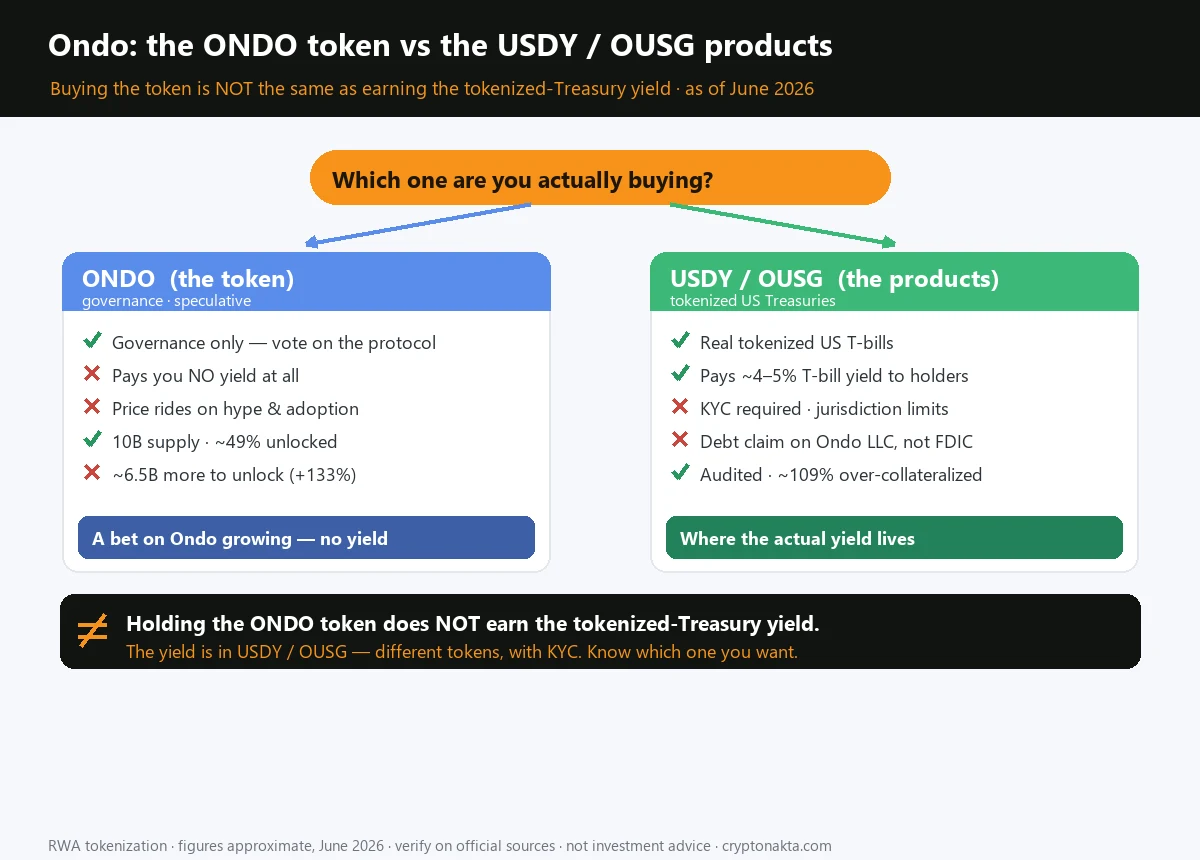
- The crucial distinction: the ONDO token does not pay you the Treasury yield. ONDO is a governance token (speculative). The yield comes from separate products — USDY and OUSG, tokenized T-bills that require KYC. Confusing the two is the costly beginner mistake.
- How the products work: after KYC you deposit USDC and the platform mints USDY/OUSG to your wallet; the underlying T-bill interest (~4–5%, rate-dependent) accrues to the token, audited and over-collateralized (~109%).
- Tokenomics: 10B total supply, ~4.87B circulating (~49%); ~6.5B still to unlock (~+133%) via cliff unlocks into 2027–2028. Utility is governance only — no fee share, no yield. Price ~$0.35 (June 2026), volatile.
- Honest risks: token ≠ yield, permissioned/KYC “DeFi”, issuer/credit and securities-regulation exposure, heavy dilution, and a yield that simply tracks (falling) Treasury rates.
- This guide separates the token from the products, explains USDY/OUSG and tokenized stocks, the unlock schedule, the risks, and how to buy ONDO. Not investment advice.
1. What is Ondo (ONDO)?
2. The crucial distinction: the ONDO token vs USDY/OUSG
3. How tokenized US Treasuries actually work (USDY & OUSG)
4. Beyond Treasuries: tokenized stocks & Ondo Global Markets
5. ONDO tokenomics: supply, unlocks and dilution
6. The honest risks
7. Five myths about Ondo and RWA
8. Strengths vs risks
9. Key terms, in plain English
10. How to buy ONDO safely (and where the yield really is)
11. Next steps
1. What is Ondo (ONDO)?
Ondo Finance is the leading platform for putting real-world assets — chiefly US Treasury bills and, increasingly, US stocks — on the blockchain as tradable tokens. If 2026 has one dominant institutional narrative, it’s RWA (real-world asset tokenization), and Ondo sits at the center of it, with more than $2.75B in total value locked and a commanding share of the tokenized-Treasury and tokenized-stock markets.
Here’s the honest snapshot, as of June 2026:
| Ticker | ONDO (the governance token — not the same as the yield products) |
| What it is | The leading platform for tokenized US Treasuries and stocks |
| Flagship products | USDY & OUSG (tokenized T-bills) + 430+ tokenized stocks |
| Token’s role | Governance only — ONDO does NOT pay you the Treasury yield |
| TVL | ~$2.75B+ · #1 in tokenized Treasuries (~70% of tokenized stocks) |
| Price | ~$0.35 (June 2026 — highly volatile; verify live) |
| Supply | 10B total · ~4.87B circulating (~49%) · large unlocks ahead |
| Biggest risk | Confusing the token with the product + dilution + regulatory exposure |
But there’s a catch most beginners miss, and it’s the single most important thing in this guide: the ONDO token is not the yield product. Buying ONDO does not earn you the Treasury yield — that comes from separate tokens called USDY and OUSG. Confusing the two is the most expensive mistake you can make here, so we’ll untangle it first.
2. The crucial distinction: the ONDO token vs USDY/OUSG
This is the distinction that changes everything, so let’s be blunt about it. “Ondo” refers to two completely different things, and they have different purposes, different risks, and different ways of (not) making you money.
| ONDO (the token) | USDY / OUSG (the products) | |
|---|---|---|
| What it is | A governance token — vote on the protocol’s direction | Tokenized US Treasury bills — the actual yield-bearing assets |
| Does it pay yield? | No. ONDO is not a fee-share or dividend; it pays you nothing for holding | Yes. T-bill interest (~4–5%, tracking rates) passes through to holders |
| Why you’d hold it | A speculative bet that Ondo the company/ecosystem grows | To park dollars and earn conservative, TradFi-style yield on-chain |
| Main risk | Price volatility + heavy token dilution (unlocks) | Issuer/credit risk + KYC + regulatory treatment |
3. How tokenized US Treasuries actually work (USDY & OUSG)
Now the part that makes Ondo genuinely interesting: how it turns a boring, reliable asset — short-term US government debt — into a token you can hold in a wallet. The two flagship products:
| Product | What it is | Who it’s for |
|---|---|---|
| USDY (US Dollar Yield) | A yield-bearing token; a debt claim on Ondo USDY LLC, backed by short-dated (<6mo) US Treasuries plus bank deposits at insured US banks | Non-US individuals/businesses (KYC required); grew from ~$60M at launch to $740M+ by early 2026 |
| OUSG (Short-Term US Gov Treasuries) | A tokenized T-bill fund; redeemable, institutional-grade | Mainly qualified purchasers (institutions / large investors) |
The mechanics are refreshingly simple: after completing KYC, you connect a non-custodial wallet, deposit USDC, and the platform mints the equivalent USDY/OUSG straight to your wallet. The underlying T-bill interest then accrues to that token — no brokerage account, no settlement delays, a low (~$50) minimum, and 24/7 trading. Ondo uses a third-party custodian (Ankura Trust) and publishes regular attestations; as of late May 2026 it reported an asset-to-obligation ratio of ~109% (i.e. over-collateralized).
4. Beyond Treasuries: tokenized stocks & Ondo Global Markets
Treasuries were just the start. In 2026 Ondo’s fastest-growing arm is tokenized stocks via Ondo Global Markets — and here it’s become the dominant player.
| 2026 development | Detail |
|---|---|
| Tokenized-stock leader | Roughly 70% of the tokenized-stock market; 430+ tokenized stocks & ETFs across multiple chains (added 173 in one expansion) |
| Multi-chain | BNB Chain joined Global Markets (Oct 2025); Solana launched 200+ tokenized US equities and became the largest network by asset count |
| Shareholder rights | Proxy voting and access to prospectuses/filings for 250+ tokenized stocks, via a Broadridge integration |
| DeFi plumbing | Chainlink price feeds for tokenized US stocks on Ethereum, enabling them as DeFi collateral (e.g. SPYon, QQQon) |
5. ONDO tokenomics: supply, unlocks and dilution
Back to the ONDO token specifically — because if you’re buying it on an exchange, its tokenomics are what you’re actually exposed to. And this is where you need clear eyes.
| Item | Detail (June 2026) |
|---|---|
| Total supply | 10,000,000,000 ONDO |
| Circulating | ~4.87B (~48.7% unlocked) |
| Still to unlock | ~6.5B more — roughly a +133% increase in circulating supply over the next few years, via cliff unlocks (notably Jan 2027 and Jan 2028) |
| Allocation | Ecosystem Growth 52.1% · Protocol Development 33.0% · Private Sales 12.9% · Community Sale 2.0% |
| Utility | Governance only — no fee share, no yield, no staking-for-Treasury-income |
6. The honest risks
No hype, no doom — here are the risks that actually matter, especially the ones marketing tends to gloss over.
| Risk | What it means |
|---|---|
| Token ≠ yield | The #1 misunderstanding: holding ONDO earns you nothing. The yield is in USDY/OUSG, which are different tokens with KYC. |
| “DeFi” but permissioned | USDY/OUSG require KYC and have jurisdiction limits (USDY isn’t for US persons; OUSG targets qualified purchasers). This is TradFi yield wrapped on-chain, not permissionless DeFi. |
| Counterparty / credit | USDY is a debt claim on an Ondo entity, not a direct T-bill and not an FDIC-insured deposit. Over-collateralized (~109%), audited — but you rely on the issuer, custodian and their disclosures. |
| Regulatory dependence | Tokenized Treasuries and especially tokenized stocks look like securities. Ondo is actively engaging the SEC; a shift in regulatory treatment is a real swing factor. See 2026 crypto regulation. |
| Dilution | Over half the ONDO supply is still locked; large cliff unlocks add selling pressure. |
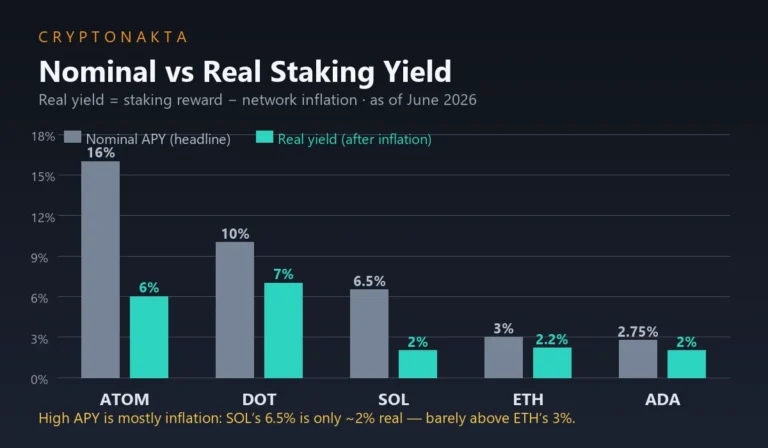
| Yield is just T-bill yield | ~4–5% that falls when rates fall. It’s conservative and rate-dependent, not a crypto-native high yield — compare honestly in our real-yield guide. |
7. Five myths about Ondo and RWA
RWA is a credible corner of crypto, which is exactly why the marketing around it gets fuzzy. Five myths worth unlearning before you commit a cent:
| The myth | The reality |
|---|---|
| “Holding ONDO pays me the Treasury yield.” | No — the #1 mistake. ONDO is a governance token with no yield. The Treasury interest goes to USDY/OUSG holders, which are different, KYC-gated tokens. |
| “Tokenized Treasuries are as safe as a bank deposit.” | No. USDY is a debt claim on an Ondo entity, not an FDIC-insured deposit. It’s over-collateralized and audited, but you carry issuer, custodian and regulatory risk. |
| “It’s real, permissionless DeFi.” | No. The yield products require KYC and have jurisdiction limits. It’s TradFi yield wrapped on-chain — convenient, but permissioned and centralized around Ondo. |
| “A tokenized stock means I own the stock.” | Not necessarily. A token like SPYon is tokenized exposure; the legal rights, eligibility and redemption depend on the product’s terms. Read them. |
| “RWA is ‘real assets’, so it’s basically guaranteed.” | No. Real backing removes some risk, not all. Rate risk (yield falls with rates), regulatory risk, and the ONDO token’s heavy dilution are all still live. |
8. Strengths vs risks
Weigh both sides before you decide. This is a balance sheet, not a recommendation.
Strengths
- Clear category leader in RWA — #1 in tokenized Treasuries, ~70% of tokenized stocks
- Real, audited assets (Ankura custody, ~109% asset-to-obligation, daily attestations)
- Genuine institutional traction and the dominant 2026 narrative
- Deep liquidity — listed on Binance, Coinbase, Kraken, KuCoin, Bybit and more
Risks
- ONDO pays no yield — it’s a governance/speculation token, not the product
- Heavy dilution ahead — >50% of supply still to unlock
- Permissioned & centralized — KYC, jurisdiction limits, issuer reliance
- Regulatory & rate sensitivity — securities questions; yield falls with rates
9. Key terms, in plain English
RWA comes with its own vocabulary, and the words carry the risk — “governance token” vs “yield product” is the whole ballgame. Plain-English definitions:
| Term | What it means |
|---|---|
| RWA (real-world asset) | An off-chain asset — a Treasury bill, a stock, real estate — represented on-chain as a token. |
| Tokenization | Wrapping that real asset as a blockchain token so it can be held in a wallet and traded 24/7. |
| T-bill | A short-term US government debt security — low-risk, the “yield” behind USDY/OUSG. |
| USDY | Ondo’s yield-bearing dollar token for non-US users (KYC); a debt claim backed by short-dated Treasuries + bank deposits. |
| OUSG | Ondo’s tokenized short-term Treasury fund, aimed mainly at qualified (institutional) purchasers. |
| ONDO | The governance token — votes on the protocol; pays no yield. Not the same as USDY/OUSG. |
| TVL (total value locked) | The dollar value of assets held in a protocol — a rough size/traction gauge (~$2.75B+ for Ondo). |
| Attestation | A third-party report verifying the assets backing a token really exist (Ondo publishes these regularly). |
| Qualified purchaser | A US regulatory category for large/sophisticated investors — who OUSG mainly targets. |
| Cliff unlock | A vesting event that releases a big block of tokens at once — why ONDO faces dilution into 2027–2028. |
10. How to buy ONDO safely (and where the yield really is)
The ONDO token trades on every major exchange, so buying it is straightforward: open an account, complete verification (KYC), and buy ONDO. (Note: this gets you the token — to access the yield products USDY/OUSG you complete KYC on Ondo’s own platform, where eligibility depends on your country and status.) These are the exchanges we keep dashboard-verified sign-up guides for — a referral code at sign-up can unlock a fee perk:
Binance

Bybit
OKX

Gate.io
KuCoin

Affiliate disclosure: some links are partner links. We may earn a commission at no extra cost to you. This is not investment advice.
11. Next steps
The honest summary: Ondo is one of the most credible projects in crypto — the clear leader in real-world-asset tokenization, with real T-bills behind USDY/OUSG, real audits, and the dominant 2026 institutional narrative. But keep the two “Ondos” apart: the products (USDY/OUSG) give you conservative, KYC-gated Treasury yield; the ONDO token is a governance/speculation play that pays no yield and faces heavy unlock-driven dilution. Decide which you actually want. If it’s the token, buy it on a major exchange, keep only trading-size balances there, and move the rest to a wallet you control. To go deeper, understand the stablecoin you’d fund with, how this fits DeFi, the real-yield comparison, tokenized stocks in the tokenized-stock guide, the regulatory backdrop, and the scam patterns. New here? Start at the beginner’s guide. Not investment advice — verify current figures on official sources.