Crypto Staking Real Yield Compared (2026): Why High APY Is Misleading
An honest, data-backed comparison of staking rewards across the major proof-of-stake coins — Ethereum, Solana, Cardano, Polkadot and Cosmos — ranked by “real yield” (nominal reward minus network inflation), the number that actually counts. Figures as of June 2026, with sources and method.
- The most useful staking number isn’t the advertised APY — it’s “real yield”: the staking reward minus the network’s own inflation. By that measure, the rankings flip.
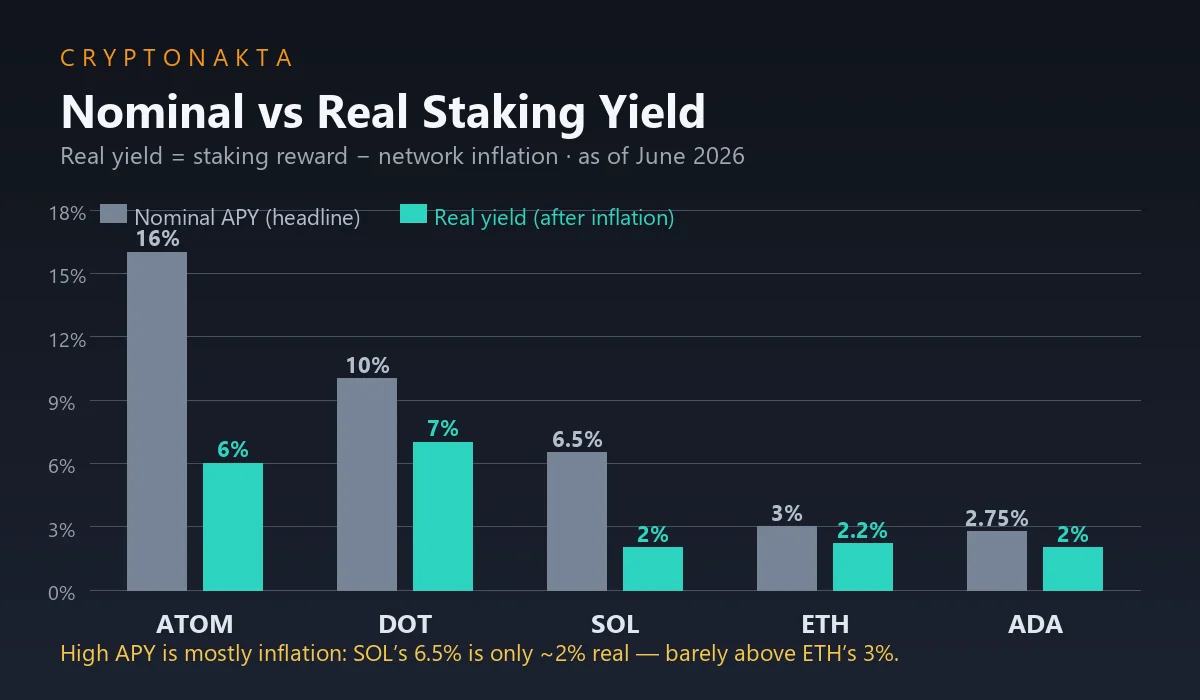
- As of June 2026, ranked by real yield: Polkadot ≈ 7% (after its 2026 inflation cut), Cosmos ≈ 6%, Ethereum ≈ 2.2%, Solana ≈ 2%, Cardano ≈ 2%.
- The surprise: Ethereum’s modest ~3% nominal beats Solana’s ~6.5% on a real basis, because almost none of ETH’s reward is inflation while most of SOL’s ~6.5% just offsets its ~4.5% inflation.
- A high advertised APY is mostly the network printing new coins and handing them back to you — it largely keeps you from being diluted, rather than growing your real ownership.
- The bigger factor is always price: a 50% drop in a coin wipes out years of even the best real yield. Use real yield to cut through marketing, not as the sole reason to pick a coin.
- This page gives the full data table, the method (real yield = reward − inflation), the honest caveats, and links to our complete staking guide. Not investment advice.
1. The finding: real yield flips the rankings
2. Real staking yields at a glance
3. Full comparison: staking real yield by coin (2026)
4. What “real yield” means (and how we calculate it)
5. Three findings that contradict the hype
6. The caveats: what this data does and doesn’t capture
7. How to stake safely (if you decide to)
8. Next steps
1. The finding: real yield flips the rankings
The single most useful number in crypto staking isn’t the headline APY — it’s the “real yield”: the staking reward minus the network’s own inflation. By that honest measure, the rankings flip. A coin advertising 16% can deliver less than one advertising 3%, because most of that 16% is just the network printing new coins and handing them back to you.
Here is the core finding, as of June 2026:
| Coin | Nominal reward | Network inflation | Real yield ≈ |
|---|---|---|---|
| Polkadot (DOT) | ~10% | ~3.1% | ~7% |
| Cosmos (ATOM) | ~16% | ~10% | ~6% |
| Ethereum (ETH) | ~3% | ~0.8% | ~2.2% |
| Solana (SOL) | ~6.5% | ~4.5% | ~2% |
| Cardano (ADA) | ~2.5–3% | low (capped supply) | ~2% |
New to staking itself? Start with our complete guide to crypto staking, which explains validators, lock-ups, slashing and risks in plain language. This page is the data companion to it.
2. Real staking yields at a glance
Here are the headline numbers at a glance:
| Highest real yield | Polkadot (DOT) ≈ 7% (after its 2026 inflation cut) |
| Lowest real yield | Solana (SOL) ≈ 2% — most of its 6.5% offsets inflation |
| Surprise | ETH ≈ 3% nominal beats SOL ≈ 6.5% on a real basis |
| Formula | Real yield ≈ staking reward − network inflation |
| Why it matters | High nominal APY is mostly the network printing coins |
| Bigger factor | Price: a 50% drop dwarfs any staking yield |
| As of | June 2026 (yields & inflation change constantly) |
The key idea below: a high “APY” is not free money. On a proof-of-stake network, most of your reward is newly issued coins — inflation. If the network prints 4.5% new supply and pays you 6.5%, your real gain in network ownership is only about 2%. The rest just stops you being diluted.
3. Full comparison: staking real yield by coin (2026)
This is the full comparison, ranked by real yield (highest first). All figures are approximate and as of June 2026; staking rewards and inflation rates change continuously with network conditions.
| Coin | Nominal reward (APR) | Network inflation | Real yield ≈ | Staked | Unstaking | Slashing |
|---|---|---|---|---|---|---|
| Polkadot (DOT) | ~8–15% (≈10% typical) | ~3.1% | ~7% | varies | ~28 days | Yes |
| Cosmos (ATOM) | ~15–19% (≈16%) | ~10% (dynamic 7–20%) | ~6% | ~67% | ~21 days | Yes |
| Ethereum (ETH) | ~2.8% base, ~3–4% with MEV | ~0.8% (near-zero net) | ~2.2% | ~33% | Exit queue (hrs–days) | Yes |
| Solana (SOL) | ~5.9–7.5% (≈6.5%) | ~4.5% (8%→1.5% taper) | ~2% | ~68% | ~2–3 days | Rare |
| Cardano (ADA) | ~2.5–3% | Low — fixed 45B cap, reserve-funded | ~2–2.5% | ~60% | No lock-up | No |
Sources & method: nominal rewards from public staking dashboards (e.g. Staking Rewards) and network documentation; inflation from each protocol’s published issuance schedule; real yield = nominal reward − network inflation. Polkadot’s inflation reflects its March 2026 tokenomics change (≈10% → ≈3.1%, with a new 2.1 billion DOT cap). Figures are illustrative ranges as of June 2026, not a promise — always check live rates.
4. What “real yield” means (and how we calculate it)
“Real yield” sounds technical but the idea is simple, and it’s the single most important correction to make to staking marketing.
| Step | What it means |
|---|---|
| 1. The nominal reward | The headline APY/APR a platform advertises — e.g. “stake SOL, earn 6.5%.” This is paid in new coins. |
| 2. The network’s inflation | How fast the total supply grows each year. Those new coins are created to pay stakers. If you don’t stake, your share of the network shrinks by roughly this amount. |
| 3. Real yield = reward − inflation | Subtract the second from the first. It’s how much your ownership of the network actually grows. A 6.5% reward on 4.5% inflation is only ~2% real — the rest just keeps you from being diluted. |
5. Three findings that contradict the hype
Three findings stand out from the 2026 data — and each one contradicts a common belief.
| Finding | Why it matters |
|---|---|
| 1. ETH ≈ SOL on a real basis | Solana’s ~6.5% looks far better than Ethereum’s ~3%. But after inflation, both land near ~2% real. Ethereum’s low headline number is misleadingly modest; its near-zero net issuance means almost all of it is “real.” |
| 2. Polkadot’s 2026 cut flipped the ranking | In March 2026 Polkadot overhauled its tokenomics, cutting annual inflation from roughly 10% to about 3.1% and adding a hard 2.1 billion DOT cap. Overnight, DOT’s real yield jumped to the top of this table — a clear example of how a protocol change, not the headline APY, drives real returns. |
| 3. Cosmos’s 15–19% is mostly inflation | ATOM advertises some of the highest staking rewards in crypto, but with ~10% inflation the real yield is closer to ~6%. Eye-catching, but far less than the headline implies — and Cosmos is actively debating reform to lower it. |
6. The caveats: what this data does and doesn’t capture
A fair comparison has to name its limits. Here is what this data does and doesn’t capture.
| Caveat | Detail |
|---|---|
| Price dwarfs everything | Real yield is measured in the coin, not in dollars. A 50% price drop wipes out years of even the best real yield. Yield is a secondary consideration; the coin’s volatility is primary. |
| Rates move constantly | Staking rewards fall as more of a coin is staked (ETH’s yield compressed as its staked ratio passed 32%), and inflation schedules taper or get reformed. These are June 2026 snapshots, not fixed values. |
| Commission & method reduce it | Validators take a cut (often 0–10%); exchanges take more. Liquid staking adds smart-contract and depeg risk. Your realized yield is usually below the gross figures here. |
| Real yield ≠ no risk | Higher real yield (DOT, ATOM) comes with longer lock-ups and slashing. Lower-yield ADA has none. The right choice balances real yield against lock-up, slashing and your conviction in the coin. |
| ADA is measured differently | Cardano has a fixed 45-billion cap and funds rewards from a declining reserve plus fees, so its “inflation” isn’t directly comparable to uncapped chains. Its net dilution is low, leaving a modest but mostly-real yield. |
7. How to stake safely (if you decide to)
If you decide to stake after weighing the real-yield picture, do it through your own wallet or a reputable, regulated exchange — never a “guaranteed high yield” link. Our staking guide covers the safe step-by-step; these are the exchanges we have dashboard-verified sign-up guides for, with staking on popular coins:
Binance

Gate.io

KuCoin

Bybit

MEXC

Affiliate disclosure: some links are partner links. We may earn a commission at no extra cost to you. This is not investment advice.
8. Next steps
The honest summary: nominal staking APY is one of the most misleading numbers in crypto, and “real yield” — reward minus inflation — is the correction. As of June 2026, Polkadot and Cosmos lead on real yield (with longer lock-ups and slashing), while the popular Ethereum, Solana and Cardano cluster around ~2% real. But real yield is secondary to price volatility, it changes constantly, and higher real yield comes with more friction. Use it to see through marketing — then stake only a coin you’d hold anyway. Build the rest of your foundation with our complete staking guide, deep dives on Ethereum and Solana, and how blockchains work; learn to spot traps in our scams guide; and when you’re ready, compare regulated exchanges. New to all of it? Start at the complete beginner’s guide. Stake small, stay skeptical, and never chase a headline yield.