DeFi: Banking Without a Bank — the Yields, and the Risks Nobody Mentions
A plain-English guide to DeFi (decentralised finance): how it works (smart contracts, wallets, gas), what you can do (swap, lend, borrow, stake, yield-farm), how it differs from exchanges (CeFi), the big services, where yields really come from, the honest risks and real hacks, how to use it safely, regulation and tax, and where to start.
DeFi is finance that runs on code, with no bank in the middle. Earn interest, borrow, swap coins — the things a bank does, done by smart contracts straight from your own wallet. Short on time? Read this table; the detail is below.
| Item | The gist |
|---|---|
| What it is | Short for “decentralised finance” — automated, staff-free finance run by code (smart contracts) instead of a company. |
| What you can do | Swap coins (DEX), earn interest, borrow against collateral, stake, yield-farm. |
| What you need | Your own wallet (e.g. MetaMask) + a little gas (ETH on Ethereum). |
| Vs an exchange | An exchange holds your coins; in DeFi you hold them. Most people buy on an exchange, then move to a wallet to use DeFi. |
| The yields | Not free — they come from borrower interest, trading fees and freshly minted tokens. The quoted rate is an estimate. |
| Legal & tax | No ban on personal use in most places, but dedicated rules/tax are a grey area. Check locally. |
| Watch out | Hacks, rug pulls, drainers, liquidation · no safety net · transactions can’t be reversed. |
1. What is DeFi?
2. DeFi at a glance (the spec sheet)
3. A short history: from DeFi Summer to now
4. How DeFi works: smart contracts
5. What you can do in DeFi
6. 1) Swapping coins & the DEX (pools & AMMs)
7. 2) Lending, borrowing & liquidation
8. 3) Staking & yield farming
9. Where DeFi runs: Ethereum, L2s & other chains
10. DeFi vs an exchange (CeFi)
11. The big services (Uniswap, Aave, Lido)
12. Where the yield really comes from
13. The real risks (with real hacks)
14. How to use DeFi safely
15. Regulation & tax
16. Common beginner mistakes
17. DeFi terms you should know (quick glossary)
18. Where to start (step by step)
19. Next steps
1. What is DeFi?
In one sentence, DeFi is finance that runs on code on a blockchain, with no bank or broker in the middle. The name is short for “Decentralised Finance.” The things a bank does for you — let you earn interest, lend you money, swap one currency for another — DeFi does the same, except a program handles it directly instead of a company.
Think of it as a 24/7 bank with no staff. No tellers, no loan officers, no opening hours. It follows fixed rules written in code, and anyone can read those rules. Nobody can freeze your account or refuse to let you in. But that freedom comes with a twin you can’t separate it from: responsibility.
The fastest way to get it is to put it next to the bank you already know.
| Banks & exchanges (traditional finance) | DeFi | |
|---|---|---|
| Who’s in the middle | A bank, broker or exchange | No company — code (smart contracts) |
| Who holds your money | The company holds it for you | You hold it in your own wallet |
| To use it | Sign up, get approved, opening hours | Just a wallet — anyone, 24/7 |
| The ledger | Private, inside the company | Public, on the blockchain |
| If something goes wrong | Support line, deposit insurance, etc. | No one to call, nothing to reverse |
2. DeFi at a glance (the spec sheet)
Before the deep dive, here’s the whole thing on one card.
| One-line definition | Financial services run by code on a blockchain, not by a company |
| Full name | DeFi — Decentralised Finance |
| What you can do | Swap coins · earn interest · borrow · stake · yield-farm |
| Runs on | Ethereum and other smart-contract chains (plus L2s) |
| What you need | Your own wallet + a little gas (ETH on Ethereum) |
| Total size | ~$120-130B locked (2026; varies by source) |
| Who runs it | Not a company — code (smart contracts) + token holders (DAOs) |
| Big names | Uniswap (swaps) · Aave (lending) · Lido (staking) |
| Biggest risk | Hacks, rug pulls, drainers — nothing can be reversed or refunded |
| As of | June 2026 |
Keep two ideas in your head. One, DeFi is finance you do from your own wallet — you never hand your coins to anyone. Two, no company in the middle means no company to protect you either. That trade — freedom for responsibility — is the beginning and end of DeFi.
3. A short history: from DeFi Summer to now
DeFi didn’t appear overnight. A quick tour of its history tells you a lot about where the hype ends and the real stuff begins.
| When | Milestone |
|---|---|
| Dec 2017 | MakerDAO launches on Ethereum — the first decentralised lending system and the DAI stablecoin. The seed of DeFi. |
| Nov 2018 | Uniswap introduces the “automated market maker” (AMM) — a way to swap coins with no order book and no counterparty to find. |
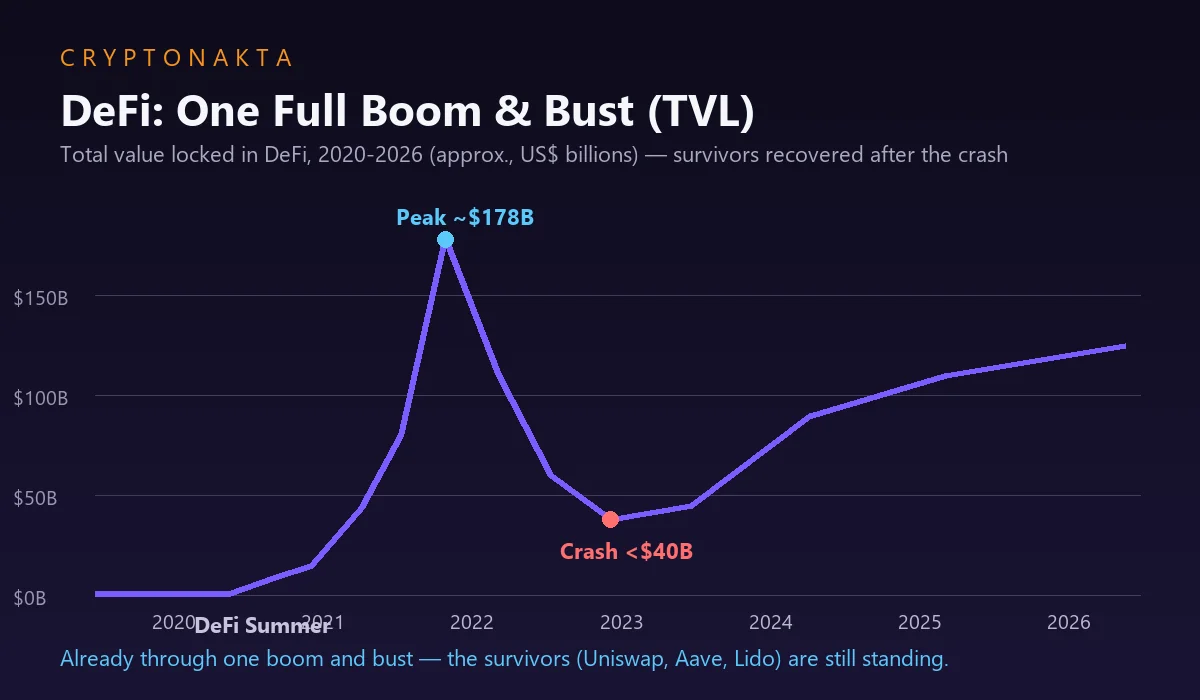
| Jun 2020 | Compound hands its governance token COMP to users, kicking off “DeFi Summer.” Yield farming explodes; total value locked jumps from ~$1B to ~$15B in three months. |
| Sep 2020 | SushiSwap siphons liquidity from Uniswap in a “vampire attack” — Uniswap responds by launching its UNI token. The token-reward race is on. |
| Nov 2021 | Total value locked peaks at roughly $178B. |
| 2022 | The Terra/Luna collapse and a broad crash drag locked value below $40B — the bubble deflates. |
| 2023-2026 | Recovery led by the survivors, ~$120-130B locked in 2026, increasingly centred on L2s and stablecoins. |
Take one pattern away from this: DeFi has already lived through one full boom and bust. Plenty of scams and bad designs were exposed along the way. But the services that survived several cycles — Uniswap, Aave, Lido — are still standing. That history is exactly why this guide keeps saying “stick to the old, tested ones, and start small.”
4. How DeFi works: smart contracts
So how does money move and interest accrue with no company involved? It comes down to one thing: smart contracts.
A smart contract is a self-running program living on a blockchain. You write the rules in code — “if this, then that” — and the moment the condition is met, it executes on its own, no human hands. Picture a vending machine: put money in, press the button, and a drink comes out with no clerk. DeFi is that vending machine doing “lending,” “swapping” and “paying interest.” New to this? Start with how a blockchain works and it’ll click faster.
| Building block | What it does |
|---|---|
| Smart contract | The automatic program that replaces the bank teller — it runs the deposit, loan and swap rules. |
| Wallet | Your key and your account for DeFi. You connect a self-custody wallet like MetaMask directly. |
| Gas | The fee to record a transaction on the blockchain. On Ethereum you pay it in ETH. It rises when the network is busy. |
| Token | The coin a DeFi service issues. Holders often vote on how it’s run (a DAO). |
| Oracle | The bridge that feeds real-world prices (“ETH is $X right now”) into the code. Loans and liquidations run on this price. |
The actual flow is simple: connect your wallet to a DeFi service → tap deposit, swap or borrow → the smart contract handles it on the spot and writes the record to the blockchain. The crucial difference is that the record lands on a public ledger anyone can see, not on a company’s server.
5. What you can do in DeFi
What can you actually do in DeFi? There’s a lot, but the common activities boil down to five. We’ll take each one deeper in the sections right below.
| What you can do | In one line | Big names |
|---|---|---|
| Swap coins (DEX) | Trade coin A for coin B with just a wallet, no sign-up | Uniswap, Curve |
| Earn interest | Lend your coins into a pool and collect interest | Aave, Compound |
| Borrow | Lock up coins as collateral and borrow another coin | Aave, Sky (Maker) |
| Stake / liquid stake | Help secure a blockchain and earn rewards | Lido |
| Yield farming | Supply coins to a swap pool for fees + reward tokens | Many DEXs, vaults |
And stablecoins are the lubricant for all of it. Because they’re pegged to a dollar and don’t swing in price, a big share of what people lend and borrow in DeFi is stablecoins — the convenience of handling something like dollars instead of a volatile coin.
6. 1) Swapping coins & the DEX (pools & AMMs)
Start with the most-used activity: swapping coins. On a normal exchange you sign up and place an order. In DeFi you just connect a wallet and the swap happens on the spot. These venues are called a DEX (decentralised exchange), and Uniswap is the flagship.
The trick is a method called an AMM (automated market maker). A regular exchange matches a “seller” with a “buyer.” A DEX has no such counterparty. Instead, people pool two kinds of coin into a liquidity pool, and when you put one coin in, another comes out according to a formula — like a currency booth with two jars, where pouring into one makes the other flow out at a set ratio.
| Concept | Plain meaning |
|---|---|
| Liquidity pool | A shared jar holding two coins for swapping. Anyone can add to it. |
| Liquidity provider (LP) | Someone who put coins in the pool. They earn a cut of the fee on every swap. |
| Slippage | Swapping a large amount shifts the pool’s ratio, so you fill at a worse price than expected. |
| Gas | Each swap also costs a network fee. On a busy Ethereum day, small swaps can cost more than they’re worth. |
7. 2) Lending, borrowing & liquidation
Next: earning interest and borrowing. They’re two sides of one coin. Someone’s deposited coins get borrowed by someone else, and the interest the borrower pays flows back to the depositor. Aave is the flagship here.
The key rule is over-collateralisation. DeFi has no credit check. So to borrow, you must post collateral worth more than you borrow — say, lock $1,000 of ETH to borrow $500 of stablecoin. “Why borrow against what I already own?” Because it lets you raise cash without selling the coin you want to keep.
| Concept | Plain meaning |
|---|---|
| Over-collateralisation | Posting more collateral than you borrow. Collateral, not credit, makes it work. |
| Interest rate | Set automatically by supply and demand of lenders and borrowers. Not fixed. |
| Liquidation | If your collateral’s value drops below a line, it’s sold automatically to repay the loan. It happens in an instant. |
8. 3) Staking & yield farming
Third comes the “put it to work” zone: staking and yield farming.
Staking means locking coins to help secure a blockchain and earning a reward. Liquid staking goes a step further: you get a receipt token (e.g. stETH) for your staked coins that you can then use elsewhere in DeFi. Lido is the largest service here. The mechanics and risks are laid out in our staking guide.
Yield farming means putting a pair of coins into a liquidity pool (above) to earn fees plus reward tokens. The advertised yields look high, but there are two traps.
9. Where DeFi runs: Ethereum, L2s & other chains
If you think “DeFi happens on Ethereum,” you only know half of it. Which “neighbourhood” (blockchain) DeFi runs on changes the gas and the speed a lot.
| Where it runs | What it’s like |
|---|---|
| Ethereum (mainnet) | DeFi’s home turf — the most services and the most assets. But when it’s busy, gas is expensive — rough on small amounts. |
| L2s (layer 2) | Arbitrum, Optimism, Base and others. Built on top of Ethereum to make gas far cheaper. A lot of DeFi activity has moved here. |
| Other chains | Solana, BNB Chain and more, each with its own DeFi scene. Fast and cheap, but the services and assets differ. |
This is where a bridge comes in — a crossing that moves coins from one chain to another. Handy, but also a favourite target for hackers (more in the risks section). If you’re new, rather than hopping between chains, get comfortable on one cheap L2 first.
10. DeFi vs an exchange (CeFi)
Here’s the spot people get confused. An exchange like Binance also buys, sells and pays interest — but that’s not DeFi. Those are CeFi (centralised finance). The difference is one thing: who holds your coins.
| Exchange (CeFi) | DeFi | |
|---|---|---|
| Custody | The exchange holds your coins | You hold them in your own wallet |
| Sign-up | Account + ID check required | Just a wallet, straight in |
| Ease | One app, support line | You handle it; mistakes are yours |
| If it breaks | You can ask the exchange, maybe recover | Nothing to reverse |
| Cash in/out | Yes (bank transfer) | No — coins only |
| Best for | First buys, cashing in/out | Hands-on use, newer services |
The usual line: an exchange is a bank you deposit money in; DeFi is a wallet you carry yourself. The bank is easy but holds your money; the wallet is free but it’s on you if you lose it. So most people buy their first coins on an exchange, then move them to their own wallet to use DeFi. The two aren’t rivals — they’re different stages of the same journey.
11. The big services (Uniswap, Aave, Lido)
Names aside, it helps to see the services people actually use. You don’t need to memorise these — “oh, so these kinds exist” is enough.
| Service | Area | In one line |
|---|---|---|
| Uniswap | Coin swaps (DEX) | The largest decentralised exchange. In late 2025 it began routing part of its fees into buying back and burning UNI. |
| Aave | Lending & borrowing | The largest lending service. Deposit to earn, or borrow against collateral. |
| Lido | Liquid staking | Among the biggest by assets. Holds roughly a third of all staked Ethereum. |
| Sky / Maker | Stablecoins | The classic protocol for minting a dollar coin against crypto collateral. |
| Curve | Stablecoin swaps | Specialises in cheaply swapping one dollar coin for another. |
As of 2026, total value locked across DeFi sits around $120-130B (the count varies a lot with what you include). That’s the level after the bubble inflated to $178B and deflated, with the big survivors above settling into place.
12. Where the yield really comes from
The thing that hooks people in DeFi is yields like “tens of percent a year.” So you need to see clearly where that interest comes from. There’s no free money.
| Source of yield | What it really is |
|---|---|
| Interest from borrowers | The interest someone pays to borrow the coins you lent. The most honest, sustainable source. |
| Trading fees | Supply coins to a DEX pool and you share the fee people pay on every swap. |
| Freshly minted tokens | Extra tokens a service prints to attract users. If that token’s price falls, your real return shrinks or vanishes. |
Here’s the key: the quoted rate (APR/APY) isn’t a promise — it’s a snapshot estimate. High yields padded with “new token rewards” melt away when the token drops. If a big number is on the billboard, the safe habit is to ask first: “is this coming from borrower interest, or from freshly minted tokens?”
13. The real risks (with real hacks)
Now the most important part. DeFi is as risky as it is free. Not “avoid it out of fear” — but go in knowing what to watch for.
| Risk | What it means |
|---|---|
| Code bugs / hacks | A flaw in a smart contract can drain it entirely. Billions a year have left DeFi this way. Audited doesn’t mean risk-free. |
| Bridge hacks | Bridges between chains pool huge sums and become targets. The biggest exploits ever happened here (cases below). |
| Rug pulls | Anyone can launch a token and a service, so “founders take the money and vanish” scams are common. |
| Wallet drainers | Fake sites lure you to “connect and approve,” then empty your wallet. A huge share of DeFi losses. Read the scams guide. |
| Liquidation | Borrow against collateral, the collateral drops, and it’s sold off automatically. In an instant. |
| Impermanent loss | The yield-farming risk where your pooled value shrinks as two coins diverge. |
| No undo | Send to the wrong place or approve a scam transaction and there’s no cancel, no refund. No support line exists. |
Real cases land harder than vague warnings. Even big services weren’t spared.
| Incident | Scale & nature |
|---|---|
| Ronin bridge (Mar 2022) | ~$625M — the bridge for the game Axie Infinity was breached. Among the largest ever (tied to a North Korea-linked group). |
| Poly Network (Aug 2021) | ~$601M — unusually, the hacker returned most of it. |
| Wormhole bridge (Feb 2022) | ~$325M — another bridge hack. |
14. How to use DeFi safely
Having seen the risks, here are the practical habits that cut accidents down. They’re not hard — and most DeFi losses come not from sophisticated hacks but from fake sites and careless approvals.
| Habit | Why it matters |
|---|---|
| Official URL only | Enter via a bookmark, never a search ad or a DM link. Fake sites look identical to the real thing. |
| Test small | Run a new service once with a tiny amount, then scale up as you get comfortable. |
| Read the approval | Don’t rubber-stamp the wallet pop-up — see what you’re granting access to. Beware “unlimited approval.” |
| Revoke old approvals | Periodically pull back permissions you gave to services you no longer use. Old approvals can be abused later. |
| Old and tested first | A service that has survived years and stacked up audits is less likely to blow up than yesterday’s high-yield newcomer. |
| Split your wallets | Keep a DeFi “experiment” wallet separate from your savings wallet, so one breach doesn’t take everything. |
| Hardware wallet for size | As the amount grows, connect via a hardware wallet so your private key stays offline. |
15. Regulation & tax
“So is DeFi legal where I am, and how is it taxed?” Honestly, this is an area that isn’t cleanly settled anywhere. Here’s the factual landscape, without guessing — verify your own situation locally.
| Question | The situation (as of June 2026) |
|---|---|
| Using it | In most places there’s no law banning an individual from using DeFi from their own wallet. But a dedicated regulatory framework aimed at DeFi mostly doesn’t exist yet either. |
| The grey zone | In the US, no single DeFi law exists; the SEC and CFTC contest jurisdiction. Centralised exchanges are regulated; fully decentralised protocols sit in a grey area. |
| Tax | Many countries treat crypto as property and tax gains. DeFi income (interest, rewards, farming) is usually taxable too, but exactly how it’s classified is often unsettled. |
Because DeFi has no borders, no single country can regulate it cleanly. The EU’s MiCA regulates “identifiable parties” like issuers, but its grip on fully decentralised protocols is fuzzy. Rules and tax move fast, so confirm the current treatment locally or with a professional before you file. This is not tax advice.
16. Common beginner mistakes
Finally, the landmines beginners step on most. Know them in advance and you’ll dodge nearly all of them.
- Leaving no gas. On Ethereum-style chains, every transaction costs ETH for gas. Drain your ETH to zero and you can’t even move your other coins — always keep a little for gas.
- Tapping “unlimited approval.” One approval can grant access to all of a coin. Approve only what you need, and revoke when you’re done.
- Entering via an ad or DM link. Plenty of fakes hide in top search ads and Twitter/Telegram DMs. Bookmark the official site and only go there.
- Chasing “300% a year.” Abnormally high yields usually come bundled with risk, reward tokens and rug pulls.
- Typing your seed phrase somewhere. Real DeFi never asks for your seed. Any box asking for it is 100% a scam.
- All-in on one service. However big it is, hacks and liquidations happen. Don’t pile everything into one place.
Notice none of this is technically hard. What it takes is the discipline not to rush large sums in.
17. DeFi terms you should know (quick glossary)
Wandering through DeFi, the same terms keep popping up. Keep this mini-glossary handy.
| Term | Plain meaning |
|---|---|
| Smart contract | A self-running program on a blockchain — DeFi’s “staff.” |
| DEX | Decentralised exchange — swap coins by just connecting a wallet (e.g. Uniswap). |
| AMM | Automated market maker — swapping automatically from a liquidity pool, no counterparty. |
| Liquidity pool / LP | A jar of coins for swapping / someone who supplied coins to it. |
| Gas | The network fee to record a transaction (ETH on Ethereum). |
| TVL | Total value locked — how much is parked in a service or in DeFi overall. |
| Stablecoin | A coin pegged to a dollar (etc.). DeFi’s base currency. |
| Yield farming | Supplying coins to pools to earn fees and reward tokens. |
| Impermanent loss | The loss when two pooled coins drift apart in price. |
| Liquidation | Automatic sale of collateral when its value falls below a line. |
| DAO | A “decentralised organisation” run by token-holder votes. |
| L2 (layer 2) | A fast network on top of Ethereum that slashes gas. |
| Bridge | A crossing that moves coins from one chain to another. |
| Drainer | A malicious site/code that empties a wallet via a fake approval. |
18. Where to start (step by step)
Once DeFi makes sense, the actual starting point is simple. Almost everyone starts on an exchange, because it’s the easiest on-ramp from regular money to coins. The order looks like this.
| Step | What to do |
|---|---|
| 1. Buy coins on an exchange | Open an account and buy ETH or a stablecoin. The beginner’s guide walks you through it. |
| 2. Make a self-custody wallet | Create a wallet like MetaMask and store the seed phrase safely. |
| 3. Move coins to your wallet | Send from the exchange to your wallet address. Keep a little ETH for gas. |
| 4. Connect to a DeFi service | Go to the official URL, connect your wallet, and start small (a cheap L2 is a gentle entry). |
Below are the main exchanges people use to buy their first coins. Entering a referral code at sign-up unlocks a fee discount on some of them.
Binance

OKX

Bybit

Gate.io

MEXC

KuCoin

19. Next steps
You’ve now done a full loop: what DeFi is, where it came from, how it works, and what to watch for. DeFi does what a bank does, without a company in the middle, straight from your own wallet. It’s free and fast, but remember it has no safety net — there’s no one to undo a mistake or a hack. The habits of official-URL-only, test-small and read-the-approval cut the risk dramatically. Want more foundation? See how blockchains and Ethereum work, and get to know DeFi’s lubricant, stablecoins, plus staking. To dodge the traps, the scams guide helps a lot. To get your first coins, compare reputable exchanges; brand new? Start with the beginner’s guide. DeFi changes fast, so always verify the latest on official sources.