The Cheapest Way to Buy Bitcoin in 2026 — Where the Fees Actually Hide
The cost of buying Bitcoin isn’t the number on the homepage — it’s a stack of four (trading fee, spread, how you deposit, how you withdraw), and almost everyone overpays in the two they never see. This is the honest version: why the “Buy with card” button is the real tax, how to read “zero-fee,” maker vs taker, the 2026 spot fees compared, and a checklist that gets you to roughly 0.1%. As of June 2026.
- The cheapest way to buy Bitcoin is to fund by bank transfer and buy with a limit order on the spot market — not the “Instant Buy” button with a card. That one swap takes you from ~5–7% to roughly 0.1%.
- You pay four costs, not one: the trading fee (the headline %), the spread (hidden inside the quoted price), the deposit cost (a card runs 3–7%; a bank transfer is near-free), and the withdrawal network fee. The overpaying happens in the spread and the deposit, unseen.
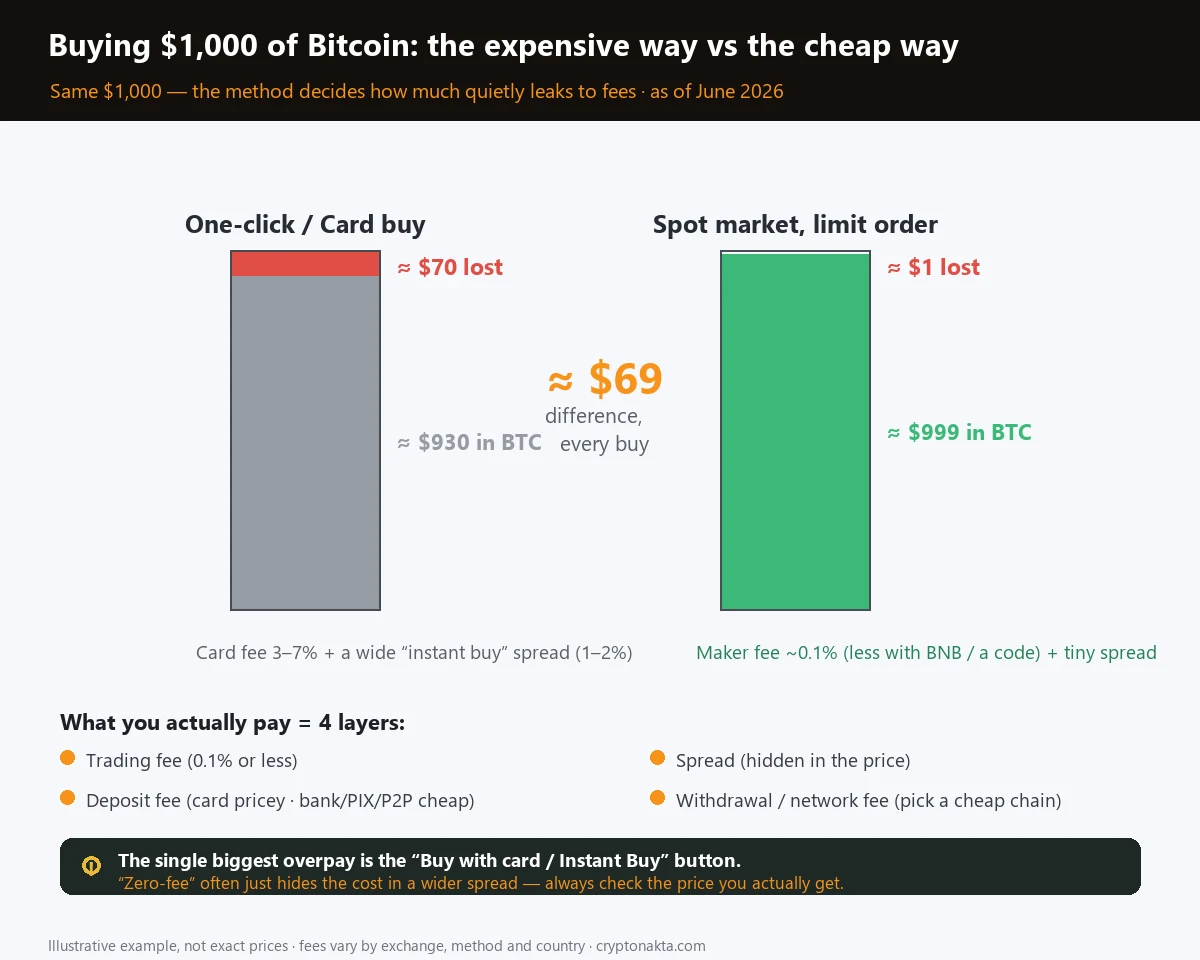
- The card / instant-buy button is the real tax — a 3–7% card fee plus a 1–2% spread, versus about 0.1% on the spot market. On $1,000 that’s $40–70 versus around a dollar — the same coin for fifty times the cost.
- “Zero-fee” is usually a wider spread in disguise. Don’t compare advertised fees; compare the all-in price per coin you actually get against the live market price. A visible 0.1% beats an invisible “free.”
- 2026 spot fees: Binance/Bybit/OKX ~0.1% (Binance 0.075% in BNB), MEXC 0% maker/0.05% taker, Gate ~0.1% with lifetime discounts, Kraken 0.25/0.40%, Coinbase Advanced 0.25–0.60% — never its “simple” one-click. Cut fees further with BNB, a referral code, maker orders, and by not over-trading.
- This guide covers the card-vs-spot tax, the spread trick, maker/taker, the exchange landscape, deposit/withdrawal know-how, and a cheapest-path checklist. Not investment advice.
1. It’s not which app — it’s four costs, not one
2. The card button is the tax most people pay
3. How to actually read “zero-fee”
4. Maker vs taker, and the order that costs least
5. The 2026 fee landscape — and four ways to cut it
6. Funding in, moving out: the know-how
7. The cheapest-path checklist
8. Where to do it, and the bottom line
1. It’s not which app — it’s four costs, not one
People hunt for “the cheapest exchange” the way they hunt for the cheapest airline — and end up paying for the seat, the bag, the meal and the priority boarding anyway. Buying Bitcoin is the same trap. The price you pay isn’t one fee; it’s a stack of them, and the one printed in big letters on the homepage is usually the smallest.
There are really four costs. The trading fee is the percentage the exchange charges to fill your order — the famous “0.1%.” The spread is the gap between the buy and sell price, a cost baked silently into the number you’re quoted. The deposit cost is what it takes to get money onto the platform — trivial by bank transfer, brutal by card. And the withdrawal fee is the flat network charge to move coins out, which you only pay if you actually move them. Almost everyone who overpays does it in the middle two — the spread and the deposit — without ever seeing a line item for it.
2. The card button is the tax most people pay
If this guide changes one habit, let it be this one: stop using the “Buy with card,” “Instant Buy,” or “Simple Buy” button. It exists because it’s frictionless, and frictionless is exactly how it earns. It quietly stacks the two most expensive layers at the same moment — a card “convenience” fee of 3–7%, and on top of that a spread of 1–2% baked into a price that looks like the market but isn’t.
Put real numbers on it. Buy $1,000 of Bitcoin through that button and you can hand over $40–70 before a single satoshi reaches you. Buy the same $1,000 on the exchange’s actual spot market and you’ll typically pay about a dollar. That’s not a rounding difference — it’s the card route costing fifty times more for the identical coin.
The fix takes thirty seconds longer. Instead of the one-tap screen, open Spot or Trade, pick the BTC pair (BTC/USDT or BTC and your local currency), and place an order at a price. If you’re buying for the long haul, none of the convenience the card button sells you is worth a recurring 5% tax — least of all on a regular DCA, where that tax would ride along on every single purchase for years.
3. How to actually read “zero-fee”
“Zero-fee” and “0% trading fees” are everywhere now, and they’re not always a lie — MEXC genuinely runs 0% maker on spot, and big exchanges run real zero-fee BTC promotions. But “free” is also the most comfortable place in the world to hide a cost, so it deserves one suspicious question: what price am I actually getting?
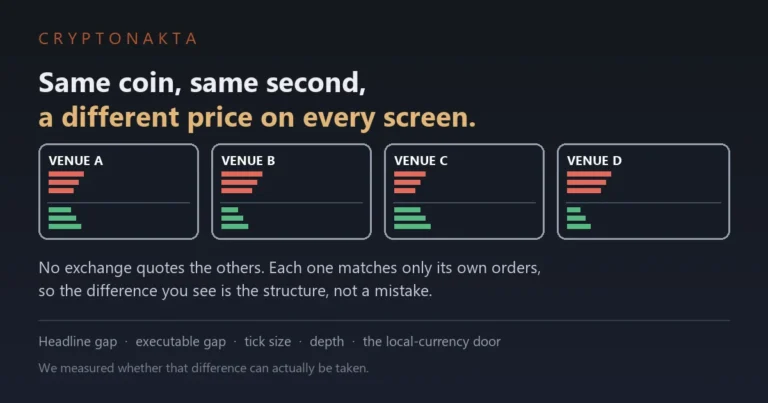
Because if the trading fee is zero but the buy price sits 1.5% above the real market price, you paid 1.5% — it was simply moved from the column marked “fee” to the one marked “spread,” where it doesn’t show up on your receipt. The number worth comparing isn’t the advertised fee at all. It’s the all-in price per coin you end up with, held against the mid-market price you can pull up on any chart. A visible 0.1% on a deep order book beats an invisible “free” almost every time, because at least you can see what you’re paying.
4. Maker vs taker, and the order that costs least
Once you’re on the spot market, the cheapest possible order is a maker order, and the difference between maker and taker is worth understanding because it’s the one lever fully in your hands. A taker order is a market order — it fills instantly by taking liquidity that’s already there, and costs a touch more for the privilege. A maker order is a limit order placed at a price that doesn’t fill immediately; it rests on the book adding liquidity, and exchanges reward that with the lowest fee tier, sometimes even a rebate.
In practice that means: decide the price you’re willing to pay, set a limit order there, and let the market come to you. You give up instant gratification and gain the cheapest fill on the platform. For most buyers the saving is small in absolute terms, but it’s free money for thirty seconds of patience — and it compounds if you buy often.
5. The 2026 fee landscape — and four ways to cut it
Now the trading fee itself. It’s small on the spot market, but it does vary, and a few exchanges are meaningfully cheaper than the rest. Here’s the landscape in June 2026, on standard spot rates before any discounts:
| Exchange | Spot maker / taker | The honest read |
|---|---|---|
| MEXC | 0% / 0.05% | About the cheapest there is — 0% maker for everyone, no tier games |
| Binance | 0.10% / 0.10% | Drops to 0.075% when you pay fees in BNB; deepest liquidity, so the spread is tight |
| Bybit · OKX | 0.10% / 0.10% | Clean, predictable spot pricing |
| Gate | ~0.10% | Huge coin selection; a referral code adds a lifetime discount |
| Kraken (Pro) | 0.25% / 0.40% | Trusted and well-regulated, but plainly pricier than the 0.1% crowd |
| Coinbase Advanced | 0.25% / ~0.40–0.60% | Use Advanced — its “simple” one-click buy can cost several percent |
And four ways to push that number lower still: pay the fee in the exchange’s own token (BNB cuts Binance fees by about a quarter), enter a referral code when you sign up for an ongoing kickback or a lifetime discount, use maker orders, and don’t treat trading as a hobby. None of these are tricks — they’re just the difference between paying the list price and paying attention.
6. Funding in, moving out: the know-how
The last two costs are about moving money in and coins out, and they’re where “cheap” and “expensive” really part ways.
Getting money in is the single highest-leverage decision, and we’ve already named the villain: the card. A bank transfer, an instant local rail, or buying a stablecoin by P2P and moving it in are all typically free or near-free. So the most valuable change most people can make costs nothing — just fund any way except a card.
Getting coins out only matters if you move Bitcoin off the exchange to your own wallet, in which case you pay a flat network fee that depends entirely on the chain. If you’re only holding or trading on the platform, there’s no withdrawal fee at all — just secure the account with app-based 2FA and keep only trading-size balances there. When you do withdraw, the rule is simple: do it rarely and in larger amounts (each withdrawal pays the flat fee once), and for stablecoins pick a cheap network like TRC20, BEP20, an L2 or Solana rather than an expensive one. Ten small withdrawals pay the network ten times; one larger one pays it once.
7. The cheapest-path checklist
Here’s the whole thing distilled. Do these and you’re paying close to the floor — no magic 0% exchange required:
| Step | Why it’s cheaper |
|---|---|
| 1. Fund by bank / local rail / P2P, never a card | Removes the single biggest fee (3–7%) |
| 2. Buy on the Spot market, not the Instant-Buy button | ~0.1% instead of a wide built-in spread |
| 3. Use a limit (maker) order when you can wait | Cheapest fee tier; sometimes a rebate |
| 4. Pay fees in the exchange token + use a referral code | BNB −25%; ongoing or lifetime discounts |
| 5. Judge the real price, not the “0% fee” label | Catches a spread dressed up as free |
| 6. Withdraw rarely, on a cheap chain (or not at all) | Avoids repeating the flat network fee |
| 7. Don’t over-trade | Every round-trip pays the fee twice |
8. Where to do it, and the bottom line
For a genuinely low all-in cost you want four things together: transparent spot fees, deep liquidity (which keeps the spread tight), a cheap way to fund where you live, and discounts you can actually switch on. These are the exchanges we keep dashboard-verified sign-up guides for; entering a referral code at sign-up applies the fee perks:
Binance

Bybit

Gate.io

KuCoin

OKX

Affiliate disclosure: some links are partner links. We may earn a commission at no extra cost to you. This is not investment advice.