
When a Crypto Exchange Goes Bankrupt: Who Owns the Coins on Your Screen?
Your balance is a claim on the exchange. Here is the order in which an insolvency decides whose property it is, what rank you hold, and whether you are paid in coins or in cash.
| The question readers arrive with | The short answer | Where it is settled |
|---|---|---|
| Is the coin on the exchange mine? | Your balance is a claim on the exchange for that quantity. It becomes your coin when it reaches an address whose keys you hold | Section 1 |
| Whose property is it if the exchange cannot pay? | Either client assets held separately, which can come back in kind, or assets pooled into the estate, which demotes you to an unsecured creditor paid pro rata | Section 2 |
| Do I get coins, or cash? | A separate decision. Some procedures fix the claim in money at the value on the failure date; others distribute the coins themselves | Sections 3 and 4 |
| Why did two customers of one exchange get different answers? | Ownership was split by which product the assets sat in, on the reasoning of the terms of use accepted at sign-up | Section 5 |
| Does proof of reserves settle it? | It shows the assets at one snapshot moment and cannot show the liabilities standing against them | Section 8 |
| Does picking a large exchange settle it? | Size is one input into creditworthiness rather than an answer. Two customers of one exchange have had opposite outcomes depending on which product held their coins | Section 5 |
| Doesn’t everybody get repaid in the end? | Some have been, years later, and the amount, the unit and the date were all settled by other people | Section 7 |
| What is still in my hands today? | Which product bucket, how much sits on an exchange at all, which records you have downloaded, and whether the account’s own protections are switched on | Sections 6, 9, 11 and 12 |
1. Your purchase never reaches a blockchain, and withdrawal is the only part that does
2. What your balance turns into when an exchange cannot pay
3. Cash at the failure-date value, or the coins themselves
4. How a claim repaid in full leaves you holding fewer coins
5. Two customers, one exchange, two different verdicts
6. What actually decides which outcome you get
7. Why recovery takes years
8. What proof of reserves cannot show
9. The machinery that keeps client assets separate
10. Why warning signs mislead more often than they warn
11. Fraud aimed at creditors, and the records you cannot make later
12. Deciding how much sits where
13. Glossary of the legal terms that decide the outcome
An exchange balance is a claim on the exchange for a quantity of an asset, and that one piece of accounting explains the part that sounds impossible: a claim repaid at more than 100 percent can still leave the holder with fewer coins than they deposited. While every withdrawal clears on request, holding a coin and holding a claim to a coin have identical observable consequences, which is how the difference goes unexamined for years. When an exchange cannot pay, a procedure answers three questions about your balance, in this order: whose property it is, what rank you hold among the people it owes, and what unit the claim is paid in. The first two were shaped by documents you agreed to before anything went wrong. If you are choosing where to hold anything, our exchange comparison is the companion piece.
1. Your purchase never reaches a blockchain, and withdrawal is the only part that does
Nothing about buying a coin on an exchange touches a blockchain. Your order is matched against another customer’s order inside the exchange’s own system, and then the exchange edits its own database: your account row loses currency and gains coin. That is the whole transaction, and no chain confirmation forms part of it.
The coins the exchange holds sit at addresses the exchange controls, pooled across all customers and split between hot wallets and cold storage. Who is owed what out of that pool lives in a database, which is also why sending coins to another customer of the same exchange is instant and free: nothing moves, two numbers change.
So the figure on your screen is not the coin. It records what the exchange owes you, which is a duty to hand over that quantity of that asset when you ask for it. Insolvency law has a name for a duty like that, and the name is a claim. Withdrawal is the part that changes what you hold. A chain transaction sends coins to an address whose private keys sit with you, and from there the position no longer depends on the company’s balance sheet, its lenders, or anything a court might later decide. Our guide to crypto wallets covers where keys live and who controls them.
Pooling customer assets in shared wallets is the ordinary architecture of a custodial platform, and it is what makes trading fast and liquid. It also keeps the difference out of sight, because every withdrawal that clears looks like proof the coins were yours all along. On the day withdrawals stop clearing, three answers arrive from people you have never met: whose property the balance is, where you rank among everyone the company owes, and whether you are paid in coins or in money.
2. What your balance turns into when an exchange cannot pay
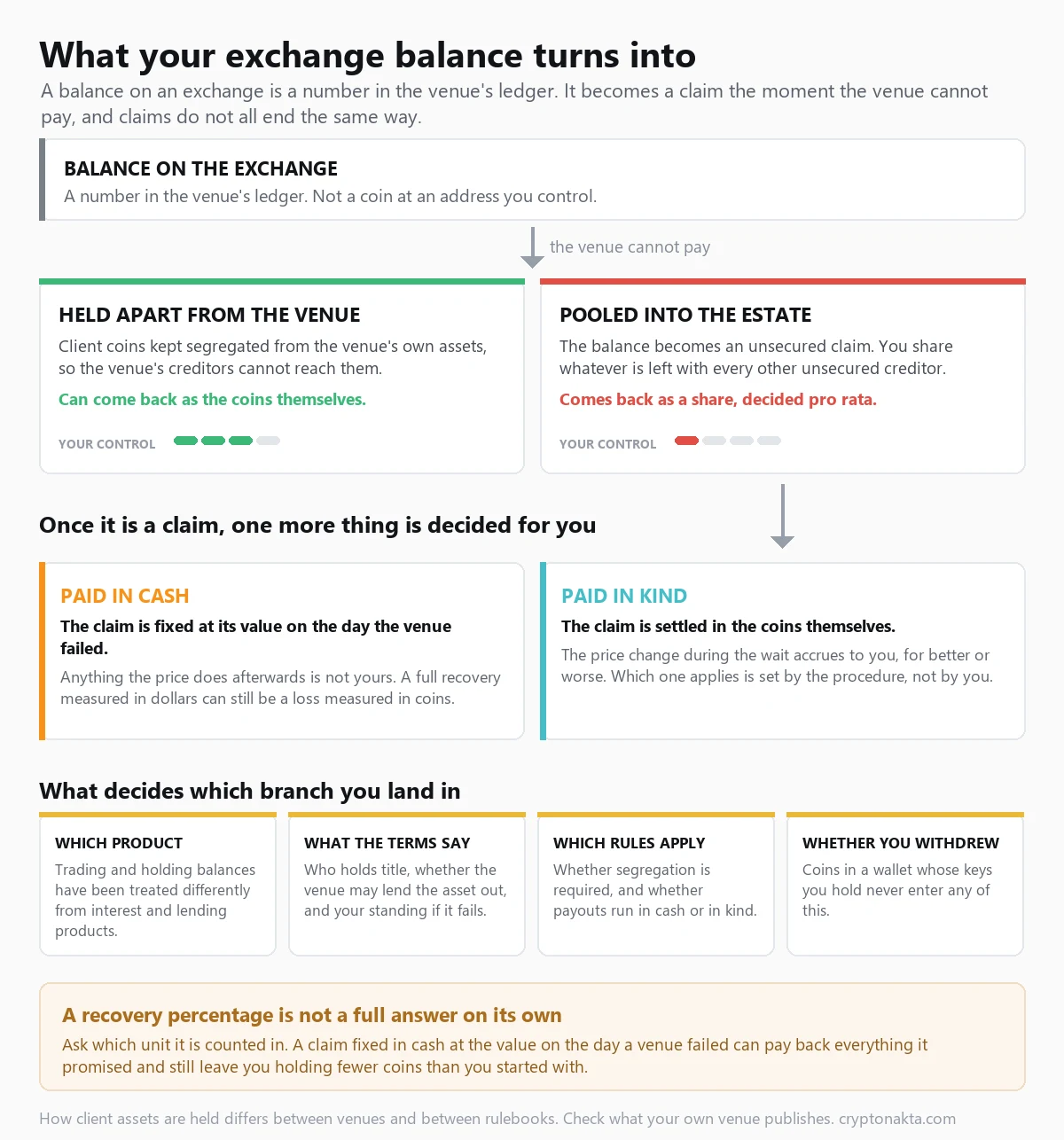
Once an exchange cannot meet withdrawals and an insolvency procedure opens, your balance stops being something you can use and becomes a claim handled by a trustee the court appoints. The first question is where the coins you deposited belong: with you, held apart from the exchange’s own property, or in the pool the trustee gathers up to pay creditors.
When the assets count as client property
Assets marked as client property in the records and at the wallet level, and held under an arrangement that keeps them legally apart from the company’s own property, sit out of reach of its creditors. The work to be done on them is identification and reconciliation, and once that is finished they can come back in the asset itself: the same coin, the same quantity. This is the strongest position a customer can be in, and it is still slow.
When the assets fall into the estate
Your rank is the second question, and how the first one came out decides it. If title to the deposited assets had passed to the company, or if client property cannot be picked out because everything was commingled and the records will not support the exercise, the assets go into the estate. You are then a general unsecured creditor, paid from what the trustee collects and sells, after secured claims and the costs of the case, at the same percentage as everyone else in your class. That percentage is a pro rata distribution, and neither the figure nor the date is yours to set.
| What your balance becomes | Legal character | What comes back | How much control you have |
|---|---|---|---|
| Client assets legally segregated | Your property, and the company’s creditors cannot reach it | Can come back in kind: same asset, same quantity | Highest of the four, and you still wait for the procedure |
| Assets pooled into the estate | You are demoted to a general unsecured creditor | A share of the proceeds, at the same percentage as your whole class | Low. Neither the percentage nor the schedule is yours to set |
| Payment stage: claim fixed in money | A money claim in a fixed amount | Cash calculated from the value on the day the exchange failed | None. Price movement after that day sits outside your claim |
| Payment stage: distribution in kind | A claim performed in the asset itself | Coins | None over the timing, but the price movement during the wait accrues to you |
3. Cash at the failure-date value, or the coins themselves
The third question is the unit. A claim has to be paid in something, and there are two mechanics: either it is converted into money at a value fixed on the day the case opened, or the coins themselves are distributed to claimants.
A claim fixed in money at the failure date
Some procedures value every claim as at a single moment, the day the case opens, which in United States practice is the petition date. From that instant your claim is a sum of money: if you deposited a coin, you hold a claim to the number of dollars that coin was worth at that hour. The logic is administrative, since one pool has to be divided among creditors who deposited dozens of different assets, and one unit of account makes claims comparable. The consequence for the claimant is that everything the price does afterwards sits outside the claim.
FTX is the case everyone has heard of, and this is what its plan did with customer balances. Claims were fixed in dollars as at the hour the case opened, when bitcoin traded around $17,000. A customer who deposited bitcoin holds a claim to that many dollars, and the plan pays dollars.
A distribution paid in the coins themselves
Mt. Gox is the contrast. Its failure moved out of bankruptcy in Japan and into civil rehabilitation, a procedure that allowed claims to be performed in the assets themselves. Claimants were paid in bitcoin and bitcoin cash alongside yen, and because what they received was quantity, the price movement across the years the procedure ran accrued to them.
Which mechanic applies follows from the procedure, from the law of the place the company was set up in, and from the plan the court approves, all settled without your input.
4. How a claim repaid in full leaves you holding fewer coins
A claim repaid at 100 percent, or at more than 100 percent, can still leave the holder with fewer coins than they deposited. The arithmetic behind that is ordinary. It happens whenever the percentage is measured in one unit and your holding is measured in another.
Work it through with a single coin. The exchange fails, the procedure fixes your claim at whatever that coin was worth on the day the case opened, and years later the plan pays in full. From the moment the claim became a dollar figure it stopped following the coin, so the number of coins you walk away with is set by one price the claim never tracked: what that coin costs on the day you are paid. At the same price you buy your coin back. At double the price a full recovery buys half a coin, and a 120 percent recovery buys 0.6 of a coin.
| Price when you are paid, against the failure-date price | A claim paid at 100% buys back | A claim paid at 120% buys back | Where that leaves your holding |
|---|---|---|---|
| The same | 1.00 coin | 1.20 coins | Whole, or slightly ahead |
| Twice as high | 0.50 coin | 0.60 coin | Half your coins gone, with the claim paid in full |
| Three times as high | 0.33 coin | 0.40 coin | Two thirds of your coins gone on a full recovery |
| Half as high | 2.00 coins | 2.40 coins | More coins than you deposited |
Assumes one coin deposited, the whole payout used to buy the same asset back, and no fees or tax.
The last row matters as much as the others, and it is the one that gets left out of angry commentary. If the asset is cheaper on the day you are paid, a claim fixed in money is the favorable side of the same mechanic: you receive dollars struck at a higher price and buy back more coins than you lost. Fixing claims at a date cuts price risk off at an instant, and which party that helps depends on what the market did afterwards.
A recovery percentage is a statement about the allowed claim, measured in the unit that claim was fixed in. To convert one into your own position, divide the payout by the asset’s price on the day the money arrives, then compare that quantity with what you deposited.
5. Two customers, one exchange, two different verdicts
Two customers of the same exchange have walked out of the same insolvency with completely different outcomes, and what separated them was which product their assets were sitting in. In the Celsius bankruptcy in the United States, assets in the interest-bearing Earn accounts were held to be property of the estate, while assets in the plain custody accounts were ordered returned to the customers who deposited them.
The court read the terms of use that Earn customers had accepted, found that those terms transferred title to the deposited assets to the company, and concluded that the assets belonged to the estate. Those customers became unsecured creditors. Holdings in the custody and withhold accounts, on the order of $44 million, were ordered returned in the same case. One exchange, one moment of failure, two answers, and what decided which answer a customer got was the document they had clicked through at sign-up.
“Not your keys, not your coins” is the phrase everyone already knows, and this is the ruling that gives it legal content: title to a deposited asset is set by the contract you accepted, and a contract can move it. Read that way, the phrase tracks the wording of each product’s terms. The Earn terms handed title to the company; the custody terms left it with the customer, inside the same company and the same failure.
Interest is the most reliable signal of which bucket a balance is in, because a return has to come from somewhere: lending to borrowers, deployment into a protocol, market making, funding-rate positions. That is what the product is, and it puts two questions on the table at once. Will the strategy perform, and where does this balance stand if the company fails? The second one is answered in the terms rather than in the rate. Plenty of readers here use these products, and our explainer on how crypto interest products work covers the machinery. The same question follows any balance the platform is permitted to do something with, margin collateral and staking arranged through the site included.
6. What actually decides which outcome you get
Two of the three questions were settled long before any procedure opened, by decisions taken while everything still worked. They are ordered here by how much of each one is yours to make, and each carries an action that is available while the account still works normally.
| What splits the outcome | Why it splits | What you can do about it today |
|---|---|---|
| Which product the assets sat in | Custody and trading balances have been treated differently from interest and lending balances in the same insolvency | Decide separately how much belongs in a yield product and how much does not |
| Who holds title, in the words of the terms | A ruling turned on this sentence, and it is where ownership of a deposited asset is settled | Search the document for title, ownership, legal owner, beneficial owner, remain your property |
| Whether the company may lend or pledge the asset | Permission to use puts somebody else’s credit inside your balance, and it often changes how the asset is characterized | Search for lend, pledge, hypothecate, rehypothecate, right to use, invest, commingle |
| What the terms say about a failure | The document may have placed you as a general creditor before anything went wrong | Search for insolvency, bankruptcy, liquidation, unsecured, general creditor, priority |
| Which procedure and which rulebook | Whether segregation is a legal duty, and whether payment is in cash or in kind, follow from the procedure | Read what your exchange publishes about how client assets are held |
| Money balance or coin balance | Fiat balances often attract bank trust arrangements and priority payment; coins attract holding and storage duties instead | Place your balances knowing the two are not equally protected |
| Whether you withdrew | Coins at an address you control enter no procedure at all | Set the threshold above which coins leave the exchange, and automate it |
The quickest row to act on is the second one. Open the terms of use for the account you use most, search the document for the word title, and read the sentence it lands you in.
7. Why recovery takes years
Recovery from an exchange failure of any size is measured in years, and for the whole of that period the balance is immobile. Set the shortfall in coins against the years the position cannot move, and the years are often the more expensive of the two.
The duration is structural. A trustee has to secure whatever assets exist and work out which of them are client property, rebuild a usable ledger covering the whole customer base, settle claims including from customers who dispute the balance on record, and chase money owed by trading partners and related companies. Only then does a plan reach the court, and only after the court approves it does money move, in tranches, with verification at each one.
While the procedure runs you cannot sell the position, move it, hedge it, post it as collateral or rebalance around it. Every decision you would have taken about that part of your holdings during those years gets taken for you by somebody else’s timetable. Customers of failed exchanges have in fact been repaid. It took years, and the amount, the unit and the date were all settled by other people.
One consequence is a market most people never hear about until they are inside a process. Insolvency claims can be sold, with buyers offering cash now at a discount to the recovery they expect. What gets traded is time against final value, and it is a legitimate market, unlike the impersonation attempts and up-front fee demands that also follow a failure.
8. What proof of reserves cannot show
Proof of reserves shows that assets were sitting at identified addresses at one moment, and lets a customer confirm that their own balance was included in the total those assets were measured against. Both of those are facts about the asset side of the balance sheet. Money borrowed against the same coins sits on the other side, where the report does not reach.
What the check actually does
The exchange takes a snapshot of customer balances. Each account is hashed into a leaf of a Merkle tree, the exchange publishes the root together with the total of the balances inside it, and hands each customer the path needed to confirm their own leaf is part of that root. The asset side is shown separately, usually by signing messages from the addresses the coins sit at. The coverage ratio quoted is assets held divided by the customer balances inside the tree. Some platforms wrap the inclusion check in a zero-knowledge proof, so you can check that your balance was counted without seeing anyone else’s.
| What proof of reserves establishes | What stays invisible inside it |
|---|---|
| Assets were present at those addresses at the snapshot moment | Whether those assets were borrowed, or pledged to somebody else |
| A customer can verify their balance was in the tally | Whether other accounts were left out of the tally |
| The size of the asset base inside the audited scope | Assets outside that scope, and liabilities sitting off the balance sheet |
| The coverage ratio at the moment of the snapshot | Everything that happened between one snapshot and the next |
| In one line: the assets are there | In one line: whether it can pay what it owes |
Four things to read off a report when you open one. The snapshot date, and how often snapshots repeat. Which assets are in scope. The per-asset coverage figure, taken from the exchange’s own current page, since that number is restated with every snapshot. And which side of the balance sheet the verification covered, which the report states in its own scope note.
9. The machinery that keeps client assets separate
Protection of client assets is assembled from a handful of components that recur everywhere in different combinations, and knowing them turns a disclosure page into something you can read for information. Three do most of the work. Records and addresses are kept segregated, so client property can be identified by somebody who did not build the system. A legal arrangement, commonly a trust or a statutory ring-fence, holds client assets outside the pool a failed company’s creditors can reach, and that arrangement is what settles the first question, whose property the assets are. And a liability standard makes the platform answer for client coins, or for the means of access to them, lost through its own fault.
The European Union’s MiCA regime shows several of these in one instrument. Its custody rules, gathered in Article 75, require a provider to hold clients’ crypto assets separately from its own holdings and to keep client holdings identifiable, and they keep those assets legally separate from the provider’s own property, so its creditors cannot reach them if it fails. The same article also makes a provider answer for client crypto assets, or the means of access to them, lost through something attributable to the provider, measured at what the asset was worth when it was lost. Other rulebooks assemble the same components differently, through trust accounts, duties to hold the same kind and quantity of each coin, independent audit of the separation procedure, and minimum offline storage proportions.
The gap most readers have not noticed
In nearly all of these frameworks the money balance and the coin balance are protected by different instruments and to different strengths. Fiat can sit in a bank, in trust, invested only in safe assets, sometimes with a defined priority for customers if the firm fails. Coins attract holding duties, storage requirements and audit obligations instead, since holding a specific quantity of a specific asset in trust is harder to arrange than holding money in an account. Neither is a deposit guarantee scheme, and the arrangement covering a currency balance does not extend to the coins in the same account. If your working balance is dollar-denominated, our explainer on what a stablecoin is matters here too, since a stablecoin balance is a claim on an issuer sitting inside a claim on an exchange.
Exchanges differ in how they arrange all of this and in how much of it they publish, so the accurate starting point is what yours publishes: the custody wording in the terms of use, the reserve report page, and any audit statement. Read the word “segregated” carefully while you are there, since some disclosures use it for an operational split in the ledger and others for a legal arrangement, and only the second one changes whose property your balance is. Our checklist for judging an exchange runs those checks in order. While you are in the account settings, switch on what is entirely yours to control: app-based two-factor authentication rather than SMS where both are offered, a withdrawal address whitelist so payouts can only reach addresses you approved in advance, and a clear-out of unused API keys. None of that changes an insolvency outcome. It addresses an account being taken over, a separate risk that arrives with no procedure attached to it.
The platforms below are ones we hold accounts with and link to commercially. The line under each is something you can verify on their own pages, and none of it is a safety claim, because nobody outside a company is in a position to make one.
Binance

OKX

Bybit

Gate.io

Affiliate disclosure: some links are partner links. We may earn a commission at no extra cost to you. This is not investment advice.
10. Why warning signs mislead more often than they warn
The signals people list as warnings before an exchange fails also appear on entirely ordinary weeks, which means any one of them read alone will mislead you more often than it warns you.
Withdrawals paused for one asset are routinely caused by node maintenance, a chain upgrade, a congested network or a bridge issue, and they normally arrive with a notice naming the network. Withdrawals taking longer than usual are frequently a batching window, a compliance review triggered by a pattern rather than by you, or a risk hold on a newly added address, and our explainer on why a withdrawal is still pending walks through the ordinary causes. A sudden high-yield promotion means the exchange wants deposits, which is what commercial businesses do; a marketing push and a funding problem look identical from outside. Even an account frozen outright usually has a procedural explanation, the subject of our guide to frozen withdrawals and locked accounts.
What carries more information than any single signal is a cluster: several at once, across multiple assets and networks, persisting past the stated window, with no notice naming a cause and with support giving answers that do not match each other. Even a cluster shifts a probability rather than settling anything. People outside an exchange do not have the balance sheet, and pattern-matching from outside has produced confident wrong calls in both directions.
One move needs no verdict at all, and that is the size of the balance you keep there. If a cluster of signals bothers you this week, moving part of that balance out this week does not require you to be right about the cause.
11. Fraud aimed at creditors, and the records you cannot make later
An insolvency procedure creates something that did not exist before: a documented list of people known to be owed money, known to hold crypto, and known to be waiting for a message about it. That list has to be assembled, verified and communicated, and creditor data of exactly this kind has been exposed in a breach at a claims agent, which is what makes impersonation of the trustee or the claims agent so convincing: the name and the claim amount in the message are real. The other shape it takes is a demand for money before a distribution reaches you.
The adjacent fraud is the offer to recover or trace funds for an up-front fee, which follows every large loss event, and our piece on whether scammed crypto can be recovered covers how those operations are structured. One test sorts them quickly. Buying a claim sends money toward you, and a service that needs paying first has the same shape as the loss it offers to undo.
The records to download while you still can
After an exchange stops operating the interface may not open at all, and support may be a notice board on a court docket instead of a help desk. Every piece of evidence a claim needs comes out of that interface. Put these on a calendar and let the files pile up in a folder.
- Screenshot the balance page with the date visible. Login may be unavailable after a failure.
- Export trade, deposit and withdrawal history as files. Claim registration needs the history, and the export tool goes away with the site.
- Keep the transaction hashes of your deposits. The chain keeps the record, but you need the link between that record and your account.
- Keep the account emails: opening, verification, notices. They are used at the identity-verification stage.
- Save a copy of the terms of use you accepted. That document decides how your balance is treated, and published versions get replaced.
- Write down the threshold above which coins leave the exchange. A threshold decided after a failure is not a threshold.
12. Deciding how much sits where
Splitting your holdings into three is what turns all of this into a number: a working balance that stays where you trade, since moving it back and forth costs fees and creates chances to send coins to the wrong place; a yield allocation, which can be treated differently from a custody balance and deserves a number of its own; and a long-term holding, where the question is whether it sits on an exchange at all.
| Where it sits | Risk you are carrying | If the exchange fails | If you make a mistake |
|---|---|---|---|
| Exchange trading balance | Counterparty risk on the exchange | Becomes a claim, and you wait for the procedure | There is a support desk and a procedure |
| Exchange interest or lending product | Counterparty risk, plus the risk in whatever generates the yield | May be characterized differently from a custody balance | A desk exists, and your rank may sit further back |
| A wallet whose keys you hold | No counterparty risk | Nothing happens to your coins | No support desk exists. A lost or exposed key is final |
The threshold is what makes this work, and the number is personal. Pick an amount, or a share of your holdings, above which coins move off the exchange, write it down, and attach it to something that already happens, such as a sweep after each purchase, so a routine executes it instead of your mood on a difficult day.
What changes when you hold the keys
Moving coins to a wallet whose keys you hold takes an exchange’s balance sheet out of your risk entirely, and puts in its place a set of losses with nobody to appeal to. A seed phrase lost in a house move. A seed typed into a page that looked like wallet recovery. A transfer sent over the wrong network. A signature approving something you did not read. Nobody can reverse any of those, and no procedure eventually returns a percentage. Our wallet guide covers how keys and backups work, and the piece on what to do when a seed phrase is exposed is worth reading before you need it. This changes the type of risk you carry, and it improves a long-term holding only if you are prepared to handle the type you take on.
Three things you could write down today: the share of your holdings you are willing to hold as claims on exchanges, which products those claims sit in, and the date you last exported your records.
13. Glossary of the legal terms that decide the outcome
These terms decide what happens to a balance, and most come from insolvency and trust law rather than from crypto. Knowing them makes a disclosure page and a court filing readable.
- Custodial account. An account where the platform holds the assets and keeps a record of what you are entitled to, which makes your position an obligation of that company.
- Segregation of client assets. Holding client coins apart from the firm’s own, in the records and at the address level, so client property can be identified later.
- Ring-fencing, trust. A legal arrangement placing client assets outside the firm’s own property, so its creditors have no recourse to them.
- Estate. The pool of assets gathered up when a company fails, sold by a trustee the court appoints, and shared out among the creditors.
- Unsecured creditor. A creditor with no security over specific assets, paid out of the estate after secured claims and the costs of the case.
- Pro rata distribution. Every creditor in a class receives the same percentage of their allowed claim, however much or little is available.
- Petition date, claim fixed in money. The day a case opens, and in United States practice the date claim values are fixed at, after which price movement in the original asset no longer affects the claim.
- Distribution in kind. Performing a claim in the asset itself rather than in cash, so the claimant receives quantity.
- Rehypothecation. Reuse by the custodian of assets a customer provided, typically as collateral for the custodian’s own borrowing.
- Proof of reserves. A published attestation of assets held at a point in time, usually with a Merkle tree so a customer can confirm their balance was counted.
- Self-custody. Holding coins at addresses whose private keys you control, which takes the company out of the position entirely.
Questions readers ask before they move anything
Compare exchanges: what each one publishes about custody, reserves and account protection