Kaspa (KAS): The Toccata Hard Fork Just Landed. Is It Enough?
The Toccata hard fork just turned Kaspa’s fast proof-of-work blockDAG into a programmable Layer 1. What’s actually new, what the fair-launch story leaves out, and why “ASIC-resistant” stopped being true years ago.
| What | Detail |
|---|---|
| What it is | Proof-of-work Layer 1 using GHOSTDAG, a blockDAG that processes blocks in parallel instead of discarding “orphan” blocks |
| Speed | ~10 blocks/second, near-instant confirmation |
| Just happened | Toccata hard fork, live June 30, 2026: native covenants (SilverScript), base-layer KRC-20 tokens, ZK-proof verification |
| Price context | ~$0.03 as of early July 2026, close to 85% below its ~$0.207 all-time high (July 2024) |
| Fair launch | No premine, ICO, or VC allocation at Nov 2021 launch — but also no protocol treasury funding the ecosystem |
| Mining reality | Marketed as ASIC-resistant; ASICs (IceRiver, later Bitmain) dominated within 18 months |
| Where to buy spot | Bybit, OKX, Gate, KuCoin, MEXC — Binance offers KAS futures only, no spot |
1. Kaspa Just Shipped Its Biggest Upgrade Ever. The Market Shrugged.
2. Why Kaspa Runs on a blockDAG Instead of a Blockchain
3. What Toccata Actually Unlocks: SilverScript, KRC-20, and ZK Opcodes
4. The Fair-Launch Story Everyone Tells You
5. …And the Part Almost Nobody Covers: No Treasury Means No One’s Funding the Ecosystem
6. “ASIC-Resistant” Was the Pitch. IceRiver Ended That in 18 Months.
7. Can a Leaderless, Treasury-less Chain Actually Beat Ethereum L2s and Solana for Developers?
8. The Numbers: Supply, Emission, and the Chromatic Phase
9. What’s Next After Toccata: DAGKnight, Clearly Labeled as Roadmap, Not Reality
10. Where to Actually Buy KAS
11. Glossary: The Terms This Article Uses
Kaspa spent close to three years building toward Toccata: native covenants, base-layer tokens, zero-knowledge verification baked into consensus, the whole programmable-Layer-1 pitch in one release. It activated on June 30, 2026. KAS popped 10-15% that week, gave almost all of it back within seven days, and by early July the price chart barely shows the fork happened at all. That disconnect, between what actually shipped and how little the market cared, is the honest starting point for this coin, and it drags in the questions Kaspa’s fan base tends to skip past: what “fair launch” quietly cost the project once the mining was done, why the original ASIC-resistance pitch didn’t survive contact with 2023, and whether a chain with no leader and no treasury can actually pull developers away from Ethereum’s L2s and Solana.
1. Kaspa Just Shipped Its Biggest Upgrade Ever. The Market Shrugged.
Kaspa’s mainnet crossed DAA score 474,165,565 at around 16:15 UTC on June 30, 2026, and with it came
Toccata, the biggest protocol upgrade the chain has shipped. Three pieces of engineering landed in a
single activation: native covenant programming, a base-layer token standard, and zero-knowledge proof
verification, all wired directly into consensus instead of bolted on top of it after the fact. Anyone
who’s been tracking Kaspa’s roadmap since 2023 or so had this specific release circled.
KAS rose about 10-15% in the days around the fork, then gave most of it back within a week. As of
this writing, KAS trades near $0.03, with a market cap sitting somewhere between $790M and $830M
depending on which tracker you check (CoinMarketCap, Bybit, and Gate don’t even agree on Kaspa’s rank,
placing it anywhere from the high-60s to high-90s among all coins, which tells you how thin and
fragmented altcoin-rank tracking gets once you’re outside the top 50). That price is down close to 85%
from Kaspa’s all-time high of $0.207, reached on July 31, 2024.
Toccata rewired what the chain is capable of running, top to bottom, and the market gave that news
about two weeks of attention before drifting back to where it started. That gap is worth sitting with,
because protocol upgrades tend to play out exactly this way: the real payoff, if there is one, takes
longer than a headline cycle to show up. Right now, Toccata is a capability that exists on mainnet and
nothing more. No live SilverScript application, no meaningful liquidity sitting inside a KRC-20
contract, nothing running on the new ZK opcodes yet, just the plumbing sitting there, built and waiting
for someone to use it.
proof-of-work coin,” skip to section 4 for the fair-launch story, section 6 for the ASIC-resistance
reality check, or section 10 to see where you can actually buy it (and where you can’t).
2. Why Kaspa Runs on a blockDAG Instead of a Blockchain
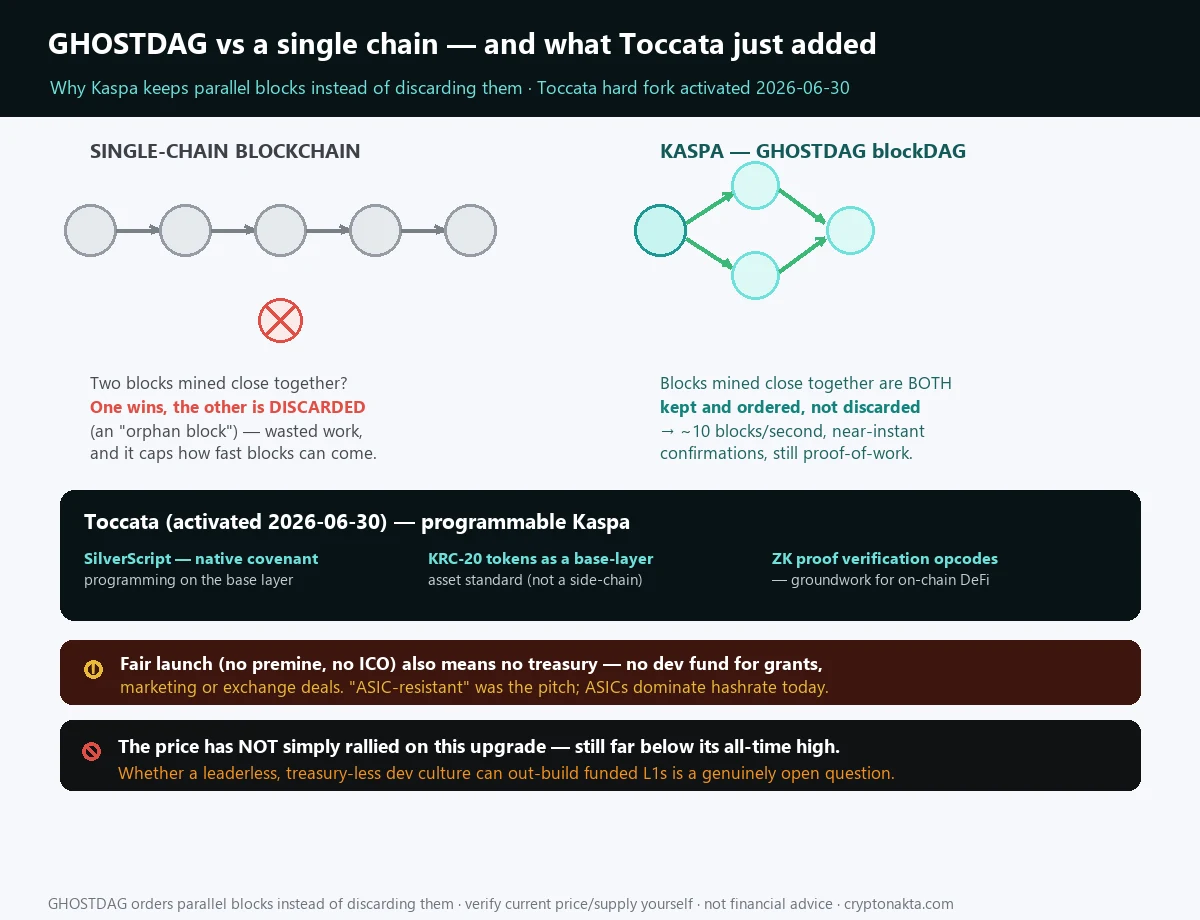
Bitcoin, Ethereum, and Litecoin all run on the same basic structure: a single chain, where one block
gets accepted at the tip at a time. That works fine until two miners find valid blocks within moments
of each other, which happens constantly at scale, and the network has to pick a winner. The loser’s
block gets discarded as an “orphan,” and the miner who found it walks away with nothing. Nothing was
wrong with their block. It just lost a timing race: some other node on the network happened to hear
about a competing block a few seconds sooner, and the protocol only has room for one winner. That’s
more than wasted electricity. It caps how fast the whole network can safely produce blocks, because shrinking the
interval between blocks doesn’t shrink the time a block actually needs to propagate across a global
peer-to-peer network. Push block times down too far on a single chain and orphan rates start climbing
fast. Bitcoin settled on 10-minute blocks for exactly this reason, and Litecoin, designed from the start
to be the faster option, still only made it down to 2.5 minutes before the same physics caught up with
it.
Kaspa’s answer, GHOSTDAG (Greedy Heaviest Observed Sub-DAG), throws out the single-chain assumption
entirely. Instead of a chain, Kaspa is a blockDAG: a directed acyclic graph where multiple blocks can be
produced in parallel, each one referencing several “parent” blocks instead of just one. When two miners
find blocks around the same time, GHOSTDAG doesn’t discard either one. It runs a deterministic ordering
algorithm that classifies blocks as “blue” (honestly contributing to the main structure) or “red”
(off to the side, usually from network delay rather than an attack), and then merges everything into a
single total order that every node can agree on. Nothing gets thrown away. Both blocks’ transactions
end up counted.
The practical result is a chain producing somewhere around 10 blocks per second, about 6,000
times faster than Bitcoin’s block cadence, with confirmations that feel close to instant because you’re
waiting a fraction of a second for the next several blocks rather than minutes for the next one. For a
chain that started out pitching itself as a payments and store-of-value network, the UX gap between
“your transaction confirmed” and “your transaction confirmed and the merchant can trust it” shrinks to
something closer to a card swipe than a bank wire. Toccata builds directly on this property: a chain
that can settle a lot of small blocks quickly is a sturdier base for token transfers and
covenant-checked transactions than one that batches everything into rare, heavy blocks.
3. What Toccata Actually Unlocks: SilverScript, KRC-20, and ZK Opcodes
“Programmable Layer 1” gets thrown around loosely in crypto coverage. Toccata backs the phrase with
three specific, separately shippable pieces of engineering.
SilverScript gives Kaspa native covenants. A covenant is a spending condition that goes further
than an ordinary signature check: it also locks down how a UTXO can be spent and what shape the
resulting transaction has to take. Non-custodial vaults, escrow that enforces its own rules, and
DEX-style order logic that can’t be quietly rewritten by whoever happens to hold the private key: all
three run on covenants under the hood. Kaspa builds this without bolting on a general-purpose virtual machine the way account-based
chains do. It extends the UTXO scripting model instead, which keeps transaction validation cheap and
parallel-friendly, the same property that makes GHOSTDAG fast to begin with.
KRC-20 existed before Toccata, but as an off-protocol convention: tokens were tracked by
indexers reading inscription-style data embedded in ordinary transactions, similar in spirit to how
early Bitcoin ordinals worked. If you held a KRC-20 token in 2024, your balance was really only as
trustworthy as whichever indexer you happened to be querying, and if that indexer’s node crashed, fell
behind, or shipped a bad update, two wallets could disagree about what you owned. Toccata folds token
issuance and transfers directly into consensus, the same layer that already tracks every KAS balance.
Transfers become atomic, nobody has to trust a third-party indexer to stay online and honest, and moving
value around no longer needs bridging or wrapper contracts.
ZK opcodes let the chain verify a zero-knowledge proof directly: an application does the heavy
computation off-chain, hands Kaspa a compact proof that the computation was done correctly, and the
base layer checks that proof cheaply instead of re-running the computation itself. Rollups on Ethereum
and proof-carrying apps elsewhere run on this exact mechanism, and Kaspa now has the raw opcode support
to do the same thing. Nobody has shipped a mature rollup on top of Kaspa yet, which is a separate,
harder project from simply having the opcodes to build one.
| Element | What it does |
|---|---|
| Activation | Mainnet, June 30, 2026, ~16:15 UTC, at DAA score 474,165,565 |
| SilverScript | Native covenant-programming compiler for Kaspa’s UTXO model, no separate global virtual machine |
| KRC-20 | Token standard moved into base-layer consensus (previously handled by an indexer layer on top) |
| ZK opcodes | Zero-knowledge proof verification available directly at L1 |
| Precursor | Covenant functionality was live-tested on Testnet 12 before this mainnet activation |
| Net shift | Payments-and-hodl chain → programmable base layer with room for DeFi-style applications |
These three pieces together are the raw materials for smart contracts and DeFi running on a
proof-of-work blockDAG, a genuinely different approach from how Ethereum or Solana build the same thing
(more on that in section 7). Nobody has actually built with them yet, and that’s the honest state of
play as of this writing: a working DEX, a lending market, a vault protocol that actually holds user
funds under a covenant instead of a multisig, none of it exists on Kaspa today. Each one is its own
multi-month engineering project that has to start now, on top of what went live on June 30.
4. The Fair-Launch Story Everyone Tells You
Kaspa’s mainnet went live on November 7, 2021. There was no presale. No ICO. No venture round. No
allocation set aside for a founding team, a foundation, or early backers. Whatever KAS exists today came
out of the same proof-of-work mining process, mined by whoever pointed hardware at the network, starting
from block one. Even Yonatan Sompolinsky, the researcher behind the GHOSTDAG protocol and the project’s
most visible technical figure, got his coins the same way everyone else did: by mining.
Not many top-100 chains launched this decade can say the same thing. Most Layer 1s that started around
the same era, and plenty that started since, carried a seed round, a strategic round, a public sale,
and a team-and-advisor bucket that together often add up to a third or more of total supply before a
single retail buyer gets a chance. Kaspa skipped all of it. Every KAS in circulation, about 27.5
billion of it, was earned through mining, with no early-insider head start.
This is the part of the Kaspa story that shows up in nearly every writeup, and it’s the line crypto
Twitter’s proof-of-work crowd reaches for first: “the fastest fair-launch PoW chain.” Fair launch is
real and the label is earned. What almost every retelling leaves out is the flip side of that same
decision: skipping a premine also meant skipping any pot of money Kaspa could later spend on itself,
and that trade-off runs deeper into the project’s day-to-day reality than most fans want to admit.
5. …And the Part Almost Nobody Covers: No Treasury Means No One’s Funding the Ecosystem
Fair launches carry a cost that rarely makes the highlight reel. If nothing was set aside at launch,
there’s no pot of money sitting anywhere that Kaspa can draw on today. No foundation treasury quietly
holding 15-20% of supply to fund grants, pay for audits, or write a check to get listed somewhere. No
team allocation vesting into a war chest for marketing or business development. Picture the first team
that wants to launch a lending market on top of SilverScript: a serious third-party audit from a firm
like Trail of Bits or CertiK runs anywhere from $50,000 on the low end to well over $150,000 for
anything with real complexity, and there’s no Kaspa treasury sitting around to underwrite that bill the
way the Aptos Foundation or the Sui Foundation could write a check for one of their own ecosystem
projects. Same story with the smaller stuff that keeps a chain visible: exchanges that expect a listing
fee, the grant that would pay a developer to build wallet tooling nobody wants to build for free on
their own time, the hackathon prize pool that actually pulls outside teams in instead of just the
regulars. A funded chain pays for all of that out of its treasury. Kaspa launched without one, by
design, and Toccata didn’t change that.
What’s stood in for that missing treasury since is the Kaspa Ecosystem Foundation (KEF), a non-profit
set up after launch, not funded from a premine. Its Katalyst grant program has reportedly put around
$10M toward ecosystem funding in its first stage, raised from donations, sponsorships, and outside
investment rather than drawn from a pre-allocated protocol treasury. A fully-funded competitor
foundation typically starts with several hundred million dollars set aside at launch and ready to
deploy on day one. Ten million dollars, raised piecemeal, doesn’t sit in the same universe. Kaspa’s
version has to be raised dollar by dollar, on an ongoing basis, from a community and a set of backers
who volunteered to fund it after the fact instead of drawing down a war chest that already existed.
The same imbalance shows up in development. There’s no single corporate entity or well-staffed
foundation running Kaspa’s roadmap the way a VC-backed L1 might have. It runs more like an open-source
project: a core group of committed contributors plus a wider volunteer base, the kind of setup that’s
clearly capable of producing something as technically ambitious as GHOSTDAG and now Toccata. What that
same setup struggles to do is compete on the unglamorous stuff (paid business development, marketing
budgets, exchange relations teams) that a fully funded competitor can simply write a check for. The
engineering side of Toccata’s rollout is already done, and GHOSTDAG plus Toccata together prove Kaspa’s
contributors can ship hard, novel cryptography on volunteer time. Getting SilverScript in front of
developers who’ve never heard of Kaspa, landing a feature placement on a major exchange, sponsoring the
conference talk that actually gets covered by crypto media: that’s paid work most well-funded L1s cover
with a marketing line item, and it’s the part Kaspa has to do slower, thinner, or sometimes not at
all.
6. “ASIC-Resistant” Was the Pitch. IceRiver Ended That in 18 Months.
The other founding claim was that Kaspa’s kHeavyHash mining algorithm would be resistant to ASICs,
keeping mining spread across ordinary GPUs the way it started. That claim held for about a year and a
half. In 2023, IceRiver, a Hong Kong-based mining hardware maker, released the first Kaspa-specific
ASICs, the KS0 through KS2 lineup, and GPU miners were priced out almost immediately. IceRiver remains
the dominant ASIC brand for Kaspa today, and hosted mining farms running its hardware operate across a
spread of low-electricity-cost jurisdictions, Dubai among them, where hosting providers have advertised
power rates around $0.0575 per kilowatt-hour. Bitmain has since entered with its own competing Antminer
KS-series units. Count it out and the ASIC-resistant window lasted from Kaspa’s November 2021 launch to
sometime in 2023, give or take a year and a half, with every year since running on specialized hardware
instead. Hashrate now sits with a relatively small number of large operators running that hardware. The
broad base of hobbyist GPU miners who mined KAS in year one is long gone, priced out the moment the
first ASIC shipped.
Kaspa’s defenders raise one counterargument that holds up: because GHOSTDAG produces close to
10 blocks a second instead of one every 10 minutes, a smaller miner or a solo operator finds blocks far
more often, in relative terms, than they would on a slow single chain like Bitcoin, where a tiny
hashrate share might mean going years between block rewards. Fast blocks reduce solo-miner variance in a
real, measurable way. Hashrate is still concentrated among a handful of large ASIC-hosting operations,
and that concentration hasn’t gone away just because small miners now see more frequent, smaller
payouts instead of one rare, large one.
| Claim vs. reality | Detail |
|---|---|
| Original pitch | kHeavyHash algorithm marketed as ASIC-resistant, GPU-mineable |
| What actually happened | Hong Kong-based IceRiver shipped the first Kaspa-specific ASICs (the KS0/KS1/KS2 line) in 2023, about a year and a half after launch |
| Hashrate today | Concentrated among a handful of large ASIC-hosting operations (Czechia, Norway, Dubai, Texas, Paraguay among them); Dubai hosting has cited power costs around $0.0575/kWh |
| 2026 mining economics | With KAS near $0.03 and difficulty near multi-year highs, about 87% of the ~24 tracked Kaspa ASIC models are unprofitable at $0.07/kWh; only the Antminer KS7 (~36 TH/s, breakeven ~$0.088/kWh) stays reliably in the black |
The 2026 profitability numbers are where this stops being abstract. Trackers cataloging close to two
dozen Kaspa ASIC models put about 87% of them underwater at a standard $0.07/kWh power rate, with KAS
trading around $0.03 and network difficulty sitting near multi-year highs. The Antminer KS7 survives
that squeeze on raw efficiency alone: 2,772 watts for 36 TH/s is a far better power-to-hashrate ratio
than older units like the KS5, which needs 3,000 watts for just 20 TH/s. That efficiency edge is
enough to keep the KS7 profitable down to just under $0.088/kWh, no pricing trick or difficulty
workaround required. Every other model on the tracker needs cheaper power than that, or a higher KAS
price, just to break even. Older units are in far worse shape: an IceRiver KS1, one of the
first-generation Kaspa ASICs, pulls 600 watts for just 1 TH/s, working out to roughly 7.8 times the
power draw per unit of hashrate the KS7 needs. There’s no power rate on the tracker, not even the
cheapest hydro or flared-gas deals miners
chase, that makes a KS1 profitable at today’s price and difficulty. Most operators still running
first-generation hardware have either upgraded to newer units, relocated to the small handful of
jurisdictions with the very cheapest power, or shut the machines off entirely. Emissions are already
shrinking on a steady monthly schedule (more on that in section 8), so the mechanism ahead is
straightforward if fees and on-chain activity don’t grow enough to close that deficit: unprofitable
miners switch off hardware, hashrate drops, and the network’s security budget shrinks with it. Kaspa’s
own community has raised this mining “death spiral” risk on public forums and developer calls before,
and it isn’t a hypothetical anymore. At today’s price and difficulty, the arithmetic already pushes
most of the deployed hardware into the red.
7. Can a Leaderless, Treasury-less Chain Actually Beat Ethereum L2s and Solana for Developers?
Ethereum’s rollups (Arbitrum, Optimism, Base, and the rest) sit on top of years of tooling, audited
frameworks, a Solidity developer population in the hundreds of thousands, and, in several cases, venture
backing or a corporate parent with real budgets for developer relations; Base is literally run by
Coinbase. Solana brings its own foundation with a treasury, a well-funded venture ecosystem around it, an
established DeFi TVL base, and a hackathon-and-grants machine that’s been running for years. Both
ecosystems have something Kaspa doesn’t have yet: existing liquidity and existing users who already trust
the chain with real money.
Kaspa is starting this specific competition from a cold start. Its programmability primitives are, as
of this writing, days old, built by a leaderless, largely volunteer development culture, with no
comparable treasury to fund grants, hackathons, or a developer-relations team. The technical case for
Kaspa holds up on its own terms: GHOSTDAG’s throughput and near-instant confirmation set it apart from
account-based chains, and building smart contracts on a proof-of-work blockDAG is a genuinely different
architecture from how Ethereum or Solana do it. None of that automatically pulls developers and
liquidity away from places where both already exist in abundance. Developers tend to go where the users
and the money already are, and users go where the apps already work.
So what did June 30 actually change for Kaspa’s odds in this race? Technically, a lot: working
covenants, a token standard wired into consensus, and ZK verification, all real and all live on
mainnet as of today. What that release couldn’t produce is a single existing user, a dollar of
liquidity already parked in a Kaspa contract, or a developer who already knows the tooling, because
Ethereum’s L2s and Solana spent years building exactly those three things up. Two numbers will tell the
real story over the next couple of quarters: how many independent teams ship a working SilverScript
application, and how much liquidity actually sits inside KRC-20 contracts once the initial testing wave
settles down. Track those.
8. The Numbers: Supply, Emission, and the Chromatic Phase
Kaspa calls its emission curve the “chromatic phase,” and it works nothing like Bitcoin’s four-year
halving cliffs. Instead of one big step down every so often, Kaspa’s block reward shrinks continuously:
every month, the reward multiplies by (1/2) raised to the power of (1/12), a smooth monthly decay rather
than a sudden cut. The starting reward was 440 KAS per block back in November 2021, and it’s been
sliding down that curve ever since. On current projections, the reward keeps shrinking on that schedule
for close to 36 years before it dips below one sompi, KAS’s smallest indivisible unit (0.00000001 KAS),
at which point emission effectively ends.
Kaspa has already mined 95.8% of its entire 28.7-billion hard cap, less than five years after a launch
that comes with a 36-year emission tail. Those two facts look like they should contradict each other,
and they don’t: because the decay is exponential and blocks arrive at 10 per second, the bulk of total
emissions gets front-loaded into the earlier years of the curve, and the long tail is real but it’s
mining out a shrinking fraction of a supply that’s already mostly issued. New-supply inflation from
mining is now a small and steadily shrinking part of the picture, which loops straight back to section
6’s mining-profitability numbers: as block rewards keep thinning, miners lean harder on price and fee
revenue to stay in business, and neither one has grown enough yet to make up the difference.
| Metric | Value |
|---|---|
| Mainnet launch | November 7, 2021 |
| Premine / ICO / VC allocation | None — fully fair-launched |
| Maximum supply | 28.7 billion KAS (fixed hard cap) |
| Circulating supply (early July 2026) | ~27.49 billion KAS (~95.8% already mined) |
| Initial block reward | 440 KAS per block |
| Emission model (“chromatic phase”) | Reward multiplies by (1/2)^(1/12) every month — a continuous monthly decay instead of a single quadrennial halving |
| Reward reaches minimum unit | ~36 years after genesis (drops below 1 sompi, the smallest KAS unit) |
| Block rate | ~10 blocks per second |
| All-time high | ~$0.207, July 31, 2024 |
| Price (early July 2026) | ~$0.03 (about 85% below ATH) |
| Market cap (early July 2026) | ~$790M–$830M depending on tracker |
9. What’s Next After Toccata: DAGKnight, Clearly Labeled as Roadmap, Not Reality
If you’ve read anything about Kaspa’s longer-term roadmap, you’ve probably seen the name DAGKnight.
People often talk about it like it’s already live. It isn’t, so here’s precisely what it is.
DAGKnight is Sompolinsky’s next research step past GHOSTDAG, aimed at a consensus protocol that’s
“no-delay-bound,” meaning it doesn’t need to assume a fixed maximum network propagation delay to hit its
security target the way GHOSTDAG’s current parameters do. The goal is a materially higher Byzantine
fault tolerance ceiling than the standard under-50%-adversarial-hashrate assumption most proof-of-work
chains, Kaspa included, currently rely on. In plain terms: a protocol that could theoretically stay
secure even if honest miners were a much smaller share of total hashrate than today’s models require,
while adapting automatically to real-world network conditions instead of a hardcoded delay assumption.
a developer test network, with core pieces already working in Rust: hierarchical conflict resolution,
incremental block coloring, and parent selection along the virtual selected parent chain. Cascade
voting, one of the remaining components a full implementation needs, hasn’t been built yet. A dev-net
is several stages removed from a public testnet, and a testnet is several stages removed from a mainnet
activation with a DAA-score date attached the way Toccata had. Anyone telling you DAGKnight is arriving
on a specific date is guessing.
Mentioning DAGKnight here says something about Kaspa’s research priorities: even with Toccata just
activated, the team’s stated next step is pushing consensus security further rather than pivoting
entirely to application-layer growth. That’s a bet on security research over developer outreach, made
at the exact moment well-funded competitors are courting builders with grants and hackathons Kaspa has
no comparable budget to match. Sompolinsky has spent years betting on consensus theory over marketing
before, and Kaspa exists at all because that bet already paid off once.
10. Where to Actually Buy KAS
Five exchanges on our list carry spot KAS: Bybit, OKX, Gate, KuCoin, and MEXC. MEXC was the earliest,
listing it in its Innovation Zone back in September 2022, not long after mainnet launch. KuCoin followed
in May 2023 with KAS/USDT and added a KAS/BTC pair in March 2024. Bybit and OKX both carry spot and
futures side by side, so if you want to size a leveraged position later, you can do that on the same
account you bought spot on. If cutting exchange fees on your first purchase matters to you, our
guide to buying crypto with the lowest fees and our full
exchange comparison cover the mechanics in more detail, and each of the exchange
cards below includes the sign-up flow and any referral benefit we’ve verified.
| Exchange | Spot | Futures | Notes |
|---|---|---|---|
| Bybit | Yes | Yes, up to 50x | Typical spot fees around 0.01% maker / 0.06% taker |
| OKX | Yes | Yes | Standard tier around 0.08% maker / 0.10% taker, lower at higher volume |
| Gate | Yes | Yes | Low fees, deep liquidity for KAS pairs |
| KuCoin | Yes (KAS/USDT, KAS/BTC) | Yes | KAS/USDT listed May 2023, KAS/BTC added March 2024 |
| MEXC | Yes | Yes | One of the earliest KAS listings (Innovation Zone, September 2022) |
| Binance | No | Yes, KAS USDⓈ-M perpetual, up to 50x | Futures-only since November 17, 2023; no spot KAS market |
One note on Binance: it lists KAS as a USDⓈ-M perpetual futures contract only (live since November 17,
2023, up to 50x leverage), not as a spot market, so if your plan is simply to buy and hold KAS, use one
of the five spot venues above instead.
Bybit

OKX

Gate.io

KuCoin

MEXC

Binance

Affiliate disclosure: some links are partner links. We may earn a commission at no extra cost to you. This is not investment advice.
11. Glossary: The Terms This Article Uses
| Term | What it means |
|---|---|
| GHOSTDAG | Kaspa’s consensus protocol. Orders blocks produced in parallel by classifying them as “blue” or “red” and merging all of them into one agreed-upon sequence, instead of discarding competing blocks the way a single-chain protocol does. |
| blockDAG | A directed acyclic graph of blocks, where a block can reference multiple parent blocks, as opposed to a blockchain, where each block has exactly one parent. Lets Kaspa produce many blocks in parallel. |
| Orphan block | On a traditional single chain, a valid block that loses the race to become part of the main chain and gets discarded, along with its miner’s reward. GHOSTDAG’s whole design point is to avoid this by including near-simultaneous blocks instead of throwing them out. |
| DAGKnight | Kaspa’s next-generation consensus research direction, aimed at a “no-delay-bound” protocol with a higher Byzantine fault tolerance target than GHOSTDAG. Early-stage research and prototype work only, not live as of this writing. |
| Covenant | A spending condition attached to a UTXO that goes beyond who can spend it and also locks down the shape the spending transaction must take. The building block behind vaults, enforced escrow, and on-chain order logic. |
| SilverScript | The compiler and scripting extension Toccata introduced for writing covenants natively on Kaspa, without a separate global virtual machine. |
| KRC-20 | Kaspa’s token standard. Before Toccata it ran on an off-protocol indexer layer; Toccata moved issuance and transfers into base-layer consensus. |
| Hard fork | A protocol upgrade that changes consensus rules in a way old software can’t validate, requiring every node to upgrade. Toccata is a hard fork; it activated at a specific, pre-announced block height (DAA score) that every participating node had to be running compatible software for. |