
Bank Account Frozen After a P2P Crypto Sale: The Dispute Button Cannot Reach It
The order shows completed and the coin is gone, but the banking app refuses everything. Where the authority really sits, and what to gather before it disappears.
| The question | The short answer |
|---|---|
| Why did it freeze? | Money that was reported upstream reached your account, and the report travels down the route that money took |
| Can the platform lift it? | No. It controls its own ledger and has no authority over a bank account. What it can give you is the order record |
| Doesn’t escrow cover this? | Escrow covers one risk: a buyer paying and not receiving the coin. The origin of the money was never inside its scope |
| Who can lift it? | The bank holding the account, the counter that received the report, and the body that instructed the hold |
| How long will it take? | Nobody can tell you. It varies case by case, and anyone quoting a figure attached to a fee is running a second scam |
| What decides the speed? | The records that exist, the counter you take them to, and whether the money is still sitting in the account |
| What do I do right now? | Stop moving funds, save the order record and chat today, and ask your bank what is restricted and who instructed it |
1. The order says completed. The banking app says blocked.
2. One trade, two rails: where the coin moves and where the money moves
3. Escrow was built to stop exactly one thing
4. How a stranger’s fraud report walks down a chain of accounts into yours
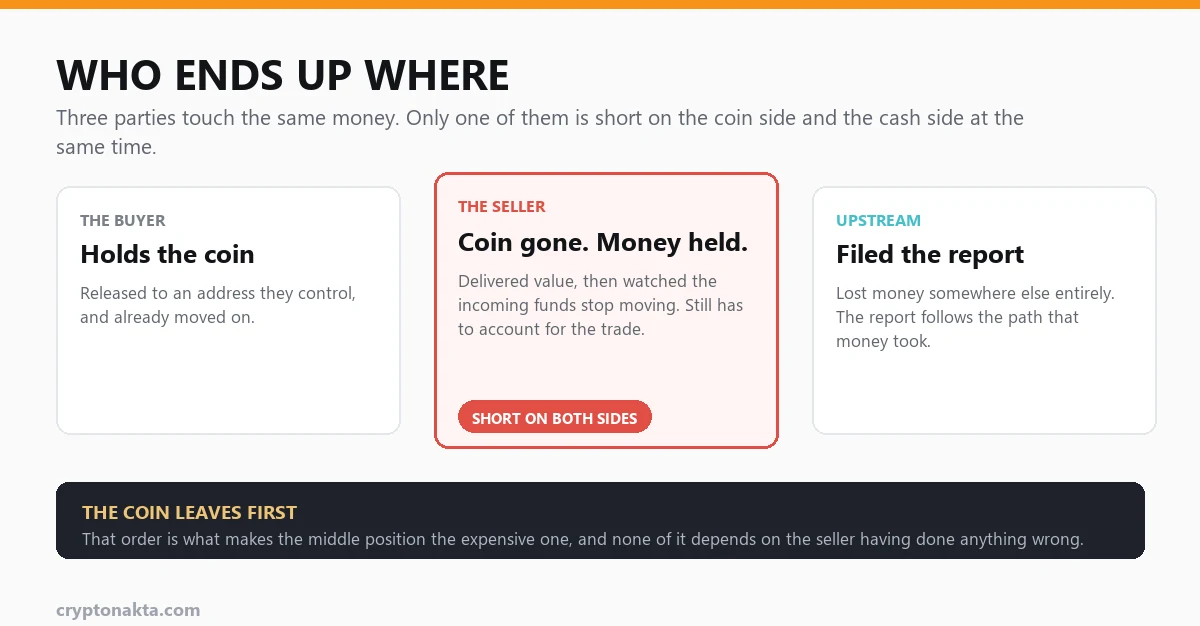
5. The seller is the only party who can lose on both sides at once
6. Who can actually lift a hold, and what the platform can hand you instead
7. Being a genuine trader is a claim you have to prove
8. The evidence that stops existing the moment the trade is over
9. Which counter to walk into, and what comes after it
10. If your account is locked right now, work in this order
11. Lowering the odds, and the exact point where each measure stops
12. Words you will run into while sorting this out
A peer-to-peer sale looks like a single transaction and behaves like two. The coin moves inside the platform’s own books, where escrow can lock it and release it. The money moves across the banking network, where the platform has no visibility and no power. That split is why a marketplace can complete an order and still be unable to help when the cash side goes wrong. Authority over a blocked bank account sits with the bank and with whoever instructed it, and the material that decides how that goes gets created while a trade is running.
1. The order says completed. The banking app says blocked.
Two screens, side by side, telling opposite stories. On the phone the P2P order sits at completed: the buyer marked the transfer as sent, the money landed, you released the USDT, the rating came through. On the laptop the banking app greys out every button. A card declines at a till and a standing order bounces.
The first instinct is to go back to the platform, and it is a reasonable one. The reply is polite and useless: the order completed, there is nothing to dispute, and the account you are asking about is not one they hold. Both statements are true, and neither of them reaches the account.
2. One trade, two rails: where the coin moves and where the money moves
One form, one order number, one counterparty. Underneath that surface are two systems with separate owners, separate records and separate rules about who may stop what.
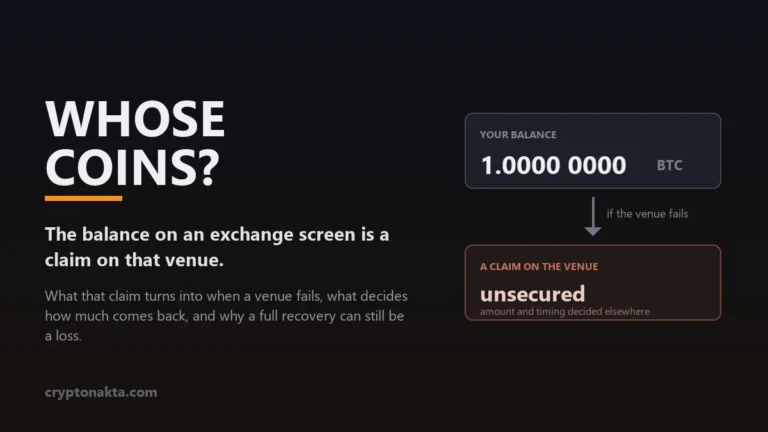
The coin side never leaves the platform. When the order opens, your balance moves into the platform’s custody, which is a change to an entry in its own database. If the buyer later sends that coin to an outside wallet, that becomes a blockchain transaction, but the part between you and the buyer is internal bookkeeping. An exchange balance is a claim on the venue’s books, the same thing that matters when a venue gets into trouble.
The money side never enters the platform at all. The buyer instructs their bank, that instruction crosses the payment system, and your bank credits your account. The platform never sees the transfer, never holds it, never verifies it. What it sees is you tapping a button that says the money arrived. Release is your own confirmation, written into the platform’s ledger, about an event on a network the platform cannot observe.
| What we are comparing | The coin side | The money side |
|---|---|---|
| Where it actually moves | Inside the platform’s own ledger | Across the banking network, outside the platform |
| Who can stop it | The platform, by locking escrow | Your bank, and whoever instructed your bank |
| What the platform is able to do | Lock it, hold it, release it | Nothing at all |
| What it protects you from | A buyer walking off with coin they never paid for | Nothing on this side falls under the order’s protection |
| What you, the seller, can see | Order status, quantity, timestamps, the chat thread | The credit that landed and the name your bank shows for the payer |
| What stays hidden from you | Which wallet the buyer moves the coin to afterwards | Where that money came from before it reached you |
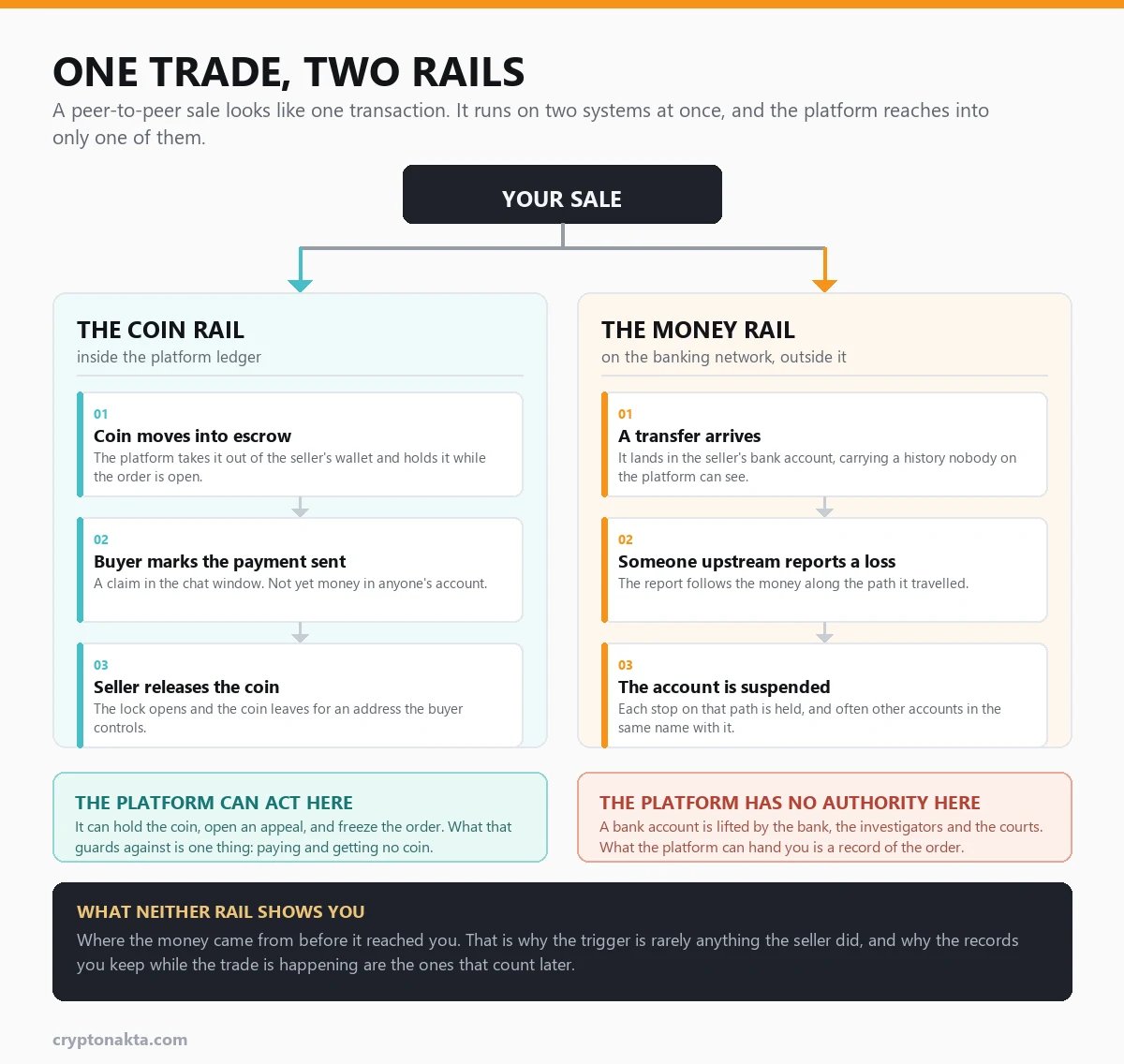
Where the buyer forwards the asset afterwards costs you nothing, since the price was agreed and the coin belongs to them. Where that money sat before it reached you is the one thing no version of this trade lets a seller check, and that gap is built into the structure. The platform can lock a row in its own database. Placing or lifting a block on a bank account happens somewhere it holds no account, no login and no standing.
3. Escrow was built to stop exactly one thing
Escrow gets treated as a general safety guarantee, which is far more than it ever claimed.
You post an offer. A buyer opens an order, and at that instant the platform moves the quantity out of your spendable balance and locks it. The buyer pays you outside the platform and marks the order paid. When you confirm the money is in your account, the lock lifts and the coin lands in the buyer’s balance. That prevents exactly one failure: a buyer who pays and never receives the asset. It also hands you a window, because until you press release the asset is still frozen in place.
That window is worth using. A notification image, a receipt the buyer forwards, or a credit that still shows as pending can all appear before any money has settled where you can spend it. Payment screens are trivially faked and pending credits get pulled back; the standard playbook around P2P leans on exactly that pressure. Open your own banking app, look at the available balance, and let the buyer wait.
4. How a stranger’s fraud report walks down a chain of accounts into yours
The sequence that ends at your banking app starts somewhere you were never able to see.
Somewhere upstream, a person is defrauded. They are talked into a transfer, or their online banking is taken over, or they pay for something that never arrives. When they realise it, they report it to their bank or to whatever reporting channel their banking system runs, and that report names an account: the one their money went to.
That account gets suspended, and the money is rarely still in it. It was pushed onward within minutes, sometimes through several accounts, often into a P2P purchase where it buys an asset that leaves for a wallet nobody can reach. So the suspension follows the trail, and the accounts further down belong to people who have never heard of whoever filed the report. That is the seat you were sitting in. You sold coin at a fair rate to a stranger who paid from a bank account, and that payment happened to be one link in the chain. Forum threads call what landed in your account tainted funds; the case file calls it reported money.
None of this machinery was built around crypto. Where a banking system runs a procedure of this kind, it reaches whatever the reported money was spent on, and sellers of second-hand goods or jewellery have described the same experience with no crypto involved anywhere. Sellers of crypto meet it more often for a dull reason: they accept transfers from strangers repeatedly, by design. The names differ from one banking system to the next, and the sequence is recognisable across them: a report is made, the money is traced, and accounts along the route stop moving while it is sorted out.
5. The seller is the only party who can lose on both sides at once
Walk down the line of accounts a report touches and look at what each party is left holding.
The person defrauded upstream has lost money and has a procedure built to help them recover it. The buyer has the asset and, if they were running the scheme, moved it out within minutes. The banks are executing instructions. The platform holds neither the money nor the coin, having released its side when you told it to. The seller is the only party who has already given up the asset while the cash sits immobilised, and depending on how the case resolves that cash may go back upstream. Once the coin is released, the only part of the exchange a procedure can still reach is the seller’s side of it.
The bill runs well past the amount that was frozen
Sellers do the arithmetic on the trade size. Holds do not always stop at one account. Mechanisms that extend a restriction to other accounts held in the same name are common across banking systems under various labels, and when that happens, Tuesday’s trade takes down things that have nothing to do with it. Salary lands in an account you cannot draw from. Direct debits and standing orders fail: rent, utilities, insurance, loan instalments, school fees. Card authorisations decline at the worst moments, and every one of those failures has its own counterparty wanting an explanation.
People who trade regularly keep the trading flow in one account and the household plumbing in another. When a hold lands, those failing debits need attention early, and separately from the case itself.
6. Who can actually lift a hold, and what the platform can hand you instead
The most expensive misconception here is that the platform’s dispute process connects to your bank. It does not, and the time spent discovering that is time the case sits still. A platform dispute governs an order on the platform’s books. While the coin is still locked in escrow that process has genuine force: the asset stays frozen, the other side gets a chance to respond, and staff decide who receives it after reviewing both parties’ material. Once you have released, those powers shrink quickly, and once the coin has moved to an outside wallet they are gone. A blocked bank account was never inside that scope at all.
| The situation | Who holds the authority | What the platform can do | What you do |
|---|---|---|---|
| You have not released the coin yet and the payment looks wrong | The platform | Keep the coin locked, open a dispute, act on the buyer’s account | Open the dispute while the coin is still locked |
| You released the coin and the payment was reversed | The platform, within narrow limits | Review the dispute, confirm the order record | Gather the record and file while the trail is fresh |
| Your bank account is blocked | Your bank, and the counter or authority that instructed it | Hand you the order record, nothing beyond it | Take that record through the procedure your bank names |
| Other accounts in your own name went down with it | Whoever placed the original hold | Not involved | Work the original case; the linked holds follow it |
| The coin has already left for another wallet | Nobody | Not involved | Drop the recovery expectation and put the effort into the account |
What to ask the platform for instead
There is still something worth having from them: the paperwork proving your side of the exchange existed. The full order record with numbers, timestamps, asset, quantity and price. The counterparty identifier exactly as displayed to you, including any verified name. The complete chat transcript, exported where an export exists. Confirmation that the asset was released, with the transaction hash if the coin left the venue. And, where support will provide it, a written statement that the order took place on their marketplace between those two accounts. Ask for all of it in one message, and keep the request separate from any argument about who is responsible.
What sellers assume, and what the system actually does
A handful of assumptions turn up in almost every one of these cases.
| What sellers assume | What the system actually does |
|---|---|
| Escrow is there, so P2P is covered | Escrow guarantees delivery of the coin. The origin of the money sits outside it |
| The platform arranged the trade, so the platform sorts out the fallout | The platform has no authority over a bank account. What it can give you is the record |
| My trade was clean, so the hold comes off quickly | Good faith is demonstrated through a procedure, and the funds stay still while that runs |
| The coin already left, so I have nothing more to lose | The coin left and the cash is immobilised. The seller carries both sides |
| Only the account that received the payment is affected | Holds commonly reach other accounts held in the same name |
| A big platform means this cannot happen to me | Venue size and the origin of the buyer’s money are unrelated questions |
7. Being a genuine trader is a claim you have to prove
The expectation at this point is a short conversation: the trade was clean, the records exist, someone reads them and the account opens again. What answers is a procedure that runs on documents.
The burden of showing what happened sits with you. Nobody reconstructs your trade from the outside; the bank has a credit and a report and no window into the platform where the other half of the exchange lives. What lands in front of a reviewer is what you put there, in the format they asked for.
And the funds stay where they are while that runs. There is no arrangement in which the money is unblocked first and the explanation follows, because the design assumes money that may belong to a victim should not move while that question is open.
Being asked for information is also not an accusation. Questions about the origin of funds are ordinary banking practice, and account holders with nothing unusual in their history field them regularly. The productive response is a boring one: answer precisely, keep the wording identical in every channel you use, and do not improvise.
One thing at this stage is still in your hands, which is where the money sits. A credit that arrived and stayed put makes a simple picture: it came in, it is still here, and this is what went the other way in return. A credit moved onward across several accounts adds hops, and each hop is one more item somebody wants accounted for, whatever the reason behind the moves. Amounts sitting far outside the pattern of an account’s ordinary income work the same way, and two sentences prepared in advance about why the flow looks like that beat assembling an answer under pressure.
8. The evidence that stops existing the moment the trade is over
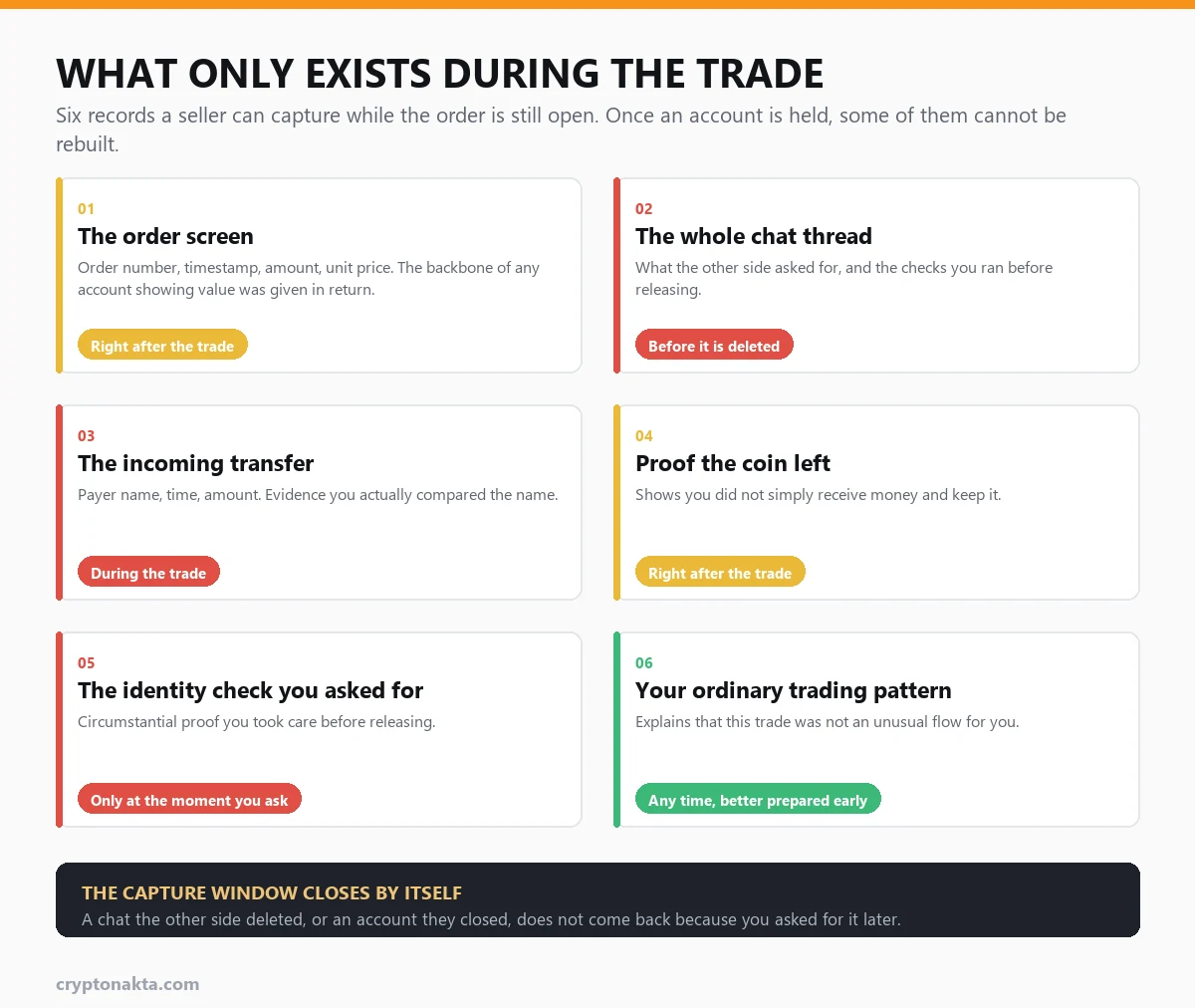
The material that carries weight can only be captured while the trade is running. Afterwards some of it is retrievable, some of it partly, and some of it is simply gone.
| What to capture | Why it carries weight later | When it is still possible |
|---|---|---|
| The order detail screen: order number, timestamps, quantity, unit price | Documents that value went the other way, with numbers attached | Right after the trade, while the order is still queryable |
| The full chat thread, top to bottom | Shows what the buyer asked for and what you checked before releasing | Before either side deletes it or the account closes |
| The incoming payment detail: payer name, timestamp, amount | Records who the payer was and when the credit actually landed | At the moment the credit lands |
| The release record, plus the transaction hash if the coin left the venue | Records that the asset went out, and where it went | Right after the trade |
| Any trace of asking the buyer to verify who they are | Shows the check happened before you released, with a timestamp | Only at the moment you ask |
| A picture of how your account normally behaves | Places the trade inside the account’s ordinary pattern | Any time, and easier if you keep it tidy in advance |
The chat thread goes first, since a counterparty who abandons an account can take the conversation with them, and a thread you never exported is one you are describing from memory. Their profile follows: verified name, completed-order count, registration age, payment methods offered, all of it evidence that you checked before trading. Order history and bank statements have their own limits, because interfaces cap how far back you can query and a blocked account is awkward to query at exactly the moment you need it.
9. Which counter to walk into, and what comes after it
Procedure names, deadlines and forms differ from one banking system to the next. The order of approach follows authority, so it holds even where every document in it carries a different name.
First: the bank that holds the account
This is where you learn what you are dealing with, and the answers change what you do next. Ask, in writing where the channel allows:
- What exactly is restricted: one amount, one account, or every account in the customer relationship.
- Who instructed it.
- What reference the case carries.
- What they need from you, in what format, sent where.
- Whether an internal review route exists, and what starts it.
Second: the counter that received the original report
A hold placed at someone else’s request generally comes off at their instruction, so the file that decides your case is often not held by your bank at all. It sits with whoever took the report upstream, which depending on the system may be the payer’s own bank, a police or fraud-reporting office, or a prosecutor’s office. Ask your bank to name that institution and to give you the reference the case carries there. Ask one more thing while you are at it: whether they forward what you send them, or whether you have to submit it yourself. Material that goes only to your own branch can sit in a folder nobody handling the case ever opens.
Third: the body that placed the hold
Submit a written account of the transaction in whatever form they accept. Keep it to one page in plain order: what you sold, on which marketplace, to which counterparty identifier, at what time, at what price, what landed in your account and under which payer name, and what you handed over. Number the attachments and refer to them by number in the text, so the order screen, the chat export, the credit line from your statement and the release confirmation each map to a line a reviewer can check without asking you. Put the case reference at the top of every page, send it through the channel they name, and keep whatever receipt that channel produces. If anything has to be certified, translated or copied onto a particular form, do that in the same pass.
Fourth: the route above it
Every banking system has a path beyond the first decision, under widely varying names: an internal appeal, a written objection to the institution, a complaint to an ombudsman or a supervisory office, and beyond that a court route where entitlement to the money is settled. Each of those has its own window, and that window usually starts running from a date printed on a notice. Ask which document starts that clock and where a copy of it is, and where the amount justifies the cost, someone qualified locally can tell you which of the routes fits your case.
10. If your account is locked right now, work in this order
If this is happening to you as you read, work through it in this order. None of it requires knowing yet which procedure applies where you bank.
- Leave the money alone. No transfers, no attempts through another channel, no asking anyone to move it on your behalf.
- Capture the trade record today. Order details, the full chat thread, the incoming payment showing the payer’s name, the release record and the transaction hash if the coin left the venue. Store it somewhere that is not the app.
- Put the five questions to your bank in writing: scope, who instructed it, the case reference, what they want from you, which review route exists.
- Establish which stage you are at. A short precautionary hold on one amount and a formal block on the account call for different urgency, and treating one as the other either wastes effort or loses time.
- Write one clean statement. One page, plain order, attachments numbered and referred to by number, no adjectives.
- Send it through the named channel to the party that placed the hold, and keep the submission receipt.
- Keep a log. Date, channel, who you spoke to, what was said, what was asked for. These cases repeat across shifts and departments, and the log stops you starting from zero.
- Handle the household fallout separately. If salary lands in a blocked account or direct debits are failing, tell those counterparties early that the account is under review. Late fees and cut-off services will not pause themselves.
- Do not pay anyone who guarantees an unfreeze. Nobody outside the case file can promise that outcome, and the fee leaves with whoever collected it.
One more situation comes up while an account is locked: someone contacts you claiming the money was theirs and asks you to send it back directly. You cannot verify who is writing, and a private transfer outside the procedure can leave you with the money gone, the coin gone and nothing on record showing anything was settled. Tell your bank you were approached, and let the counter handling the case decide where that money belongs.
11. Lowering the odds, and the exact point where each measure stops
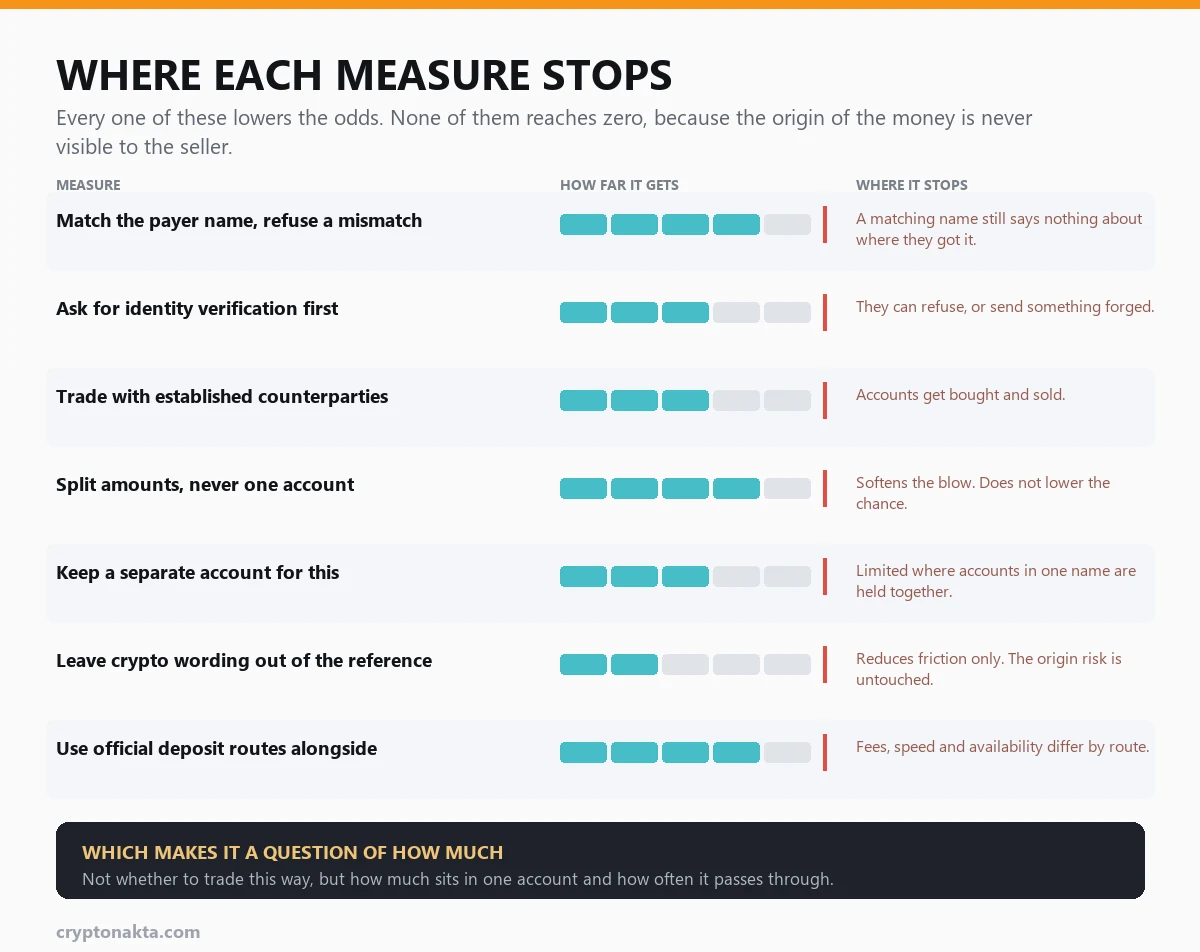
None of these measures removes the risk. Each one lowers the odds and then stops at a defined point, which the third column names.
| Measure | What it actually does | Where it stops |
|---|---|---|
| Compare the platform account name with the payer name, refuse any mismatch | Filters out money that passed through at least one other person | A matching name says nothing about where that person got the money |
| Ask for identity verification before you open the trade | Discourages impulsive approaches and leaves a timestamped record of the request | The buyer can refuse, and documents can be faked |
| Favour buyers with a long completed-order history | Shifts the odds in your favour | Accounts are bought, sold and taken over |
| Cap how much runs through any one account | Reduces how much of your life stops when a hold lands | The chance of it happening stays exactly where it was |
| Keep a separate account for P2P settlement | Keeps salary and household payments away from the trading flow | Where holds reach accounts in the same name, separation only goes so far |
| Keep crypto wording out of the payment reference | Cuts needless friction with automated monitoring rules | The source-of-funds risk is untouched, and it hides nothing |
| Keep the official deposit and withdrawal gateways open as well | Stops you depending on a single rail for everything | Cost, speed and availability differ from place to place |
Name matching and third-party payments
This is the one with real teeth. If the name on the platform account and the name on the incoming payment differ, the money reached you through at least one other person. Major marketplaces prohibit third-party payment in their own rules, and the defined handling is to send the funds back to the source and cancel the order, so declining a mismatch is the handling those rules already describe. It filters out one route money can take to you, and a matching payer name still says nothing about where that person got it.
Where every measure runs out
You cannot see where your buyer got the money. Verification documents, a long order history and every filter a marketplace offers all stop short of that question, because the information does not exist on your side of the trade. So the decision left to you is how much you expose to one account at a time: how much you route through it, how often, how much household finance depends on that same account, and how much working capital you can afford to have standing still for a period nobody can quote you in advance.
Moving everything into your own wallet leaves this untouched
A common reaction after a freeze is to move the coin into a personal wallet, on the theory that holding your own keys puts you beyond all this. Self-custody solves a real set of problems, covered in crypto wallets. The block landed on the banking side, triggered by money that arrived in your account, and where the coin was stored has no bearing on it. Sell to a stranger for a bank transfer and you are on the same rail with the same blind spot, whether the coin came from an exchange balance or a device in a drawer. Venue choice works the same way: a bigger marketplace changes dispute handling, merchant vetting and the records you can export, and changes nothing about where your buyer got the money.
P2P is one rail among several, and a reasonable one
In many places P2P is the cheapest and fastest route between local currency and crypto, and advice to abandon it ignores where people actually live. Part of what makes it cheap is that the user carries this risk, and a rail you use for everything is a single point of failure. Exchanges also run official gateways: card payments, bank transfers and local instant-payment integrations. Which is cheapest depends on where you are, so compare before you assume: the cheapest ways to buy and sell and how to check whether a venue is legitimate go through that.
Binance

Bybit

Gate.io

Affiliate disclosure: some links are partner links. We may earn a commission at no extra cost to you. This is not investment advice.
Availability differs by region, so let your own screen settle it, whatever a list says, and compare the full set in the exchange hub. No venue removes this risk, since it arrives through the banking network and lands on the bank’s side of the wall.
12. Words you will run into while sorting this out
These turn up in bank letters, forms and phone calls, and the wording shifts between institutions, though the meanings underneath are stable enough to be worth knowing in advance.
Escrow
The platform holding the seller’s asset in its own custody from the moment an order opens until the seller confirms payment. It guarantees delivery and says nothing about the payment.
Hold, block, freeze
Used loosely, and the distinction matters. A hold usually applies to a specific amount and leaves the rest of the balance usable. A block or freeze applies to the account, and in the widest form to every account in the customer relationship. Ask which one you have, because the answer changes what you can still do while the case runs.
Source of funds
Where the money in an account came from and how it was earned. For a P2P seller the answer is short: proceeds from selling a digital asset on a marketplace, with the order record behind it.
Third-party payment
A payment made by someone other than the person who placed the order. Marketplaces generally prohibit it, and the defined handling is a return of the money and a cancelled order.
Linked or related accounts
Other accounts in the same name that fall under restriction alongside the one that received the reported funds. This is how a hold stops salary, direct debits and cards that had nothing to do with the trade.
Appeal or objection
The formal route for contesting a decision or a restriction. Names, deadlines and formats differ between institutions and banking systems. The first thing to establish is which route applies to your account and which document starts the clock on it.
Statement of the account holder
Your written account of the transaction, submitted into the case. It carries your side of the exchange, since the trade itself lives on a platform the reviewer cannot see.