Stellar (XLM) Explained: Does a Busier Payment Network Mean More Demand for the Coin?
Three layers, four jobs, and the exact points where activity on Stellar stops feeding the token.
| What Stellar is | A public payment ledger live since 2014, stewarded by a nonprofit foundation |
| What XLM is | The network’s own coin. Total supply 50,001,786,839, fixed, no new issuance |
| What actually moves on it | Mostly assets issued by companies: USDC, EURC, MoneyGram’s MGUSD, tokenised money market funds |
| What XLM is used for | Transaction fees, minimum balances, spam control, and as a middle hop when currencies convert |
| Fee per operation | 100 stroops, which is 0.00001 XLM, rising only in congestion auctions |
| Where fees go | A fee pool owned by no account. Stellar does not burn them. XRP does |
| Staking | None at protocol level. Any advertised XLM yield is a company’s product |
| What you cannot withdraw | 1 XLM per account, plus 0.5 XLM for every asset you hold |
| Before sending to an exchange | Add the memo from the deposit page, or the credit does not happen automatically |
1. Open one Stellar payment and look at what is actually inside it
2. Is XLM a second version of XRP? Same founder, different structure
3. Three layers: the network, the assets issued on it, and XLM
4. The four jobs XLM does, and the transfers where it does none
5. Path payments: the one case where XLM sits inside a transfer
6. Where network growth and token demand stop tracking each other
7. Stellar does not burn fees. They collect in a pool no account owns
8. How Stellar agrees on a ledger without mining and without staking
9. If Stellar has no staking, what is an exchange rate paying you?
10. Two rules that decide whether your transfer arrives
11. Who can freeze a dollar token on Stellar?
12. What actually runs on Stellar, and how the volume compares
13. Glossary: lumen, stroop, trustline, anchor, fee pool, path payment, Soroban, memo
Stellar has been listed almost everywhere for close to a decade, which means plenty of people recognise XLM without being able to say what it does. This article answers that from the mechanism up: what a Stellar payment actually contains, the four narrow jobs the coin performs, and the specific points where a busier network stops translating into demand for the token. No price talk, no forecasts, and no advice about whether to own it.
1. Open one Stellar payment and look at what is actually inside it
A Stellar transaction is a short record. You can pull one up on any block explorer and read it in about ten seconds, and two of its fields settle most of the argument about XLM.
A single payment carries a source account, a destination account, an asset, an amount, a fee, and usually a memo.
The asset field almost never says XLM. On a typical payment it holds two values: a short code such as USDC, and the address of the account that issued it. The asset is defined by the company that created it, and it exists on Stellar because that company put it there. The ledger records who issued it, right there in the payment.
The fee field says 100 stroops. A stroop is the smallest unit of a lumen, one ten-millionth of one XLM, so 100 stroops is 0.00001 XLM. That is the entire amount of XLM involved in sending a hundred dollars, or a hundred thousand dollars, of a dollar token from one Stellar account to another.
So one record already shows the shape of the whole system. The money moving is an asset issued by a company. The coin paying for the move is XLM, in an amount so small that most wallets round it away in the display. That gap is the subject of this article, and it leads straight to the question people actually want answered: if more money keeps flowing across Stellar, does XLM get busier along with it?
2. Is XLM a second version of XRP? Same founder, different structure
The question that brings most people here is whether XLM is a second version of XRP, so it is worth settling before anything else. Jed McCaleb built Ripple, left, and started Stellar in 2014 with Joyce Kim. Stellar’s first code came from Ripple’s, and the consensus layer was replaced later with SCP, written separately. That shared origin is why the two turn up in the same sentence so often, and why the differences get flattened.
The structural difference that drives the rest is the operator. Stellar is stewarded by a nonprofit foundation. Ripple, the company behind XRP, is a for-profit business. A foundation spends its allocation through published programmes. A company releases from escrow on a schedule. Both end up selling coins into the market.
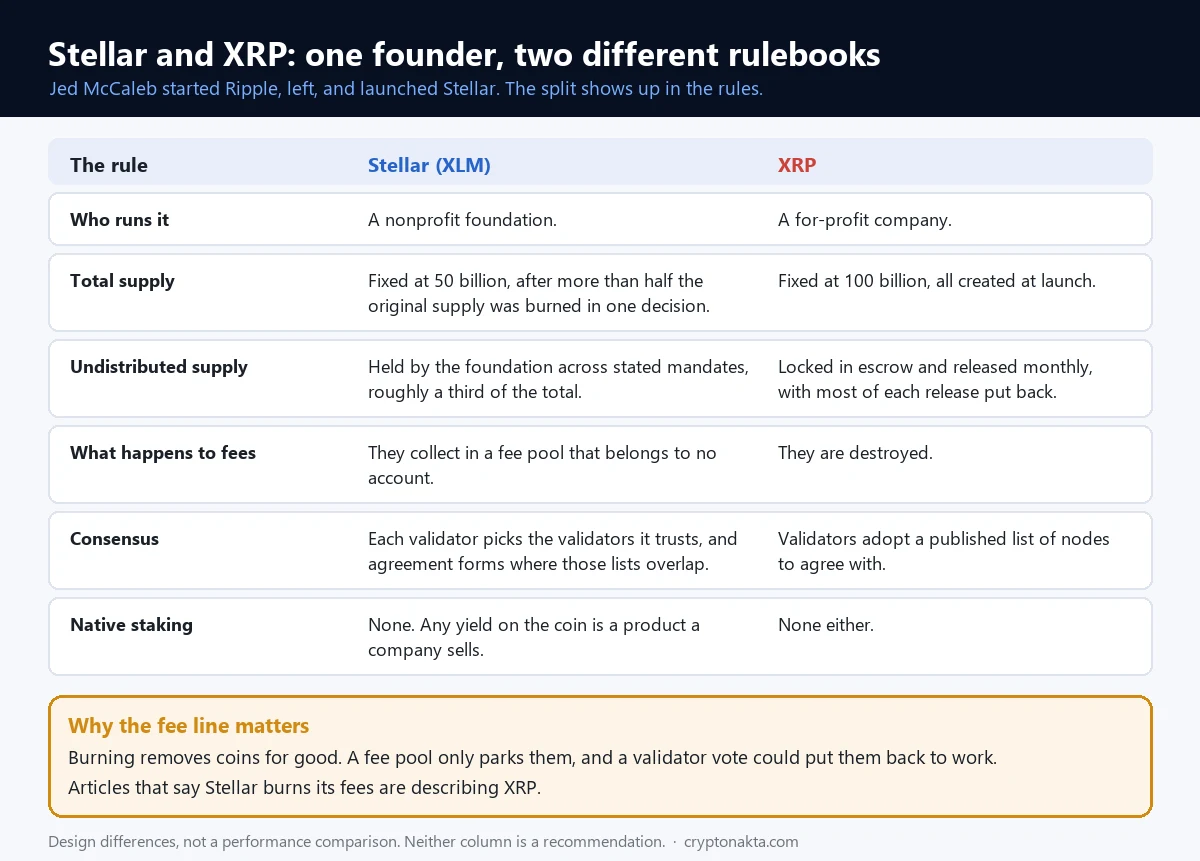
| Item | Stellar (XLM) | Ripple (XRP) |
|---|---|---|
| Origin | Founded 2014 by Jed McCaleb and Joyce Kim, code initially forked from Ripple | Founded earlier by a group including Jed McCaleb, who then left |
| Steward | Stellar Development Foundation, a nonprofit | Ripple, a for-profit company |
| Consensus | SCP, federated Byzantine agreement, validators publish their own trust lists | Its own federated consensus with a recommended validator list |
| Total supply | 50,001,786,839, fixed, no new issuance | 100 billion, issued at the start |
| Undistributed supply | A large foundation allocation spread across four published mandates, spent as those programmes run | Held in escrow contracts that release up to 1 billion XRP per month, with unused amounts re-escrowed |
| Fee handling | Fees accumulate in a fee pool owned by no account. They are not destroyed | Fees are destroyed and total supply falls |
| Staking | None at protocol level | None at protocol level |
| Main use of the chain | Issued assets: dollar and euro tokens, tokenised funds, anchor-issued local currency tokens | Payments and its own issued asset ecosystem |
One more thing about the nonprofit point, since it is often used as reassurance. The foundation’s allocation is close to a third of total supply, split across four published mandates covering direct development, ecosystem growth, product work, and assets and liquidity. A nonprofit has a different purpose from a company, and it holds the same kind of large position. Coins allocated to growth programmes reach the market when those programmes spend them.
3. Three layers: the network, the assets issued on it, and XLM
With the Ripple question settled, the next thing to sort out is the word Stellar itself. Three separate things share the name in ordinary conversation: a public payment ledger live since 2014, the assets companies issue on top of it, and the coin. Mixing them up is what makes most coverage of XLM confusing.
Layer one: the ledger
A shared record of accounts and balances, updated in a new ledger roughly every five seconds by a set of validators. It also has an orderbook and automated market maker pools built into the protocol, so an exchange between two assets is a protocol operation rather than a smart contract someone deployed. Fees are paid in XLM.
Layer two: the assets issued on top
Any account can issue an asset on Stellar. The ones carrying real volume come from companies: Circle’s USDC (on Stellar since 2021) and EURC, MoneyGram’s MGUSD (issued through Bridge as the issuing party, live since 2 June 2026), and tokenised money market funds from regulated fund managers, including Franklin Templeton’s FOBXX, the share class most people know by its BENJI app name. If you have never worked through what a dollar token is and who backs it, our explainer on what a stablecoin actually is covers the mechanics.
Layer three: XLM itself
The lumen. Fixed supply, no new issuance, used for fees, for the minimum balances the ledger requires, and as a middle step when one currency is converted into another.
Growth stories about Stellar almost always describe layer two. When a payment company adds a dollar token, when a fund manager tokenises a treasury fund, when cash agent networks start paying out against on-chain balances, that activity sits one level above the coin. Here is how the three relate.
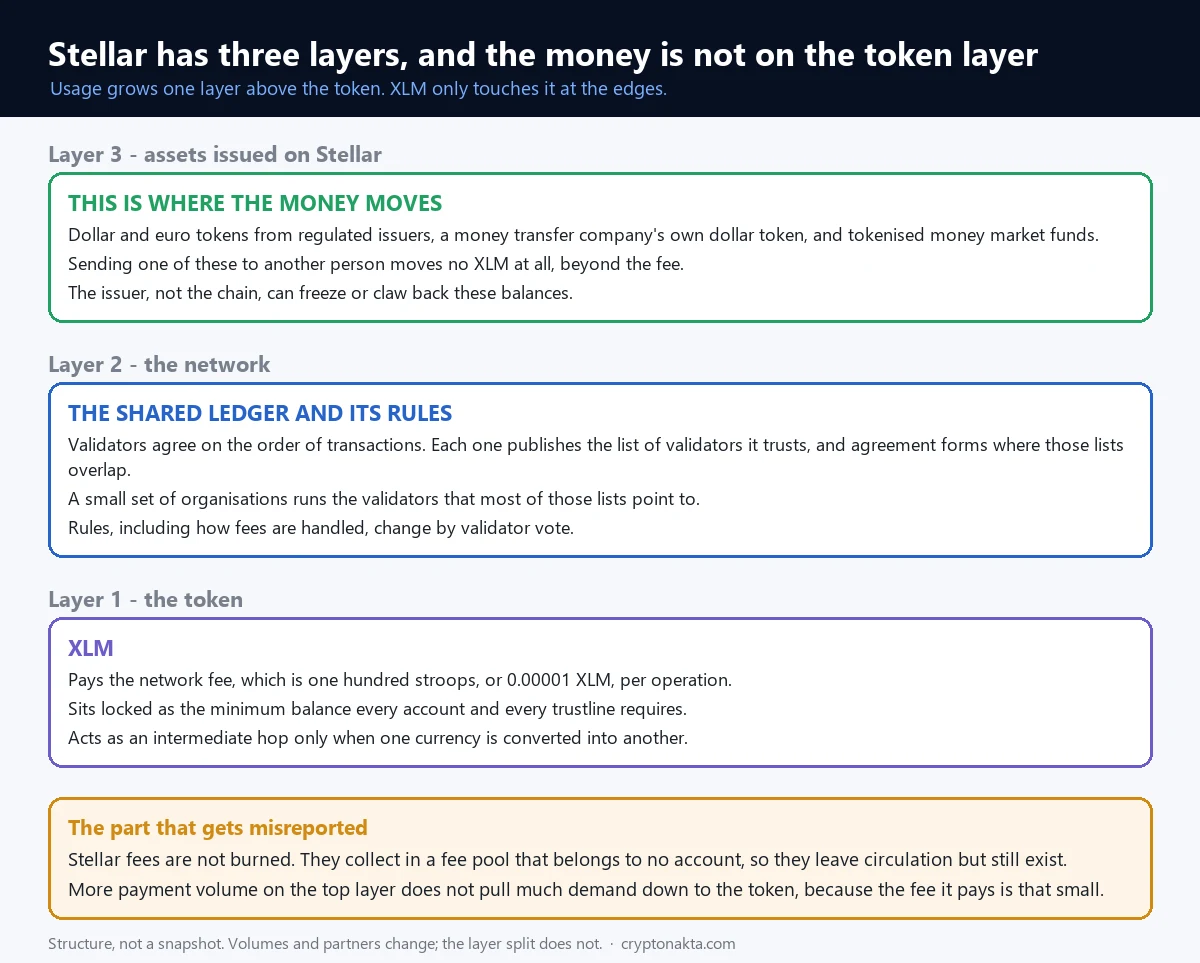
| Layer | What it is | Who earns from it | Relationship to XLM |
|---|---|---|---|
| The network | The ledger, the rules, the built-in orderbook and AMM pools | Nobody directly. Validators are run by organisations that need the ledger to work, and there is no block reward | Collects a fee of 100 stroops per operation, which is 0.00001 XLM |
| Assets issued on it | USDC, EURC, MGUSD, tokenised money market fund shares, plus assets issued by local financial firms | The issuer, from float, fees, fund management or payment margin | Moves between accounts without touching XLM at all, beyond the fee |
| XLM (the lumen) | The network’s own coin, fixed at just over 50 billion units | Holders only, and only through the market | Pays fees, sits locked as minimum balance, acts as a middle hop in conversions |
4. The four jobs XLM does, and the transfers where it does none
XLM has four jobs. All four are narrow, and each one stops somewhere specific.
1. It pays the fee
Every operation costs a base fee of 100 stroops, which is 0.00001 XLM. A transaction can bundle several operations, so a transfer that also opens a trustline costs two operations. When the network is busy, transactions compete in a fee auction and the price paid rises above the base, but the starting point is tiny by design. Fees can only be paid in XLM, which is the one thing every Stellar user needs the coin for.
2. It sits locked as minimum balance
Stellar charges nothing per year for storage, and instead requires accounts to hold a reserve. The base reserve is 0.5 XLM. An account costs two base reserves, so 1 XLM stays locked for as long as the account exists. Each trustline you open, meaning each additional asset you are willing to hold, locks another 0.5 XLM. Reserves scale with the number of self-custody accounts and the assets those accounts hold, and they are why a Stellar wallet can never be emptied to zero.
3. It discourages spam
The fee and the reserve together make it costly to create millions of accounts or flood the ledger with junk transactions. Spam control comes out of the fee and the reserve; it is not a separate source of demand.
4. It acts as a middle hop in conversions
When someone sends one currency and the receiver takes delivery in another, the protocol can route the payment through the built-in orderbook. XLM frequently sits in the middle of that route because it has the deepest pairs on the network. The next section takes this apart, because it is the only case where XLM is genuinely inside a transfer.
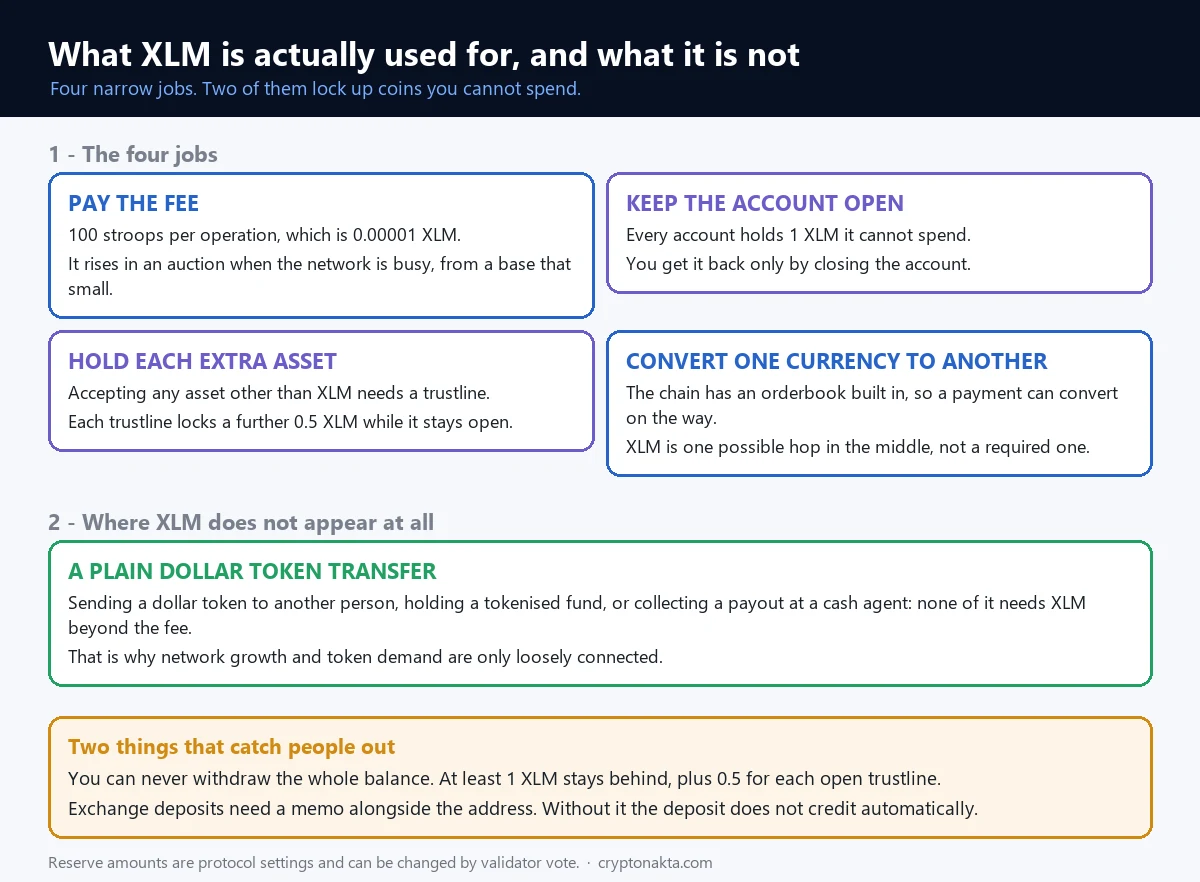
| Job | How much XLM it actually uses | When it does not apply |
|---|---|---|
| Paying the fee | 0.00001 XLM per operation at the base rate, higher only during congestion auctions | Never. Every transaction pays something |
| Account minimum balance | 1 XLM locked per account, permanently, until the account is merged and closed | Custodial users on an exchange, where the exchange holds the account and the reserve |
| Trustline minimum balance | 0.5 XLM locked per asset the account is willing to receive | Accounts that only ever hold XLM, and custodial users again |
| Spam control | None on its own. It is the effect of the two lines above | Not applicable |
| Middle hop in a conversion | Held for the length of one transaction, then passed on | Any transfer where the send asset and the receive asset are the same, which is most payment traffic |
Read the last column and the picture is clear enough. Send USDC to someone who wants USDC, which is what a dollar payment on Stellar normally looks like, and the coin’s involvement is the 0.00001 XLM fee plus whatever reserve was already locked when the account was created.
5. Path payments: the one case where XLM sits inside a transfer
A path payment is Stellar’s built-in currency conversion. The sender specifies what they are sending, the receiver specifies what they want to receive, and the protocol finds a route through the orderbook and the AMM pools that connects the two. The whole thing happens inside one transaction. Either the full route executes within the price limit the sender set, or nothing happens and the balance stays where it was.
A concrete version: someone holds a euro token and wants the receiver to be credited in a dollar token. There may be no direct market between those two assets, or the direct market may be thin. So the route goes euro token to XLM, XLM to dollar token, in one atomic step. XLM shows up in the middle because it is the asset most other assets have a market against, which makes routes through it available more often than routes through anything else.
Three things follow from this, and they are easy to state precisely.
- The XLM moves through and is gone when the transaction closes. Nobody in the chain of events ends up holding it. It exists inside the transaction for as long as the transaction takes.
- It creates real order flow. Someone had to be sitting on the other side of both hops, quoting prices. That market making requires inventory in XLM, and that inventory is held for as long as the market maker chooses to keep quoting.
- It only happens when currencies change. Same asset in and out, which is what a dollar token remittance is, and there is no path and no middle hop.
This is the strongest link between network usage and the token, and it is worth being exact about its size. It applies only to the share of traffic that changes currency, and the XLM involved is held for the length of one transaction and handed straight on.
6. Where network growth and token demand stop tracking each other
The base fee is 0.00001 XLM per operation. If Stellar processed one million payments in a day, the total fees collected that day would come to roughly 10 XLM. A hundred million payments in a day would come to about 1,000 XLM. Set that against a supply of just over 50 billion units and the effect on the coin is very small. The base fee was set this low on purpose, so the total stays near 10 XLM per million payments however far the volume climbs.
The connection that does exist
Reserves. Every new account locks 1 XLM. Every trustline locks 0.5 XLM. A wallet that holds a dollar token, a euro token and a fund token has one account plus three trustlines, so 2.5 XLM sits locked for as long as that wallet stays open. Growth in on-chain users therefore does take XLM out of circulation in a measurable way.
Two qualifications keep this honest. The lock is reversible: close a trustline and the 0.5 XLM comes back, merge an account and the 1 XLM comes back. And most people who hold Stellar-based assets never touch a Stellar account of their own, because they hold through an exchange or an app where the operator runs one account structure for many customers.
The connection that is missing
Issuers choose which chains to deploy on, and they usually deploy on several. A dollar token exists on Stellar because the issuer decided it should, and the same token exists on other chains under the same issuer for the same reason. Circle’s cross-chain transfer protocol reached Stellar, and it moves USDC across fifteen chains including Ethereum, Solana, Base and Arbitrum, with no wrapped version in between. The same issuer runs the same dollar token on several chains at once, and a holder can move a balance off Stellar without the issuer doing anything.
| What grows | Does XLM demand grow with it? | Why |
|---|---|---|
| Payment volume in dollar tokens | Barely | Each operation absorbs 0.00001 XLM. Volume in dollars has no bearing on the fee |
| Number of self-custody accounts and trustlines | Yes, in a small and reversible way | 1 XLM per account plus 0.5 XLM per trustline stays locked while they are open |
| Currency conversions through the orderbook | Indirectly | Path payments route through XLM and market makers need inventory to quote both sides |
| Assets issued on the network | No mechanical link | An issuer can support several chains at once and users can move between them |
| Custodial holdings at exchanges and apps | No | The operator holds the accounts, so per-user reserves never appear |
Rows two and three are the two real links, and both are small next to the payment volume figure that usually leads the story.
7. Stellar does not burn fees. They collect in a pool no account owns
Stellar does not burn fees. Here is what it does instead.
Every fee paid goes into a balance called the fee pool. The fee pool is part of the ledger and no account owns it, so there is no transaction anyone can submit that moves those lumens. Under the current rules they stay where they are, which from the outside produces a result that resembles a burn.
The difference sits in what the ledger says. Burned coins are gone from the accounting. Fee pool coins still exist as a number the network tracks, and how they are handled is a protocol rule. Protocol rules on Stellar change when validators vote to adopt a new version, which is the same procedure that ended the network’s old 1{‘xrp’: ‘https://cryptonakta.com/what-is-xrp/’}nnual inflation in October 2019. So the fee pool is a rule with a defined amendment path, and describing it as destruction skips over that.
XRP does destroy its fees. When an XRP transaction pays a fee, the drops used stop existing and the published total supply figure falls. That is the split behind the comparison table earlier in this article. XRP’s total supply drifts down a little with every transaction it processes, and Stellar’s stays at 50,001,786,839 whatever the traffic does.
Where the fixed supply came from
Total supply is 50,001,786,839 XLM and no new lumens are created. It has not always looked like that. Stellar launched with 100 billion units and ran a 1% annual inflation that added around 5.44 billion before validators voted it away on 28 October 2019. That November, the foundation burned 55 billion of the units it held, taking supply down to roughly 50 billion in one action.
8. How Stellar agrees on a ledger without mining and without staking
Stellar does not use mining and it does not use proof of stake. It runs the Stellar Consensus Protocol, an implementation of federated Byzantine agreement, and the design explains several things about XLM that otherwise look arbitrary.
The rule is short. Each validator publishes a quorum set, which is its own list of the validators it is not willing to disagree with. Validators choose those lists themselves. Where enough of the lists overlap, the network reaches agreement on the next ledger, and where they do not overlap enough, agreement stalls rather than splitting into two histories. Safety comes from the overlap in the configuration, and there is no election, no coin weighting, and no stake to slash.
What this design gives up
There is no block reward, because there is nothing to reward. A validator earns nothing for validating. Organisations run validators because they need the ledger to keep working for their own operations: payment companies, wallet providers, fund managers, infrastructure firms. That is a coherent incentive, and it is a narrower one than paying anybody willing to supply capital.
Two consequences follow, and both matter later in this article. Security depends on how a relatively small number of organisations configure their trust lists, which is covered in the risks section. And there is nothing for a coin holder to bond, which is the next section.
What a ledger close looks like in practice
A new ledger closes every five seconds or so, and a transaction is final when the ledger containing it closes. There is no probabilistic confirmation count to wait through, which is why exchange deposits of XLM tend to credit quickly once the exchange sees them, and why the memo problem covered further down is about bookkeeping at the exchange rather than about speed on the network.
9. If Stellar has no staking, what is an exchange rate paying you?
Stellar staking is one of the most searched phrases about this coin, and the accurate answer is that the network has nothing to stake. Consensus does not bond coins, so there is no protocol reward to distribute. Any rate advertised on XLM is paid by the company advertising it.
A yield product on XLM is sold by a company and comes with terms. When an exchange or an app advertises a rate, the money behind it comes from one of a few places:
- Lending. Your coins are lent to traders who borrow to trade with leverage. The interest they pay funds the rate you see, minus the platform’s cut.
- Market making. The platform uses inventory to quote prices and keeps the spread, paying a portion out as yield.
- Promotion. A marketing budget pays the rate for a period, usually with a cap on how much you can put in.
All three carry the same category of risk, which is credit risk on the company running the product. If the borrower does not repay, or the platform is unable to meet withdrawals, the position is a claim on that business. There is no principal guarantee, funds are frequently locked for a fixed term, and the advertised rate is variable in most terms and conditions. Our general guide to how staking works and what it is not goes through the difference between a protocol reward and a platform product across the whole market.
| Question to ask | What a network reward would look like | What an XLM yield product looks like |
|---|---|---|
| Who pays? | The protocol, by issuing or redistributing coins | A company, out of lending or trading revenue |
| Where is the coin? | Bonded on-chain under rules anyone can read | On the platform’s balance sheet, under the user agreement |
| What if it fails? | Defined slashing conditions written in the protocol | A claim against the company, ranked with other creditors |
| Is the rate fixed? | Set by protocol parameters | Variable in the terms, and frequently capped by size or tier |
| Does it exist for XLM? | No. Consensus does not use bonded coins | Yes, at several platforms, with the terms above |
Before committing coins to any such product, the terms page is the document that matters: who the counterparty is, how the yield is generated, whether there is a lock-up, and how redemption works when many people ask at once. Our checklist on how to tell whether an exchange is legitimate covers the same ground for the platform itself.
10. Two rules that decide whether your transfer arrives
Two things trip up almost everyone moving XLM for the first time. Both come from design decisions covered above, and both are avoidable once you know the rule.
You cannot empty a Stellar wallet
The base reserve is 0.5 XLM. An account requires two of them, so 1 XLM is locked for as long as the account exists. Every trustline you have open, meaning every non-XLM asset the account is willing to receive, locks a further 0.5 XLM. Try to send the full balance and the transaction fails, because the network will not let the account drop below its reserve.
Work out your own floor by counting: 1 for the account, plus 0.5 for each asset you have added, plus a little for fees. An account holding USDC and one other asset needs 2 XLM present at all times. To release a trustline reserve, remove the asset balance to zero and close the trustline. To release the account reserve, merge the account into another one, which closes it.
The memo is not optional on an exchange deposit
Exchanges do not create a separate Stellar account for every customer. They run a shared deposit account and identify who sent what using the memo, a short text or number field attached to the transaction. Send without the memo and the coins arrive at the exchange’s address correctly, and the exchange has no way to know they are yours. Recovery becomes a support ticket, and outcomes vary by platform.
This applies to XLM and to every asset issued on Stellar. It also applies in reverse: withdrawing from an exchange to your own wallet needs no memo, because your account is yours alone. Our walkthrough on what happens when you send crypto without a memo or tag covers the recovery process, and the related guide on sending crypto on the wrong network covers the other common transfer mistake. If you are weighing up which network to use for a stablecoin transfer in general, the comparison of USDT on ERC-20 versus TRC-20 lays out how fees differ between chains.
| Before you press send | What to check | What happens if you skip it |
|---|---|---|
| Network selection | Both sides must be set to Stellar (XLM). The same asset code exists on many chains | The funds land on a chain the receiving address does not control |
| Memo | Required for deposits to an exchange, copied exactly from the deposit page | The deposit is not credited automatically and needs manual recovery |
| Account reserve | 1 XLM must remain in a self-custody account | The transaction is rejected outright |
| Trustline reserve | 0.5 XLM per asset held, on top of the account reserve | You cannot open a trustline, so the incoming asset cannot be received |
| Trustline exists | The receiving account must already trust the asset being sent | The payment fails and the sender keeps the funds, minus the fee |
| Fee headroom | Leave a small amount of XLM above the reserve | You hold assets you cannot move until you top up XLM |
Where XLM trades
XLM is one of the older listings in the market and is available on most large venues. The point of the cards below is access and transfer mechanics, and every one of these platforms asks for a memo on Stellar deposits. Fees, available pairs and which products appear on your screen vary by region, so check your own account page rather than a summary.
Binance

Bybit

OKX

Gate.io

KuCoin

MEXC

Affiliate disclosure: some links are partner links. We may earn a commission at no extra cost to you. This is not investment advice.
If you are comparing venues rather than picking one, our overview of crypto exchanges and how their fees and security compare covers the selection process.
11. Who can freeze a dollar token on Stellar?
Every structural feature described above has a corresponding weak point. These are the ones specific to Stellar, stated without softening.
The issuer can freeze and claw back
An asset on Stellar carries flags set by whoever issued it. With authorisation flags enabled, the issuer can revoke an account’s permission to hold the asset, which freezes that balance. With the clawback flag enabled, the issuer can take the asset back from an account. This is how regulated issuers meet their compliance obligations, and it is how the dollar tokens on Stellar are configured. Authorisation and clawback are protocol features that the issuer switches on, so the freeze executes through the ledger’s own rules.
Few validators, and a halt that already happened
The organisations classified as Tier 1 numbered seven for a long stretch, including the foundation itself, and reached ten during 2026 as payment and infrastructure firms joined, against a stated target of thirteen. Tier 1 status requires running three geographically distributed validators with uptime above 99.9%. Ten organisations is a small set for a network where safety comes from overlapping trust lists.
This is not theoretical. In May 2019 a node configuration problem stopped the network, and research published the same year identified a cascading halt as possible given how few nodes the configuration depended on. A configuration failure halts the ledger instead of producing two competing histories. While the ledger is halted, no payment on it completes.
Concentrated supply
Close to a third of total supply sits with the foundation, allocated across four published mandates. The foundation can spend from that allocation, and those coins reach the market when the programmes pay out.
Competition where issuers make the choice
Dollar tokens live on many chains, and issuers choose. Cross-chain transfer standards make it routine to move the same token between them. Volume on Stellar reflects decisions by a handful of issuers and payment companies, and those decisions are theirs to revisit.
Smaller hazards worth knowing
- Junk trustlines. Anyone can send you an asset once a trustline is open, and some wallets prompt you to open trustlines liberally. Unwanted assets clutter the account, and each open trustline holds 0.5 XLM. Closing them returns the reserve.
- Lookalike tokens. Asset codes are not unique on Stellar. Anyone can issue something called USDC. What distinguishes the real one is the issuer address, which is why wallets display it. Confirm the issuer before you trust an asset.
- Fake airdrops. The Stellar name appears regularly in claim-your-tokens scams that ask for a wallet key or a signature. There is no protocol distribution to claim.
- Platform yield. Covered above, and worth repeating in a risk list: an advertised return on XLM carries the credit risk of the company offering it.
12. What actually runs on Stellar, and how the volume compares
Stellar has real usage, and it is smaller than the marketing around blockchain payments suggests. Both halves of that sentence are supportable with figures, so here are the figures, gathered in one place with a date attached because they move.
Anchors
An anchor is a licensed financial business that accepts local currency and issues the matching balance on Stellar, or takes a Stellar balance and pays out local currency. The anchor is who you deal with when money enters or leaves the chain in a country, and it is the anchor that holds the licence, runs the compliance checks and decides who it will serve. Stellar publishes a directory of them, with the count and the coverage in the table below.
Cash payout at agent counters
MoneyGram operates cash in and cash out against Stellar-based USDC. Someone hands cash to an agent in one country, a dollar token moves across Stellar, and someone else collects cash from an agent in another country. Note what is actually moving in the middle of that. It is a dollar token issued by Circle, and the XLM involved is the fee.
Tokenised funds
Regulated fund managers issue money market fund shares on Stellar. The share is recorded on the ledger and moves between accounts like any other issued asset, while the fund behind it stays with its manager under the same regulator as before. This is the same category covered in our piece on tokenised treasury products, where the pattern of a regulated issuer putting fund shares on a public chain is explained in more depth.
Smart contracts
Soroban is Stellar’s smart contract environment, written in Rust and running on mainnet. Most of what is built on it relates to payments and tokenised assets. Measured by value locked, Soroban’s DeFi activity is a small fraction of what sits on Ethereum or Solana.
| Measure | Figure | As of |
|---|---|---|
| Anchors in the public directory | 82, covering 225+ jurisdictions and 170+ currencies | April 2026 |
| MoneyGram cash network | Deposits in ~40 countries, payouts in 170+, ~500,000 agent locations | 2026 |
| Cumulative USDC remittance volume, MoneyGram and Circle route | More than 4.2 billion dollars | Early 2026 |
| Tokenised real-world assets on Stellar | 67 products from 10 regulated issuers, about 1.4 billion dollars | Early 2026 |
| Stellar stablecoin payment volume | Around 5.5 billion dollars per month | 2026 |
| Stablecoin transfer volume, other chains | Ethereum about 620 billion, Solana about 650 billion, Tron about 310 billion dollars per month | Same period |
| Circulating XLM | About 34.56 billion, roughly 69% of total | August 2026 |
| Foundation allocation | About 15.56 billion XLM allocated across four published mandates | August 2026 |
| Tier 1 validator organisations | 10, against a stated foundation target of 13 | Mid-2026 |
The last two rows of volume are worth reading together. Stellar describes itself as built for payments, and the chains carrying the most stablecoin volume are general-purpose ones where dollar tokens ended up anyway. The smallest of those three chains moves roughly fifty times what Stellar moves, and the largest more than a hundred times.
Five claims about XLM, checked against the rules
| Claim | What actually happens |
|---|---|
| Stellar burns the fees it collects | The fee goes into the fee pool, a ledger balance no account owns. Nothing is destroyed, and validators can vote to change how the pool is handled. XRP is the network that destroys fees |
| XLM can be staked for a network reward | Consensus does not bond coins, so there is no protocol reward. Any rate advertised on XLM is a lending, market making or promotional product sold by a company |
| XLM is Ripple’s sister coin, so the two move together | They share a founder and Stellar’s first code came from Ripple’s. The steward, the supply history, the fee handling and the consensus rules all work differently |
| The foundation is a nonprofit, so its holding is not a supply question | The allocation is close to a third of total supply, spread across four published mandates. Those coins reach the market as the programmes spend them |
| Stellar is built for payments, so its payment volume must be large | Around 5.5 billion dollars of stablecoin volume a month. Tron moves roughly fifty times that and Ethereum more than a hundred times |
| A payment company or fund manager on Stellar is a verdict on the coin | What they issue and use is a dollar asset on the ledger. That is a choice of which ledger to use, and the XLM involved is the fee each transfer pays |
13. Glossary: lumen, stroop, trustline, anchor, fee pool, path payment, Soroban, memo
These eight terms cover most of what you will encounter in Stellar wallets, explorers and exchange help pages.
| Term | What it means |
|---|---|
| Lumen (XLM) | Stellar’s own coin. Lumen is the unit name and XLM is the ticker. Used for fees, minimum balances and conversion routing |
| Stroop | The smallest unit of a lumen, one ten-millionth of one XLM. The base fee of 100 stroops equals 0.00001 XLM |
| Trustline | An explicit permission from your account to hold a specific asset from a specific issuer. Required before that asset can reach you, and it locks 0.5 XLM while open |
| Anchor | A licensed business that takes local currency and issues the matching balance on Stellar, or converts a Stellar balance back into local currency at a payout point |
| Fee pool | The ledger balance where all paid fees accumulate. No account owns it and nothing can be spent from it under the current rules |
| Path payment | A payment that changes currency in transit, routed through the built-in orderbook and AMM pools. It executes as a whole or fails as a whole |
| Soroban | Stellar’s smart contract environment, written in Rust, running on mainnet, used mostly around payments and tokenised assets |
| Memo | A short text or number field attached to a transaction. Exchanges use it to identify which customer a deposit belongs to on a shared account |
One naming note that saves confusion: Stellar is the network and the foundation, XLM is the coin, and Stellar Lumens is a common way of writing the coin’s full name. There is no separate token called Stellar.
Questions people ask the first time they hold or move XLM
Compare crypto exchanges: fees, security and what to check first