
Unstaking Period | How Long Unstaking Takes by Coin, Binance and Coinbase Unstake, Funds Not Arriving
Unstaking can take a few hours or a few weeks, depending on the coin and on where you staked it. Some networks set a fixed number of days. Others put you in a line that grows when many people leave at once.
Maybe you just pressed Unstake and the app only says Pending. Usually your coins aren’t lost, just waiting. Below is how long that wait is right now for each coin, what it costs you and what to check if nothing arrives.
In this guide (12)
How long does it take to unstake coins right now?Unstaking period meaning: why coins don’t come back right awayFixed wait or a line? Three shapes of the unbonding periodCurrent ETH unstaking time: why Ethereum takes daysHow long does unstaking take on Binance, Coinbase and Kraken?Can you unstake instantly, and what does it cost?Do I earn rewards while unstaking?Can I cancel unstaking once it has started?Unstaking delayed or funds not arriving? Check these in orderCan someone speed up my unstaking for a fee?How we measured, and what we couldn’tMy take after timing every wait
How long does it take to unstake coins right now?
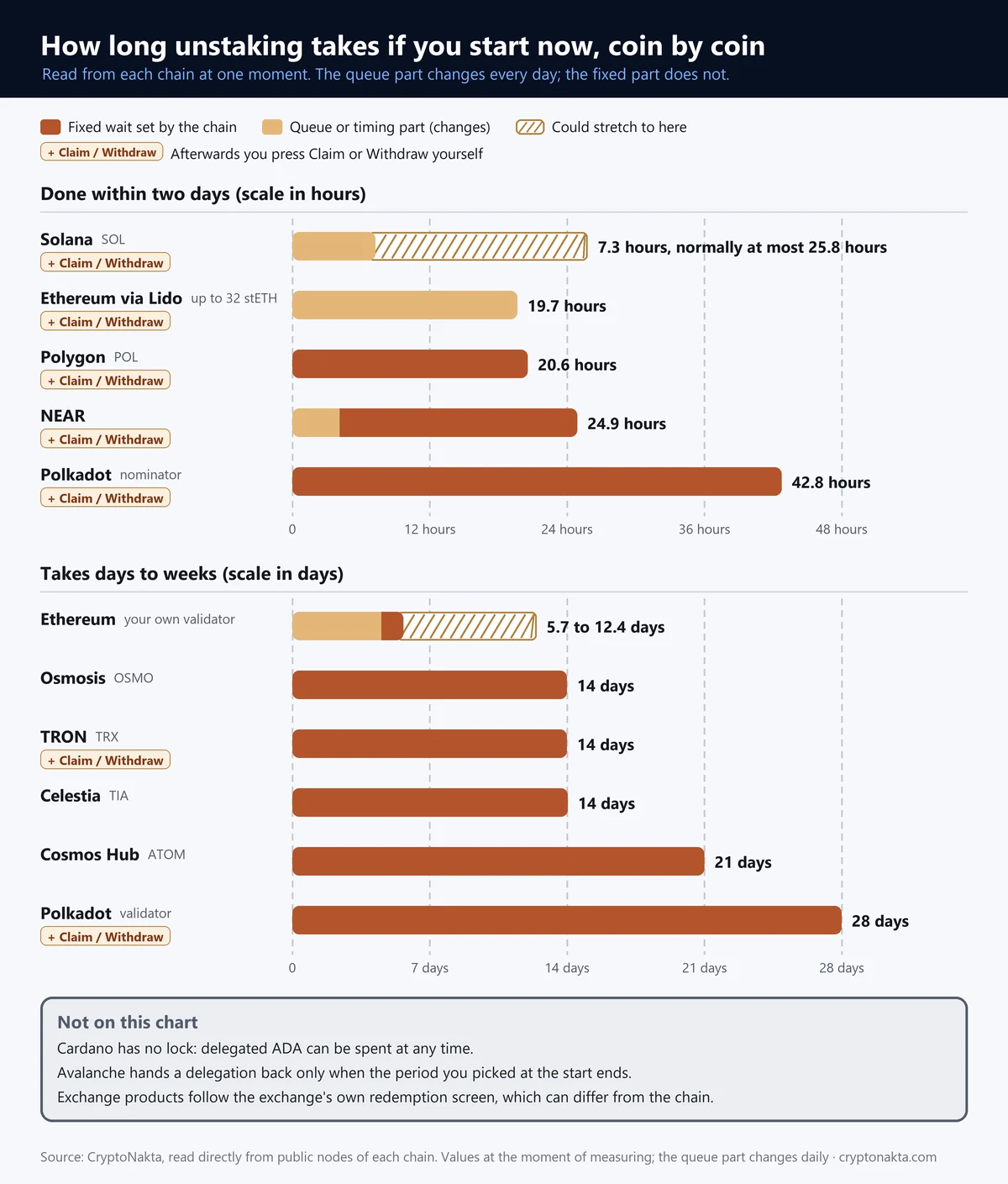
It depends on the coin and on where you staked it. When we measured, Solana needed 7.3 hours and a Polkadot nominator 42.8 hours. Cosmos Hub takes a set 21 days. Ethereum from your own validator took 5.7 to 12.4 days, because there is a line to leave.
Pick a coin and an amount in the calculator. It shows when the coins should arrive and how much of the wait is fixed. It also flags a second button, and shows how much the amount could have shrunk in the past month’s worst stretch.
It can’t time exchange products or see the line move after we measured. Queue numbers are a snapshot from the moment we measured, and queues change every day. Nothing you type leaves your browser.
| Coin and route | If you unstake now | Fixed part (set by the chain) | Queue or timing part | Second step to get the coins |
|---|---|---|---|---|
| Ethereum (ETH), your own validator | 5.7 to 12.4 days (about 9.1 days on average) | Withdrawal delay 27.3 hours (256 epochs) | Exit queue 4.5 days + payout round 0 to 6.8 days | No, it arrives on its own |
| Ethereum via Lido (stETH, up to 32) | 19.7 hours | — | Lido’s estimate from its withdrawal queue and buffer | Yes: Claim |
| Solana (SOL) | 7.3 hours (normally at most 25.8 hours) | — | Time left to the next epoch boundary (an epoch is about 25.8 hours) | Yes: Withdraw |
| Cosmos Hub (ATOM) | 21 days | Unbonding wait 21 days | None: the same whenever you unstake | No, it arrives on its own |
| Osmosis (OSMO) | 14 days | Unbonding wait 14 days | None: the same whenever you unstake | No, it arrives on its own |
| Celestia (TIA) | 14 days | Unbonding wait 14 days | None: the same whenever you unstake | No, it arrives on its own |
| TRON (TRX) | 14 days | Unstaking wait 14 days | None: the same whenever you unstake | Yes: Withdraw |
| Polkadot (DOT), nominator | 42.8 hours | 2 eras: 24 to 48 hours by timing | Timing within the current era (up to one era shorter) | Yes: Withdraw |
| Polkadot (DOT), validator | 28 days | 28 eras (28 days) | None: the same whenever you unstake | Yes: Withdraw |
| NEAR | 24.9 hours | 4 epochs (an epoch is about 6.9 hours) | Time left in the current epoch: 4.1 hours | Yes: Withdraw |
| Polygon (POL) | 20.6 hours | 80 checkpoints (one every 15.4 minutes on average) | Checkpoint pace (slower when Ethereum is busy) | Yes: Claim Stake |
Measured values, read from each chain at one moment. Queues change every day, so the queue part is the number to re-check before you unstake.
Fixed part: a rule written into the chain, changed only by a vote or an upgrade. Queue or timing part: depends on how many people are leaving, or on where you are in the cycle when you press unstake.
Not in the table because there is nothing to time: Cardano has no lock, so delegated ADA can be spent at any time. Avalanche returns a delegation only when the period you chose at the start ends (at least two weeks), and it can’t be ended early.
NEAR’s four epochs come from the staking pool contract, not from a chain setting, so a pool running different code could differ. Exchange products are not here either; their wait is whatever the exchange’s redemption screen says.
 View full size ↗
Unstaking period meaning: why coins don’t come back right away
Unstaking means taking staked coins back out of staking. The unstaking period is the wait before you can sell or send them again. The coins stay yours the whole time. They just can’t move.
The wait is there on purpose. Staked coins back a validator, a computer that checks transactions for rewards. If it breaks the rules, slashing cuts the staked coins. The wait stops stakers from leaving before a penalty can reach them.
A fixed wait and a queue are different things. A fixed wait, the unbonding period, is the same whenever you leave. A queue grows when many people leave together, so only that part changes from day to day.
| Word on the screen | What it means |
|---|---|
| Unstake, Unstaking | Take coins out of staking. The wait starts. |
| Unbonding | The fixed wait the network sets. |
| Deactivating, Cooldown | Solana’s wait, until the next epoch boundary. |
| Exit queue, Withdrawal queue | The line to leave. |
| Redeem, Redemption | An exchange’s word for unstaking its product. |
| Claim, Withdraw | A second button that moves coins to your balance. |
| Pending | Your request is in and waiting. |
Most people don’t run a validator. They delegate, pointing their coins at someone else’s validator. Our guide to staking covers the basics.
Fixed wait or a line? Three shapes of the unbonding period
Each coin’s wait takes one of three shapes. Solana and NEAR wait for the network’s schedule to roll over. Cosmos chains and TRON use a fixed unbonding period, and so do Polkadot and Polygon. Ethereum and Lido make you wait in line.
An epoch is one cycle of the network’s schedule, and stake changes take effect when it ends. A Solana stake you deactivate cools down until the current epoch ends, so this cooldown depends on timing.
Solana’s faster slots have made an epoch about 25.8 hours. If a large share of all stake leaves at once, the network spreads it over several epochs. NEAR pools hold coins for 4 epochs, which came to 24.9 hours.
Fixed waits are written into the chain and change only by a vote or an upgrade. A Polkadot nominator now waits 2 eras of about 24 hours each. The era already under way counts, so it took 42.8 hours when we measured. A validator still waits 28 days.
Older guides still give Solana two to three days and every Polkadot staker 28 days. Polygon’s docs put a checkpoint at about half an hour. We measured 15.4 minutes on average, so its 80 checkpoints took 20.6 hours.
Current ETH unstaking time: why Ethereum takes days
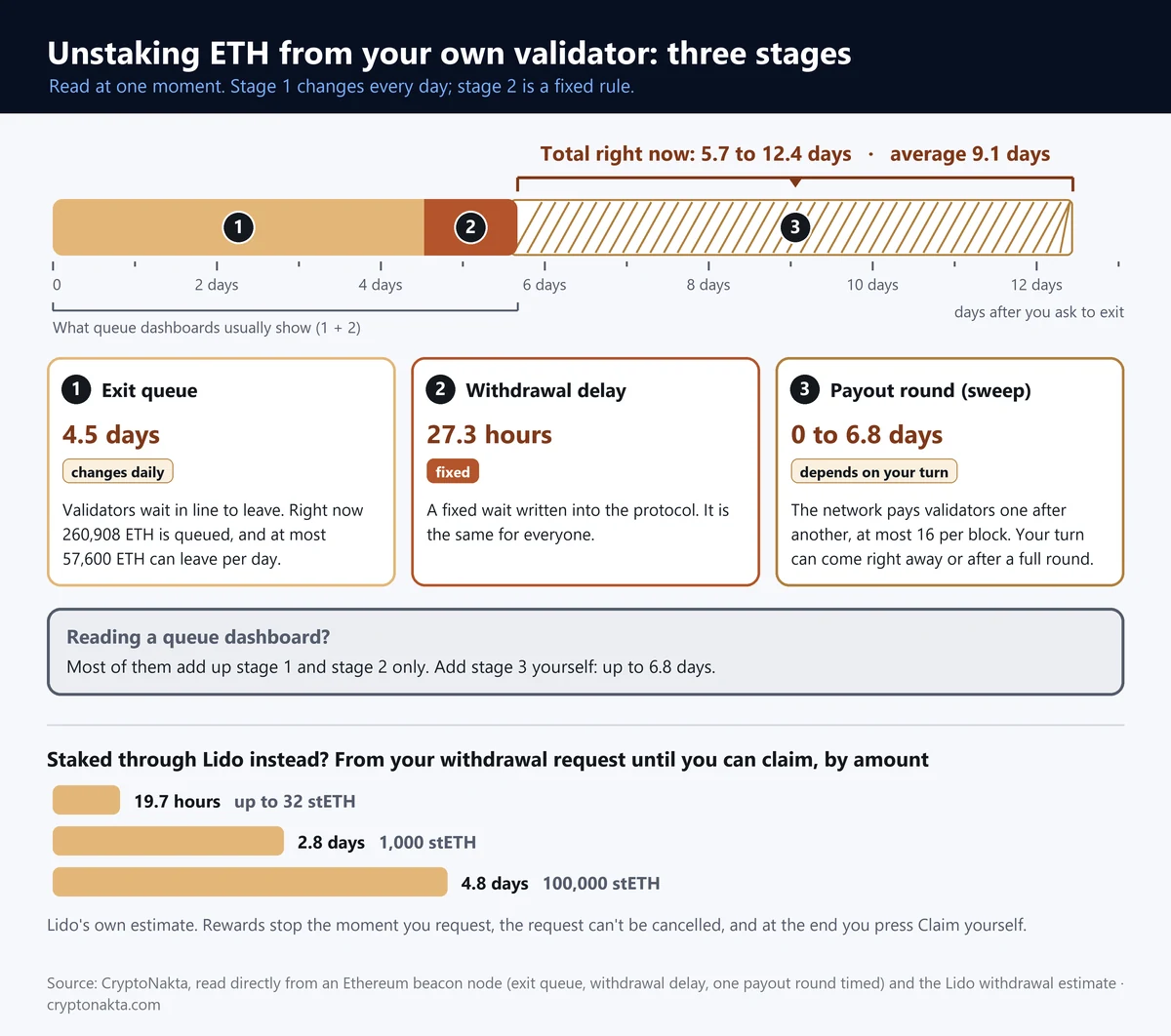
Ethereum unstaking has three steps, and only the middle one is fixed. They are the exit queue, a withdrawal delay and your turn in the payout round. For your own validator, the ETH unstaking time came to about 9.1 days on average when we measured.
The exit queue is the line to leave. At most 57,600 ETH can leave per day, so a new exit request faced a wait of 4.5 days. The fixed delay adds 256 epochs, about 27.3 hours.
In the payout round, or sweep, the network pays validators in turn. One round took 6.8 days, so your ETH can land at once or up to that much later.
| Stage | Right now | What sets it |
|---|---|---|
| Exit queue | 4.5 days | Queue: 260,908 ETH waiting to leave, and at most 57,600 ETH can leave per day |
| Withdrawal delay | 27.3 hours | Fixed: 256 epochs written into the protocol |
| Payout round (sweep) | 0 to 6.8 days | Your turn: the network pays validators one after another, at most 16 per block |
| Total for your own validator | 5.7 to 12.4 days (about 9.1 days on average) | The three rows above added up |
| Lido, up to 32 stETH | 19.7 hours | Lido’s own withdrawal estimate for this amount; then you press Claim |
| Lido, 1,000 stETH | 2.8 days | Lido’s own withdrawal estimate for this amount; then you press Claim |
| Lido, 100,000 stETH | 4.8 days | Lido’s own withdrawal estimate for this amount; then you press Claim |
Measured values at one moment. The exit queue changes every day; the withdrawal delay does not.
Queue dashboards usually show the exit queue plus the withdrawal delay. The payout round is not in that figure, so add anything up to one full round (6.8 days) when you read it.
For reference only: the line to start staking was 16 days long at the same moment. It is a separate queue and does not slow unstaking.
Lido rows are what Lido’s own withdrawal estimate returned for each amount. One request holds at most 1,000 stETH, so larger amounts are split. Rewards stop the moment you request, and the request can’t be cancelled.
Reading an ETH withdrawal queue dashboard? Queue sites usually leave the payout round out of their number, so add up to 6.8 days yourself.
With Lido you request a withdrawal, wait and then press Claim. Its estimate was 19.7 hours for up to 32 stETH. Lido says a request can’t be cancelled, and rewards stop the moment you make it.
 View full size ↗
How long does unstaking take on Binance, Coinbase and Kraken?
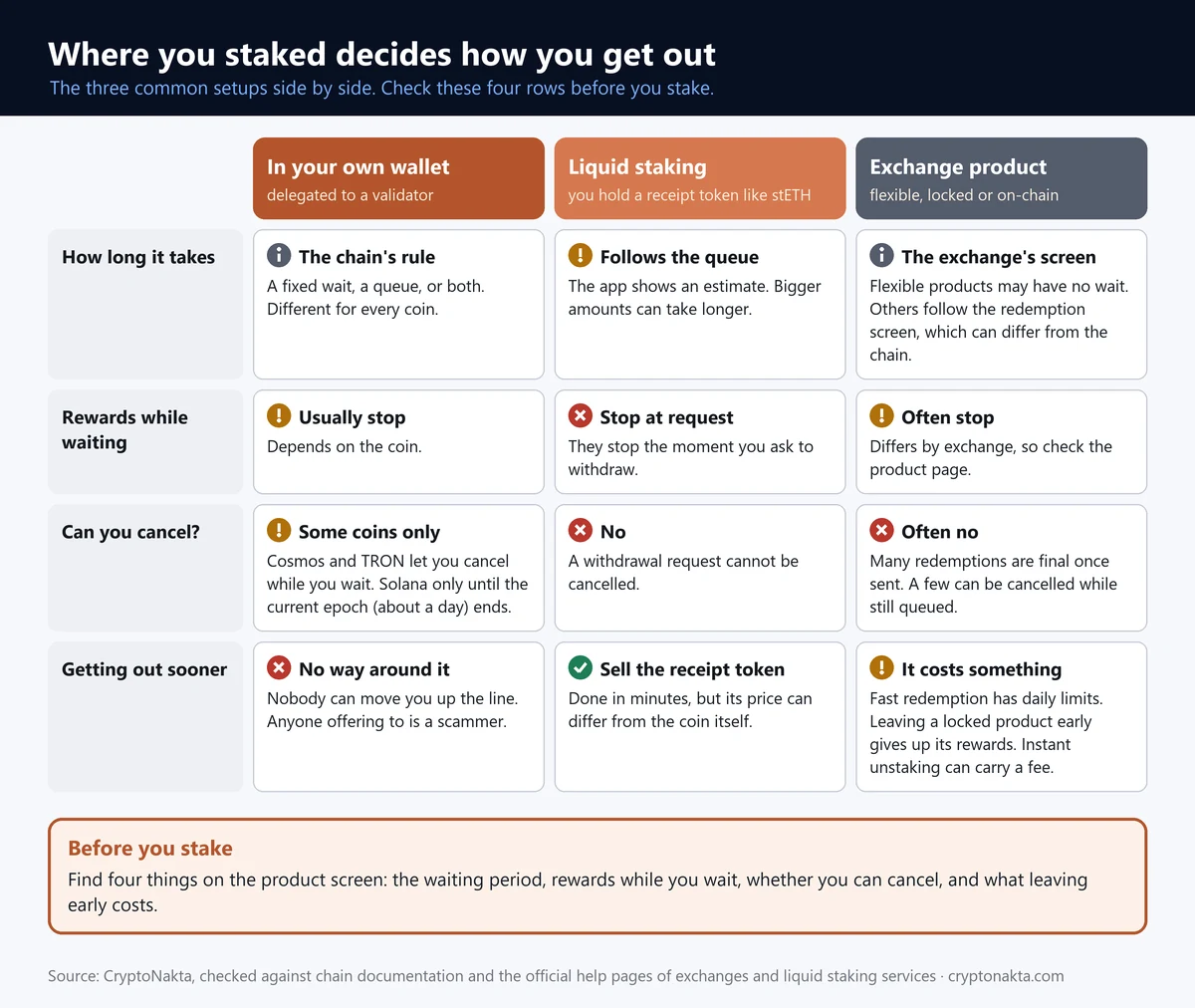
On Binance, Coinbase and Kraken, the wait depends on the product. Binance’s ETH redemption page shows an expected date. Kraken’s bonded staking waits out the network’s unbonding, while its flexible staking has no wait. Coinbase adds its own processing time to the network’s wait, per search excerpts of its help pages.
Your own wallet gives you the network’s wait. A liquid staking token is a receipt for staked coins, such as stETH or WBETH, and it has its own queue. Exchange products are flexible or locked, and taking coins out of one is usually called redeem. For an exchange product, the exchange’s own redemption screen is what counts.
| Where you staked | How long (their wording) | Rewards while you wait | Can you cancel | Getting out sooner | Basis |
|---|---|---|---|---|---|
| Lido (stETH) | Depends on the queue, the exit rate and Lido’s buffer; the app shows an estimate | Stop | No | Sell stETH on the market; the price can differ from ETH | Official help page, read in full |
| Binance ETH staking (WBETH) | No set number of days: the redemption page shows the expected date; daily redeem limit | Stop | No | Trade WBETH on the spot market | Official help page, read in full |
| Binance SOL staking (BNSOL) | “No more than 4 days” after the request (Binance wording) | Stop | No | Trade BNSOL on the spot market | Official help page, read in full |
| Binance Simple Earn, locked | Early redemption: back within 72 hours | Early redemption forfeits accrued rewards; rewards already paid come out of principal | No | Early redemption, giving up the rewards | Official help page, read in full |
| Coinbase | Network wait plus processing time; standard unstaking is free* | Keep coming* | Not stated | Instant unstaking for a fee (a % shown in the app)* | Official page, search excerpt only* |
| Kraken | Bonded: “3 or more days, depending on the asset”; Flexible: no wait | Stop | Not stated | Flexible staking has no wait | Official help page, read in full |
| OKX on-chain Earn | Standard redemption follows the on-chain wait; fast redemption within daily limits | Not stated | Yes, while in the fast-redemption queue | Fast redemption within personal and platform limits | Official help page, read in full |
| Robinhood | The app shows “up to X days”; it can take weeks | Not stated | Not stated | Not stated | Official help page, read in full |
Each row is the venue’s own wording in its help pages (sources at the end), not our measurement. The exchange’s redemption screen is what counts.
Rewards while you wait are not the same everywhere, and some venues say nothing about it. Check before you choose where to stake.
One venue in this table says rewards keep coming during unstaking, the opposite of the others; we saw that only in a search excerpt.
* We could not open the original page and saw it only as a search excerpt. Treat it as unconfirmed and check the screen in the app.
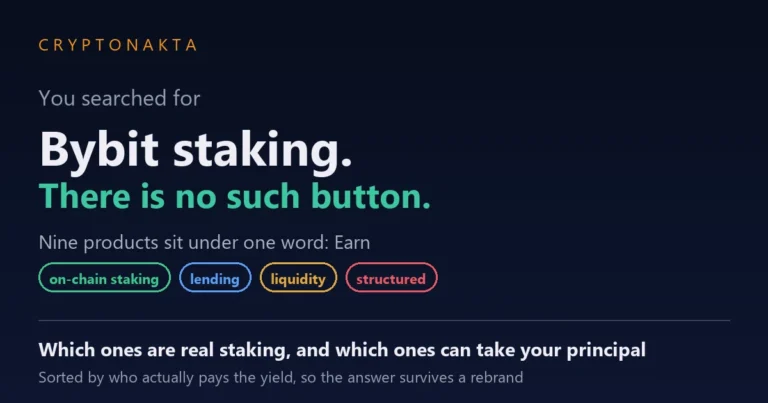
Coinbase may be the odd one out. Its help pages, seen only in search excerpts, say rewards continue during the unstaking period. For Bybit, see our Bybit staking guide.
 View full size ↗
Binance

Affiliate disclosure: some links are partner links. We may earn a commission at no extra cost to you. This is not investment advice.
CRYPTONAKTA
Can you unstake instantly, and what does it cost?
Sometimes you can skip the wait, but it is never free. You can sell a liquid staking token, use fast redemption or break a locked product early. Each way costs something: a price gap, a fee, lost rewards or a cap on how much you can take out.
Lido says selling stETH gives instant liquidity, but the price may differ from ETH. It also says stETH is intentionally not pegged to ETH. WBETH and BNSOL trade on Binance’s spot market. A large sale can move the price against you.
OKX caps fast redemption with a personal limit and a platform limit. When the platform limit runs out, you join a redemption queue. Coinbase’s instant unstaking charges a fee shown in the app, per search excerpts of its help pages.
Early redemption breaks a locked product before its term ends. On Binance you lose the rewards built up, and rewards already paid come out of your principal. Our guide to crypto earn products explains flexible and locked terms.
Do I earn rewards while unstaking?
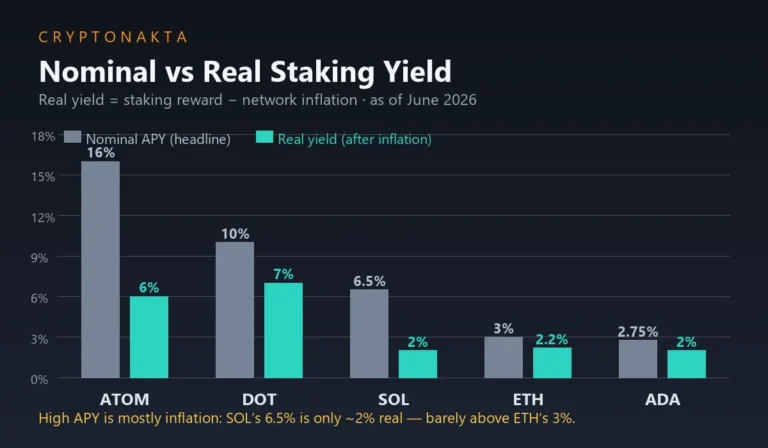
Mostly no, but it depends on where you staked. Binance, Kraken and Lido say rewards stop when you unstake, and so do Polygon and Polkadot. Solana keeps paying on the part still cooling down. Coinbase’s pages, in search excerpts, say rewards continue.
An Ethereum validator keeps earning while it waits in the exit queue, according to Coinbase’s developer docs. TRON takes your votes back the moment you unstake. Voting rewards end there.
The bigger cost is often the price, since you can’t sell during the wait. In the past month, ATOM dropped 30.1% inside one stretch of 21 days. These price drops are past records, not a forecast.
| Coin | Wait if you unstake now | Stretch we checked | Biggest drop inside that stretch | 30-day price range |
|---|---|---|---|---|
| Ethereum (ETH) | about 9.1 days on average | 14 days | -18.1% | $2,006 to $2,539 |
| Solana (SOL) | 7.3 hours | 1 day | -9.1% | $81.34 to $109.20 |
| Cosmos Hub (ATOM) | 21 days | 21 days | -30.1% | $1.27 to $1.90 |
| Osmosis (OSMO) | 14 days | 14 days | -50.8% | $0.0305 to $0.0672 |
| Celestia (TIA) | 14 days | 14 days | -48.8% | $0.338 to $0.769 |
| TRON (TRX) | 14 days | 14 days | -17.4% | $0.302 to $0.365 |
| Polkadot (DOT), nominator | 42.8 hours | 3 days | -16.7% | $0.824 to $1.220 |
| NEAR | 24.9 hours | 1 day | -16.8% | $3.45 to $5.45 |
| Polygon (POL) | 20.6 hours | 1 day | -13.9% | $0.0831 to $0.1060 |
Past prices, not a forecast. For each coin we took the last 30 days of daily candles (Binance USDT pairs) and found the biggest fall from one day’s high to a later low inside any stretch as long as the wait.
The stretch is the shortest one we measured (1, 3, 7, 14, 21 or 30 days) that covers the wait; Ethereum uses its average wait. Daily candles cannot show whether the high or the low came first within the same day.
While coins are unstaking you usually cannot sell them, so this is the size of move someone unstaking at the wrong moment would have had to sit through.
Celestia fell 48.8% inside its wait, and ETH 18.1%. Prices can also rise during a wait. The table only shows how far a price can move while you can’t sell.
Can I cancel unstaking once it has started?
On some networks you can: Cosmos and TRON let you cancel while you’re still waiting. Solana only lets you undo it within the same epoch. Lido and Binance redemptions can’t be cancelled. We found no official way to call off an Ethereum exit.
| Where | Can you cancel? | How |
|---|---|---|
| Cosmos Hub and other Cosmos SDK chains | Yes, until the wait ends | Coins go back to the validator you left |
| TRON | Yes, all at once | Every pending unstake is cancelled together |
| Solana | Only in the same epoch | Delegate back to the same validator |
| Polkadot | By rebonding | Stake the coins again |
| Ethereum, own validator | No official way found | Staking again means a new validator |
| Lido, Binance ETH and SOL | No | A request is final |
| Binance locked products | No | Early redemption is final once confirmed |
| OKX fast redemption | While in its queue | Per OKX’s own example |
| Avalanche | No | A delegation can’t end early |
| NEAR, Polygon | Not stated | No official wording found |
TRON’s cancel puts every unstake that is still waiting back into staking, however far into its 14 days it was. Your votes don’t come back by themselves. Vote again after you cancel.
On Cosmos, if you only want another validator, redelegate instead. It switches validators with no unbonding at all.
Unstaking delayed or funds not arriving? Check these in order
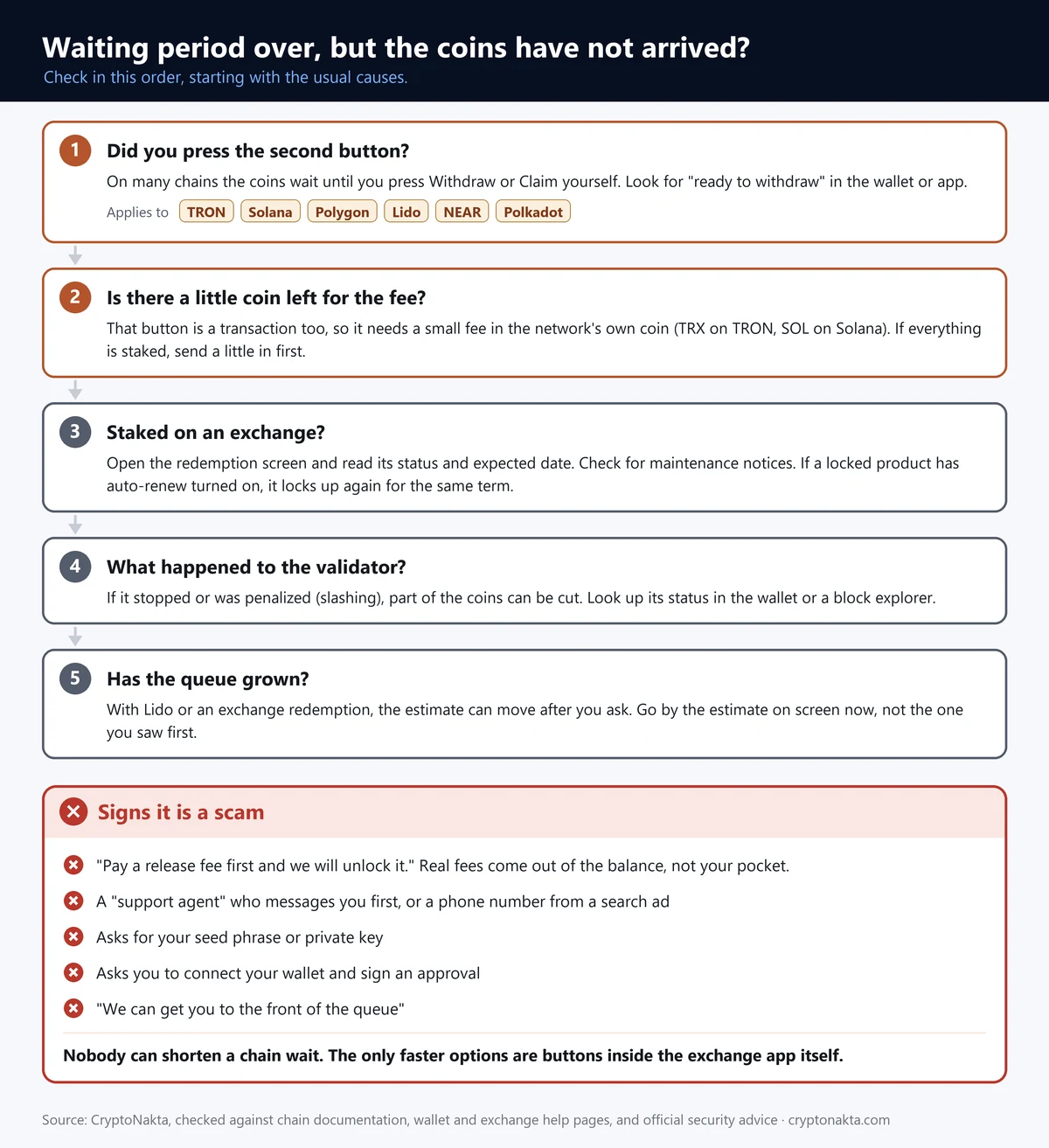
Most unstaking delays have a plain cause. The wait isn’t over, or it ended and a second button is waiting. The wallet may also lack the fee coin, or the exchange may be under maintenance.
| Check | What it looks like | What to do |
|---|---|---|
| Is the wait over? | Still Unbonding, Deactivating or Pending | Compare with the table above |
| Second button? | Wait over, balance unchanged | Press Withdraw or Claim |
| Fee coin? | Withdraw fails or stays grey | Add a little of the network’s coin |
| Exchange product? | Redeeming too long, or locked again | Check the redemption page and auto-subscribe |
| Validator? | An unbonding you didn’t start | Check the validator and any slashing |
| Estimate moved? | Lido or exchange ETH date changed | Recheck Lido’s Claim tab or the redemption page |
When the wait ends, some coins still need a second step before they reach your balance. On TRON, Solana, NEAR, Polkadot and Lido you usually press Withdraw or Claim yourself. Polygon calls it Claim Stake. That press needs a little of the network’s coin; if you have none, see what to do with no TRX for the fee.
On an exchange, check the product page and any maintenance notice. Our guide to Binance maintenance shows what pauses. A locked product with auto-subscribe renews at maturity, which looks just like a stuck redemption.
On Cosmos, a validator that leaves the active set starts unbonding all its delegations by itself. Slashing can also shrink what comes back. To trace a payout, look up its transaction ID.
 View full size ↗
Can someone speed up my unstaking for a fee?
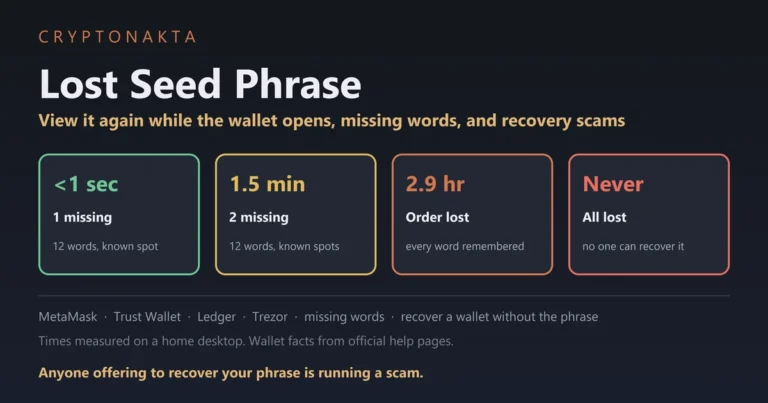
No, nobody can move you up a network queue or shorten a fixed wait. Anyone who asks for a fee or your seed phrase to release your stake is running a scam. The only real shortcuts are official ones, like fast redemption or selling a liquid staking token. You pay for those out of what you hold.
Kraken says it will never ask you to “Send a payment to release, unfreeze or ‘verify’ your funds.” Real fees come out of your balance, not your pocket. Pay a fake one once, and it comes back under a new name.
Kraken also warns that fake support numbers show up in search ads. It never messages you first on social media. Treat any DM about your stuck unstaking as a scam.
Fake staking sites copy trusted names such as Lido, then ask you to connect and sign. If you signed something odd, read how to revoke token approvals. An anti-phishing code helps you spot fake exchange emails. A promise of a fixed monthly payout with no risk is another sign, more so on a coin that has no staking at all.
No real service asks for your recovery phrase. If yours is already out, unstaked coins land in a wallet someone else can open. Move them to a new wallet the moment they’re free, and see what to do about an exposed seed phrase. More patterns are in our guide to crypto scams.
How we measured, and what we couldn’t
We read every unstaking number here from public chain data ourselves, as of November 12, 2026, 16:49 UTC.
| What | Value |
|---|---|
| Measured at | November 12, 2026, 16:49 UTC |
| Where we read it | public Ethereum beacon node · Lido withdrawal estimate API · public RPC and REST nodes of Solana, Cosmos Hub, Osmosis, Celestia, TRON, Polkadot Asset Hub, NEAR and Ethereum (Polygon staking contracts) · Binance public market data (no key) |
| Ethereum exit queue | 4,337 validators exiting with 260,908 ETH; at most 57,600 ETH leaves per day, so a new exit waits 4.5 days; then a fixed delay of 256 epochs |
| Ethereum payout round | read which validator each block paid last, going back a day at a time until the round closed: one full round took 6.8 days (the simple formula gives 7 days) |
| Lido estimate by amount | 1 stETH 19.7 hours · 32 stETH 19.7 hours · 1,000 stETH 2.8 days · 10,000 stETH 2.8 days · 100,000 stETH 4.8 days |
| Solana epoch | epoch 1,084; slot time 0.215 seconds over the last hour, so an epoch lasts about 25.8 hours; 7.3 hours left at measurement |
| Cosmos chains | unbonding time read from each chain: Cosmos Hub (ATOM) 21 days · Osmosis (OSMO) 14 days · Celestia (TIA) 14.04 days |
| TRON | unstaking delay parameter 14 days; cancelling all pending unstakes is switched on |
| Polkadot | nominators 2 eras, validators 28 eras; era length measured at 24 hours; nominators are not slashable |
| NEAR | 4 epochs (a staking pool contract constant, not read from the chain); epoch length measured at 6.9 hours |
| Polygon | withdrawal delay 80 checkpoints read from the staking contract; average gap between checkpoints 15.4 minutes |
| Prices (USDT pairs) | daily candles October 13, 2026 to November 12, 2026 · ETH $2,006 · SOL $81.51 · ATOM $1.41 · OSMO $0.0320 · TIA $0.415 · TRX $0.316 · DOT $0.827 · NEAR $3.42 · POL $0.0852 |
| Not measured | real processing time of exchange products · nomination pools · Avalanche (no queue: the term is chosen when you delegate) · TON |
| Chain docs and help pages compared on | November 13, 2026 |
A snapshot as of November 12, 2026, 16:49 UTC. Queues, epochs in progress and prices move every day; chain rules (unbonding times, eras, epochs) change only by vote or upgrade.
We read chain values ourselves. Exchange products were not timed: for those, the exchange’s redemption screen is the only reliable number.
We read the chain values ourselves, but we could not time how long exchanges take to process redemptions. Where an official page disagreed with the chain, such as the Polkadot wiki, we went with the chain.
My take after timing every wait
Most long waits turned out to be fixed rules, and the only big line was Ethereum’s. Many numbers people repeat are out of date. And during a wait, prices moved far more than a few weeks of staking rewards would make up.
Before staking, I’d check the unstaking period and whether rewards stop during it. Then I’d check whether you can cancel and what leaving early costs.
What I trust least is anyone offering to speed things up, whether for a fee up front or through a support number from an ad.
To be fair, liquid staking tokens and instant redemption can get you out the same day, at the cost of a price gap, a fee or a limit. What staking really pays covers the other side.
This site uses exchange referral codes, and we earn a commission when you sign up with ours. With our Binance code, you get back 10% of the spot trading fees you pay. If you stake on an exchange, check its product screen first for the unstaking period, rewards during it and the cost of early redemption.
Binance
Affiliate disclosure: some links are partner links. We may earn a commission at no extra cost to you. This is not investment advice.
Questions people ask about unstaking
- Ethereum consensus specs: Electra beacon chain · checked November 13, 2026
- ethereum.org: staking withdrawals · checked November 13, 2026
- Anza docs: stake delegation and rewards · checked November 13, 2026
- Solana stake program: instruction processor · checked November 13, 2026
- SIMD-0525: reduce slot times · checked November 13, 2026
- Cosmos SDK: staking module · checked November 13, 2026
- Polkadot OpenGov referendum 1910: nominator unbonding · checked November 13, 2026
- TRON Developer Hub: unstaking and cancellation · checked November 13, 2026
- Polygon docs: how to delegate · checked November 13, 2026
- Lido: how withdrawals work · checked November 13, 2026
- Lido docs: token integration guide · checked November 13, 2026
- Binance FAQ: ETH staking · checked November 13, 2026
- Binance FAQ: SOL staking · checked November 13, 2026
- Binance FAQ: Simple Earn locked products · checked November 13, 2026
- OKX Help: how fast redemption works · checked November 13, 2026
- Kraken Support: overview of staking · checked November 13, 2026
- Kraken Support: fake support and impersonation scams · checked November 13, 2026
- Coinbase developer docs: staking lifecycle · checked November 13, 2026
- Robinhood Support: crypto staking · checked November 13, 2026
Not investment advice. Chain values and exchange terms change, so check the screen again before you unstake.