Are Prediction Markets Like Polymarket Legal in 2026? A Country-by-Country Reality Check
Polymarket and Kalshi are everywhere — and so are the headlines about bans, the CFTC, and lawsuits. Here’s the calm, honest version: the one question regulators actually ask, why the US went from banned to regulated, which countries blocked these platforms in 2026, how to check your own jurisdiction, and why a VPN is a trap. As of June 2026.
- There’s no single yes/no — legality is decided country by country, and 2026 redrew the map. The useful lens is one question every regulator asks: is this a financial market, or is it gambling?
- United States: legal again — but with an asterisk. After a 2022 geo-block, the CFTC cleared Polymarket’s return in December 2025 via its QCEX/QCX acquisition, so a regulated “Polymarket US” now exists. The international site still blocks US users, and several states (e.g. Massachusetts, Illinois) restrict it.
- Much of the world tightened in 2026. 30+ jurisdictions now restrict or block Polymarket or Kalshi — Spain, Brazil, India, Portugal, Hungary, Argentina, Indonesia and more — almost always by calling them unlicensed gambling. South Korea went further and opened a criminal probe into individual users.
- How it works: deposit USDC on Polygon, buy “Yes/No” shares; the price (1¢–$1) is the market’s implied probability. No fee on winnings; small taker fees by category.
- A VPN does not make it legal. Bypassing a country block usually violates the platform’s terms and can get your funds frozen — and may break local law. If your country is blocked, that’s your answer.
- This guide covers the US comeback, the global ban wave, a four-step way to check your own country, the honest risks even where it’s legal, and Polymarket vs Kalshi. Not investment or legal advice.
1. The short answer: legal where, exactly?
2. What a prediction market actually is (so the law makes sense)
3. The United States: from geo-block to CFTC-regulated comeback
4. How we got here: the legal saga in one timeline
5. The rest of the world: the 2026 restriction wave
6. Is it legal where you are? A four-step check (and the VPN trap)
7. Five myths about prediction-market legality
8. The honest risks — even where it’s perfectly legal
9. Polymarket vs Kalshi: which is the “regulated” one?
10. Key terms, in plain English
11. What you need to try one (and where to get the USDC)
12. Next steps
1. The short answer: legal where, exactly?
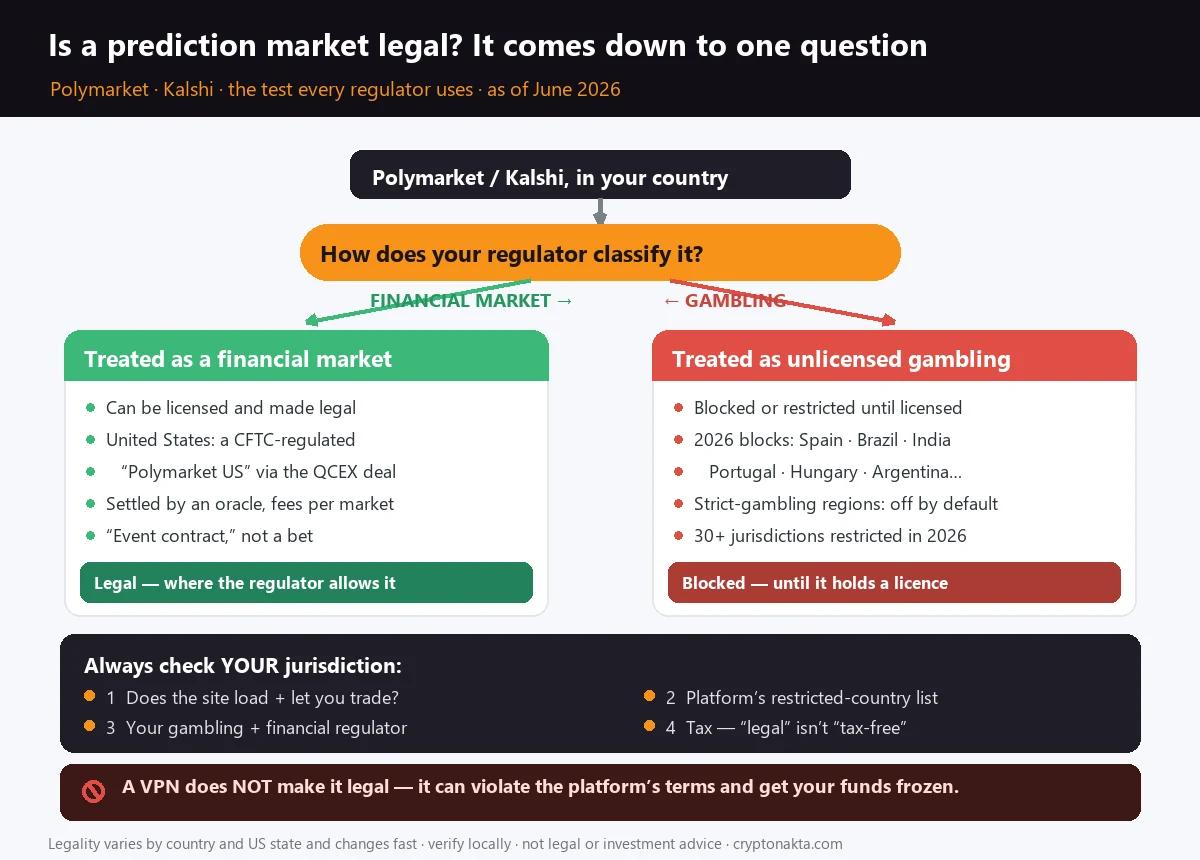
Quick version: “Is Polymarket legal?” has no single yes-or-no answer, because legality is decided country by country — and in 2026 the map redrew itself in months. The cleanest way to understand any headline is to know the one question every regulator is really asking: is a prediction market a financial market (an “event contract,” regulated like a derivative) or is it gambling (a bet, which needs a gambling licence)? Almost every approval, ban and lawsuit in this space comes down to which side of that line a regulator puts it on.
| If a regulator calls it… | Then… | Example |
|---|---|---|
| A financial / “event contract” market | It can be licensed and legal under a markets regulator | United States (CFTC) in 2026 |
| Unlicensed gambling | It gets blocked or restricted until it holds a gambling licence | Spain, Brazil, India, France… in 2026 |
2. What a prediction market actually is (so the law makes sense)
Before the law makes sense, it helps to know what you’d actually be doing on a prediction market — because the mechanics are why regulators argue about it. Polymarket is the best-known one, so we’ll use it as the example.
You connect a crypto wallet, deposit USDC (a dollar stablecoin) on the Polygon network, and buy “Yes” or “No” shares on a real-world question — “Will X happen by [date]?” Each share pays out $1 if it’s right and $0 if it’s wrong, so the live price sits between $0.01 and $1.00 — and that price is the market’s estimated probability. A “Yes” trading at $0.63 means the crowd is pricing roughly a 63% chance.
| Piece | How it works |
|---|---|
| Money | USDC stablecoin, held in your own self-custodial wallet (you hold the keys, not Polymarket) |
| Network | Polygon — positions are on-chain tokens (ERC-1155), low transaction fees |
| Price = odds | A share’s price in cents is the implied probability; it moves with supply and demand |
| Fees (as of March 2026) | No deposit fee, no fee on winnings; taker fees apply by category (e.g. ~1.00% politics, ~0.75% sports, ~1.80% crypto); limit (maker) orders are free |
| How a market settles | An on-chain oracle (UMA) reports the real-world result, with a dispute window before payout |
| The honest answer | It depends where you live — and 2026 changed the map fast |
| The one test | Regulators ask one thing: is this a financial market, or gambling? |
| United States | Legal again — via CFTC-regulated “Polymarket US” (QCX) — but several states still block it |
| The 2026 wave | 30+ countries now restrict or block Polymarket or Kalshi — mostly as “unlicensed gambling” |
| How it works | USDC on Polygon · buy “Yes/No” shares · price ($0.01–$1.00) = the market’s odds |
| Big risk besides the law | It can resolve against you, there’s no bank-style protection, and clone scam sites are everywhere |
| Never | Bypass a country block with a VPN to dodge KYC — it can freeze your funds and break the law |
3. The United States: from geo-block to CFTC-regulated comeback
The United States is the headline story, because it flipped from banned to regulated — and understanding it stops a lot of confusion.
Back in 2022, the CFTC fined Polymarket and it geo-blocked US users as part of the settlement. For four years, Americans couldn’t legally use it. Then in December 2025, the CFTC cleared a path back: Polymarket acquired QCEX (operated as QCX LLC), a CFTC-licensed Designated Contract Market and clearinghouse. That gave it a compliant US foundation.
The key thing to grasp in 2026 is that there are now two different products under one brand:
| Product | Who it’s for | Status |
|---|---|---|
| Polymarket (international) | Non-US users | Still geo-blocks US IP addresses — a leftover condition of the 2022 settlement |
| Polymarket US (QCX) | US residents | A CFTC-regulated exchange — the only Polymarket product Americans can lawfully use |
So “is Polymarket legal in the US?” in 2026 is yes — through the regulated US version. But it’s not clean nationwide. States complicate it: Polymarket blocks Massachusetts, Illinois and several other states, and gambling regulators have pushed back — Tennessee ordered Polymarket, Kalshi and Crypto.com to shut down their sports prediction markets and refund wagers, and Minnesota moved to ban them. The unresolved fight is federal-vs-state: do CFTC-regulated event contracts override state gambling law? A federal appeals court has leaned toward federal preemption, and the question may end up at the Supreme Court — traders themselves price a meaningful chance the Court takes a case by the end of 2026.
4. How we got here: the legal saga in one timeline
None of 2026 makes sense without the backstory — the same platform was illegal in the US, then became the regulated one, while the rest of the world moved the opposite way. Here’s the whole arc in one timeline:
| When | What happened | Why it mattered |
|---|---|---|
| 2020 | Polymarket launches as a crypto-native prediction market on Polygon | Bets become on-chain tokens — global and permissionless by default |
| Jan 2022 | CFTC fines Polymarket and it geo-blocks US users | Regulators call the contracts unregistered — the US door closes for four years |
| Nov 2024 | The US election sends volumes to records; “Polymarket odds” go mainstream | Prediction markets stop being niche — and regulators start paying attention |
| Dec 2025 | CFTC clears Polymarket’s return via acquiring QCEX (QCX LLC), a licensed exchange | “Polymarket US” is born — legal, regulated, US-only |
| 2026 | A global backlash: 30+ jurisdictions restrict or block it; Korea probes users; US states push back | The world splits — regulated in some places, treated as illegal gambling in others |
5. The rest of the world: the 2026 restriction wave
Outside the US, 2026 was the year governments pushed back hard. More than 30 jurisdictions now restrict or block Polymarket or its main rival Kalshi, and the reasoning is almost always identical: a regulator decided it’s unlicensed gambling, not a licensed financial market. Here’s a snapshot — but read it as “the direction of travel,” not a permanent list, because this changes monthly:
| Jurisdiction | Status in 2026 | Reason given |
|---|---|---|
| United States | Legal via regulated Polymarket US; some states block it | Treated as CFTC “event contracts” |
| UK, France, Belgium, Italy, Netherlands, Germany, Australia | International order placement restricted | Licensing / treated as gambling or regulated betting |
| Spain | ISP-blocked (ordered May 2026) | Unlicensed gambling — disciplinary proceedings |
| Portugal, Hungary | Blocked (early 2026) | Unlicensed gambling |
| Brazil | Blocked (April 2026) | Unlicensed betting |
| Argentina | Block ordered (2026) | Gambling regulation |
| India | Polymarket went dark (May 2026) | “Prohibited online money gaming” (2025 Act) |
| Indonesia, Singapore | Blocked | Gambling law |
| Taiwan | Political markets restricted / platform blocked | Election-betting and gambling rules |
| South Korea | Not blocked yet — but police opened a criminal probe into individual users | Possible illegal gambling under the Criminal Act |
A few patterns are worth pulling out. First, “available” is not the same as “regulated” — or even “safe to use.” South Korea is the sharpest example: the site still loads there, yet in 2026 police opened the country’s first criminal investigation into Polymarket users over election bets, on a theory of illegal gambling. That’s the gap that catches people out — a platform can be reachable and still be a legal trap for you personally. Kalshi, for its part, publishes a country page listing roughly 143 countries available and ~52 restricted — but “available” usually just means “not yet blocked,” not “explicitly approved.” Second, countries where gambling itself is tightly restricted or prohibited — much of the Gulf and wider Middle East, and strict-gambling jurisdictions across Asia — tend to treat these platforms as off-limits by default, even without a Polymarket-specific headline. Third, a country can ban part of it (e.g. only election or sports betting) while leaving other markets alone.
6. Is it legal where you are? A four-step check (and the VPN trap)
Because the answer is local and moving, the only reliable approach is to check your own jurisdiction before you put money in. Here’s the honest four-step gut-check:
| Step | What to do |
|---|---|
| 1. Does it even load + let you trade? | If the site geo-blocks you or won’t let you place an order from your country, that is your answer — it’s restricted for you. |
| 2. Read the platform’s own restricted-countries list | Polymarket and Kalshi both publish one. If your country is on it, stop there. |
| 3. Check your local regulator | Look at your gambling commission and your financial/securities regulator. If either calls prediction markets unlicensed gambling or unregistered securities, it’s not legal for you — regardless of whether the site loads. |
| 4. Check the tax angle | Even where trading is allowed, winnings may be taxable as income or capital gains. “Legal to trade” doesn’t mean “tax-free.” |
7. Five myths about prediction-market legality
Because this topic moves fast and gets reported in headlines, a handful of myths spread faster than the facts. Here are the five worth unlearning before you risk a cent:
| The myth | The reality |
|---|---|
| “The US approved it, so it’s legal everywhere now.” | No. Legality is decided country by country — and 2026 was a ban wave, not an approval wave. US clearance changed nothing about Spanish, Brazilian or Korean law. |
| “If the site loads for me, it’s legal for me.” | No. “Available” isn’t “approved.” In Korea the site loads and police are investigating users. Your local gambling and financial law is what decides — not whether the page opens. |
| “A VPN makes it legal.” | No. A VPN only hides your location. It usually breaks the platform’s terms (risking frozen funds) and can break your local law on top. |
| “It’s regulated, so I can’t really lose.” | No. Regulation supervises the venue, not your bet. A share can resolve to $0, in full, like any binary option. |
| “Winnings are tax-free.” | Usually no. Depending on your country, winnings can be taxable as income or capital gains — “legal to trade” is not “tax-free.” |
8. The honest risks — even where it’s perfectly legal
Suppose it is legal where you live. “Legal” still isn’t the same as “safe” or “a good idea.” These are the honest risks that have nothing to do with which country you’re in:
| Risk | What it means |
|---|---|
| It can resolve against you — fully | A “No” share you bought for 70¢ pays $0 if the event happens. Unlike a stock, there’s no “hold and recover” — at settlement it’s $1 or nothing. |
| It looks a lot like gambling | Regulators aren’t wrong that it can be. Speculating on outcomes with money is high-variance; treat it as risk capital you can afford to lose, never savings. |
| Resolution disputes | Markets settle via an oracle (UMA) with a dispute window. Ambiguous questions occasionally resolve in ways traders disagree with — and “the rules as written” win, not your interpretation. |
| No bank-style protection | There’s no deposit insurance and, on the international product, limited consumer recourse. Self-custody also means your wallet security is on you. |
| Tax + reporting | Winnings can be taxable; large, untracked activity can become a compliance headache later. |
| Clone-site & “recovery” scams | Fake “Polymarket” sites, fake support DMs, and paid “unlock/recovery” services are everywhere — see the crypto scams guide. |
9. Polymarket vs Kalshi: which is the “regulated” one?
You’ll see Kalshi mentioned alongside Polymarket constantly, so here’s the honest difference — it matters for legality:
| Polymarket | Kalshi | |
|---|---|---|
| What it is | Crypto-native, on-chain (Polygon), USDC, self-custodial | A US, CFTC-regulated exchange from day one; funded in dollars |
| US legality | Legal via the new regulated US product (QCX); international site geo-blocks the US | Has been federally regulated and legal in the US — the established compliant option |
| Outside the US | Widely available but increasingly blocked (the 2026 wave) | Also expanding and also hitting country blocks |
| Feel | Crypto wallet, global, more markets, more “DeFi” | App/brokerage feel, dollars, US-centric |
For a US resident who wants the most clearly-regulated route, Kalshi and the regulated Polymarket US product are the lawful options; the international Polymarket site is the one that locks you out. Outside the US, both are subject to the same “is this gambling?” question that drove 2026’s bans — so the country-by-country check in the previous section applies to either name.
10. Key terms, in plain English
This topic is thick with jargon, and the words do a lot of the legal heavy lifting — “event contract” vs “bet” is literally the whole fight. Here’s the plain-English version of the terms you’ll meet:
| Term | What it actually means |
|---|---|
| Prediction market | A marketplace where you trade shares on whether a real-world event happens; the price reflects the crowd’s estimated probability. |
| Event contract | The US regulatory name for these. Calling it a “contract” is what lets the CFTC treat it as a financial derivative rather than gambling. |
| Yes / No share | A token that pays $1 if your side is right and $0 if it’s wrong. Its price (1¢–$1) is the implied odds. |
| Oracle (UMA) | The on-chain system that reports the real-world outcome to settle a market, with a dispute window before payout. |
| Geo-block | Blocking access by country/IP. Polymarket’s international site geo-blocks US IP addresses. |
| CFTC | US Commodity Futures Trading Commission — the regulator that oversees event contracts (and cleared Polymarket’s US return). |
| DCM (Designated Contract Market) | A CFTC-licensed exchange. QCX is the DCM that makes “Polymarket US” lawful. |
| KYC | “Know Your Customer” ID verification. If your KYC country and your access location clash (e.g. via VPN), funds can be frozen. |
| USDC | A US-dollar stablecoin used to fund trades — $1 in, roughly $1 of value. |
| Self-custodial | You hold your own wallet keys; the platform never holds your funds (and can’t recover them for you). |
11. What you need to try one (and where to get the USDC)
If prediction markets are legal where you are and you’ve decided to try one with money you can afford to lose, the practical first step is the same for almost everyone: you need a small amount of USDC (or other crypto) and a wallet to hold it. Most people buy that stablecoin on a mainstream exchange, then move it on-chain. These are the exchanges we keep dashboard-verified sign-up guides for — entering a referral code at sign-up applies fee perks on the part you can control, the buying:
Binance

Bybit
OKX
Gate.io
KuCoin
Affiliate disclosure: some links are partner links. We may earn a commission at no extra cost to you. This is not investment advice.
12. Next steps
The honest summary: don’t ask whether Polymarket is legal in the abstract — ask whether it’s legal where you are, today. In the US it’s legal again through the CFTC-regulated Polymarket US product (with state exceptions and an ongoing federal-vs-state fight); across much of the world, 2026 brought a wave of blocks that treat these platforms as unlicensed gambling. Run the four-step check on your own jurisdiction, remember that a VPN doesn’t make it legal (and can cost you your balance), and even where it’s allowed, treat it as the high-variance speculation it is. To go deeper: see the 2026 crypto regulation overview for the bigger policy picture, understand the USDC stablecoin you’d fund it with, keep funds in a wallet you control, learn the scam patterns (fake Polymarket clones are common), compare low-fee on-ramps in the best exchanges guide, and if you’re new, start at the complete beginner’s guide.