Your Exchange Just Delisted Monero: What Happens to Your Coins, and How Long You Have
A decision guide for XMR, ZEC and DASH holders: the withdrawal deadline, forced conversion, wallet routes for all three assets, and the correction the headlines keep getting wrong
| Your situation | Do this | Deadline pressure |
|---|---|---|
| Notice received, deadline still ahead | Withdraw to your own wallet, or move to an exchange that still lists it. Finish five days early | High |
| Deadline passed, you did nothing | Pull your account statement and find what the balance was converted into, and at what rate | Over. The exchange chose for you |
| Already on your own seed phrase | Nothing urgent. Verify your backup restores. Your coins are untouched | None |
| Not sure which regulator applies to you | Find the operating entity and licence in your exchange’s terms of service. That licence sets your deadline | Check today |
| Holding XMR, ZEC or DASH with Kraken in the UAE | Trading stopped on 16 June 2026, and withdrawals stay open until 14:00 UTC on 14 September 2026. Move the coins while that still works | Live, and counting down |
The correction that matters most: a delisting is one company’s decision about its own order books. AMLR Article 79
(applying 1 July 2027), MiCA Article 76(3), the DFSA’s DIFC rules and Korea’s 2021 framework all bind regulated intermediaries. In
most jurisdictions, holding, self-custodying and mining a privacy coin remains lawful for an individual. What changes is liquidity,
fiat ramps, and how hard it will be to sell later.
1. You Just Got the Email. Two Things Matter in the Next Hour
2. Three Situations. Find Yours Before You Read Any Further
3. Branch A, Notice Received and the Deadline Still Ahead of You
4. Branch B, The Deadline Went By and the Exchange Chose For You
5. Branch C, Already on Your Own Keys. Nothing Is Happening to Your Coins
6. Five Phases, and Seven Real Notices Side by Side
7. A Delisting Is Not a Ban on Owning the Coin
8. The Licence in Your Terms of Service Sets Your Deadline
9. Where XMR and ZEC Still Trade in 2026 (Check It Yourself Before You Send)
10. Leaving Without an Exchange: Atomic Swaps, Haveno, P2P, and What Each One Can Cost You
11. Your Local Law Binds You, and We Will Not Help You Route Around It
12. Seven Checks Before You Press Send
13. The Price Tag on “I Will Just Hold Forever”
14. Delisted Coins Sometimes Come Back, and So Do the Recovery Scammers
15. The Words in Your Notice, in Plain English
A delisting notice is a deadline dressed up as an announcement. It carries three dates, most people read the first one, and the second one decides whether they keep their coins. This is a decision guide for anyone holding Monero, Zcash or Dash on an exchange, whether the email has landed already or you are watching the news and expecting it. One question sorts the first hour: are the coins still sitting on the exchange?
1. You Just Got the Email. Two Things Matter in the Next Hour
Before you read a single opinion about whether Monero deserves this, do one mechanical thing. Open the notice your exchange sent
you and find three timestamps. They are almost always buried in the same paragraph.
- Trading halt. The moment the XMR, ZEC or DASH order books disappear. After this you cannot sell on that exchange at any price.
- Withdrawal deadline. The moment the send button stops working. It usually falls weeks or months after the trading
halt. People see the first date, breathe out, and archive the email. The second date then arrives while nobody is looking at it. - Conversion window. The date range in which the exchange will take whatever is left in your account and turn it into
something else, at a price it picks.
All three are normally published in UTC. Convert them into your own time zone and put the withdrawal deadline in your calendar with
a five-day warning on it. Then check your verification tier. KuCoin’s 2026 policy requires Level 2 identity verification specifically
for privacy-coin withdrawals, so if you are sitting on Level 1 with a Friday deadline, your real deadline is whenever the document
review finishes.
2. Three Situations. Find Yours Before You Read Any Further
Delisting panic is mostly caused by people reading advice written for a situation they are not in. There are three situations,
they have almost nothing in common, and you can identify yours in about ten seconds.
| Branch | Where you are | What to do | What you keep control of |
|---|---|---|---|
| A | Notice received, deadline has not passed, coins still on the exchange | Withdraw to a wallet you control, or move to a venue that still lists the asset | Price, timing, and which asset you end up holding |
| B | Deadline gone, or you ignored the notice | Read your account statement and find what the balance became | Almost nothing. The exchange chose the rate, the moment, and the payout asset |
| C | Already in your own wallet, on your own seed phrase | Nothing urgent. The delisting does not reach your coins | Everything. Price, timing, and whether you ever sell at all |
Branch C is worth stating plainly because a surprising number of people in it are panicking anyway. If your XMR sits in a wallet
whose seed phrase you hold, no exchange announcement anywhere can touch it. Almost everything below is written
for Branch A, where the window is finite and your decisions still change the number you end up with.
3. Branch A, Notice Received and the Deadline Still Ahead of You
You still have your coins and you still have time. That is the only combination where the exit price and what you hold afterwards
are both yours to pick. You can put the coins on your own keys, or you can move them somewhere that still trades them.
Withdraw to a wallet you control
This ends the deadline problem permanently. Once the coins sit on a seed phrase you hold, no future notice from any exchange
reaches them. The tooling differs by asset.
- Monero. The official GUI and CLI wallets from getmonero.org, Feather on desktop, Cake Wallet or Monerujo on mobile.
There is no privacy setting to forget, since the protocol offers no transparent mode. Verify the hash on desktop clients and reach the
site through a link you already trust, because a counterfeit Monero wallet page usually sits near the top of the search results. - Zcash. Transparent addresses start with t and read like a Bitcoin address on any block explorer, while shielded
addresses start with z or arrive as a unified address. Exchanges pay ZEC out to transparent addresses almost without exception,
so the withdrawal on its own shields nothing. Zodl shields by default, Zingo supports unified addresses, and YWallet can move a
balance between pools. - Dash. Dash Core, Dash Electrum on desktop, DashPay on Android, and both Ledger and Trezor support the asset. CoinJoin
mixing is a switch inside the wallet, and the chain underneath publishes everything, so an unmixed DASH balance reads as plainly as
any other transparent balance.
The honest cost is that you have taken on 100% of the loss risk. Lose the seed, send to a wrong address, get phished
on a fake wallet download, and there is no support desk, no chargeback and no reversal. Read the wallet basics
before you press send, not after.
Move to an exchange that still lists it
If you want to keep the ability to sell quickly, transferring to a platform that still carries the pair keeps you inside a market.
KuCoin, MEXC and Gate.io were running XMR spot when we checked, and Kraken still runs a Monero market outside the EEA, Canada, India and the UAE. Whichever
you pick, you are re-entering the same category of risk you are escaping, with a different regulator’s calendar attached. An exchange
that lists XMR in July can publish its own notice in September, and several have. Complete the receiving exchange’s identity
verification first and confirm it accepts privacy-coin deposits from your region, because a deposit arriving at an account that
cannot legally hold it is one of the most common ways people end up with a locked balance.
holds through the trading halt waiting for a bounce, discovers that selling on that platform is over permanently, and then reads the
withdrawal window as another soft date too. Withdraw in the calm part of the window and stay out of the last 48 hours, when everyone
else has had the same idea and the book is thin.
4. Branch B, The Deadline Went By and the Exchange Chose For You
If the withdrawal deadline has gone by, stop searching for a way to reverse it and go find out what your balance became. Nobody is
punishing you. The exchange is clearing a liability it is no longer permitted to hold, on a schedule that has nothing to do with you.
Whatever XMR, ZEC or DASH is left in customer accounts gets sold or converted at a market rate of the exchange’s choosing, and the
proceeds are credited in a different asset. Kraken’s European customers received BTC. Binance’s received USDC. Kraken’s India
customers had their balances liquidated over a five-day window.
Three blanks the exchange fills in for you
Notices describe this with language like “remaining balances will be converted to BTC at prevailing market rates”. Read it again
and ask who decides what.
- The rate. “Prevailing market rates” means whatever the exchange can see at the moment it runs the conversion. It is under no
obligation to find the best rate available that week, and there is no appeal afterwards. No exchange reprices a forced conversion
because a customer felt the fill was poor. - The clock. The exchange picks the moment inside a window it published, and that window opens after the withdrawal
deadline, once every other customer has already sold and gone. It is selling into a book everybody else has left. - The output asset. You held a privacy coin, possibly for reasons that had nothing to do with speculation, and you end up
holding BTC or a dollar stablecoin. The conversion changes your price exposure and strips out the property you were paying for.
another is treated as a disposal regardless of who initiated it. You did not press sell, and a sale may still have occurred in the
eyes of your tax authority. Find out which side of that line your country sits on before the return is due, and save the conversion
statement today either way. No other record you can get shows the rate and the date somebody else picked for you.
What to do today
Download your account statement for the conversion date range, where the conversion appears as a trade or credit with a rate
attached. That is your evidence of proceeds and cost basis, so save it before you ever close the account. Then check the resulting
balance. It is sitting there as BTC, USDC or whatever the exchange picked, and it withdraws under normal rules. If nothing was
credited, open a support ticket with your account ID and the notice reference. Some operators hold unconverted balances for a period
and some do not, and no industry rule guarantees you anything here.
The genuinely bad version of Branch B is a withdrawal window closing while the operator also restricts your region. From there you
are dependent on that company’s internal policy and nothing else. If your withdrawal is still processing and the window has not
formally shut, our pending withdrawal checklist is the more useful read.
5. Branch C, Already on Your Own Keys. Nothing Is Happening to Your Coins
Monero’s network does not know that Kraken exists. A block still lands roughly every two minutes, and nowhere in the protocol is
there a field for exchange listings. Your ownership is untouched. Two things do change for a Branch C holder, and both land on the day
you decide to sell. Fewer regulated markets mean fewer order books, so spreads widen and an order of any real size walks further down
the book before it fills. And turning XMR back into money in your bank account gets structurally harder with every regulated exchange
that leaves, which people underestimate badly because they picture the eventual sale as one button press on a screen they already
know.
Nothing short of that proves the phrase is correct and complete. Then check what it is written on, and that it is not sitting in a
photo roll, a shared password note or a cloud drive. The delisting created none of those weaknesses. What it took away was the
exchange that had been quietly acting as your backup, so that phrase is now your whole access.
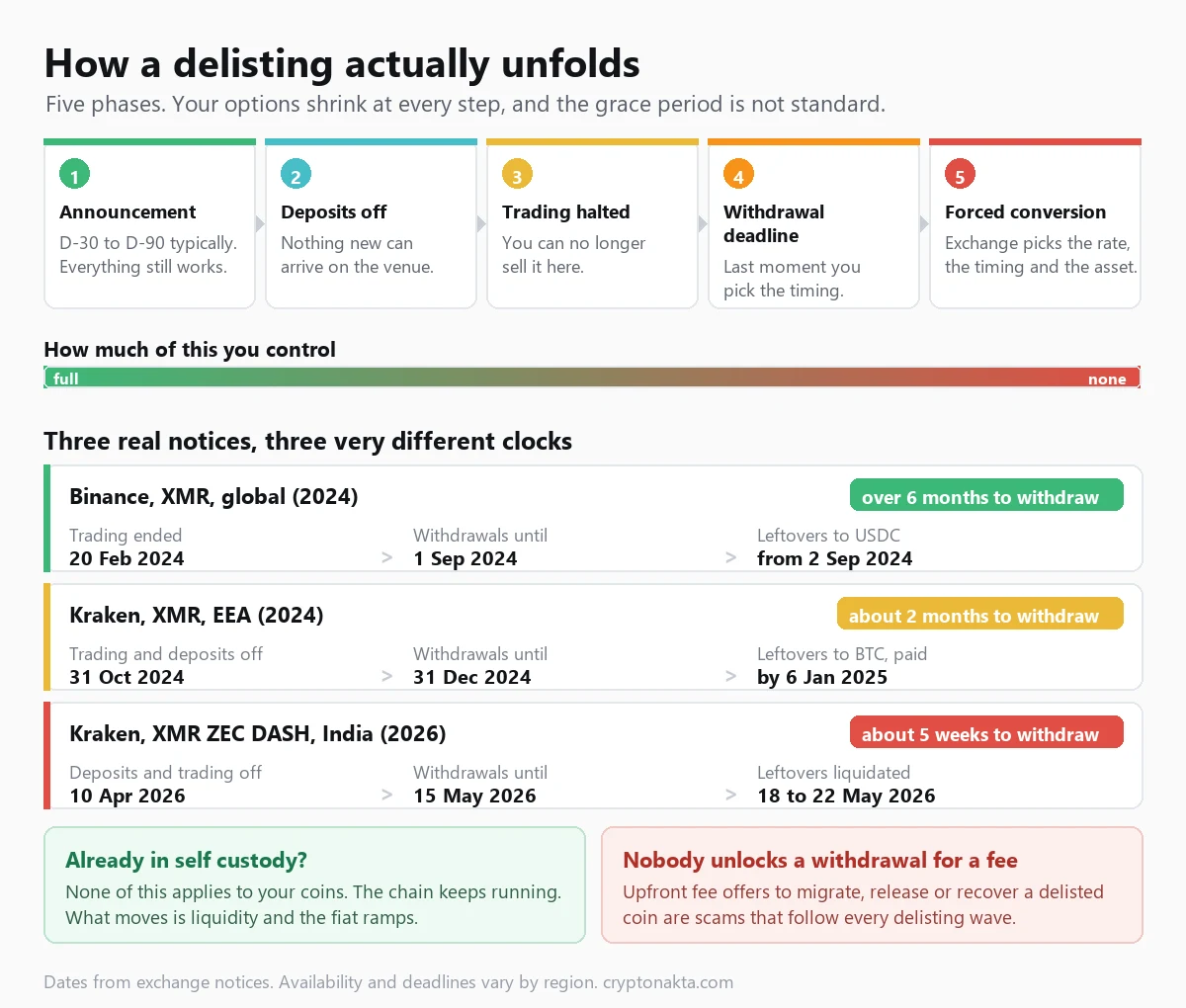
6. Five Phases, and Seven Real Notices Side by Side
Every delisting notice runs through the same five phases. Once you know them you can read a notice in thirty seconds and see how
much room you have left.
| Phase | What happens | Typical timing | What you can still do |
|---|---|---|---|
| 1. Announcement | Delisting published with a schedule | 30 to 90 days of notice is common | Everything. Sell, withdraw, or transfer on your own terms |
| 2. Deposits suspended | The asset can no longer arrive | Often the same day as the notice | Sell or withdraw only. No consolidating holdings from elsewhere into this account |
| 3. Trading halted | Pairs removed, open orders cancelled | A stated time in UTC | Withdraw only. Selling on this platform is over |
| 4. Withdrawal deadline | The send function is switched off | Weeks to months after the halt | Last chance to take custody of the asset itself |
| 5. Forced conversion | Leftovers converted to BTC, USDC or similar | After the deadline | Nothing. You receive proceeds in an asset you did not pick |
Two consequences catch people out. Phase 2 kills the plan to pool coins from three exchanges onto the delisting one and sell in
one go, because deposits usually close within hours of the notice. Phase 3 cancels the resting limit sell you placed eight months ago
at a price you would have been delighted with, and no email arrives to tell you so.
The comforting assumption about phase 4 is that exchanges give you months. Sometimes they do. Sometimes they give you five weeks,
and the gap between those two realities is where people lose coins:
| Exchange | Region | Asset | Trading halted | Withdrawal deadline | Leftovers |
|---|---|---|---|---|---|
| Kraken | EEA | XMR | 2024-10-31, 15:00 UTC | 2024-12-31, 15:00 UTC | Converted to BTC at market rate, distributed by 2025-01-06 |
| Binance | Global | XMR | 2024-02-20, 03:00 UTC | 2024-09-01 | Converted to USDC from 2024-09-02 |
| Kraken | Canada | XMR | 2025-09-02 | Withdrawals maintained past the halt | Not specified in the notice |
| Kraken | India | XMR, DASH, ZEC | 2026-04-10, 14:00 UTC | 2026-05-15, 14:00 UTC | Liquidated 2026-05-18 to 05-22 |
| Kraken | UAE | XMR, ZEC, DASH, plus USDD, DAI, USDS, USDE | 2026-06-16, 14:00 UTC | 2026-09-14, 14:00 UTC | Announced 19 May 2026; margin closed 15 June |
| OKX | Global | 11 privacy pairs incl. XMR, DASH, ZEC, ZEN | 2024-01-05 | – | – |
| Binance | FR, IT, PL, ES | 12 assets incl. XMR, ZEC, DASH | 2024-06-26 | – | Region-specific removal |
Count the days between the halt column and the deadline column. Binance’s global Monero exit ran 194 days, Kraken’s EEA notice 61,
its UAE notice 90, its India notice 35. Same asset, same company in three of those four cases, and the shortest window was a fifth of
the longest. There is no industry norm to plan around. Use the number in your own notice and ignore everybody else’s.
The UAE notice is the live one as this article goes out. Kraken named four stablecoins in it alongside the three privacy coins, so
a compliance sweep is not always about the technology in the asset. Withdrawals stay open until
14:00 UTC on 14 September 2026, so if you hold XMR, ZEC or DASH with Kraken there, the send button is still working while you read this.
7. A Delisting Is Not a Ban on Owning the Coin
Look at who each of these rules actually addresses. CASPs. Trading platforms. Registered exchanges. Licensed firms in the DIFC.
The addressee is a licensed company every time, and the person holding the coin never appears in the sentence.
In the United States there is no federal prohibition on an individual owning, self-custodying, sending, receiving or mining a
privacy coin. AMLR Article 79 binds the licensed firms it calls obliged entities, and self-custody and peer-to-peer transfers sit
outside its scope. The DFSA’s DIFC prohibition reaches regulated activity carried on in or from the centre, and a personal wallet is
not regulated activity. Korea’s framework bars exchanges from handling assets whose transfer records cannot be identified, and it did
not criminalise ownership. Headlines collapse that distinction, and the collapse costs people money. They dump an asset they wanted to
keep, or decide they are now outlaws and go quiet in ways that make the tax position worse later.
notice. Your keys keep signing, your ownership stays lawful in most jurisdictions, and what changes is the price you get on the way
out and how many hops it takes to reach your bank account.
One caveat we will not soften: a handful of countries do reach past the firms and restrict individuals directly, and rules move.
Yours may sit outside the pattern, so go and check.
8. The Licence in Your Terms of Service Sets Your Deadline
Whoever licenses the company holding your coins sets your deadline, and that very often has nothing to do with the country on
your passport. Finding the entity takes under a minute: the opening clause of the terms of service names the company you contracted
with, and the footer of your account page usually repeats it next to a licence number. The domain in your address bar tells you
nothing, because one brand routinely operates four or five licensed companies and which one holds your account was decided by where
you were standing when you signed up.
| Jurisdiction | Instrument | In force | Who is bound | Personal holding |
|---|---|---|---|---|
| EU | AMLR (EU) 2024/1624, Article 79 | 2027-07-01 | CASPs holding anonymity-enhancing coins | Not prohibited |
| EU | MiCA (EU) 2023/1114, Article 76(3) | With MiCA application | Trading platforms admitting assets with inbuilt anonymisation | Not prohibited |
| Dubai (DIFC) | DFSA amended Crypto Token rules | 2026-01-12 | Trading, promotion, fund management, derivatives, mixers | Personal wallet holding not the target |
| India | Reported FIU direction, then FIU clarification | Reported 2026-01; clarified 2026-03-10 | Registered exchanges, in practice | Permitted; FIU issued no formal order |
| South Korea | Specific Financial Information Act | 2021-03 | Domestic exchanges handling untraceable assets | Not prohibited |
| Japan | FSA guidance | 2018 | Registered exchange listings | Not prohibited |
| Taiwan | FSC ruling | 2021-03 | Domestic exchange listings | Not prohibited |
| Brazil | BCB virtual asset rules | 2026-02-02, reporting from 2026-05-04 | Licensed providers | Not prohibited |
Now find your row. A crypto-asset service provider registered in Ireland, Malta or Lithuania puts you in the two EU rows: 1 July
2027 is the legal outer limit, and your exchange will set a commercial deadline years ahead of it. Korea’s FIU or Japan’s FSA puts you
in a market that cleared these assets out years ago, so pull the statement for that year. “Incorporated in the Republic of Seychelles”
matches no row at all, and that is the case to act on early. There is no legislative countdown to watch, and your first warning is the
notice itself.
The two European laws everybody mixes up
“MiCA bans privacy coins” made it into a thousand headlines and it points at the wrong law. The instrument doing the work is
Article 79 of the Anti-Money Laundering Regulation, which most of the coverage never mentions. It stops credit institutions, financial
institutions and crypto-asset service providers from keeping anonymous accounts, including accounts holding anonymity-enhancing coins.
That clause tells firms what they may hold for customers. Individuals are not in the sentence. MiCA Article 76(3) does a different
job: platforms may not admit assets with inbuilt anonymisation functions unless holders and transaction histories can be identified. A
coin designed around unlinkability has almost no way to satisfy that carve-out, so European platforms read it as closed to Monero and
started removing the asset in 2024 instead of waiting for 2027. Assuming the AMLR
date gives you until 2027 is the mistake that costs money here. Binance removed XMR, ZEC and DASH for French, Italian, Polish and
Spanish users on 26 June 2024, and Kraken closed its EEA Monero market that October.
Two headlines to correct before you act on them
Coinbase did not delist Monero. It never listed it, and Brian Armstrong said so publicly on 24 July 2020. What was
reported on 30 March 2026 is narrower: coverage said Coinbase was removing Zcash, Dash and Horizen for failing its listing standards,
with effect around 7 April 2026, and several write-ups added Monero to the list. We pass the ZEC, DASH and ZEN part on as reporting
and we do not repeat the Monero part. If you hold any of those three at Coinbase, read Coinbase’s own notice.
India’s regulator says it ordered nothing, and the delisting happened anyway. January 2026 reporting said the Financial
Intelligence Unit had directed registered exchanges to stop privacy-coin trading. On 10 March 2026 the FIU clarified that it had
issued no such order, and that the actions appear to have followed exchanges’ own reading of broader anti-money-laundering guidance.
Kraken ran its India sequence in full four weeks later. Exchanges do not wait for a regulator to be unambiguous. De-risking a whole
asset class is cheaper than defending a grey area, so “my country hasn’t banned anything” is a poor reason to relax. For the wider
picture, we keep a separate 2026 crypto regulation overview.
9. Where XMR and ZEC Still Trade in 2026 (Check It Yourself Before You Send)
Availability is the part of this topic that ages fastest. Everything below was true when this article went out, so open the
exchange’s own page before you act on any row. The direction of travel is not in doubt either way: the count of exchanges carrying
Monero has fallen every year since 2023.
| Venue | XMR | ZEC | Notes |
|---|---|---|---|
| KuCoin | Listed | Listed, ZEC/USDT and ZEC/BTC | XMR/USDT and XMR/BTC spot. Level 2 verification required for privacy-coin withdrawals. US: no |
| MEXC | Listed | Listed, ZEC/USDT | XMR/USDT and ZEC/USDT spot, the thickest XMR book of the three when we checked. Parts of the EU excluded. US: no |
| Gate.io | Listed | Listed | XMR and ZEC spot on gate.com, moderate depth. US: no |
| Kraken | Listed outside the EEA, Canada, India and the UAE, including XMR/USD for US clients | Listed, on the same regional map. UAE withdrawals for ZEC close 14:00 UTC on 14 September 2026 | The one regulated dollar pair left to a US reader. Granted state by state, New York closed under the BitLicense, and Kraken has trimmed the regional map four times since 2024 |
| Binance | Not listed since the 2024-02 global delisting | Listed, with ZEC/USDC added in March 2026 alongside ZEC/USDT | All three removed for FR, IT, PL and ES on 2024-06-26. Globally ZEC stayed and lost its monitoring tag on 2025-07-09 |
| OKX | Not listed since 2024-01-05 | ZEC/USDT relisted 2025-11-24, 12:00 UTC | The clearest precedent for an asset coming back after a sweep. XMR did not return with it |
| Bybit | Verify at the venue | Listed, with an active ZEC/USDT spot market | A price page existing does not mean the pair is tradable from your region |
| Coinbase | Never listed | Reported removal around 2026-04-07 | Secondary sources only for the removal; check Coinbase’s own notice |
Four of the eight ran an XMR market when we checked, and seven ran ZEC. That gap comes down to plumbing. An exchange can hold every
customer ZEC balance in transparent addresses and screen it with the same tooling it points at Bitcoin, and Monero offers no equivalent
arrangement. Treat the Bybit row as the general rule, though. Exchanges keep serving market pages, charts and sometimes order forms for
assets a given region can no longer trade, so a page that loads proves nothing. Tradability is set at account level, and your own
logged-in trade screen is where you find out.
If you are moving in Branch A
Three of the exchanges we carry referral arrangements with still ran Monero spot at the last check. They are the three below.
Kraken runs it too, on the terms in its row above, and we have no arrangement there and earn nothing if you use it.
US readers, skip the cards. All three are closed to you, and the paragraph after them explains what is left instead.
KuCoin

MEXC

Gate.io

Affiliate disclosure: some links are partner links. We may earn a commission at no extra cost to you. This is not investment advice. Listings change without notice, and these three were verified when this article went out. Confirm the pair from your own logged-in trade screen before you send anything.
Funding from a US bank. Kraken still runs XMR/USD spot for US clients, so the “there is no US route left” line you will
find elsewhere is out of date. It licenses that service state by state and New York is closed under the BitLicense regime, so nothing
about US availability is actionable until the pair opens in your own account. If it will not, nothing regulated replaces it: KuCoin is
barred from the US market with no end date under the CFTC order that followed its operator’s guilty plea, MEXC lists the United States
as a prohibited country, and the gate.com you reach through a search does not serve US residents. Dollars into a stablecoin and then
an offshore account is the frozen-deposit story with the ending already written, so hold what you already own on your own keys
instead. Our getting started guide covers funding for routes open to you, and the exchange fees
breakdown covers what a round trip costs.
10. Leaving Without an Exchange: Atomic Swaps, Haveno, P2P, and What Each One Can Cost You
You can exit a privacy coin without touching a centralised exchange. These routes work, and every one of them takes risk off a
company and puts it on you, which the guides recommending them rarely mention. None of this is a recommendation.
| Route | What it is | What it can cost you |
|---|---|---|
| Atomic swap (BTC to XMR and back) | Peer-to-peer, non-custodial, enforced by the protocol | Technically demanding, thin liquidity, and a swap running 10 to 60 minutes while Bitcoin confirmations land. A failed leg means waiting on a refund path |
| Haveno | Decentralised P2P marketplace over Tor with multisig escrow | Real usage exists, with 24,018 completed trades through 10 May 2026. But RetoSwap, the largest Haveno-based network, halted trading after an arbitrator message forgery exploit on 20 May 2026 that cost roughly $2.7 million |
| THORChain | Cross-chain swaps without a custodian | Monero integration has been slated for 2026 pending a second audit. It is not shipped. Do not build a deadline plan on an unreleased feature |
| No-KYC swap services | Intermediated, quote-and-send | Counterparty risk with no recourse, honeypot risk, and funds that may be flagged when they later touch a regulated venue |
| Direct P2P, cash or bank transfer | Person to person | Fraud, chargeback exposure on the fiat leg, personal safety in cash meets, and no dispute process worth the name |
The RetoSwap money left and the people it belonged to did not get it back. No operator pocketed it and no team went dark, and that
is the uncomfortable part. When a custodial exchange fails there is a company to sue, a regulator to complain to and sometimes an
insurance fund. A flawed contract hands you none of the three. If you take the atomic swap or Haveno route, do a small trade a
fortnight before your deadline, while a failed first attempt still costs you nothing but the evening.
The venue those guides still recommend does not exist
had dismantled the platform in what it called the largest cryptocurrency seizure in Canadian history, valued at over C$56 million. The
investigation, opened in June 2024 following a Europol tip, found the platform had never registered with FINTRAC as a money services
business and did not identify its clients. Registration reportedly required nothing more than an email address.
Listicles still name it, usually with an approving note about how it required no identity verification. It was custodial, so it
held the keys, and it sat outside every registration regime that might have given customers a claim on anybody once those keys were
taken. So run three checks on any venue a guide sends you to: load its announcements page and confirm something was posted this month,
search the name next to the word seized, and look for people saying withdrawals are processing today. Our
exchange failure and security history has the wider record.
11. Your Local Law Binds You, and We Will Not Help You Route Around It
restricted where you live, we have no workaround for you. Using an exchange that skips identity verification to dodge a rule
that applies to you is a legal exposure you take on personally, and it is not one we are going to call clever.
That is why the section above describes the non-custodial routes factually and stops there. Somebody moving their own coins off an
exchange before a deadline has a legitimate need to know how atomic swaps, Haveno and P2P markets work and what each one costs. Two
warnings travel with them. Some no-KYC exchanges are themselves the scam, honeypot or exit, and a platform that keeps no record of who
you are keeps no record you can point to when it vanishes. And funds with an opaque history can be harder to move into a regulated
exchange or a bank months later, whichever route you picked.
We are not lecturing you about wanting privacy. It is a normal preference and there is nothing shameful in it. Your jurisdiction is
the one fact this page cannot see, so work it out against the rule that binds your exchange, not the one you would prefer, and do that
before you pick a route.
12. Seven Checks Before You Press Send
The withdrawal is the moment the whole plan can go wrong in a way nobody can fix. Work through these before you press send.
| Check | What to confirm |
|---|---|
| 1. Network | Select the correct chain for the asset. A wrong-network send is usually permanent. If it has already happened to you, the wrong network recovery guide covers the narrow cases where anything can be done |
| 2. Address format | Monero uses its own address scheme, and exchanges differ on integrated addresses and subaddresses. Zcash payouts usually go to a transparent t-address, so confirm what your wallet expects before you generate one |
| 3. Memo or tag | Some destinations require one, and omitting it means the funds arrive at the exchange but not at your account. That is a support ticket and a wait, usually without a loss at the end of it. See missing memo or tag |
| 4. Test transaction | Send a small amount first, wait for it to arrive and be spendable, then send the rest. You pay the network fee twice, which on XMR is a few cents |
| 5. Timing | Not on deadline day. Congestion, review queues and exchange-side processing delays all cluster at the end of a withdrawal window. Finish several days early |
| 6. Limits and verification tier | Check your daily withdrawal limit against your balance, and clear any higher verification tier required for privacy assets before the last week |
| 7. Seed phrase backup | Confirm the receiving wallet’s recovery phrase is written down offline and tested with a restore, before it holds anything meaningful. No photos, no cloud notes |
Once the address is in the field, read it: check the first five and last five characters against what the wallet shows, because
clipboard-hijacking malware swaps addresses for ones that look just as plausible. And before you start, check that the mailbox and the
authenticator app you need at the confirmation step still let you in. A 2FA reset is its own support ticket, in its own queue, behind
everybody else’s withdrawal.
13. The Price Tag on “I Will Just Hold Forever”
There is a respectable position that says: delistings are exchange problems, and I will keep the coins on my own keys
indefinitely. Nothing here argues against holding. But “hold forever” has a price tag and it should be chosen with the tag visible.
Fifty-one exchanges delisted Monero in 2023, sixty in 2024 and seventy-three in 2025. By May 2026 roughly 20 exchanges and 49
markets were left. Each departure removes a book, and the ones still standing absorb the same flow with less depth underneath them.
You meet all of it at once, on the day you sell. Spreads widen, and that gap is the tax on leaving a thin market. Size gets slow, so a
large holder picks between a worse average price and breaking the exit into pieces over several days while the market moves. And fiat
conversion turns indirect, because with no regulated pair to your national currency an exit becomes two or three hops, each with its
own fee, spread and counterparty.
That predicts nothing about price, and you will not find a quote anywhere on this page, because quotes go stale within hours. What
works instead is a rehearsal. Decide what portion of your holding you would want to convert within a week if you had to, then take a small
amount through that whole route once, end to end, while there is no deadline in your calendar. Learning the same lesson inside a
withdrawal window costs you the position, at whichever price the calendar hands you.
The bill for a sale you did not make
The second cost arrives a year later. You never pressed sell, but in a good many countries a forced conversion is still a disposal:
somebody else sold on your behalf, a gain or loss crystallised on a date they picked, and it landed in a tax year you had not planned
around. Whether that is true where you live, at what rate and against which cost basis are questions for your tax authority or
somebody qualified to read your situation, and we are not going to guess at them for you.
The paperwork is the same everywhere, and it disappears when the account does. Export the delisting notice with its dates, which
shows the disposal was forced on you; the statement covering the conversion, with the rate applied and the asset you received;
your full acquisition history back to the first buy, which vanishes first and is what every cost-basis calculation is built on; and
the withdrawal transaction IDs if you took the Branch A route, since without them a send to your own wallet reads like a sale to
anyone auditing the account later. Download the files first, then spend half an hour with somebody qualified: the export stops working
the day the account closes, and professional advice keeps indefinitely.
14. Delisted Coins Sometimes Come Back, and So Do the Recovery Scammers
The framing that a delisting is a death sentence is popular and the record does not support it. OKX removed 11 privacy-coin spot
pairs on 5 January 2024 and relisted ZEC/USDT on 24 November 2025, and Binance dropped its monitoring tag from ZEC on 9 July 2025.
Now the honest half. A relisting proves the door can open again. It proves nothing about your coin, your exchange or your
deadline. ZEC came back on one exchange while XMR did not, the gap was nearly two years against a withdrawal deadline measured in
weeks, and a relisting restores nothing to a balance that was already force-converted. Deal with the notice first.
The second wave is fraud, and you are pre-qualified for it
The target is easy to find: someone who has just lost access to a balance and is searching for a way to get it back. A service
offers help with “privacy coin migration”, “frozen asset release” or “delisting recovery”. It sounds procedural. Then it asks for a
fee up front, or a “gas payment”, or a “compliance deposit”, or your seed phrase so it can “verify ownership”. Every one of those is
the scam. Nothing legitimate recovers a converted balance for a fee, because there is nothing to recover: the conversion was
contractual and it settled.
victims of an earlier fraud using fake social media profiles, AI-generated video of senior FBI figures, and complaint websites built
to look like ic3.gov. Three lines out of it work as a filter:
IC3 keeps no social media presence at all and will never contact you by phone, email, messaging app or public forum. It will never
ask for payment to recover lost funds, and never refers you to a company that does. The only place to file is ic3.gov, typed into the
address bar yourself. Anyone reaching out as IC3 on Telegram, WhatsApp or X is impersonating a federal agency.
The AI-generated video is what makes 2026 different. A convincing recorded case officer is cheap to produce now and a live call
is not far behind, so confirm any such person through a channel you navigated to yourself. The fake complaint forms are thin in a way
you can spot too: a real filing asks for a great deal, the spoofed ones for little beyond your name, email and how much you lost. If
you have already been hit, our guides on whether scammed crypto can be recovered and on
current scam patterns cover the reporting steps. Stop paying the moment a second payment is requested, because
there is always a second one.
15. The Words in Your Notice, in Plain English
Delisting notices are written by compliance teams, which means they are precise and unhelpful at the same time. This is what the
recurring vocabulary translates to.
| Term | What it means in practice |
|---|---|
| Delisting | An exchange removing an asset from trading. One company’s decision about its own order books, with no legal force and no effect on the underlying blockchain |
| Forced conversion | The exchange converting leftover balances into another asset after the withdrawal deadline, at a rate and moment it selects, with no opt-out and no appeal on the fill |
| Withdrawal deadline | The last moment you can move the asset itself off the platform. The single most important date in any notice |
| Self-custody | Holding the private keys yourself, usually as a seed phrase. No intermediary can freeze, convert or delist what you hold this way, and none can help you if you lose it |
| CASP and obliged entity | The EU’s terms for the regulated businesses that MiCA and the AMLR bind. When a clause opens by naming them, it is telling a licensed company what to do and you are not in the sentence |
| Inbuilt anonymisation | The MiCA Article 76(3) phrase for privacy supplied by the protocol rather than chosen by the user. It is the property that makes an asset hard for a regulated platform to admit |
| Atomic swap | A direct trade between two chains enforced by cryptography rather than a custodian, so neither side can take the funds and disappear |
| Shielded pool and t-address | Zcash’s two halves. Balances in a shielded pool are not publicly readable; a transparent t-address behaves like a Bitcoin address on a block explorer, and exchange ZEC withdrawals commonly land on one |
| On-ramp and off-ramp | The routes between national currency and crypto. Delistings mostly damage the ramps and leave the asset alone, and the bill arrives when you try to sell |
Questions People Ask in the Days After the Notice Lands
Compare exchanges and check where an asset is still tradable from your region