Cardano (ADA): One of Crypto’s Busiest Codebases, and a Chain Almost Nobody Uses
Record development against shrinking usage, staking with no lockup and no safety net, a 45 billion cap with nothing burned, and the three gates a spot ETF still has to pass.
| Question | Short answer |
|---|---|
| What is it? | A peer-reviewed proof-of-stake chain, live since 2017-09-27, running Ouroboros consensus and the eUTXO accounting model |
| Development vs usage | 3,645 weekly commits against ~$81M to $90M of DeFi TVL, ~13,660 daily active addresses, ~34 live apps |
| Staking | No lockup, no slashing, rewards every ~5-day epoch, effective 2% to 3%. None of that protects principal |
| Supply | 45B cap, ~36.5B circulating (81%), no burn mechanism, ~1.65B in the on-chain treasury |
| Latest upgrade | Van Rossem, protocol v11. First fork ratified purely by on-chain vote, at 78.97% |
| Next upgrade | Leios. Testnet running; 10x to 65x and 1,000+ TPS are targets, mainnet unscheduled |
| Governance | Real enough to say no: the Cardano Summit budget failed at 65.21% against a 66.67% threshold |
| Spot ETF | Three gates. Eligibility cleared, approval open, securities status undetermined with no process running |
| CRDD and CRDX | Already listed, futures-based, and CRDX is a daily 2x product. Neither is spot ADA |
| Price context | Still below the $3.10 high of 2021-09-02, roughly 94% below it as of mid-2026. Not a straight line down: $0.32 to $1.32 and back in between |
| NIGHT airdrop | Claims closed in 2025. Any claim page now is impersonation |
1. Ouroboros, eUTXO, and a Chain That Waits for Peer Review
2. Is Cardano a Ghost Chain? Both Camps Are Reading Real Numbers
3. Van Rossem: Protocol v11 and the First Upgrade No Company Ratified
4. What Leios Runs Today, and What Is Still a Target Number
5. 45 Billion Capped, Nothing Burned, 1.65 Billion Held in Treasury
6. Where the 2 to 3 Percent Comes From, With No Lockup and No Slashing
7. Governance You Can Vote In, Founder Risk You Cannot Vote Out
8. Three Separate Gates Stand Between ADA and a US Spot ETF
9. How the Listing Path Works, and What Sits on the Reviewer’s Desk
10. Nobody Has Ruled on Whether ADA Is a Security, and the Filings Say So
11. Two ADA Tickers Already Trade, and Neither One Holds ADA
12. Why Every Midnight NIGHT Claim Page You See Now Is Impersonation
13. The Dated Record: Every Fixed Date in One Place
14. Buying ADA Inside and Outside the US, and Deciding Where It Sleeps
15. Glossary: Terms Cardano Threads Keep Raising
Cardano runs one of the largest sustained development efforts in crypto and one of the emptiest networks to actually use. Thousands of commits land every week, roughly 60% of the coin supply is delegated to the stake pools securing it, and the applications running on top hold less value than a mid-sized protocol on a busier chain. ADA has never reclaimed its 2021 high, though it did run from $0.32 to $1.32 and hand the whole move back within a few months along the way. Those facts belong to the same asset, and they don’t point the same direction.
1. Ouroboros, eUTXO, and a Chain That Waits for Peer Review
Cardano’s mainnet went live on September 27, 2017, founded by Charles Hoskinson, one of Ethereum’s
co-founders. Input Output (IOG) writes the code and the Cardano Foundation looks after standards and
stewardship, while the Voltaire constitution put the deciding vote on protocol changes with three
groups of on-chain voters. That arrangement explains a lot about the project’s tempo, in both
directions.
Consensus runs on Ouroboros, a proof-of-stake protocol whose distinguishing feature is procedural.
Each major revision got written up and submitted to academic peer review before it shipped. The core
node is written in Haskell, a functional language with a small hiring pool and a strong story about
proving what code does before it runs. For the general mechanics of proof-of-stake without the
Cardano specifics, our staking explainer and
blockchain primer cover the ground.
eUTXO, and why it feels different to use
Cardano’s accounting model is eUTXO, an extension of the unspent-output model
Bitcoin uses. Ethereum tracks account balances instead. In
practice a Cardano transaction consumes specific outputs and produces new ones, so you can determine
validity before you submit. Fees are predictable, and a transaction that would fail gets caught
locally instead of burning gas on chain. The cost shows up in application design, where contention
over a single shared output is a real constraint. A busy contract that thousands of users touch at
once has to be architected around that in a way Ethereum developers never think about, and it’s one
honest reason Cardano’s app ecosystem grew slowly.
What ADA does inside the network
ADA pays transaction fees. It’s also the stake in proof-of-stake, delegated to a pool in exchange
for rewards. And under the current governance system it carries voting weight, exercised directly or
handed to a delegate representative. That third job is much newer than the other two, and it’s doing
more than most people realize.
The honest cost of the peer-review approach: smart contracts didn’t arrive until the Alonzo
upgrade in September 2021, four years after mainnet, and by then competing ecosystems had built a
lead in applications and developer mindshare that has never fully closed.
2. Is Cardano a Ghost Chain? Both Camps Are Reading Real Numbers
“Is Cardano dead” is a search query with genuine volume, and it usually gets answered with vibes
from whichever side is doing the answering. Both camps are reading true numbers off the same
chain.
| Metric | Reading | As of |
|---|---|---|
| DeFi total value locked | Roughly $81M to $90M, against a December 2024 peak near $700M | 2026 |
| Daily active addresses | About 13,660 | 2026 |
| Weekly GitHub commits | 3,645 | 2026 |
| Applications live on chain | About 34 | 2026 |
| Drawdown | About 94% from the $3.10 high of 2021-09-02, and about 87% from the $1.32 high of 2024-12 | 2026-07 |
| Circulating supply delegated to pools | Roughly 60% | 2026 |
The case that it’s a ghost chain
Under $90 million of value locked in DeFi is a small ecosystem by any
standard of this cycle, and it’s down close to 90% from a peak that was itself modest next to the
chains Cardano gets compared to. You could read through all 34 or so live applications in an
afternoon. About 13,660 daily active addresses is village-scale traffic for a top-twenty asset. And
the high that drawdown gets measured against was set in September 2021, so a full cycle has come and
gone with ADA still well underneath it.
The case that the label is lazy
3,645 commits a week is among the highest sustained development output in the industry, and you
can’t buy that number with a marketing budget. Roughly 60% of circulating ADA is delegated to stake
pools, so the security budget is enormous relative to market capitalization and holders are
participating instead of sitting on an exchange waiting to sell. Governance is live and producing
binding results, which is more than most chains with larger TVL can say. And the TVL peak was
December 2024, because smart contracts didn’t exist on Cardano until Alonzo. Anyone framing this as
“it never recovered from 2021” is measuring against something that could not have happened.
Both readings hold at once. Cardano is a heavily built, heavily staked, lightly used network, and
buying ADA means betting that the build eventually pulls usage behind it.
3. Van Rossem: Protocol v11 and the First Upgrade No Company Ratified
The upgrade named Van Rossem moved Cardano to protocol version 11. The chain didn’t halt, blocks
kept producing, and most holders noticed nothing at all. That’s the intended outcome on this network,
where the fork mechanism switches protocol versions without a restart or a coordinated downtime
window.
Five Cardano Improvement Proposals shipped together, and two effects reach ordinary users. Some
existing smart contracts simply got cheaper to run, because the built-in functions across Plutus V1,
V2 and V3 were consolidated and the cost model that prices on-chain operations was refreshed. And
verifying a large batch of signatures in a single operation became practical on chain, which is the
piece bridges, rollup-style constructions and identity systems have been waiting on.
Van Rossem was proposed, deliberated and ratified entirely through on-chain governance, and that
had never happened before on this chain. Delegate representatives voted 78.97% in favor, and IOG,
which wrote the code, didn’t make the call.
person’s to change, and holders find out afterward. A chain that can ratify a protocol upgrade
through a stakeholder vote has relocated part of that risk. Keep it out of the price forecast,
though. Alonzo went live within days of ADA’s all-time high in September 2021, and the chain has
kept shipping right through the drawdown since.
4. What Leios Runs Today, and What Is Still a Target Number
Leios is Cardano’s answer to throughput. Part of it is running and part of it is a target number,
and the two get quoted interchangeably.
What exists is a public testnet called Musashi Dojo, the first time the design has run in a
networked environment with real participants instead of in simulation. The engineering effort behind
it is documented and large, with more than 705,000 cumulative lines of code and over 5,700
development updates logged along the way.
What’s a target is the performance. Throughput of ten to sixty-five times the current network, and
a figure above 1,000 transactions per second, are stated goals rather than measured results. A
mainnet ambition has been announced publicly, no scheduled deployment date stands behind that
ambition, and Cardano’s record with roadmap timing argues for patience. Shelley, Goguen and the
smart-contract era all landed later than early communication implied, and the four-year gap between
mainnet and Alonzo is the clearest example on the record.
Between a testnet running and that testnet becoming mainnet sit performance work under adversarial
conditions, node upgrades across a large distributed set of stake pool operators, and a governance
vote, any of which can take quarters.
A demand question hides inside this supply-side story. The current network isn’t
capacity-constrained, and nothing is queuing to get on it. Raising a ceiling that traffic never
touches to a much higher ceiling doesn’t produce activity on its own, and the argument that it will
rests on developers choosing Cardano for headroom they don’t currently need.
5. 45 Billion Capped, Nothing Burned, 1.65 Billion Held in Treasury
Supply is where a lot of ADA narratives break down, and the numbers behind them are plain
enough.
Maximum supply is fixed at 45,000,000,000 ADA. Circulating supply is roughly 36.5 billion, about
81% of the cap. There’s no burn mechanism. Fees paid on Cardano get recycled into rewards and the
treasury instead of being destroyed.
That last point breaks a comparison people make constantly. Bitcoin’s scarcity story runs on a
hard cap plus permanently lost coins. Ethereum’s runs on fee burning that can push net issuance
negative when the network is busy. Cardano has a cap and nothing that removes coins, so its supply
curve only ever flattens toward 45 billion. Any scarcity argument for ADA has to rest on the cap
alone, and a cap that’s already 81% filled has most of its work behind it.
ADA reached $3.10 on September 2, 2021 and has not returned to it since. That gap is the number
most often quoted, and quoting it by itself gets the history wrong. In the month after the November
2024 US election ADA ran from $0.32 to $1.08, then printed $1.32 in December 2024 before handing the
entire move back. Anyone who bought that December high is down roughly 87%, and for most people who
have bought ADA in the years since, that figure describes their position far better than a drawdown
measured from 2021 does.
The treasury that sits outside the price
Cardano’s on-chain treasury holds roughly 1.65 billion ADA, about 4.5% of circulating supply,
funded continuously from fees and issuance. Every coin in it moves only by governance vote.
As an asset, it’s a self-funding development budget most chains would love to have. As an
overhang, it’s 1.65 billion ADA already counted in the circulating figure that a single vote can hand
to a recipient with no obligation to hold it, which is a different mechanism from the roughly 8.5
billion still to be issued against the cap.
6. Where the 2 to 3 Percent Comes From, With No Lockup and No Slashing
Cardano staking is unusually forgiving, and the two features it lacks are precisely the two that
scare people off staking elsewhere.
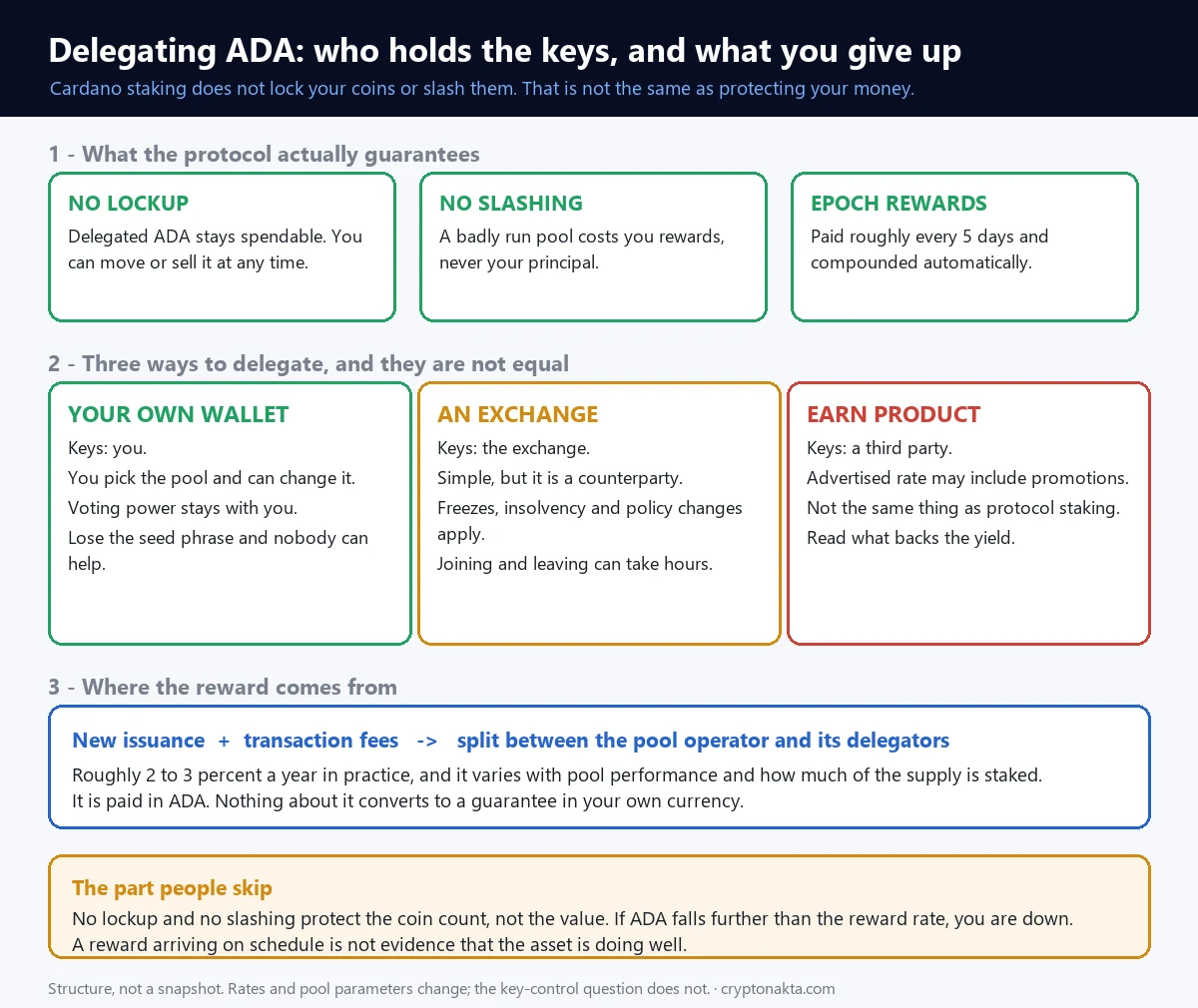
There’s no lockup. Delegated ADA never leaves your wallet and never becomes untransferable. You can
sell it, send it or spend it at any moment while it’s delegated, and no unbonding period applies.
There’s also no slashing. A stake pool that performs badly or drops offline costs you rewards for
that stretch and can’t touch your principal. Set that against networks where a validator fault
destroys a slice of delegated stake and it’s easy to see why Cardano’s design attracts the crowd it
does.
Rewards arrive every epoch, roughly five days, and they compound automatically into your delegated
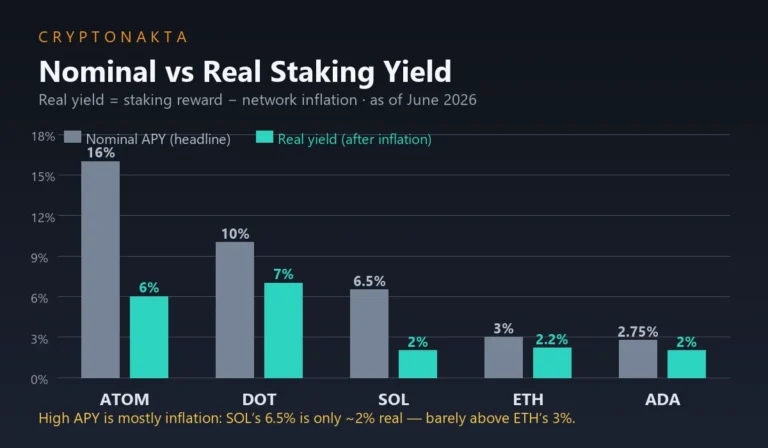
balance with no claim step. Effective returns land in the 2% to 3% range, with published figures
spanning roughly 2.18% to 4.5% depending on the source, the period and the pool. Around 60% of
circulating supply is delegated. If you want to understand why headline staking yields across the
industry usually overstate what a delegator keeps, our
real staking yield comparison works through the arithmetic.
new issuance and fees, and they’re denominated in ADA. If ADA falls 30% over a year, a 2.5% reward
rate hasn’t made you whole in dollar terms and was never designed to. Staking pays a yield on a
volatile asset and leaves the volatility exactly where it was.
Who holds the keys while you earn
| Route | Lockup | Reward cadence | Key control | What can bite you |
|---|---|---|---|---|
| Delegating from your own wallet (Lace, Eternl, Yoroi and similar) | None | Every epoch, about 5 days | You | Lose the seed phrase and nothing recovers it. You also have to pick a pool that is neither saturated nor abandoned |
| Exchange delegation or a staking service | None nominally, though enrolling and unenrolling take time | Set by the venue | The venue | Counterparty exposure: freezes, insolvency, policy changes. The venue also takes a cut before you see a number |
| Liquid staking and packaged Earn products | Varies by product | Varies by product | A third party | Advertised rates can include promotional top-ups that expire. Smart-contract and counterparty risk stack on top of each other |
Exchange delegation is genuinely convenient. It also swaps one set of risks for another: anything
you don’t hold keys to depends on an institution staying solvent and cooperative for as long as you
hold it. Our exchange security track record and the
wallet guide cover both sides of that trade honestly.
The US tax collision
IRS Revenue Ruling 2023-14 treats staking rewards as ordinary income the moment the taxpayer
gains dominion and control over them. Cardano pays out automatically every epoch. Put those two facts
together and a US filer holding delegated ADA generates roughly 73 income events a year without
pressing a single button, each one valued at the price when it landed. No exchange hands you a tidy
summary of that. This is general information rather than tax advice, so confirm your own situation
with someone qualified before filing.
7. Governance You Can Vote In, Founder Risk You Cannot Vote Out
Cardano’s Voltaire era gave the network something most chains still discuss in the future tense: a
ratified constitution and a working three-body vote. Delegate representatives, elected by ADA holders
who hand over their voting weight, sit alongside a constitutional committee that checks proposals
against the constitution, and stake pool operators who vote on a defined set of questions. Van Rossem
shipping through that machinery is the proof it functions.
The sharper proof is a failure. A proposal to withdraw roughly 7.8 million ADA from the treasury
to fund the Cardano Summit drew 65.21% support against a 66.67% threshold. It fell short by less
than a point and a half, and the summit was cancelled outright. Governance then approved a
scaled-down alternative: attending TOKEN2049 instead of hosting a flagship event of its own.
Capture risk looks different on a chain where the treasury turns down its own flagship event. The
same machinery means roadmap items, marketing and funding all sit under a vote that can go against
them, which is a category of uncertainty single-company chains simply don’t carry.
The part you can’t vote on
An NFT artist named Masato Alexander alleged publicly that genesis keys were used during the 2021
Allegra hard fork to alter the ledger and take control of roughly 318 to 350 million unclaimed ICO
ADA, about 0.2% of the original ICO allocation. Hoskinson denied it outright, stating that unclaimed
allocations had been moved into custodial accounts and that 99.8% of ICO entitlements were redeemed
normally, and IOG published audit documentation to that effect. He then declared the matter closed on
his end. Parts of the community didn’t accept that as closure, and the dispute has gone quiet without
ever resolving.
Separately, there is a documented history of friction between Hoskinson and the Cardano Foundation
over governance and transparency, including a proposal to change the Foundation’s jurisdiction, and
a formal governance review opened since.
settled is as unserious as treating it as proven, and the audit documentation on the table is the
company’s own account of its own conduct. File it as an unpriced tail, a class of risk where the
asset is exposed to one person’s reputation and disclosure practices, and let position size carry
it.
8. Three Separate Gates Stand Between ADA and a US Spot ETF
Ask when a US spot Cardano ETF arrives and you tend to get a date back. Three separate gates stand
between ADA and a listed spot fund, they open by three different mechanisms, and only one of them
runs on a calendar at all.
The first gate is arithmetic. The SEC’s generic listing standards let an exchange list a
commodity-based trust on an asset that has traded for six months on a futures market the CFTC
regulates. CME built and listed an ADA futures contract, the count ran from there, and nobody
exercised judgment along the way. Cardano cleared that requirement.
The second gate is a decision. Once a spot filing is live and its review is triggered, the agency
gets a capped number of days to respond, and it can respond with a denial. Eligibility puts a product
in front of the desk and says nothing about what comes back off it.
The third gate has no procedure attached at all. No court and no regulator has held that ADA is a
commodity, and nothing is running that would produce such a ruling. That open status is why the
risk-factor sections of spot filings carry language about a trust being wound down if the underlying
asset is later held to be a security.
| Gate | What opens it | Where ADA stands |
|---|---|---|
| Eligibility | Six months of trading on a CFTC-regulated futures market, counted mechanically | Cleared, satisfied by the CME contract |
| Approval | An SEC decision on a specific filing, inside a review window capped at 75 days once triggered | Open. A denial comes out of the same window as an approval |
| Securities status | A court ruling or a formal agency determination | Open, with no process running and no deadline |
delegated by you, so the staking rewards that come with holding the coin yourself stay out of reach
for as long as you own the shares.
9. How the Listing Path Works, and What Sits on the Reviewer’s Desk
For most of the last decade, getting a spot crypto ETF listed in the US meant a bespoke fight. Each
product needed its own rule-change filing, its own comment period, and its own argument about whether
a surveilled market of significant size existed, which is what kept everything except Bitcoin and
Ether stuck for years.
Generic listing standards replaced that fight with a checklist, and for ADA the binding item is
the futures one. A regulated derivatives venue had to build the contract, publish specifications and
find enough institutional interest to justify the effort. Once it did, regulators had a surveilled
price series to point at. The agency formed no view about Cardano’s roadmap, its developer count, or
whether ADA belongs in a portfolio.
Bitcoin is the useful comparison. Futures traded on CME from 2017 and spot funds still took until
January 2024, held up by everything downstream of the futures market: custody arrangements,
surveillance-sharing agreements, and a regulator willing to say yes. ADA enters that same stretch
with a shorter history and a far smaller asset behind it.
What sits on the reviewer’s desk
Eligibility only matters if something is in front of the agency to be reviewed, and the review runs
on an entire package rather than on the asset’s merits. A spot filing has to name a custodian,
describe how ADA is held and how keys are secured, explain how the fund prices the asset when it
strikes a net asset value, disclose the fee, and lay out how creations and redemptions work. The
Grayscale vehicle that would convert existing Cardano exposure into a listed spot product sits in
that queue alongside other single-asset altcoin filings.
The 75 days people quote is the outer edge of that window once a review is triggered, and it isn’t
a countdown that starts by itself. Amend, withdraw or refile and the count can restart, which is how
carefully built calendars stop describing reality.
reaching one produces a listed fund.
Spot funds change the plumbing of demand more than they change the asset. They let money that’s
only permitted to hold listed securities reach something it otherwise can’t touch: retirement
accounts, advisor-managed portfolios, mandates written before crypto existed. An advisor whose
platform carries the ticker still has to decide ADA belongs in a client’s account, and plenty will
look at it and pass.
10. Nobody Has Ruled on Whether ADA Is a Security, and the Filings Say So
American readers usually meet the securities question in one place, buried in the risk factors of
a filing. In 2023 the SEC brought enforcement actions against major exchanges and, in the supporting
complaints, listed a set of tokens it characterized as securities. ADA appeared on those lists. The
Coinbase and Binance matters were later dismissed, which settled the exchanges’ immediate exposure
and left ADA’s status exactly where it had been. No court has held that ADA is a commodity, and the
claim came off the board before anyone ruled on it.
Undetermined status has consequences, and they show up in paperwork. An S-1 for a spot trust has
to tell investors what happens in the bad branch, and the bad branch here reads roughly like this: if
a court or regulator concludes the asset is a security, the trust may be forced to wind down and
liquidate, potentially at a time and price the sponsor doesn’t choose. Every issuer writing an
altcoin spot filing under these conditions carries some version of that sentence. Read it as a live
mechanism that would hit the fund and its holders in the same moment.
An approval wouldn’t settle any of this. A listing decision and a securities-status determination
come out of different machinery and can coexist in an uncomfortable state for years. And if you
already hold ADA on a US exchange, the question reaches you too, since the venues you trade on are
the ones that got sued. Our 2026 regulation roundup has our broader read on
where the rules are heading.
11. Two ADA Tickers Already Trade, and Neither One Holds ADA
A lot of US retail exposure goes wrong right here. There are already ADA-shaped tickers you can
buy in an ordinary brokerage account, and buying one of them believing you’ve bought spot ADA is an
expensive misunderstanding.
Volatility Shares listed two of them. CRDD tracks ADA through futures contracts and CRDX targets
twice the daily move, and neither one holds a single unit of ADA.
| Product | What it holds | How it behaves | Who it suits |
|---|---|---|---|
| CRDD (Volatility Shares) | CME ADA futures | Tracks ADA, with roll costs and basis drift accumulating over long holds | Traders who want listed exposure and understand futures mechanics |
| CRDX (Volatility Shares) | Derivatives targeting 2x the daily move | Resets daily, so multi-day paths compound against the holder in choppy markets | Short-horizon positioning. Holding it for weeks is where people get hurt |
| A spot trust (the pending Grayscale filing, if approved) | ADA itself, held in custody | Tracks the asset, minus the fund fee | Investors who want the asset inside a brokerage wrapper |
| ADA on an exchange or in your own wallet | ADA, with keys held by the venue or by you | The asset, plus the ability to delegate it for staking rewards | Anyone who wants to actually use the network |
CRDX’s daily reset catches people who think they’ve done the homework. Suppose ADA drops 10% one
day and rises 11.1% the next, finishing roughly where it started. A 2x daily product falls 20%, then
rises 22.2%, and ends below where it began. Repeat that pattern across a sideways month and the gap
widens with every cycle. The 2x objective is a daily objective, and it resets at the close of every
session.
12. Why Every Midnight NIGHT Claim Page You See Now Is Impersonation
Search Midnight and NIGHT today and you’ll find claim pages. Every single one of them is chasing a
window that closed in 2025.
The real sequence: Midnight took a snapshot on June 11, 2025 covering holders of at least $100 in
ADA, BTC, ETH, XRP, SOL, BNB, AVAX or BAT. The Glacier Drop claim period ended on October 20, 2025.
The Scavenger Mine, a secondary route for unclaimed allocation, ended on November 19, 2025. No new
claim route has opened since, and none has been announced.
NIGHT’s total supply is 24 billion, and what holders actually collected came in far below what was
earmarked for them. The Glacier Drop ended with 3.5 billion tokens claimed, about 14.6% of total
supply, across a little over 170,000 wallets, and the Scavenger Mine added roughly 1 billion more.
Cardano wallets took the largest share of what did get claimed.
Tokens that were claimed didn’t become immediately liquid either. They release in four stages of
about 90 days each under a thaw schedule that began in December 2025 and runs about a year. So a
sizeable population claimed correctly and then spent months waiting on portions of their allocation,
checking for news, half-expecting another step in the process. That population is exactly who fake
claim pages are built to catch.
Any site telling you to connect a wallet, enter a seed phrase or sign a transaction to claim NIGHT is
trying to drain you. No legitimate airdrop has ever needed a seed phrase. Our
scam red flags guide catalogs the patterns these pages reuse.
Midnight is a privacy-focused sidechain in the Cardano family, and spreading NIGHT across holders of
eight chains was a deliberate attempt to seed a user base wider than one community.
13. The Dated Record: Every Fixed Date in One Place
Everything above describes rules, mechanisms and events already on the record. This section is the
only place in the article where a calendar does any work, and it was written in July 2026. Check
anything in it against a current source before you act on it.
| Date | What it is | Settled? |
|---|---|---|
| 2026-02-09 | CME lists ADA futures, starting the six-month count | Settled |
| 2026-04 | Volatility Shares lists CRDD (futures-based) and CRDX (daily 2x) | Settled, and neither is spot |
| 2026-06-23 | Ouroboros Leios public testnet, Musashi Dojo, goes live | Settled |
| 2026-07-18 | Van Rossem activates protocol v11, ratified on chain with 78.97% delegate approval | Settled |
| 2026-08-09 | Six months of CME futures trading complete, so spot ETF eligibility opens under the generic listing standards | Fixed date, and not an approval |
| 2026-10-23 | Outside decision date if a full 75-day review runs from the first eligible day | Moves with whenever a review is actually triggered |
| Unscheduled | Leios on mainnet, where 10x to 65x throughput and 1,000+ TPS are stated targets | Open |
| No date | Approval of a US spot ADA ETF | Open |
| No date | A ruling on whether ADA is a security | Open |
The eligibility date is a counting result carrying no decision with it, and the outside decision
date is a ceiling rather than an appointment. If you’re reading this after both windows closed, the
outcome is public record by now, and the gate structure described earlier is what explains it.
Price belongs in the same category. ADA traded around $0.16 to $0.17 in July 2026, with a market
capitalization in the six-billion-dollar range and a rank in the fifteen-to-twenty band.
14. Buying ADA Inside and Outside the US, and Deciding Where It Sleeps
Buying ADA takes a few minutes. Deciding where it lives afterward matters more with every month you
hold it.
Inside the US
Coinbase and Kraken are the regulated domestic on-ramps most American readers will use. Both list
ADA, both connect to a US bank account, and both handle the reporting side in a way an offshore venue
won’t. Coinbase also offers ADA staking, which is the exchange-delegation route from the table above:
convenient, with the venue holding keys and taking a cut of rewards before you see a number. Check
your own state first, though. Access to exchange staking has moved around with state regulators, and
your account screen will show whether it’s available where you live before you commit anything.
Outside the US
ADA sits in the top twenty by market capitalization, so spot pairs are widely available on global
venues. Binance, Bybit, OKX, Gate, MEXC and KuCoin all run ADA spot markets, and most also list
perpetual futures on it. Availability shifts by region and by account status, so check the exchange’s
own notice for your country before you fund anything. Fee structures differ more than people expect,
and our exchange fee comparison lays them out side by side.
Binance

Bybit

OKX

Gate.io

MEXC

KuCoin

Affiliate disclosure: some links are partner links. We may earn a commission at no extra cost to you. This is not investment advice.
On futures: they’re a legitimate instrument and plenty of experienced traders use them well.
They’re also a leveraged product where liquidation counts as a normal outcome, so a first ADA
position is better placed in spot. If this is early days for you, the
getting started guide is the better first stop and the
exchange comparison covers how to choose one.
Where it sleeps
Leaving ADA on an exchange means the exchange holds the keys. That’s reasonable for an amount
you’re actively trading and much less reasonable for a position you intend to hold through a
multi-year thesis about Leios and usage growth. Self-custody in Lace, Eternl or Yoroi puts delegation
and keys in your hands, at the cost of being solely responsible for a seed phrase that nothing on
earth can recover. Hardware wallets pair with all three if the amount justifies the extra step. The
wallet guide walks through the setup, and the Earn overview covers
packaged yield products if you are weighing those against plain delegation.
15. Glossary: Terms Cardano Threads Keep Raising
Ouroboros
Cardano’s proof-of-stake consensus protocol. Its distinguishing feature is process: each major
revision was published and peer reviewed before deployment. Slower to ship, harder to argue with once
it’s out.
eUTXO
Extended unspent transaction output, Cardano’s accounting model. A transaction consumes specific
outputs and creates new ones, so validity and fees can be determined before you submit. It trades
some application flexibility for predictability.
Epoch
A period of about five days that structures the network’s schedule. Staking rewards are calculated
and distributed on epoch boundaries, which is why ADA rewards arrive on that rhythm rather than
daily.
DRep (delegate representative)
Someone who holds voting power delegated by ADA holders under the Voltaire governance system. Van
Rossem was ratified with 78.97% DRep approval. You can delegate your vote to one or register as one
yourself.
SPO and saturation
Stake pool operators run the nodes that produce blocks. Every pool has a saturation point, and
stake delegated beyond it earns diminished rewards for everyone in that pool. Delegating to a pool
already at saturation is the most common avoidable mistake in ADA staking.
Slashing
The penalty on many proof-of-stake networks where validator misbehavior destroys a portion of
delegated stake. Cardano doesn’t implement it. Poor pool performance costs you rewards, never
principal.
Treasury
An on-chain pool of roughly 1.65 billion ADA, funded from fees and issuance, spendable only by
governance vote. The failed Cardano Summit withdrawal shows how contested those spending votes can
get.
Generic listing standards
The SEC framework that lets an exchange list a commodity-based trust on an asset meeting stated
criteria, instead of running a bespoke rule-change process for every product. ADA’s relevant
criterion is six months of futures trading on a CFTC-regulated market, a bar the CME ADA contract
cleared.
Plutus
Cardano’s smart contract platform. Van Rossem consolidated built-in functions across its V1, V2
and V3 versions and refreshed the cost model that prices on-chain operations.