Bitcoin ETF vs owning bitcoin, measured over a full year of closed market hours
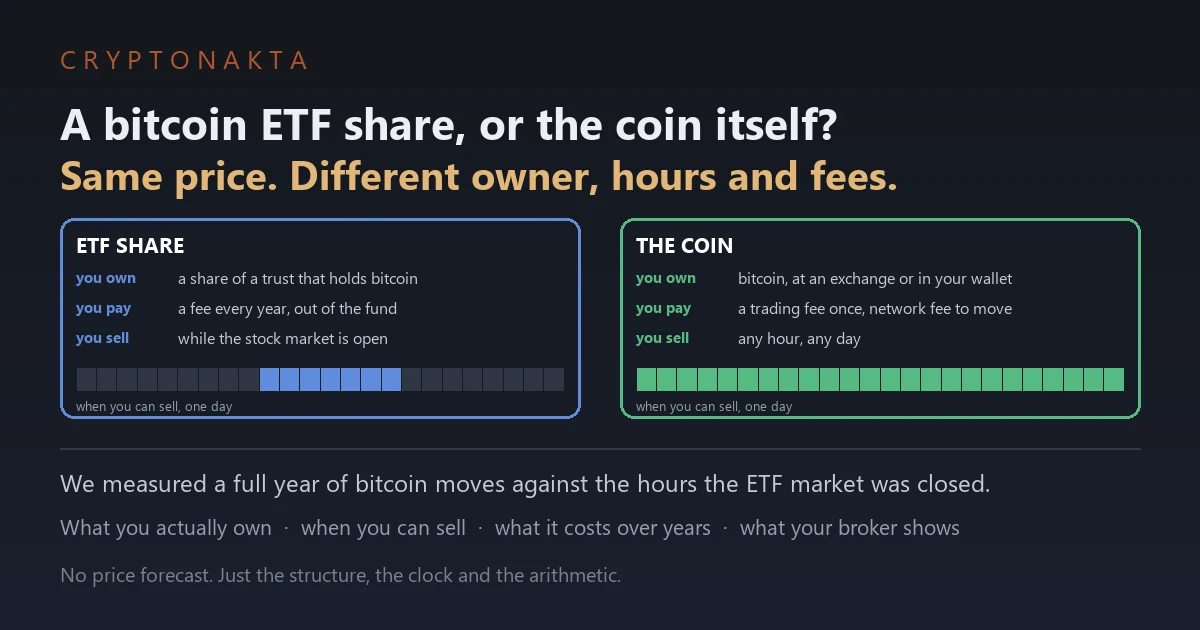
A spot bitcoin ETF share and a bitcoin you hold yourself follow the same price. They are not the same thing. The share is a claim on coins that a custodian keeps for a trust. You can only trade it while the stock market is open, and a yearly fee comes out of the balance. The coin sits in an exchange account or in your own wallet. It trades at any hour, and most of its costs are paid once.
I wanted to know how much of bitcoin’s movement happens while an ETF holder cannot trade. So I took a full year of half-hour prices and split every bar by the New York session, open or closed. The results are below, next to the fee tables and the withdrawal costs. Which one fits you comes down to who holds the keys, when you can sell and how much you hold for how long.
What this article covers (13)
Bitcoin ETF vs owning bitcoin: what you actually holdWhat is a spot bitcoin ETF, and how does it work?Why the share price stays close to bitcoin, and when it did notThe stock market is open about a fifth of the weekA full year of closed hours, measured bar by barWhat an ETF cannot do, and what it makes easierWhat US spot bitcoin ETFs charge, and what Europe’s ETPs chargeYearly fee vs one-time cost at three position sizesWhat it costs to move the coins to your own walletIf a broker, an exchange or your own wallet failsFutures ETFs, leveraged funds and inverse funds are different productsHow to buy bitcoin directly, step by stepMy take: keys, hours and holding period decide it
 View full size ↗
Bitcoin ETF vs owning bitcoin: what you actually hold
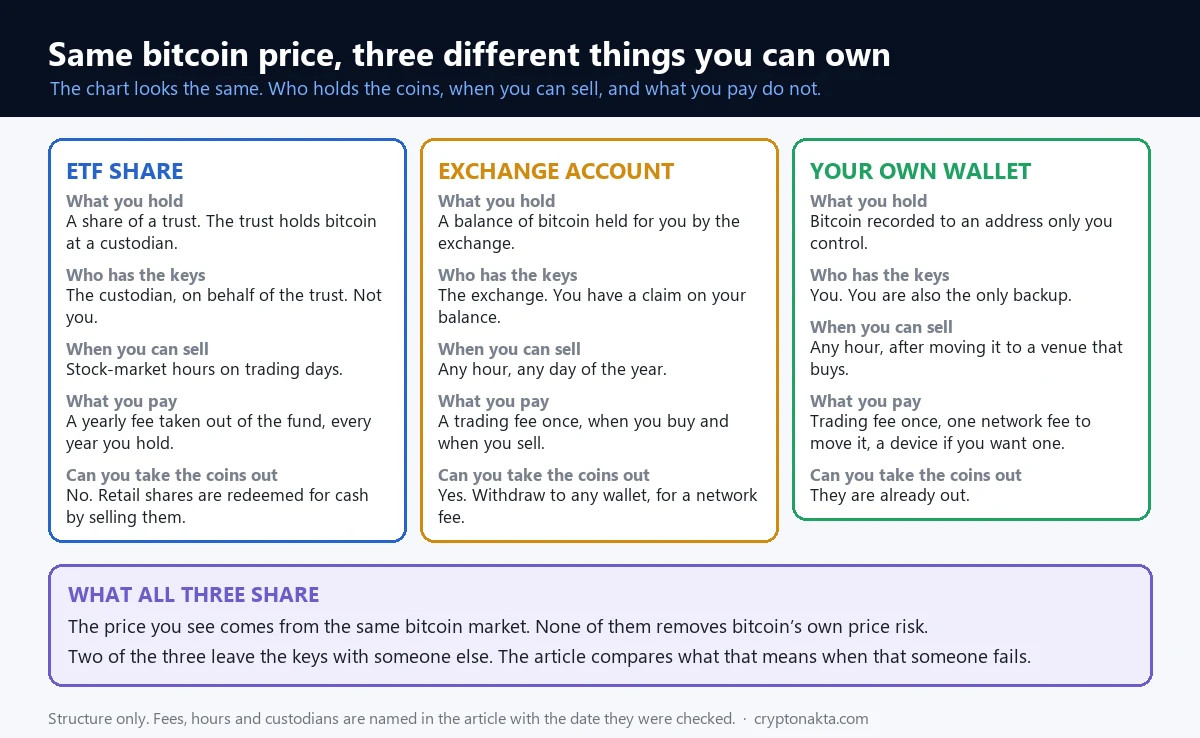
There are three common ways to hold the bitcoin price. You can buy shares of a spot bitcoin ETF in a brokerage account. You can buy bitcoin on a crypto exchange and leave it in your account there. Or you can buy it and move it to a wallet you control. All three go up and down with the same market price.
The difference is in what you actually own. An ETF share is a claim on a slice of the coins a trust holds. The trust does not keep those coins itself. A custodian keeps them in the trust’s name. A coin in an exchange account is held by the exchange in its own wallets. Your balance is a row in its database. A coin in your own wallet is controlled by a private key that only you have.
A private key is the secret that lets a wallet spend its coins. Whoever holds it can move the coins. Nobody else can, and nobody can reset it if it is lost. That single fact drives most of the comparison below.
| Question | Spot ETF share | Coin in an exchange account | Coin in your own wallet |
|---|---|---|---|
| What do you own? | A share of a trust that holds bitcoin | A balance the exchange owes you | The bitcoin itself, on the ledger |
| Who holds the keys? | The trust’s custodian | The exchange | You |
| When can you sell? | Stock market hours | Any hour, any day | Any hour, after sending to an exchange or a buyer |
| What do you pay? | A yearly fee taken from the fund, plus any broker commission | A trading fee when you buy and sell | Trading fee, a withdrawal fee, and a device if you want one |
| Can you withdraw the coin? | No. You sell for cash. | Yes, to any address | It is already with you |
| Can you use it on-chain? | No | Only after withdrawing | Yes |
| Who handles inheritance? | Your broker’s estate process | The exchange’s process, if it has one | Whoever you left the backup with |
Two of these three are set-ups where someone else holds the coins for you. The ETF and the exchange account differ in hours and cost, and they share that one trait. Only your own wallet puts the private key in your hands, and that also makes the backup your job.
If bitcoin itself is new to you, read what bitcoin is and how a crypto wallet works first.
What is a spot bitcoin ETF, and how does it work?
An exchange-traded fund is a fund whose shares trade on a stock exchange, the same way a stock does. A spot bitcoin ETF is one that holds real bitcoin rather than contracts about bitcoin. In legal terms the US products are grantor trusts listed as exchange-traded products. Almost everyone calls them ETFs, and I do too.
The trust owns a pile of bitcoin. A custodian is the firm that keeps that pile in cold storage in the trust’s name. The trust also has a sponsor, the issuer whose brand is on the ticker. The sponsor runs the fund, pays the custodian and collects the yearly fee.
The net asset value (NAV) is the value of the coins in the trust divided by the number of shares. It is what one share is worth on paper. The price you see on your broker’s screen is the market price. It moves around the NAV during the day and usually stays close to it.
An authorized participant (AP) is a large trading firm with a contract from the sponsor. It is the only party that can create new shares or hand shares back to the trust. When it creates, it delivers bitcoin or cash and receives shares. When it redeems, it returns shares and receives bitcoin or cash. You and I only trade existing shares with other investors in the market.
Take IBIT, the iShares fund from BlackRock. It is the one that comes up most in searches. It listed on January 11, 2024. Its coins sit with Coinbase Custody, and the fund later added Anchorage Digital as a second custodian. The fee is 0.25% a year (checked September 25, 2026). It comes out of the trust’s assets a little at a time, so you never see a bill.
You cannot take bitcoin out of an ETF. You sell the share and receive cash. Swapping shares for coins is something only an authorized participant does, and that stayed true after in-kind redemptions were allowed in 2025.
One line on scale, dated so it can age. On September 18, 2026 the US spot bitcoin ETFs held about $102.5 billion in assets. That is around 6.3% of all bitcoin. IBIT alone held about $67.3 billion on September 24, 2026.
Why the share price stays close to bitcoin, and when it did not
The market price of a share stays near the NAV because the authorized participants make money when it drifts. If the share trades above NAV, an AP delivers bitcoin to the trust for new shares and sells those shares on the market. That extra supply pushes the price back down.
If the share trades below NAV, the AP buys shares and hands them back for bitcoin. It pockets the difference, and that demand pulls the price back up.
This loop is the whole reason an ETF share follows the bitcoin price. It is a business, not a rule written into the share. A share price that sits on the bitcoin price is the result of that arbitrage running, and nothing more. When the loop stops, the price and the coins can drift apart.
GBTC is the example to know. Grayscale started it in 2013 as a trust with no way to redeem shares. Money could go in and shares could be sold to other investors. That was it. From February 2021 the shares traded below the value of the coins inside. By December 2022 the discount was about 48 to 49%. A holder who sold that month got about half of what the coins were worth.
On January 11, 2024 GBTC converted into an ETF alongside the new funds listed that day. Redemptions opened. The discount nearly disappeared. Same coins, same sponsor and same custodian. The only thing that changed was that the loop started running.
One more date matters here. From the January 2024 listings until July 29, 2025 the US spot ETFs could only create and redeem in cash. On July 29, 2025 the SEC allowed in-kind creations and redemptions, so the AP can now deliver or receive bitcoin itself. The order said this cuts costs for the AP and can tighten spreads. It changed nothing for ordinary holders. You still get cash when you sell.
The loop has one more limit. It only runs while the stock market is open. Bitcoin keeps trading through the night and the weekend. So the first trade on Monday morning simply jumps to wherever bitcoin already is. That jump is the gap I measured.
The stock market is open about a fifth of the week
US spot bitcoin ETFs trade on US stock exchanges. The regular session runs from 09:30 to 16:00 New York time, Monday to Friday. On the West Coast that is three hours earlier in the morning. For readers in the UK the same session is 14:30 to 21:00 London time. In Spain it is 15:30 to 22:00 Madrid time. Those times shift for a few weeks a year when daylight-saving changes fall on different dates.
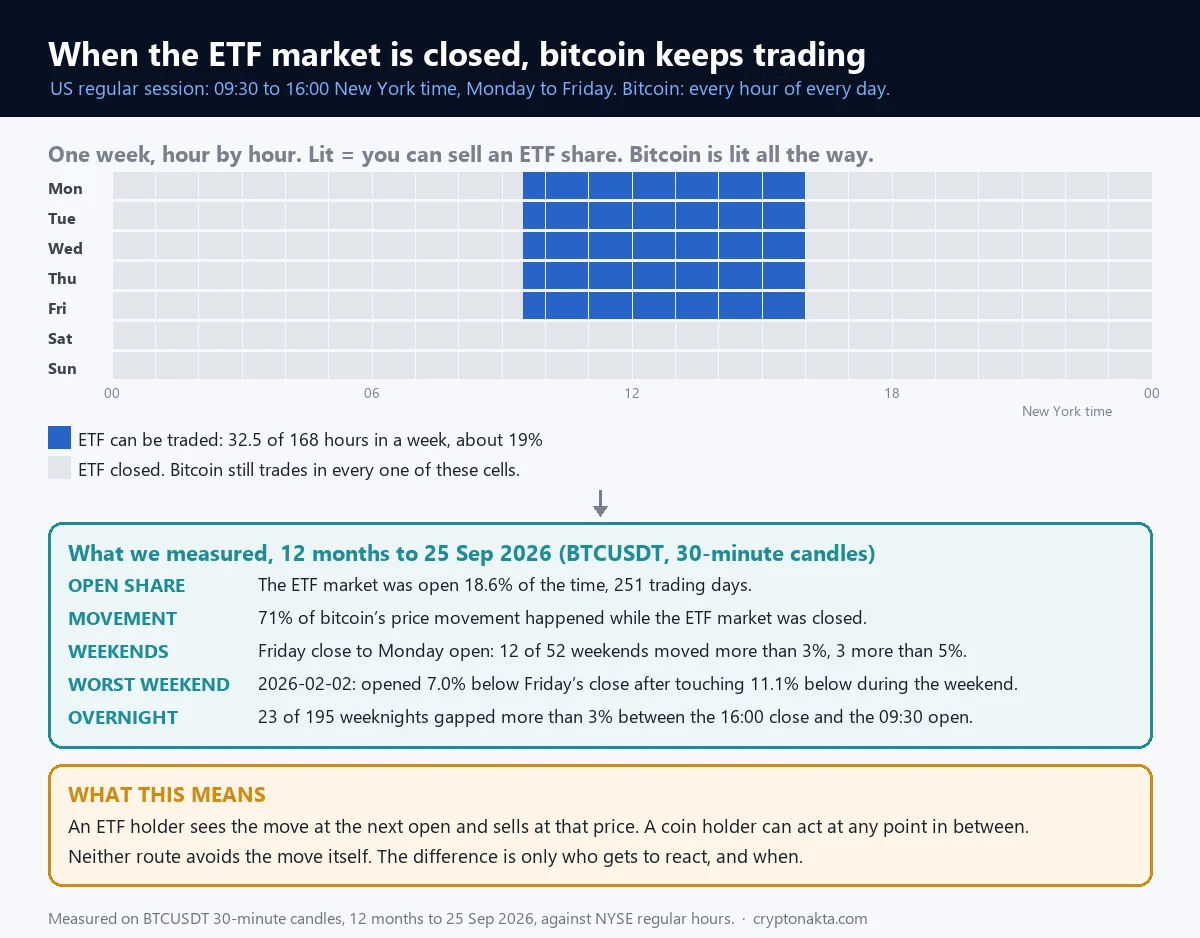
Bitcoin trades every hour of every day. A week has 168 hours. The regular session covers 32.5 of them, which is about 19%. Take out market holidays and early closes, and the share over a full year drops to 18.6%. The market is closed for the other 81.4%.
| Where you trade | Regular session, local time | Weekends | Share of the week |
|---|---|---|---|
| US spot ETF, New York time | 09:30 to 16:00 | Closed | About 19% |
| US spot ETF seen from London | 14:30 to 21:00 | Closed | About 19% |
| US spot ETF seen from Madrid | 15:30 to 22:00 | Closed | About 19% |
| Bitcoin on a crypto exchange | Every hour | Open | All of it |
| Bitcoin in your own wallet | Every hour, once sent to a buyer or an exchange | Open | All of it |
Session times converted with standard time-zone data on 2026-09-25. Holidays and early closes vary by year.
Some brokers offer pre-market and after-hours sessions for ETFs. The hours differ by broker, and the volume in those sessions is thin. Prices there can sit far from where the next regular session opens. ETFs do not trade around the clock, whatever the extended hours are called.
None of this matters if you never look at the price between Friday and Monday. It matters if you want to act on news over a weekend. An ETF order placed on Saturday waits until Monday morning. A sell order on a crypto exchange fills on Saturday.
A full year of closed hours, measured bar by bar
Here is what I did. I downloaded every half-hour candle for BTCUSDT on Binance for the year ending September 25, 2026. That is 17,520 bars. I converted each bar to New York time. Then I marked it as open if it fell inside the regular session on a trading day, and closed otherwise. Market holidays and early closes came out of the open set. That left 3,251 open bars across 251 trading days.
Time first. The open bars are 18.6% of the year. Movement next. I added up the size of every half-hour move in either direction, without netting them against each other. Of that total, 71% happened in closed bars. Only 29% happened while an ETF could trade.
That is not because the closed hours are wilder. Per hour, the open session moves more. Annualized volatility was 64.5% in the open bars and 39.2% in the closed ones. The closed hours simply outnumber the open ones by more than four to one.
Then the gaps. I took the last price before 16:00 New York time on Friday and the first price at 09:30 on Monday. Over 52 weekends the median gap was 2.04%. It was above 2% on 26 weekends and above 3% on 12. It was above 5% on 3. Inside the weekend, the high-to-low range was more than 5% on 21 weekends and more than 10% on 2.
| Closed period | Count | Median gap | Above 2% | Above 3% | Above 5% | Range above 5% |
|---|---|---|---|---|---|---|
| Weekend (Friday close to Monday open) | 52 | 2.04% | 26 | 12 | 3 | 21 |
| Overnight (weekday close to next open) | 195 | 1.10% | 51 | 23 | 5 | 11 |
| Holiday and long weekend | 10 | 1.88% | 4 | 4 | 0 | 3 |
| All closed periods together | 250 | 1.18% | 78 | 36 | 8 | 32 |
Gap is the size of the move from the last open-session price to the next one, either direction. Range is the high minus the low while the market was closed. Measured on 2026-09-25 from Binance BTCUSDT half-hour data for 2025-09-25 to 2026-09-25.
The worst weekend ran from Friday January 30 to Monday February 2, 2026. Bitcoin was at $83,906 when the Friday session ended. When Monday opened it was at $78,022. That is 7.0% lower. At the low point in between it was 11.1% below the Friday price. An ETF holder who wanted out saw neither the low nor a chance to act before the open.
| Weekend | Gap at Monday open | Low point vs Friday close | High-to-low range |
|---|---|---|---|
| January 30 to February 2, 2026 | -7.0% | -11.1% | 13.3% |
| June 5 to June 8, 2026 | +5.5% | -1.3% | 8.0% |
| June 12 to June 15, 2026 | +5.1% | -0.3% | 5.6% |
| November 28 to December 1, 2025 | -4.9% | -6.5% | 8.5% |
| January 16 to January 20, 2026 (long weekend) | -4.8% | -5.1% | 5.5% |
| September 18 to September 21, 2026 | +4.6% | -1.3% | 6.7% |
The six largest weekend gaps in the window, from the same data. A holder who wanted to buy on Saturday paid Monday’s price instead.
Ordinary weeknights gap as well. Across 195 overnight breaks the median gap was 1.10% and 23 of them were above 3%. The largest was 6.04% up, from the close on August 20 to the open on August 21, 2026. Of 10 holiday breaks 4 gapped more than 3%.
An ETF holder sells at the next open, and a coin holder can act in between. Neither one escapes the move itself. The coin holder just gets to choose the moment, including a bad one.
 View full size ↗
What an ETF cannot do, and what it makes easier
The share and the coin follow the same price. What you can do with them is not the same. Here is the list, with nothing left out on either side.
Things an ETF share cannot do.
- Withdraw the bitcoin. You sell for cash. No broker can send you the coins.
- Send bitcoin to someone. There is no address attached to a share.
- Hold your own keys. The custodian holds them for the trust.
- Pay for anything on-chain, use the Lightning Network, or move value between exchanges.
- Collect coins from a fork or an airdrop. See the next paragraph.
- Trade on a weekend or overnight, as measured above.
The fork point deserves its own lines. IBIT’s prospectus says the trust gives up incidental rights from forks and airdrops permanently, unless rules change later. Other issuers write similar risk factors. If you hold the coin yourself, those rights land with you. Whether they are worth anything is a separate question, and how you claim them differs by wallet and exchange.
Things an ETF share makes easier.
- Keep bitcoin in the same brokerage account as your stocks and funds, on one statement.
- Hold it inside a US IRA, if your broker lists the fund. The account’s tax rules apply to the share like any other holding.
- Set up automatic buys through your broker’s regular investing tools.
- Trade options. Options on IBIT started trading on Nasdaq on November 19, 2024.
- Skip seed phrases, hardware devices and address checks entirely.
- Pass it on. Inheritance follows your broker’s estate process, the same as a stock.
Coin-side derivatives exist too. Futures and options on bitcoin trade on the crypto exchanges themselves, under their own rules. Spot vs futures explains what changes when you move from buying the coin to trading a contract on it.
Tax treatment differs between ETF shares and coins, and between countries. I am not going to put numbers on that here. Check how your own country treats each one before you decide on size.
What US spot bitcoin ETFs charge, and what Europe’s ETPs charge
The expense ratio is the yearly fee a fund takes out of its own assets. You never get an invoice. The sponsor sells a little bitcoin through the year to pay itself, and the NAV per share drifts down by that amount. A broker may add a commission per trade on top, and many charge none for ETFs.
Here are the US spot bitcoin ETFs with their fees, custodians and listing dates. Fees change and several of these were cut once already. Treat the numbers as a snapshot.
| Ticker | Issuer | Fee per year | Custodian | Listed | Note |
|---|---|---|---|---|---|
| IBIT | iShares (BlackRock) | 0.25% | Coinbase Custody, Anchorage Digital added later | January 11, 2024 | largest by assets |
| FBTC | Fidelity | 0.25% | Fidelity Digital Assets (in-house) | January 11, 2024 | |
| GBTC | Grayscale | 1.50% | Coinbase Custody | January 11, 2024 | trust since 2013, converted to an ETF |
| BTC | Grayscale Bitcoin Mini Trust | 0.15% | Coinbase Custody | July 31, 2024 | |
| BITB | Bitwise | 0.20% | Coinbase Custody | January 11, 2024 | |
| ARKB | ARK 21Shares | 0.21% | Coinbase Custody | January 11, 2024 | |
| HODL | VanEck | 0.25% | Gemini, later also Coinbase | January 11, 2024 | |
| EZBC | Franklin Templeton | 0.19% | Coinbase Custody | January 11, 2024 | |
| BTCO | Invesco Galaxy | 0.25% | Coinbase Custody | January 11, 2024 | |
| BTCW | WisdomTree | 0.25% | Coinbase Custody | January 11, 2024 | |
| BRRR | CoinShares Valkyrie | 0.25% | Coinbase Custody | January 11, 2024 | |
| MSBT | Morgan Stanley | 0.14% | Coinbase Custody and BNY (per the filing) | April 8, 2026 | lowest fee as of September 2026 |
Fees and custodians from issuer documents and fund pages (checked September 25, 2026). Custodian arrangements have changed since launch for some funds and can change again.
A few things stand out. GBTC still charges 1.50%, the leftover of its trust days. Grayscale answered with the Bitcoin Mini Trust, ticker BTC, at 0.15%. Most of the January 2024 group sit between 0.20% and 0.25%. Morgan Stanley’s MSBT listed on April 8, 2026 and had the lowest fee of the group at 0.14% as of September 2026.
Look at the custodian column too. At launch, 9 of the first 11 spot ETFs used Coinbase Custody. Fidelity keeps its own coins and VanEck started with Gemini. One firm holding the coins for most of the industry is a concentration. That is a fact about the structure, not a prediction about it.
Now the European screen. A broker in Europe does not list the US funds above. It lists European exchange-traded products (ETPs). Legally these are debt notes backed by bitcoin held with a custodian.
Two examples are CoinShares Physical Bitcoin at 0.15% a year and 21Shares Bitcoin Core at 0.21%. WisdomTree Physical Bitcoin was at 0.15% as a temporary reduction with an end date in the issuer’s document. All three were checked on 2026-09-25.
The rules for an ETP are the same as for the US funds. No coin withdrawal. Market hours only. A yearly fee. What shows up on your screen depends on where you live and which broker you use. Some platforms show only futures-based or leveraged products. Check your own screen before you assume a product is there.
Yearly fee vs one-time cost at three position sizes
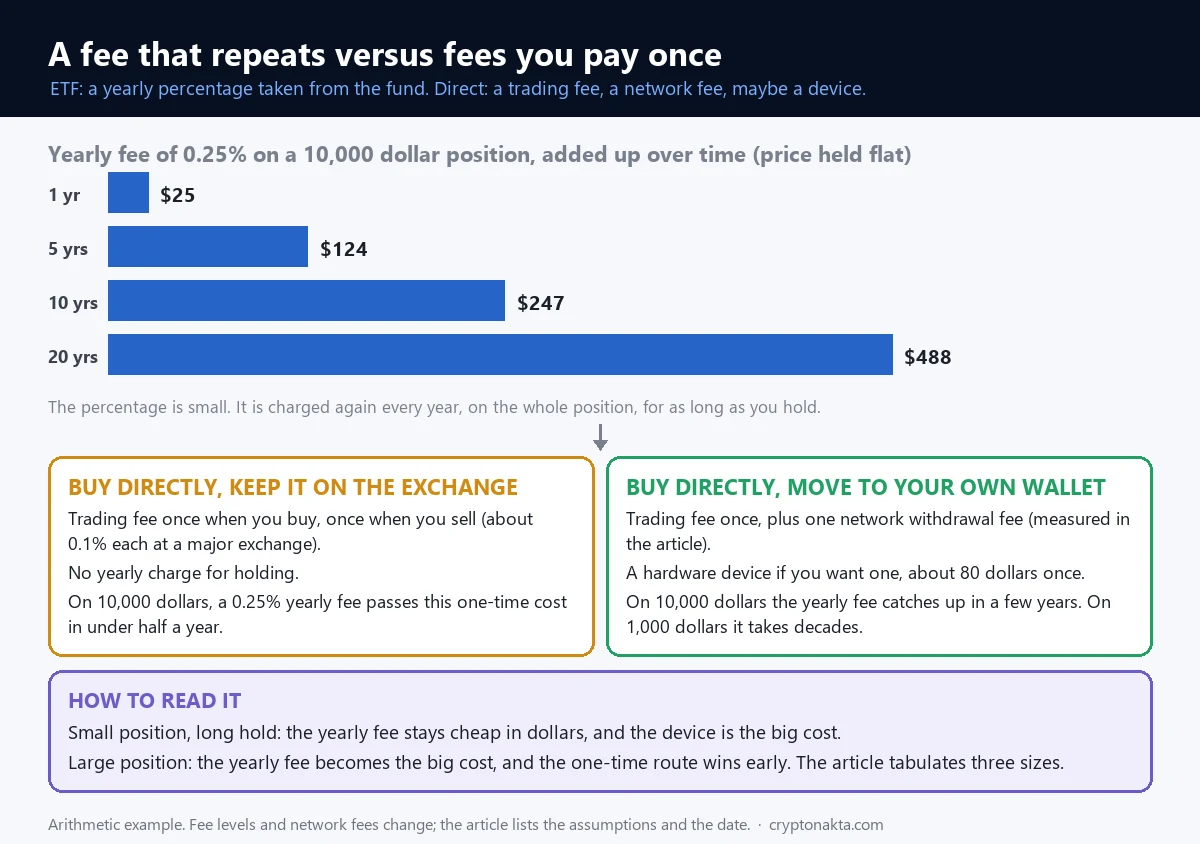
A yearly fee and a one-time fee grow differently, and the size of your position decides which one costs more. So I ran the numbers three ways. The assumptions are simple and stated up front. The bitcoin price stays flat, so the fee is easy to see. The ETF fee is 0.25% a year and is taken from the balance every year, so it compounds.
The direct route pays a 0.10% trading fee once. Then it pays the measured Binance withdrawal fee of $1.68 if you move the coins. Then $80 for a hardware device if you want one. Nothing after that.
| Position | ETF fee after 1 year | 5 years | 10 years | 20 years | Exchange account, once | Own wallet with device, once | ETF fee overtakes the exchange route | Overtakes the wallet route |
|---|---|---|---|---|---|---|---|---|
| $1,000 | $2.50 | $12.44 | $24.72 | $48.83 | $1.00 | $82.68 | 0.4 years | 34.5 years |
| $10,000 | $25 | $124 | $247 | $488 | $10 | $91.68 | 0.4 years | 3.7 years |
| $100,000 | $250 | $1,244 | $2,472 | $4,883 | $100 | $181.68 | 0.4 years | 0.7 years |
Assumes a flat price and a 0.25% yearly fee deducted from the balance. The direct route assumes a 0.10% trading fee plus the Binance withdrawal fee measured on 2026-09-25 plus an optional $80 device. Broker commissions and spreads and taxes are left out on both sides.
Read the middle row. On $10,000 the ETF fee is $25 in the first year. After five years the running total is $124 and after ten it is $247. After twenty it is $488. Buying the same amount on an exchange and leaving it there costs $10 once. The ETF fee passes that in about 0.4 years, so a few months. Add the withdrawal and the device and the direct route costs $91.68 once. The ETF fee passes that after 3.7 years.
Now the top and bottom rows. On $1,000 the device is most of the cost. The ETF fee needs 34.5 years to catch up with the wallet route. A small position and a hardware device are an odd pair on cost alone. On $100,000 the picture flips. The ETF fee is $250 in year one and passes the full wallet route in 0.7 years.
The fee level matters as much as the years. Over ten years on $10,000 a 0.15% fee costs $149 and a 0.14% fee costs $139. GBTC at 1.50% costs $1,403 over the same ten years. At the lower fee the wallet route on $10,000 takes 6.1 years to be overtaken instead of 3.7.
The yearly fee comes out of the whole balance every year, and the direct costs are mostly paid once. Which one is cheaper for you depends on the amount and on how long you hold. The table is there so you can find your own row. Trading fees and spreads by venue are in the cheapest way to buy bitcoin.
What it costs to move the coins to your own wallet
The direct route has one cost the ETF route never shows. If you want the coins in your own wallet, you withdraw them from the exchange. The exchange charges a network fee for that. I read the current numbers straight from Binance’s public withdrawal settings rather than from memory.
| Network | Withdrawal fee | Minimum withdrawal | Fee in dollars |
|---|---|---|---|
| Bitcoin network (default) | 0.00002 BTC | 0.0001 BTC | $1.68 |
| Lightning Network | 0.000001 BTC | 0.00002 BTC | $0.08 |
| Ethereum, as an ERC-20 token | 0.0000095 BTC | 0.000019 BTC | $0.80 |
| BNB Smart Chain, as a BEP-20 token | 0.00000028 BTC | 0.00000056 BTC | $0.02 |
Read from Binance’s public withdrawal settings at 2026-09-25 15:08 UTC. Bitcoin was at $83,924 at that moment. These fees change with network conditions and with exchange policy, so check the withdrawal page before you send.
The Bitcoin network is the default and the one to use for a wallet you plan to keep for years. On 2026-09-25 it cost 0.00002 BTC, about $1.68. The minimum withdrawal was 0.0001 BTC. Lightning was cheaper still at 0.000001 BTC, roughly $0.08. It only works if your wallet supports Lightning.
The other two rows are not bitcoin on the Bitcoin network. They are tokens on Ethereum and on BNB Smart Chain that represent bitcoin. They are cheap to withdraw, and sending them later costs gas on that chain. For a long-term holding, most people want the coin on its own network. Transfer fees between exchanges covers the same choice when the destination is another exchange rather than your wallet.
The device is optional. A hardware wallet keeps the private key on a small device that never touches the internet. A software wallet on your phone holds the same kind of key for free. Either way the backup is a list of words. What happens when a seed phrase is exposed is the part to read before you write those words down.
 View full size ↗
If a broker, an exchange or your own wallet fails
The safety question usually comes down to one scenario. The place that holds my thing goes under. What do I have left? The answer is different for a broker, an exchange and your own wallet. Here is each one plainly.
Your broker fails. The ETF shares in your account are securities held for you. The bitcoin behind them is trust property held by the custodian, separate from the broker’s own balance sheet. In the US SIPC steps in when a member broker fails and customer securities are missing, up to a set limit per customer. Other countries have their own schemes with their own limits. The ETF itself keeps running.
The ETF’s custodian has an incident. The coins are with Coinbase Custody for most of the US funds, as the fee table showed. An issue at one custodian would touch many funds at once. Issuers list this in their risk factors. It has not happened. I am stating the structure, not predicting anything.
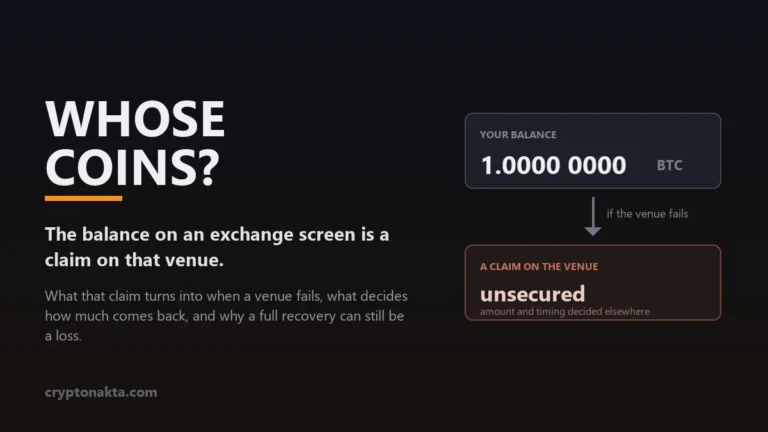
Your crypto exchange fails. Your coins are in the exchange’s wallets, often pooled with everyone else’s. In a bankruptcy you may be an unsecured creditor waiting in line. Whether customer coins are segregated depends on the exchange and on the law where it is based. What happens if a crypto exchange goes bankrupt walks through real cases. How to tell if an exchange is legit is the check to do before you deposit.
You lose your own wallet. Nobody fails but you, and nobody can help. If the device breaks and the seed phrase is gone, the coins stay on the ledger forever and nobody can spend them. If someone else gets the seed phrase, they can take everything. There is no support line and no reset.
| What breaks | What you hold | What protects you | What you can lose |
|---|---|---|---|
| Your broker | ETF shares held for you | Segregated trust assets, plus SIPC or a local scheme up to a limit | Time, and anything above the scheme’s limit if records are a mess |
| The ETF’s custodian | A claim on the trust’s coins | The controls the issuer describes in its filings | Depends on the incident, across many funds at once |
| The crypto exchange | A balance the exchange owes you | Segregation and proof-of-reserves practices, where they exist | Some or all of the balance, after a long wait |
| Your own wallet | The coins on the ledger | Your backup and your habits | Everything, with no one to ask |
I am not going to rank the three as safe or unsafe. Each one moves the risk to a different place, and you get to pick the place.
Futures ETFs, leveraged funds and inverse funds are different products
Searches for bitcoin ETFs also bring up futures ETFs, two-times funds and short funds. They are a different product from everything above, and they are a different product from owning bitcoin. Here is what each one actually holds.
A futures-based bitcoin ETF does not hold bitcoin. It holds bitcoin futures contracts, mostly on the CME. Each contract expires, so the fund sells the expiring one and buys the next one. That step is a rollover. When the next contract costs more than the one expiring, the fund pays that difference every time it rolls. Over months and years, the fund’s return can drift well away from the bitcoin price.
A leveraged bitcoin ETF aims for a multiple of the daily move, two times being the common one. It resets that target every day. Over several days the compounding of daily moves means you do not get two times the multi-day move. In a choppy market a leveraged fund can lose money while bitcoin ends up flat.
An inverse fund aims for the opposite of the daily move. It is a way to bet on a fall inside a brokerage account. The same daily reset applies, so holding it for weeks does not give you the mirror image of bitcoin’s return over those weeks.
| Product | What it holds | Follows the bitcoin price over years? | Made for |
|---|---|---|---|
| Spot bitcoin ETF | Bitcoin, with a custodian | Yes, minus the yearly fee | Holding the price in a brokerage account |
| Futures bitcoin ETF | Futures contracts, rolled each expiry | Roughly, with drift from rollovers | Accounts that could not hold spot before 2024 |
| Leveraged bitcoin ETF | Swaps or futures sized to a daily multiple | No, it resets every day | Single-day trades |
| Inverse bitcoin ETF | Short positions sized to the daily move | No, it resets every day | Single-day bets on a fall |
| Bitcoin, held directly | The coin | It is the price | Holding, using, moving |
One more product shows up on some screens. A CFD that tracks IBIT or bitcoin is a contract with a platform on the price difference. It is not a share and it is not a coin. You own a position against the platform, and the platform sets the terms.
How to buy bitcoin directly, step by step
If the direct route is the one for you, the order of steps is the same on every major exchange.
- Open an account. Register on the exchange with your email or phone, and finish identity checks. The Binance sign-up walkthrough shows the screens and where the referral code goes.
- Fund it. Card payments, bank transfers and peer-to-peer trades are the usual options. Which ones you see depends on your region and your account. The fee for each method is shown before you confirm.
- Buy bitcoin on the spot market. Place a market order for a fixed amount of money, or a limit order at a price you choose. How to buy bitcoin goes through the order screen step by step.
- Decide where it lives. Leave it in the exchange account, or withdraw it to a wallet you control. Check the fee table above and send a small test amount first.
Buying on a schedule is easy to set up on the exchange side too. How to set up DCA on Binance and Bybit shows the recurring-buy settings. If you are still choosing a venue, the exchange comparison lists the ones I use and why.
Binance

Bybit

OKX

Gate.io

Affiliate disclosure: some links are partner links. We may earn a commission at no extra cost to you. This is not investment advice.
None of this changes what an exchange account is. Your coins are with the exchange until you withdraw them.
My take: keys, hours and holding period decide it
After a year of data and a pile of issuer documents, here is my view. The comparison is decided by three things, and none of them is the price. Who holds the keys. When you can sell. How much you hold, and for how long. Everything else in this article is detail under one of those three.
The ETF fits someone who wants one account, one statement and one estate process. It fits someone who does not plan to use the coins for anything. The IRA point is real for US readers. So is never having to write down a seed phrase. The price of that is the yearly fee and the market clock, and the fee is small on a small position for a few years.
Owning the coin fits someone who wants to use it, move it or keep it away from every third party. It also fits a large position held for a long time, where a yearly fee on the whole balance adds up to real money. The price of that is the backup. Lose the words and the coins are gone.
Plenty of people hold both. Some of the position in a brokerage account for the paperwork, and some on an exchange or in a wallet for the hours and the keys.
The claim I trust least on both sides is the one about safety. “The ETF is safe” and “owning bitcoin is the real thing” are both half stories. With the ETF and with the exchange account, someone else holds the coins. With your own wallet nobody holds them but you, and nobody backs you up. Each one moves the risk. None of them removes it.
The strongest case against my own leaning toward direct holding is also real. Removing the seed phrase from your life has value. So does a retirement account, and so does an estate process that a lawyer already understands. If those matter to you more than weekend hours and fork rights, the ETF is the honest pick.
One disclosure, so it is in the text and not only under the cards. This site uses affiliate links, including the exchange cards in the buying section. We may earn a commission if you sign up through them. That has no effect on the numbers above, which you can re-run yourself from the same public data. Nothing here is a forecast of the bitcoin price, and nothing here is a recommendation to buy either product.