The Same Transfer, 100x the Fee: What Moving Crypto Between Exchanges Really Costs
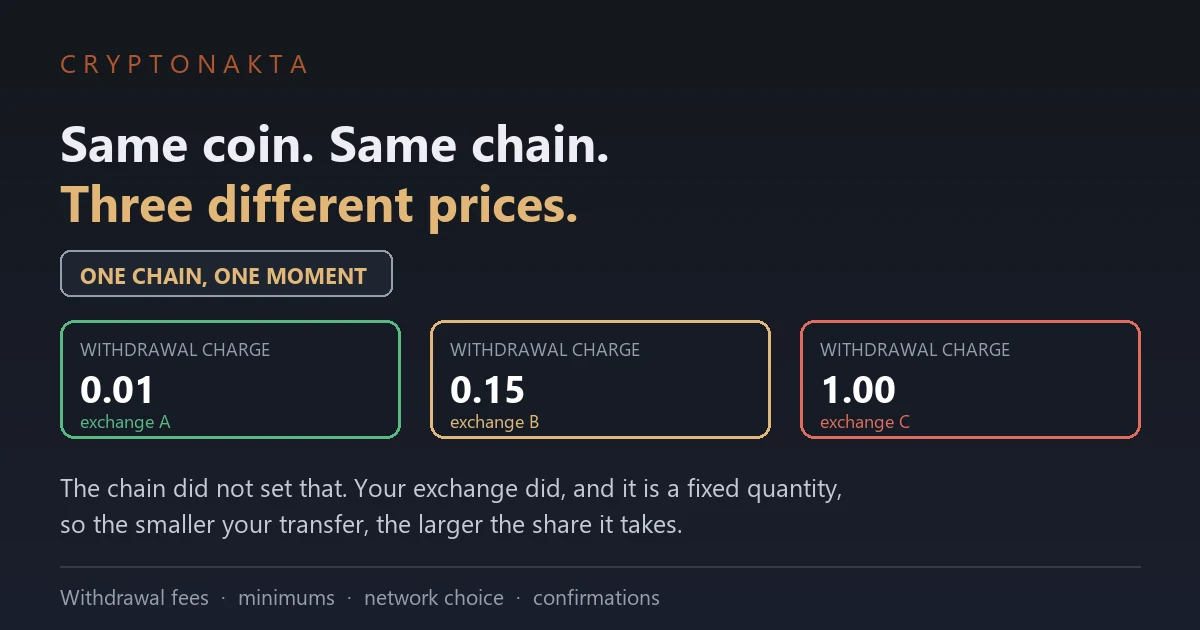
Your exchange picks the withdrawal charge, and the chain has nothing to do with it. The number is fixed too, so the less you send, the bigger the bite.
| Question | Short answer |
|---|---|
| Who sets the withdrawal charge? | Your exchange does. It is an estimate of the network cost, not the network cost itself. |
| Is one chain always cheapest? | No. The ranking flips between exchanges. The cheap chain on one platform is mid-priced on another. |
| Why do small transfers hurt? | The charge is a fixed quantity. It does not shrink with the amount, so the percentage grows. |
| Should I convert to a cheaper coin first? | Only if the saving beats two trading fees plus two spreads. Often it does not. |
| What blocks a transfer before the chain does? | The minimum withdrawal quantity. It differs by exchange on the same chain. |
| What decides arrival time? | The chain, and how many confirmations the receiving exchange demands before crediting. |
1. Four places the money leaves, not one
2. Who actually sets the withdrawal charge
3. A fixed charge means small transfers pay the most
4. You can only use a chain both sides support
5. The minimum that stops you before the chain does
6. Converting to a cheaper coin costs four times
7. Sending inside one exchange skips the chain
8. What decides when it arrives
9. The check order before you press withdraw
10. Five beliefs that cost money
11. Where the balances sit
12. How I decide in practice
Two platforms quoted one hundred times apart for the same transfer, on the same coin, on the same chain, on the same afternoon. Both numbers were public and neither was a mistake. That gap is the whole subject here, and it sits somewhere most guides never look, because it is not on the chain at all.
1. Four places the money leaves, not one
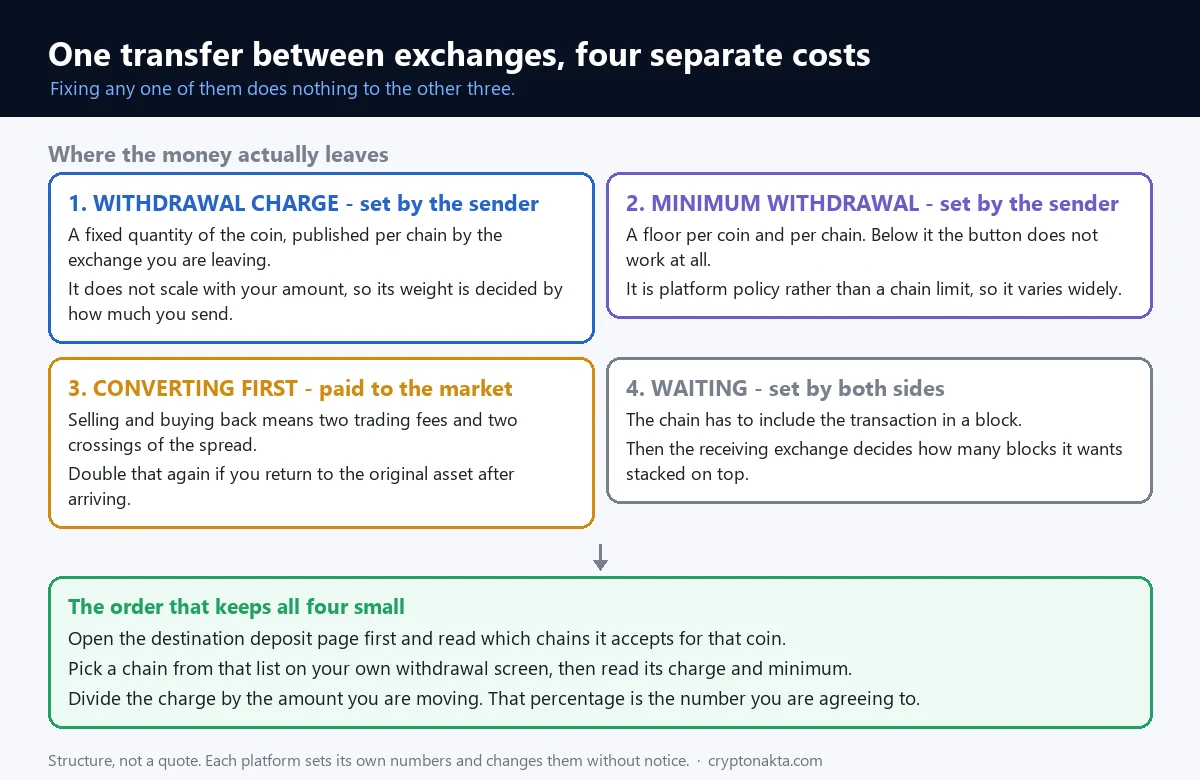
Most people picture one charge. You press withdraw, the exchange takes a cut, the coins arrive. That is one of four places money leaves.
The four are independent. Fixing one does nothing to the others.
| Where cost appears | What it depends on | Can you change it? |
|---|---|---|
| The withdrawal charge | Your exchange, and the chain you select | Yes, by choosing a different chain |
| The minimum withdrawal quantity | Your exchange, per chain | Only by sending more, or sending elsewhere |
| Converting to a cheaper asset first | Two trades, each with a fee and a spread | Yes, by not converting |
| Waiting | The chain, plus the receiving exchange’s rules | Partly, by picking a faster pair |
Two terms, then nothing else technical
A chain (also called a network) is the ledger the coin actually lives on. The same coin often exists on several chains at once. They do not talk to each other.
The withdrawal charge is a quantity of that coin your exchange removes when you send it out. It is a fixed number per chain. It does not scale with your amount.
That second sentence carries most of this article. Hold onto it.
The question people actually ask
The most common search on this topic is some version of “cheapest way to move crypto between exchanges”. It is a reasonable question. It just has no fixed answer.
The answer depends on which exchange you are leaving, which one you are arriving at, and how much you are sending. Change any one of those and the cheapest route changes.
What does hold still is the method. That is what the rest of this covers.
2. Who actually sets the withdrawal charge
Here is the fact that reorders everything else. The withdrawal charge is not a property of the chain. It is a number your exchange chose.
The exchanges say so themselves. Binance’s help pages describe the charge as an estimate of network transaction fees, paid to miners or validators rather than kept by the platform, and adjusted as network conditions change.
Read that again. An estimate. Three platforms estimating the same chain on the same afternoon do not land on the same number.
The same coin, the same chain, three exchanges
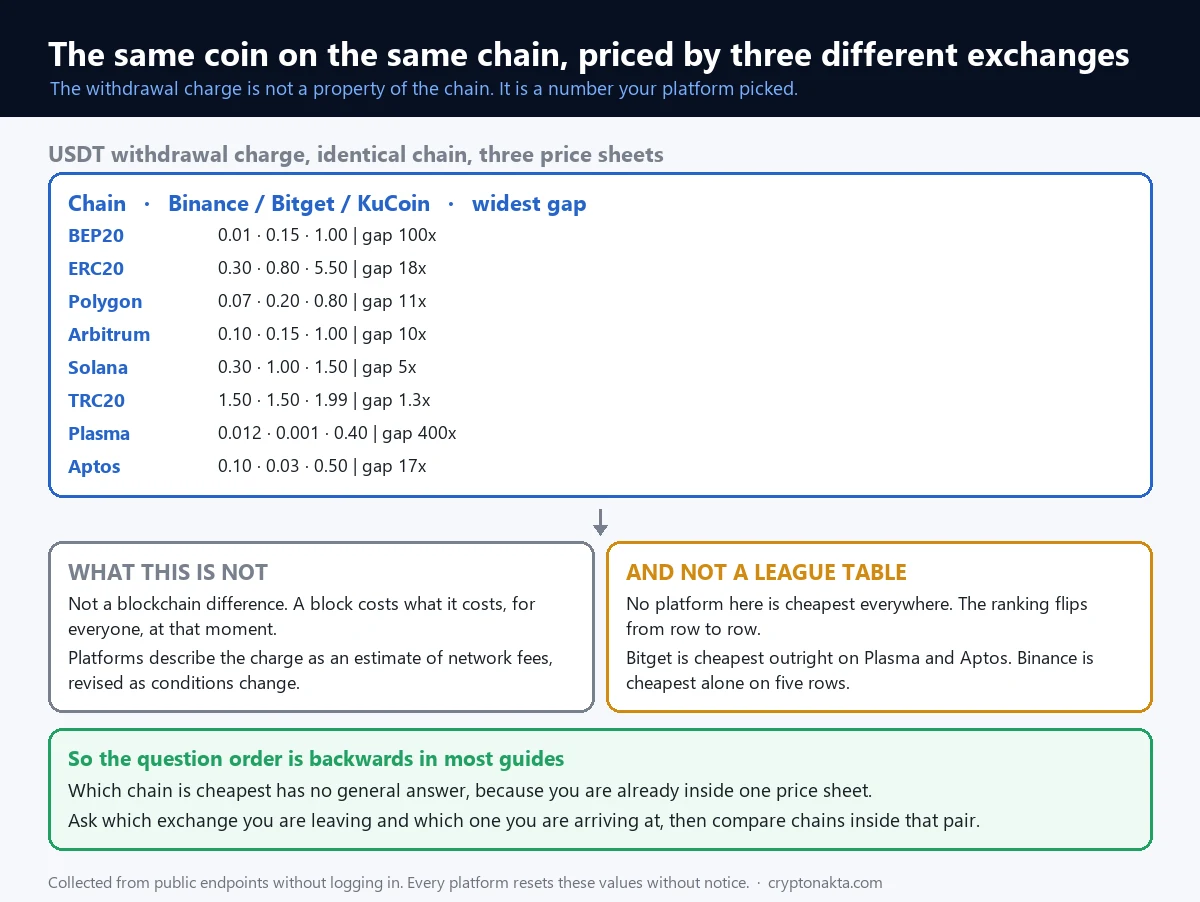
These are USDT withdrawal charges collected from public endpoints on 16 September 2026. No login was involved. The Binance set was collected twice to confirm it was stable.
| Chain | Binance | Bitget | KuCoin | Widest gap |
|---|---|---|---|---|
| BEP20 (BNB Smart Chain) | 0.01 | 0.15 | 1 | 100x |
| ERC20 (Ethereum) | 0.3 | 0.8 | 5.5 | 18x |
| Polygon | 0.07 | 0.2 | 0.8 | 11x |
| Arbitrum | 0.1 | 0.15 | 1 | 10x |
| Solana | 0.3 | 1 | 1.5 | 5x |
| TRC20 (Tron) | 1.5 | 1.5 | 1.99 | 1.3x |
| Plasma | 0.012 | 0.001 | 0.4 | 400x |
| Aptos | 0.1 | 0.03 | 0.5 | 17x |
Figures in USDT, checked September 2026. They change without notice. Yours will not match exactly, and that is the point.
What the table is telling you
One hundred times, on the same coin and the same chain, at the same moment. That gap is not a blockchain gap. Blocks cost what blocks cost.
Notice also that no single platform wins everywhere. Binance is cheapest outright on five rows and ties with Bitget on a sixth. Bitget wins Plasma and Aptos on its own. That is why “use exchange X” is not the lesson.
The lesson is narrower. Before you compare chains, you are already inside one exchange’s pricing sheet, and that sheet decides most of your bill.
The TRC20 habit
For years the standard advice was to move stablecoins over Tron because it was cheap. On the data above, Tron is the most expensive row on Binance. It costs one hundred and fifty times a BEP20 withdrawal from the same account.
On KuCoin the picture is different again. There, Tron sits close to the middle and Ethereum is the expensive one.
The habit was right once. It stopped being a rule. The mechanics of why chains differ at all are in USDT on ERC20 versus TRC20. The cost of a block itself is in what gas fees are.
3. A fixed charge means small transfers pay the most
A fixed quantity behaves in one specific way. It ignores your transfer size.
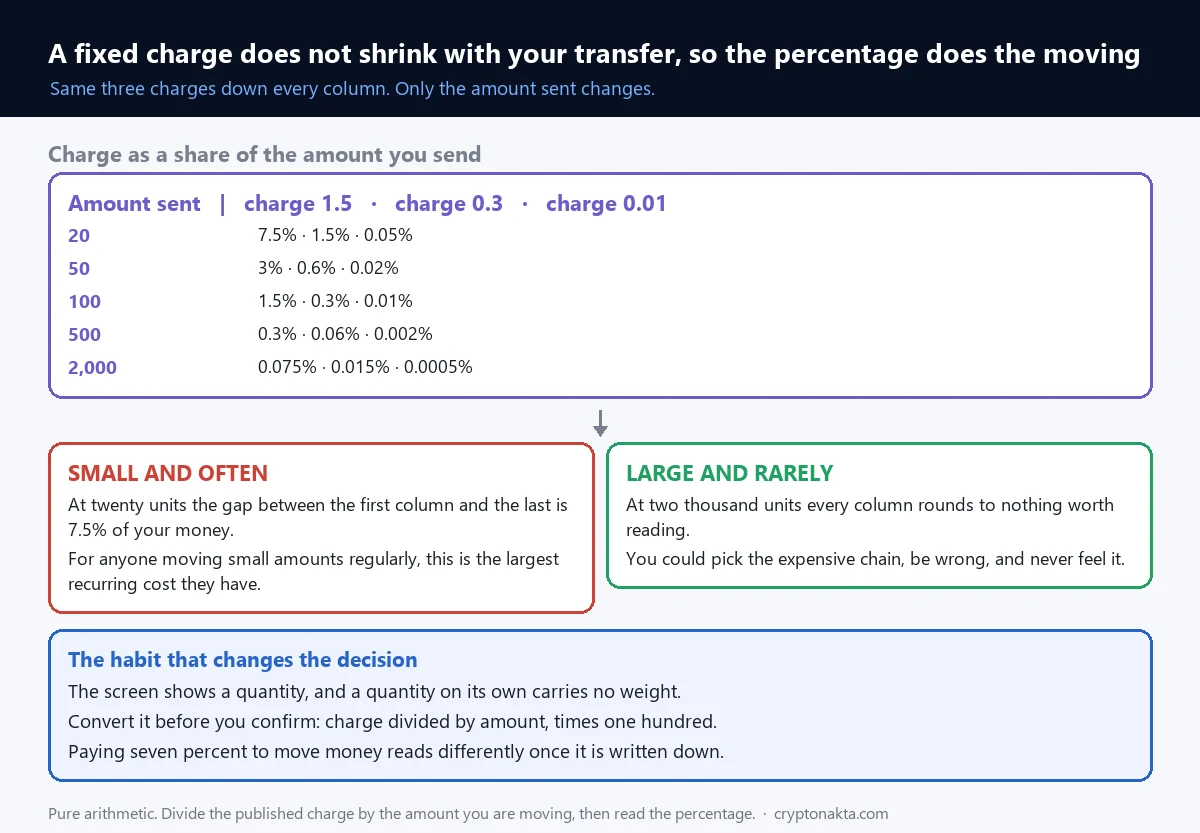
So the charge you pay is the same whether you move a little or a lot. As a share of what you moved, it swings enormously.
| You send | Charge 1.5 | Charge 0.3 | Charge 0.01 |
|---|---|---|---|
| 20 | 7.5% | 1.5% | 0.05% |
| 50 | 3% | 0.6% | 0.02% |
| 100 | 1.5% | 0.3% | 0.01% |
| 500 | 0.3% | 0.06% | 0.002% |
| 2,000 | 0.075% | 0.015% | 0.0005% |
Same three charges down every column. Only the transfer size moved.
Where this bites
Small transfers are where chain choice stops being a detail. At twenty units, the difference between the first column and the last is seven and a half percent of your money.
At two thousand units, both columns round to nothing. You could pick the expensive chain, be wrong, and not feel it.
So the honest version of the advice is conditional. If you move small amounts often, this is the single biggest cost in your crypto life. If you move large amounts rarely, it barely registers.
The trap inside the trap
People respond to a high percentage by batching. They wait, accumulate, and send once. That does reduce the percentage.
It also means holding the balance somewhere while you wait. That is a different decision with a different risk, and it belongs to you rather than to arithmetic.
The calculation here only tells you what the trip costs. It does not tell you when to take it.
4. You can only use a chain both sides support
You cannot pick a chain from your own screen alone. Both exchanges have to support the same one.
That sounds obvious and it still catches people, because the lists are not identical and the names are not identical either.
The same chain under three names
| What it is | Common labels you will see |
|---|---|
| BNB Smart Chain | BEP20, BSC, BNB Smart Chain |
| Tron | TRC20, TRX, Tron |
| Ethereum | ERC20, ETH, Ethereum |
| Polygon | Polygon, MATIC, Polygon POS |
| Avalanche C-Chain | AVAXC, AVAX C-Chain, Avalanche C |
| Arbitrum | Arbitrum, ArbitrumOne, ARB |
Those are the labels the three exchanges above actually print for the identical chain. Nothing is different underneath. Only the spelling.
The list lengths differ too
On the September 2026 snapshot, USDT withdrawals were open on nineteen chains at Binance, eighteen at KuCoin, and twenty-four in Gate’s published chain list.
The overlap is what you can use. A chain that is cheap on your side and absent on theirs is not an option at any price.
The rule that prevents the expensive mistake
Open the deposit page at the destination first. Read which chains it offers for that coin. Then go back to your withdrawal screen and match one.
Never the other way round. Choosing on your own screen and hoping the other side accepts it is how coins end up on a chain nobody is watching. What happens then, and when it is recoverable, is in sent crypto to the wrong network.
One more detail from the same page. Some chains need a memo or tag alongside the address. If the deposit page shows one, it is not optional, and sending without the memo covers what to do if it was missed.
5. The minimum that stops you before the chain does
Before the chain comparison matters, there is a line that can stop you outright. Every exchange sets a minimum withdrawal quantity, per coin, per chain.
It is not a rounding rule. Below that number the button does not work.
It is an exchange policy, not a chain property
On the same September 2026 snapshot, the minimum USDT withdrawal on Ethereum was five at Binance and thirty at KuCoin. Bitget applied a flat ten across every chain it listed.
Thirty versus five, same coin, same chain. One of those platforms has decided small withdrawals are not worth processing on that route, and has said so with a number.
The double-send loss
Here is the expensive version of getting this wrong. You have a balance slightly below the minimum. You top it up, send, and discover the charge left you short at the destination for whatever you planned next.
So you send again. You have now paid the fixed charge twice on one move. The second one was for a small amount, which is the worst ratio there is.
Checking the minimum and the charge together, before the first send, avoids the whole sequence. They are on the same screen.
What to read off the screen
Four fields on the withdrawal page decide the whole transfer. They sit close together and three of them change the moment you switch chains.
Minimum withdrawal. Whether this route is open to you at all. It usually sits under the amount box in small type, which is why it gets discovered after the fact.
Withdrawal charge. The fixed quantity removed from your balance. Switch the chain and this number switches with it.
Amount received. Your entry minus the charge. Some screens only show it after you have typed something, so it is easy to confirm without ever reading it.
Chain selector. Which chain the destination address has to belong to. It often arrives pre-filled with something you did not choose, and that default is the single most expensive thing on the page.
6. Converting to a cheaper coin costs four times
This is the move that feels clever. Your expensive coin has a high charge, so you sell it, buy something with a low charge, send that, and buy back on the other side.
Sometimes it wins. Often it does not, and the reason is that you just paid four times instead of once.
Counting the four
Selling is one trading fee. Buying the cheap asset is a second. Buying back at the destination is a third, and selling back later, if you want the original coin, is a fourth.
On top of those sits the spread, which is the gap between the buying price and the selling price of the same asset at the same moment. You cross it on every one of those trades, and it never appears as a line item.
The comparison that settles it
| Side | What to add up |
|---|---|
| What you save | Old chain’s charge minus new chain’s charge, in the coin you are moving |
| What it costs | Trading fee out, trading fee in, spread crossed twice, and the same again if you convert back |
| How to compare | Turn both into a percentage of the amount being moved |
| Extra risk | Price moves while you are mid-conversion, which is not a fee but is still a cost |
Run those two lines and the answer stops being a matter of opinion.
When converting clearly wins
Large transfers, a big charge gap, and an asset you were happy to hold anyway. Then the two trading fees are small next to what you saved.
Small transfers rarely survive the maths. Four fees on a small amount eat the saving before you get to the chain.
There is also a middle case worth naming. If you already hold a stablecoin on a cheap chain, no conversion is needed at all, and that is the cheapest version of this whole article. Where those balances live is covered in what a stablecoin is.
7. Sending inside one exchange skips the chain
There is a route that skips the chain completely. If the person or account you are sending to is on the same exchange, the transfer never touches a blockchain.
It is a database entry moving between two accounts. No block, no confirmation, no chain charge.
What the exchanges publish about it
Binance describes sending crypto to other Binance users by phone number, email address or user ID as credited immediately and carrying zero transaction fees. Sending limits are per account and visible in your own account.
The same documentation carries a warning worth repeating. Those transfers credit immediately and cannot be recovered if you enter the wrong details.
What it is good for and what it is not
| Internal transfer | On-chain withdrawal | |
|---|---|---|
| Cost | No transaction fee, within your account limits | Fixed quantity per chain |
| Speed | Immediate | Minutes to hours |
| Who can receive | Only users of the same exchange | Any address on the matching chain |
| Traceable on a block explorer | No | Yes |
| If you send to the wrong place | Immediate and not reversible | Depends on where it landed |
So it solves one situation completely and leaves the main one untouched. Moving your own balance from one exchange to a different exchange still goes over a chain.
It does change one common plan. Say your goal is handing coins to another person and you both hold accounts on the same platform. Then the cheapest transfer is not a cheap chain. It is no chain.
8. What decides when it arrives
Arrival is not decided by the chain alone. It is decided twice.
First the chain has to include your transaction in a block. Then the receiving exchange has to decide that enough blocks have stacked on top for it to credit your balance.
The second number is the one nobody checks
That second figure is the confirmation requirement, and exchanges set it themselves. From the same September 2026 snapshot, for USDT deposits:
| Chain | Binance requires | Bitget requires |
|---|---|---|
| TRC20 | 1 confirmation | 3 confirmations |
| BEP20 | 1 | 60 |
| ERC20 | 6 | 96 |
| Polygon | 200 | 300 |
| Arbitrum | 120 | 12 |
| Optimism | 25 | 50 |
Same chains, different demands. On BEP20 one platform credits after a single block and the other waits for sixty.
Why the cheap chain can be the slow one
Fast blocks usually come with high confirmation counts, because each block carries less weight. Polygon is the clearest case above, with hundreds required.
So a chain that looks instant on a block explorer can still leave your balance missing for a while at the destination. Nothing is wrong. The counter is simply still running.
If yours is stuck at the sending end instead, the stages are laid out in why a withdrawal stays pending. If the chain shows it delivered but the exchange has not credited it, that is a different check. It is in a deposit that does not show up.
9. The check order before you press withdraw
Everything above collapses into a short sequence. It takes under a minute once you have done it twice.
The order that matters
- Open the destination’s deposit page for that coin. Not your withdrawal screen. This is the step that prevents picking a chain the other side does not accept.
- Write down which chains it offers, and whether it asks for a memo or tag. A transfer that arrives without a required memo has no label on it.
- Go to your withdrawal screen and select a chain from that list. Never from your own dropdown alone.
- Read the charge and the minimum for that chain. Both change the instant you switch chains, and both are on the same screen.
- Divide the charge by your amount. This is the number you are actually agreeing to. Most people never see it as a percentage.
- Copy the address from the destination page, not from your address book or your history. The address belongs to a chain, and an old one may belong to a different chain.
- Send a small test first if the amount is significant to you. Then send the rest once it lands.
On the test transfer
A test costs you one extra charge. On an expensive chain that is real money, so it is a judgement call rather than a rule.
It buys certainty about the address, the chain, the memo and the destination’s crediting behaviour, all at once. For a first transfer between two platforms, that is usually worth one charge.
If it goes wrong anyway
Four situations cover almost all of it, and each has its own path. The wrong chain is here. A missing memo is here. A withdrawal that never leaves is here. A deposit the exchange has not credited is here.
A fifth case is different in kind. If the withdrawal itself is blocked at your account rather than in transit, that is covered in a withdrawal that will not go out.
10. Five beliefs that cost money
Five beliefs cause most of the overpaying. They are all reasonable and all incomplete.
| What people believe | What the data shows |
|---|---|
| Tron is the cheap chain for stablecoins | It was the most expensive USDT route measured on one major platform, and mid-priced on another |
| The charge is the network cost | Platforms describe it as an estimate, and three estimates of one chain differed by up to a hundred times |
| Bigger exchanges charge more | Direction varies by chain, and no platform measured was cheapest everywhere |
| A small transfer is a small cost | The charge is fixed, so small transfers pay the highest percentage |
| Converting to a cheap coin always saves money | It adds two trading fees and two spreads, which often exceed the saving |
One more that is half true
People say the receiving exchange charges nothing for deposits. Usually correct.
What it hides is that the receiving side still shapes your cost. It sets the confirmation count, which decides your wait, and it decides which chains exist for you at all, which decides your charge.
So the destination is not passive in this. You simply pay it in time and in options rather than in a visible fee.
11. Where the balances sit
Choosing where to hold the balances is upstream of every number above. The fee sheet you land on comes with the account.
These are the platforms this article measured against, with public data and no login. Charges move, so treat any figure here as a method rather than a quote.
Binance

Bitget

KuCoin

Gate.io

Affiliate disclosure: some links are partner links. We may earn a commission at no extra cost to you. This is not investment advice.
If you are still deciding, the comparison is in choosing a crypto exchange. The checks that matter before depositing anywhere are in how to tell if an exchange is legitimate.
12. How I decide in practice
My own rule is short, and it is built from the arithmetic rather than from loyalty to a chain.
What I check, in order
I open the destination deposit page first, every time. Not because the mistake is likely, but because it costs five seconds and the alternative is unrecoverable.
Then I read the charge as a percentage of what I am moving. Under a tenth of a percent, I stop thinking. Over one percent, I look for another chain or wait until the amount is larger.
I do not convert to a cheaper coin unless the transfer is large. Below a few hundred units the four fees eat the saving, and I have tested that often enough to stop relitigating it.
Where I think the common advice is wrong
The advice to always use one particular chain is the part that has aged worst. It made sense when one chain was an order of magnitude cheaper than everything else. The measured spread between platforms is now wider than the spread between chains.
That reverses the order of the questions. Ask which exchange you are leaving before you ask which chain to leave on.
The part I am least sure about
I do not know how long any of these numbers hold. Platforms adjust them with no notice and no announcement, and the direction is not predictable.
What I am confident about is the structure. A fixed quantity set by the sender, a minimum set by the sender, a confirmation count set by the receiver. Those three have been true across every platform I have checked, and they are what I would still teach if every number on this page changed tomorrow.
A reasonable objection
Someone could argue this optimises the wrong thing. If you move money rarely and in size, the whole calculation is worth a few units of currency. The time spent is then worth more than the saving.
That is fair. The people this matters to are the ones moving small amounts often, and for them it is not a rounding error. It is the largest recurring cost they have.
Frequently asked questions
Read next: USDT on ERC20 or TRC20, and what the chains actually cost