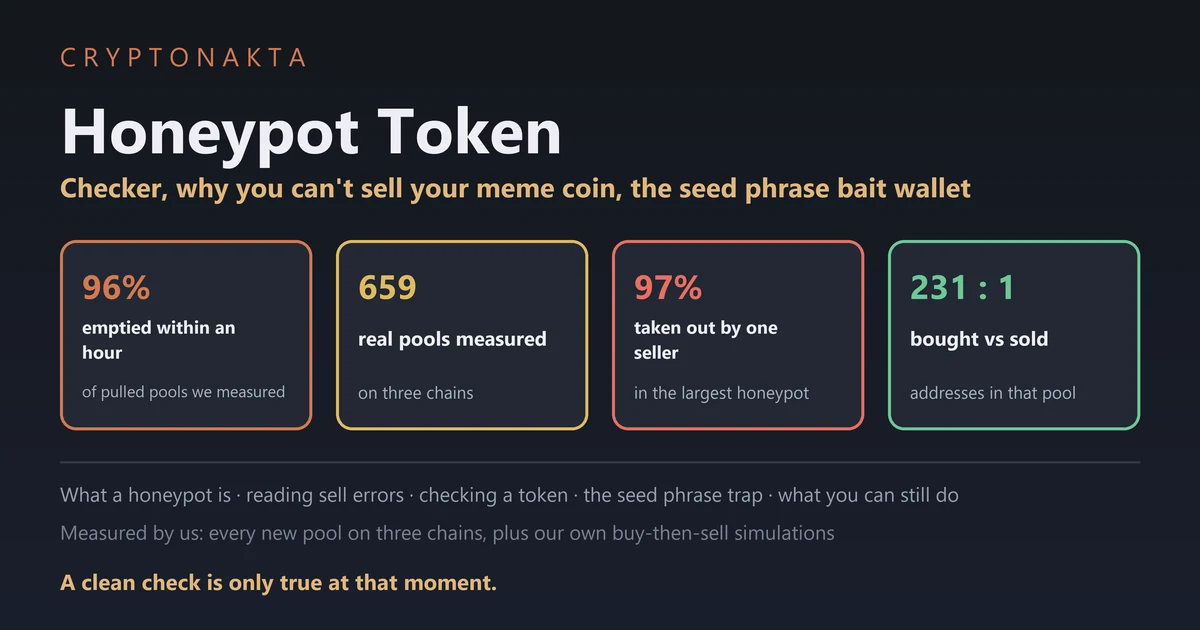
Honeypot Token | Honeypot Checker, Why You Can’t Sell Your Meme Coin, Seed Phrase Bait Wallet
A honeypot token is a coin whose contract lets you buy but blocks you from selling. Testing a buy and an instant sell before you pay catches most of them, but only for that moment. We watched new pools ourselves. Most of the ones people bought into had their money pulled out within the hour. Blocked or not, anyone still holding at that point was stuck.
A failed sell isn’t always a honeypot, so start with the error message. If you’re already stuck, getting the money back is very unlikely, and paid recovery offers are a second trap. And if a stranger shares a seed phrase for a wallet full of USDT, that wallet is bait.
In this guide (13)
What is a honeypot token? The crypto honeypot meaning in plain wordsHow does a honeypot token block selling?Honeypot checker: how to check a token before you buyWhy a passed honeypot check can still leave you stuckRug pull vs honeypot: what is the difference?Can’t sell tokens on Uniswap, Base or Phantom? Read the error firstCan a Solana or TON token be a honeypot?A token you never bought showed up in your wallet. Should you sell it?Found a seed phrase with USDT in the wallet? It is a bait walletAlready bought a honeypot token? What you can and can’t doCan you get money back from a honeypot crypto scam?My take on honeypot tokens after watching new poolsWhat we measured on BNB Chain, Base and Ethereum
What is a honeypot token? The crypto honeypot meaning in plain words
A honeypot token is a crypto token whose contract lets you buy but stops you from selling. Your balance shows up and the chart may even climb. Yet every sell fails or pays you almost nothing.
A smart contract is the program that runs a token. It decides who may send the token and when. Selling on a DEX (a decentralized exchange such as PancakeSwap or Uniswap) means sending tokens into its pool. A honeypot contract refuses that one transfer for you.
That pool is a liquidity pool, two coins held in a contract that pays sellers from what buyers put in.
The name comes from a pot of honey that draws insects in. In computer security a honeypot is a decoy server, which is a different topic.
A hard honeypot makes your sell fail outright. A soft honeypot lets the sell go through but keeps nearly all of it as sell tax, a fee the contract takes on each sale.
| Can you buy? | Can you sell? | Money still in the pool? | What you usually see | |
|---|---|---|---|---|
| Hard honeypot | Yes | No, the sell reverts | Yes, out of your reach | An error such as TRANSFER_FROM_FAILED |
| Soft honeypot | Yes | Yes, for almost nothing | Yes | A sell that succeeds and pays dust |
| Rug pull | Until the pull | Yes, into an empty pool | No, the creator took it | The price drops to near zero at once |
| Failed swap | Yes | Yes, once you fix the cause | Yes | Slippage, gas or route errors |
A rug pull is when the creator takes the money out of the pool. A honeypot keeps the money in the pool and blocks your way to it.
Here is what surprised us. We tested every new pool on three chains ourselves. Some were already blocking sells in their first minutes. A few hours later, nearly every pool people had bought into had lost its liquidity, blocked or not. From your wallet the two look the same, so this guide covers both.
How does a honeypot token block selling?
A honeypot token blocks selling with a rule in its contract that treats a sell differently from a buy. Most of these rules come down to one idea. Only certain addresses may send the token into the pool.
Some contracts keep an allow list, so only the creator’s wallets can sell. Others add buyers to a block list, raise the sell tax until a sale pays nothing, or have a trading switch. Some are upgradeable, or keep a hidden owner. We won’t go into how any of this is written. A rule can sit quiet until someone turns it on.
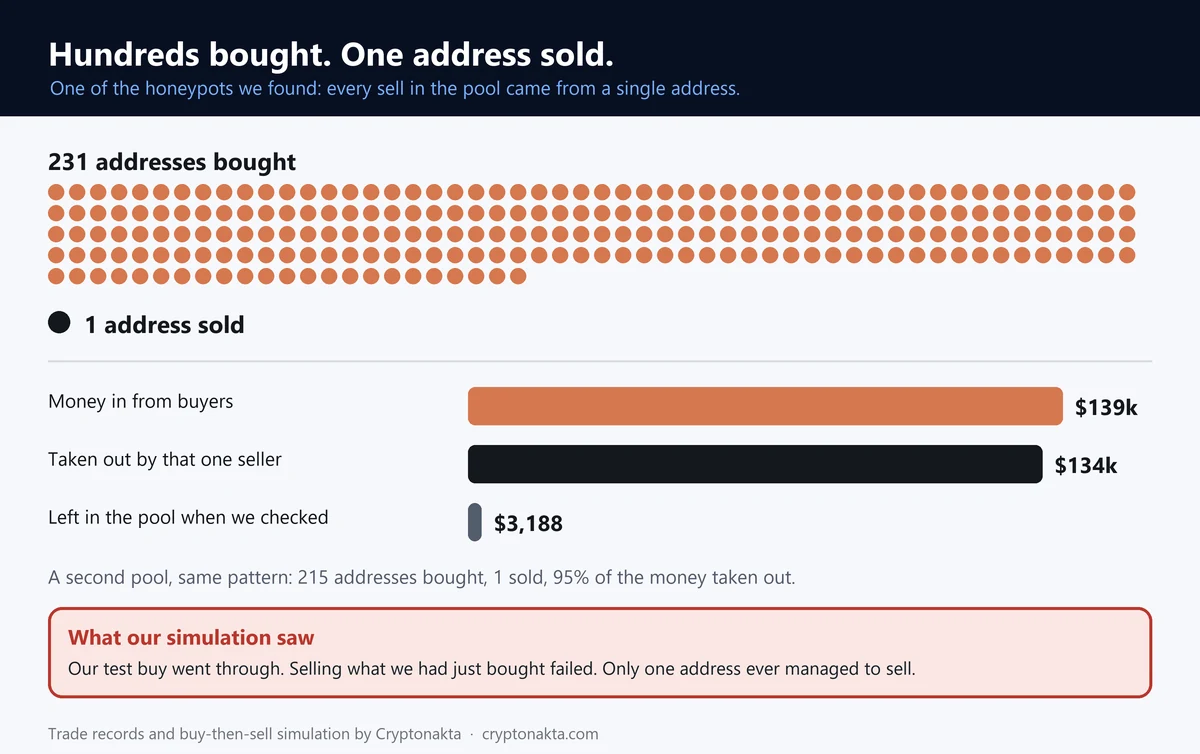
We saw this in real pools. Among the 659 pools that outside buyers put money into, 4 were blocking sells when we tested them. In 2 of those, many addresses bought and exactly one address ever sold.
 View full size ↗
| Case | Chain | Addresses that bought | Money in | Addresses that sold | Share taken out by sells | Left in the pool |
|---|---|---|---|---|---|---|
| Case 1 | BNB Chain | 231 | $139k | 1 | 97% | $3,188 |
| Case 2 | BNB Chain | 215 | $122k | 1 | 95% | $11k |
| Case 3 | BNB Chain | 244 | $29k | 19 | 7% | $27k |
| Case 4 | Ethereum | 22 | $7,460 | 8 | over 100% | under $1 |
Pools where our simulation could buy but not sell at the time we checked. We list no names or addresses. “Addresses that sold” are the senders of every sell transaction in that pool.
When hundreds bought and one address made every sell, no other address managed to sell, and our own test sell was reverted too.
In the starkest case, 231 outside addresses put in about $139k. One address made every sale. That single address took out 97% of the money outside buyers had put in. In both one-seller pools, that lone seller kept selling as new buyers arrived, from minutes after launch to hours later.
In the one-seller pools our simulated sell failed with PancakeLibrary: INSUFFICIENT_INPUT_AMOUNT. The tokens we sent toward the pool arrived as zero. In the others it was TransferHelper: TRANSFER_FROM_FAILED. Our test had already approved the sale, so the token itself refused to move.
The other 2 cases looked different. In the BNB Chain one, 19 addresses sold in roughly the first hour after launch. Then selling stopped, while buying went on for hours. A check run in that first hour would have shown a token you could sell. In the Ethereum one, 8 addresses sold until the pool was nearly empty.
Honeypot checker: how to check a token before you buy
To check a token for a honeypot, simulate a buy and an instant sell before you spend anything. Then open a block explorer and count how many different addresses have actually sold. The checker below runs that test from your browser.
Paste a token address from BNB Chain, Base or Ethereum. Your browser asks a public node to run a buy, an approval and a full sell in one block. That is a simulation, a test run on a copy of the chain’s current state. Nothing is sent or signed. You see whether the sell went through, the taxes and the pool size.
For a Solana token, paste the mint address instead. The checker shows whether a mint authority or a freeze authority, the power to lock holders’ accounts, is still set. The address goes from your browser to the public node and never comes to our server.
Every check result, ours included, is only true for that moment. You can sell now and still be blocked later, or find the pool empty. The checker can’t see a tax or block list switched on after you buy. It only tests V2 pools, not V3 or V4. It also misses a block list aimed at real buyers, since the test uses a fresh address.
This is the order we’d go through.
| Check | What it tells you | What it misses |
|---|---|---|
| Buy and sell test (our checker or honeypot.is) | Whether a sell goes through now, and the tax | Rules switched on later |
| Code flags (GoPlus) | A changeable tax, a block list, a pause switch, a proxy | Whether your address is on the list |
| Explorer sell history | How many different addresses have sold | Bots trading with each other |
| Owner powers | Who owns the contract, and if ownership was renounced | A hidden owner |
| Pool size and lock | How much is in the pool and who holds the pool tokens | Other ways to drain it |
| Top holders | How much the biggest wallets hold | Wallets the creator split up |
| Small test sell | That one small sale works | That a full sale works later |
The explorer step is the one most people skip. Open the token’s trade list on BscScan, Basescan or Etherscan and look at who sold. Many buyers and a single seller is the pattern we found in real honeypots.
honeypot.is runs a buy and a sell, while GoPlus reads the contract, so using both catches more.
Why a passed honeypot check can still leave you stuck
A honeypot check can pass and you can still lose the money. The contract can change after you buy, and the creator can still pull the pool’s money.
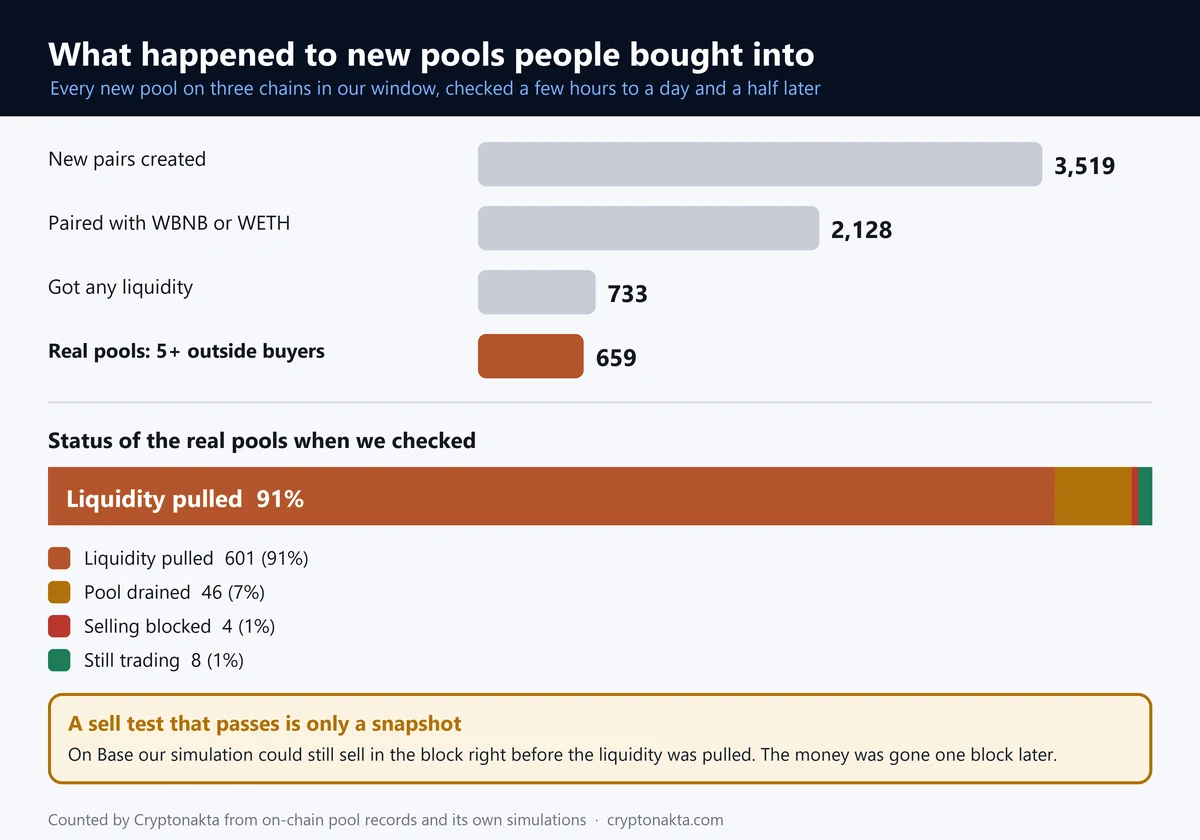
An owner can raise the sell tax, block buyers or turn trading off after a clean result. The table shows where the pools that outside buyers put money into stood when we checked.
 View full size ↗
| Chain | Pools real people bought into | Liquidity pulled | Pool drained (under $50 left) | Selling blocked | Still trading |
|---|---|---|---|---|---|
| BNB Chain (PancakeSwap V2) | 308 | 255 (83%) | 42 (14%) | 3 (1%) | 8 (3%) |
| Base (Uniswap V2) | 274 | 274 (100%) | 0 (0%) | 0 (0%) | 0 (0%) |
| Ethereum (Uniswap V2) | 77 | 72 (94%) | 4 (5%) | 1 (1%) | 0 (0%) |
| All three | 659 | 601 (91%) | 46 (7%) | 4 (1%) | 8 (1%) |
A real pool means at least 5 addresses other than the creator bought, for $10 or more in total. Status is what our own buy-then-sell simulation and the pool balance showed when we checked, a few hours to a day and a half after each pool was created.
“Liquidity pulled” means 90% or more of the BNB or ETH the creator put in was taken back out. “Pool drained” means you could still sell, but less than $50 was left to pay you.
A few hours after launch, most new pools that outside buyers bought into had already lost their liquidity. Whether selling was blocked before that or not, the buyer ends up just as stuck. Of the pulled pools, 96% lost their liquidity within an hour of launch.
Don’t read the small blocked count as proof that honeypots are rare. When we checked pools in their first minutes, some already blocked sells, and some of those vanished soon after. So a honeypot that takes the money early may later show up only as a pulled pool.
We also watched new pools from the moment they appeared. Of the 114 pools that held at least $50 at our first check, about two minutes in, 16 (14%) were already blocking sells, and 7 of those were emptied within the hour. Of the 98 that still let us sell at that first check, 93 were emptied within the hour as well.
We also went back in time on Base and reran the test in the block just before each pull. Selling worked in every one of the 274 real Base pools right up to the pull. A checker would have said you could sell. The money still vanished.
Outside checkers have blind spots too. For brand-new BNB Chain pairs, honeypot.is answered pair not found, though it did return results on Ethereum and Base.
Rug pull vs honeypot: what is the difference?
A rug pull empties the pool, while a honeypot blocks your sell and leaves the pool full. Either way you can’t get your money back out.
In a rug pull the creator removes the liquidity they added, and the coins buyers paid in leave with it. Your tokens still move, but nothing is left to swap them for. A soft rug is slower. The team sells bit by bit, or just walks away.
 View full size ↗
| Chain | Pools pulled | Median time to pull | Middle 50% of pools | Within 15 min | Within 1 hour |
|---|---|---|---|---|---|
| BNB Chain (PancakeSwap V2) | 255 | 11 min | 10 ~ 16 min | 169 (66%) | 252 (99%) |
| Base (Uniswap V2) | 274 | 13 min | 13 ~ 31 min | 195 (71%) | 274 (100%) |
| Ethereum (Uniswap V2) | 72 | 30 min | 27 ~ 103 min | 1 (1%) | 49 (68%) |
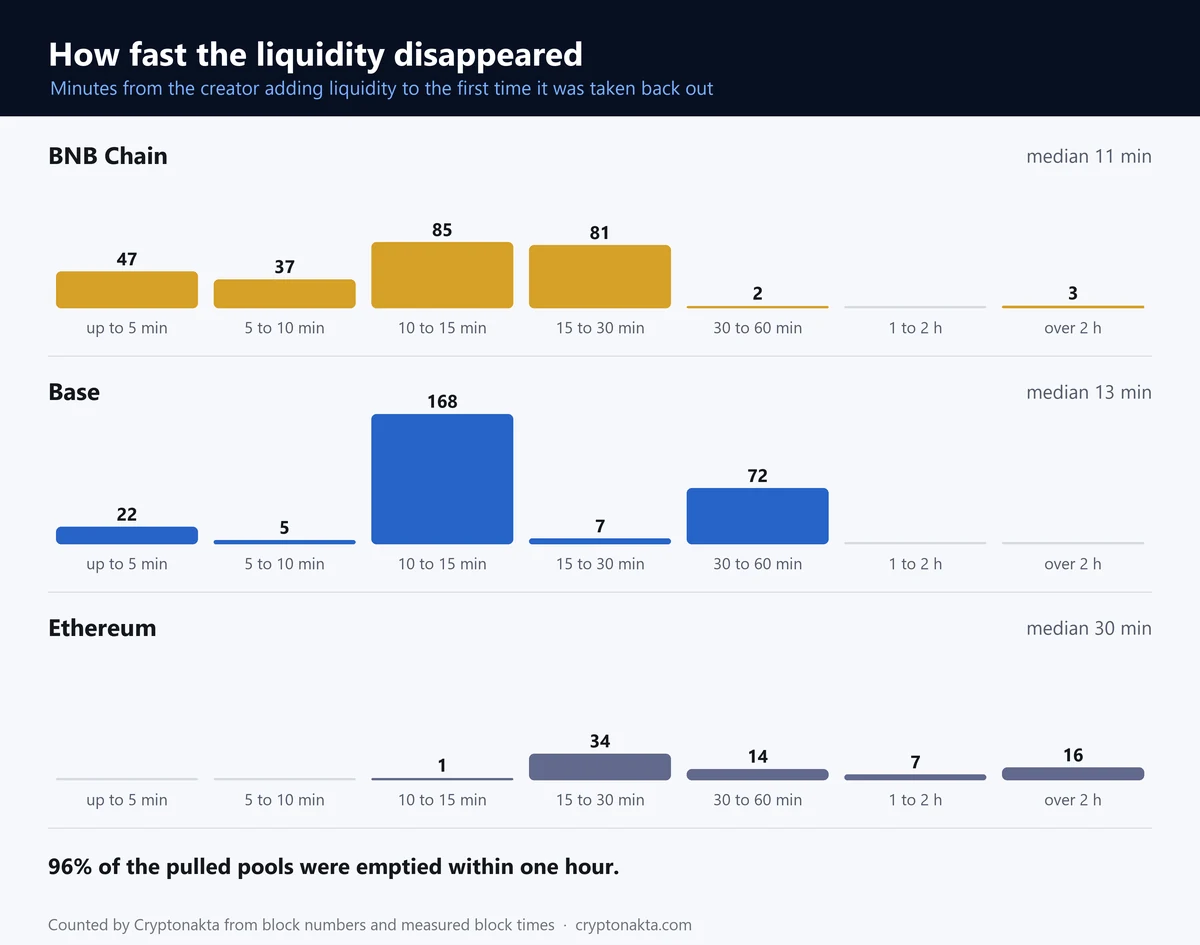
| All three | 601 | 13 min | 11 ~ 26 min | 365 (61%) | 575 (96%) |
Time from the block where the creator first added liquidity to the block where liquidity was first removed. Minutes come from block numbers and the average block time we measured in the same window.
On BNB Chain the median pull came 11 min after launch. On Base it was 13 min. Ethereum pools lasted longer, with a median of 30 min.
On BNB Chain, a pulled pool typically had 51 outside buyers and about $9,127 of their money (both medians). A big pool shouldn’t reassure you, since most of its coins are the creator’s own to take back.
When a token has renounced ownership, the owner address in its contract has been set to zero. Renounced ownership or locked liquidity is no guarantee that you can sell. Other roles or a hidden owner can survive it, and a block list set earlier stays in place. A liquidity lock only protects the locked pool tokens until it ends. And a honeypot never needs to touch the pool.
Can’t sell tokens on Uniswap, Base or Phantom? Read the error first
Not every failed sell is a honeypot. Before you assume the worst, read the error message. Missing gas, low slippage and thin liquidity cause many failed sells on Uniswap, PancakeSwap and Phantom.
Your slippage setting is how far the price may move against you before the swap cancels itself.
| Error message | What it usually means | What to try |
|---|---|---|
INSUFFICIENT_OUTPUT_AMOUNT | You’d get less than your minimum. Slippage is too low or the pool too thin. It can also be a token you can’t sell. | Check the pool size. Raise slippage a little, not to the maximum. |
UniswapV2: K or Pancake: K | The token takes a fee on each transfer, and the plain swap route breaks on it. | Use the fee-on-transfer route and allow slippage above the fee. |
TRANSFER_FROM_FAILED | Your approval or balance is short. Or the token itself refused the transfer. | Check the approval first. If it is fine, the token may be blocking you. |
insufficient funds for gas | Not enough ETH, BNB or the chain’s own coin for the fee. | Add a little of that coin to the same wallet. |
| Transaction is expected to fail (Uniswap) | The app expects a revert, often from a token you can’t sell. | Don’t keep paying for repeats. |
Jupiter 6001 or 6024 | The price moved past your slippage, or you lack SOL for fees and rent. | Add a bit of slippage or SOL. |
Account is frozen (0x11) | The token’s freeze authority locked your account. | Your wallet can’t undo it. |
| pump.fun: no trades on the curve | The curve is full and the token is waiting to move to PumpSwap. | Wait for the migration. |
PancakeSwap’s docs blame TRANSFER_FROM_FAILED on a missing approval or balance. But a token that rejects the transfer shows the same text.
Pushing slippage to the maximum doesn’t fix a honeypot. A hard honeypot reverts no matter what you set. With a high-tax token the sell may go through and pay close to nothing, and bots can trade just ahead of you.
On tokens that take a fee on every transfer, Trust Wallet may show Swap is blocked by asset tax value.
On Base, hold a little ETH on Base itself, not on Ethereum. On Phantom, the usual causes are too little SOL, low liquidity and fast price moves. If you trade through another app, check those same three things first.
Our gas fee guide shows which coin pays the fee on each chain. A pending sell is covered in our stuck transaction guide, and swap basics in the Uniswap guide.
Can a Solana or TON token be a honeypot?
Yes, a Solana token can be a honeypot, but it works differently from Ethereum. The usual tool is a freeze authority that locks holders’ token accounts. Some Token-2022 features can block sales too, and so can some TON jettons.
A Solana token can keep a mint authority, the power to create more tokens, and a freeze authority. If the creator keeps the freeze authority, they can freeze a holder’s account. That holder then can’t send, swap or sell. Phantom says it can’t unfreeze tokens, since only the creator holds that power. The error reads Account is frozen or custom program error: 0x11.
Token-2022, also called Token Extensions, is Solana’s newer token program. A Permanent Delegate can move or burn tokens in any holder’s account. A Transfer Hook runs another program on every transfer, and that program can refuse a sale. A Pausable token can stop all transfers at once. A transfer fee can reach the full amount, but a change only applies two epochs later.
None of these powers makes a token a scam on its own. Stablecoin issuers use them on purpose. The real question is who holds the power.
Standard pump.fun tokens are created with no mint authority and no freeze authority. We looked up a sample on chain, including tokens still trading on the curve, and none had either power. So a pump.fun coin that won’t sell usually has another cause. Right after a token fills its curve, trading pauses until it moves to PumpSwap.
honeypot.is doesn’t cover Solana, so use the checker above, the Solana fields of GoPlus (in beta) or RugCheck.
On TON, tokens are called jettons, and a jetton contract can accept transfers from chosen addresses only. STON.fi labels such tokens Honeypot and won’t swap them in its app. Every retry still costs TON for gas.
| Chain | What can block a sale | Where to look |
|---|---|---|
| Ethereum, BNB Chain, Base | Allow or block lists, sell tax, a trading switch, an upgradeable contract | A buy and sell checker, code flags, the sell list |
| Solana (classic tokens) | Freeze authority | Mint details on an explorer or our checker |
| Solana (Token-2022) | Permanent Delegate, Transfer Hook, Pausable, transfer fee | The extensions listed on the mint |
| pump.fun tokens | Standard ones have neither authority | Mint details |
| TON jettons | A jetton contract that rejects transfers | The STON.fi Honeypot label |
A token you never bought showed up in your wallet. Should you sell it?
No. If a token you never bought appears in your wallet, leave it alone. Trying to sell it is usually how the trick starts. The large balance is there to make you try.
When you try to swap, the swap fails and the error points you to a website. That site says you must approve something before you can sell. A token approval is a permission you sign that lets a contract move a token from your wallet. The approval that site asks for hands over your real tokens.
As MetaMask points out, receiving a token can’t take your funds by itself. The trouble starts when you try to sell or swap it. Phantom says to leave tokens you didn’t buy alone, and to hide and report them. Checkers often don’t know these tokens yet, so a blank result means little.
If you already approved something on such a site, revoke that approval now. For more on free tokens, see how to tell a real airdrop from a wallet drainer.
Found a seed phrase with USDT in the wallet? It is a bait wallet
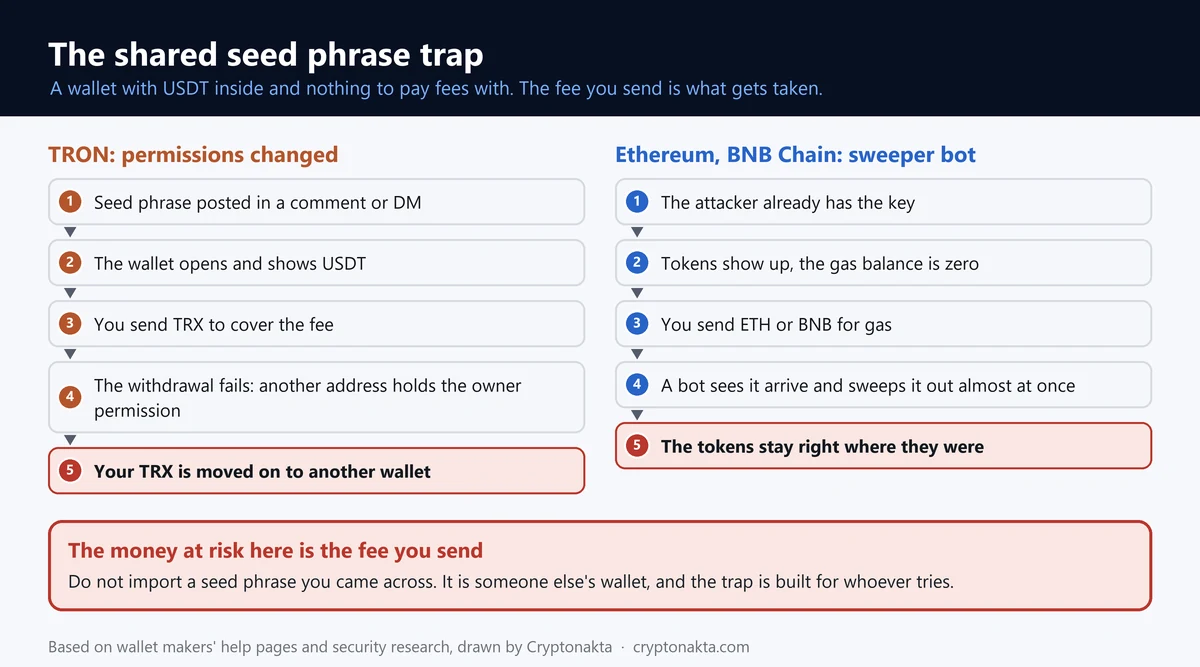
A wallet whose seed phrase a stranger posts in a comment or a DM is bait. The USDT inside can’t be moved, and any coin you send in to pay the fee disappears.
A seed phrase is the list of words that restores a wallet. Someone asks how to move the USDT in their wallet and pastes the words. You restore it and see a real balance, but no TRX or ETH for the fee. So you send a little. You can’t take the tokens out, and you only lose the gas you put in.
On TRON, the trick uses account permissions. Every TRON account has owner and active permissions that decide who can sign for it. The scammer hands those permissions to their own address. This is called a multisig wallet. A transfer now needs a signature from a key you don’t have.
Your seed phrase opens the wallet but can’t approve a transfer. The TRX you send is moved on to another wallet. On Tronscan, the account permissions show it. The owner is a different address.
On EVM chains such as Ethereum or Base, the attacker already has the private key. A sweeper bot is a script that moves anything landing in a wallet to the attacker. MetaMask notes this can happen almost instantly, so your gas leaves before you can use it.
 View full size ↗
| TRON permission trap | EVM sweeper bot | |
|---|---|---|
| What you see | USDT and no TRX | Tokens and no ETH or BNB |
| Why it won’t move | Owner and active permissions belong to another address | The attacker has the key and a bot watching |
| Your fee coin | Taken by the real controller | Swept out as soon as it lands |
| Where it shows | Account permissions on Tronscan | Gas leaving in the very next transaction |
Moving coins out of a stranger’s wallet also means taking money that isn’t yours. The setup is built for people who try.
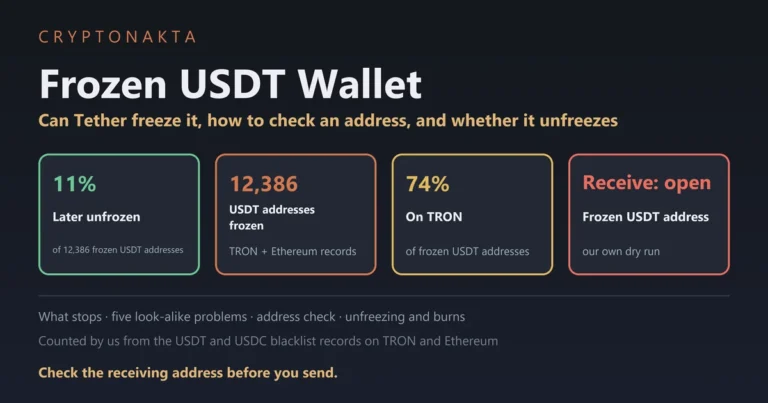
A frozen USDT address is locked in the USDT contract by Tether, while a bait wallet is locked by its permissions or a bot. Our TRON guide explains how TRX pays for transfers.
If your own seed phrase was shown to anyone, read what to do when a seed phrase is exposed.
Already bought a honeypot token? What you can and can’t do
If you already hold a honeypot token, treat that money as lost and protect the rest of your wallet. Holding the token alone can’t drain your other funds.
Don’t buy more to bring your average down, and don’t pay anyone to make the token sellable. Neither changes what the contract allows.
If you signed an approval on a site that promised to help you sell, revoke it now. revoke.cash says its tool is for prevention and can’t recover stolen funds. If you typed your seed phrase anywhere, move everything to a new wallet with a new seed phrase.
Save the transaction hashes, the contract address and screenshots of the chat that sent you there. Report the token to honeypot.is, GoPlus and the block explorer. That won’t bring the money back, but it can warn the next buyer. Then hide the token in your wallet.
| What you can do | What you can’t do |
|---|---|
| Revoke approvals you signed on linked sites | Undo a swap that already went through |
| Move to a new wallet if your seed phrase leaked | Make the contract let you sell |
| Save hashes, addresses and screenshots | Unfreeze a Solana token from your wallet |
| Report the token to checkers and explorers | Pay someone to get the money back |
Can you get money back from a honeypot crypto scam?
Almost never. Blockchain transactions can’t be reversed, and we found no confirmed case of money coming back from a honeypot token. Anyone who offers to get it back for a fee up front is running a second scam.
Recovery scammers usually contact you first, often right after you post about your loss. They promise to get it all back and ask for a fee before any work starts. Some ask for your seed phrase.
The fee comes under many names. It may be a release fee, a gas fee, a tax or a wallet activation fee. Each one is a reason to stop talking to them.
After a TRON permission trick, someone often offers to restore your permissions for a fee. It’s the same scam a second time.
revoke.cash, which makes a tool for canceling approvals, says never to pay upfront fees for recovery.
Our guide on whether scammed crypto can be recovered covers what does help. For other common tricks, see our crypto scams guide.
My take on honeypot tokens after watching new pools
My take is that a honeypot check answers only part of the question on a new DEX token. Measuring every new pool on three chains showed me that most pools people bought into were empty within the hour. On Base, those tokens could be sold right up to the moment the money left.
Some pools were already blocking sells in their first minutes. The honeypots we caught were stark. In one, 231 addresses bought and a single address made every sale. No chart showed that. The sell list on the explorer did.
If I were buying a new meme coin anyway, I’d run a buy and sell simulation first. Then I’d count how many different addresses have sold, and buy a small amount. Even then, I’d remember the result only holds for that moment.
What I trust least are channels promising “the next 100x”, seed phrases in comments, recovery offers and screenshots of other people’s profits.
There’s a fair case on the other side. Some people have made large gains on brand-new DEX tokens. That’s a choice you can make for yourself.
Maybe you mainly want to own crypto, not a brand-new DEX token. Then coins listed on a large exchange take the sell block out of the picture. Trades there happen in the exchange’s own order book, so a token contract can’t stop your sale. That doesn’t make listed coins safe. Their price can still fall a long way.
One disclosure. We use exchange referral codes, and if you sign up with ours we earn a commission. On Binance, our code also returns 10% of the spot trading fees you pay.
Binance

Affiliate disclosure: some links are partner links. We may earn a commission at no extra cost to you. This is not investment advice.
CRYPTONAKTA
What we measured on BNB Chain, Base and Ethereum
We pulled every new pool from PancakeSwap V2 on BNB Chain and Uniswap V2 on Base and Ethereum. Out of all those pairs, 659 were real pools that outside buyers put money into.
Our simulations ran until November 9, 2026, 14:40 UTC.
| What | BNB Chain | Base | Ethereum |
|---|---|---|---|
| Time window (UTC) | November 9, 2026, 02:00 UTC ~ November 9, 2026, 08:00 UTC | November 8, 2026, 00:00 UTC ~ November 9, 2026, 00:00 UTC | November 8, 2026, 00:00 UTC ~ November 9, 2026, 00:00 UTC |
| New pairs created | 3,125 | 296 | 98 |
| Paired with WBNB or WETH | 1,750 | 284 | 94 |
| Got any liquidity | 370 | 283 | 80 |
| Excluded: 2 to 4 bots trading with each other | 11 | 4 | 0 |
| Real pools (5+ outside buyers, $10+) | 308 | 274 | 77 |
| Outside addresses that bought (sum over real pools) | 15,330 | 3,655 | 2,184 |
| Different creator addresses | 300 | 274 | 73 |
| Live watch: pools first seen (UTC) | November 9, 2026, 12:04 UTC ~ November 9, 2026, 13:40 UTC | November 9, 2026, 12:04 UTC ~ November 9, 2026, 13:40 UTC | November 9, 2026, 12:04 UTC ~ November 9, 2026, 13:40 UTC |
| Live watch: $50+ in the pool at the first check | 90 | 21 | 3 |
| Selling already blocked at the first check | 16 (18%) | 0 (0%) | 0 (0%) |
| Of those, emptied within the hour | 7 | 0 | 0 |
| Sellable at first, emptied within the hour | 70 (95%) | 21 (100%) | 2 (67%) |
Our own simulations ran until November 9, 2026, 14:40 UTC. Prices for dollar amounts: BNB and ETH hourly close on Binance in the same window.
Some “outside” buyers may belong to the creator. We could not tell them apart, so treat buyer counts as an upper bound.
We collected 6 hours of new pairs on BNB Chain and 24 hours on Base and Ethereum, with every swap and every liquidity add or removal. The test sent a buy, an approval and a full sell to a public node as one block with eth_simulateV1. Nothing was sent on chain.
Our numbers come from V2 pools on three chains in fixed time windows, and some buyers may be the creator’s own wallets. We didn’t count V3 or V4 pools, other DEXs or Solana pools. Public nodes don’t serve old state on BNB Chain and Ethereum, so only Base could be retested back in time. On those two chains we can’t say whether a pulled pool blocked sells before the pull.
A peer-reviewed study of Uniswap V2 from May 2020 to January 2023 found 11,943 tokens you could buy but not sell. The pattern-based scanner GoPlus caught 7,172 of them, about 60%. CertiK traced one wallet that funded 979 addresses between August and October 2023. Each of them launched a honeypot token.
In December 2024, Kaspersky described a TRON bait wallet holding about $8,000 in USDT under multisig control. None of these figures are shares of all new tokens, and they don’t line up with ours.
Honeypot token questions people ask
- honeypot.is · checked 2026-11-09
- honeypot.is docs: supported chains · checked 2026-11-09
- GoPlus Security docs: token security fields · checked 2026-11-09
- GoPlus Security docs: Solana token fields · checked 2026-11-09
- Phantom help: frozen tokens on Solana · checked 2026-11-09
- Phantom help: why did my swap fail · checked 2026-11-09
- Phantom help: common token scams · checked 2026-11-09
- MetaMask support: airdrop or airdrop phishing · checked 2026-11-09
- MetaMask support: sweeper bots · checked 2026-11-09
- Trust Wallet help: swap blocked by asset tax · checked 2026-11-09
- PancakeSwap docs: troubleshooting errors · checked 2026-11-09
- Uniswap v2 docs: troubleshooting · checked 2026-11-09
- OpenZeppelin Ownable source code · checked 2026-11-09
- Solana Token-2022 extensions docs · checked 2026-11-09
- Solana SPL Token error codes · checked 2026-11-09
- pump.fun public program docs · checked 2026-11-09
- Jupiter docs: common swap errors · checked 2026-11-09
- STON.fi: how non-standard tokens are labeled · checked 2026-11-09
- Revoke.cash FAQ · checked 2026-11-09
- Revoke.cash: crypto recovery scams · checked 2026-11-09
- Ethereum execution API: eth_simulateV1 · checked 2026-11-09
- Research paper: trapdoor tokens on Uniswap V2 · checked 2026-11-09
- CertiK blog: honeypot scams · checked 2026-11-09
- Kaspersky blog: free seed phrase scam · checked 2026-11-09
Not investment advice. A checker result, ours included, only covers the moment it ran. Wallet and DEX screens change, so check the official page before you act.