
Send USDT Without TRX | Not Enough TRON for Fee, Tron Energy Cost, Insufficient Funds for Gas
Sending USDT on TRON takes a network fee paid in TRX, because every blockchain charges its fee in its own coin. Getting a few TRX is easy, and the wallet that receives them pays nothing.
Maybe you’re staring at that screen right now. There’s USDT in the balance and the Send button is grey. Under it, a line says “Not enough TRX for fee” or something close. Your USDT is fine. The wallet just has nothing to pay the network with.
In this guide (12)
Can I send USDT without TRX? What “not enough TRON for fee” meansHow do I get TRX into a wallet that has none?How much TRX do I need to send USDT? Tron energy cost per sendCan I pay gas fees with USDT on TRON?Tron energy rental: how it works and how to spot a fakeWhy can’t I swap USDT for TRX in my wallet?Should I stake TRON for energy?TRON transfer failed out of energy? Check before you resendIs that USDT wallet in the comments a scam?Why do I need ETH to send USDT on Ethereum?How we measured, and what we couldn’tMy take after reading the receipts
Can I send USDT without TRX? What “not enough TRON for fee” means
Not directly. The TRON network takes its fee in TRX or energy, never in USDT. A wallet with no TRX and no energy can’t send USDT, however much it holds. The way out is to get a few TRX, or use a wallet feature that pays the TRX for you and takes the cost from your USDT.
Every network charges its network fee in its own coin, and people often call it gas. TRON takes TRX, Ethereum takes ETH and Solana takes SOL. On TRON the fee is counted in energy for running the USDT contract and bandwidth for the bytes sent. Energy has no free allowance, so without staked or rented energy the network burns your TRX instead. More in our guide to gas fees.
Each wallet words the error its own way, from Trust Wallet and Exodus to TronLink and MetaMask. Here is what the common wordings mean.
| What you may see | What it means | First move |
|---|---|---|
| “Not enough TRX (or TRON) for fee” · “Insufficient TRX balance for gas fee” | No TRX here to pay for energy and bandwidth. Your USDT is untouched. | Get a few TRX sent here, or use the wallet’s fee-in-USDT option. |
| “Tron energy is lower than necessary” | Some energy, but not enough, and no TRX to burn for the rest. | Add TRX, or rent energy. |
| “Insufficient funds for gas * price + value” | This account doesn’t have enough of the network’s own coin. | Add a little ETH, BNB or POL on that network. |
| MetaMask “insufficient funds” while you hold ETH | The ETH is on another network or account. | Switch network or account. |
| “Not enough SOL” | Solana needs SOL for the fee. | Add a little SOL. |
| OUT_OF_ENERGY on Tronscan | The send ran out of energy, and the fee it used is gone. | Don’t resend yet. See the section on failed sends. |
New wallets hit one more snag. A fresh TRON address becomes active only after it receives TRX. MetaMask’s help page says it plainly: “Sending USDT (and other TRC-20 tokens) does NOT activate your account. Send TRX first.” Activation costs 1.1 TRX (1 TRX activation fee + 0.1 TRX bandwidth), paid by whoever sends that first TRX.
How do I get TRX into a wallet that has none?
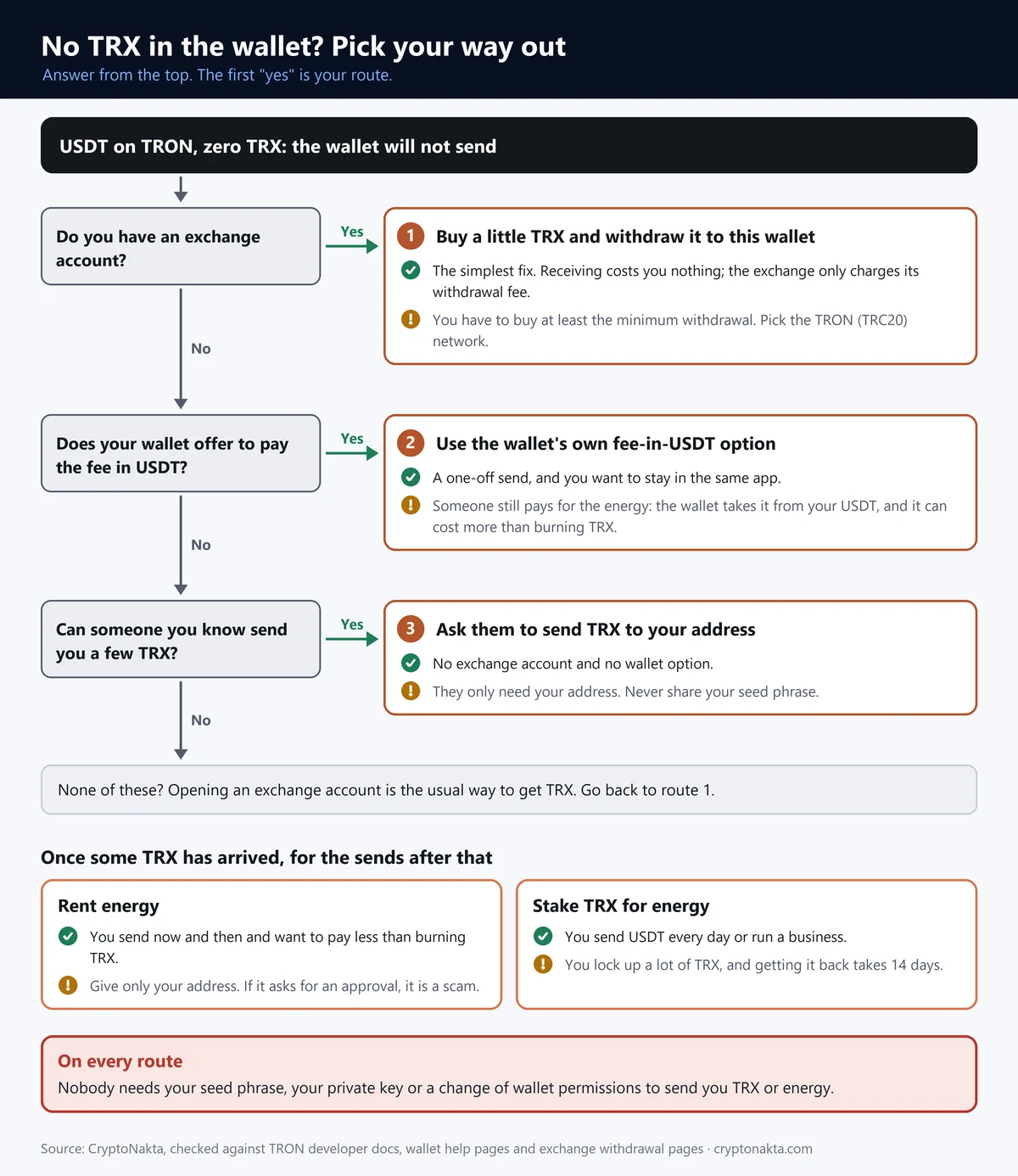
The simplest fix is to buy a little TRX on an exchange and withdraw it to the address that holds your USDT. When an exchange sends you TRX, the receiving wallet pays nothing. Even an address with zero TRX can receive it.
A brand-new address also gets activated by that first TRX, at the exchange’s cost. OKX’s help page says the withdrawal fee “is always paid by the withdrawing party, not the receiving party.”
| Exchange | Minimum TRX withdrawal | Withdrawal fee | Arrives if you withdraw the minimum | USDT sends it covers (recipient holds USDT) |
|---|---|---|---|---|
| Binance | 20 TRX · $6.32 | 2 TRX · $0.63 | 18 TRX | 2 sends |
| KuCoin | 2 TRX · $0.63 | 1 TRX · $0.32 | 1 TRX | not enough for one |
| Bitget | 28.43 TRX · $8.98 | 1.5 TRX · $0.47 | 26.93 TRX | 3 sends |
Read from each exchange’s public withdrawal settings for TRX on the TRON network. The exchange’s withdrawal screen is what counts, and these settings change without notice.
We assumed the fee comes out of the amount you withdraw. If your exchange takes it from the rest of your balance, the full minimum arrives.
Sends counted at 6.77 TRX each: you burn TRX, the recipient already holds USDT, no energy of your own. The first send of the day can use free bandwidth and costs a little less.
Your wallet pays no network fee to receive. You pay only the withdrawal fee above; the exchange covers the network fee and, for a new address, the activation.
Exchanges set a minimum withdrawal, so you’ll take out more than one fee’s worth. Binance’s minimum was 20 TRX when we checked. The last column shows how many sends the minimum covers, so take a little more than that. Pick TRX on the TRON network, often shown as TRC20. Paste your address, which starts with T. Once the TRX lands, send the USDT.
The reverse isn’t free. Sending USDT from your wallet to an exchange still costs you the TRON fee. If your USDT sits on an exchange, send it from there and pay a withdrawal fee instead. Our guide to moving crypto between exchanges compares those fees. Picked the wrong network? See our guide on sending crypto on the wrong network.
 View full size ↗
Binance

Affiliate disclosure: some links are partner links. We may earn a commission at no extra cost to you. This is not investment advice.
CRYPTONAKTA
How much TRX do I need to send USDT? Tron energy cost per send
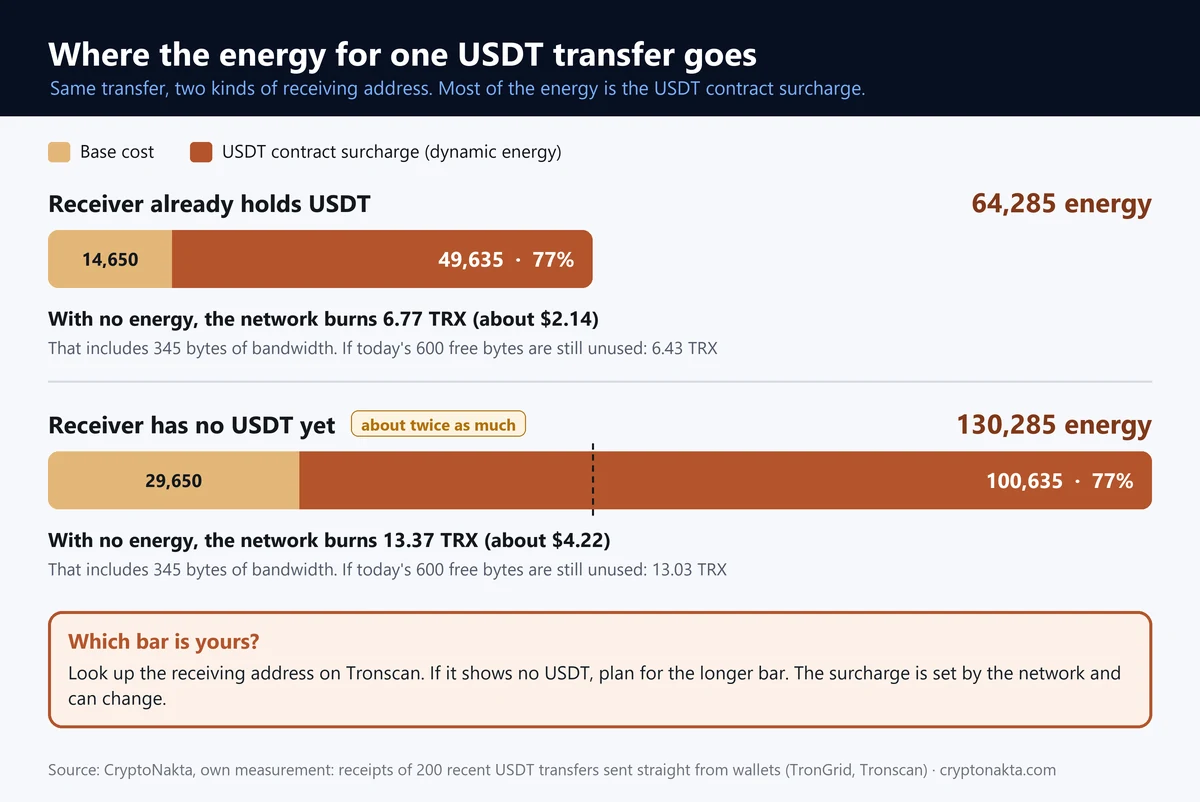
In the receipts we measured, one USDT send on TRON used 64,285 energy when the receiving address already held USDT. It used 130,285 energy when that address held none. With no energy of your own, your wallet burns about 6.77 TRX or 13.37 TRX instead. That’s roughly $2.14 or $4.22.
Enter your planned sends, the receiver’s status and your TRX. The calculator shows the TRX you’d burn, what you’re short and how that compares with an exchange minimum. It runs on our measured values, so it misses later price moves and what a wallet’s fee-in-USDT option charges. Nothing you type leaves your browser.
| Recipient address | Energy per USDT send | Base | USDT contract surcharge (dynamic energy) | Bandwidth | Daily free bandwidth | Seen in our sample |
|---|---|---|---|---|---|---|
| Already holds USDT | 64,285 | 14,650 | 49,635 (77%) | 345 bytes | 600 bytes: enough for 1 send a day | 158 of 200 |
| Holds no USDT (new or emptied) | 130,285 | 29,650 | 100,635 (77%) | 345 bytes | 600 bytes: enough for 1 send a day | 42 of 200 |
From the receipts of 200 recent USDT transfers that a wallet sent straight to the USDT contract. Every transfer in each group used exactly the same energy.
The surcharge is TRON’s dynamic energy for heavily used contracts. It goes up and down with demand, so the totals move with it.
Energy is never free. Bandwidth is free up to a daily allowance for activated addresses, and that allowance refills over a day.
| Recipient address | TRX burned (energy + bandwidth) | If free bandwidth is left today | In dollars |
|---|---|---|---|
| Already holds USDT | 6.77 TRX | 6.43 TRX | $2.14 |
| Holds no USDT (new or emptied) | 13.37 TRX | 13.03 TRX | $4.22 |
TRX burned = energy × 100 sun + bandwidth bytes × 1,000 sun (1 TRX = 1,000,000 sun), at the chain prices we read. Dollars at $0.32 per TRX.
This is the cost with no staked or rented energy at all. In our sample most sends burned no TRX because they used staked or rented energy; see the rental section.
Sending TRX to a brand-new address for the first time costs 1.1 TRX (1 TRX activation fee + 0.1 TRX bandwidth) on top of this. Whoever sends that TRX pays it, so when an exchange sends it, the exchange pays. Receiving USDT does not activate an address.
Both prices are chain parameters that can change by vote. Your wallet’s confirmation screen shows the real number.
The surprise was where the energy goes. 77% of it is a surcharge on the USDT contract, which TRON calls dynamic energy. A send to an empty address takes about twice as much in both parts. Per TRON’s docs, the surcharge factor goes up with heavy use and “decays when usage drops.”
To know which number is yours, look up the receiving address on Tronscan. No USDT there means the bigger number. Bandwidth is the small part, with 600 free bytes a day for activated addresses. Our numbers are a snapshot from one moment, so the surcharge may differ when you send.
 View full size ↗
Can I pay gas fees with USDT on TRON?
Yes, in some wallets. Trust Wallet and Binance Wallet say in their help pages that a TRON fee can be paid with USDT. So do Bitget Wallet and TokenPocket. MetaMask and OKX Wallet take stablecoins for fees too, but not on TRON.
| Wallet | Works on TRON | Networks | How it works | Basis |
|---|---|---|---|---|
| Trust Wallet | Yes | TRON · BNB Chain · Ethereum · Arbitrum · Optimism · Base | TRON: built-in energy rental, fee paid in TRX or USDT, whichever is cheaper. Other networks: FlexGas (gas in USDT, USDC or TWT) | Official help page or article, read in full |
| Binance Wallet | Yes | BNB Chain · Ethereum · Solana · TRON | Pay the fee in USDT; transfers and dApp approvals only, not swaps or bridges | Official help page or article, read in full |
| Bitget Wallet (GetGas) | Yes | Ethereum · Solana · BNB Chain · Morph · Polygon · Base · Arbitrum · Optimism · TON · TRON | GetGas: top up a gas balance with USDT, USDC or BGB; fees paid this way run about twice as high | Official help page or article, read in full |
| TokenPocket | Yes | TRON · BNB Chain · Ethereum · Solana · Base · Polygon · Arbitrum | Switch on Energy Rental on the send screen; the fee is paid in USDT (or USDD) | Official help page or article, read in full |
| imToken | Yes | TRON | Energy rental cost shown in the fee field; GasFree transfers too* | Official page, search excerpt only* |
| MetaMask | No | Ethereum · BNB Chain · Arbitrum · Polygon · Linea · Base | Gas included transactions: the fee comes out of a token such as USDT, plus a small MetaMask fee | Official help page or article, read in full |
| OKX Wallet (Gas Station) | No | Solana | Gas Station: pay gas in USDC, USDT or USDG; not for sending native coins | Official help page or article, read in full |
| GasFree (in TronLink and other wallets) | Yes | TRON | A separate GasFree address; a provider pays the TRX and the fee comes out of the USDT you send* | Official page could not be opened; fees only in media reports* |
Each row is what the wallet itself says in its help pages or official articles (sources at the end). Features change, so check your wallet’s confirmation screen before you send.
Even when the fee shows as zero, someone pays for the energy: the wallet or a provider pays the TRX and takes the cost back from your token. Free sends are limited promotions.
OKX Wallet’s English page lists Solana only; other language versions of the same page list more networks. TRON is on none of them.
* We could not open the original page and saw it only as a search excerpt (or in media reports). Check the screen in your wallet before relying on it.
Bitget says fees through GetGas are “generally about twice as high,” so check the total before you confirm.
Trust Wallet rents energy through Tronify, an energy provider built into the app. The fee comes out of TRX or USDT, whichever is cheaper at the time. TokenPocket has an Energy Rental switch on the send screen.
GasFree shows up in TronLink and some other wallets as a way to pay the fee from the USDT you send. We couldn’t open GasFree’s own pages, and saw TronLink’s guide only as a search excerpt. Media reports describe a flat USDT fee. Even when a fee shows as zero, someone is paying for the energy, so read the amount on the confirmation screen.
Tron energy rental: how it works and how to spot a fake
Renting energy means someone who staked TRX lends energy to your address for a set time. It usually costs less than burning TRX. Rented or staked energy is how most senders in our sample paid. Of 200 transfers, 85% burned no TRX at all, and only 11.5% paid the whole fee by burning TRX.
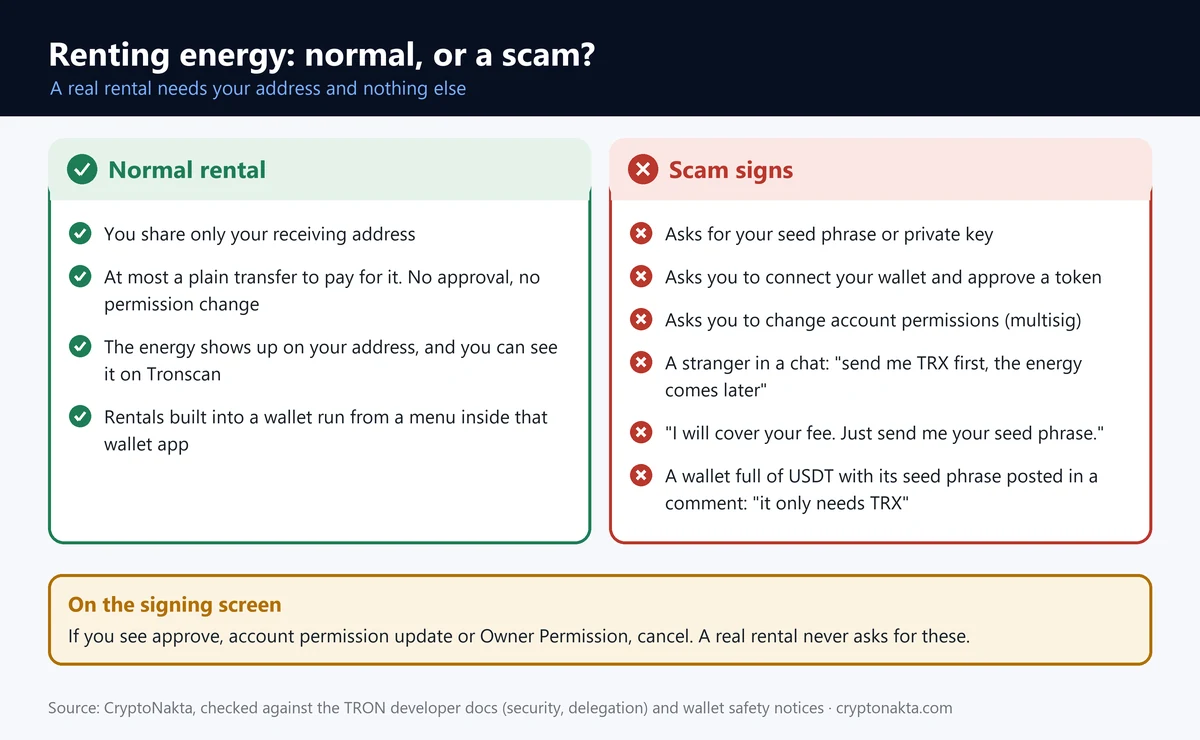
The lending step is called delegation, and only the lender signs it. In TRON’s docs, the lender’s TRX “stays staked” the whole time. A real energy rental needs only your address, and it never asks you to approve a token or change wallet permissions. An approval lets a contract spend your tokens later, which is how fake rental sites empty wallets.
| Check | Normal rental | Scam |
|---|---|---|
| They ask for | Your TRON address | Seed phrase, private key or a wallet connection |
| You sign | Nothing, or a plain TRX or USDT payment | An approve or an account permission update |
| Afterwards | Energy shows on your address on Tronscan | Nothing arrives, then a request for more |
Rented energy doesn’t last. When the rental period ends, the lender takes it back. Unused energy goes too, so rent just before you send. If a rental fails, check on Tronscan whether any energy arrived before you try again. We don’t name rental services. We only cover rentals built into wallets.
Why can’t I swap USDT for TRX in my wallet?
A swap trades one token for another, such as USDT for TRX. Inside a TRON wallet it is a transaction too, so it needs energy or TRX. With zero TRX it hits the same error. MetaMask’s help says a swap “will need energy to complete the transaction.”
Binance Wallet’s USDT fee doesn’t cover swaps either. So get TRX from outside first, then swap or send. No exchange account? Ask someone you know for a few TRX. They need only your address. If you hold USDT on an exchange, convert some to TRX there and withdraw it. And when you set up a new address for USDT, have a little TRX sent with it.
Should I stake TRON for energy?
Staking TRX gives your address its own energy every day, but it takes a lot of TRX. You’d need about 6,664 TRX staked to send USDT once a day to an address that holds USDT. For a receiver with no USDT, it’s about 13,505 TRX.
Staking locks TRX in your own account in return for energy, which refills over a day. Unstaking takes 14 days, a chain setting that can change by vote. So it suits people who send USDT daily, such as a shop. For a one-off send, getting TRX or renting is quicker. You can stake for bandwidth too, but one send a day already fits in the free allowance. Our guide to staking covers the basics.
TRON transfer failed out of energy? Check before you resend
A TRON transfer that fails with OUT_OF_ENERGY still costs you. A failed send doesn’t refund the fee it used, so pressing Send again can burn TRX twice. TRON’s docs say “Energy already consumed is still charged up to that limit.”
That limit is the fee limit, the most a transaction may spend. Set too low, the send stops partway. Before retrying, look up the transaction ID on Tronscan. Our guides on finding a TXID and pending transfers show how.
An oddly large fee usually has a plain cause. The receiver may hold no USDT, or the address may need activating. The surcharge may also be high at that moment. Top up a little, then send once.
Is that USDT wallet in the comments a scam?
Almost always, yes. People stuck with USDT and no TRX are exactly who these scams target. Anyone who asks for your seed phrase or private key is running a scam, whatever the reason.
The common bait is a comment asking how to move USDT out of a wallet, with the seed phrase pasted in. Someone else holds the signing rights, so any TRX you add to that wallet is gone. A Binance-affiliated help page names the hook: “the wallet doesn’t have enough TRX.”
| Trap | What you see | What happens |
|---|---|---|
| Seed phrase bait | A wallet full of USDT with its seed phrase posted in a comment | Someone else controls signing. The TRX you add is lost |
| Fake energy seller | Cheap energy if you send TRX first, or a site asking you to approve | No energy, or your tokens drained later |
| Permission change | A signing screen saying account permission update, then an offer to undo it for a cut | You lose the wallet, then pay a second scammer |
| Flash USDT | A balance that looks like USDT but is not the official token, plus a fee demand | The token is worthless and the fee is gone |
 View full size ↗
TRON’s security guide asks you to “pay extra attention to permission-changing operations” before signing. Cancel if the signing screen shows approve, account permission update or Owner Permission during a rental.
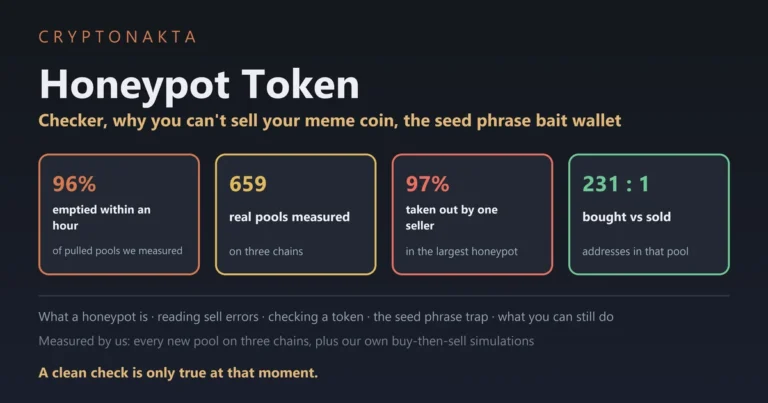
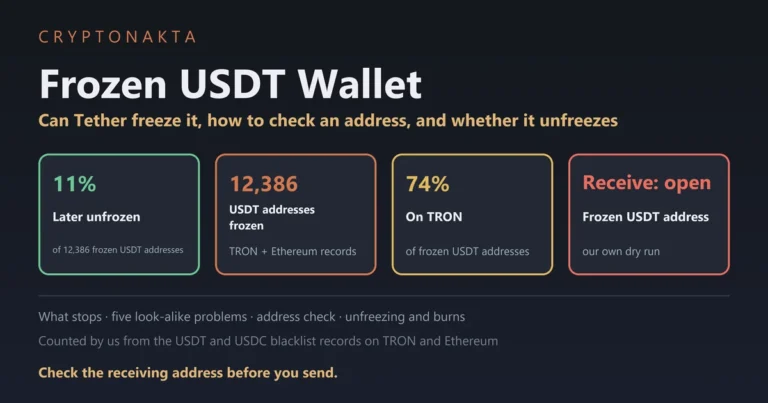
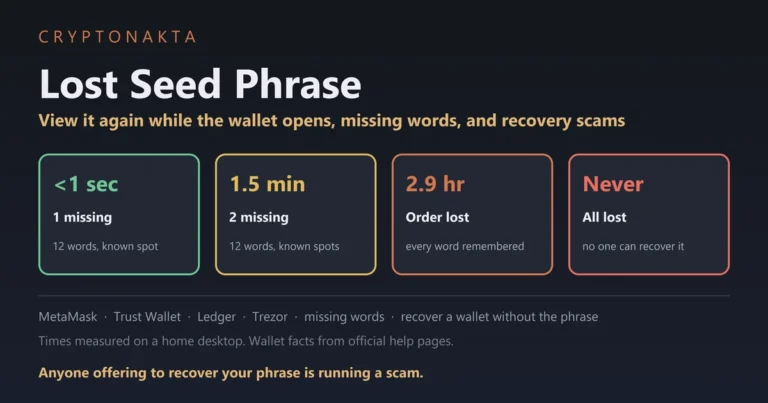
Signed an approval already? Read how to revoke token approvals. Fake USDT that won’t sell is covered in our honeypot token guide. A wallet that receives but can’t send may be frozen by the issuer, a separate problem covered in can USDT be frozen. If your seed phrase may be exposed, see what to do about a lost seed phrase.
Why do I need ETH to send USDT on Ethereum?
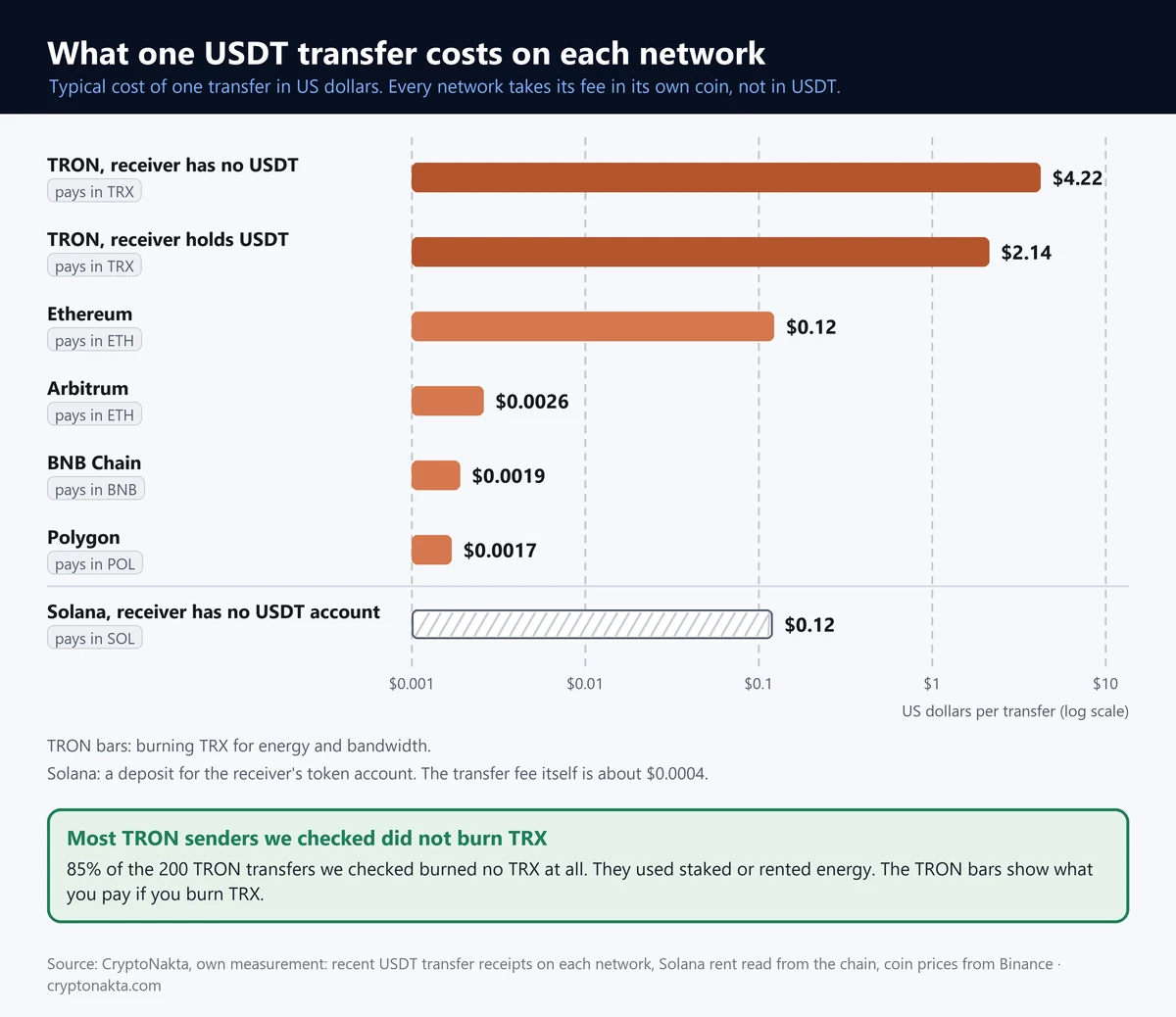
You need ETH because Ethereum charges its fee in ETH, the way TRON charges in TRX. USDT on BNB Chain, Polygon or Arbitrum also needs that network’s own coin in the same account. A median USDT send on Ethereum cost $0.12 in the receipts we checked.
| Network | Fee is paid in | One USDT send (median) | 9 in 10 sends cost at most | Receipts checked |
|---|---|---|---|---|
| TRON, burning TRX (recipient holds USDT) | TRX | $2.14 | — | 200 |
| TRON, burning TRX (recipient holds no USDT) | TRX | $4.22 | — | 200 |
| Ethereum | ETH | $0.12 | $0.32 | 40 |
| BNB Chain | BNB | under $0.01 | under $0.01 | 40 |
| Polygon | POL | under $0.01 | under $0.01 | 40 |
| Arbitrum | ETH | under $0.01 | $0.08 | 35 |
| Solana | SOL | under $0.01, plus a $0.12 deposit if the recipient has no USDT account yet | — | — |
Ethereum, BNB Chain, Polygon and Arbitrum: the fees actually paid in recent USDT transfers sent straight to the USDT contract, at the coin’s market price when we measured.
TRON rows are the cost if you burn TRX because you have no energy. 85% of the TRON transfers we checked burned no TRX at all, so the table shows what burning would cost instead of a spread of fees paid.
Solana: a new USDT account for the recipient locks a deposit of 0.00149 SOL, which we read from the chain; the sender’s wallet usually covers it. TON is not in the table because we found no official number.
When we measured, burning TRX made a TRON send cost more than an Ethereum one. Most TRON senders in our sample didn’t burn, though. MetaMask’s “insufficient funds” error means the account is short of the network’s native token. If you do hold ETH, it is likely on another network or account. Arbitrum and Base each need their own ETH.
On Solana, sending USDT to a wallet that has no USDT account yet creates a token account there. That account needs a deposit of 0.00149 SOL, and the sender’s wallet usually pays it. USDT on TON needs TON for the fee. Our USDT ERC20 vs TRC20 guide compares the networks.
 View full size ↗
How we measured, and what we couldn’t
We read these numbers from public chain data ourselves, as of November 12, 2026, 14:13 UTC. We opened 200 USDT transfer receipts on TRON one by one. We also read EVM receipts, the Solana deposit and three exchanges’ TRX withdrawal settings.
| What | Value |
|---|---|
| Measured at | November 12, 2026, 14:13 UTC |
| Sources | TronGrid public API (chain parameters, total staking) · TRONSCAN (USDT transfer receipts) · public RPC of each network · Binance, KuCoin and Bitget public withdrawal settings (no key) |
| TRON sample | 200 recent USDT transfers that a wallet sent straight to the USDT contract (exchange batch sends left out): 158 to addresses holding USDT, 42 to addresses without |
| TRON chain prices | energy 100 sun · bandwidth 1,000 sun per byte · free bandwidth 600 bytes a day · new-address activation 1.1 TRX (1 TRX activation fee + 0.1 TRX bandwidth) |
| How the sampled senders paid | burned no TRX (staked or rented energy) 85% · burned all of it in TRX 11.5% · partly 3.5% |
| Staking estimate | about 9.6 energy a day per staked TRX (total energy limit ÷ total staked for energy) · one send a day needs 6,664 TRX staked (recipient holds USDT) or 13,505 TRX (no USDT) · unstaking wait 14 days |
| Other networks | recent USDT transfer receipts: Ethereum 40 · BNB Chain 40 · Polygon 40 · Arbitrum 35 |
| Solana deposit | rent-exempt minimum for a token account read from the chain: 0.00149 SOL |
| Exchange withdrawals | Binance 20 TRX / 2 TRX · KuCoin 2 TRX / 1 TRX · Bitget 28.43 TRX / 1.5 TRX (minimum / fee, TRX on the TRON network) |
| Prices used (USDT pairs) | TRX $0.32 · ETH $2,007 · BNB $655 · POL $0.09 · SOL $81.12 |
| Not measured | real charges of wallets’ pay-the-fee-in-USDT features · prices of energy rental services · exchange batch transfers · TON |
| TRON docs and wallet help pages compared on | November 12, 2026 |
A snapshot as of November 12, 2026, 14:13 UTC. The USDT contract surcharge, chain prices, the TRX price and exchange settings all move; your wallet’s confirmation screen is what counts.
We measured only transfers a wallet sent itself, so wallet fee features and rental prices are not in these numbers.
We measured only transfers that a wallet sent itself, leaving out exchange batch sends. For scam patterns we also read write-ups by Kaspersky and Cointelegraph Magazine, as background.
My take after reading the receipts
The biggest surprise was the USDT contract’s surcharge, which makes up most of the energy. An empty receiving address roughly doubles the total. Yet most senders in our sample burned no TRX at all, and burning it cost more than an Ethereum send.
With USDT and no TRX, we’d withdraw a few TRX from an exchange first. Without an exchange account, we’d try the wallet’s fee-in-USDT option, then a rental built into the wallet. If you send often, it’s worth rethinking which network you use.
We trust least a comment that hands you a seed phrase or offers to cover your fee. A chat seller who wants TRX up front, and anyone charging to undo a permission change, come close behind. To be fair, rentals often beat burning TRX. Someone who sends every day and can lock up thousands of TRX may do better staking.
This site uses exchange referral codes, and we earn a commission when you sign up with ours. With our Binance code, you get back 10% of the spot trading fees you pay. If you have no exchange account yet, an exchange is the most common place to buy a few TRX and withdraw them.
Binance
Affiliate disclosure: some links are partner links. We may earn a commission at no extra cost to you. This is not investment advice.
Questions people ask about sending USDT without TRX
- TRON Developer Hub: resource model · checked November 12, 2026
- TRON Developer Hub: paying for resources and energy sharing · checked November 12, 2026
- TRON Developer Hub: accounts · checked November 12, 2026
- TRON Developer Hub: unstaking · checked November 12, 2026
- TRON Developer Hub: delegating resources · checked November 12, 2026
- TRON Developer Hub: security and scam prevention · checked November 12, 2026
- ethereum.org: gas and fees · checked November 12, 2026
- Solana Program Library: associated token account · checked November 12, 2026
- MetaMask Support: TRON network · checked November 12, 2026
- MetaMask Support: insufficient funds error · checked November 12, 2026
- Trust Wallet Support: sending USDT (TRC20) on TRON · checked November 12, 2026
- Binance FAQ: network fees (gas fees) · checked November 12, 2026
- OKX Wallet: Gas Station · checked November 12, 2026
- Bitget Wallet Academy: GetGas · checked November 12, 2026
- TokenPocket Help: USDT as network fee · checked November 12, 2026
- TronLink Support: GasFree user guide · checked November 12, 2026
- OKX Help: deposit and withdrawal fees · checked November 12, 2026
- Binance FAQ: crypto withdrawal fees · checked November 12, 2026
- Binance-affiliated help center: staying safe from multisig scams on TRON · checked November 12, 2026
Not investment advice. Network fees and wallet features change, so check the confirmation screen in your wallet before you send.