Sent Crypto to the Wrong Address: How to Recover It, Address Typos, Can You Reverse It
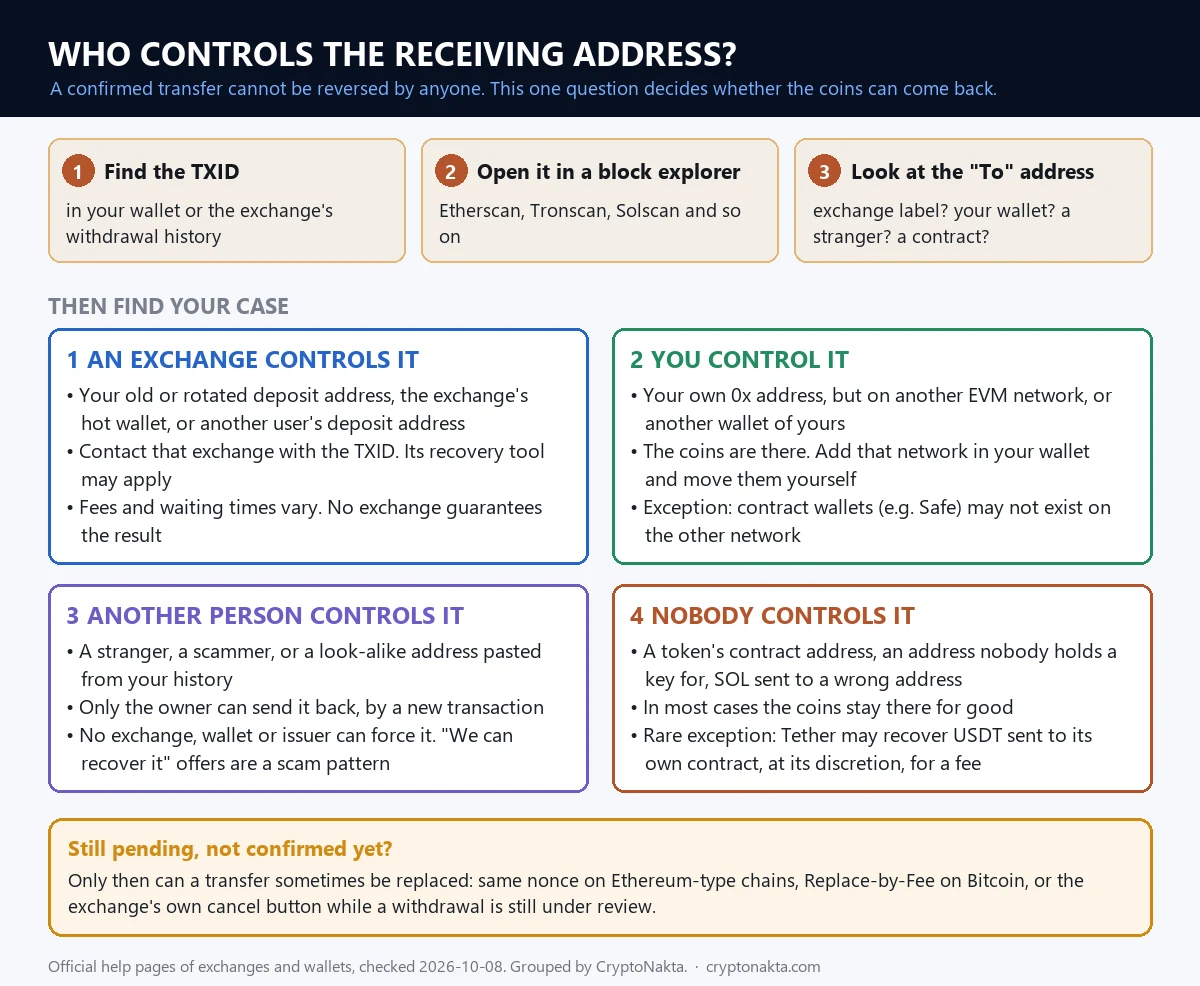
Once a crypto transfer to the wrong address is confirmed, nobody can reverse it, and whether the coins come back depends only on who controls the receiving address. That could be an exchange, you, another person or nobody at all.
I wanted to know how people end up at the wrong address in the first place. So I coded the address rules for nine formats and fed them random typos. A typo almost never produced a valid Bitcoin, TRON or XRP address. The real danger is copy and paste. Scammers plant look-alike addresses in your history, and some malware swaps the address you paste.
In this article (13)
Can you reverse a crypto transaction sent to the wrong address?What to do if you sent crypto to the wrong address: the two-minute checkWhat if the wrong address belongs to an exchange?Sent to your own 0x address on the wrong network? It’s not lostCan one typo send your crypto to someone else? I tested itAddress poisoning: how a look-alike address gets into your historyClipboard malware that swaps the address you pasteCan you get crypto back from a stranger or a scammer?Exchange recovery tools compared: Binance, Bybit, OKX, KuCoin and moreHow to recover USDT sent to a contract addressWhat happens if you send crypto to an old deposit address?How to stop sending crypto to the wrong addressMy take after testing typos and look-alike addresses
 View full size ↗
Can you reverse a crypto transaction sent to the wrong address?
No. A confirmed crypto transaction can’t be reversed by your exchange, your wallet app or the coin’s issuer. Coins sent to the wrong address come back only if whoever controls that address sends them back.
“There is nothing MetaMask or anyone else can do to revert it,” MetaMask writes. Phantom says no one can undo a confirmed transaction, its own support team included. Ledger’s version is shorter: “no one can.”
So whether you get anything back depends on one thing: who holds the receiving address. That will be an exchange, you, someone else or nobody. The amount and the story behind the mistake don’t change that.
Still pending? You may have a short window
A transaction that hasn’t confirmed can sometimes be replaced. On Ethereum-style (EVM) chains, every send carries a nonce. That’s a counter that goes up by one with each transaction. A new transaction with the same nonce and a higher fee can take the pending one’s place. MetaMask’s Cancel button does exactly this.
Bitcoin has RBF, short for replace-by-fee (BIP-125). If the original signaled RBF, your wallet can swap it for one that pays more. Neither trick is guaranteed. If the original confirms first, it wins.
Exchange withdrawals have their own cancel windows. Here’s what each help page said on October 8, 2026.
| Sent from | When you can still stop it | Notes |
|---|---|---|
| MetaMask (EVM chains) | While pending | Same nonce, priority fee at least 10% higher |
| Bitcoin wallet | While unconfirmed | Only if the original signaled RBF |
| Bybit withdrawal | Only in “pending review” | A grey Cancel button means it’s too late |
| Bitget withdrawal | Within 1 minute | Then it goes to the chain |
| OKX withdrawal | Before the chain queue | No cancel once it’s queued |
| Binance withdrawal | Not published | I found no page with a cancel window |
| Coinbase send to an email | While it shows Pending | Unclaimed sends return after 30 days |
| Walt send to a Telegram contact | Before it’s claimed | Unclaimed sends return after 7 days |
The last two rows never touch the blockchain. The coins move inside Coinbase’s or Walt’s own records (Walt is the app formerly called Wallet in Telegram), so they can come back until the other person claims them. If your withdrawal is stuck rather than wrong, see why a withdrawal stays pending.
What to do if you sent crypto to the wrong address: the two-minute check
If you sent crypto to the wrong address, spend two minutes finding out who controls that address. Find the TXID, open it in a block explorer and read the “To” address. That tells you whether an exchange, you, another person or nobody holds the coins.
The TXID, or transaction hash, is the unique ID of your transfer. Your wallet shows it in the activity list. Exchanges show it in withdrawal history. Our TXID guide shows where each app puts it.
A block explorer is a public website that lists every transaction on one blockchain. Etherscan covers Ethereum, Tronscan covers TRON and Solscan covers Solana. Paste the TXID, then click the receiving address.
One catch with tokens like USDT. On Etherscan, the “Interacted With (To)” field shows the token’s contract, because that’s the program your wallet called. The real recipient is in the “ERC-20 Tokens Transferred” line.
| What you see at the receiving address | Who controls it | What you can do |
|---|---|---|
| An exchange name tag, or you copied it from an exchange deposit page | That exchange | Contact that exchange with the TXID |
| Your own 0x address on another network | You | Switch networks and move the coins |
| A normal wallet with history and no tag | Another person | Only they can send it back |
| Marked as a contract | Usually nobody | Mostly gone; USDT has a narrow exception |
| A burn address or a never-used address | Nobody | Gone |
A missing name tag doesn’t mean it’s a person. Explorers tag only some exchange wallets, and many exchange deposit addresses carry no tag at all. Write down the TXID, the address and the network. Every support team will ask for all three.
What if the wrong address belongs to an exchange?
If the wrong address belongs to a crypto exchange, only that exchange can credit or return the coins. Contact the exchange that owns the receiving address, even if you sent from somewhere else, and give it the TXID.
Another customer’s deposit address
The receiving exchange can see which account owns the address. Trust Wallet and Phantom both tell you to contact that exchange with the transaction hash. What happens next depends on its rules and on the account holder. The exchange you sent from can’t do much. Binance says it can’t help once coins go to an address that isn’t Binance’s.
The wrong UID in an internal transfer
Internal transfers move coins between two accounts on the same exchange. OKX says one that lands in someone else’s account comes back only if that user cooperates. If they refuse or don’t answer, OKX can’t force it. Bitget says these transfers can’t be reversed. Binance tells users to contact support. Bybit’s page doesn’t say whether one can be undone.
A withdrawal to the wrong outside address
Binance, OKX, Bitget and Kraken all say they can’t pull back a withdrawal once it hits the chain. If the address belongs to another platform, take the TXID to that platform’s support.
Right exchange, but the deposit never showed up
A wrong coin, an unsupported network or a missing memo can leave coins stuck on the exchange’s own address. Those cases can often be fixed. Start with deposits that never got credited. XRP and some other coins need a destination tag. For that, read what to do when you forgot the memo or tag.
Sent to your own 0x address on the wrong network? It’s not lost
If you sent coins to your own 0x address on a different EVM network, nothing is lost. A wallet made from a recovery phrase has the same address on every EVM chain, so the coins sit at your address on the network you picked.
EVM stands for Ethereum Virtual Machine. EVM chains run Ethereum-style accounts and share the 0x address format. MetaMask names Polygon, Arbitrum, Optimism and Avalanche as examples. Its help page says funds sent on the wrong EVM network aren’t lost. The owner only has to switch networks.
So open the same wallet and add the network where the coins went. You may need to add the token too. To move them, you need a little of that chain’s own coin for the gas fee. A friend’s wallet works the same way. Ask them to switch networks. Phantom and Keeper say the same for their users.
Smart contract wallets are the exception. A Safe exists only on the chains where it was deployed. Safe’s docs say you can sometimes deploy the same Safe at the same address on the other chain and reach the funds. It doesn’t always work, and it never works on non-EVM chains like zkSync Era.
If the 0x address was an exchange deposit address, the exchange holds the coins. Its unsupported-network rules apply, and the fees can be high. Our guide on sending crypto on the wrong network covers that case.
Can one typo send your crypto to someone else? I tested it
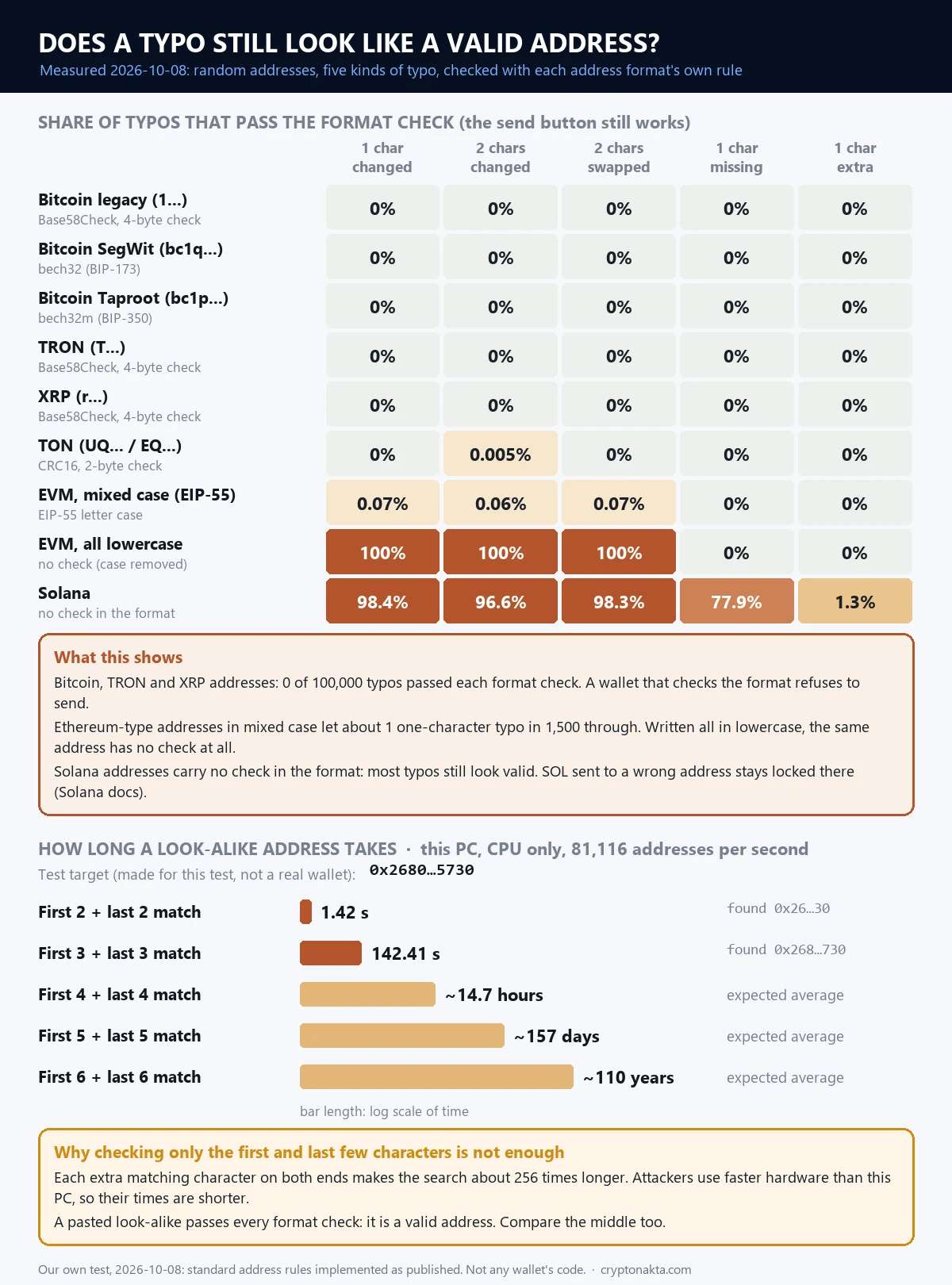
A single typo almost never turns a crypto address into another valid address. On October 8, 2026, I ran 100,000 typos per format through the standard address rules. Not one Bitcoin, TRON or XRP typo passed. All-lowercase EVM addresses and Solana were the exceptions.
Most addresses carry a checksum. That’s a few extra characters calculated from the rest of the address. Change one character and the math stops matching, so a wallet will usually show “invalid address” and refuse to send.
Here’s the math. Bitcoin addresses that start with 1 or 3 use a 4-byte checksum. Four bytes is 2^32, or 4,294,967,296 possible values. The Bitcoin wiki puts the odds of a random typo slipping through at about one in 4.3 billion. TRON and classic XRP addresses use the same kind of check. Bitcoin addresses starting with bc1q go further. Their standard, BIP-173, guarantees it catches any error of up to four characters.
Here is how I tested it. I coded the rules for nine address formats straight from their standards. Then I made random addresses and added five kinds of typo. One character changed, two changed, two neighbors swapped, one missing and one extra. I ran 20,000 of each kind, and 400,000 for mixed-case EVM changes and swaps. Then I counted how many still passed the format check.
| Address format | Built-in check | 1 character changed | 2 characters changed | 2 neighbors swapped | 1 character missing | 1 character extra | Passed in total |
|---|---|---|---|---|---|---|---|
| Bitcoin legacy (1…) | Base58Check, 4-byte check | 0% | 0% | 0% | 0% | 0% | 0 of 100,000 |
| Bitcoin SegWit (bc1q…) | bech32 (BIP-173) | 0% | 0% | 0% | 0% | 0% | 0 of 100,000 |
| Bitcoin Taproot (bc1p…) | bech32m (BIP-350) | 0% | 0% | 0% | 0% | 0% | 0 of 100,000 |
| TRON (T…) | Base58Check, 4-byte check | 0% | 0% | 0% | 0% | 0% | 0 of 100,000 |
| XRP (r…) | Base58Check, 4-byte check | 0% | 0% | 0% | 0% | 0% | 0 of 100,000 |
| TON (UQ… / EQ…) | CRC16, 2-byte check | 0% | 0.005% | 0% | 0% | 0% | 1 of 100,000 |
| EVM 0x, mixed case | EIP-55 letter case | 0.07% | 0.06% | 0.07% | 0% | 0% | 790 of 1,240,000 |
| EVM 0x, all lowercase | none (case removed) | 100% | 100% | 100% | 0% | 0% | 60,000 of 100,000 |
| Solana | none in the format | 98.4% | 96.6% | 98.3% | 77.9% | 1.3% | 74,510 of 100,000 |
All three Bitcoin formats, TRON and XRP caught every typo. TON let 1 through in 100,000, a two-character change. Mixed-case EVM addresses passed 0.07% of one-character typos, about one in 1,465. Write the same addresses in all lowercase and 100% of changes and swaps passed.
That gap comes from how EIP-55 works. The EVM checksum lives in the letter case, and a hash decides which letters are capitals. The standard also accepts all-lowercase addresses with no check at all.
To see where those passes came from, I ran 300,000 more one-character typos. Of those, 0.0187% beat the checksum itself. Another 0.0447% passed because the typo left the address all one case. The EIP-55 spec estimates 0.0247% for random typos, close to my checksum-only number.
Solana passed 98.4% of one-character changes and 77.9% of missing characters. My read is that a Solana address is a 32-byte key written in base58, with no check digits in the format. Solana’s docs say SOL sent to an incorrect recipient is permanently locked. Tokens get a bit more protection, since a transfer to an account that doesn’t match the token fails.
TON addresses that start with UQ or EQ carry a 2-byte CRC16 check. The raw form, which starts with 0:, has none. TON’s docs warn that a single wrong character there can cause irreversible loss.
I built these checks from the published standards and ran them on random addresses. They are not any wallet app’s code, and passing the format check doesn’t mean anyone owns that address. A typo that slips through most likely lands where nobody holds a key.
 View full size ↗
Address poisoning: how a look-alike address gets into your history
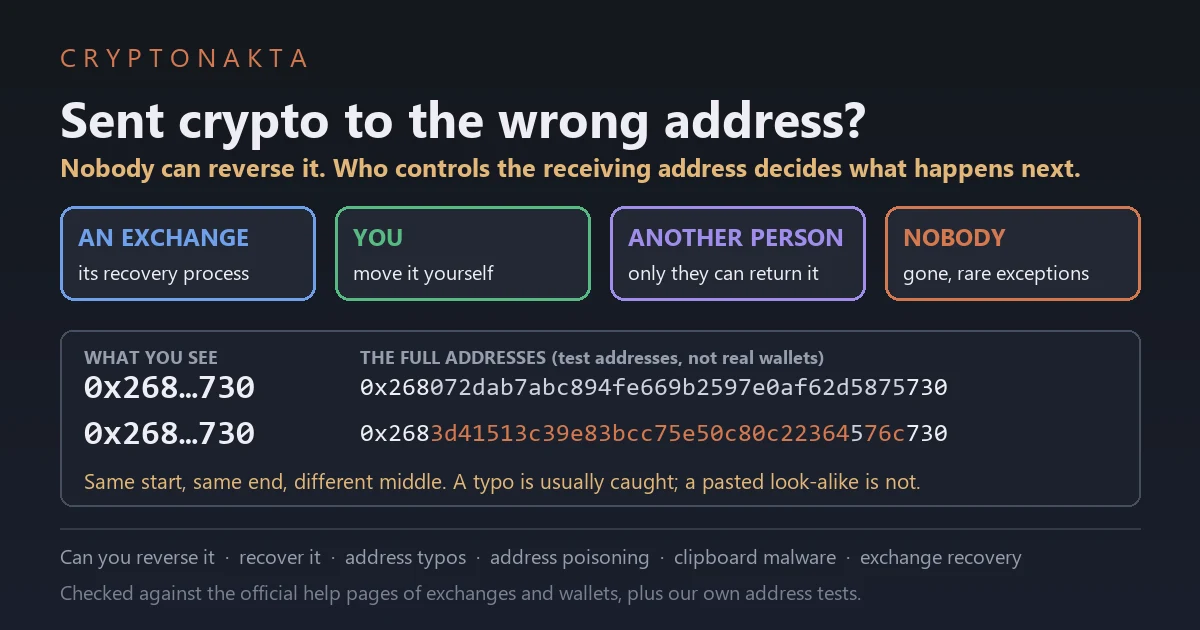
Address poisoning is a scam that plants a look-alike address in your wallet history so you copy it next time. The fake matches the first and last few characters of an address you really use, and wallets often hide the middle.
Address poisoning, also called address spoofing, starts right after you send. A transfer from a new address shows up in your history, often for zero USDT or a fake token. Etherscan says it can appear within a minute. The sender’s address starts and ends like the one you just paid. Copy it from history next time, and you pay the scammer.
Ledger says it’s most common on low-fee chains like TRON, Polygon and Solana. Ledger also points out that poisoning doesn’t mean your private key or recovery phrase leaked. If your phrase really was exposed, read seed phrase exposed.
I timed how fast a PC makes a look-alike
On October 8, 2026, I used my PC’s CPU to make random Ethereum-style addresses. It ran 12 threads with no graphics card and made 81,116 addresses per second. The target was 0x2680…5730, a test address I created for this. It isn’t a real wallet.
| Characters that match at each end | Average tries needed | Time on this PC |
|---|---|---|
| 2 + 2 | 65,536 | Found in 1.42 seconds |
| 3 + 3 | 16,777,216 | Found in 142.41 seconds |
| 4 + 4 | 4,294,967,296 | Calculated: about 14.7 hours on average |
| 5 + 5 | 1,099,511,627,776 | Calculated: about 157 days on average |
| 6 + 6 | 281,474,976,710,656 | Calculated: about 110 years on average |
A 2-and-2 match took 1.42 seconds. A 3-and-3 match took 142.41 seconds. I didn’t run longer matches. Worked out from that speed, a 4-and-4 match needs about 14.7 hours on average. A 5-and-5 match needs about 157 days. Each extra character at both ends multiplies the work by 16 × 16 = 256.
Here is that 3-and-3 look-alike next to my test address. Shortened, they look identical.
| My test address | Look-alike my PC found | |
|---|---|---|
| Shortened, the way many wallets show it | 0x268…730 | 0x268…730 |
| Full address | 0x268072dab7abc894fe669b2597e0af62d5875730 | 0x2683d41513c39e83bcc75e50c80c22364576c730 |
| Time to find it | Made for the test | 142.41 seconds |
I measured this on one PC’s CPU against a test address I made myself. Attackers use faster hardware, so their real cost is lower.
MetaMask’s help pages, checked the same day, describe a blocking warning for an address that matches the first 4 and last 4 characters of one you’ve used before. It only compares against your own past transactions in MetaMask, though. My 3-and-3 look-alike wouldn’t trip it either. It ends in c730, not 5730. Everywhere else, your eyes do the checking.
A USENIX Security 2025 paper by Tsuchiya and colleagues counted 270 million poisoning attempts on Ethereum and BNB Smart Chain from July 2022 to June 2024. It found 6,633 cases that cost victims at least $83.8 million. Chainalysis reported that on May 3, 2024, one person sent about $68 million in WBTC to a poisoned address. The attacker sent the funds back in ETH on May 9, which almost never happens.
Most attempts fail, which is why attackers send so many. Etherscan, citing the same paper in March 2026, put the success rate of one attempt on Ethereum at about 0.01%. MetaMask said in June 2026 that its partner Blockaid flagged 65.4 million poisoning transactions from January 2025 to February 2026.
Clipboard malware that swaps the address you paste
A crypto clipper is malware that swaps any address you copy for the attacker’s address. You copy the right address, paste it, and a different one lands in the send field.
A clipper, or clipboard malware, never touches your wallet. It only needs you to paste. ESET found the first one on Google Play in February 2019, posing as MetaMask. Kaspersky reported in March 2023 on one hidden in fake Tor Browser installers. It hit more than 15,000 users in 52 countries. Kaspersky says it can sit quietly for years, with no network activity, until the day it swaps an address.
In June 2026, Microsoft described a Windows clipper that checks the clipboard about every half second. For TRON addresses, it swaps in one that matches only the first two characters. My PC needed 1.42 seconds for a stricter 0x match with two characters at each end.
The defense is one habit. After you paste, compare the whole address with the source, middle included. ESET’s advice is to “always check if what you pasted is what you intended to enter.” A hardware wallet helps too, because it shows the address on its own screen.
Can you get crypto back from a stranger or a scammer?
Crypto sent to a stranger’s or a scammer’s address comes back only if that person chooses to send it. No exchange, wallet company or issuer can force a refund. If nobody knows who owns the address, the coins are effectively gone.
Coinbase tells users to contact the recipient directly. It says recovery isn’t possible if the owner is unknown. Trust Wallet says only the owner of the receiving address can return the funds. It can’t find or contact that person for you.
If you know who got it, ask fast and make it easy. Send them your current deposit address and the network to use. Don’t let them send it back to the “From” address. If you sent from an exchange, that address is the exchange’s. Coinbase warns that refunds sent there go to Coinbase, not to you.
If poisoning or a clipper sent it to an attacker, don’t expect it back. Anyone offering to recover or cancel a confirmed transfer is using a known scam pattern. MetaMask and Phantom both call this a scam. We don’t point readers to any business that sells crypto recovery. For your real options, read can you recover scammed crypto.
Exchange recovery tools compared: Binance, Bybit, OKX, KuCoin and more
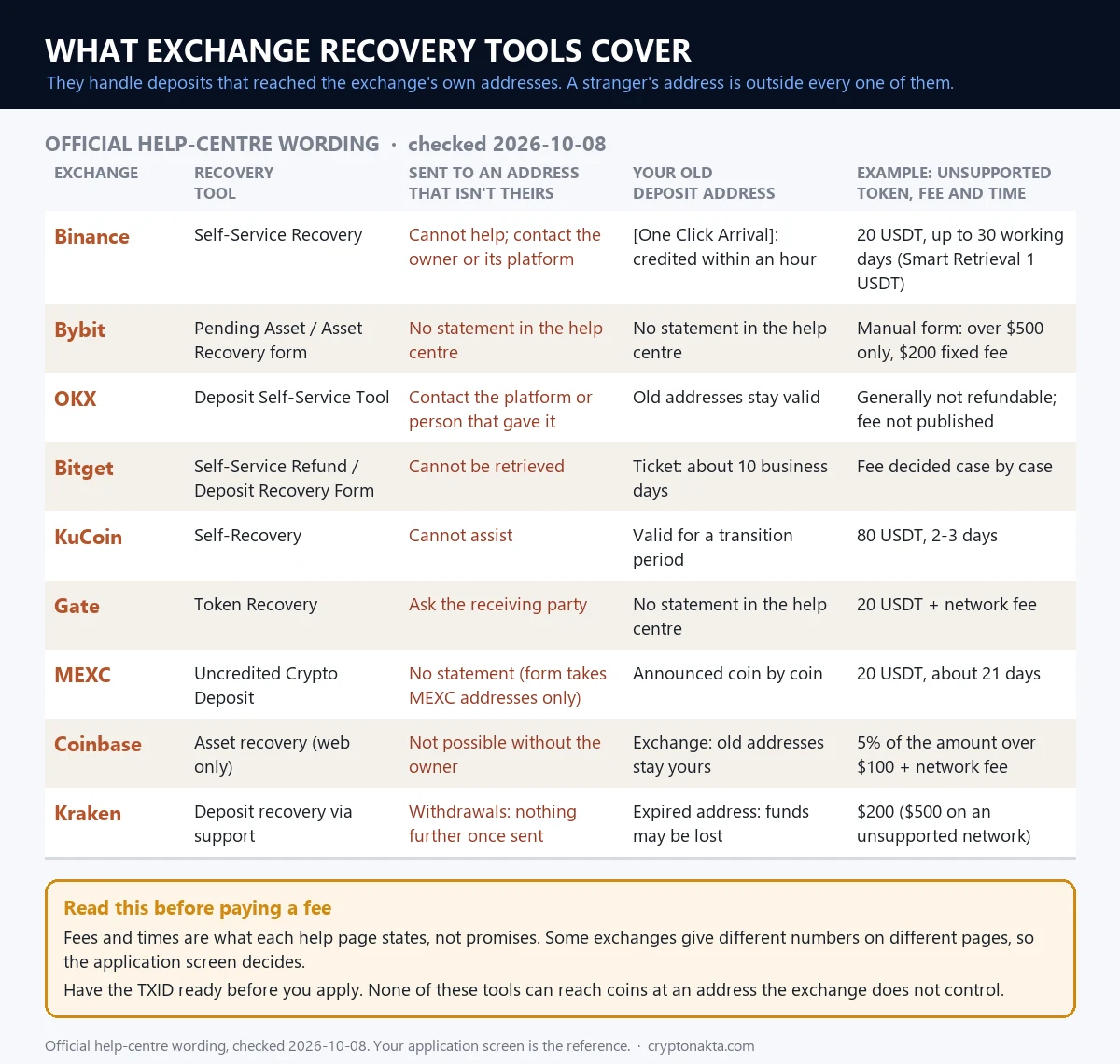
Exchange recovery tools only handle deposits that landed on that exchange’s own addresses. Binance, Bybit, OKX, KuCoin and the rest can sometimes fix a wrong coin, a missing memo or an old deposit address. None of them recover crypto sent to an address they don’t control.
I read the recovery pages of nine exchanges on October 8, 2026. Fees can differ even between two pages of the same exchange. Go by the form you actually fill in.
| Exchange | Recovery tool | Sent to an address it doesn’t control | Old deposit address | Fee and time examples |
|---|---|---|---|---|
| Binance | Self-Service Recovery | Can’t help | [One Click Arrival] | Hot wallet free, 5 business days; unlisted token 20 USDT |
| Bybit | Pending Asset, Asset Recovery form | Not stated | Not published | Manual: over $500 only, $200 flat |
| OKX | Deposit Self-Service Tool | Ask whoever gave you the address | Stays valid | Not published |
| Bitget | Support form | Can’t recover | Support case, about 10 business days | Hot wallet about 7 business days |
| KuCoin | Self-Recovery | Can’t help | Valid during switch-over | 80 USDT, 2 to 3 days |
| Gate | Token Recovery | Check whose address first | Not published | 20 USDT plus network fee |
| MEXC | Uncredited Crypto Deposit | Not stated | Coin-by-coin notices | 20 USDT, 7 to 21 days |
| Coinbase | Asset recovery | Only the recipient can return it | Stays tied to your account (Exchange) | 5% of the amount over $100 |
| Kraken | Deposit recovery via support | Nothing it can do | Funds may be lost | $200 to $500 |
The fees and times are what the help pages say, not promises, and none of them guarantee success. Binance charges only when a recovery works. MEXC freezes the fee and releases it if recovery fails. Bybit’s manual fee isn’t refunded.
Check where the coins go back, too. KuCoin’s Self-Recovery returns coins only to the address they came from. If you sent from another exchange, that’s the other exchange’s address, so ask it how it credits returns. Bybit sends manual recoveries to an outside address on the same chain, not to your Bybit account.
If you’re opening a Binance account, our Binance sign-up guide walks through it.
Binance
Bybit
OKX
KuCoin
Affiliate disclosure: some links are partner links. We may earn a commission at no extra cost to you. This is not investment advice.
 View full size ↗
How to recover USDT sent to a contract address
USDT sent to a token contract address is usually lost, because most contracts aren’t built to send tokens back out. Tether is the main exception. It sometimes recovers USDT at its own discretion, above $1,000 and for a fee.
A contract address belongs to a program on the blockchain, not to a person’s wallet. Every token lives at one, USDT included. MetaMask says recovery from a contract isn’t guaranteed. The project team may help, or may not. Phantom says contracts usually can’t send tokens back.
As of October 8, 2026, Tether’s terms are strict. It takes only cases above $1,000. The fee is up to 10% or $1,000, whichever is higher. Nothing is guaranteed, and cases often take months. You also need to be a verified Tether user, and Tether asks you to contact the receiving side first. Tether’s recovery is at its sole discretion and only opens in certain cases. Circle has no recovery process for USDC at all.
A burn address is one nobody holds a key for, used on purpose to destroy tokens. A well-known one is 0x000000000000000000000000000000000000dEaD. Anything sent there stays there. Bitcoin.org says the same about any valid address nobody controls.
TON’s rules tell wallet apps to switch off “bounce” when sending to a brand-new address, so don’t count on coins bouncing back. One trick from Keeper (formerly Tonkeeper) does work. If you sent GRAM (prev. TON) to the address of an NFT you own, send that NFT to yourself and the coins come back. More on the coin is in what Toncoin is. Network mix-ups with USDT are covered in USDT on ERC20 vs TRC20.
What happens if you send crypto to an old deposit address?
Sending crypto to an old deposit address on your own exchange account is often fixable, but each exchange handles it differently. OKX and Coinbase Exchange keep old addresses working. Binance has a one-click fix. Kraken warns that funds sent to an expired address can be lost.
Exchanges retire deposit addresses when they upgrade wallets. The old one may still sit in another app’s address book. Here is what each help page said on October 8, 2026.
| Exchange | Old deposit address | What to do |
|---|---|---|
| Binance | Not credited automatically, but the funds are safe | Use [One Click Arrival]; it lands within an hour |
| OKX | Still valid after the March 2025 upgrade | Nothing |
| Coinbase Exchange | Tied to your account for good | Credited automatically |
| KuCoin | Works during the switch-over period | Nothing while it lasts; check KuCoin’s notice |
| Bitget | Case by case | Deposit Issue > On-chain Deposit > I made a wrong deposit |
| Kraken | Funds may be lost | Contact support with the TXID |
| Bybit | No published policy | Contact support with the TXID |
Kraken’s advice works everywhere: check the deposit address in your account every time. An old receive address that your own wallet app gave you stays yours, as long as you still have that wallet or its recovery phrase.
How to stop sending crypto to the wrong address
Most wrong-address losses can be prevented with three habits. Never copy an address from your transaction history. Compare the whole address after you paste it. Send a small test first when the amount matters.
- Copy from the source. Use the recipient’s receive screen or your exchange’s deposit page. History is where poisoned addresses sit.
- Check every character. Read the middle too, not just the ends. My look-alike test shows why.
- Save addresses you reuse. An address book keeps checked addresses. A withdrawal whitelist blocks withdrawals to anything not on the list. Binance calls it [Add Address to Whitelist].
- Send a test first. Binance and Trezor both suggest it for large amounts.
- Confirm on a hardware wallet screen. Malware on your computer can’t change what that screen shows.
- Keep EVM addresses in mixed case. Lowercasing a 0x address removes its typo check.
Here are the warnings wallets had built in on October 8, 2026.
| Wallet or tool | Built-in protection |
|---|---|
| MetaMask | Blocking warning for a first 4 and last 4 match; warning for first-time recipients |
| Trust Wallet | Address Poisoning Protection on 32 EVM chains, on by default |
| Phantom | Warns when you copy an unused address from history |
| Exodus | Hides zero-value transactions |
| Etherscan | Labels spoofed addresses and hides zero transfers |
| Ledger | Hides transactions of exactly zero |
My take after testing typos and look-alike addresses
After these tests, I think wrong-address losses are rarely about typing. Checksums stop almost every typo, so the real danger is copy and paste. If you’ve already sent, find the TXID, find the owner and deal only with that owner.
The test changed how I hear the word “typo.” Bitcoin, TRON and XRP stopped every typo I threw at them. So when someone says they mistyped an address, I’d bet the coins went to an address they copied. The weak spots are lowercase EVM addresses and Solana. And checking four characters at each end is weaker than it feels.
If I’d just sent to the wrong address, I’d go in this order. Find the TXID. Look up who controls the address. Then contact that owner through its official channel. I wouldn’t pay anyone else anything.
The part I trust least is the “we can recover it” crowd. They show up in replies, direct messages and ads, and many want a fee up front.
There’s also a fair case for not filing a claim. If the recovery fee is more than what you lost, skip it. Bybit’s manual recovery costs $200 and only takes cases over $500. Tether’s process won’t open below $1,000, even for USDT sent to the USDT contract.
One disclosure. This site uses affiliate links, including the exchange cards above, and we may earn a commission. That doesn’t change what the help pages say.
Wrong address questions people ask
- Bitcoin.org: FAQ, checked 2026-10-08
- MetaMask: Reversing a confirmed transaction, checked 2026-10-08
- MetaMask: Funds sent on the wrong network, checked 2026-10-08
- Trust Wallet: Sent crypto to the wrong address, checked 2026-10-08
- EIP-55: Mixed-case checksum, checked 2026-10-08
- Solana docs: Verify an address, checked 2026-10-08
- Safe docs: Multi-chain deployment, checked 2026-10-08
- Binance: Incorrect deposits FAQ, checked 2026-10-08
- Bybit: Unsupported deposit recovery, checked 2026-10-08
- OKX: Deposit to the wrong address, checked 2026-10-08
- KuCoin: Deposited to the wrong address, checked 2026-10-08
- Coinbase: Crypto sent to the wrong address, checked 2026-10-08
- Kraken: Deposit recovery, checked 2026-10-08
- Tether: Token recoveries, checked 2026-10-08
- Circle: USDC risk factors, checked 2026-10-08
- Etherscan: Address poisoning, checked 2026-10-08
- USENIX Security 2025: Tsuchiya et al., checked 2026-10-08
- Microsoft Security: Crypto clipper, checked 2026-10-08
This guide explains how transfers and recovery policies work. It is not financial advice. Exchange pages change, so go by your own screen.
Read next: how to find your TXID and check it on a block explorer