What Is Litecoin? Nobody Talks About It, and One Processor’s Checkout Still Ranks It Third
Bitcoin’s code with four numbers changed, one optional privacy layer, and no apps on top. Here is what LTC actually sells.
| Question | Short answer |
|---|---|
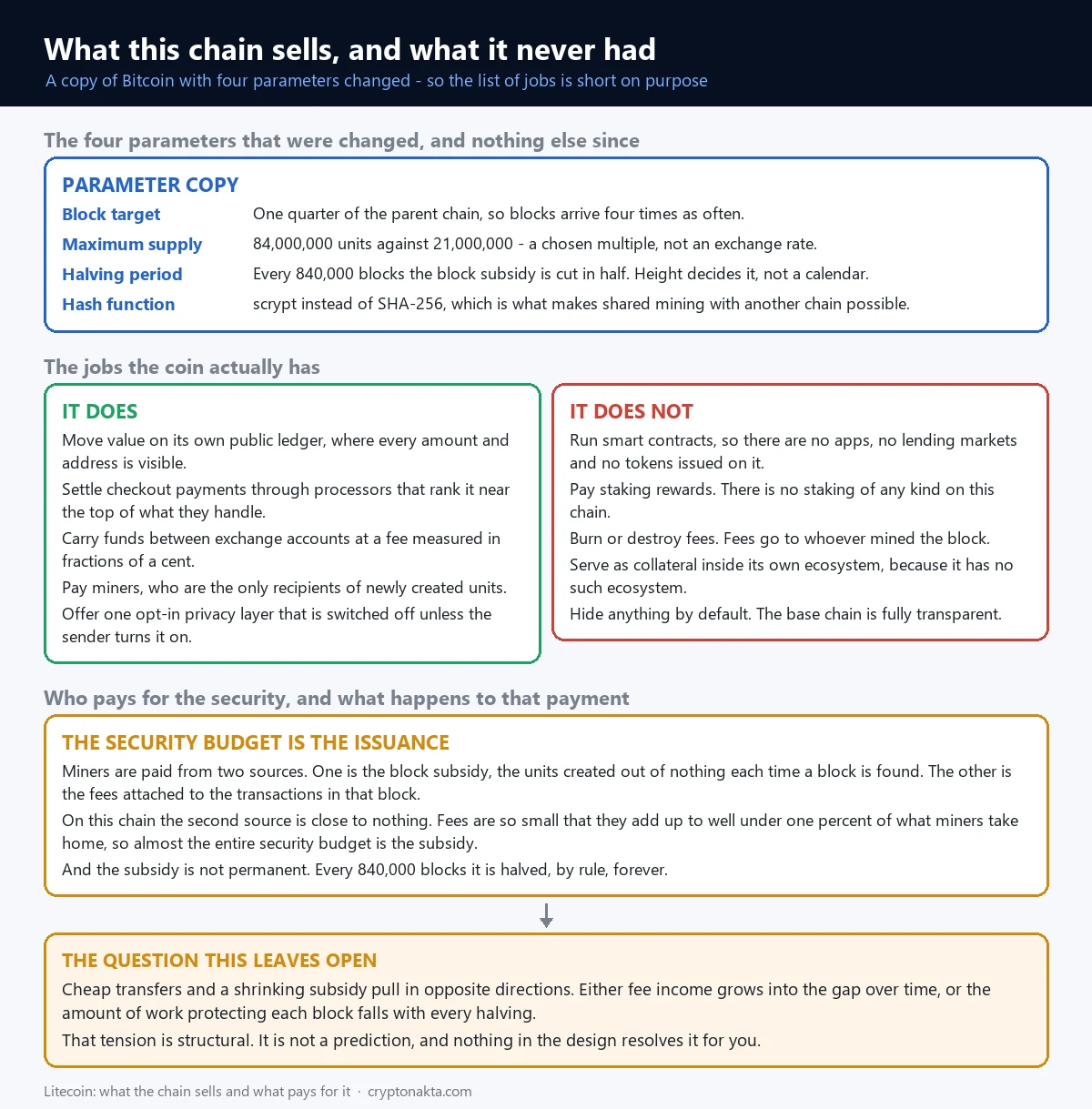
| What is it, at the code level? | Bitcoin’s code with four parameters changed: 2.5-minute block target, 84,000,000 maximum supply, halving every 840,000 blocks, scrypt instead of SHA-256. No smart contracts. |
| What do you own when you hold LTC? | Block space on a transfer and payment chain. Nothing more is built on top of it. |
| Can you stake it? | No. There is no staking on this network. New coins go to miners only. |
| Who pays for security? | Almost entirely the block subsidy. Network fees stay under 1% of what miners earn, and the subsidy halves every 840,000 blocks. |
| Is it a privacy coin? | No. MWEB is opt-in and off by default, and under 1% of the supply sits inside it. |
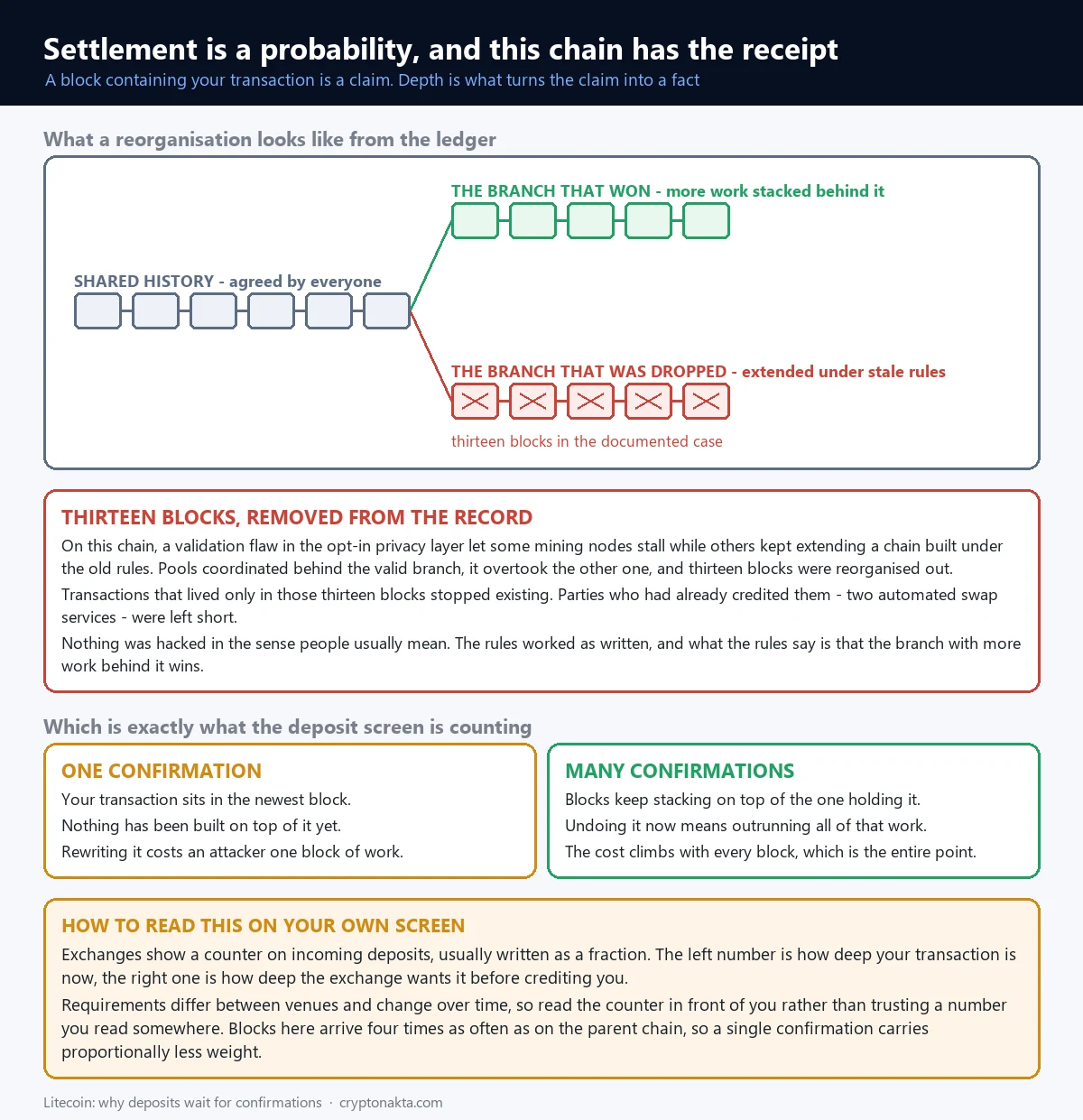
| Is a confirmed transaction final? | No. Confirmations only make a reversal more expensive. In 2026 a 13-block stretch was reorganised out of the chain and third parties lost funds. |
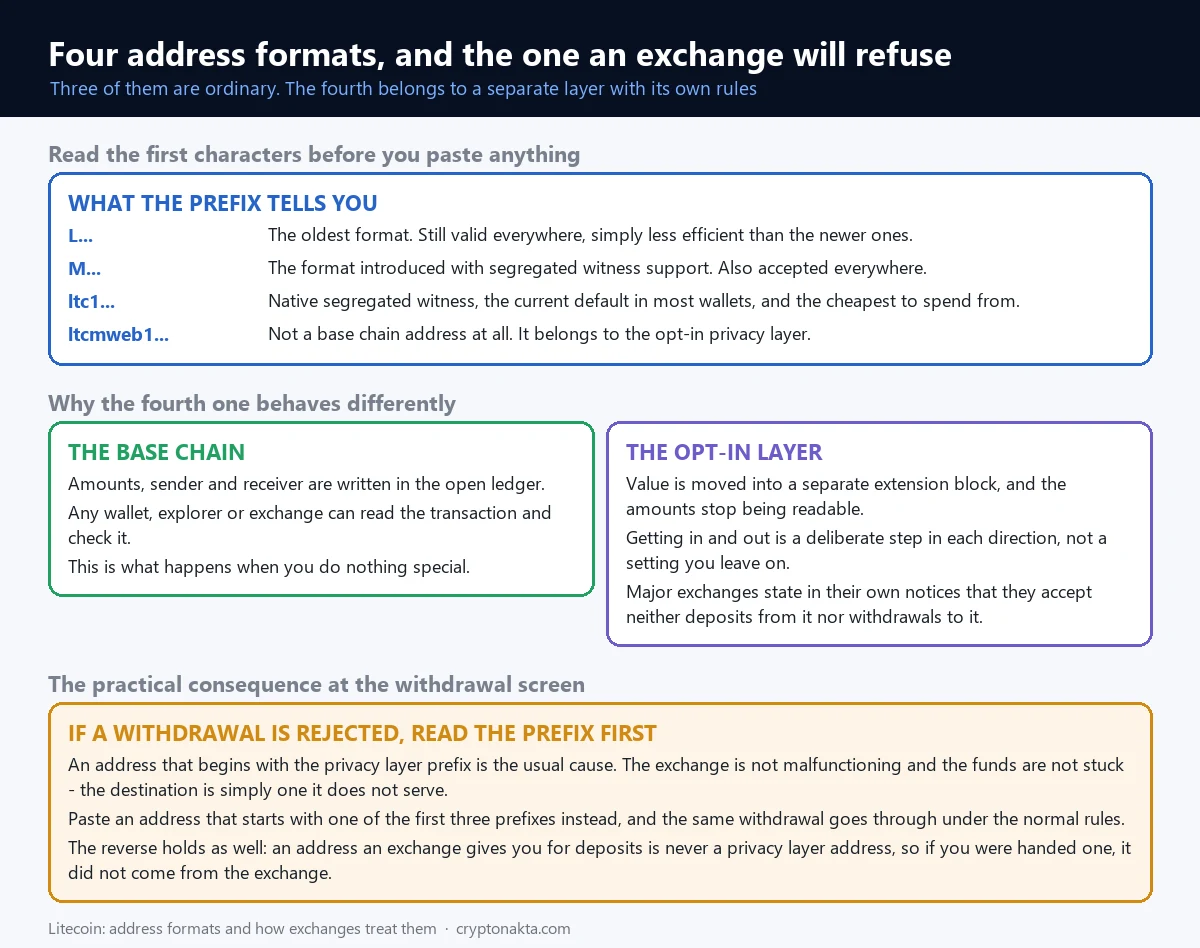
| Which address formats exist? | Four: L…, M…, ltc1… and ltcmweb1…. Exchanges reject the last one on both deposits and withdrawals. |
| Who secures it? | Miners running scrypt hardware, and the same machines mine Dogecoin at the same time. There is no validator set and nothing to delegate. |
1. Nobody talks about Litecoin, and it still ranks third on one processor’s checkout
2. Bitcoin’s code with four numbers changed, and nothing sold before launch
3. The chain where things get switched on first instead of piling up
4. What you actually own: block space on a transfer chain, with no contracts and no staking
5. Every new coin goes to a miner, and the issuance halves every 840,000 blocks
6. One scrypt machine, two chains: what merged mining with Dogecoin ties together
7. MWEB is opt-in, off by default, and holds under one percent of the supply
8. Four address formats, one network dropdown, and the one an exchange will never give you
9. What the two 2026 validation failures actually were
10. Settlement is a probability, and that is what deposit screens are counting
11. With no apps on top, demand comes from a short list of places
12. Six things people repeat about Litecoin, checked one at a time
13. A founder holding nothing, and an ETF that adds an access route
14. One table for every number that changes
15. Terms you will run into, defined once
Litecoin has been producing blocks since 2011, and in most crypto conversations it does not come up at all any more. It still shows up on checkout pages. In its 2025 annual figures CoinGate put Litecoin at 14.4% of the transactions it processed, third on that list behind Bitcoin at 22.1% and USDT. That number counts what happened on one company’s own checkout. This chain has almost no features, almost no news flow and no apps built on top of it, and one processor’s checkout data still puts it third. So what is it selling, and what does a person actually get when they buy LTC?
1. Nobody talks about Litecoin, and it still ranks third on one processor’s checkout
On that processor’s checkout, Litecoin gets picked for two things a customer can see: what the transfer costs, and how quickly it can be treated as received. The chain targets a block every 2.5 minutes and its fees sit at a fraction of a cent. On a payment of a few dollars, a fee measured in cents decides whether the payment is worth making at all.
The cap on the CoinGate figure matters as much as the figure. A processor’s ranking describes what its own merchants and their customers chose at that one checkout, and that is the whole of it. It says nothing about crypto payments in general, and nothing about whether the chain is well designed, well funded or safe. It only tells you that when someone wants to move a small amount cheaply and have it settle within minutes, this chain is often the one selected.
2. Bitcoin’s code with four numbers changed, and nothing sold before launch
Charlie Lee, a Google engineer at the time who later worked at Coinbase, published Litecoin in October 2011. It launched as Bitcoin’s source code with a handful of parameters changed, released with no presale and no ICO.
Four numbers were changed, and those four still describe the chain today.
| Parameter | Litecoin | Bitcoin |
|---|---|---|
| Block target interval | 2.5 minutes | 10 minutes |
| Maximum supply | 84,000,000 LTC | 21,000,000 BTC |
| Halving interval | every 840,000 blocks | every 210,000 blocks |
| Proof-of-work function | scrypt | SHA-256 |
| Smart contracts | none | none |
| Native staking | none | none |
| Daily transactions (21 August 2026) | 182,487 | 505,912 |
| Median fee (same day) | about $0.0005 | about $0.27 |
The four-to-one supply ratio people quote as “Bitcoin is gold, Litecoin is silver” is one of those parameter choices, nothing more. What is genuinely unusual is how little the skeleton has moved since. The block target is still 2.5 minutes, the cap is still 84,000,000, the halving is still every 840,000 blocks, and the hash function is still scrypt, unchanged since 2011.
3. The chain where things get switched on first instead of piling up
Litecoin has not added features. What it has done instead is switch changes on earlier than other chains did. Segregated Witness, the transaction format change that separates signature data from the rest of a transaction, was activated on Litecoin before it was activated on Bitcoin. The Lightning Network and cross-chain atomic swaps were both demonstrated on Litecoin first as well.
This gets described as Litecoin being “Bitcoin’s testnet”, and that description is wrong in a specific way. There is no agreement between the two projects, no shared governance, no funding relationship and no formal arrangement of any kind. Bitcoin’s developers are not obliged to look at anything that happens here, and the fact that a change worked on one chain does not automatically tell you it will work on the other, since the chains carry different transaction volumes and different economics. What is true is narrower: a smaller chain with an active client and a cooperative mining base can turn something on sooner, and several times it did.
The upside is that there is less to maintain: fewer consensus rules, fewer upgrades to coordinate, a client that a small team can keep running. The downside is that nothing accumulates on top. No developer base builds here, no applications depend on this specific chain, and the block space gets used for the same job it was used for in 2011.
One early goal did not hold. scrypt was picked as the hash function because it was memory-hard and, at the time, expected to keep mining reachable for people with ordinary computers. Purpose-built scrypt ASIC machines appeared around 2014 and that expectation ended. Mining Litecoin today means buying dedicated hardware, and the choice of scrypt now matters for an entirely different reason, covered in the merged mining section below.
4. What you actually own: block space on a transfer chain, with no contracts and no staking
When you hold LTC, the thing you hold is the ability to use block space on a chain whose only function is moving value between addresses. The two lists below are what that buys and what it does not.
| What the chain does | What the chain does not do |
|---|---|
| Transfers on the public main chain, visible to anyone | Run smart contracts of any kind |
| Payments routed through payment processors | Pay staking rewards. There is no staking on the network |
| Movement of funds between exchanges and wallets | Burn fees. No burn mechanism exists; fees go to miners |
| Payment of block rewards to miners | Act as collateral inside a lending or derivatives protocol on its own chain |
| Optional private transfers inside MWEB, if the sender turns it on | Host token issuance. Nobody launches a token on Litecoin |
The staking line is the one that trips people most often, so it is worth stating plainly. This is a proof-of-work chain. New coins are produced by miners solving blocks, and they are paid to miners. There is no validator set, no bonding, no delegation and no protocol-level yield. If you see an “LTC earn” or “LTC savings” product paying a percentage, that product belongs to whoever is offering it. The company takes your coins, does something with them, and owes you a return from its own balance sheet. That is a company obligation with company risk, and it works the same way whether the coin underneath supports staking or not. Our explainer on exchange earn products goes through how those arrangements are structured.
The absence of contracts has a second consequence that is easy to miss. On chains with contract platforms, block space gets consumed by applications, and that consumption is a source of fee demand independent of anyone sending money to anyone. Litecoin has none of that. Every unit of demand for its block space comes from a person or a business actually moving coins.
5. Every new coin goes to a miner, and the issuance halves every 840,000 blocks
Miners get paid in two ways: the block subsidy, which is newly created coins, and the fees attached to the transactions they include. On Litecoin the split between those two is extremely lopsided.
Start with the subsidy. It began at 50 LTC per block and has been cut in half three times, to 25, then 12.5, then 6.25. The cut is written as a block height rule: every 840,000 blocks, the subsidy halves. The next boundary is block 3,360,000, where 6.25 becomes 3.125, and the one after that follows 840,000 blocks later. The protocol defines the halving by height rather than by date, so any calendar figure you see is an estimate built on the current block rate.
Now the fees. At roughly 556 blocks a day, the chain issues around 3,475 new LTC daily. Against that, all the fees paid by every transaction on the network in the same day add up to a fraction of a percent of what miners collect. A chain with fees measured at a fraction of a cent and traffic measured in the low hundreds of thousands of transactions cannot produce a meaningful fee pool. Low fees are why processors pick it, and they are also why fee income never becomes a real part of what miners earn.
One more thing follows from this. Because fees go to miners and nothing is destroyed, the supply schedule is one-directional. Coins are added until 84,000,000 is reached and none are ever removed. Any claim that fees get burned here, or that some mechanism shrinks the supply over time, is simply describing a different chain.
6. One scrypt machine, two chains: what merged mining with Dogecoin ties together
Litecoin and Dogecoin are joined by merged mining, and this is the one relationship that genuinely affects how Litecoin is secured. Both chains use scrypt. Under an arrangement called auxiliary proof of work, Litecoin acts as the parent chain and Dogecoin accepts Litecoin’s proof of work as valid for its own blocks. A machine performs one set of calculations and can be rewarded on both chains at the same time.
| Item | Litecoin | Dogecoin |
|---|---|---|
| Hash function | scrypt | scrypt (identical) |
| Merged mining role | parent chain | accepts the same proof of work |
| Block target interval | 2.5 minutes | 1 minute |
| Maximum supply | 84,000,000 | no cap; a fixed amount is added each year |
| Share of scrypt mining revenue | the remainder | reported at 35% to 45% in industry data |
| Hashrate (21 August 2026) | about 2.40 PH/s | about 3.25 PH/s |
A large share of what a scrypt machine earns comes from the Dogecoin side. If that share moves, the profitability of running the machine moves with it, and the hashrate protecting Litecoin responds to a decision made about a different chain. It works in the other direction too: Dogecoin’s security is borrowed from a mining base that exists partly because of Litecoin.
This is worth knowing before reading any hashrate figure as a statement about Litecoin alone. The owners of those machines are paid on two chains at once, so the figure reflects the revenue from both chains together.
7. MWEB is opt-in, off by default, and holds under one percent of the supply
MWEB, short for MimbleWimble Extension Blocks, activated in May 2022 at block 2,265,984. It is the only addition unique to this chain, since everything else it switched on early came from Bitcoin’s own roadmap, and its effects reach as far as address formats and exchange policies.
Structurally it is an extension block: a separate area attached alongside the main chain, produced and secured by the same miners in the same blocks. To use it, coins are moved from the main chain into that area, which is called a peg-in, and moved back out later, which is called a peg-out. Inside, amounts and addresses are hidden, so the individual transfers are not readable the way main-chain transfers are.
The usage numbers reflect that. The balance sitting inside MWEB is roughly 535,527 LTC, which is under 1% of coins in circulation. Over 99% of the supply has never been moved into the private area. The total sitting in there is public even though the transfers inside it are not, because every peg-in and peg-out crosses the main chain where anyone can count it.
The contrast with chains where privacy is the default is sharp, and it is not just a technical distinction. On Monero every transaction is shielded by construction, and on Zcash shielded transfers are a first-class part of the protocol. Because that is the default there, those chains get handled differently by exchanges, as our piece on what happens when a privacy coin is removed from an exchange sets out. Litecoin sits in a third position: a transparent chain with a small optional compartment, which is enough to change how some venues treat it without making the chain itself private.
8. Four address formats, one network dropdown, and the one an exchange will never give you
The withdrawal screen is where most people run into the optional privacy compartment for the first time, and the usual way it announces itself is a rejected address. Four address formats exist, and they are not interchangeable.
| Starts with | Name | Where it is used | Exchange handling |
|---|---|---|---|
| L… | Legacy | The oldest format, still valid everywhere | Accepted |
| M… | P2SH | Introduced around the SegWit period, still common | Accepted |
| ltc1… | Native SegWit | The current default in most wallets, cheapest to spend | Accepted |
| ltcmweb1… | MWEB | Only inside the optional privacy area | Rejected by most major exchanges on both deposits and withdrawals |
The last row is the one that generates support tickets. Binance, Gate and CoinEx have all published notices stating that they do not process MWEB addresses. If you paste an ltcmweb1 address into a withdrawal field, the exchange refuses it before sending. The reverse case does not exist: an exchange never hands you an ltcmweb1 address as a deposit address, so if something you are looking at shows one, it did not come from the exchange.
The other trap on the same screen has nothing to do with MWEB. Many exchanges show a network selector next to the withdrawal address, and some of them list forms of LTC that live on other chains instead of on Litecoin itself. Picking one of those sends a wrapped representation of LTC across a different network. That form arrives on that other network, and only if the receiving side supports that exact form. The address format and the network selector have to match what the destination expects, both at once. Our guides on sending crypto on the wrong network and deposits that do not get credited cover what can and cannot be done afterwards, and the short version is that recovery depends entirely on the receiving party.
If you are moving coins to a wallet you control rather than between exchanges, the same rules apply from the other side: the wallet has to generate the format you intend to receive, and a wallet that supports MWEB will offer both a normal address and an ltcmweb1 address. Our wallet guide covers how self-custody changes what you are responsible for.
9. What the two 2026 validation failures actually were
In 2026, two validation defects in the MWEB code were found and used. They are worth recording precisely, because they are the concrete evidence behind a claim that otherwise sounds theoretical.
| Point | What happened | Size | Outcome |
|---|---|---|---|
| 19 March, block 3,073,882 | MWEB input metadata was not re-checked against the actual UTXO being spent when the block was connected | 85,034.47285734 LTC pegged out, inflated | The attacker cooperated and signed a recovery transaction, with an 850 LTC bounty paid by Charlie Lee. The returned amount was pegged back into MWEB and the resulting output was permanently frozen. No confirmed user losses. |
| 25 April, blocks 3,095,931 to 3,095,943 | An attempt to reuse the same defect hit a different weakness: malformed MWEB block data stalled upgraded mining nodes, while miners who had not upgraded kept extending a chain under the old rules | 13 blocks reorganised out once the pools cooperated to restore the correct chain | Third parties lost funds: NEAR Intents had already sent 7.78814476 BTC and the 11,000 LTC it received went with the reorganised blocks; THORChain lost 10 LTC. |
| Fixes | v0.21.5.3 and v0.21.5.4 | The first added the permanent freeze and stronger accounting checks on peg-outs. The second removed stored malformed block data so that the mining RPC would stop stalling. | |
Both defects were in MWEB code, and in both cases people had to step in and clean up afterwards. An attacker chose to cooperate, a bounty was paid, and mining pools agreed to reorganise. Those were human decisions, and the protocol guarantees none of them.
Then there is the frozen output. The recovered coins were pegged back into MWEB and then rendered permanently unspendable through a client rule. That was the practical way to prevent a repeat, and it also established that value sitting inside the private area can be immobilised by a rule shipped in a software release. Anyone using MWEB should count that as a known property with a precedent behind it.
10. Settlement is a probability, and that is what deposit screens are counting
A transaction being included in a block is not the end of the process. Blocks are only the most recent version of history, and a competing chain of blocks can replace them if it accumulates more work. Each additional block stacked on top makes that replacement more expensive, until the cost is high enough that nobody attempts it. Confirmation counts are a measurement of that accumulated cost.
April 2026 turned this from a textbook statement into an observed event on this chain. Thirteen blocks were removed from the accepted history. Anything that had been treated as complete inside those blocks stopped being complete, and two counterparties who had already released value on the other side of a swap absorbed the difference. NEAR Intents had sent out 7.78814476 BTC, and the 11,000 LTC it received in exchange disappeared with the blocks that were removed. THORChain lost a much smaller amount the same way.
Block speed interacts with this in a way that is easy to get backwards. Litecoin produces four blocks in the time Bitcoin targets one. That makes each individual confirmation arrive faster, and it also means one confirmation covers a quarter of the time span one Bitcoin confirmation covers. Six confirmations on a 2.5-minute chain and six confirmations on a 10-minute chain are not comparable amounts of protection. This is the honest version of “faster blocks”: the same waiting time buys more confirmations, and each one carries a smaller share of the work.
None of this makes ordinary transfers risky in practice. Reorganisations of any depth are rare, and the 2026 case required a validation defect plus a split between upgraded and non-upgraded miners. It does mean the correct mental model is probabilistic. Nothing on the chain declares a transaction irreversible; the chain only makes reversal steadily more expensive, and that is what you are waiting for when a deposit sits pending.
11. With no apps on top, demand comes from a short list of places
Since nothing is built on top of the chain, the demand for its block space comes from a list short enough to write out completely. People sending coins to other people. Businesses accepting payments through processors. Traders moving funds between venues because a transfer costs almost nothing. Miners selling what they produced.
Compare that with a chain that hosts applications, where every lending position, swap and contract call consumes block space regardless of whether anyone is sending money to anyone. That category of demand does not exist here and cannot be created without changing what the chain is. Litecoin’s designers made that choice at the start and kept it, and the narrow demand profile follows directly from it. Anyone buying LTC is buying that scope.
The competitive position follows from the same fact. When the offer is cheap, fast transfers with nothing else attached, the comparison set is every other cheap, fast transfer option: stablecoins on low-fee networks, other proof-of-work chains built for payments such as Kaspa, and Bitcoin’s own second-layer routes. Litecoin competes on cost, reliability and how widely it is already integrated, and integration is where its age genuinely helps. Running since 2011 means the major exchanges, processors and wallets already support it.
On the practical side, LTC has spot pairs on every large global venue, and the deposit and withdrawal screens covered in the address formats section are the ones you will be reading. If you are comparing places to trade or transfer, our exchange comparison covers fees and account requirements, and the buying guide walks through the same steps with Bitcoin as the example.
Binance

Bybit

Gate.io

KuCoin

Whichever venue you use, the two things to check are the same: the address format matches what the receiving side accepts, and the network selector says Litecoin rather than a wrapped form on another chain.
12. Six things people repeat about Litecoin, checked one at a time
Six claims come up repeatedly, and each of them is either wrong or true in a narrower sense than it sounds. Here they are next to what the chain actually does.
| Common claim | What is actually true |
|---|---|
| “Bitcoin is gold, Litecoin is silver.” | The nickname dates from 2011 and describes nothing about supply. 84,000,000 is four times 21,000,000 because a parameter was set that way, and the two coins are connected by no exchange ratio, peg or mechanism. |
| “It is faster, so it is safer.” | Four times as many blocks means one confirmation covers a quarter of the time span one Bitcoin confirmation covers, and the two chains run different hash functions, so a count on one cannot be converted into a count on the other. The same confirmation count does not mean the same protection. |
| “It is a privacy coin.” | MWEB is opt-in and off by default. Under 1% of the supply sits inside it, and everything else is on a public ledger. |
| “You can stake LTC and earn yield.” | There is no staking on this network. It is proof of work and new coins go to miners. Any yield product is something a company is selling. |
| “It is Bitcoin’s official testnet.” | No agreement of any kind exists between the projects. Some changes were switched on here first, and that is the entire basis of the claim. |
| “The founder is promoting his own bag.” | He disclosed selling or donating his whole holding in 2017. The founder section below covers what that did and did not change. |
Two of them need more than a table row. People repeat the staking claim because exchanges put LTC yield products in the same menu as genuine staking for proof-of-stake coins, and the wording looks identical from the outside. Nothing on that screen marks which entries are protocol rewards. An LTC row and a proof-of-stake row sit under the same heading, show a percentage in the same column and use the same subscribe button, so the interface gives no signal that the two work differently underneath. The section on what you own above covers where an LTC yield actually comes from.
People repeat the speed claim because faster sounds strictly better. In a payment context it genuinely is, since a merchant waiting for the same number of confirmations waits minutes instead of tens of minutes. In a security context it does not follow. What protects a transaction is the cost of replacing the blocks stacked on top of it, and a displayed confirmation count on its own never tells you that.
13. A founder holding nothing, and an ETF that adds an access route
In December 2017 Charlie Lee announced that he had sold or donated his entire LTC holding. His stated reason was conflict of interest: he had become one of the loudest voices about a coin he held, and anything he said moved the price. He kept working on the project and remains involved through the Litecoin Foundation.
The decision drew criticism because of when it happened. The sale landed close to the top of that period’s market, and a founder exiting at that moment reads differently to holders who did not. Both readings can be held at once: the conflict-of-interest argument was coherent, and the timing was favourable to him. What matters for anyone assessing the chain today is the structural consequence. There is no founder position to be distributed into the market later, and there is also no founder whose personal outcome depends on the coin. The second half of that is not automatically reassuring. Projects still need funding and maintainers, and a foundation model is a thin arrangement compared with a company with revenue.
Separately, in September 2025 he disclosed the purchase of 40,000 shares of the spot ETF in an SEC filing, which is a different instrument from holding coins.
A US spot product, the Canary Litecoin ETF, trades on Nasdaq under the ticker LTCC and opened with a seed of about one million dollars. What it changes is access: someone with a brokerage account can hold exposure without an exchange account, a wallet or an address format. What it does not change is anything in this article. The block target is the same, the subsidy schedule is the same, there is still no staking, MWEB is still opt-in, and confirmations still work exactly as described. The ETF holds LTC on your behalf inside a brokerage account, and the blocks, the subsidy and the confirmations are the same either way.
14. One table for every number that changes
Everything in this article that moves is in the table below, captured on one day. The parameters discussed elsewhere, the 2.5-minute target, the 84,000,000 cap, the 840,000-block halving interval and scrypt, are not in this table because they do not change.
| Measure (as of 21 August 2026) | Value |
|---|---|
| Block height | 3,163,786 |
| Blocks per day | about 556 |
| Transactions per day | 182,487 |
| Median transaction fee | about $0.0005 |
| Hashrate | about 2.40 PH/s |
| Coins in circulation | 77,521,716 LTC |
| Maximum supply | 84,000,000 LTC, so about 92% already issued |
| Current block subsidy | 6.25 LTC |
| Next halving boundary | block 3,360,000, where the subsidy becomes 3.125 LTC |
| Balance held inside MWEB | about 535,527 LTC |
Two rows deserve a note. The first is the supply row: with about 92% of the maximum already issued, most of the coins that will ever exist are already in circulation, and each halving reduces what is left to distribute. The second is the halving row, which is written as a height rather than a date on purpose. A height is a fact about the protocol and stays correct; a date is a projection built on the current block rate and stops being correct as soon as that rate drifts.
If you are reading this well after the snapshot date, every row above has moved except the maximum supply and the next halving boundary, which are protocol rules. The height is larger, the amount in circulation sits closer to the cap, and the subsidy may already have dropped one step. The relationships between the rows, and every rule described in the other sections, hold either way.
15. Terms you will run into, defined once
These terms appear on block explorers, exchange screens and release notes, and they are defined here once so the rest of the article reads without interruption.
| Term | Definition |
|---|---|
| scrypt | The proof-of-work hash function Litecoin uses. It was chosen because it demands memory as well as processing power, though dedicated machines for it have existed since around 2014. |
| Merged mining (AuxPoW) | An arrangement in which one chain accepts another chain’s proof of work. One machine performs the calculation once and can be paid on both chains. |
| Block subsidy | The newly created coins a miner receives for producing a block, paid on top of the transaction fees in that block. |
| Halving | The rule that cuts the block subsidy in half every 840,000 blocks. It is defined by block height, never by a calendar. |
| Confirmation | One block built on top of the block containing your transaction. More confirmations mean more accumulated work protecting it. |
| Reorganisation (reorg) | The replacement of recent blocks by a competing chain with more work. Transactions in the replaced blocks return to an unconfirmed state. |
| SegWit | A transaction format that separates signature data from the rest of a transaction, activated on Litecoin before Bitcoin. Native SegWit addresses begin with ltc1. |
| Extension block | A block attached alongside the main chain, produced in the same slot by the same miner, holding transactions that follow different rules. |
| MWEB | MimbleWimble Extension Blocks, the optional privacy area on Litecoin. Off by default; addresses inside it begin with ltcmweb1. |
| Peg-in and peg-out | Moving coins from the main chain into MWEB, and moving them back out. The peg-out step is where the 2026 accounting defect appeared. |
| UTXO | An unspent output from a previous transaction. A balance is the sum of the unspent outputs an address controls, rather than a number stored in an account. |
One naming point that causes confusion: MWEB and MimbleWimble are related but not identical. MimbleWimble is a transaction protocol designed for other chains to use as their whole design. Litecoin adopted it as an optional compartment attached to an otherwise transparent chain, which is why the two words appear together in the acronym.