BNB vs BSC vs BEP-20: What Is BNB · Burn Mechanism · Fee Discount · Supply
| Question | Short answer |
|---|---|
| What BNB is | A coin created by Binance. It is also the coin that pays fees on BNB Chain. |
| BNB vs BSC | BSC is the network. BNB is the coin you pay that network with. |
| BNB vs BEP-20 | BEP-20 is a token format on BSC. BNB is one asset that moves in that format. |
| Use inside Binance | A trading fee discount once you switch it on, and HODLer Airdrops through Simple Earn. |
| Use on the chain | Paying gas fees and staking with validators. |
| Supply | Fixed at launch, never mined, reduced only by burns. Scheduled burns stop at a set floor. |
| The burn | A quarterly burn that shrinks when the price is higher, plus a small burn from gas in every block. |
| Most common mistake | Sending on the wrong network. The old BEP-2 network is closed. |
| Main open question | Much of the demand depends on decisions made by Binance as a company. |
1. BNB, BSC, BNB Chain and BEP-20: which is which
2. One coin, used in two places
3. Inside Binance: the fee discount and its switch
4. Inside Binance: HODLer Airdrops and the past snapshot
5. On BNB Chain: gas fees, validators and staking
6. Supply: a fixed start, no mining, a floor for burns
7. How BNB is burned: quarterly and in every block
8. BNB burn schedule: the formula’s direction beats the date
9. Numbers we measured ourselves
10. Validators and the 2022 halt
11. Sending BNB: the network choice
12. Where to buy BNB
13. My take: a consistent design tied to one company
Search for BNB and four names show up at once. BNB, BNB Chain, BNB Smart Chain and BEP-20 often sit on the same screen. They are related, and they are different kinds of thing. BNB is the coin, and the others are networks or formats that use it.
1. BNB, BSC, BNB Chain and BEP-20: which is which
BNB is a coin. Binance, the exchange, created it in 2017. Everything else with “BNB” in its name is either a network that uses this coin or a label for a format on that network. Once those roles are clear, most of the naming questions go away.
BNB Chain is the name of a family of networks. The main one is BNB Smart Chain, usually shortened to BSC. BSC is a blockchain that runs smart contracts, and every transaction on it is paid for in BNB. A second, smaller network called opBNB runs on top of BSC. It also takes its fees in BNB.
BEP-20 is a token standard. It is the set of rules a token follows so that it can exist on BSC. Stablecoins, app tokens and many other assets on BSC are BEP-20 tokens. BNB is the native coin of BSC, and wallets and exchanges show it under the BEP-20 label too.
So is BNB the same as BEP-20? No. BEP-20 names the format, and BNB is one asset that moves in that format. When a withdrawal screen shows “BNB Smart Chain (BEP20)”, it is asking which network to use. The coin is already chosen at that point.
BNB vs BSC works the same way. BSC is the network. BNB is the coin you pay that network with. So “I hold BSC” really means holding BNB on BSC.
| Name you see | What it is | Where you usually meet it |
|---|---|---|
| BNB | The coin itself | Price pages, exchange balances, fee settings |
| Binance Coin | The original name of BNB | Older articles and some price sites |
| BNB Chain | The name for the whole family of networks | Official site, news, developer docs |
| BNB Smart Chain (BSC) | The main network where BNB moves and smart contracts run | Deposit and withdrawal screens, wallets |
| BEP-20 | The token standard on BSC | Next to the network name when you send |
| opBNB | A layer-2 network built on BSC, fees paid in BNB | Some withdrawal screens, some apps |
| BNB Beacon Chain (BEP-2) | The old Binance Chain, shut down in December 2024 | Old guides and old saved addresses |
The coin started as Binance Coin. In February 2022 the networks were renamed BNB Chain. At the same time, BNB was redefined as short for “Build and Build”. Older guides still say Binance Coin, and it is the same coin.
Is BNB EVM compatible? BSC runs the Ethereum Virtual Machine, the same system that executes smart contracts on Ethereum. Addresses on BSC use the 0x format, the same as Ethereum addresses. That makes it easy to use the same wallet on both. It also makes it easy to send to the wrong network, as the section on sending explains.
2. One coin, used in two places
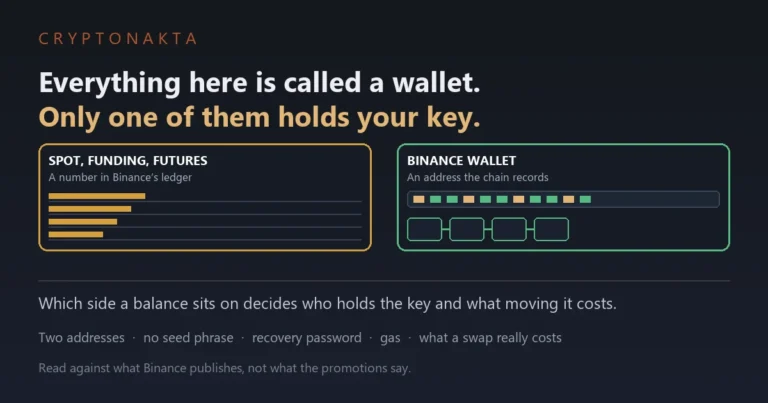
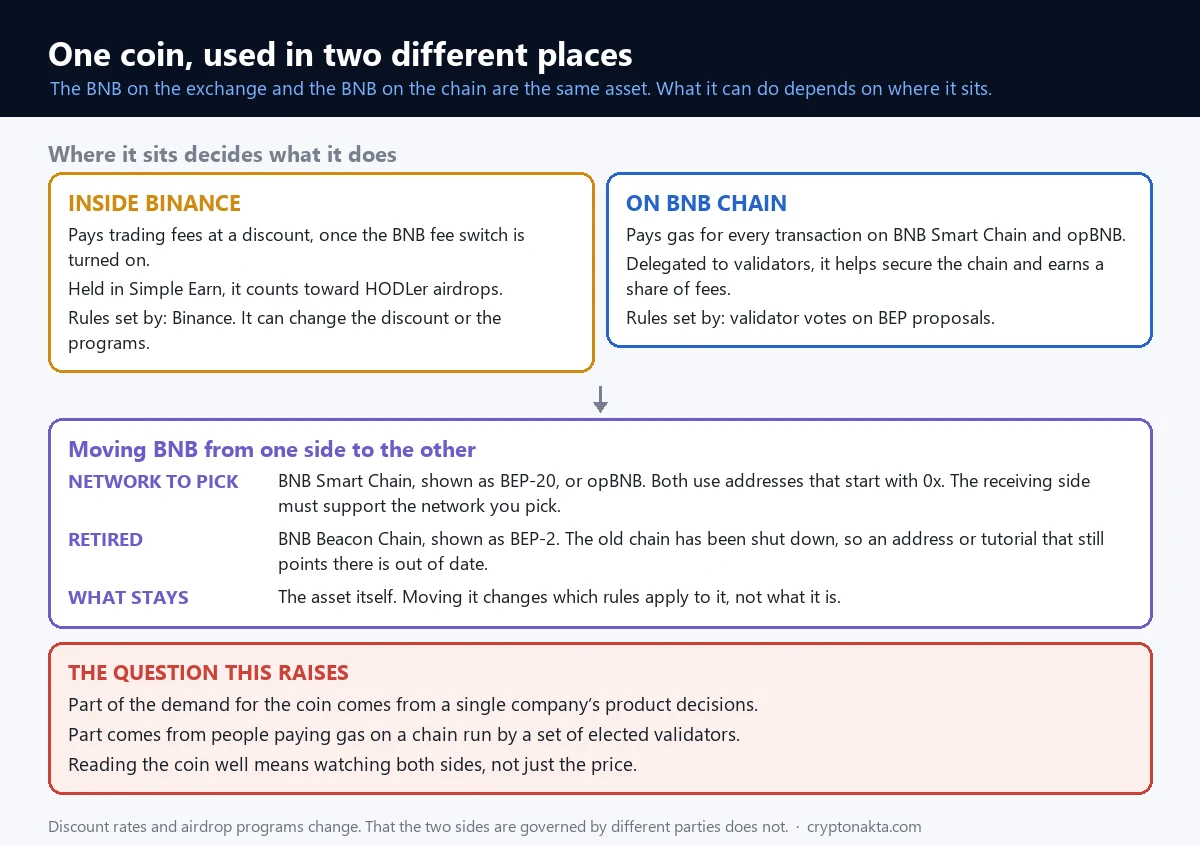
BNB has two separate jobs. Inside the Binance exchange, it lowers trading fees and makes holders eligible for airdrops. On BNB Chain, it pays for transactions and is staked to secure the network. The coin is the same in both places.
What differs is who makes the rules. Binance decides the discount rate and runs the airdrop programme. On the chain, fees and many settings change through network proposals and validator votes. These are two different decision-makers, and keeping them apart makes BNB much easier to follow.
| Inside Binance | On BNB Chain | |
|---|---|---|
| What BNB does | Cuts trading fees, qualifies for HODLer Airdrops | Pays gas fees, can be staked with validators |
| Where the coin sits | Your Binance account (spot wallet, Simple Earn) | A wallet address on BSC or opBNB |
| Who sets the rules | Binance, as a company | Network proposals (BEPs) and validator votes |
| What you need | A Binance account | A wallet and a little BNB for gas |
| How rules change | Binance announcement | Network upgrade or validator vote |
Moving BNB between the two places means a withdrawal or a deposit. BNB in your Binance spot wallet can get the fee discount, and it pays no gas while it stays there. BNB in your own wallet can pay gas, and it gets no trading discount. The place where the coin sits decides which job it does.
A holder can use just one side. A trader on Binance may never touch BSC. A person who uses apps on BSC may never trade on Binance. Both hold the same coin for different reasons, and the rest of this guide keeps the two sides separate.
Some people use both. A trader might keep BNB in the Binance spot wallet for the discount. The same person might withdraw a small amount to a personal wallet to pay gas on BSC. Each part of the balance then follows the rules of the place where it sits.
3. Inside Binance: the fee discount and its switch
Binance gives a discount when trading fees are paid in BNB. The published rate is 25% for spot and margin trading. For USDⓈ-M futures it is 10%. These rates come from Binance’s own fee FAQ, and Binance can change them.
The discount does not turn on by itself. There is a setting called “Use BNB to deduct fees” or similar, and it has to be switched on. BNB also has to sit in the right place. For spot trades that is the spot wallet. For futures it is the futures wallet. Margin depends on the mode. Cross margin needs BNB in the cross margin account. Isolated margin needs it in the spot wallet.
| Market | Discount when paying in BNB | Where the BNB must be |
|---|---|---|
| Spot | 25% | Spot wallet, switch on |
| Margin | 25% | Cross: cross margin account. Isolated: spot wallet |
| USDⓈ-M futures | 10% | Futures wallet, switch on |
| With a VIP tier | Stacks with the VIP discount | Same as above |
If the switch is off, fees are charged the normal way. If the BNB balance in that wallet runs out, the discount stops too. A trader who set this up months ago can lose it without noticing. A quick look at the fee line on a recent trade shows which way it was paid.
A simple example shows the size of it. Say a spot trade would cost 10 dollars in fees. With the switch on and enough BNB in the spot wallet, the fee is 7.50 dollars, paid in BNB. On a futures fee of 10 dollars, the same setup brings it to 9 dollars. The saving grows with the number of trades.
This discount is a different thing from a referral code. A referral code is entered once, at sign-up, and has its own terms. The BNB discount comes only from paying fees in BNB. Both can apply to the same account, and neither replaces the other. Our Binance referral code guide covers the sign-up side.
Who gains the most? Someone who trades often pays many fees, so a quarter off adds up. Someone who buys once or twice a year saves very little. Holding BNB for the discount also means holding a coin whose price moves. That price risk can be larger than the fees saved.
4. Inside Binance: HODLer Airdrops and the past snapshot
An airdrop is a free distribution of a new token to people who already hold something. Binance runs one for BNB holders called HODLer Airdrops. You take part by putting BNB into Simple Earn, in either a Flexible or a Locked product. Nothing else needs to be done after that. Our guide to crypto earn products explains how these accounts work.
Timing is the detail that matters most. Rewards are based on a snapshot taken in the past. It uses your average hourly balance over a period that has already ended. The announcement comes after that period.
So buying BNB after reading an airdrop announcement does not count for that round. The snapshot is already closed. Only BNB that sat in Simple Earn during the snapshot window is counted.
Here is the order of events for one round. First comes a snapshot period, which is not announced while it runs. Then Binance announces the new token and the period it used. Then the tokens are sent to the holders who qualified. A holder who wants to be counted has to keep BNB in Simple Earn beforehand, since each window becomes known only after it has ended.
Some BNB is left out. Simple Earn BNB that is pledged as collateral for Binance Loans does not count. Eligibility also depends on region. Check your own account screen to see whether the programme is shown to you.
This programme gives people a reason to keep BNB on Binance. It is also a Binance decision from start to end. Binance picks which projects are included and sets how rewards are shared. It can change the programme or stop it.
Simple Earn products have their own terms. Locked products hold the coin for a fixed period, and it cannot be sold during that time. Read the product page before moving funds. An airdrop is a possible extra, and its size is never known in advance.
5. On BNB Chain: gas fees, validators and staking
Every transaction on BSC costs a small fee. This is the gas fee, the amount paid to the network to process a transfer or a contract call. On BSC it is always paid in BNB. Our guide to gas fees explains how these fees work on different chains.
This is why a wallet on BSC needs a little BNB, even for sending something else. A transfer of a BEP-20 stablecoin still charges gas in BNB. If the sending address has no BNB, the transfer cannot go out, even with a large stablecoin balance.
Blocks on BSC are made by validators. A validator is an operator that runs a node, checks transactions and adds new blocks to the chain. Validators are ranked by how much BNB is staked with them. The ones at the top form the elected set that produces blocks.
When a validator’s turn comes, it produces several blocks in a row. Then the turn passes to the next one in the set. The exact count per turn and the size of the set are network settings, and they can change with upgrades. Current values are in the measured section.
Staking means committing BNB to a validator to support it. You do not need to run a node. A holder can delegate BNB to a validator and receive a share of what that validator earns. Our guide to staking covers the general idea.
The rewards come mainly from gas fees. BSC does not create new BNB to pay validators. Gas fees paid by users are split between the burn, a system reward contract, and the validators with their delegators. So staking rewards rise and fall with how much the chain is used.
Staking terms, such as how long it takes to get coins back, are set by the network. They can change with upgrades. Check them in the staking screen before delegating.
To use BNB on the chain yourself, you need a wallet that holds your own keys. Binance offers one inside its app. Our Binance Wallet guide explains how it handles keys, addresses and gas.
opBNB follows the same pattern on a smaller scale. It is a layer-2 network that settles back to BSC. Transactions there also pay gas in BNB. A wallet that uses opBNB needs BNB on opBNB itself, since BNB sitting on BSC does not cover fees on the other network.
6. Supply: a fixed start, no mining, a floor for burns
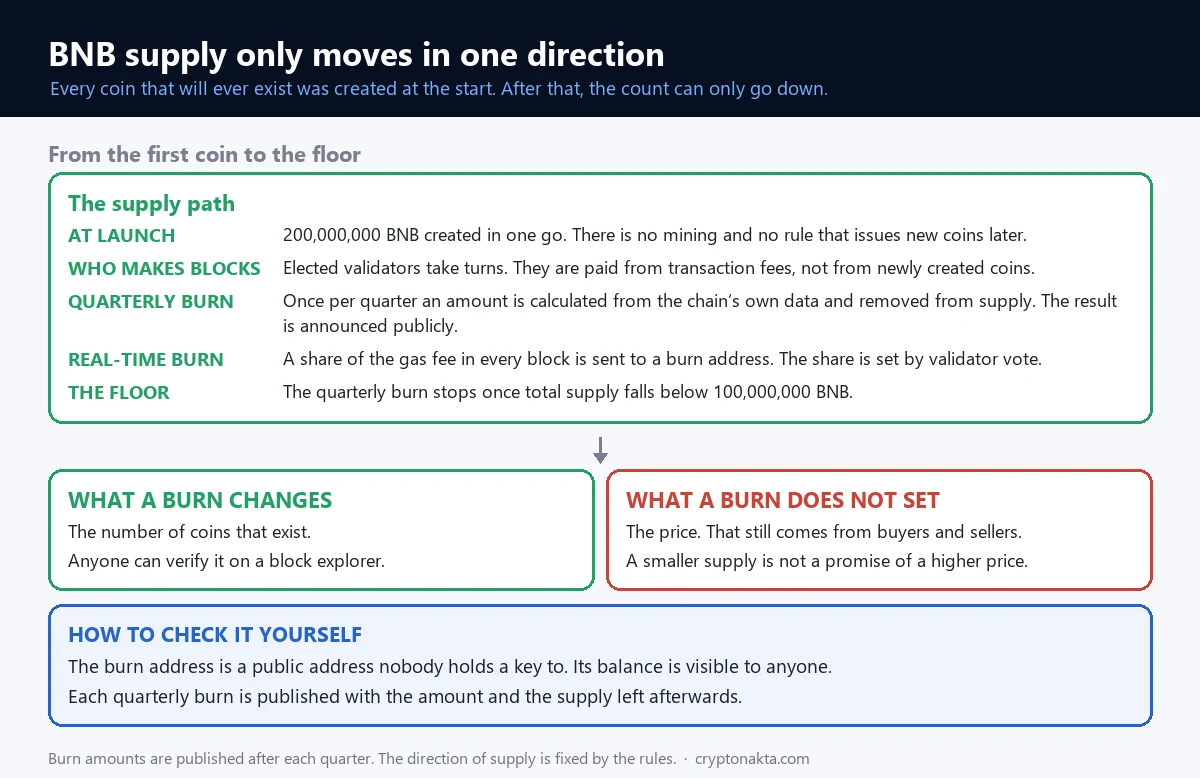
BNB was created in July 2017 through an initial coin offering, or ICO. A total of 200 million coins were made at once. That number has never been raised. There is no rule in BNB that creates new coins.
| Share | Coins | Who received them |
|---|---|---|
| 50% | 100,000,000 | Public ICO buyers, at $0.15 per coin |
| 40% | 80,000,000 | Founding team |
| 10% | 20,000,000 | Angel investors |
| 100% | 200,000,000 | Total at launch |
BNB is not mined. There are no miners and no block rewards made from new coins. Blocks come from validators elected through staking. Any app or site that offers to let you “mine BNB” is describing something BNB does not have. Treat that offer as a warning sign, and see our guide to crypto scams for the common patterns.
Supply only goes down. Coins leave circulation through burning. A burn sends coins to an address that nobody is known to control. Coins sent there can never be spent again.
The burning has an end point. The quarterly Auto-Burn stops once the total supply falls below 100 million BNB. That is half of the starting amount. After that, the scheduled burns end.
Searches for the BNB coin max supply lead to data sites, which show 200 million as the maximum. That is the launch figure, and it is also the ceiling, since nothing adds coins. The current total is lower because burns have already removed a large share. The exact number, with the time we checked it, is in the measured section.
Data sites often show two current figures, circulating supply and total supply. For BNB they are close to each other. Both count the coins that are left after the burns so far. The measured section lists both, with the time we checked them.
The coin has moved between networks. At launch it was an ERC-20 token on Ethereum. In 2019 it moved to Binance’s own network, Binance Chain, where it used the BEP-2 format. In September 2020 BSC launched and added smart contracts.
In February 2022 both networks were renamed BNB Chain. In 2023 two more networks joined the family. One was opBNB, a layer-2 network, and one was Greenfield, for data storage. On December 3, 2024, the old Beacon Chain was shut down. Today BNB moves on BSC and opBNB.
7. How BNB is burned: quarterly and in every block
BNB is burned in two ways. One happens once a quarter in a single batch. The other happens in every block. They follow different rules and are run by different parties.
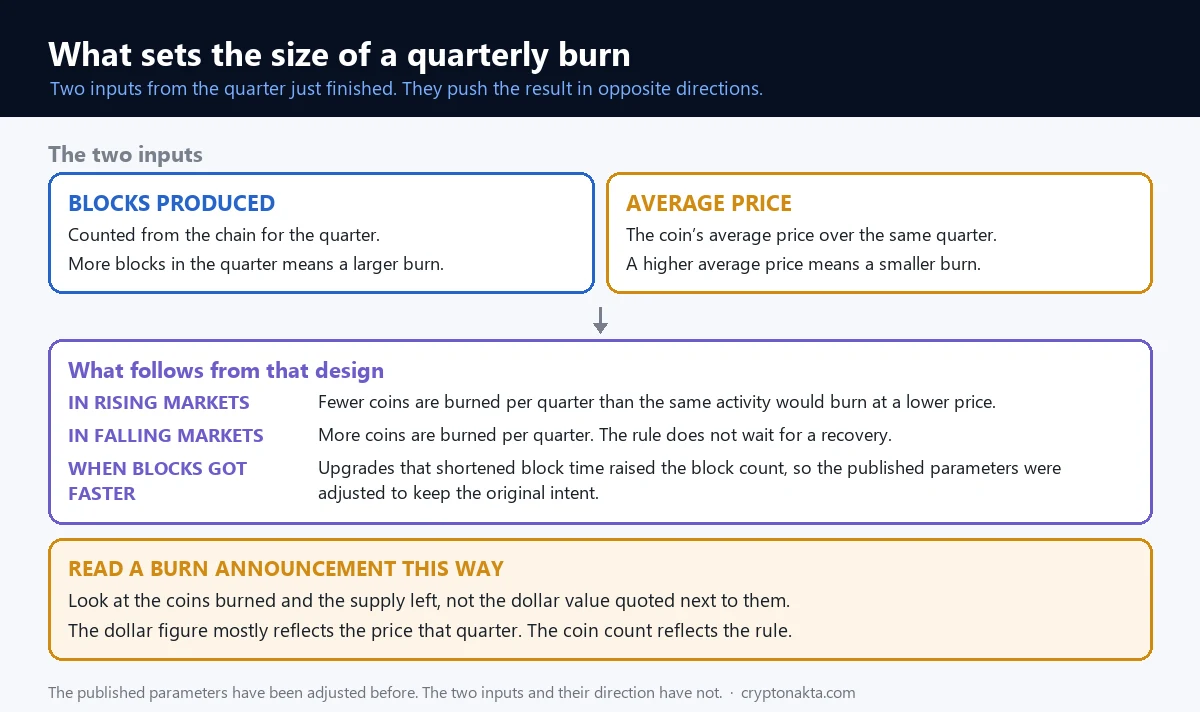
The first is the quarterly Auto-Burn. The amount is worked out from a formula and is not chosen by hand. The formula uses the number of blocks produced in that quarter. It also uses the average BNB price over the quarter.
Binance’s own explanation states the direction plainly. In its words, “the formula produces larger burns when BNB’s price is lower and smaller burns when the price is higher.” More blocks push the burn up. A higher price pulls it down.
Block times on BSC have become shorter through several upgrades, named Lorentz, Maxwell and Fermi. Shorter blocks mean more blocks per quarter. BNB Chain has said it adjusted the formula’s parameters after these upgrades. Official documents write the formula in different ways, so we describe only its direction here.
The second is the real-time burn, set out in a proposal called BEP-95. In every block, part of the gas fees the validator receives goes straight to the burn address. That share started at 10%. Validators can change it by vote.
The rest of the gas fees is split two ways. One sixteenth goes to the system reward contract, and only while that contract holds less than 100 BNB. Everything else goes to the validators and their delegators.
| Quarterly Auto-Burn | Real-time burn (BEP-95) | |
|---|---|---|
| How often | Once per quarter | Every block |
| What sets the amount | Blocks in the quarter and the average price | Gas fees in each block and the burn share |
| Higher BNB price | Fewer coins burned | No direct effect |
| More network activity | No direct effect, since blocks come at a set interval | More gas fees, so more coins burned |
| Who can change it | BNB Chain adjusts the parameters | Validators, by vote |
| Size so far | Almost all of the coins removed | A small share, see the measured section |
The two burns differ a lot in size. The quarterly batches account for almost all of the coins removed. The real-time burn is a small fraction of that, and the measured section gives the figure from the official blog. The numbered burns in official BNB Chain blog posts are the quarterly batches.
8. BNB burn schedule: the formula’s direction beats the date
If you searched for a BNB burn schedule, you probably wanted the next date. The date is the least useful part. Burns happen once a quarter, and the amount is set by the formula.
The direction of the formula tells you more. More blocks raise the burn. A higher average price lowers it. In a quarter when BNB costs more, fewer coins are burned. In a quarter when it costs less, more coins are burned.
Burning reduces the coin count and does not set the price. Price comes from buyers and sellers on the market. A burn changes how many coins exist, and many other things act on demand at the same time. Reading a burn announcement as a price signal mixes up two separate things.
The design itself points the same way. If the burn were built around a rising price, it would burn more when the price rises. It does the opposite. A large burn in a quarter tells you the price was lower, or blocks were more numerous, during that quarter.
There is a better thing to watch than dates. Each quarterly burn has an official post on the BNB Chain blog. That post lists the amount burned and the total supply after the burn. Comparing it with the previous quarter shows the supply trend, which is the only thing the burn controls.
Supply trends also move slowly. Each quarterly batch removes a small share of the total. Over several years those shares add up. Over a single quarter the change in supply is modest, which is why one burn post says little on its own.
The official posts also make the rule easy to check. Each one names the quarter, the amount and the new total. Lining up several posts in a row shows how the amount moved as the price and block count changed. That is a clearer picture than any single date.
9. Numbers we measured ourselves
The numbers in this section change over time. We measured them ourselves on 2026-09-24, between 04:16 and 04:41 UTC. We called public BSC RPC endpoints and public APIs directly. Read every figure here as a snapshot of that morning.
| What we measured | Result | How |
|---|---|---|
| Block interval | 0.45 seconds on average (exactly 450 ms over the last 3,000 blocks, up to block 123,691,411) | Block timestamps in milliseconds via RPC |
| Blocks per day | About 192,000 | From the block interval |
| Transactions per day | About 18.3 to 18.5 million (estimate) | Two block samples of 200 and 1,600 blocks |
| Gas price | 0.05 gwei suggested by RPC, sample median 0.0511 gwei | eth_gasPrice and sampled transactions |
| Cost of a plain BNB transfer | 0.00000105 BNB, about $0.0008 at BNB/USDT 766.22 | 21,000 gas at 0.05 gwei |
| Elected validators | 45 (56 registered) | StakeHub and ValidatorSet contracts |
| Blocks per validator turn | 8 in a row | getTurnLength |
| System reward contract | 100.0014 BNB | Balance check |
| Burn address balance | About 16,498,241 BNB | Balance check |
| Circulating and total supply | 133,159,945 and 133,159,943 BNB | CoinGecko API at 04:41 UTC |
The block interval comes from the Fermi hard fork on January 14, 2026. It cut the interval from 0.75 seconds to 0.45 seconds. Values like this change with each upgrade. That is why they sit only in this section.
The transaction count is an estimate. We sampled 200 blocks spread over 24 hours and found 96.2 transactions per block. A second sample of 1,600 blocks gave 95.3. Multiplied by blocks per day, that gives roughly 18.3 to 18.5 million.
Gas prices varied within the sample. The lowest 10% of transactions paid 0 gwei. The highest 10% paid 0.82 gwei. A plain BNB transfer uses 21,000 gas, which at 0.05 gwei is the tiny amount in the table.
The validator set had 45 elected members. In our 1,600-block sample, 43 different addresses produced blocks. The system reward contract held just over 100 BNB. That matches the BEP-95 rule that the contract only receives fees while it holds less than 100 BNB.
The burn address is 0x000000000000000000000000000000000000dEaD. Nobody is known to hold its key, so coins sent there stay there. Its balance can include real-time burns and other transfers, and we did not break it down. The official blog puts the real-time burn total at about 291,000 BNB.
| Burn | Date | BNB burned | Total supply after |
|---|---|---|---|
| 35th | April 15, 2026 | 1,569,307.34 | 134,786,916.53 |
| 36th | July 15, 2026 | 1,615,827.795 | 133,166,127.91 |
After the 36th burn, total supply was about 66.83 million BNB below the 200 million start. That is a third of the original supply. The floor at 100 million is still about 33 million coins away.
10. Validators and the 2022 halt
Blocks on BSC come from a small elected set of validators. The size of the set at the time we checked is in the measured section. A small set is a design choice. It can coordinate quickly, and it has a cost.
The cost showed on October 7, 2022. A bug in the BSC Token Hub was exploited that day. The Token Hub was the cross-chain contract that moved assets between Binance’s two chains at the time. The attacker used the bug to create 2 million new BNB.
Binance asked the validators to stop the chain, and BSC halted for several hours. Before the halt, about $100 million to $110 million worth left BSC for other chains. The rest of the created coins stayed on BSC and were frozen there.
That event shows two things at once. The response was fast, and it limited the damage. It also shows that the chain can be stopped when enough validators agree to stop it.
Both readings are fair. A network with thousands of independent block producers is much harder to stop. It is also slower to coordinate in an emergency. BSC made the opposite choice, and each reader can weigh the two sides.
For an ordinary holder, the practical meaning is simple. BNB on BSC runs on a network where a small group of operators can act together. That made the 2022 losses smaller. It also means the network’s rules and records depend on the choices of that small group.
The validator set and the stake behind each validator are public. Staking pages and block explorers list them. Anyone can check how concentrated the stake is at a given moment.
11. Sending BNB: the network choice
Choosing the network is the most common place where BNB transfers go wrong. A withdrawal screen can show several options that all say BNB. They are different networks, and the receiver has to support the one you pick.
| Network on the screen | What it is | Status | Address format |
|---|---|---|---|
| BNB Smart Chain (BEP-20) | The main BNB network | Active | 0x, same as Ethereum |
| opBNB | Layer-2 network on BSC | Active | 0x, same as Ethereum |
| BNB Beacon Chain (BEP-2) | The old Binance Chain | Shut down on December 3, 2024 | Different format, no longer usable |
BEP-2 is finished. The Beacon Chain was shut down in December 2024. If an old guide, an old saved address or an old memo field mentions BEP-2, do not use it. Older help pages may still mention the name.
The shared 0x format makes this mistake easy. A BSC address looks exactly like an Ethereum address. A wallet accepts it without complaint, whatever network you picked. The address check passes, and the coins still land on a network the receiver may not watch.
If that happens, recovery depends on the receiver. A wallet you control can usually see the coins by adding the right network. An exchange may need a manual recovery request, or may not support it. Our guide to crypto sent on the wrong network goes through each case.
A safe order helps. Check which network the receiving side supports for BNB. Pick that same network on the sending side. Send a small test amount and wait for it to arrive.
Here is how that looks when moving BNB from Binance to your own wallet. In the wallet, copy the BSC address that starts with 0x. On Binance, start a BNB withdrawal and pick BNB Smart Chain (BEP20) as the network. Paste the address, send a small amount, and confirm it arrives in the wallet.
Then send the rest. If the test does not show up, do not send more. Our guide to a deposit that was not credited lists what to check first.
12. Where to buy BNB
Binance spot has the deepest BNB markets. The main pairs are BNB/USDT, BNB/USDC and BNB/FDUSD. Bybit, OKX, Gate, KuCoin and MEXC also list BNB/USDT. The products and payment methods you see differ by region, so check what appears on your own screen.
Buying on the spot market means you own the coin. Futures contracts track the price, and they do not give you BNB. Only spot BNB can pay trading fees, go into Simple Earn or be withdrawn to a wallet. Our spot vs futures guide explains the difference.
If you plan to use the fee discount, buying on Binance keeps things simple. The coin is already in the spot wallet where the discount needs it. If you plan to use BNB on the chain, any of these exchanges can send it to your wallet on BSC. For a wider comparison, see our guide to crypto exchanges.
Binance also lists BNB against several local currencies, such as EUR, BRL, TRY, JPY and ARS. Which of these pairs you see depends on your account and region. If none is shown, another route is to buy USDT first and then trade it for BNB on the BNB/USDT market.
Binance

Bybit

OKX

KuCoin

Affiliate disclosure: some links are partner links. We may earn a commission at no extra cost to you. This is not investment advice.
13. My take: a consistent design tied to one company
The design is consistent. The supply started fixed, no rule adds coins, burns only take them away, and the scheduled burns stop at a stated floor. Gas paid in BNB ties chain activity to the coin. The fee discount ties exchange activity to it. Each piece fits the others.
BNB is most useful to a few kinds of people. Frequent traders on Binance save on fees. Users of apps on BSC need BNB for gas anyway. Holders who already keep coins in Simple Earn get the airdrop programme on top. Someone who rarely buys crypto and uses neither Binance nor BSC gets little of this directly.
The part I find hardest to accept is outside the technology. Much of the demand for BNB depends on decisions made by one company. Binance sets the fee discount. Binance runs the airdrop programme and picks what goes into it. Either can change with an announcement.
I should also be plain about my own position. This site uses Binance affiliate links, including the referral link in the card above. If you sign up through it, we may earn a commission. That is worth knowing when you read my view of Binance-related points.
There is a fair case against my concern. The chain side has demand that Binance does not grant. Every transaction on BSC pays gas in BNB, whatever happens to exchange perks. The real-time burn and many network settings are decided by validator votes, so they sit outside the exchange’s announcements.
My own reading sits between those views. BNB has clear supply rules and demand from two places. One of those places is run by a company, and the other runs on network rules. How much that matters to you depends on which side you actually use.