Satoshi’s Wallet Address: the First 50 BTC Nobody Can Spend · Why Nothing Has Ever Left · The Genesis Block Message
The first bitcoin block paid its reward here in January 2009. I opened the public ledger to see what has arrived since, and what has left.
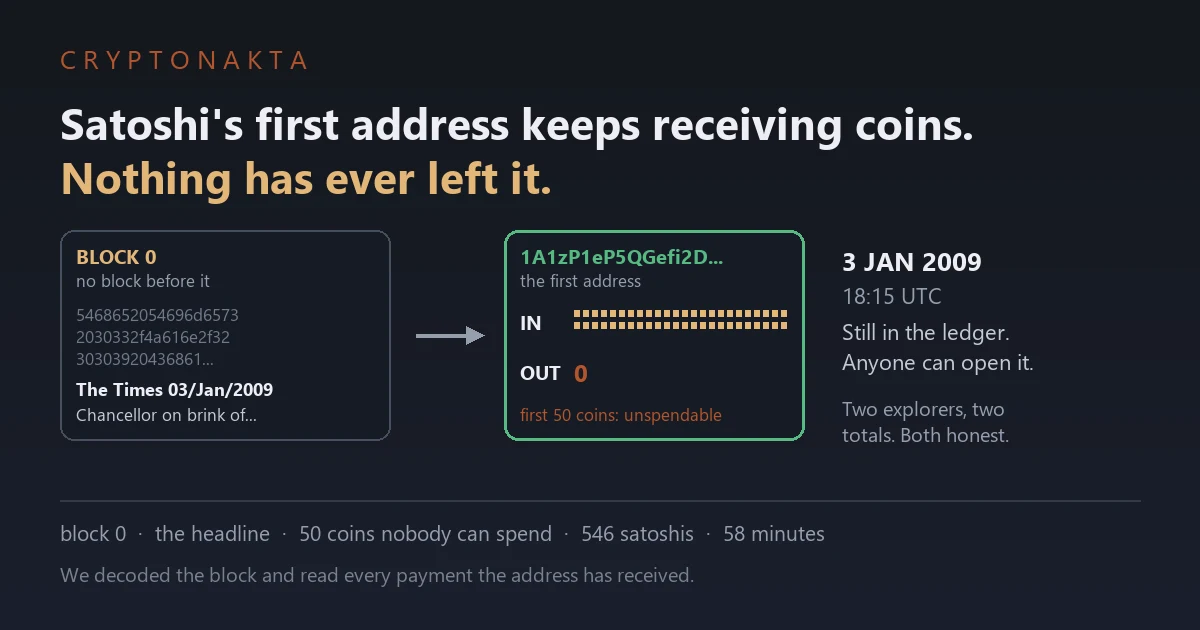
The address people call Satoshi’s wallet is 1A1zP1eP5QGefi2DMPTfTL5SLmv7DivfNa. It is where the reward for the very first bitcoin block went, in January 2009.
Anyone can look it up. Anyone can send coins to it, and tens of thousands of payments have arrived. Not one coin has ever gone out.
I opened the public ledger to read what is actually there. The method is written out below, so you can check every number yourself.
A newspaper headline inside the first block
The quiet days before block 1
The reward nobody can spend, and two totals for one address
The first stranger’s payment
Fifty-eight minutes in January
546 satoshis at a time
The price on the day I checked, and your own wallet
Search for Satoshi’s wallet address and you land on the same string every time: 1A1zP1eP5QGefi2DMPTfTL5SLmv7DivfNa.
Here is the odd part. Everybody knows it, and nobody has ever taken a coin out of it. The first 50 coins cannot leave, because the software refuses to count them. The rest could leave. They never have.
So I read the ledger itself, from block 0 up to block 968,475.
A newspaper headline inside the first block
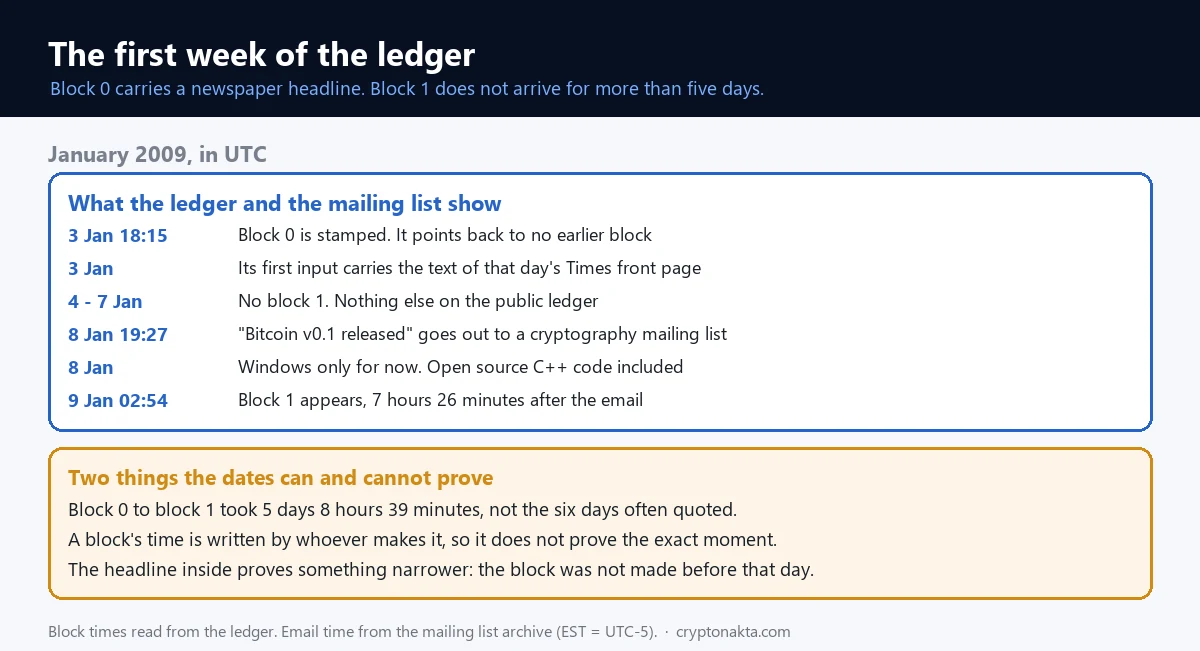
The first bitcoin block carries a timestamp of 3 January 2009, 18:15 UTC. People call it block 0, or the genesis block.
A block is a batch of transactions sealed together and added to a shared public ledger. Each block points back to the one before it. Block 0 is the only one that points back to nothing. The space for the previous block’s fingerprint is filled with zeros.
The whole block is 285 bytes. It holds a single transaction. That transaction creates 50 new bitcoins and pays them out. Every block starts with a transaction like this. It is called the coinbase transaction, and it has a small field the block’s maker can fill with anything.
I wanted to see that field myself. A screenshot in someone else’s article was not enough. So I opened block 0 on a public block explorer and copied out the raw coinbase transaction.
The field is written in hexadecimal. That is a way of writing each byte as a pair of digits and letters. The start of it looks like this.
04ffff001d0104455468652054696d6573…
The first few pairs are technical settings. Then comes the pair 45. In this spot it says how many bytes of data follow, and the answer is 69. I turned those bytes back into letters one pair at a time. The pairs 5468652054696d6573 spell “The Times”. All 69 bytes together read:
The Times 03/Jan/2009 Chancellor on brink of second bailout for banks
That is a headline from the front page of The Times of London on that date. It said the British finance minister was close to a second rescue of the banks.
It is easy to take the block’s date as proof of when it was made. It is not proof. A block’s timestamp is typed in by whoever makes the block. The rules allow some slack. In January 2009 nobody else was on the network to object.
The headline proves something narrower. Nobody could quote that sentence before the paper printed it. So the headline shows the block was not made before that day. It says nothing about how much later it was made.
I checked one more thing. A block’s hash is a fingerprint made from its contents, written as a long string of characters. The rules at the time asked for a hash starting with eight zeros. Block 0’s hash, 000000000019d668…, starts with ten. The ledger records that and nothing more about it.
The program that made this block was published under the name Satoshi Nakamoto. Who is behind that name has never been established. This article does not try to settle it. If you are new to all of this, here is what bitcoin is, in plain terms.
The quiet days before block 1
Then the ledger goes quiet.
I subtracted one timestamp from the other. The next block did not appear for 5 days, 8 hours and 39 minutes. You will often read that the gap was six days. The two timestamps say it was shorter.
Nothing else reached the public ledger in between. What happened on the maker’s computer during those days is not recorded anywhere I could find. The ledger only keeps what was published to it.
What we do have is an email. On 8 January 2009 at 14:27 US Eastern time, a message titled “Bitcoin v0.1 released” went out to a cryptography mailing list. In UTC that was 19:27. The list archive still has it, and the original message is public.
I read it slowly. It is short and practical. It announces the first release of “a new electronic cash system that uses a peer-to-peer network to prevent double-spending.” A few lines later comes a plain note.
Windows only for now. Open source C++ code is included.
Then it tells you how to start. Unpack the files and run the program. It connects to other computers by itself. The email also warns that the software is still alpha and experimental.
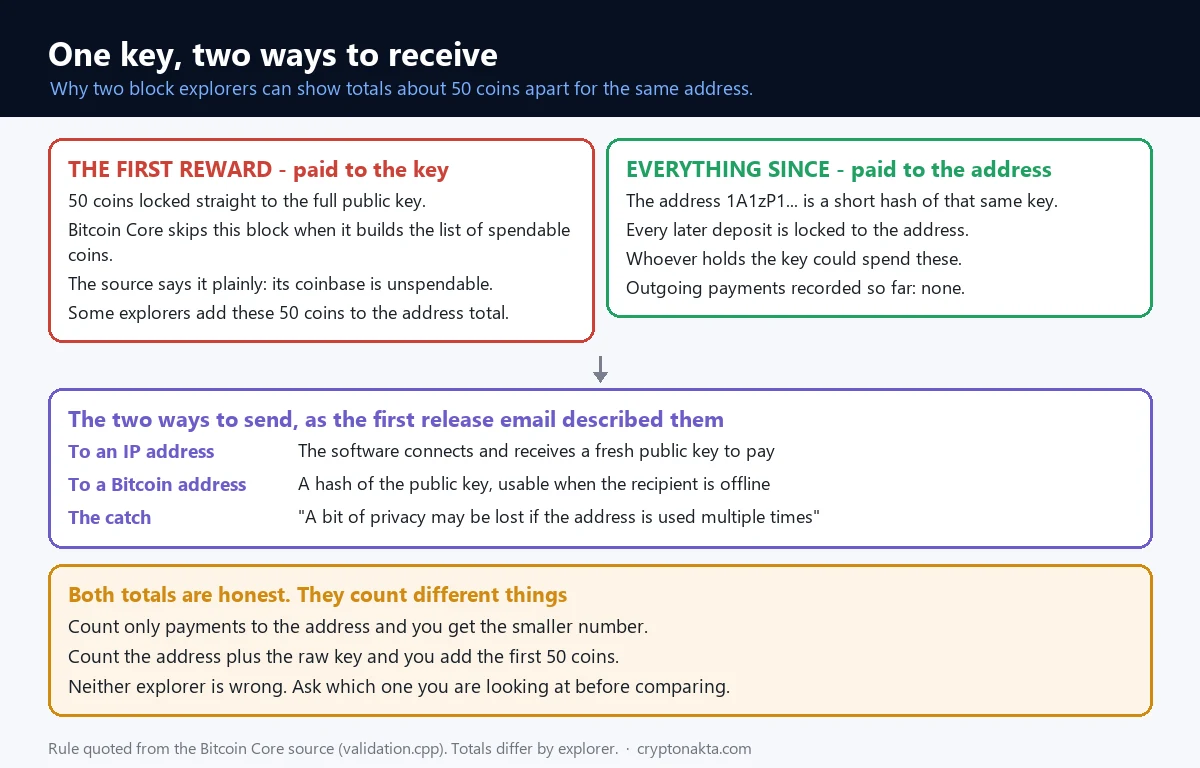
One paragraph matters more than the rest for this story. It says there are two ways to send money. If the other person is online, you enter their IP address. Your program connects to theirs, gets a new public key from it, and sends the payment there.
If the other person is offline, you send to their Bitcoin address instead. The email calls that address “a hash of their public key that they give you.” Then it adds a caution.
…a bit of privacy may be lost if the address is used multiple times…
So from the first day there were two ways to receive coins. One pays a public key directly. The other pays an address made from that key. Hold on to that, because the address in this story was paid both ways.
Block 1 carries a timestamp of 9 January 2009, 02:54 UTC. That is 7 hours and 26 minutes after the email went out. In US Eastern time, that was the same evening the program became public.
The reward nobody can spend, and two totals for one address
Back to the reward in block 0. It paid 50 bitcoins, and it paid them the first way. The coins went straight to a public key.
A public key is a long number that anyone can see and send coins to. Only the matching private key can sign those coins away. An address is a shorter code made by hashing a public key. The address 1A1zP1eP5QGefi2DMPTfTL5SLmv7DivfNa is the hash of the public key in block 0.
So why is that first reward unspendable? The answer sits in the code, and it is still there today. Bitcoin Core is the main program that runs the network. When it loads block 0, it skips the step that adds the block’s coins to the list of spendable coins. The source file has a comment that says so.
Special case for the genesis block, skipping connection of its transactions (its coinbase is unspendable)
That means the first 50 coins cannot be spent by anyone. The owner of the key cannot spend them either. As far as the network is concerned, they were never added to the pile of coins that can move.
Was that on purpose? I looked for a record from the time that says so and found none. Without a primary source, I am leaving that question open.
Then I tried to count what the address holds, and the numbers did not match.
A block explorer is a website that reads the public ledger and shows it in plain form. Some wallets use a similar kind of lookup server, called an Electrum server. I queried nine separate sources of both kinds. All nine gave the same total, to the last digit. It was 57.47547771 BTC, counted at block 968,475.
Other explorers show 107.48586302 BTC for the same address. That is 50.01038531 BTC more. At first I assumed one side had a bug.
Neither side has one. They are counting different things. The first group counts only payments made to the address. The second group also counts payments made straight to the public key behind it. That includes the 50 coins from block 0.
This goes back to the two methods in the email. The key and the address are two ways of receiving for the same owner. Some explorers add them together and some keep them apart. Both totals are honest. Before you compare figures for this address, check which one you are looking at.
The 50 coins explain almost all of the gap. A remainder of 0.0104 BTC is left over. I could not confirm where that remainder comes from, so I am reporting it as unexplained.
One figure was the same everywhere. I pulled every incoming payment recorded at the address. There are 79,687 of them, spread across 66,571 transactions. The count of outgoing payments is 0. Nothing has ever been sent out of this address.
The two kinds of coins still differ. The first 50 coins cannot move. Everything paid to the address since then could move, if the holder of the key ever signed it away. That has never happened.
While I was counting, five more small payments were still waiting to be confirmed. Together they came to 5,915 satoshis. The total creeps up almost every day, which is why each figure here comes with a block number.
The first stranger’s payment
For a long time, nobody sent anything to the address.
Its first incoming payment arrived 860 days after block 0. It came on 13 May 2011 at 21:04 UTC, in block 123,723. The amount was 0.01 BTC. This is that transaction. I do not know who sent it.
A satoshi is the smallest unit of bitcoin. It is one hundred-millionth of a coin. Once you count the early payments in satoshis, some of them look playful.
On 1 June 2011 at 05:50 UTC, a payment of exactly 1 satoshi arrived in block 127,909. That is the smallest amount the ledger can record. At 10:32 UTC, block 127,943 brought three more. They were for 222,222, 333,333 and 444,444 satoshis.
These four payments are linked. The change from each transaction was spent in the next one. Together they come to exactly 1,000,000 satoshis, or 0.01 BTC. The transaction that sent the 1 satoshi paid a fee of 1,000,000 satoshis. The ledger does not say why.
| Date (UTC) | Satoshis | BTC |
|---|---|---|
| 13 May 2011 | 1,000,000 | 0.01 |
| 28 May 2011 | 1,000,000 | 0.01 |
| 1 June 2011 | 1 | 0.00000001 |
| 1 June 2011 | 222,222 | 0.00222222 |
| 1 June 2011 | 333,333 | 0.00333333 |
| 1 June 2011 | 444,444 | 0.00444444 |
| 4 June 2011 | 500,000 | 0.005 |
| 4 June 2011 | 500,000 | 0.005 |
| 17 June 2011 | 1,000,000 | 0.01 |
| 6 July 2011 | 6,660,000 | 0.0666 |
The table shows the first ten payments. Most are round hundredths of a coin or halves of one.
A year later, on 12 June 2012, someone sent 1.23456 BTC. The digits run from one to six in order. I could not find out who sent that either.
The larger early payments are few. On 27 January 2013 someone sent 4 BTC. Almost ten years later, on 8 January 2023, another payment of exactly 4 BTC arrived. The ledger gives the dates and the amounts. It gives no names and no reasons.
By the end of 2022 the pattern was steady. Most years brought a few dozen to several hundred payments. Most were small. A payment of exactly 546 satoshis was still rare.
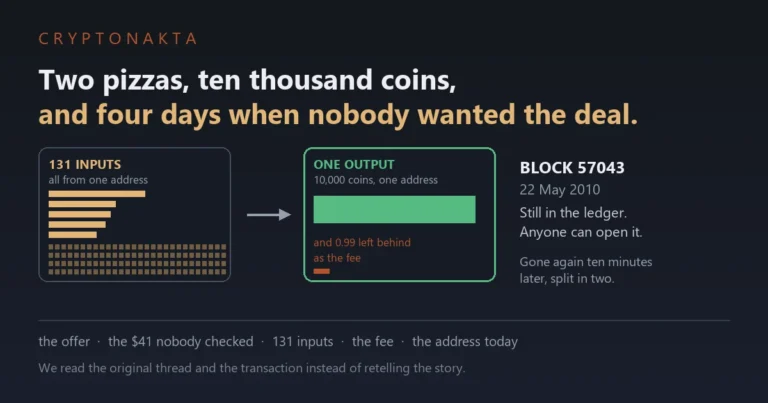
This address is not the only famous one that people send coins to. The address from the bitcoin pizza purchase gets them too, several on the anniversary.
Fifty-eight minutes in January
The biggest single payment the address ever received came on 5 January 2024. It was 26.91679286 BTC.
That one payment is 46.8 percent of everything ever paid to the address. It outweighs all the payments that came before it put together.
I opened the transaction. Then I opened the address that sent it and read its history from the start. The records tell a short story.
At 18:02 UTC that day, the coins landed in the sending address. At 19:00 UTC the same coins went out again, to the genesis address. That is 58 minutes later.
The payment has one input and one output. A normal payment sends part of a balance and returns the leftover to the sender as change. This one had no change. Every coin went across, less a network fee of 27,753 satoshis.
So 26.91679286 BTC arrived at one address, and within the hour all of it went on to an address that has never paid anyone. Those coins can in principle be spent by the holder of the key. They have not moved since.
The sending address did not go quiet afterwards. Small amounts started arriving there too. I counted nine payments to it after that day. They came to 341,448 satoshis in total.
Who sent the 26.91679286 BTC, and why? I do not know. The ledger records amounts, addresses and times. It does not record a reason.
I have seen theories about it online. None of them came with evidence I could check. Repeating them here would dress up a guess as a finding, so I am leaving them out.
What I can say is how much weight this one payment carries. Take it away and the total drops by almost half. When people quote how much the address holds, close to half of that figure is this one payment.
546 satoshis at a time
Count the payments instead of the coins, and the address looks different again.
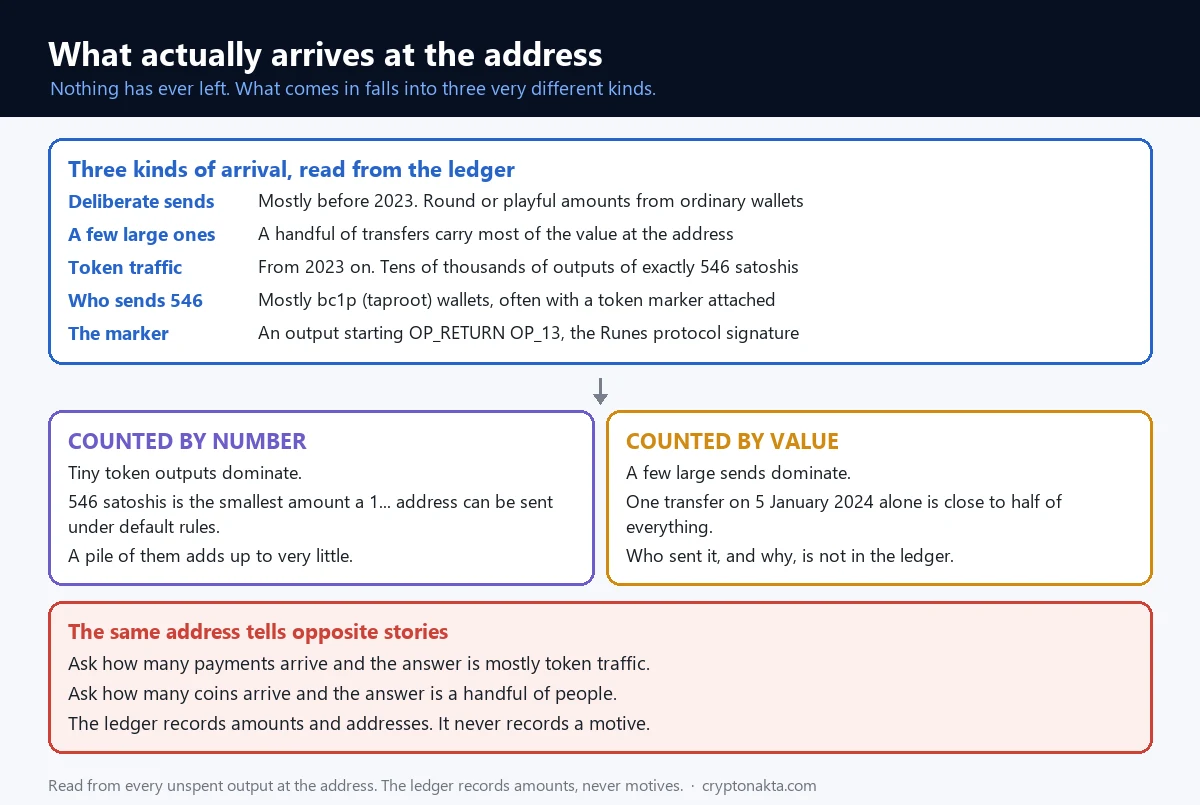
Of the 79,687 incoming payments, 65,404 are for exactly 546 satoshis. That is 82.1 percent of all the payments. Added up, they come to 0.35710584 BTC. In value that is 0.62 percent.
546 is not a random number. It is the smallest amount the network’s default rules allow you to send to an old-style address. Those are the addresses that start with “1”, as this one does. Anything smaller counts as dust, and ordinary nodes refuse to pass it on.
Bitcoin Core’s policy code spells it out in a comment. It reads “546 satoshis at the default rate of 3000 sat/kvB.” So 546 is the least anyone can send here through the normal network.
For most of the address’s life, hardly anyone sent that amount. Before 2023 there were 15 payments of exactly 546 in total. In 2023 there were 2,050. In 2024 there were 35,265. The year 2024 alone accounts for 52.0 percent of every incoming payment the address has ever had.
| Year | Incoming payments | BTC | Of which exactly 546 satoshis |
|---|---|---|---|
| 2011 | 19 | 0.9627 | 0 |
| 2012 | 54 | 7.0185 | 0 |
| 2013 | 793 | 6.934 | 0 |
| 2014 | 82 | 0.4661 | 0 |
| 2015 | 55 | 0.7826 | 0 |
| 2016 | 68 | 0.3704 | 0 |
| 2017 | 76 | 0.1997 | 2 |
| 2018 | 334 | 0.1678 | 1 |
| 2019 | 424 | 1.2236 | 3 |
| 2020 | 792 | 0.2211 | 3 |
| 2021 | 481 | 0.1715 | 2 |
| 2022 | 444 | 0.0377 | 4 |
| 2023 | 2,999 | 4.1774 | 2,050 |
| 2024 | 41,437 | 27.5601 | 35,265 |
| 2025 | 19,230 | 4.1707 | 16,239 |
| 2026 | 12,399 | 3.0117 | 11,835 |
The table is counted up to block 968,475. The current year is still open, so its row is still growing.
I wanted to know who was sending all this. I could not open tens of thousands of payments by hand. So I took a sample. I picked 400 incoming payments at random, using a fixed seed of 20260925, so anyone can repeat the same draw. Then I opened each one.
In the sample, 78.5 percent came from addresses starting with bc1p. Those are taproot addresses, a newer format that bitcoin added in 2021. None of the sampled payments from before 2023 came from one.
In 22.0 percent of the sample, the transaction also carried a small marker. It is an extra output that begins with OP_RETURN OP_13. That is the tag the Runes protocol puts on its transfers, according to its published specification.
Runes are tokens carried inside ordinary bitcoin transactions. Every payment output in such a transaction still has to carry some bitcoin. For an address starting with “1”, the least it can carry is 546 satoshis. Why so many of these transfers point at this particular address is not something the ledger explains.
Another ten payments in the sample carried other kinds of attached data. One payment from 25 October 2025 carried far more. Its transaction held a complete image file of 42,681 bytes. It shows someone’s guess about who Satoshi is. I am not naming the person in it. A guess written into the ledger is still a guess.
Now count by value. Only 13 payments at the address were for one bitcoin or more. Together they hold 84.5 percent of the value. By count, the address is mostly token traffic. By coins, it is mostly a handful of large sends.
Part of the traffic follows the calendar. Payments arrive on 3 January, the date in block 0, every year from 2014 on. In 2024 there were 3 of them. In 2025 there were 41. I cannot tell from the ledger which of those were meant for the date and which only landed on it.
The price on the day I checked, and your own wallet
Everything above is fixed in the ledger. The figures in this part are not. They were true at 04:22 UTC on 25 September 2026, and prices move every minute.
I took the price from four public exchange sources at the same moment and averaged them. They differed from each other by 0.029 percent. I collected everything twice. The price moved 0.037 percent between the two runs. One bitcoin came to $84,109.
| What | BTC | US dollars at 04:22 UTC on 25 September 2026 |
|---|---|---|
| Everything paid to the address, up to block 968,475 | 57.47547771 | $4,834,206 |
| The first reward from block 0, which cannot be spent | 50 | $4,205,450 |
| The largest single payment, 5 January 2024 | 26.91679286 | $2,263,945 |
So on paper the address is worth a few million dollars. Most of that was sent in by other people over the years. The first reward can never be spent at any price.
You will see much larger figures quoted for how much bitcoin Satoshi owns. Those come from studying the pattern of early mined blocks. They are estimates. No address on the ledger has a name attached, and this one address is all I checked.
Every so often a headline says Satoshi’s wallet has moved. When you see one, find out which address the story means. Then paste it into any block explorer and look for an outgoing payment. For this address, the answer up to block 968,475 is none. Other early addresses each have their own history to check.
If two explorers show different balances for an address, the reason may be the one in this story. One counts the address alone. The other adds payments made to the key behind it. Check what each one counts before you decide either is wrong.
A block explorer is also how you check a payment of your own. If coins you sent have not shown up, here is how to trace a deposit that has not been credited.
Anyone who sent coins to this address cannot get them back. There is nobody to ask. A payment to a wrong address or a wrong network works the same way. That is the reason to check the network and the address before you send.
Tiny amounts and unknown tokens can turn up in your own wallet too. They may be the same kind of traffic this address receives. The safe habit is to leave them alone. This guide explains how to tell a real airdrop from a wallet drainer.
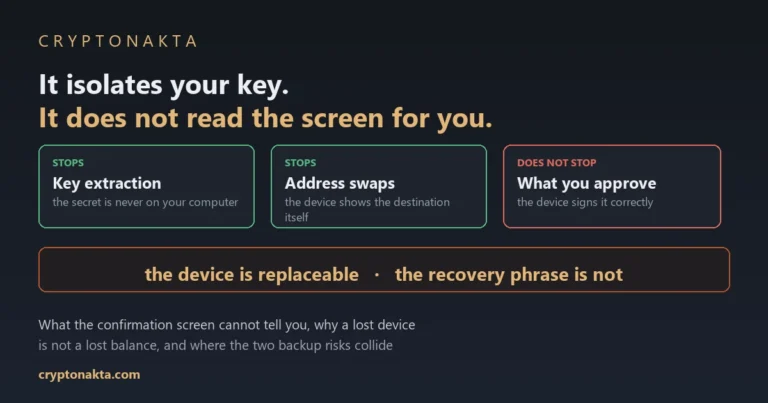
The whole story comes down to one rule. Coins move only when someone signs with the private key. The first reward is the single exception, blocked by the code. For your own coins, the key is everything. Start with how a crypto wallet holds that key. Then read what to do if your seed phrase was ever exposed and what a hardware wallet protects.
If you want to own a little bitcoin and look up your own transaction this way, here is how buying it works. The two exchange cards below are affiliate links, and we may earn a commission if you sign up through them.
Binance

OKX
Affiliate disclosure: some links are partner links. We may earn a commission at no extra cost to you. This is not investment advice.