Shiba Inu coin: I counted every SHIB burn on the Ethereum ledger
Shiba Inu is a meme token on Ethereum, and its supply can only shrink. The contract has no way to mint new SHIB. It started with a quadrillion tokens, which is why one SHIB costs a tiny fraction of a cent. Almost every SHIB ever burned left in a single transaction, sent by Vitalik Buterin in May 2021. I know this because I pulled every burn transfer from the ledger and added them up myself.
The questions below are the ones that come up when you search for SHIB. Can Shiba Inu reach 1 cent or a dollar? How many coins are left, and what is a burn tracker actually counting? I also cover SHIB on ERC-20 vs BEP-20, the Shibarium bridge hack and where to buy.
What this guide covers (14)
Can Shiba Inu reach 1 cent or $1?What is Shiba Inu coin, and what is it used for?How many Shiba Inu coins were made, and where did they go?How many Shiba Inu coins have been burned?Why a SHIB burn address and burn() give two supply numbersHow many Shiba Inu coins are left (measured September 25, 2026)What a SHIB burn tracker spike measuresShibarium, BONE and the Shibarium burnWhat the Shibarium bridge hack showedIf burns go up, does the SHIB price follow?SHIB ERC-20 or BEP-20: which network to pickWhere to buy Shiba Inu and how to read its priceCan you mine or stake SHIB?My take: a clear supply rule and an oversold burn story
 View full size ↗
Can Shiba Inu reach 1 cent or $1?
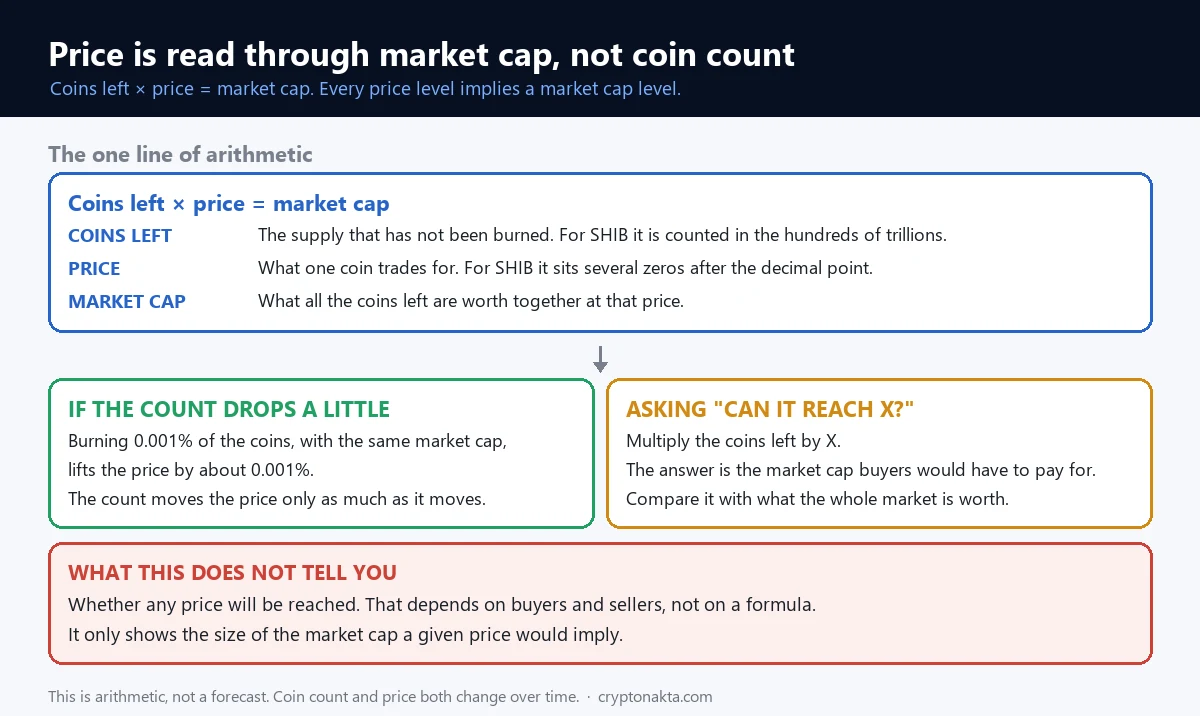
Every target price for a coin comes with a market cap attached. Market cap is the number of coins that exist, multiplied by the price of one coin. So the question “can it reach this price” is really a question about market cap. For SHIB the coin count is enormous, and so is the market cap that any round-number price implies.
On September 25, 2026 (UTC), about 589.5 trillion SHIB were left after all burns. The price on Binance’s SHIB/USDT market was $0.00000593. That puts SHIB’s market cap near $3.5 billion. The table keeps the same coin count and swaps in the prices people ask about.
| SHIB price | Market cap needed | Times the measured price | Compared with the whole crypto market |
|---|---|---|---|
| $0.001 (a tenth of a cent) | $589.5 billion | 169x | 0.20x |
| $0.01 (1 cent) | $5.89 trillion | 1,686x | 2.04x |
| $1 | $589.5 trillion | 168,634x | 204x |
Coin count and SHIB price measured on 2026-09-25 (UTC). The whole crypto market was about $2.885 trillion on CoinGecko at the same time.
Look at the 1 cent row first. SHIB would need a market cap of about $5.89 trillion. The whole crypto market was worth about $2.885 trillion when I measured it on 2026-09-25. Bitcoin alone was about $1.70 trillion. With today’s coin count, a 1 cent SHIB means a market cap about 2.04 times the entire crypto market.
The $1 row is much further out. It needs about $589.5 trillion. That is about 204 times everything in crypto today. The tenth-of-a-cent row is the only one smaller than the whole market.
The table is plain multiplication. It says nothing about whether the price gets there, and I am not predicting either outcome. It shows how far each price is from the measured one, in dollars.
Only two things can move a row. The market cap can grow, or the coin count can shrink. Burning is how the count shrinks. It means sending tokens somewhere they can never be spent again.
How much burning would 1 cent take on its own? At the market cap measured on 2026-09-25, only about 349.6 billion SHIB could remain. That means burning all but 1 of every 1,686 SHIB left today. At the burn pace of the past year, that would take about 121,000 years. The pace can change, so treat that as arithmetic and nothing more.
What is Shiba Inu coin, and what is it used for?
Shiba Inu, ticker SHIB, is an ERC-20 token. That means it lives on the Ethereum blockchain and follows Ethereum’s standard rules for tokens. It has no blockchain of its own. Each SHIB transfer on Ethereum is an Ethereum transaction, and it pays an Ethereum fee.
SHIB is also a meme coin. A meme coin takes its name and image from an internet joke, and its value comes from attention rather than from a product. SHIB borrowed both from Dogecoin. The shiba inu is the Japanese dog breed in the original Doge meme.
The supply works the opposite way to Dogecoin’s. Dogecoin adds new coins every year through mining. SHIB was created in one go at launch, and nothing adds to it. Its count can only go down.
The founder used the name Ryoshi and never revealed a real identity. “An experiment in decentralized spontaneous community building” is how Ryoshi described SHIB, as quoted in the project’s official WOOF Paper from April 2021. Ryoshi deleted their social media posts and stepped back in late May 2022, according to press reports.
So what is Shiba Inu coin used for? Mostly, people buy it, hold it and trade it. It trades against dollars, stablecoins and other coins on several exchanges. Binance listed it in May 2021. Coinbase followed in September 2021. Its all-time high came in late October 2021.
A group of related projects grew around the token. ShibaSwap is a decentralized exchange that opened in July 2021. Shibarium is a separate network built by the Shiba Inu team, with its own fee token called BONE. SHIB itself pays no interest and gives holders no share of any revenue.
How many Shiba Inu coins were made, and where did they go?
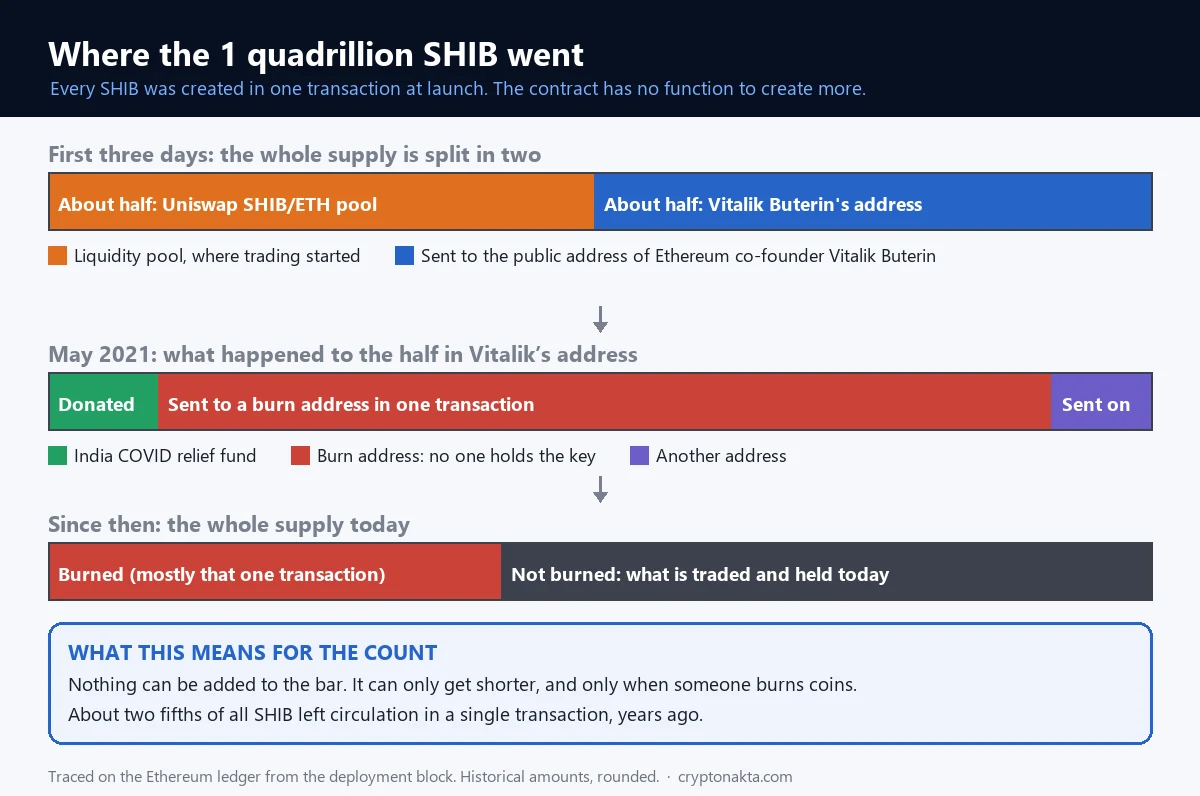
The SHIB contract went live on July 31, 2020 at 18:32 UTC, in Ethereum block 10,569,013. In that block, one quadrillion SHIB were created and sent to a single address. One quadrillion is 1,000 trillion. The contract has no function that creates new SHIB, so that was the only issue ever.
I read the verified source code of the contract to check this. It is a standard template called TokenMintERC20Token. Its public functions include transfer and burn. None of them mints. The entire supply was made once, inside the constructor, which is the code that runs when a contract is deployed.
Over the next three days the supply went two ways. About half went into a liquidity pool on Uniswap. A liquidity pool is a shared pot of two tokens that lets anyone swap one for the other. The other half went to the public address of Vitalik Buterin, the co-founder of Ethereum. The table lists each move as it appears on the ledger.
| Date and time (UTC) | What moved | SHIB |
|---|---|---|
| Jul 31, 2020 · 18:32 | Whole supply created at the launch address | 1,000 trillion |
| Jul 31, 2020 · 19:14 | Launch address to Vitalik Buterin | 10 trillion |
| Jul 31, 2020 · 20:42 | Launch address to the Uniswap V2 SHIB/ETH pool | 495 trillion (49.5%) |
| Aug 1, 2020 · 21:34 | Through a relay address to Vitalik Buterin | 254.7 trillion |
| Aug 2, 2020 · 21:46 | Through the same relay address to Vitalik Buterin | 240.3 trillion |
| May 12, 2021 · 17:23 | Vitalik returns the pool’s LP tokens and takes out the launch liquidity | – |
| May 12, 2021 · 18:36 | Vitalik to the India Covid-Crypto Relief Fund | 50.69 trillion |
| May 16, 2021 · 21:48 | Vitalik to the burn address 0xdEAD…42069, one transaction | 410.24 trillion |
| May 17, 2021 · 14:15 | Vitalik to another address | 46 trillion |
Vitalik’s half added up to 505 trillion, or 50.5% of the supply. Counting a few later transfers from other people, about 507.2 trillion SHIB reached his address before the burn.
Some write-ups say the pool half was “locked” and the keys thrown away. The ledger shows something different. Putting tokens into a Uniswap pool creates LP tokens, a receipt that lets the holder take the liquidity back out. Thirty-six minutes after the pool was funded, those LP tokens were sent to Vitalik’s address as well. So his address held the launch liquidity too.
In May 2021, Vitalik emptied the address. He returned the LP tokens on May 12 and withdrew the launch liquidity. The same day, he sent about 50.69 trillion SHIB to the India Covid-Crypto Relief Fund. On May 16 he sent 410.24 trillion SHIB to a burn address in one transaction.
That single burn was about 41% of all SHIB ever created. It was also about 90% of what he still held after the donation. On May 17 he sent the last 46 trillion to another address. His address has held zero SHIB since then.
Who controls that last 46 trillion today is something I could not confirm from the ledger. At the time, Vitalik said he did not want to be “a locus of power of that kind,” as quoted by CoinDesk. He said the rest would go to charitable uses.
How many Shiba Inu coins have been burned?
A burn address is an address that nobody holds a key for. Tokens sent there still show up on the ledger. They can never move again. In my ledger count to 2026-09-25, 14,385 of the 19,505 SHIB burn transfers went to one of these addresses.
SHIB has three places where burned tokens end up. Two are burn addresses, 0xdEAD…42069 and the standard 0x…dEaD. The third is the contract’s own burn function, which deletes tokens outright. I collected every transfer into all three, from launch up to Ethereum block 26,054,200. There were 19,505 of them.
Then I checked my totals against the chain. The transfers into each burn address added up exactly to that address’s balance. The tokens deleted by the burn function added up exactly to the drop in the contract’s total supply. So no transfer was missed.
The result is about 410.5 trillion SHIB burned, as of September 25, 2026. That is 41.05% of the quadrillion created at launch. It is easy to read that as a steady process. The ledger shows otherwise.
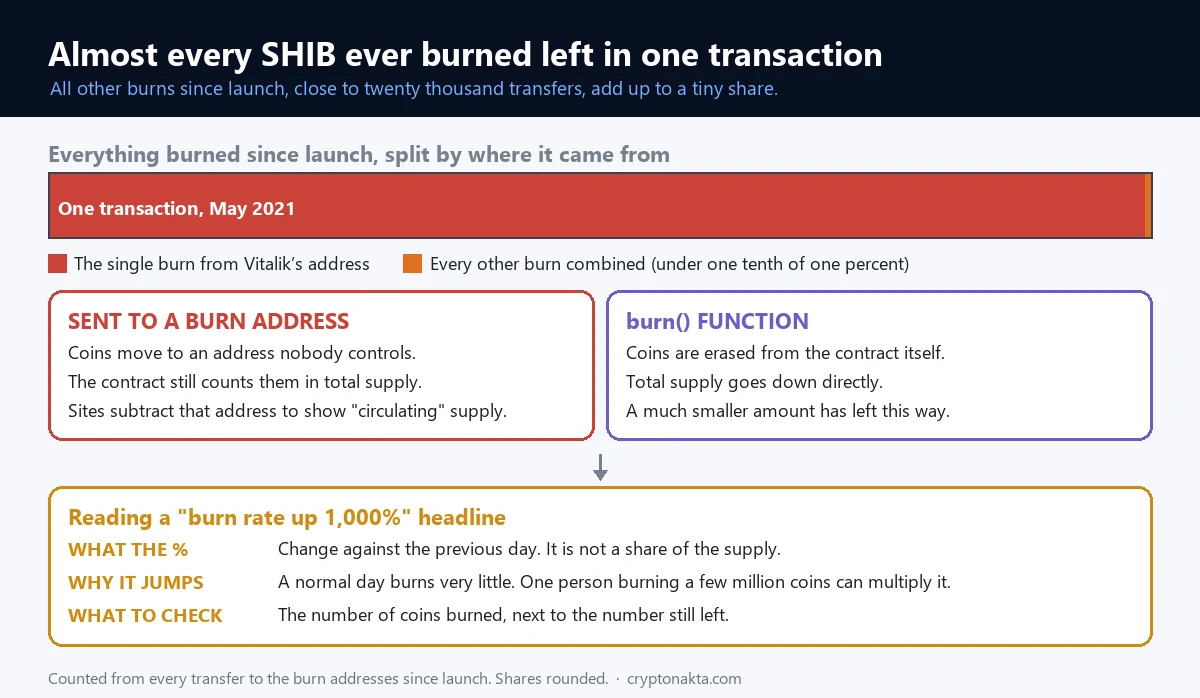
Almost everything ever burned came from one transaction in May 2021. Vitalik’s single transfer is 99.94% of all SHIB burned, by my count to 2026-09-25. The other 19,504 transfers add up to about 261.9 billion SHIB. Together they are 0.06% of the total.
| Year | SHIB burned (Vitalik’s transfer left out) | Burn transfers |
|---|---|---|
| 2020 | 27.0 billion | 1 |
| 2021 | 31.5 billion | 3,408 |
| 2022 | 83.4 billion | 6,629 |
| 2023 | 72.0 billion | 4,032 |
| 2024 | 35.6 billion | 1,718 |
| 2025 | 8.0 billion | 2,183 |
| 2026 (to September 25) | 4.5 billion | 1,533 |
Counted from the Ethereum ledger on 2026-09-25 (UTC). Years are split at the first block of January 1, UTC.
The yearly totals peaked in 2022 at about 83.4 billion SHIB. They have shrunk since then. 2025 came to about 8.0 billion. 2026 had reached about 4.5 billion by September 25. Even the peak year is a small fraction of Vitalik’s 410.24 trillion.
Part of the 2022 activity came through the ShibaSwap burn portal. It opened in late April 2022. It gave a reward token to people who burned SHIB through it. Press reports put the first day at about 11 billion SHIB. ShibaSwap took the portal over in October 2022. I could not confirm whether it still runs.
Why a SHIB burn address and burn() give two supply numbers
There are two ways to burn SHIB. They leave different marks on the contract, and that difference explains why supply figures differ from site to site.
The common way is a plain transfer to a burn address. The tokens still exist in the contract’s books. They just sit in an address nobody controls. The contract’s own count of all tokens, called totalSupply, stays the same. totalSupply is the figure the contract reports as its total number of tokens.
The other way is the burn() function. Anyone can call it on their own balance. It deletes the tokens and lowers totalSupply. On SHIB this path has stayed small. Up to 2026-09-25 it was used 5,120 times, for about 17.67 billion SHIB in total. Most of that amount came from other projects’ contracts, such as the SHIBOSHIS NFT collection and a project called Marswap.
| Transfer to a burn address | burn() function | |
|---|---|---|
| What happens to the tokens | They move to an address with no owner | They are deleted |
| Contract totalSupply | Unchanged | Goes down |
| Where you see the burn | The burn address balance | A lower totalSupply |
| Transfers, launch to 2026-09-25 | 11,705 to 0xdEAD…42069 · 2,680 to 0x…dEaD | 5,120 |
| SHIB burned this way | 410.44 trillion + 49.5 billion | 17.67 billion |
This is why sites disagree on SHIB’s supply. A block explorer that reads totalSupply straight from the contract shows a number very close to one quadrillion. That number only drops when someone calls burn(). A price site that subtracts the burn address balances shows a much smaller number.
Both read the same ledger. They just answer different questions. totalSupply tells you how many tokens the contract has on its books. The figure after subtracting burn addresses tells you how many tokens can still move. For price math, the second one is the right one to use.
The missing mint function matters here too. Because nothing can add SHIB, both numbers can only stay flat or fall. No update, vote or team decision can raise them. The code simply has no path for it.
 View full size ↗
How many Shiba Inu coins are left (measured September 25, 2026)
Every figure in this section was measured on September 25, 2026, between 11:30 and 12:00 UTC. Counts come from the public Ethereum ledger. Prices come from Binance and CoinGecko at the same time. All of these change daily.
| Measure | Value on 2026-09-25 (UTC) |
|---|---|
| Created at launch | 1,000 trillion (one quadrillion) |
| Contract totalSupply | 999.98 trillion |
| Burned in total | 410.5 trillion (41.05%) |
| Left after all burns | 589.5 trillion (58.95%) |
| Circulating supply on CoinGecko | 589.2 trillion |
| Burned in the past 365 days | 4.86 billion, in 2,096 transfers |
| Burned in the past 30 days | 173.2 million, in 185 transfers |
| Past year’s burn as a share of coins left | 0.0008% |
| Past year’s burn in dollars | about $28,804 |
| SHIB price (Binance SHIB/USDT) | $0.00000593 |
| SHIB market cap (CoinGecko) | about $3.5 billion |
So how many Shiba Inu coins are left? About 589.5 trillion, or 58.95% of the launch supply. CoinGecko’s total supply matches that figure. Its circulating supply is a little lower, at about 589.2 trillion. Either works for rough price math.
The past year of burns removed about 0.0008% of the coins left. At that pace, burning 1% of the remaining supply would take about 1,214 years. There is no guarantee the pace stays the same. It could speed up or slow down. The figure shows the current scale and nothing more.
The dollar value makes the scale easier to see. At the measured price, a full year of SHIB burns was worth about $28,804. SHIB’s market cap at the same moment was about $3.5 billion.
Is Shiba Inu dead? No single number answers that, so here is what I could check on the same day. SHIB had spot markets on Binance, Bybit, OKX, Gate, KuCoin and Bitget. Binance alone listed it against 7 different currencies and stablecoins. Burn transfers kept arriving, with 2,096 of them in the past year. Shibarium was still producing blocks, at a height of about 19.16 million.
What a SHIB burn tracker spike measures
Some headlines say the SHIB burn rate jumped by hundreds or thousands of percent. That percentage compares one day’s burns with the day before. It is a change between two days. It says nothing about how much of the supply was burned.
Daily burns start from a very small base. In the 365 days to 2026-09-25, the median day saw about 2.0 million SHIB burned. At the measured price, that was worth about $12.
In the same period, the top 10% of days had 12.1 million SHIB or more. Going from a median day to one of those days is a rise of about 504%. In dollars, the difference is about $60. A headline can call that a surge, and the number is technically correct.
The busiest day in that year, around July 26, 2026, had about 2.08 billion SHIB burned. 13 days had no burns at all. After a quiet day, a single person burning a modest amount can produce a four-digit percentage.
A burn tracker is a website that adds up these transfers and posts daily totals. I could not find an official burn counter published by the Shiba Inu team. One of them, Shibburn, is an independent community site that started in June 2021. Trackers also differ in which burn addresses they count. Their running totals differ a little for that reason.
You can check any burn yourself. Open the 0xdEAD…42069 burn address on Etherscan and look at its incoming token transfers. Each one shows the sender, the amount and the time. Vitalik’s 2021 burn is there too, in block 12,448,006.
Shibarium, BONE and the Shibarium burn
Shibarium is a layer-2 network that runs on top of Ethereum. A layer-2 network processes transactions on its own chain and uses Ethereum as its base. Its mainnet opened on August 16, 2023. Its chain ID is 109. Fees on Shibarium are paid in BONE.
The launch had problems. Heavy traffic halted block production for several hours right after opening. About $1.7 million in ETH and other assets sat stuck in its bridge for a while. A bridge is a set of contracts that moves tokens from one chain to another. Press reports say things were back to normal by late August 2023.
BONE has three jobs. It is the governance token, the fee token on Shibarium, and the token that validators stake. Its on-chain total supply is about 250 million. LEASH is another token in the family. A flaw in its first contract inflated its supply in 2025, and it is being moved to a new contract. For that reason I do not quote a LEASH supply here.
TREAT is a newer token with 10 billion units. It started trading in January 2025. None of these tokens replaces SHIB, and none of them changes SHIB’s own supply rules.
Shibarium has a burn built into its design. 70% of each transaction’s base fee is meant to be converted to SHIB and burned. The other 30% goes to running costs. A hard fork in August 2024 automated the process.
The collected BONE goes through a tool called ShibTorch. Anyone can trigger it. It moves the BONE to Ethereum, swaps it for SHIB and sends the SHIB to a burn address. That is the design as the Shiba Inu docs describe it.
I could not confirm that the 70% share still runs at the same ratio today. What I can show is the result on Ethereum. All SHIB burns in the year to September 25, 2026 came to about 4.86 billion, from every source together. Whatever Shibarium sent is inside that number.
What the Shibarium bridge hack showed
A bridge holds the tokens users have moved across. You lock tokens on one side, and a matching amount is released on the other. That pile of locked tokens is what attackers go after.
On September 12, 2025, the Shibarium PoS bridge was attacked. The attacker used a flash loan, which is a loan borrowed and repaid inside a single transaction. That gave them 4.6 million BONE, which they delegated to validators. They also had leaked signing keys for 10 of the 12 validators. That let them approve fake withdrawals.
Early counts put the loss near $2.4 million. That included 224.57 ETH and about 92.6 billion SHIB. Later counts put it near $4.1 million across several tokens. The two figures come from different stages of the count.
The team paused staking, which froze the borrowed BONE, and got it back. They replaced the validator keys and brought in security firms. On October 14, 2025, the Plasma bridge reopened for BONE only, with a seven-day wait on withdrawals. I could not confirm whether the SHIB side of the bridge had reopened as of my measurement.
Victims did not get an instant full refund. The team created SOU, short for “Shib Owes You.” It is an NFT that records the amount owed to each holder. The debt is paid down over time from ecosystem income and donations. Separately, K9 Finance closed its Shibarium products as of February 25, 2026.
Moving SHIB through a bridge adds a risk that holding it on Ethereum does not have. The token contract can work perfectly while the bridge fails. That is what happened here. Holding SHIB on Ethereum or on an exchange avoids the bridge step, though each of those has its own risks.
If burns go up, does the SHIB price follow?
A burn changes the coin count and leaves the price to buyers and sellers. The price is what the last buyer paid the last seller. Market cap is that price multiplied by the count. A burn touches only the count.
Take the year of burns to 2026-09-25 as an example. About 4.86 billion SHIB were removed. Suppose the market cap had stayed exactly at $3.5 billion. The price would then have risen by about 0.0008%. At $0.00000593, that change does not reach any digit an exchange shows.
The same logic works in reverse. If buyers pay more, the price rises whether or not anything was burned. If they pay less, it falls, again with or without burns. The coin count is the same in both cases.
A burn only changes the price math in a visible way when it is huge compared with what is left. The 2021 burn was that size, since it removed about 41% of all SHIB ever created. Every burn since then has been tiny next to the remaining supply.
For any number you read about SHIB, sort it first. A price question is a market cap question. A supply question is about the coins left. A burn headline answers neither until it tells you the amount burned, in SHIB.
 View full size ↗
SHIB ERC-20 or BEP-20: which network to pick
SHIB exists on more than one network. The original lives on Ethereum as an ERC-20 token. A second version lives on BNB Smart Chain as a BEP-20 token. BEP-20 is the token standard on BNB Smart Chain, the network that uses BNB for its fees. Shibarium carries a bridged version too.
The BEP-20 version has its own contract address. BscScan and CoinGecko label it “Binance-Peg SHIBA INU,” issued by Binance. Binance has said it backs its peg tokens one-to-one with the original. I could not find a backing page specific to SHIB. On September 25, 2026 there were about 9.21 trillion SHIB on BNB Smart Chain.
Picking the network is the step where SHIB transfers most often go wrong. The sender and the receiver have to use the same network. An address that starts with 0x looks identical on Ethereum and on BNB Smart Chain. Nothing on the screen stops you from choosing the one the receiver does not support.
| Network on Binance | What you send | Withdrawal fee | Minimum withdrawal | Fee in dollars |
|---|---|---|---|---|
| Ethereum (ERC20), the default | The original SHIB token | 138,948 SHIB | 277,896 SHIB | about $0.82 |
| BNB Smart Chain (BEP20) | The Binance-issued BSC version | 4,020 SHIB | 8,040 SHIB | about $0.02 |
| Shibarium | Not in Binance’s SHIB network list | – | – | – |
From Binance’s public network settings for SHIB, checked on 2026-09-25. Dollar values use the measured SHIB price.
Binance charges far more to withdraw SHIB over Ethereum than over BNB Smart Chain. Our guide to gas fees explains why network fees differ. The cheaper network is only the right choice if the receiver supports it.
A safe order works on any exchange. Check which networks the receiving side accepts for SHIB. Pick that same network on the sending side. Send a small test amount and wait for it to arrive. Then send the rest. Our guide to fees when moving crypto between exchanges covers the costs in more detail.
If SHIB has already gone out on the wrong network, read our guide on crypto sent on the wrong network. Recovery depends on who controls the receiving address.
Sending SHIB to your own crypto wallet follows the same steps. If you then connect that wallet to apps like ShibaSwap, you sign token approvals. An old approval can let a contract move your SHIB later. Our guide on revoking token approvals shows how to check them.
Where to buy Shiba Inu and how to read its price
The exchanges in the table below list SHIB on the spot market, where you buy and own the actual tokens. The products and payment options you see differ by region, so check what your own screen shows.
| Exchange | SHIB spot markets found on 2026-09-25 |
|---|---|
| Binance | SHIB/USDT, SHIB/USDC, SHIB/FDUSD, SHIB/EUR, SHIB/BRL, SHIB/TRY, SHIB/JPY |
| Bybit | SHIB/USDT |
| OKX | SHIB/USDT, SHIB/USDC, SHIB/USD, SHIB/EUR, SHIB/TRY |
| KuCoin | SHIB/USDT, SHIB/USDC, SHIB/DOGE |
| Gate | SHIB/USDT, SHIB/USDC |
| Bitget | SHIB/USDT |
OKX has a direct SHIB/USD market. On the others, one route is to buy USDT first and then trade it for SHIB on the SHIB/USDT market. Buy spot SHIB if you want to hold the tokens or withdraw them. A futures contract only tracks the price. Our spot vs futures guide explains the difference.
The price itself looks strange at first. At $0.00000593, the price measured on 2026-09-25, there are 5 zeros after the decimal point before the first real digit. Count them before you type an order. A misplaced zero makes the amount ten times too big or too small.
Reading the price per million SHIB is simpler. One million SHIB cost about $5.93 on 2026-09-25. Multiply that by how many millions you hold, and the value is easy to read.
For sign-up steps and the fee discount on Binance, see our Binance referral code guide.
Binance

Bybit
OKX

KuCoin

Affiliate disclosure: some links are partner links. We may earn a commission at no extra cost to you. This is not investment advice.
Can you mine or stake SHIB?
You cannot mine SHIB. It is a token, and every unit was created at launch. The contract has no mint function and no admin who could add more. Ethereum itself stopped mining when it moved to proof of stake, so there is nothing to mine on that side either.
Any “SHIB mining app” is offering something the token does not have. Our crypto scams guide covers the usual patterns. Surprise SHIB airdrops that ask you to connect a wallet deserve the same caution. See our guide on real airdrops and wallet drainers.
SHIB has no staking built in either. Staking means locking coins to help run a network in return for rewards. SHIB does not secure any network, so its contract has nothing to pay stakers for. Our staking guide explains how it works on coins that do have it.
Staking-style products around SHIB come from apps and exchanges. ShibaSwap’s BURY feature gave xSHIB and paid rewards in BONE. Those BONE rewards stopped on September 26, 2023. ShibaSwap’s own docs then said reward payouts were running behind.
The newer Bury 2.0 on Shibarium gives voting power only, with no rewards, according to its docs. Exchange earn products that accept SHIB are run by the exchange. The exchange sets the rate and the lock period, and it can change them.
My take: a clear supply rule and an oversold burn story
SHIB’s design keeps one promise. The count was fixed at launch, and no code path can add to it. It makes no other promise. There is no cash flow, no revenue share and no interest. Its value rests on attention and on the community that keeps using and trading it.
That design suits some people. A buyer who wants a widely listed, liquid meme token can see exactly what they are getting. It fits poorly for anyone expecting burns to carry the price toward 1 cent. The numbers above show why that expectation has little support.
The claim I trust least is the burn story. It is the claim about SHIB I see repeated most, and the ledger does not back it. 99.94% of all burns came from a single transaction in 2021. Everything burned since then comes to about 0.044% of the coins left on 2026-09-25.
There is a fair case on the other side. SHIB has been trading since 2020. It has spot markets on the exchanges listed above, wide name recognition and a set of projects built around it. Those are real strengths for a meme coin, and they do not depend on burns at all.
This site uses affiliate links, including the exchange cards above. If you sign up through one, we may earn a commission. The figures in this article come from the ledger and public APIs, and the affiliate links do not change them.
My own reading is that SHIB is best judged on attention, liquidity and the projects around it. The burn belongs outside the price question, because the measured numbers put it far too small to matter.