Pi Network explained with numbers we pulled from its own ledger and from the exchanges
If you’ve been tapping the Pi app for years, you probably have three questions. Is the balance worth anything? Can you actually sell it? And is Pi Network real at all?
We didn’t want to guess. So we read the Pi Mainnet ledger ourselves and checked the exchanges that list PI. The answers below follow the questions Pioneers search for most. Every number that can change comes with the date we measured it.
What’s in this article (14)
Is Pi Network worth anything?Is Pi Network real? Who built it and what the mining button doesPi Network KYC, the Mainnet Checklist and the migration queueWhy only part of your balance is TransferablePi Network lockup: 2 weeks, 6 months, 1 year or 3 yearsWhat one week of the Pi ledger showsWhy most transactions on the Pi ledger failPi Wallet passphrase recovery: why nobody can do it for youHow to sell Pi coin, step by stepPi coin highest price, and why the price droppedWhat would it take for Pi to hit $1, and what is GCV?Is Pi Network on Binance?Pi Network scams and how to spot themMy take: what the ledger shows and what it can’t
 View full size ↗
Is Pi Network worth anything?
Yes. Pi has a market price. It trades against USDT on several exchanges. Kraken, a US exchange, also lists it against the dollar. We checked at 07:14 UTC on September 26, 2026. At that moment the last PI/USDT trade on OKX was 0.09133 USDT.
USDT is a stablecoin that tracks the US dollar, so one USDT is close to one dollar. In dollars, 100 Pi was worth about $9.13, 1,000 Pi about $91.28 and 10,000 Pi about $912.78. That’s before exchange fees.
The table lists the exchanges we pulled prices from, using each one’s public data. The last column shows whether the exchange is on Pi’s official KYB list. KYB means “know your business.” It’s the check Pi requires of companies that handle Pi. The core team asks users to stay away from exchanges and services that aren’t on the list.
| Exchange | Market | Last price | Trading volume, last 24 hours | On Pi’s KYB list |
|---|---|---|---|---|
| OKX | PI/USDT | 0.09133 USDT | 3,553,015 USDT | Yes |
| Gate | PI/USDT | 0.09135 USDT | 1,538,452 USDT | Yes |
| Bitget | PI/USDT | 0.09241 USDT | 1,124,433 USDT | Yes |
| MEXC | PI/USDT | 0.09128 USDT | 326,862 USDT | Yes |
| Pionex | PI/USDT | 0.09130 USDT | 60,869 USDT | Yes |
| Kraken | PI/USD | $0.09126 | $35,499 | Yes |
Measured at 07:14 UTC on 2026-09-26 from each exchange’s public API. OKX had the most PI trading, about 3.6 million USDT worth over 24 hours. CoinGecko listed PI markets on 17 exchanges in total. Some big names had none, Binance among them.
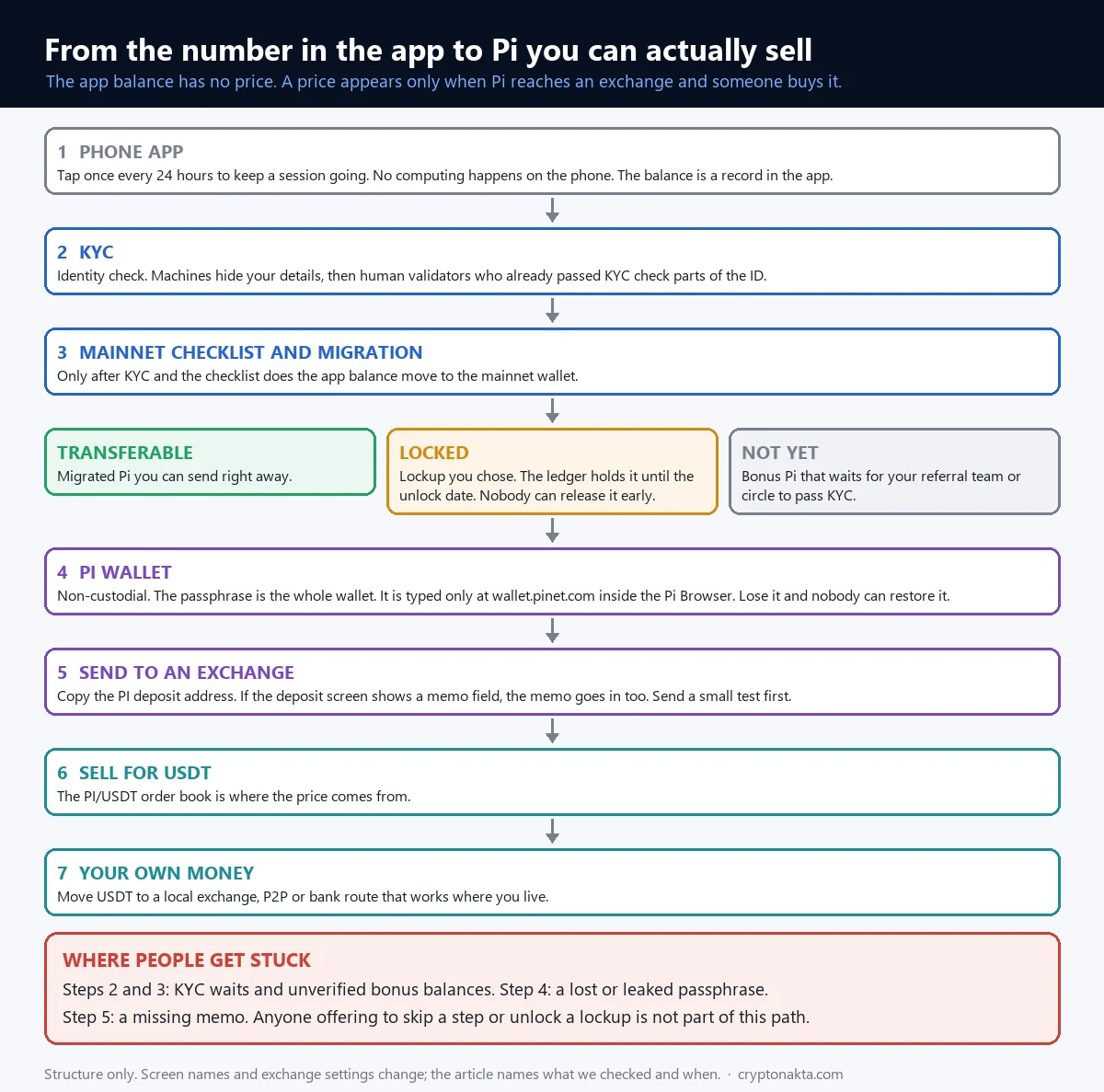
One catch before any of this. The number in the app is not money you can send or sell. It turns into sellable Pi only after KYC and the move to the Mainnet. That’s Pi’s live blockchain, where coins can go between wallets and exchanges.
Is Pi Network real? Who built it and what the mining button does
Two Stanford PhDs founded Pi Network. Nicolas Kokkalis is Head of Technology. Chengdiao Fan is Head of Product. The app went live on Pi Day, March 14, 2019. A testnet followed a year later.
On December 28, 2021, the Enclosed Mainnet started. During that phase Pi couldn’t be traded for cash or other coins, and a firewall blocked outside connections. The Open Mainnet went live at 08:00 UTC on February 20, 2025. That’s when real PI trading began on exchanges.
So what is the “mining”? You open the app once every 24 hours and tap the lightning button to start a session. When the session ends, rewards stop until you tap again. Pi’s own FAQ says the app doesn’t use your phone’s hardware or network resources.
Tapping the button does no computing. It records that you checked in. A formula set by the core team decides how much Pi you get for it. Your Security Circle counts too. That’s a list of three to five people you vouch for. The team says it feeds a trust graph that the ledger uses.
The base rate started at 3.1415926 π/h. It was cut in half each time the number of users grew tenfold. The first cut came at 1,000 users and took it to about 1.57 π/h. After five cuts it was down to about 0.1 π/h. You’ll often read that mining “started at 1.6.” That’s the rate after the first cut.
Since March 1, 2022, a different formula sets the rate each month. The rate shrinks over time so that all mining rewards stay within 65 billion Pi. The white paper doesn’t name a year when mining ends.
Your phone doesn’t check a single transaction. The ledger is run by nodes. A node is a computer running Pi’s node software on Windows, macOS or Linux. In 2025 that software was renamed Pi Desktop. Nodes agree on each update to the ledger using a system based on the Stellar Consensus Protocol, the one behind Stellar (XLM).
There can never be more than 100 billion Pi. The white paper splits them this way: 65% for mining rewards, 10% for a foundation reserve, 5% for a liquidity pool and 20% for the core team. The core team’s share is released only as fast as the community mines.
So is Pi Network real? The ledger runs, and anyone can read it. Exchanges trade PI every day. Whether people use Pi for much beyond that is a separate question. The ledger numbers below help with that one.
Pi Network KYC, the Mainnet Checklist and the migration queue
KYC means “know your customer.” It’s an identity check. Pi’s version has two layers. Software first hides parts of your ID and selfie. Then a human validator checks the partly hidden images. Validators are Pioneers (Pi’s name for its users) who have already passed KYC themselves.
KYC is free. To be eligible, you need at least 30 mining sessions. For every person who migrates, 1 Pi goes into a reward pool for validators. The first payout from that pool happened on Pi Day 2026.
KYC alone doesn’t move your coins. You also have to finish the Mainnet Checklist. It’s a list of steps in the Pi app. The steps have changed over time. We couldn’t find an official list of the current ones, so we won’t guess what a given step number means.
The move itself is called migration. It moves the Transferable part of your app balance into your Pi Wallet on the Mainnet. The first migration covers verified rewards from five sources.
- Base mining
- Security Circle rewards
- Lockup rewards
- Rewards for using Pi apps
- Node rewards
A second migration was announced on March 26, 2026. It covers referral bonuses tied to team members who finished KYC. To get it, you need your first migration done and two-factor authentication (2FA) turned on in your wallet.
Lots of people ask about the “migration queue” because the wait can be long. We found no official page that shows your place in line. Pi’s posts about the migration deadline did name some reasons for the wait. Your KYC can stay pending for more than a month or be marked tentative. And the migration system itself can lag.
In September 2026, the core team said it had cleared a group of accounts blocked by false duplicate-account flags. If your wait looks stuck, check the official blog and the messages in the app.
New users have a different route. Fast Track KYC started on September 18, 2025. It lets someone with fewer than 30 sessions get verified and activate a wallet early. It doesn’t migrate a mining balance, though. That still takes the normal KYC and the full 30 sessions.
The core team’s own counts are big. As of March 14, 2026, it reported 17.7 million KYC-verified Pioneers and more than 16.5 million who had migrated. A year earlier, it said over 60 million Pioneers had signed up.
Why only part of your balance is Transferable
The app splits your balance into parts. The Transferable balance is the part cleared to move to the Mainnet. The Unverified balance is Pi that can’t be confirmed yet. It’s tied to people who haven’t passed KYC, such as members of your Security Circle or your referral team.
Pi’s support page puts it plainly: unverified and unmigrated Pi can’t be transferred. When the people in your circle or team pass KYC, more of your balance becomes Transferable. You can’t speed that up yourself. All you can do is ask them to finish.
| What you see | What it means | Can you send or sell it? |
|---|---|---|
| Transferable balance (in the app) | Cleared for your next migration | Not yet. It has to migrate first. |
| Unverified balance (in the app) | Tied to people who haven’t passed KYC | No |
| Pi in your Pi Wallet | Migrated and not locked | Yes |
| Locked Pi (Lockup) | Migrated, but held on the ledger until a set date | Not before that date |
There was a deadline for all of this. Pi started a grace period in July 2024 and extended it several times. The final cutoff was 08:00 UTC on March 14, 2025. If you missed it, you kept only the Pi you mined in the six months before your first migration. Most of the rest of the app balance was removed.
Some people got more time. The timer paused if you weren’t yet eligible for KYC. It also paused when a KYC was stuck for over a month or was tentative. Delays in the migration system paused it too.
One more rule affected team bonuses. If a referral team member or a Security Circle member missed the deadline, the bonus tied to that person was lost as well. So part of a balance could disappear even for someone who did every step on time.
Pi Network lockup: 2 weeks, 6 months, 1 year or 3 years
With a Lockup, you commit part of your Pi so it can’t move until a set date. In return, your mining rate gets a boost. You pick one of four lengths, from 2 weeks to 3 years. The longer the lockup, the bigger the boost.
Before migration, you also picked what share of your balance to lock. Third-party guides say the choices ran from 0% to 100%. Since July 5, 2024, you can also lock Pi that’s already on the Mainnet. You do that from the wallet, up to 200% of the amount you migrated.
A lockup cannot be undone once you commit it, not by you and not by anyone at Pi. Pi’s own wording is “irreversible once committed.”
On the ledger a lockup shows up as a claimable balance. That’s an amount set aside with a condition attached. For Pi lockups, the condition is simple: the balance can’t be claimed before a certain time. Once that time passes, the owner’s account claims it and the Pi can move again.
We counted every new lockup created in the 24 hours before our check on September 26, 2026. There were 3,556. Together they held about 2.15 million Pi. Every one had the same “not before” condition.
| Lockup length | Mining boost factor (white paper) | New lockups | Pi locked | Share of new lockups |
|---|---|---|---|---|
| 2 weeks | 0.1 | 1,530 | 1,106,008 | 43.0% |
| 6 months | 0.5 | 735 | 265,433 | 20.7% |
| 1 year | 1 | 712 | 309,863 | 20.0% |
| 3 years | 2 | 285 | 198,756 | 8.0% |
| Other lengths | n/a | 294 | 268,830 | 8.3% |
| Total | 3,556 | 2,148,890 | 100% |
Source: every new claimable balance on the Pi Mainnet ledger in the 24 hours before our check on 2026-09-26. Two weeks was the most common choice by far. It made up 43.0% of new lockups and 51.5% of the Pi locked. The 3-year lockup was the rarest of the four, at 285. Another 294 didn’t match any of the four lengths.
The ledger records the end time in two ways. Most new lockups (3,056) say “a set length after this moment.” The other 500 name a fixed date and time. Fixed dates match lockups set during migration. Set lengths match lockups made from the wallet. Over the same 24 hours we also saw 8,368 claims of lockups that had reached their date.
So what does a 3-year lockup mean in practice? The Pi stays set aside for you the whole time, and anyone can see it on the ledger. Nobody can move it before the date. Any message offering to end your lockup early is offering something that can’t happen. And a lockup doesn’t protect a wallet whose passphrase has leaked. The failed transactions on the ledger show why.
 View full size ↗
What one week of the Pi ledger shows
We read every ledger the Pi Mainnet closed between 06:41 UTC on September 19 and 06:41 UTC on September 26, 2026. That came to 116,142 ledgers from Pi’s public Horizon API, which anyone can read without logging in. A ledger is one page of the record. Each page holds the transactions confirmed over a few seconds.
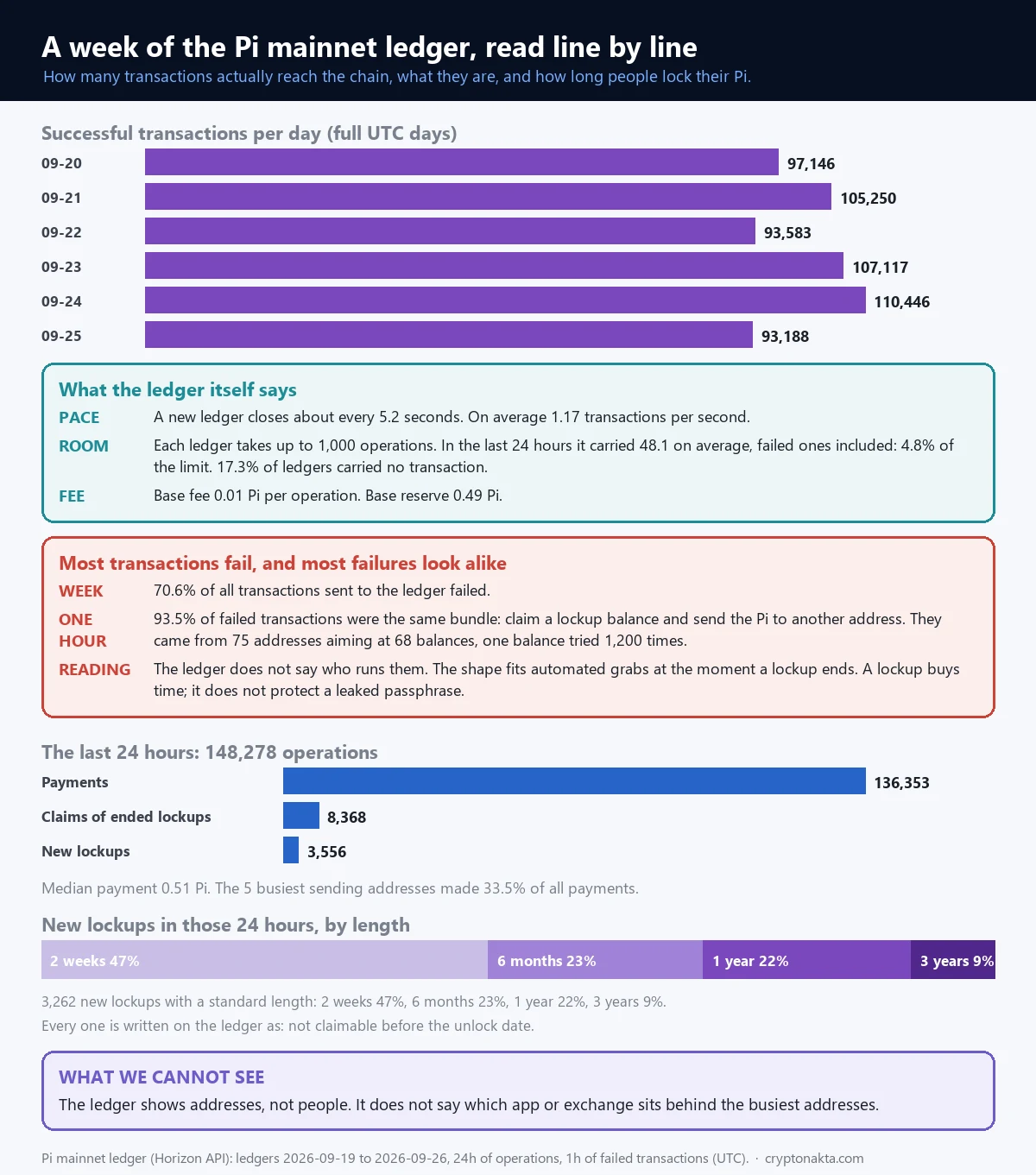
The window had 6 full UTC days. On those days the ledger confirmed 101,122 successful transactions a day on average. The quietest day had 93,188. The busiest had 110,446. That works out to about 1.17 transactions per second.
| Day (UTC) | Successful transactions | Failed transactions | Operations | Ledgers with no transactions |
|---|---|---|---|---|
| Sep 20, 2026 | 97,146 | 194,282 | 166,886 | 2,310 |
| Sep 21, 2026 | 105,250 | 214,877 | 170,219 | 2,637 |
| Sep 22, 2026 | 93,583 | 170,311 | 138,287 | 2,259 |
| Sep 23, 2026 | 107,117 | 251,099 | 174,052 | 2,630 |
| Sep 24, 2026 | 110,446 | 311,209 | 205,804 | 2,143 |
| Sep 25, 2026 | 93,188 | 318,145 | 149,801 | 2,345 |
Source: Pi Mainnet Horizon API, full UTC days inside our window, read on 2026-09-26. The network has a lot of spare capacity. A new ledger closed every 5.21 seconds on average, and 17.3% of them had no transactions at all.
Each ledger can take up to 1,000 operations, and one transaction can hold several. In the last 24 hours of our window, a ledger carried 48.1 operations on average, failed ones included. That is 4.8% of the limit. Successful operations alone averaged 8.9 per ledger.
We also pulled every operation in the 24 hours before our check. There were 148,278 of them. An operation is one action inside a transaction, such as a payment. They split into four kinds.
- Payments: 136,353
- Claims of lockups that had ended: 8,368
- New lockups: 3,556
- Other: 1
The typical payment was tiny. The median was 0.51 Pi, about 4.7 cents at the price we measured. Of all payments, 60.0% were for less than 1 Pi. Only 1,401 payments were for a thousand Pi or more. Not counting 975 payments where an address paid itself, about 21.6 million Pi moved between different addresses.
A small group did a big share of the sending. Only 9,922 addresses sent any Pi in those 24 hours. The top 5 senders sent 33.5% of all payments. The top 20 sent 48.3%. Compare that with the more than 16.5 million people the core team says have migrated. That’s about 0.06% of them, if each address were one person.
The ledger doesn’t say who owns those addresses. Some could be exchanges, apps or individual users. We don’t know, and we won’t guess.
Fees are small and fixed. The base fee is 0.01 Pi per operation. Since the Mainnet started, fees have added up to about 11.1 million Pi in the ledger’s fee pool. At the base fee that’s roughly 1.1 billion operations’ worth.
People are building on Pi too. Pi App Studio launched in June 2025. It lets people make apps without writing code. In 2025, people published about 13,400 chatbot apps and about 24,400 custom apps there. Pi’s 2025 hackathon drew more than 215 finished Mainnet apps.
A .pi domain auction ran from March 14 to September 30, 2025. Bids were in Pi only. Pi Network Ventures, a $100 million fund held in Pi and dollars, was announced in May 2025. The Mainnet switched to protocol version 27 at 16:09 UTC on September 22, 2026. We read that from the ledger itself.
We found no official announcement opening smart contracts or a Mainnet DEX to regular users. A DEX is an exchange built into the blockchain itself. So we don’t count either one as live.
Why most transactions on the Pi ledger fail
The strangest number from our week was the failure rate: 70.64% of all transactions failed. We wanted to know why. So we pulled every failed transaction between 06:18 and 07:18 UTC on September 26, 2026.
In that hour, 79.9% of transactions failed, 13,907 in all. Of those, 93.5% followed the same pattern. Each one tried to claim a locked balance and send it to another address in one go. They came from just 75 addresses, aimed at only 68 balances. One balance got 1,200 tries in that single hour.
Of the 45 addresses that added a send, 19 picked a different receiving address on each try. When we looked up some of the targeted balances, they were already gone. In the same hour 421 claims went through. Only 37 of those were the claim-and-send kind.
The ledger shows a few dozen addresses resending the same claim-and-send transaction every few seconds. They try to take a balance the moment its lockup ends and move it away. The ledger doesn’t say who runs them or why. The pattern fits bots that watch for lockup end times.
One detail matters for your own wallet. On Pi’s ledger a lockup names the account allowed to claim it, and that’s the owner’s own account. So a bot that keeps trying to claim someone’s lockup has to be able to sign for that account. If a passphrase has leaked, a lockup only buys time until its end date. At that moment the first valid claim takes the coins.
That’s why your passphrase matters more than any lockup. A lockup only stops Pi from moving for a while. It doesn’t keep Pi away from anyone who has your passphrase.
Pi Wallet passphrase recovery: why nobody can do it for you
The Pi Wallet is non-custodial. That means Pi doesn’t hold your coins for you. A passphrase controls your wallet. Exchange guides describe it as a list of 24 words. Pi’s FAQ says the passphrase is created on your phone and never goes to Pi’s servers.
So there’s no such thing as Pi Network wallet passphrase recovery. Pi can’t restore the wallet from its servers. If you lose the passphrase, you may lose all the Pi in that wallet. Pi’s FAQ says so directly.
Your passphrase is the whole wallet. Anyone who has the words can sign for your account from any device. There is only one place to type them: wallet.pinet.com inside the Pi Browser. On the real page, the browser’s top bar is purple with the Pi logo.
The core team says none of its members will ever ask for your login or authentication details. Official emails come only from @pi.email, @picoreteam.org and @minepi.com. A person or site asking for your passphrase is not Pi, whatever logo it shows.
If you think someone has seen your passphrase, act as if they have. Our guide on what to do when a seed phrase is exposed covers the general steps. On Pi, remember what the failed transactions showed. A lockup doesn’t stop someone who has your passphrase. It only makes them wait until the end date.
Selling starts in the Pi Wallet too, so the same passphrase protects every step of it.
How to sell Pi coin, step by step
Withdrawing or selling Pi means moving it from your Pi Wallet to an exchange and selling it there. Most exchanges trade PI against USDT. Go in this order to avoid the usual mistakes.
- Make sure the Pi is in your Pi Wallet on the Mainnet. Pi that’s still only in the app can’t be sent.
- Open an account on an exchange with a PI market and pass its identity check. Pi’s KYB list is a good place to start.
- On the exchange, open the PI deposit page. Copy the deposit address. If there is a memo field, copy the memo too.
- In the Pi Wallet, send a small test amount first. Wait until it shows up on the exchange.
- Send the rest. Leave a little Pi behind for the fee and the minimum balance.
- On the exchange, sell PI for USDT in the spot market.
- Sell the USDT for dollars and withdraw to your bank, if your exchange offers that for your account.
These four exchanges had PI/USDT markets when we checked, and all four are on Pi’s KYB list.
OKX

Gate.io

Bitget

MEXC

Affiliate disclosure: some links are partner links. We may earn a commission at no extra cost to you. This is not investment advice.
The memo is a short code some exchanges use to tell deposits apart. Many users send to the same address, and the memo says whose deposit it is. If the deposit screen shows a memo field, fill it in. Leave it out and the coins can arrive without anyone knowing they’re yours. Our guide on sending crypto without a memo covers what to do then.
Here’s what we found about memos for PI deposits on 2026-09-26.
| Exchange | Memo for PI deposits | Where that comes from |
|---|---|---|
| OKX | Not needed. OKX gives a deposit address that starts with M. | OKX’s PI deposit guide |
| Gate | Needed | Gate’s public deposit settings |
| Bitget | Unclear. The public settings say no memo. Bitget’s own wiki says to add one. | Bitget API and Bitget wiki |
| MEXC | We couldn’t confirm it | n/a |
These settings can change, so check the deposit screen every time. That’s what the test amount is for. It costs one extra fee and proves the address and memo work.
Each operation on the ledger costs a base fee of 0.01 Pi. A Pi account also has to keep a small reserve. The ledger’s base reserve is 0.49 Pi. Under Stellar-style rules, that means an empty account needs 0.98 Pi. That’s our own math from the ledger settings. We found no official Pi page that states it. The “you must keep 1 Pi” claim you see online had no source we could find.
Exchange settings change too. When we checked, Bitget’s public settings showed PI deposits on and PI withdrawals off. That may be temporary. Bitget also listed 20 confirmations for a PI deposit and a minimum deposit of 0.1084951 PI.
If a deposit doesn’t show up, don’t send more. Check the transaction on the ledger first. Then contact the exchange with the transaction ID. We have guides for a deposit that hasn’t been credited and for coins sent on the wrong network.
After the sale you hold USDT. Cashing out to dollars depends on the exchange and where you live. Check what your own account offers. Some people sell USDT to other users through P2P instead. If you do, read our note on P2P sales and frozen bank accounts first.
For readers in the US, Kraken is worth knowing. It had a PI/USD market when we checked, so you could sell PI straight for dollars there. Its PI/USD volume over 24 hours was $35,499. That’s much smaller than the USDT markets in the first table. Kraken started trading PI on March 13, 2026. OKX US listed PI on May 5, 2026.
Pi coin highest price, and why the price dropped
PI showed up on some exchanges long before Pi allowed any trading. On December 29, 2022, Huobi (now HTX) listed a PI IOU without the core team’s approval. An IOU is a promise to deliver a coin later. CoinGecko recorded an IOU high of $307.49 on December 30, 2022.
On January 6, 2023, the core team said it had nothing to do with those exchanges. It said the tokens traded there weren’t real Pi. Before the Open Mainnet, HTX settled those IOUs in USDT.
Real trading started on February 20, 2025. In the first minute alone, OKX saw trades anywhere from $0.10 to $2.20. The day closed at $0.871. The peak came six days later. On February 26, 2025, OKX’s daily high reached $3.00. CoinGecko puts the all-time high at $2.99 at 08:41 UTC that day.
| Moment | Date | Price |
|---|---|---|
| IOU high on HTX (not real Pi, per the core team) | Dec 30, 2022 | $307.49 (CoinGecko) |
| First trading day, first minute | Feb 20, 2025 | $0.10 to $2.20 |
| First trading day, close | Feb 20, 2025 | $0.871 |
| Highest daily high | Feb 26, 2025 | $3.00 |
| Lowest daily low | Jul 14, 2026 | $0.07032 |
| Our check | Sep 26, 2026 | $0.09133 |
Prices are OKX PI/USDT daily candles unless noted, read on 2026-09-26. At our check, the price was 97.0% below that high and 89.5% below the first day’s close. It was also 29.9% above the low of July 14, 2026. PI had been trading for 584 days.
Why did the Pi Network price drop? People buying and selling on order books set the price. We can’t see why each seller sells, but we can show what changed in supply.
CoinGecko counted 11.24 billion PI in circulation. That’s 11.2% of the 100 billion maximum. It put the total supply at 17.30 billion. The ledger itself shows 100 billion Pi in total. That means every coin sits in some account on the ledger, not that all of them are in circulation.
Each migration puts more Pi into wallets that can reach an exchange. Whether a holder sells is up to them. The chart below shows why the size of the supply matters for any price you hear.
 View full size ↗
What would it take for Pi to hit $1, and what is GCV?
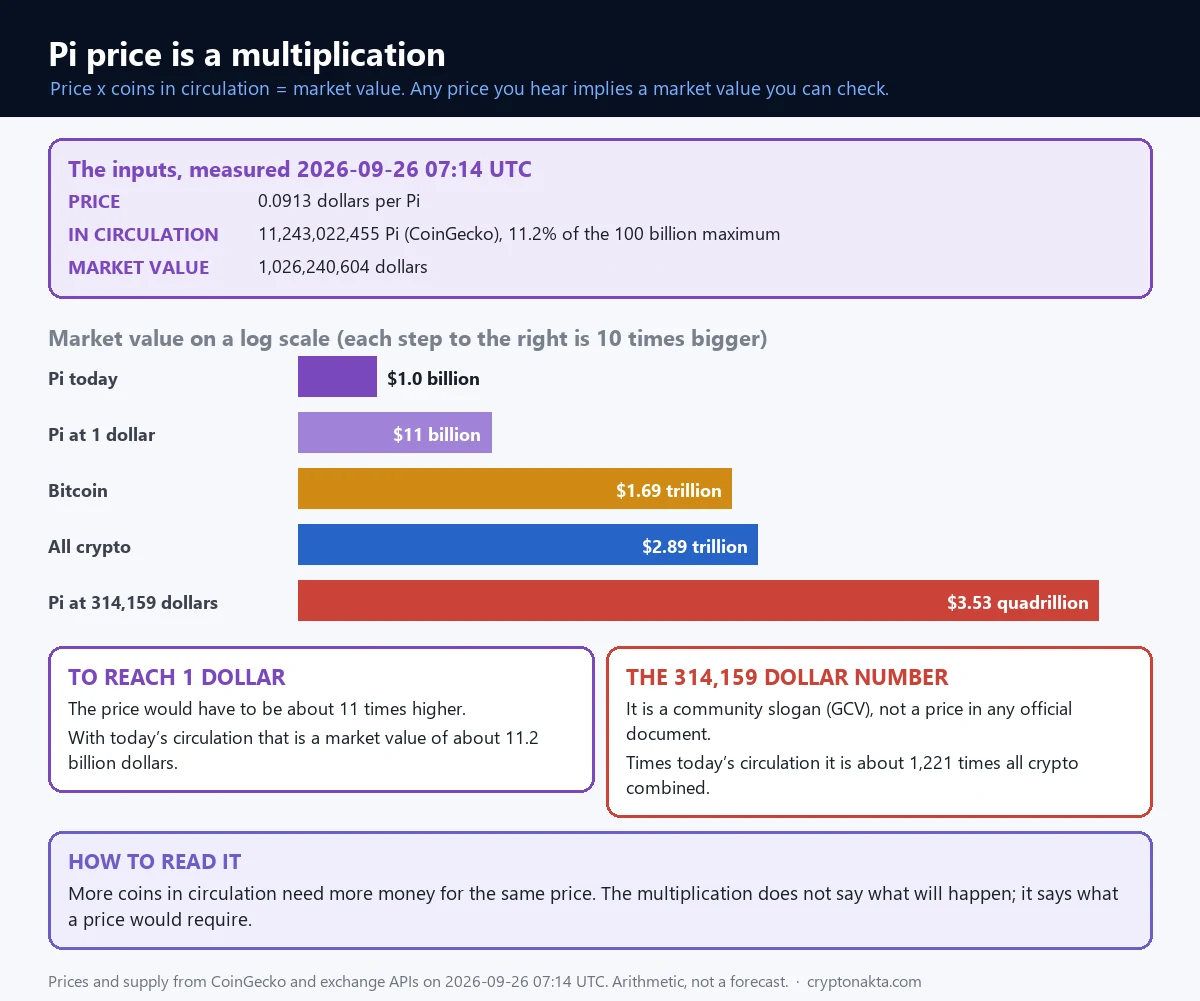
A coin’s price times the coins in circulation gives its market cap. That’s the total value the market puts on all of them. At our measured price of $0.0913 and 11.24 billion PI in circulation, Pi’s market cap was about $1.03 billion.
For 1 Pi to equal $1 with the same supply, the price would need to go up about 11.0 times. The market cap would then be about $11.24 billion. This is multiplication, not a forecast. It only shows how big the number is.
GCV stands for Global Consensus Value. It’s a community campaign to treat 1 Pi as worth $314,159. The figure comes from pi (3.14159) times 100,000. It spread through barter posts and social media. We found nothing in the white paper, the official blog or the FAQ that proposes or supports it.
So GCV is a community slogan. The price is what buyers and sellers agree on at the exchange. At GCV, the market cap of circulating Pi would be about $3.53 quadrillion. That’s about 1,221 times the value of the entire crypto market.
| Price per Pi | Market cap of circulating Pi | Compared with the whole crypto market ($2.89 trillion) |
|---|---|---|
| $0.0913 (measured) | $1.03 billion | 0.035% of it |
| $1.00 | $11.24 billion | 0.39% of it |
| $314,159 (GCV) | $3.53 quadrillion | 1,221 times it |
Prices, supply and the total crypto market cap from CoinGecko at 07:14 UTC on 2026-09-26. For scale, bitcoin alone was worth $1.69 trillion. Priced at GCV, all 100 billion Pi would come to $31.4 quadrillion.
The GCV figure is about 3.4 million times the price we measured. Anyone who sells you something for Pi sets their own rate. So does anyone who offers to buy your Pi. Compare their rate with the order book price before you agree.
Is Pi Network on Binance?
No. Binance had no PI market when we checked on September 26, 2026. Its spot and futures APIs both returned “invalid symbol” for PIUSDT. PI wasn’t in its list of deposit networks either.
Binance did run a community vote on listing Pi from February 17 to 27, 2025. It said the votes were for reference only. No listing had followed as of our check.
| Exchange | What we checked | Result |
|---|---|---|
| Binance | Spot and futures PIUSDT, deposit network list | No PI market |
| Bybit | Spot PIUSDT | No PI market |
| KuCoin | PI as a currency | Not listed |
| HTX | PI/USDT symbol | No PI market |
| Coinbase | PI-USD product | No PI market |
Each exchange’s public API, checked on 2026-09-26. The Binance listing rumor keeps coming back. A listing is real only when the exchange announces it and the market shows up on its trading screen. Until then it’s a rumor, whatever a video or post says.
Pi’s KYB list is the other check. The core team asks users not to use exchanges that claim Pi support but aren’t on it. CoinGecko showed a PI market on CoinW, which isn’t on Pi’s KYB list. HTX and BitMart aren’t on it either. For a general look at choosing an exchange, see our guide to the best crypto exchanges.
Pi Network scams and how to spot them
Pi scams tend to follow the same few patterns. Each one below comes with a check you can do yourself.
| What you see | How to check |
|---|---|
| Someone asks for your passphrase to “verify” your wallet or “fix” your KYC | The core team never asks for login details. The passphrase goes only into wallet.pinet.com in the Pi Browser. |
| A wallet page that looks like Pi’s | The real one opens in the Pi Browser at wallet.pinet.com. Its top bar is purple with the Pi logo. |
| A text or link offering to end your lockup early | A lockup can’t be ended early. The ledger refuses any claim before the date. |
| Pre-sale Pi, IOUs or “buy before the listing” deals | The core team said the IOUs traded in 2022 weren’t real Pi. |
| An exchange or app that says it’s “integrated with Pi” | Look for it on Pi’s KYB list at minepi.com. |
| An email about your Pi account | Official mail comes only from @pi.email, @picoreteam.org or @minepi.com. |
| A buyer or seller quoting the GCV rate | Compare it with the price on an exchange order book. |
| A free Pi “airdrop” that asks you to connect a wallet | See our guide to telling a real airdrop from a wallet drainer. |
The first three rows are all after the same thing: your passphrase, or a click that gets you to type it in. Pi’s safety page says that once you give your passphrase to a phishing site, there’s no undoing it, because blockchain transactions can’t be reversed.
If it’s already happened, be careful with “recovery” offers. Some of them are a second scam. Our guide on whether scammed crypto can be recovered explains what is realistic. For airdrop links, read real airdrop or wallet drainer. For the wider picture there’s our guide to crypto scams.
My take: what the ledger shows and what it can’t
Pi promised a coin that anyone could earn on a phone. The core team reports big numbers. It counted more than 60 million Pioneers in March 2025. By March 2026 it reported 17.7 million KYC-verified users and over 16.5 million who had migrated.
The ledger shows a smaller picture. Only 9,922 addresses sent any Pi in the 24 hours we measured. The network used 4.8% of its capacity. I can’t tell you who is behind those addresses. I also can’t tell you how many people use Pi without touching the ledger. I can only show what the record says.
Who is this article for? People who want to sort out an app balance and move it. People who got a message about their wallet or their lockup. And people wondering whether to buy PI at all. Each of those questions has its own section above.
What I trust least is the story that spreads fastest. GCV and “Binance is about to list Pi” get shared the most. Neither one is backed by the order books or by any exchange announcement. At our check the price was $0.0913, and Binance had no PI market.
There’s a real case on the other side too. Millions of people have passed KYC, by the core team’s count. The Mainnet runs, and anyone can read it the way we did. PI trades every day on several exchanges, including Kraken and OKX. Pi is more than an app with a number in it.
I won’t tell you whether to sell or keep your Pi. That depends on your own situation. The numbers here are measured and dated so you can judge them yourself.
A quick disclosure: this site uses affiliate (referral) links, including the exchange cards in the selling section. If you sign up through them, we may earn a commission. That doesn’t change any number in this article.
Questions Pioneers ask about Pi Network
OKX referral code: how to sign up and where to enter the code