Binance Dual Investment Explained: Earnings Calculator, Picking a Target Price, Risks
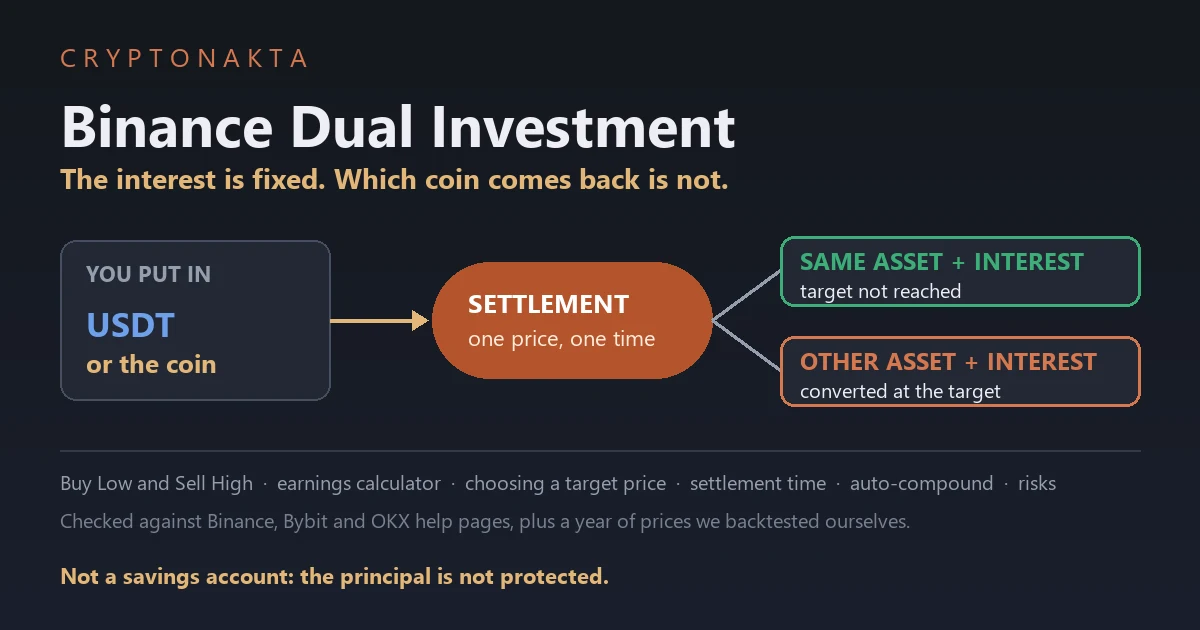
Binance Dual Investment is a product where your interest is fixed in advance and the coin you get back is not. You put in stablecoins or a coin, pick a target price and a date, and one settlement price decides whether you end up with the coin or the stablecoin. The interest comes either way.
So when a friend asks whether that huge APR on Binance is worth it, the honest answer needs numbers. In October 2026 I read the Binance, Bybit and OKX rules on the same day. I replayed a full year of Binance prices with a virtual subscription every hour. Then I checked that morning’s rates against what conversions had cost.
In this article (13)
Is Binance Dual Investment safe, and how does it actually work?How often does Dual Investment convert? A year of Binance prices, replayed hourlyIs the APR enough? Break-even APR vs what Binance offeredWhat does a huge Dual Investment APR actually pay you?Why is the Dual Investment APR so high?Binance Dual Investment calculator: work out both outcomes firstHow to pick a target price, and how it compares with a limit orderBinance Dual Investment settlement time: fixed at 08:00 UTC, paid by 14:00What happened on the biggest crash and rally days?Can you cancel Dual Investment or withdraw early?Binance Dual Investment Auto-Compound and Auto-Reverse, explainedBybit Dual Asset and OKX Dual Investment vs BinanceMy take: is Binance Dual Investment worth it?
Is Binance Dual Investment safe, and how does it actually work?
Binance Dual Investment is a structured product that pays a fixed interest rate, while one settlement price decides which coin you get back. You always receive the interest. Your principal has no protection, so it is not a risk-free place to park money.

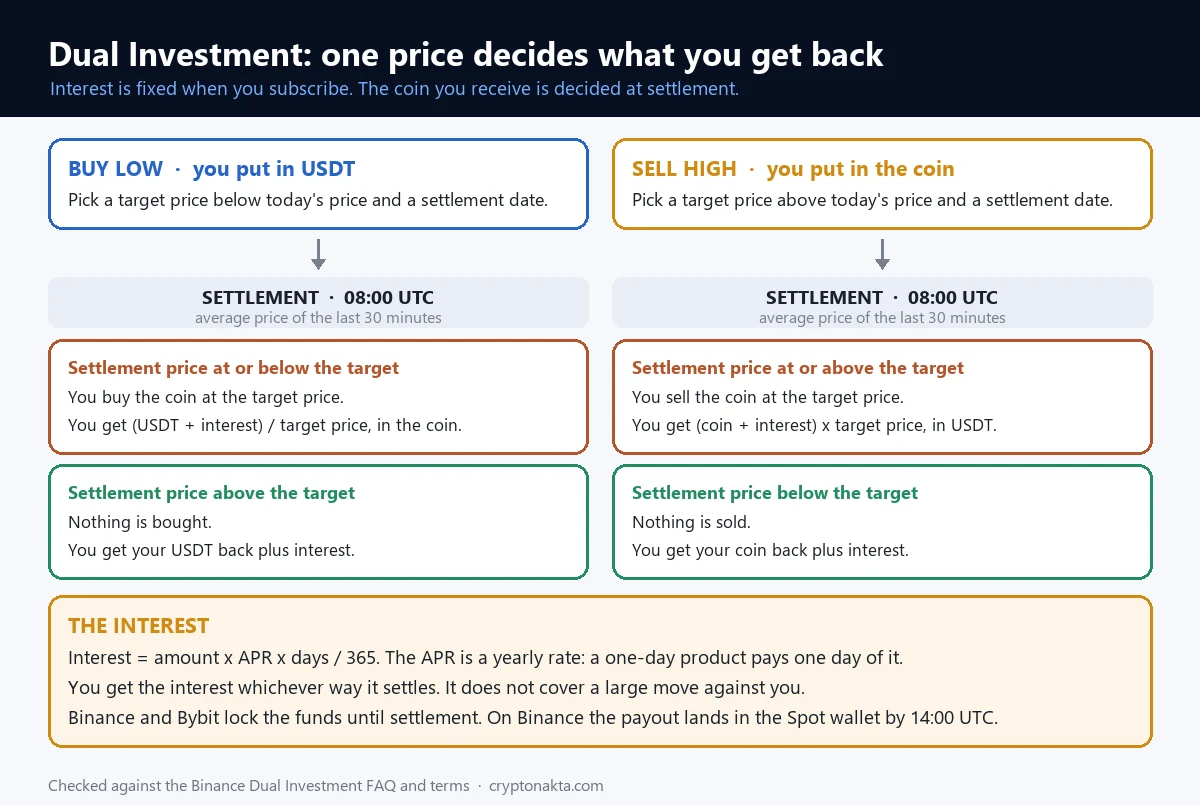
You pick three things on the screen: a direction, a target price and a settlement date. The target price is the price at which Binance will buy or sell the coin for you. On that date Binance compares its settlement price with your target. The settlement price is the average market price over the last 30 minutes before 08:00 UTC.
Buy Low means you put in USDT or USDC and offer to buy a coin below today’s price. Sell High means you put in the coin itself and offer to sell it above today’s price. If the settlement price reaches your target, the trade happens and your money is converted. If it doesn’t, you get back what you put in. Interest is added in both cases.
 View full size ↗
| You choose | You put in | Settlement price vs your target | What comes back |
|---|---|---|---|
| Buy Low | USDT or USDC | At or below the target | The coin: (amount + interest) / target price |
| Buy Low | USDT or USDC | Above the target | Your stablecoin: amount + interest |
| Sell High | The coin (BTC, ETH and others) | At or above the target | USDT or USDC: (amount + interest) x target price |
| Sell High | The coin (BTC, ETH and others) | Below the target | Your coin: amount + interest |
Dual Investment is Binance’s name for this structured product, a package that ties a fixed payout to a price condition. Bybit sells the same idea as Dual Asset. On Binance you’ll find it under Earn, then High Yield, then Dual Investment.
Dual Investment is not a savings account. The interest is set the moment you subscribe, yet the coin you get back can change. If you end up holding a coin that then falls, your balance is worth less than you put in. That is what no principal protection means. Binance’s own FAQ calls it “not a risk-free investment.”
It also uses no borrowed money, so there’s no liquidation. Our guide on how much leverage to use covers that other world. It isn’t flexible savings either. Our crypto Earn guide explains those, and the Binance features overview shows where Dual Investment sits in the app.
How often does Dual Investment convert? A year of Binance prices, replayed hourly
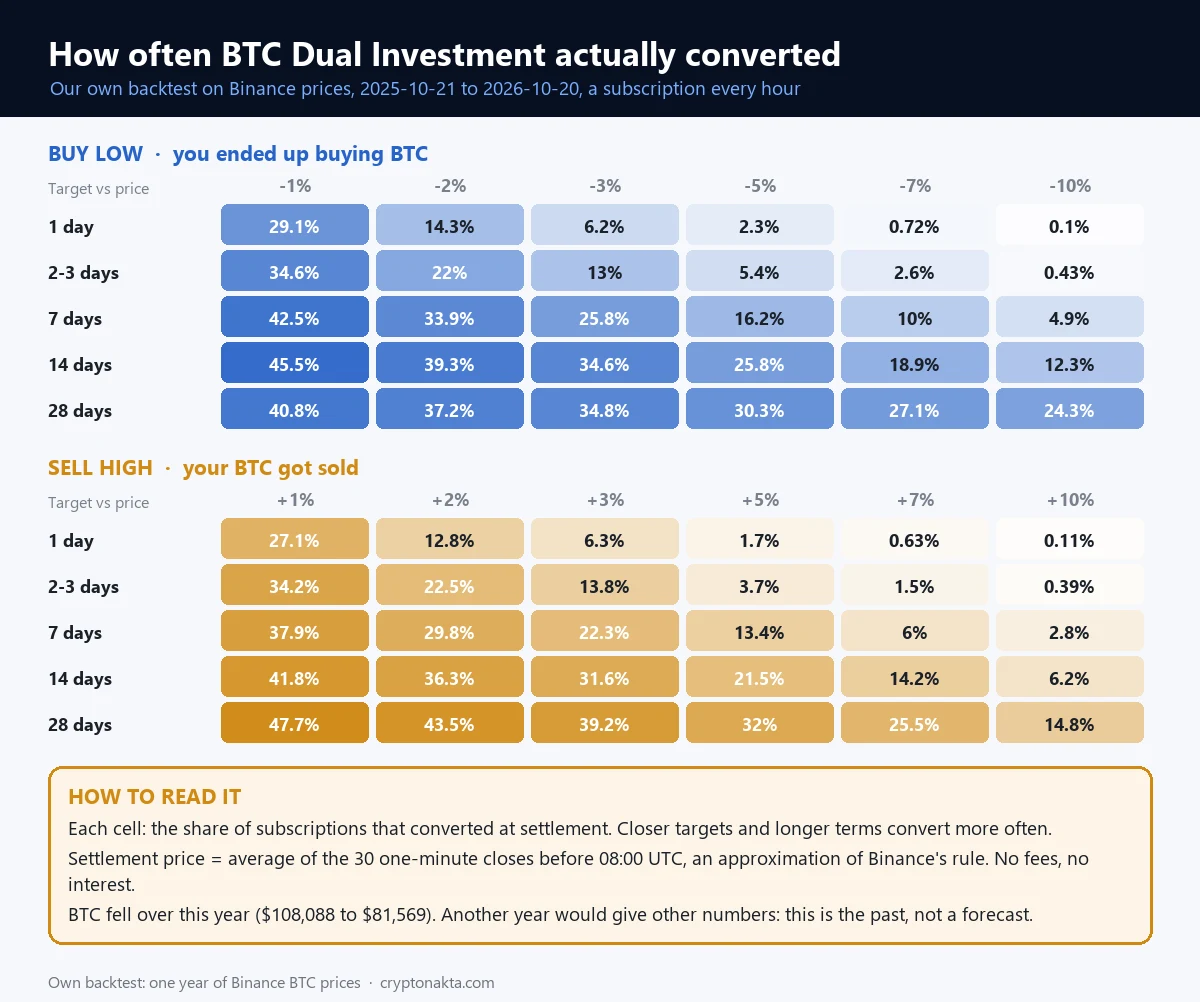
Over the past year, a one-day BTC Buy Low set 2% below the price converted 14.3% of the time. I got that by replaying Binance BTC prices from October 21, 2025 to October 20, 2026 with a virtual subscription every hour. Closer targets and longer terms usually converted more often.
The method was simple. I pulled one-hour candles from Binance’s public spot API. For each settlement day I averaged the 30 one-minute closes from 07:30 to 07:59 UTC. That’s my stand-in for Binance’s settlement price, whose exact source isn’t published.
Every hour I placed a virtual subscription with a target 1% to 20% away from the price. Settlement days followed the real product list. I counted only whether it converted, with no fees, slippage or interest.
| Product and term | 1% away | 2% away | 3% away | 5% away | 10% away |
|---|---|---|---|---|---|
| BTC Buy Low · 1 day | 29.1% | 14.3% | 6.2% | 2.3% | 0.1% |
| BTC Buy Low · 2 to 3 days | 34.6% | 22% | 13% | 5.4% | 0.43% |
| BTC Buy Low · 7 days | 42.5% | 33.9% | 25.8% | 16.2% | 4.9% |
| BTC Buy Low · 14 days | 45.5% | 39.3% | 34.6% | 25.8% | 12.3% |
| BTC Buy Low · 28 days | 40.8% | 37.2% | 34.8% | 30.3% | 24.3% |
| BTC Sell High · 1 day | 27.1% | 12.8% | 6.3% | 1.7% | 0.11% |
| BTC Sell High · 7 days | 37.9% | 29.8% | 22.3% | 13.4% | 2.8% |
| BTC Sell High · 28 days | 47.7% | 43.5% | 39.2% | 32% | 14.8% |
| ETH Buy Low · 1 day | 34.1% | 21.7% | 12.9% | 5.2% | 0.3% |
| ETH Buy Low · 7 days | 43.6% | 37.5% | 31.8% | 22.9% | 9.9% |
This was a falling year for BTC. Its settlement price went from $108,088 to $81,569, a change of -24.5%. The lowest settlement was $58,726 and the highest $115,667. ETH fell further, -38.6% from first to last. A different year would give other numbers.
Distance and term both mattered. A one-day Buy Low 10% below converted 0.1% of the time. A 28-day one at the same distance converted 24.3%.
ETH and SOL converted more often than BTC at the same distance. A one-day Buy Low 2% below converted 21.7% for ETH and 23.6% for SOL. BNB came in at 13.5%. A coin that swings more needs a farther target to get the same odds.
Our year of data is past prices from a year with a big drop in it, not a forecast. Change the window and the results flip, as the next section shows. Read these as “how often this happened,” never as “how often it will happen.”
Is the APR enough? Break-even APR vs what Binance offered
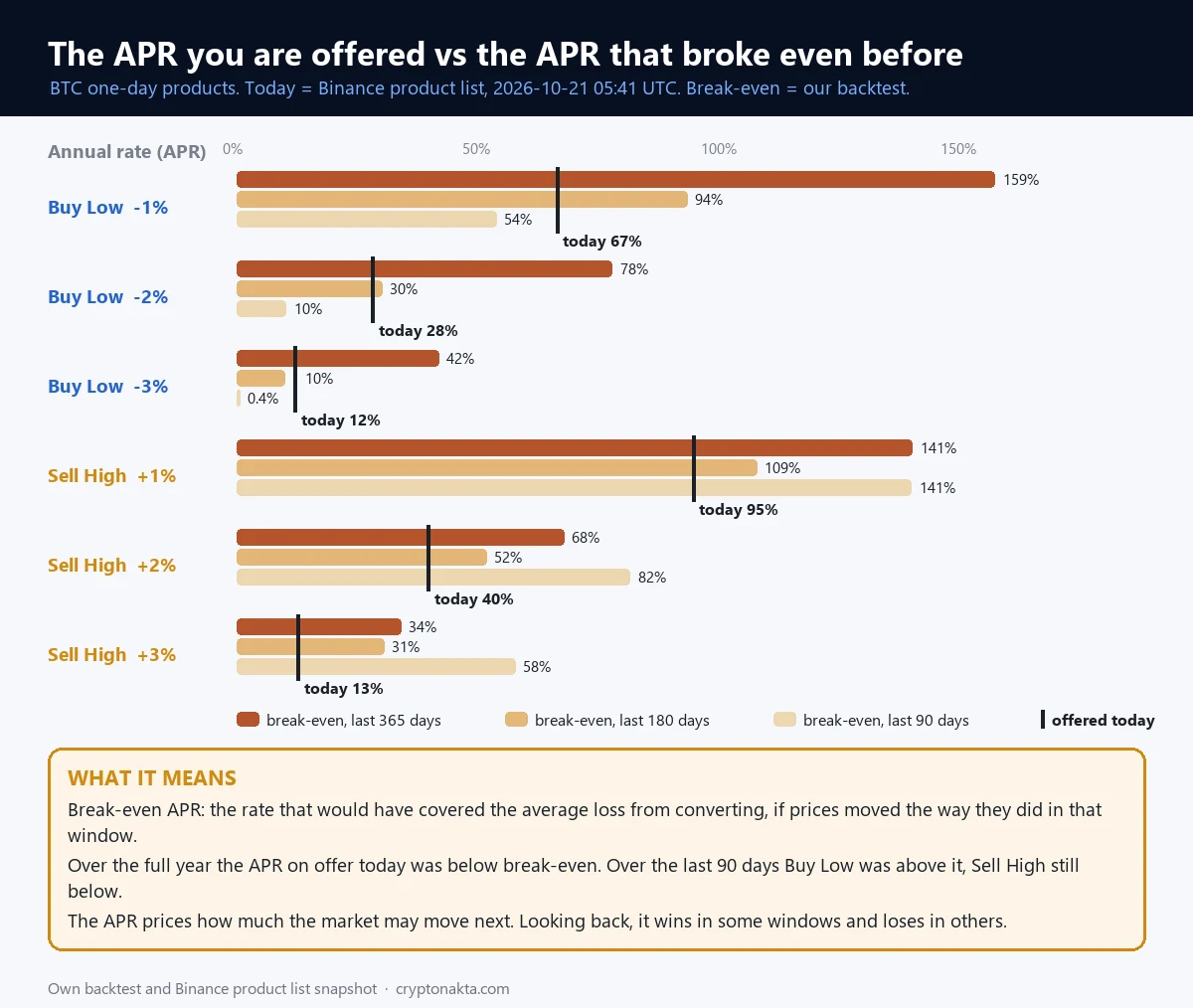
On October 21, 2026, every BTC Dual Investment APR in my table (the yearly rate Binance quotes) sat below the break-even APR from the full past year. Against the last 90 days, the Buy Low offers I could measure came out above it. A one-day Buy Low 2% below paid 28%, against a break-even of 78% over a year and 10% over 90 days.
The break-even APR is my own measure. It’s the APR that would have covered the average loss from conversions in a given window. Subscriptions that didn’t convert count as zero loss. If the APR you’re offered beats it, the past window would have paid you more than it cost. If not, conversions cost more than the interest.
 View full size ↗
The APRs come from one look at the public product list the Binance website uses, at 2026-10-21 05:41 UTC. That list isn’t documented, and I read its APR field as a decimal where 1 means 100%. “Actual distance” is how far the nearest real product sat from the price.
| Product | APR offered 2026-10-21 (actual distance · term) | Break-even APR, last 365 days | Last 180 days | Last 90 days | Converted, last year |
|---|---|---|---|---|---|
| BTC Buy Low · 1 day · 1% below | 67% (1.1% · 1 day) | 159% | 94% | 54% | 29.1% |
| BTC Buy Low · 1 day · 2% below | 28% (2% · 1 day) | 78% | 30% | 10% | 14.3% |
| BTC Buy Low · 1 day · 3% below | 12% (3.2% · 1 day) | 42% | 10% | 0.43% | 6.2% |
| BTC Buy Low · 2 days · 2% below | 37% (2% · 2 days) | 84% | 45% | 11% | 22% |
| BTC Buy Low · 7 days · 5% below | 13% (5.1% · 7 days) | 36% | not measured | not measured | 16.2% |
| BTC Sell High · 1 day · 1% above | 95% (0.98% · 1 day) | 141% | 109% | 141% | 27.1% |
| BTC Sell High · 1 day · 2% above | 40% (1.9% · 1 day) | 68% | 52% | 82% | 12.8% |
| BTC Sell High · 1 day · 3% above | 13% (3.1% · 1 day) | 34% | 31% | 58% | 6.3% |
| ETH Buy Low · 7 days · 5% below | 32% (4.7% · 7 days) | 73% | not measured | not measured | 22.9% |
The window changes everything. Over 365 days, the one-day 2% Buy Low needed 78% to break even. Over 180 days it needed 30%, and over 90 days only 10%. Buy Low conversions cost far less in the recent quarter, so today’s 28% would have covered them there.
Sell High went the other way. A one-day Sell High 2% above needed 68% over a year and 82% over 90 days. The recent window includes the August rally, when BTC kept climbing after Sell High targets were hit. Today’s offer of 40% was below both.
So I can’t call Dual Investment a losing product from one year of data. The APR is priced on how much the market might move next. Looking back, it beat the cost in some windows and lost in others.
What does a huge Dual Investment APR actually pay you?
A big Dual Investment APR pays far less than it looks, because you only get the part that matches your term. The APR is a yearly rate, so a one-day product pays one day of it. A 52% APR on a two-day product pays about 0.28%, or 2.8 USDT on 1,000 USDT.
The APR (annual percentage rate) is simple interest worked out over 365 days. Binance’s formula is short. Rewards equal the subscription amount times APR times days, divided by 365. Some Binance screens label the same number APY, yet the math in the FAQ is this simple APR formula.
One detail trims short, low-APR orders. Binance rounds the factor “APR x days / 365” down to four decimal places before it multiplies. The FAQ’s own example is 1,000 USDT at 85.3% for two days. The exact factor is 0.004674, so it becomes 0.0046, and you get 4.6 USDT. On 1,000 USDT at 37.1% for two days, the math says 2.03 USDT and you’d receive 2 USDT.
| APR on the screen | Term | What the term actually pays | On 1,000 USDT |
|---|---|---|---|
| 52% | 2 days | 0.28% | 2.8 USDT |
| 400% | 1 day | 1.1% | 10.9 USDT |
| 85.3% (Binance FAQ example) | 2 days | 0.46% after rounding down | 4.6 USDT |
| 37% (BTC Buy Low, about 2% below, 2026-10-21) | 2 days | 0.2% | 2 USDT |
People mix this up all the time. One Reddit poster saw an APY near 500% on a three-day ADA product and expected about $870. Three days of a yearly rate is a few percent. The coin side of the deal can still move against you.
Another common reading goes “52% if it hits the target, and 52% if it doesn’t, so how can it lose?” The interest really is paid both ways. The catch is the currency. When the target is hit, you get a coin bought at the target price, and the market may already be lower.
The USDT vs USDC choice barely matters here. On October 21, 2026 the Binance list offered both for Buy Low, at slightly different APRs. Minimums vary by product. That day they were 0.0001 for BTC and ETH, and 10 USDT for Buy Low.
Why is the Dual Investment APR so high?
The Dual Investment APR is high because the product works like selling an option, and the APR is what the buyer pays you. OKX says so in its own FAQ. Its return logic is “to help customers sell call or put options in the options marketplace, thereby earning premium, which is your return.”
An option is a contract that gives the buyer the right to trade at a fixed price later. The option premium is what the buyer pays for that right. In Dual Investment you are the seller, and the premium arrives as your APR. Gate’s FAQ describes the product the same way, as “a structured product based on selling options.”
Buy Low works like selling a put option, which is a promise to buy at the target if the price falls there. Sell High works like a covered call, a promise to sell a coin you already hold if the price rises there. OKX’s terms add that the user “is effectively selling an option.”
Binance’s own help pages never use the word option. Its API, though, names the product family “dci”, with a parameter optionType CALL or PUT and a field called strikePrice. Bybit only says the funds are “deployed to the Bybit Derivatives market via advanced strategies.”
So the APR follows option pricing. A target close to today’s price, a short term and a jumpy market all raise it. They also raise the chance that you get converted. An older Binance FAQ named the same inputs: target price, days left and price volatility.
That’s why “the APR is always paid” doesn’t mean the product always wins. The option buyer pays you a fixed premium. In return, the buyer gets the better side of any big move.
Binance Dual Investment calculator: work out both outcomes first
The Binance Dual Investment calculator below works out both outcomes before you subscribe. Enter the amount, target price, APR, term and a settlement price you want to test. It shows the interest with Binance’s rounding and what you’d get back if the target is reached or missed.
The same math by hand looks like this. The first two rows use round example numbers. The last row is the worked example from Binance’s FAQ.
| Example numbers | Interest | Target not reached | Target reached |
|---|---|---|---|
| Buy Low · 1,000 USDT · APR 30% · 7 days · target $80,000 | 5.7 USDT | 1,000 + 5.7 USDT | (1,000 + 5.7) / 80,000 = 0.01257125 BTC |
| Sell High · 0.1 BTC · APR 30% · 7 days · target $90,000 | 0.00057 BTC | 0.1 + 0.00057 BTC | (0.1 + 0.00057) x 90,000 = 9,051.3 USDT |
| Binance FAQ · Buy Low · 1,000 USDT · APR 85.3% · 2 days | 4.6 USDT | 1,004.6 USDT | The FAQ shows only the not-reached case |
Try two settlement prices for every idea. One just past your target, and one far past it. The first shows the normal case. The second shows what a bad day looks like, since the amount of coin you receive is fixed by the target, not by the market.
For Sell High, the far case is a rally. Your coin is sold at the target while the market keeps going. The calculator can’t show the upside you gave up, so compare the target with a few recent highs yourself.
There’s also a large-order version called Dual Investment RFQ, for orders up to $20 million. It skips the rounding and pays by 12:00 UTC. Most readers can ignore it.
How to pick a target price, and how it compares with a limit order
Picking a Dual Investment target price is a trade between interest and the odds of conversion. A closer target pays more APR and converts more often. A farther one pays less and converts less. The conversion table above shows how often each one converted last year.
Start from the trade you’d make anyway. If you’d happily buy BTC lower, Buy Low fits that plan. If you’d be glad to sell some higher, Sell High fits. If you’d hate either outcome, the APR is paying you to accept it.
 View full size ↗
Then look at what happens around the target. The price often touches it during the term and comes back before settlement. For a one-day BTC Buy Low 2% below, that happened 19.5% of the time. That’s more often than it converted at all (14.3%).
| BTC Buy Low | Converted | Touched the target, then came back | When converted: median drop past target | Worst 10% | Worst case |
|---|---|---|---|---|---|
| 1 day · 2% below | 14.3% | 19.5% | 0.86% | 3.8% | 9.6% |
| 1 day · 3% below | 6.2% | 11.3% | 1.7% | 4.3% | 8.7% |
| 1 day · 5% below | 2.3% | 3.3% | 1.2% | 3.9% | 6.8% |
| 7 days · 2% below | 33.9% | 37.2% | 2.9% | 10% | 21.2% |
| 7 days · 5% below | 16.2% | 16.8% | 2.9% | 9% | 18.7% |
This matters if you’re comparing with a limit order. A limit order is a standing order to buy or sell at a set price on the order book. It fills the moment the price gets there. A limit buy at the same target would probably have filled on many of those touch-and-return days. Dual Investment paid interest on those days instead, and you kept your USDT.
The other side of the table is the drop past the target. When the one-day 2% Buy Low converted, the settlement price sat a median 0.86% below the target. In the worst 10% of cases it was 3.8% or more, and the worst case was 9.6%. For a seven-day Buy Low 5% below, the median was 2.9% and the worst 18.7%.
So the choice comes down to three questions. Would you be fine owning the coin at this target? Would you be fine if it never gets there? Is the interest worth the chance in the table? Our order book guide explains how limit orders fill.
Some people automate “buy lower, sell higher” with a grid trading bot instead. A grid places many limit orders at once. Dual Investment makes one decision per term.
Binance Dual Investment settlement time: fixed at 08:00 UTC, paid by 14:00
Binance Dual Investment settles at 08:00 UTC on the settlement date and pays out by 14:00 UTC. Only the average of the last 30 minutes before 08:00 UTC counts. Where the price went during the term doesn’t decide anything.
Binance’s FAQ says the payout reaches your Spot wallet within 6 hours, by 14:00 UTC. Its terms call the settlement price a time-weighted average. One Reddit question keeps coming back: it’s 9:41 UTC and nothing has settled yet. That’s normal. 08:00 is the fixing time, and the payout can take until 14:00.
In local time, 08:00 UTC is 09:00 in London during summer time and 08:00 in winter. In New York it’s 04:00 in summer and 03:00 in winter. In Singapore it’s 16:00 all year. The 14:00 UTC payout deadline is 10:00 in a New York summer and 22:00 in Singapore.
Settlement days are less fixed than the help page says. The FAQ text still says BTC, ETH and BNB settle on Tuesdays and Fridays. The product list on October 21, 2026 showed BTC and ETH settling every weekday, BNB and SOL on Tuesday and Friday, and many others on Fridays only. The time is always 08:00 UTC, so pick the date from what your screen shows.
Here’s a real day from our backtest. On February 3, 2026 at 08:00 UTC, BTC was $78,797. A one-day Buy Low 3% below had a target of $76,433. During the day the hourly low hit $72,946, or -4.56% against the target.
 View full size ↗
Then the price came back. The settlement average was $76,504, or +0.09% against the target. Nothing was bought, and the USDT came back with interest. A limit order at $76,433 would have filled that day. ETH did the same, with a low at -6.49% and a settlement at +1.23% against its target.
Your past results sit under Orders, then Earn History, then Dual Investment on the web.
What happened on the biggest crash and rally days?
On the biggest Dual Investment crash days, a Buy Low bought BTC above where the market settled. BTC’s largest one-day fall in our year was 8.8%, starting November 20, 2025. A one-day Buy Low 5% below converted that day, and the settlement price sat -4% against the target.
I picked the three biggest falls and the three biggest rises, measured from 08:00 to 08:00 UTC. For each one I checked a one-day product 5% away. Then I looked at the price 30 days later. It’s a replay of past days, nothing more.
| Day (08:00 to 08:00 UTC) | Move that day | Subscription | At settlement | 30 days later |
|---|---|---|---|---|
| Nov 20, 2025 | BTC -8.8% | Buy Low, 1 day, 5% below | Bought; settlement was -4% vs target | +0.58% vs the buy price |
| Feb 5, 2026 | BTC -8.4% | Buy Low, 1 day, 5% below | Bought; settlement was -3.6% vs target | -0.31% vs the buy price |
| Feb 4, 2026 | BTC -7.1% | Buy Low, 1 day, 5% below | Bought; settlement was -2.2% vs target | -6.7% vs the buy price |
| Dec 2, 2025 | BTC +6.9% | Sell High, 1 day, 5% above | Sold; settlement was +1.8% vs target | -2.7% vs the sell price |
| Aug 19, 2026 | BTC +8.2% | Sell High, 1 day, 5% above | Sold; settlement was +3% vs target | +20% vs the sell price |
| Aug 20, 2026 | BTC +9.8% | Sell High, 1 day, 5% above | Sold; settlement was +4.5% vs target | +9.9% vs the sell price |
| Jan 31, 2026 | ETH -9.7% | Buy Low, 1 day, 5% below | Bought; settlement was -4.9% vs target | -21.5% vs the buy price |
The same kind of crash ended differently a month later. Thirty days after November 20, 2025, BTC stood at +0.58% against that buy price. After February 4, 2026 it stood at -6.7%. ETH had the harshest case. The fall starting January 31, 2026 was -9.7%. The Buy Low settled at -4.9% against its target, and 30 days later ETH was at -21.5%.
The interest does not cover a large drop. A one-day BTC Buy Low about 1% below paid 67% APR on October 21, 2026. For one day, that’s 0.18%. A settlement a few percent under the target wipes that out many times over. OKX’s terms say it directly: the yield “may be insufficient to offset the capital loss.”
Rally days hurt Sell High in a quieter way. On August 19, 2026, BTC moved +8.2%. A one-day Sell High 5% above sold, and the settlement landed +3% past the sell price. Thirty days later BTC stood at +20% against it. You keep the USDT and the interest, and you miss the rest.
Can you cancel Dual Investment or withdraw early?
On Binance and Bybit you can’t cancel or withdraw a subscription before settlement. OKX is the exception. It offers early redemption on most pairs, and that exit can cost you money.
Binance’s FAQ says you “cannot edit, cancel, or redeem your subscription” once you subscribe. Your target price, settlement date and APR are fixed from that moment. Bybit’s FAQ says the same for Dual Asset.
So check two things before you press Subscribe: that you won’t need this money before settlement, and that you’re fine with either outcome. If the market drops the next day, the subscription simply runs to its date.
OKX added early redemption on August 11, 2025, which lets you exit before the end date. It covers all Dual Investment products except the ETH/BTC pair. The window opens when interest starts and closes one hour before expiry. OKX warns that “early redemption may result in a loss.”
There are two more limits on OKX. You get back only the currency you put in, so a BTC subscription redeems as BTC. And OKX’s terms say it “is under no obligation to agree to an early unwind.” You can ask, and OKX decides.
Binance Dual Investment Auto-Compound and Auto-Reverse, explained
Binance Dual Investment Auto-Compound rolls your money into a new product after settlement, in one of three ways. Auto-Reverse sets the new target price from the market price at that moment, not from what you paid. That detail decides whether it helps you.
Auto-Compound means Binance reinvests your principal and interest automatically when a subscription settles. You can turn it on, turn it off or edit it up to 30 minutes before the settlement time. Auto-Reverse is the version that flips direction after a conversion, so a Buy Low that bought BTC turns into a Sell High.
| Auto-Compound setting | What happens at settlement | Watch for |
|---|---|---|
| Default | Principal and interest go into a new product with the same price difference and APR as before | If nothing suitable shows up within 8 hours, the funds go back to your Spot wallet |
| Auto-Reverse | If your target was reached, the new subscription goes the opposite way (Buy Low becomes Sell High) | The new target is set from the market price at that moment |
| Advanced Settings | You set a minimum APR, a target price difference and a settlement date | If no product fits before 16:00 UTC on the settlement date, funds go back to Spot |
Binance’s own example shows where Auto-Reverse can hurt. A user puts 110,000 USDT into a BTC Buy Low. At settlement it converts to 1.01 BTC. Advanced Settings ask for at least 50% APR, five days and a $1,000 difference. So Auto-Reverse enters a BTC Sell High with a target of at least $101,000. That’s the market price of $100,000 plus $1,000.
Working backward from 1.01 BTC, the user paid about $108,900 per BTC. If the new Sell High fills at $101,000, the user gets roughly 102,000 USDT plus interest. That’s about 7% below the 110,000 USDT they started with.
The loss itself appeared when Buy Low converted at a target above the market. Auto-Reverse didn’t create it. It can lock it in, though, by selling below your buy price before the market has a chance to come back. If you’d rather hold the coin and wait, Auto-Reverse works against that plan.
Bybit Dual Asset and OKX Dual Investment vs Binance
Bybit Dual Asset and OKX Dual Investment work the same way as Binance Dual Investment, with different fine print. Bybit settles on its own spot price and says the final APR can differ from the one shown. OKX settles on an index price and is the only one of the three that lets you exit early.
| Binance | Bybit | OKX | |
|---|---|---|---|
| Name on the site | Dual Investment | Dual Asset | Dual Investment |
| Where to find it | Earn → High Yield → Dual Investment | Finance → Advanced Earn → Dual Asset | Grow > Earn > Dual Investment |
| Settlement price | Average market price, last 30 min before 08:00 UTC | Average Bybit spot price, last 30 min before 08:00 UTC | Average index price just before 16:00 (UTC+8), which is 08:00 UTC |
| When the money arrives | Spot wallet within 6 hours, by 14:00 UTC | Funding account; one page says 5 minutes, the FAQ says 30 | Around 16:00 (UTC+8), delay up to 24 hours |
| Exit before settlement | No | No | Early redemption on most pairs (not ETH/BTC), may lose money |
| Automatic reinvesting | Default, Auto-Reverse, Advanced Settings | Not in the current help pages | Auto-renewal: Basic (fixed target) or Advanced (% gap) |
| APR | Fixed when you subscribe | Final APR may differ from the one shown | Term rate is fixed for the term; examples show it, not APR |
| Fees | No trading fee when it converts | Not stated | No subscription fee |
| Official wording on options | None | “Deployed to the Bybit Derivatives market” | “Sell call or put options”, premium is your return |
Binance

Bybit

OKX

Affiliate disclosure: some links are partner links. We may earn a commission at no extra cost to you. This is not investment advice.
Bybit Dual Asset has terms as short as 8 hours, with interest pro-rated at 8/24 of a day. Its FAQ says the final APR “might be different” from the one displayed, with slippage tolerance of up to 5%. Bybit’s other Earn products are in our Bybit staking and Earn guide.
OKX labels its examples with a term rate, not an annual rate. Its FAQ example of 0.2% is what the whole term pays. OKX settles on the average index price just before 16:00 (UTC+8). Its English FAQ and its terms give different averaging windows, so I won’t pin it down further. Auto-renewal comes in Basic, with a fixed target, and Advanced, with a percentage gap from the market.
Bitget’s help page describes a similar product with no early withdrawal. Which products you see depends on your region and account, so check your own screen before comparing.
For sign-up steps, see our Binance referral code guide and the Bybit and OKX pages. Binance Dual Investment charges no trading fee on conversion, so a fee discount doesn’t change its math.
My take: is Binance Dual Investment worth it?
Binance Dual Investment is worth it mainly for someone who already plans to buy or sell at the target price. For anyone drawn in by the APR alone, the numbers I measured show why the rate is high. I read Binance, Bybit and OKX help pages and terms on the same day and replayed a year of prices to get there.
What surprised me most was the touch-and-return share. In every BTC Buy Low row I checked, the price touched the target and came back more often than it converted. If you’d buy anyway, compare the product with a plain limit order at the same price. The limit order would have filled on many of those days. Dual Investment paid a little interest instead.
The second surprise was the window. Today’s APR looked thin against the full year and fine against the last 90 days for Buy Low. Short, low-APR orders also lose a bit to the rounding, whatever the amount.
If I were opening the screen for the first time, I’d go in this order. Is this a coin I’d buy, or sell, anyway? At what price? For how many days could the money sit? Then I’d run both outcomes in the calculator and check the Auto-Compound setting before subscribing.
The part I trust least is reading only the biggest APR at the top of the list. An Auto-Reverse setting nobody checked deserves a look too. So does the idea that a Buy Low and a Sell High at once cancel out the risk. You can still be converted on one side while the other just pays interest.
I’d also skip anyone offering free Dual Investment coupons in a chat or a VIP group. Our crypto scams guide lists that pattern.
There is a fair case on the other side. In calm stretches most subscriptions just pay interest and end. For someone who would place that limit order anyway, getting paid to wait can beat a plain order. And people who know options well argue that trading options directly is more transparent. They see every price, and they can close early.
One disclosure. This site uses affiliate (referral) links for Binance, Bybit and OKX, and we may earn a commission if you sign up through them. None of the numbers here depend on that.
Dual Investment questions people ask
- Binance: What is Binance Dual Investment · checked 2026-10-21
- Binance: Dual Investment Terms and Conditions · checked 2026-10-21
- Binance: What is Dual Investment RFQ · checked 2026-10-21
- Binance API docs: spot market data · checked 2026-10-21
- Bybit: Introduction to Dual Asset · checked 2026-10-21
- Bybit: FAQ, Dual Asset · checked 2026-10-21
- Bybit: How to get started with Dual Asset · checked 2026-10-21
- OKX: Dual Investment FAQ · checked 2026-10-21
- OKX: How do I use Dual Investment · checked 2026-10-21
- OKX: Dual Investment product terms · checked 2026-10-21
- OKX: Early redemption for more Dual Investment products · checked 2026-10-21
- OKX: Auto-renewal on Dual Investment · checked 2026-10-21
- Gate: Dual Investment FAQ · checked 2026-10-21
- Bitget: Dual Investment · checked 2026-10-21
This guide explains how Dual Investment works and what our own measurements showed. It isn’t financial advice. Product lists and screens change, so go by what your own screen shows.