Bybit Staking: There’s No Staking Button, and Nine Products Are Hiding Behind One Word
Savings, On-Chain Earn, Dual Asset and Liquidity Mining sorted into four buckets, so you can tell real staking from a bet on your principal
| Question | Short answer |
|---|---|
| Where’s the staking menu | There isn’t one. Yield products all live under Earn |
| Which ones are real staking | On-Chain Earn and ETH Liquid Staking. That’s it |
| What is Savings, then | Lending, not staking. It accepts BTC and USDT, which cannot be staked |
| Which can lose principal | Dual Asset, Double-Win, Liquidity Mining. Double-Win can lose all of it |
| Can I compare the APRs | No. Issuance, interest, option premium and fees are four different things |
| Can I withdraw anytime | Depends. Network queues, fixed maturities and no-early-exit are all present |
1. Why the button you’re looking for doesn’t exist
2. Four kinds of yield, not nine products
3. The two that are actually staking
4. How you can prove Savings isn’t staking
5. Why those percentages can’t be compared
6. Where the principal actually goes
7. What the headline yield leaves out
8. Three different ways to be locked in
9. Matching the money to the product
10. What custody means for all of it
11. What you see depends on where you open the app
12. Claims and reality
13. A sane order to do this in
14. Glossary
Open the Bybit app, tap around for a while, and you will not find a button that says Staking. There isn’t one. What you find instead is a section called Earn, and inside it, roughly nine different products sitting side by side.
Savings. On-Chain Earn. ETH Liquid Staking. Launchpool. Liquidity Mining. Dual Asset. Double-Win. Wealth Management. Plus a couple of automated wrappers that spread your money across several of those without telling you much about which. Each card shows a percentage. Some say 4%. Some say 20%. A few say considerably more.
Most people do one of two things at this point. They tap whichever number is biggest, or they close the app. Neither ends well, because those nine cards are not nine flavours of the same thing. Some of them put your coins on a blockchain. Some lend your coins to a stranger. And some of them are derivatives positions where losing your principal is a normal outcome, not a failure case.
The percentages make it worse. They look comparable because they share a unit. They are not comparable, because the money behind them comes from four completely different places, and each source carries its own kind of risk.
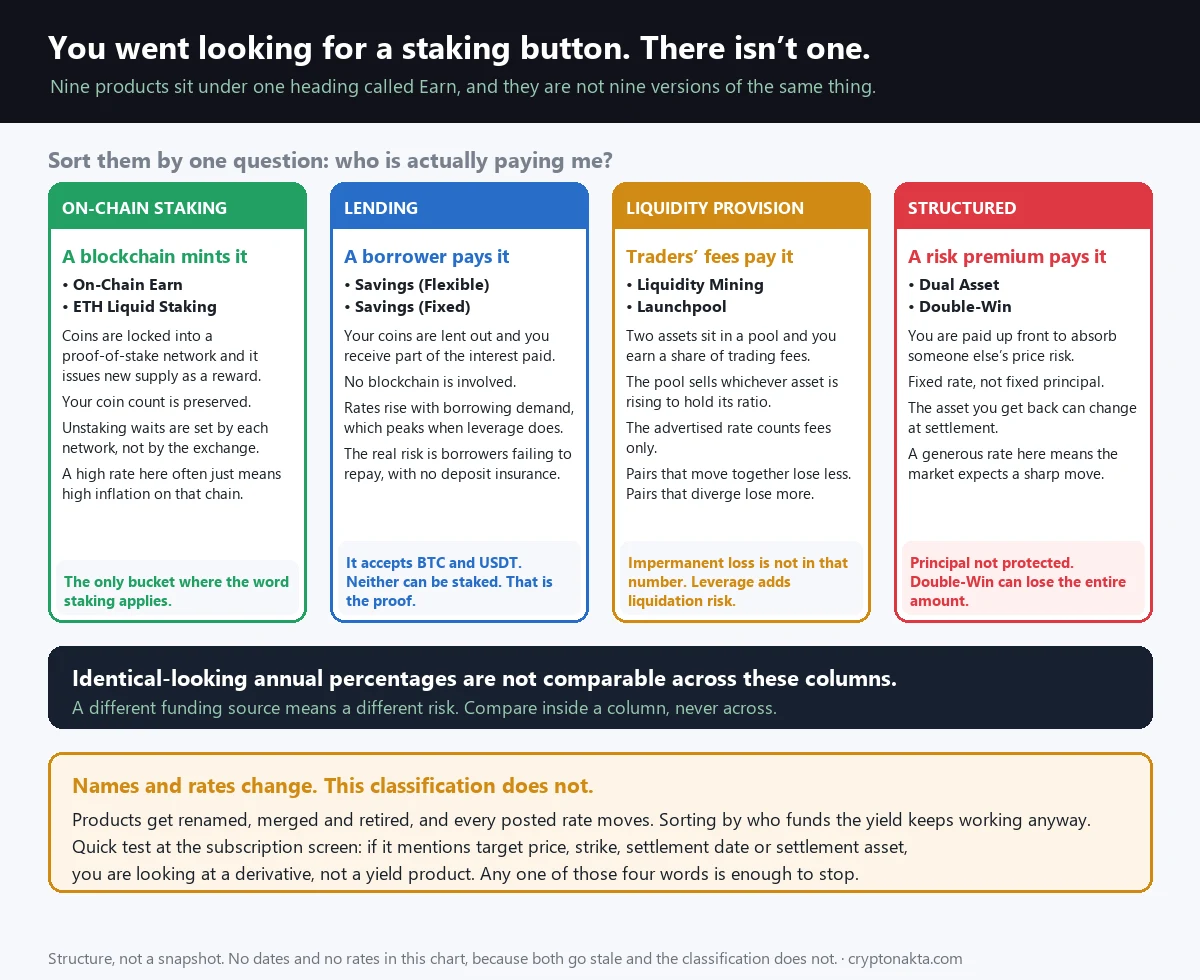
This guide takes that screen apart. Instead of memorising nine product names, you will learn to sort anything you see there into four buckets by asking one question: who is actually paying me? Product names change. Rates change. The question keeps working.
1. Why the button you’re looking for doesn’t exist
Start with the mismatch. Tens of thousands of people every month search for “Bybit staking”. The word does not appear as a menu item in the product. That gap is where the confusion begins, and it is worth understanding why the gap exists.
Exchanges group things by function for the business, not by risk for the user. Everything that pays a yield ends up under one heading, because from the platform’s side they all do the same job: they keep your coins on the platform and generate revenue. Whether that revenue comes from block rewards, borrower interest, or selling volatility is an internal detail. So a genuine proof-of-stake product and a short-dated options position land on the same shelf, in the same size card, with the same style of number attached.
As of mid-2026, here is what actually lives under Earn. Savings in flexible and fixed-term versions. On-Chain Earn. ETH Liquid Staking. Launchpool. Liquidity Mining. Dual Asset. Double-Win. Wealth Management. And sitting on top of those, automated allocation wrappers marketed under names like Easy Earn and Auto Earn.
Those wrappers deserve a note of their own. They are the friendliest entry point on the screen and, for exactly that reason, the one where you are least likely to know what you own. You deposit, the system allocates, and the composition of what you are holding is a layer removed from you. Convenience and comprehension pull against each other here.
The lineup will change. Products get added, renamed, merged, retired. That is precisely why this guide does not ask you to memorise it. The taxonomy in the next section survives a rebrand; a product list does not.
5ZGKX#0Claim your perk →Affiliate link2. Four kinds of yield, not nine products
Ask a different question and the nine collapse into four. The question is not what a product is called. The question is where does the money come from.
One: on-chain staking. Your coins are locked into a proof-of-stake blockchain to help secure it, and the network mints new coins as a reward. This is staking in the original sense of the word. If the mechanics are new to you, the staking explainer covers the ground properly.
Two: lending. You hand coins to the platform, the platform lends them to someone else, and you get a cut of the interest that borrower pays. No blockchain is involved in generating this yield. The structure is old and well understood; what is missing compared to a bank is deposit insurance.
Three: structured products. These are derivatives. You sell someone else the right to a price outcome, collect a premium up front, and absorb the loss if the market moves the wrong way. The screen calls the premium a “fixed APR”, which is technically accurate and badly misleading, because what is fixed is the rate and not the principal.
Four: liquidity provision. You deposit two assets into a trading pool and earn a share of the fees traders pay. This is standard DeFi plumbing, and it produces the flashiest headline numbers on the page. It also carries a loss mechanism that those headline numbers do not include.
Map the products onto the buckets and the screen resolves.
| Product | Bucket | Who pays you | Principal | Access | Risk |
|---|---|---|---|---|---|
| On-Chain Earn | On-chain staking | Network issuance | Coin count preserved | Varies by network | Low to moderate |
| ETH Liquid Staking | On-chain staking | Ethereum rewards | Coin count preserved | Stays liquid via stETH | Moderate |
| Savings (Flexible) | Lending | Borrower interest | Stated as protected | Anytime | Moderate |
| Savings (Fixed) | Lending | Borrower interest | Stated as protected | Locked to maturity | Moderate |
| Launchpool | Token farming | New project allocation | Deposit preserved | Generally anytime | Moderate |
| Liquidity Mining | Liquidity provision | Trading fees | Not protected | Anytime, at a price | High |
| Dual Asset | Structured | Option premium | Not protected | No early exit | High |
| Double-Win | Structured | Option premium | Not protected | Locked to settlement | High |
| Wealth Management | Third-party managed | Whatever the strategy does | Strategy-dependent | Product-dependent | High |
Read the principal column top to bottom. Four products offer no protection, and those four carry the largest numbers on the screen. That correlation is not a coincidence and it is not a scandal either. It is what risk pricing looks like when you draw it as a menu.
Ranked by how many things can go wrong, the buckets order themselves. On-chain staking is the simplest: price risk, lock-up, and the credit of whoever holds the coins. Lending adds one more party who can fail to pay. Liquidity provision makes your outcome depend on the relationship between two prices, which is harder to reason about than either price alone. Structured products are a different activity entirely, one where you are taking a view on where price will land.
So here is the habit worth building. When a card catches your eye, before you look at the rate, ask who is paying this. Is a blockchain minting it? Is a borrower paying it? Is someone handing me a premium to take a risk off their hands? Are traders paying fees? If no answer comes, the product is not ready for your money yet.
3. The two that are actually staking
Back to the original question. Of the nine, which ones are actually staking? Two.
On-Chain Earn is the first, and the name is honest. Your coins go onto the relevant blockchain. Bybit pools user deposits, runs them through that network’s validation process, and passes back the protocol rewards minus a service cut. The yield originates on a blockchain, so the word staking applies.
It also inherits every rule that blockchain has. Some networks let you request unstaking whenever you like. Others lock assets for a fixed window, anywhere from a few days to a few weeks, and no exchange can shorten that. It is set by the protocol. Which is why unstaking terms differ from coin to coin inside the same product, and why the terms for your specific coin are worth reading before you subscribe rather than after.
A few practical details rarely make it into the marketing. Rewards typically accrue daily on screen but settle to your balance on a schedule that varies by asset, so a displayed figure is not the same as a withdrawable one. The platform takes a percentage of rewards as its fee, which is why the rate you see here is lower than what the same coin pays if you delegate directly from a wallet. And slashing, the penalty a network applies when a validator misbehaves, does not disappear because an intermediary is involved. Large operators manage validators carefully and the practical odds are low, but “I gave it to an exchange, therefore the coin count cannot fall” is not quite right.
ETH Liquid Staking is the second. Deposit ETH and you receive stETH, the liquid staking token issued by Lido, which represents your staked position plus accruing rewards. The advantage is structural: your ETH is staked, but you hold a token you can move, sell, or use elsewhere. Stated yields have run around 7% at times, and they move.
The trade is an extra layer of risk. On top of ETH price exposure you take on Lido protocol risk, and stETH can trade at a discount to ETH when markets are stressed, as it has done during past dislocations. If you hold Ethereum for the long run, that history is worth knowing before you assume stETH and ETH are interchangeable at all times.
Choosing between the two is usually decided by what you hold. With ETH, liquid staking gives you room to react if markets turn. With any other proof-of-stake coin, On-Chain Earn is the only route, and the main variable becomes that network’s unstaking window. The longer the window, the more conservative the amount should be.
4. How you can prove Savings isn’t staking
Savings is the product most people actually use. It sits near the front of the screen, it takes deposits and returns them on demand, and the numbers look reasonable. Which means most sentences that begin “I’m staking on Bybit” are describing Savings.
Savings is not staking, and proving it requires no argument about definitions. Look at what it accepts.
The supported assets include BTC and USDT. Bitcoin uses proof of work, so staking does not exist on it in any form. There is mining; there is no staking. Stablecoins like USDT are tokens issued on top of other chains, with no validator set of their own to join. Neither asset can be staked by anyone, anywhere, under any product name.
When an asset that cannot be staked is paying a yield, that yield is coming from somewhere else. Someone borrowed the coins and is paying to use them. Typically that someone is a trader financing a leveraged position, or an institution running a strategy.
Two things follow. First, the rate moves with market conditions, because it is a price for borrowing. Hot market, heavy borrowing demand, higher rates; quiet market, lower. A figure you saw at signup can be half that a few weeks later. What is displayed on a flexible product is closer to a live quote than a promise.
Second, and this one matters more: the real risk is borrowers failing to repay. You are participating in a lending business with no deposit insurance behind it. That is the mechanism that took down several large yield platforms in 2022, and it is worth being precise about how it played out, because the lesson is not the one most people took away.
Those platforms all advertised flexible withdrawals. Users believed they could exit anytime, and under normal conditions they could. The failure came when a sharp drawdown caused many borrowers to default at once. Money owed inward stopped arriving while redemption requests surged, and withdrawals were suspended. Flexible was a description of normal operations, never a guarantee about stressed ones.
The conclusion is not to avoid lending products. It is narrower than that. Size positions on the assumption that flexible may not hold under stress, and treat unusually high rates as information rather than opportunity. A lender paying well above the market is lending to borrowers the market considers riskier. That heuristic applies to choosing a platform as much as choosing a product.
Notice also that the moment when rates look most attractive is the moment when leverage in the system is highest, which is the moment defaults are most likely. Best rate and worst timing tend to arrive together.
Stablecoin deposits stack one more consideration on top. You inherit whatever risk the stablecoin itself carries: reserve quality, and the issuer’s ability to freeze addresses. A few percent a year is compensation for two layers of exposure, not one.
Fixed-term Savings adds a lock. Slightly better rate, no access until maturity, no exception for market conditions. And note that Savings does not auto-compound, so if you want interest reinvested you have to redeposit it yourself. An APY figure assumes a compounding action that the product does not perform for you.
5. Why those percentages can’t be compared
The most expensive habit on this screen is scanning the rates vertically and picking the largest. They share a unit, so they invite comparison. What they do not share is a source.
| Where the yield comes from | Who is funding it | What a high number means here |
|---|---|---|
| Network issuance | The blockchain, minting new supply | Often that the network’s inflation is high. You are avoiding dilution more than you are earning |
| Borrower interest | Whoever borrowed the coins | Borrowing demand is hot. It rises with leverage in the system and falls when things cool |
| Option premium | Someone transferring price risk to you | The risk you absorbed is large. Higher premium, higher chance of the outcome you don’t want |
| Trading fees | Traders using that pool | Volume is healthy. Divergence between the two assets can still exceed what fees pay |
The third row is the one that changes behaviour. A structured product’s fixed rate is a premium you are paid for underwriting someone’s risk. Premiums are priced off expected volatility. So when Dual Asset shows an unusually generous rate on some asset, the market is telling you it expects that asset to move sharply. The screen reads as “good opportunity today”. The underlying statement is “elevated risk today”.
Once you internalise that, you stop comparing across buckets and start comparing within them. SOL rewards against ADA rewards inside On-Chain Earn is a sensible comparison. On-Chain Earn at 5% against Dual Asset at 30% is not a comparison at all. Those are different games that happen to be scored in the same units.
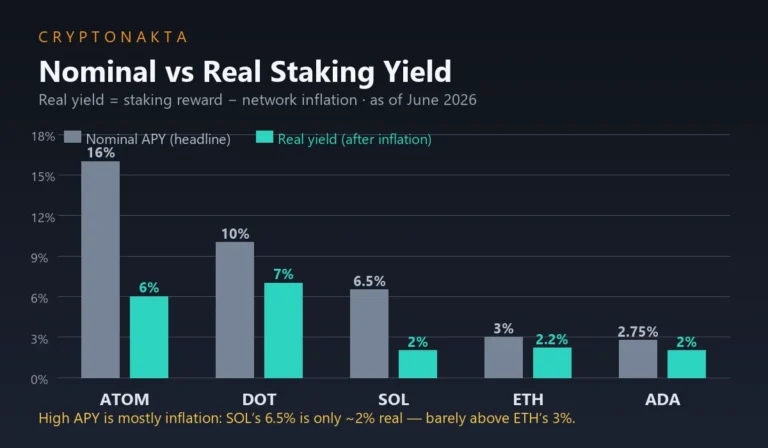
Staking rewards need one more adjustment before the number means anything. They are paid in newly issued coins, and new issuance expands supply. Earn 5% while the network expands 5% and your ownership share has not moved; you avoided the dilution that non-stakers absorbed. To see whether a reward is real, compare it against that network’s issuance rate. An 18% reward on a network inflating 20% a year is not the bargain it appears to be. We built out this calculation properly in real yield versus headline yield.
There is also the currency problem. Rewards are paid in the asset. Your coin count rises; your position in dollars does whatever the price does. A 5% annual reward does not offset a 20% drawdown. Price movement determines most of your outcome and yield is a small adjustment layered on top. Keeping that order straight is most of what protects people from chasing rates.
Finally, watch the notation. APR and APY both appear on these screens. APR is a simple annualised figure; APY assumes compounding, which makes the same product look larger. When you compare two products, check you are not comparing one of each. On products that do not auto-compound, an APY figure describes a result you would have to produce manually.
6. Where the principal actually goes
Dual Asset and Double-Win are the two places on this screen where people lose money while believing they bought a deposit. Both advertise a fixed rate. Both are derivatives.
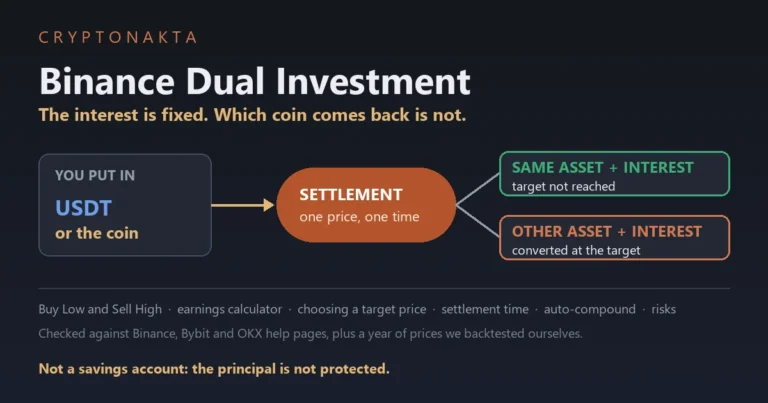
Dual Asset works like this. Pick an asset, pick a target price, pick a settlement date. You are quoted a fixed rate up front. At settlement, which asset you receive back depends on where the price landed relative to your target.
Take the buy-side version. You deposit USDT against a target that says, in effect, “if bitcoin falls to this level, I’ll buy”. If price stays above it, you get your USDT back plus interest, and that is a clean result. If price falls through it, you are settled into bitcoin at your target price, having bought above the market. The gap between your target and the market can easily exceed the interest you collected. That is what non-principal- protected means in practice. And there is no early redemption, so watching it go wrong is the only available response.
The sell-side version inverts it. You deposit a coin against a target that says “if it rallies to this level, I’ll sell”. If it stays below, you keep the coin plus interest. If it rallies through, you are settled out at your target while the market trades higher. Principal feels safer here, but you have capped your upside. A coin that doubles pays you your target price and nothing more.
Both directions share a shape. You have agreed to transact at a price you chose, and you were paid up front for that agreement. The interest is certain. What is uncertain is which asset you end up holding.
Which makes Dual Asset, in both directions, a bet that the market will stay calm. Traders call this selling volatility. For someone who holds that view deliberately it is a reasonable instrument. For someone who arrived looking for a savings product, it is close to the exact opposite of what they wanted.
Double-Win bets on range instead of direction. Define a price band; if settlement lands outside it you profit, if it lands inside you lose. The critical detail is the size of that loss. If price stays inside the band, the maximum loss is the entire amount you put in. Not a portion of it.
None of this is an argument that these products should not exist. Options are legitimate tools and experienced users price them deliberately. The issue is placement: they sit on a yield screen, in identical cards, beside products where your coin count cannot fall.
Telling them apart is mechanical. If the subscription screen mentions target price, strike, settlement date, or settlement asset, you are looking at a derivative. Any one of those four words is sufficient. A yield product does not need to ask you where you think price will be.
7. What the headline yield leaves out
Liquidity Mining posts the largest headline numbers on the page. Deposit two assets into a pool such as BTC/USDC or ETH/USDT, and collect a share of the fees generated whenever anyone trades against that pool.
What the headline APR omits is impermanent loss. The name is unfortunate; there is nothing temporary about it once you exit. The mechanism is that a pool automatically maintains a ratio between its two assets, which means it sells whichever asset is rising and buys whichever is falling. Do that continuously and you end up with less value than if you had held both assets untouched.
A simplified illustration makes it concrete. Deposit equal values of two assets, and suppose one of them doubles while the other stays flat. Held in your wallet, your total would be 1.5x. Held in the pool, the rebalancing means you finish below 1.5x, and the shortfall is the impermanent loss. Fee income has to exceed that shortfall before you are ahead of simply holding.
Which reframes the selection criteria. The question is not which pool advertises the highest APR. The question is whether the two assets in that pool tend to move together. Stablecoin pairs diverge very little, so the loss term stays small. Pairs where one asset can run independently of the other produce a much larger term. If you cannot form a view on that relationship, the honest move is to skip the product.
Enable the leverage option and liquidation risk joins the picture. At that point the product has stopped being a yield instrument and become a leveraged position. It is not a place for someone who typed “staking” into a search bar.
Launchpool behaves differently and more gently. You commit assets and receive allocations of newly listing project tokens, while the committed assets generally remain withdrawable. From a principal standpoint it is the tamest of the higher-risk group. The uncertainty sits in the tokens you receive, which frequently decline after listing.
Two things make Launchpool go better. Decide in advance when you will sell what you receive, because “it was free” is the reasoning that turns a small gain into a small loss over several weeks. And look at what asset you are committing, since its own price movement can dominate the value of the tokens you are farming.
Wealth Management routes your capital to third-party managers running structured strategies. The recurring criticism is transparency: the managers are not prominently identified. Committing capital to a strategy you cannot inspect, run by a party you cannot name, is a different proposition from everything else on this page.
8. Three different ways to be locked in
Before rate, look at access. Not being able to sell is the mechanism that converts a paper concern into a real loss, and on this screen restricted access arrives in three distinct forms.
Protocol-imposed waiting periods attach to On-Chain Earn. Request unstaking and the blockchain’s own rules may hold your assets for days or weeks. No exchange can waive this. It varies per coin, which is why the terms for your specific asset are worth checking at subscription time.
One detail inside that: whether rewards continue accruing during the unwind period differs by network. Some pay through the queue; some stop the moment you request exit. On a large position, several unpaid days is not a rounding error.
Contractual maturity attaches to fixed Savings and to structured products. Dual Asset has no early redemption at all. Between subscription and settlement your options are to observe.
Exit-at-a-cost is the shape Liquidity Mining takes. You can leave whenever you like, and leaving crystallises the impermanent loss. Nominally liquid, practically constrained at exactly the moments you would most want out.
Put the three together and one rule falls out. If you don’t know when you’ll need the money, don’t put it anywhere that restricts access. A one or two point difference in rate is small next to the cost of being unable to act.
Picture how that cost actually materialises. Sharp drawdowns produce two simultaneous effects: everyone wants out, and locked assets stay locked. A multi-day queue arrives precisely when speed has value. Rallies do the same thing in reverse, leaving you watching a position you would like to trim.
A useful test before committing to anything locked: would I hold this asset through a 50% drawdown without selling? If yes, the lock costs you little, because you would not have sold anyway. If the answer needs thinking about, restrict yourself to flexible products.
One practical technique. Splitting a position across flexible and locked products means an urgent need can be met from the flexible portion without disturbing the locked one. You give up a little yield in exchange for keeping your options open, which is usually a good trade.
9. Matching the money to the product
Now the decision can be made in the right order: start from the money, not from the product.
| What this money is | Reasonable fit | Avoid | Why |
|---|---|---|---|
| PoS coins you plan to hold for years | On-Chain Earn, liquid staking | Structured products | You weren’t selling anyway, so locks cost little, and the yield source is the most transparent available |
| Stablecoins with no near-term use | Flexible Savings | Fixed terms, structured | Stablecoins cannot be staked. As a lending decision made knowingly, this is coherent |
| Money you need soon | None of it | All of it | Restricted access and principal risk both fail you at exactly the wrong moment |
| Coins you may want to sell | Flexible products only | Fixed terms, Dual Asset | No early redemption means no selling when you decide to sell |
| Bitcoin | Savings, understood as lending | Anything calling it “BTC staking” | Bitcoin has no staking. A venue describing it that way is obscuring the mechanism |
Row three deserves emphasis because it produces the most damage. Money earmarked for something specific a few months out, parked in a yield product because idle capital feels wasteful, is the classic error. Yield is only meaningful when time is on your side.
Running through the whole table is a single principle. Staking should be a bonus on a holding you already decided to keep, never a reason to acquire it. A 5% reward on a coin that falls 30% is not a 5% year. When that order inverts, judgement goes with it. Looking at Solana or any other high-reward network, ask first whether you would hold it at zero yield.
Position size changes the calculus too. At small amounts the differences barely register. On a $1,000 position, 5% versus 7% is $20 a year, and accepting lock-ups or principal risk for $20 is a poor trade. In that range, the product you understand best is genuinely the optimal choice.
Larger positions make diversification meaningful, but the thing to diversify is custody, not products. Spreading across five products inside one venue leaves all five exposed to that venue. Real diversification means some of it lives somewhere else, which is the subject of the next section.
One question worth pre-empting: if the coin appreciates, does the reward grow? Your coin count grows on schedule and its value tracks the price, so yes in fiat terms. That is the price moving, though, not the staking working. Blending the two into “staking made me money” produces conclusions that will not survive a flat market.
10. What custody means for all of it
One risk sits underneath every product above and does not go away no matter how well you choose.
Depositing into an exchange Earn product means the coins move into the exchange’s custody. Your account shows a balance, and on-chain those assets sit in platform wallets. That balance is a record of what the platform owes you.
Which is invisible until it isn’t. The 2022 failures are instructive because users’ screens kept displaying balances the entire time. The numbers were there. The button did not work. Historical exchange failures and security incidents follow this shape often enough to treat it as a category rather than a series of accidents.
So when evaluating a venue, the useful question is how it makes money. A platform whose revenue is dominated by trading fees behaves differently under stress than one leaning heavily on deploying customer deposits. Whether it publishes proof of reserves, whether customer assets are segregated from corporate assets: these matter considerably more than a one point rate difference.
The only way to remove counterparty risk is to hold your own keys and stake from a wallet. Delegation from self-custody leaves the coins at your address the entire time; you are lending your stake weight to a validator, not your coins to a company.
In practice this is less involved than people expect. Install a wallet, move the coins in, open the staking section, choose a validator. Ethereum holders can access liquid staking directly from most wallets. Solana and Cosmos-family chains have delegation built into the wallet interface. The coins never leave your address.
What you take on in exchange is real. Lose the seed phrase and no one can restore it. Interact with a fake wallet app or a phishing site and the loss is immediate and final. Each network works slightly differently and you pay your own gas. Everything the exchange was handling silently becomes yours to handle.
Which is why most people end up with a blend rather than a doctrine. Amounts you touch often stay on the exchange; amounts meant to sit for years move to a wallet. The ratio is personal, and it tends to drift toward self-custody as the total grows. A workable threshold is whatever amount would disrupt your life if it vanished.
If venue selection is the open question, how to evaluate an exchange covers the criteria in detail.
11. What you see depends on where you open the app
One practical note before you go looking for the products described here.
What appears under Earn depends on where you open the app. The product mix is not uniform worldwide, so a walkthrough written against one region’s screen will not match another’s exactly.
The clearest example is Europe. Users in the European Economic Area are served by Bybit EU, a separate entity licensed by the Austrian financial regulator and based in Vienna. Its Earn offering is built around fixed-term products on BTC, ETH and USDC under the Rewards name. On-Chain Earn, Dual Asset and Liquidity Mining as described above are not part of that lineup in the same form. A European reader following a global walkthrough would be searching for menus that are not there.
This guide describes the global lineup. Before subscribing to anything, the accurate reference is the list your own screen displays, which is also the only place the current rates live.
Two things worth verifying in your own interface regardless of region: which specific assets each product supports right now, and what the unstaking or maturity terms are for the asset you care about. Both change more often than product names do.
If self-custody staking is the more realistic route for you, the wallet-based delegation path described in the previous section works identically everywhere, since it depends on the blockchain rather than on any platform. For many people that is the more durable answer anyway.
Account setup, verification steps and what the interface looks like are covered in the Bybit review and signup walkthrough.
12. Claims and reality
Claims that circulate about this product set, placed next to what is actually the case.
| What gets said | What is actually true |
|---|---|
| I’m staking on Bybit | Usually it’s Savings, which is lending. Actual on-chain staking is On-Chain Earn and ETH Liquid Staking |
| I earn yield staking my bitcoin | Bitcoin has no staking mechanism. That yield comes from lending it out |
| It says fixed APR, so principal is safe | Dual Asset fixes the rate, not the principal. The asset you receive back can change |
| 20% beats 4% | Different sources, different risks. The larger number usually prices a risk you absorbed |
| I can withdraw whenever | Network queues, fixed maturities and no-early-exit products are mixed together on one screen |
| It’s in my account, so it’s mine | It’s in the platform’s custody. That is a different risk profile from self-custody |
| The app looks the same everywhere | The available product mix varies by region, and Europe is served by a separate entity with a different lineup |
| 20% APR on a pool means 20% returns | That figure is fee income only. Impermanent loss is accounted for separately |
Most of these misreadings are produced by the interface rather than by carelessness. Put products with different risk profiles in identical cards, lead with a large percentage, and push the mechanism into small print, and “these are comparable” becomes the natural inference. The taxonomy has to be supplied by the reader.
Two more worth naming. “A big exchange is safe” conflates scale with product structure. Size correlates with liquidity and service quality; it does not convert a non-principal-protected product into a protected one. And the opposite reflex, “this is all a scam”, is equally unhelpful. On-chain staking is a designed feature of the protocols themselves, and lending is an ancient and well-understood structure. The problem was never the products. It was tapping them without knowing which was which.
13. A sane order to do this in
A sequence that tends to produce good outcomes.
- Classify the money first. When will you need it, and could you absorb losing it? Looking at products before answering this means the rates do the deciding.
- Identify which of the four buckets you’re looking at. If the screen mentions target price, strike, settlement date or settlement asset, it’s a derivative. Stopping there is a complete answer.
- Read the access terms. Queue length, maturity, early exit. Before the rate, not after.
- Run a small amount through the full cycle. Deposit, watch rewards accrue, and then actually withdraw. Depositing is easy everywhere; products differ on the way out. The cost of that test is trivial and what it teaches is not.
- Keep records. Date, product, amount, rewards received. Export the statements each quarter rather than trying to reconstruct them later, because historical exports are not always available on demand.
On tax, the general principle in many jurisdictions is that staking rewards are income at the time of receipt, valued at that moment, whether or not you sold anything. The United States formalised this in IRS Rev. Rul. 2023-14. Treatment differs by country and this is not tax advice, so confirm your local position. What travels everywhere is that records make the question answerable and their absence makes it expensive.
Lastly, scams. Yield is the single most productive theme for crypto fraud, and Earn products attract impersonation reliably. Three patterns recur. Sites carrying exchange branding that advertise guaranteed fixed returns, when genuine variable-rate products do not guarantee anything. Unsolicited contact from someone claiming to be support, when real platforms do not initiate contact asking you to move funds. And installers distributed outside official app stores, which reproduce the interface faithfully and change only the deposit address.
The filter is short. Did they contact you first? Is the word guaranteed involved? Is this an unofficial channel? Any one of those is enough to stop. Further patterns are catalogued in the crypto scams guide.
Bybit

Affiliate disclosure: some links are partner links. We may earn a commission at no extra cost to you. This is not investment advice.
14. Glossary
Terms that appear on these screens, in plain language.
| Term | What it means |
|---|---|
| Proof of stake (PoS) | A consensus design where locked coins secure the chain. Staking can only exist on a PoS asset |
| On-chain | Happening on the blockchain itself, as opposed to inside a platform’s internal ledger |
| Unstaking period | The wait between requesting your coins back and receiving them. Set by the network |
| Slashing | A protocol penalty that removes part of a stake when a validator misbehaves |
| stETH | The token Lido issues against staked ETH, representing your position plus accrued rewards, and freely tradeable |
| Impermanent loss | The shortfall versus simply holding, caused by a pool rebalancing as the two assets diverge |
| Option premium | Payment received for taking on someone else’s price risk. The source of a structured product’s fixed rate |
| Settlement asset | Which coin you actually receive at maturity. In Dual Asset it may differ from what you deposited |
| APR / APY | Annualised rates. APY assumes compounding, so it reads higher for the same product |
| Flexible / fixed | Whether the product allows withdrawal on demand or locks until a maturity date |
Memorising these is unnecessary. What is useful is recognising the signal words. Settlement asset or strike on a subscription screen tells you this is not a yield product. Unstaking queue or validator tells you something is genuinely happening on a chain. A handful of words function as signposts for which bucket you’re in.
For background, how blockchains work and crypto yield products in general fill in the surrounding picture. If you do not yet have an exchange account at all, getting started comes first.