Ethena and USDe Explained: If a Dollar Pays You a Yield, Somebody Is Paying It
A synthetic dollar held together by a hedge, a staked form that collects the income, and a governance token that is neither of those things.
| Question | Short answer |
|---|---|
| What is USDe? | A synthetic dollar. Spot collateral paired with a short perpetual position of the same size, so the two cancel out. No bank reserve behind it |
| Does holding it pay anything? | No. Income reaches only the supply that has been staked into sUSDe |
| Who pays the yield, and when does it thin out? | Mostly leveraged long traders, through perpetual funding, plus staking rewards and short-rate income on the collateral. It thins as long positioning thins, and negative windows are absorbed by a reserve fund instead of being charged to stakers |
| Why did supply fall so far? | Leveraged carry demand unwound once the yield dropped below borrowing costs. Redemption kept working throughout |
| Getting back out | Converting sUSDe into USDe queues for roughly one to seven days |
| And ENA? | A separate governance and fee-share token. Different asset, different risk |
1. Where to look first when a dollar pays a rate
2. How a short position does the job a reserve account usually does
3. ENA, USDe and sUSDe are three different things
4. Why the USDe sitting in your wallet earns exactly nothing
5. Who pays the funding, and the two quieter income streams
6. What happens on the days funding runs the other way
7. Why borrowed money crowded into a dollar that pays
8. Why the supply shrank without the dollar breaking
9. Three numbers that all look like the price
10. Where the collateral sits, and who can actually redeem it
11. Set beside a reserve-backed stablecoin and a bank deposit
12. The numbers that move, and the date they were taken
13. Where readers usually get this wrong
14. Buying it is one step, receiving the yield is another
15. Glossary: delta neutral, funding, cooldown and the rest
Ethena’s dollar is held together by a hedge on the derivatives market, and the income on its staked form comes largely from traders paying to keep leveraged long positions open. Once that source has a name, the rest of the design follows from it: the staking step, the waiting period on the way back, the reserve fund that covers the negative windows, and the contraction in supply that ran its course while the dollar held.
1. Where to look first when a dollar pays a rate
Every yield has a payer. The question sounds too obvious to bother asking, and most people stop asking it the moment the thing is priced in dollars and trades at a dollar. A savings account pays because the bank earns more on its loan book than it hands back to depositors. A lending pool pays because a borrower on the other side agreed to a rate. In both cases you can point at the account the money leaves from, and describe the conditions under which that account stops paying.
USDe is a dollar-denominated token whose staked version distributes income, so the same pointing exercise applies to it. Follow the money back and it arrives in the derivatives market. Most of that income starts with traders who hold leveraged long positions in perpetual futures and pay a periodic fee to the other side to keep those positions open. Ethena runs a book that sits on the other side of those positions and collects the fee.
Once the payer has a name, several other questions answer themselves. The income tracks how traders are positioned, so it rises when speculative appetite rises and thins as appetite cools. It can invert, because positioning can flip. It accounts for why a large slice of demand for the token turned out to be borrowed money renting a spread, and why that money left in a hurry once the spread closed. And it answers the question most people want settled first, which is whether the dollar itself depends on the income. It does not. The dollar value comes from the collateral book and its hedge. The income comes from the funding fee.
So the advertised percentage is an output, and it is the output that changes fastest. The three inputs behind it carry more information: who is paying, what has to stay true for them to keep paying, and what the design does on the days they stop. If perpetual funding is new to you, our guide to spot versus futures covers what a funding payment is and why a contract with no expiry date needs one.
2. How a short position does the job a reserve account usually does
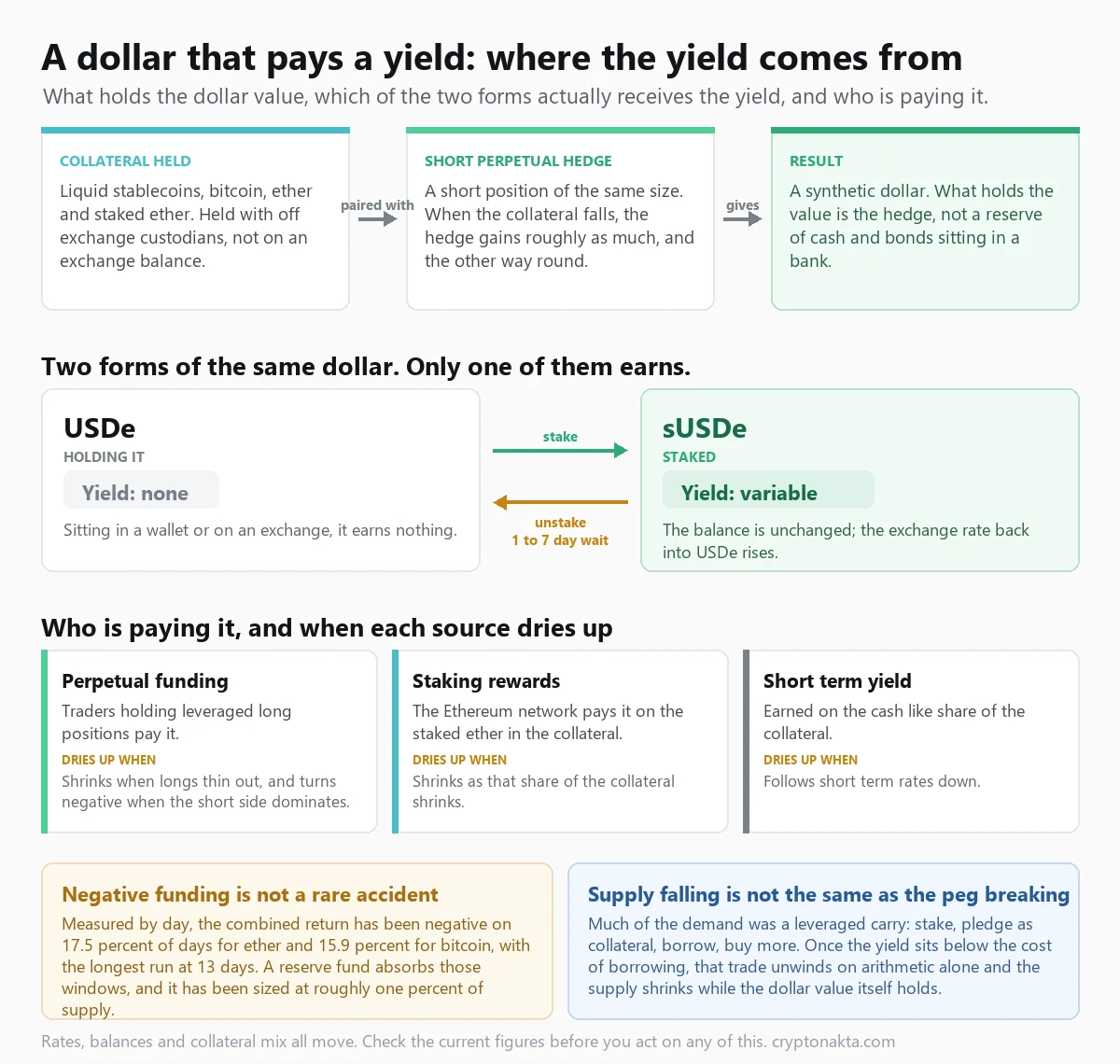
A reserve-backed stablecoin solves the dollar problem by owning something that is already a dollar. You send the issuer a dollar, the issuer buys cash equivalents and short government paper, and the token in your wallet is a claim on that pile. The peg holds because the backing does not move. USDe reaches the same number on the screen by a different route: it holds collateral that can move, then cancels the movement with a matching short position in perpetual futures.
The arithmetic is easier than the vocabulary. Suppose the backing behind a slice of supply is 100 dollars of ETH, paired with a short perpetual on ETH of the same size. ETH drops 30 percent: the spot sleeve is now worth 70, and the short has gained roughly 30. The pair is still worth about 100. ETH rallies 30 percent instead: the spot sleeve gains, the short loses the same amount, and the pair is still worth about 100. The book is called delta neutral because its net sensitivity to the price of the collateral is close to zero by construction. What is left standing after the two sides cancel is a dollar of value, and that residual is what USDe represents.
Arithmetic alone would not hold a market price, so there is a second mechanism. Approved participants can deliver collateral and mint new USDe, or hand USDe back and receive collateral. When the traded price drifts below what the collateral book would deliver, those participants have a reason to buy the cheap token and redeem it at full value, and that buying closes the gap. The peg is enforced by an arbitrage loop, and the right to operate that loop belongs to a defined set of participants.
The costs of the two designs sit in different places. A reserve account is passive: bills mature, you roll them, and the work is custody and audit. A hedge is a maintained position, with margin to keep posted, contracts to roll across venues, and a short whose size has to keep tracking the collateral as prices move. That maintenance introduces execution risk in fast markets, where opening or closing at the price you wanted is not guaranteed. It is a different risk family from the reserve-backed model, where the central question is whether the issuer holds what it says it holds.
The example uses ETH for clarity, though the real collateral is a mix of liquid stablecoins, BTC, ETH and liquid staking tokens, and only the volatile portion needs hedging at all. Those weights move as the book is managed.
3. ENA, USDe and sUSDe are three different things
Three tickers travel together in this system and get used interchangeably in conversation. Buying one gives you no exposure to the other two.
| What it is | Nature | What you receive | Main risks | Where it comes from |
|---|---|---|---|---|
| USDe | Synthetic dollar (spot collateral plus short hedge) | Roughly one dollar of value. No yield | Hedge execution, custody, secondary-market liquidity | Exchange spot markets, DEXs |
| sUSDe | USDe that has been staked | Variable income from funding and collateral rewards | All of the above, plus a rate that moves and a wait on the way out | On-chain staking, some exchange Earn products |
| ENA | Governance and fee-share token | Voting rights, and a revenue share when staked as sENA | Full price volatility. A different risk category from USDe | Major exchange spot markets |
USDe is the synthetic dollar itself, a claim on the hedged collateral book. Holding it gives you a dollar of value and nothing else. No income accrues to it, no rate applies to it, and the balance in your wallet stays exactly where it is.
sUSDe is what USDe becomes after you stake it. This is the form that receives the protocol’s income, and the only form that does. Unstaked USDe earns nothing, and staked supply takes the whole distribution.
ENA is a governance and fee-share token with a hard cap of 15 billion units. Staking it produces sENA, and a fee switch routes a share of protocol revenue to that staked position. Whether a market prices that revenue into the token is a separate question.
USDe aims to sit at a dollar and carries hedge, custody and secondary-market liquidity risk. ENA carries the ordinary volatility of a floating token, with an unlock schedule releasing supply on top of that.
4. Why the USDe sitting in your wallet earns exactly nothing
Holding USDe pays zero. The token is a dollar of value and behaves like one, with no accrual, no drip and no rebase, and income reaches you only after you stake it and hold the staked form.
The staking step is one transaction. You deposit USDe into the staking contract and receive sUSDe, and from there the accounting runs through a rising exchange rate. The number of sUSDe units in your wallet stays fixed while the amount of USDe each unit converts back into rises. Enter at a rate of 1.05, see 1.12 later, and that difference is the return. Nothing lands in your wallet in the meantime, which is why holders watching for an incoming transfer sometimes conclude that something is broken.
A structural consequence follows. Revenue is divided over staked supply alone, so every holder who leaves USDe unstaked, whether it sits on an exchange, serves as trading collateral, or simply never got the second step, is contributing to a pool shared among fewer participants. The rate quoted on sUSDe is therefore mechanically higher than the return the system earns across its total supply. If the staked share rises, the same revenue spreads across more units.
Going back is where the second surprise lives. Converting sUSDe into USDe enters a cooldown, a queued waiting period that has ranged from about one day to seven, set according to how much liquid stablecoin collateral the book is holding at the time. Instant exits at scale would force the hedge to be unwound on the spot, at whatever price the derivative market happens to offer during a rush. Anything you might need to spend inside a week is better left as USDe, since the clock on the conversion starts only when you request it. If locking an asset to receive a distribution is an unfamiliar mechanic, our guide to staking covers the pattern in a broader context.
Exchange products complicate this slightly. When a venue offers an Earn product built on USDe, the venue does the staking and the unstaking on its own book. Its withdrawal terms are what govern your exit, and those terms run faster than the on-chain cooldown in some cases, slower in others, and are always the venue’s to change.
5. Who pays the funding, and the two quieter income streams
A perpetual future has no expiry date, which creates a problem. With no settlement date forcing convergence, nothing stops the contract price from drifting away from the spot price. The fix is a periodic payment between the two sides, sized by the gap. When the contract trades above spot, which is what happens when leveraged longs crowd in, longs pay shorts. When it trades below, shorts pay longs. That payment is the funding rate.
Ethena’s book is structurally short, because the short is what neutralises the collateral, so during periods when traders want leveraged long exposure the book collects. Basis trades and cash-and-carry structures have paid people for holding the other side of speculative demand for as long as futures markets have existed.
| Where the income comes from | Who is actually paying | When it shrinks |
|---|---|---|
| Perpetual futures funding | Traders holding leveraged long positions | Immediately, as sentiment cools and long positioning thins. It turns negative when short positioning dominates |
| Staking rewards on the liquid staking collateral | New issuance on the Ethereum network | As the share of liquid staking tokens in the collateral mix falls |
| Return on liquid stablecoin and cash-equivalent collateral | Short-term interest rates | As short rates fall |
| (For reference) the reserve fund | Revenue set aside by the protocol | Not income. A buffer that fills negative windows |
Two quieter streams sit alongside it. The first is the Ethereum staking reward earned by the liquid staking token sleeve of the collateral. That reward reaches the sleeve alone, so its contribution depends on how heavily the collateral is weighted toward those assets, and that weighting has moved a long way from where it started. The second is the return on the liquid stablecoin and cash-equivalent sleeve, which tracks short-term interest rates in the ordinary way.
Blending the streams produces a rate that is part market sentiment and part interest rate, and neither component is contractual. A bank sets the rate on a deposit and can tell you what next month pays. Perpetual funding is set by how much appetite for leverage exists on the day, so any figure quoted for sUSDe describes a window that has already closed. Check the date attached to a rate before you compare it with anything.
6. What happens on the days funding runs the other way
Funding is not permanently positive. When short positioning dominates, the payment reverses and shorts pay longs. Ethena’s book is the short, so on those days it pays out.
The historical record is specific enough to be useful. Measured on a combined-yield basis across the sample, daily returns were negative on 17.5 percent of days for ETH and 15.9 percent of days for BTC. Roughly one day in six ran the wrong way for the ETH leg. Over the same sample the average stayed positive, at around 9.15 percent annualised for ETH and 7.80 percent for BTC. The longest observed run of consecutive negative days was 13. The most extreme single reading came around the Ethereum transition to proof of stake in September 2022, when funding briefly reached roughly minus 300 percent annualised as hedging demand piled onto one side of the market.
What happens to sUSDe holders during those windows is written into the design. The reserve fund absorbs negative protocol revenue, and the rate on sUSDe flattens toward zero through a bad stretch.
Through the first half of 2026 the fund has been held at roughly 1 percent of outstanding supply. Independent risk modelling has put the buffer actually required against the funding gaps in the historical sample at single-digit millions of dollars, and the fund has been kept at several times those model outputs.
What the fund is sized against is the kind of negative window that shows up in the record: short, shallow, and so far never longer than a couple of weeks. A prolonged inversion runs in stages, since the sUSDe rate reaches zero before the fund starts drawing down at all.
The collateral mix moves this exposure quietly. As the book has shifted toward liquid stablecoins and BTC, a smaller share of it depends on ETH funding specifically. That lowers the concentration in a single derivative market, and it also means a hot stretch in ETH funding lifts the blended rate less than it once did.
7. Why borrowed money crowded into a dollar that pays
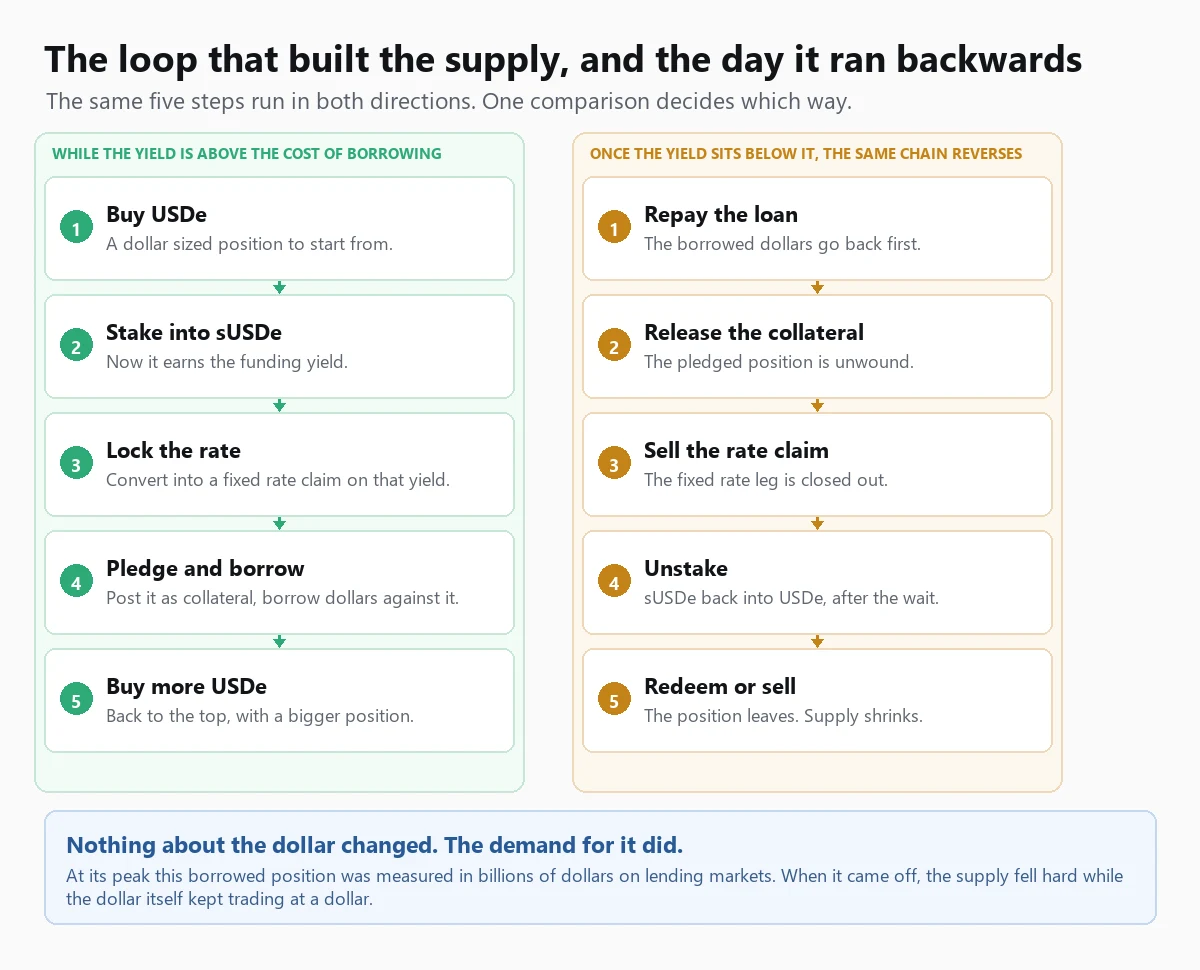
Once a dollar-denominated asset pays a rate, a second population arrives with no particular interest in the asset. They care about the gap between what it pays and what it costs to borrow. If staked USDe returns more than the cost of borrowing stablecoins in a lending market, that difference can be captured with borrowed money, and the capture scales with how many times the cycle is repeated.
The structure that grew around it borrowed stablecoins against a fixed-yield wrapper of sUSDe and recycled the proceeds back into USDe, with each turn of the cycle stacking the same spread again. Pendle supplied the wrapper by splitting a yield-bearing position into two tokens, one carrying the principal and one carrying the yield over a defined term. Aave took the principal token as collateral and lent against it.
That fixed-rate wrapping is the piece that makes the rest possible. Lending markets have to model the value of what they hold as collateral, and a floating rate whose path depends on derivative-market sentiment is uncomfortable to model. Fixing it for a defined term converts the position into something a risk framework can accept at scale, which is what let the structure grow to size.
Size is why this matters to a reader who never touched the strategy. Ethena-linked exposure inside Aave reached about 6.6 billion dollars at its peak, and analysts estimated that roughly a third of all sUSDe sat inside leveraged structures of this kind. At that point the headline supply figure was tracking the size of one spread as much as it was tracking demand for a synthetic dollar.
The arithmetic that ended the loop is on the record. In late 2025 the yield on staked USDe slid from 12 to 13 percent down to 4.7 percent, while borrowing USDC on Aave still cost around 5 percent. Below that crossing the loop pays out more than it takes in, and each additional turn of the cycle deepens the loss.
8. Why the supply shrank without the dollar breaking
The trigger conditions are mechanical, and they run in order:
- Funding cools as leveraged long positioning thins, so the rate on sUSDe falls.
- Borrowing costs for stablecoins in lending markets stay where they are, or rise as utilisation shifts.
- The spread between the two closes and then inverts. The position now costs money to hold.
- Loops unwind in sequence: repay the borrowed stablecoins, exit the fixed-yield position, convert back through the cooldown, redeem USDe for collateral.
- Supply contracts, because redemption is the exit that works at size. Redeemed tokens are burned, the matching collateral is released, and the hedge against that collateral is closed at the same time.
Every step in that list is the system operating as designed. A supply chart records the outcome without recording the cause, so the same steep line fits either story.
The two cases leave different traces. In a peg failure the price fails to recover on public markets, redemption slows or stops, and the collateral behind the token turns out to be worth less than the tokens outstanding. In a carry unwind the price holds around a dollar, redemption volume spikes, the collateral covers what it is asked to cover, and supply drops quickly because a lot of people are leaving through the intended door at once. Check the redemption channel and the on-chain price, in that order.
Supply contracted steeply through that unwind. The redemption channel kept operating the whole way down, including the days of the October 2025 liquidation cascade, when about 2 billion dollars was redeemed inside 24 hours.
There is a real consequence in the other direction that should not be skipped. A smaller system means thinner secondary-market depth, fewer venues quoting meaningful size, and more price impact for anyone exiting a large position on the open market.
9. Three numbers that all look like the price
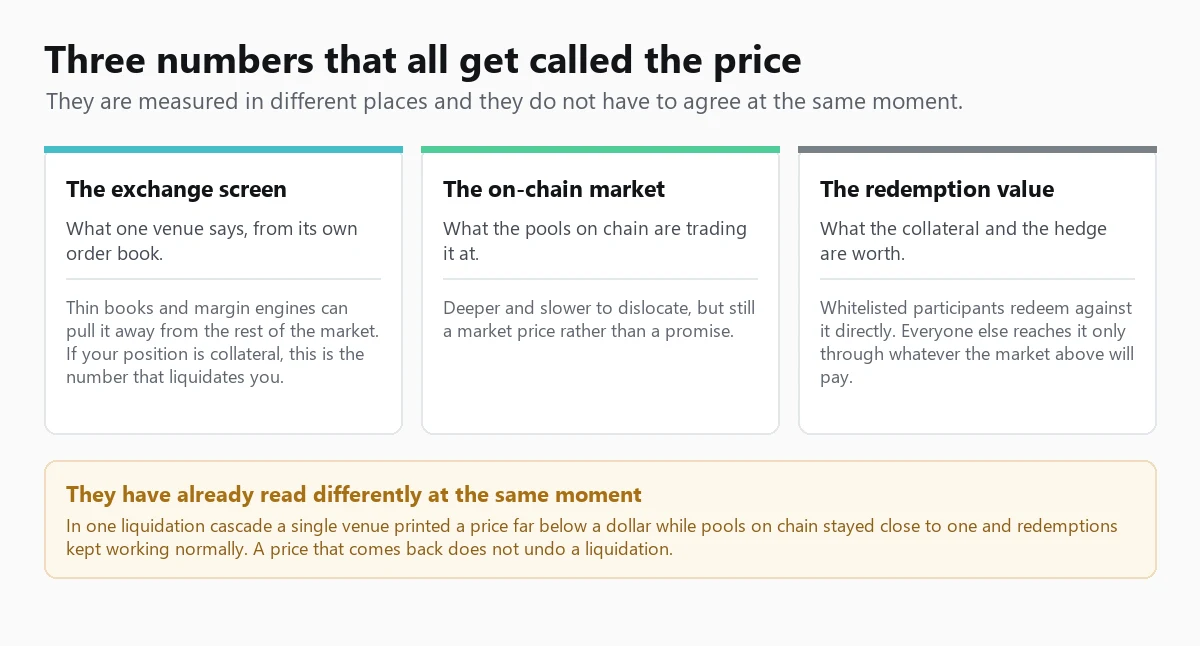
At any given moment there are at least three numbers attached to USDe that all present themselves as “the price”, and they are produced by completely different processes.
- The exchange’s internal mark. Any venue that accepts an asset as collateral needs a value for it, calculated inside its own system from its own order book, an external feed, or a blend of sources. This is the number driving margin calculations and liquidation triggers in that account.
- The traded price on public venues, principally on-chain markets where anyone can inspect the pools and the depth behind each quote. This is where an ordinary holder actually transacts.
- The redemption value, meaning what the collateral book delivers per token to a participant exercising redemption rights. It is set by the assets and the hedge, and most holders never touch that channel.
During the October 2025 liquidation cascade, Binance’s screen printed USDe at roughly 0.65 dollars. At the same moment on-chain venues were trading it around 0.99, and the mint and redemption channel was operating normally, with roughly 2 billion dollars redeemed within a day.
The cause sat in the first number. Binance’s unified account system valued collateral from its own spot order book alone. In the cascade, forced sellers met a book too thin to absorb them. The print fell, and every position the venue priced off that book fell with it. The valuation method was changed afterwards.
The same wiring exists at other venues. An internal mark inherits the depth of whatever book it reads, and every account priced off that mark inherits it too.
One habit follows from that: know which of the three you are looking at. A collateral dashboard shows the internal mark, a market screen shows the traded price, and the redemption value tracks the collateral book, which the protocol reports on its transparency pages.
10. Where the collateral sits, and who can actually redeem it
A hedge has to live on an exchange, because that is where perpetual futures trade. Ordinarily that would mean the collateral sits on the exchange too, putting the entire backing of a token inside a venue’s balance sheet. A venue failing in that arrangement takes the backing down with it, and the design routes around that.
The mechanism is off-exchange settlement. Collateral is held with custodians such as Copper, Ceffu and Fireblocks, outside any exchange account. Derivative positions are opened against that balance, and only the profit and loss on those positions is settled between the parties on a cycle, daily in Copper’s case. Legal title does not pass to the exchange, and it does not pass to the custodian either.
That removes one specific exposure: a venue failing while it holds the full backing of the token. Four counterparties stay in the picture.
- The custodian. Assets sit with a third party under a legal arrangement, and that arrangement is only as good as the entity and the jurisdiction behind it.
- The exchange as a trading counterparty. The hedge is a position facing a venue. If that venue’s risk engine, matching system or solvency comes under stress, the hedge is affected even though the collateral is elsewhere.
- The settlement gap. Between settlement cycles, unrealised profit on the hedge is still a claim. In a violent move, the distance between what a position is worth and what has actually been settled can be substantial.
- The contracts. Minting, staking and the sUSDe exchange-rate accounting run as code on a public chain. Audits and years in production lower the odds of a flaw in that code without taking them to zero.
The second structural fact concerns who can redeem. Minting and redemption run through approved participants who have completed identity and business verification with the issuer. Someone holding USDe in a wallet cannot present it and ask for a dollar of collateral. That holder’s exit is the secondary market, meaning whatever bid exists on an exchange or in an on-chain pool at the time.
This arrangement is normal for institution-facing issuance and not unique to Ethena, and it changes what a peg means from a holder’s point of view. The arbitrage that pulls the price back to a dollar is performed by other people, through a channel you do not have. How fast the price comes back depends on those participants being active and on that channel being open at the time.
11. Set beside a reserve-backed stablecoin and a bank deposit
Three dollar-shaped things get compared casually and behave differently under stress. Laying them side by side shows which questions apply to which.
| Comparison | USDe (synthetic dollar) | Reserve-backed stablecoin | Bank deposit |
|---|---|---|---|
| What maintains the dollar | Spot collateral plus a short hedge | Cash and short-term government paper | Bank balance sheet plus deposit insurance |
| Income from simply holding | None (staking into sUSDe required) | None | Yes |
| Who can demand redemption | Approved whitelisted participants | The issuer’s clients, on the issuer’s terms | The depositor |
| An individual holder’s real exit | Secondary-market liquidity | Secondary market, or issuer redemption | Branch or transfer |
| Why the rate changes | Perpetual funding and collateral returns | Not applicable | Policy rates |
| Principal guarantee | None | None | Up to scheme limits |
A bank deposit is a liability of a regulated institution sitting inside an insurance scheme that covers balances up to a defined limit, and that guarantee is the product. USDe puts value on the screen a different way, through collateral and a hedge, with no principal guarantee and no scheme behind it. So the checks differ. For a deposit you look at the institution and the scheme limit. For USDe you look at what the collateral is made of and at where you could actually sell.
One piece of regulatory context belongs here, stated as a classification. Frameworks that define payment stablecoins do not permit those issuers to pay interest to holders, which is why the large reserve-backed tokens pay nothing to the people holding them even while their reserves earn a return on short-dated paper. A dollar-denominated on-chain asset that does pay sits in a different category by construction, with different backing, a different income source and a different risk set. Our explainer on the GENIUS Act covers how that line gets drawn.
Rates on the two move on separate clocks. A deposit rate follows policy decisions that arrive on a published calendar. The sUSDe rate follows how crowded leveraged long positioning is, which can change inside a week.
12. The numbers that move, and the date they were taken
Every figure in this article that moves lives here, with the date it was taken. Quoting any of them without that date is how an accurate article turns into an inaccurate one a few months later.
| Figure | Value | Basis / as of | What moves it |
|---|---|---|---|
| Collateral mix | Liquid stablecoins 43.8%, BTC 34.9%, ETH 14.7%, WBETH 3.6%, mETH 1.3%, stETH 1.2% | First half of 2026, average weights | Active management of the book, and where hedging capacity is available |
| Reserve fund | About 62 million dollars (41.98m in USDtb plus a 20.02m USDtb-USDC liquidity pool) | 2 April 2026 | Revenue allocation, and drawdowns during negative-funding windows |
| Reserve fund as a share of supply | 1.061% | End of March 2026 | Both the fund balance and the outstanding supply |
| Supply trajectory | Peak above 14 billion dollars, around 8.5 billion within weeks of the October 2025 cascade, 3.8 to 4.1 billion in mid-2026 | Mid-2026 | Mint and redemption flow, which follows the carry spread |
| Realised sUSDe yield range | Roughly 4% to 30% across 2024 and 2025, mostly between 8% and 18%; around 9.4% and later 7.1% on a seven-day basis during 2026 | 2024 to 2025 range; April and June 2026 readings | Perpetual funding above all, then the collateral mix and short rates |
| Cooldown on converting sUSDe back | Approximately 1 to 7 days | Current design | How much liquid stablecoin collateral the book holds |
| ENA supply | 15 billion maximum, with around 7.96 billion circulating | Early 2026 | The unlock schedule, which releases supply over time |
The collateral mix has travelled furthest. A book that began concentrated in ETH and liquid staking tokens now holds a plurality in liquid stablecoins, which changes both the yield profile and the amount of derivative exposure being carried.
Rechecking any of it needs no subscription. The protocol publishes collateral composition and reserve balances on its transparency pages, governance posts carry the reserve fund updates along with their methodology, and supply is readable from chain data or any aggregator that tracks it.
13. Where readers usually get this wrong
Some of these come from marketing, some from critics, and a few from people trying honestly to fit a new instrument into categories they already own. The corrections are the same either way.
| Common assumption | What is actually the case |
|---|---|
| It is a stablecoin like USDT or USDC | It does not park reserves at a bank. Its dollar comes from a hedged position, which is a different backing model |
| Buying it earns yield | Only staked supply earns. Unstaked USDe returns exactly zero |
| Supply fell, so the peg broke | Leveraged demand left. The price and the redemption channel both held. Two different events |
| One exchange printed 0.65, so it collapsed | On-chain venues were near 0.99 at that moment and redemption operated normally. The issue sat in that venue’s internal pricing |
| If USDe grows, ENA follows | A revenue share exists. How a market prices that revenue is a separate matter |
| A high rate means a good product | The rate reports how crowded leveraged longs are, and it moves with them |
| You can always redeem for a dollar | Direct redemption belongs to whitelisted participants. An individual’s exit is the secondary market |
A high quoted yield feels like a quality signal, the way a high savings rate signals a bank competing for deposits. Here it reports that leveraged long positioning is crowded and the crowd is paying well to stay long, which is information about the state of the derivative market. A low quoted rate reports the opposite condition, subdued appetite for leverage, which by most other measures describes a calmer market.
ENA exposure and USDe exposure also get treated as one position. A fee switch routing revenue to staked ENA is a real mechanism with real cash flow behind it. Whether a market prices that cash flow into the token, and at what multiple, is a separate question that no protocol design can settle. Buying ENA for exposure to the growth of USDe rests on an assumption about market behaviour.
14. Buying it is one step, receiving the yield is another
Acquiring the asset and receiving the income are two separate actions. Buy USDe, hold it for a month without taking the second step, and the balance reads exactly what it read on day one.
The exchange route
USDe trades on major venues as a spot pair, is accepted as collateral on several of them, and appears inside Earn products where the venue handles the staking. Buying the spot pair gives you the dollar and no income. Placing it into the Earn product is what produces a distribution, with the venue staking on its own book and passing back a share under its own terms, and those terms govern your withdrawal timing. Our overview of how exchange Earn products work covers what you are agreeing to there, and our walkthrough of staking on Bybit shows the mechanics on one venue in detail.
The on-chain route
Holding USDe in your own wallet and staking it directly gives you sUSDe, with the rising exchange rate accruing to you and the cooldown applying on exit. The costs here are network fees and key management, and no intermediary sits between you and the position. What the two routes concentrate is different. The exchange route puts one venue between you and the staking contract, and the size of the balance decides how much of your position that venue is holding. Self-custody moves the whole key-management job onto you. If the on-chain vocabulary is unfamiliar, our introduction to DeFi covers the ground.
Before you commit
- Which of the two you are actually holding. USDe or sUSDe decides whether anything accrues at all.
- How long the way out takes. The cooldown applies on the return leg, and a venue’s own withdrawal terms may run to a different clock.
- The date attached to any rate you were shown. The rate follows funding, so last month’s figure describes last month.
- Whether the position is posted as collateral. A local price dislocation can liquidate it, and the liquidation does not reverse when the price returns.
- Where the asset is actually sitting. Exchange Earn, on-chain staking and self-custody carry different categories of risk.
Two records are worth keeping from the start: which form you hold at any given time, and the exchange rate at the moment you converted. A rising-rate design leaves no transaction history of received payments, so the entry rate and the exit rate are the whole record of what the position did. And if you post the asset as collateral anywhere, check how that venue prices it before deciding the size.
Which products are visible to you depends on your region and on the venue, so your own account screen is more reliable than any list. The exchange cards carry sign-up codes where we have them.
Binance

Bybit

Gate.io

Bitget

Affiliate disclosure: some links are partner links. We may earn a commission at no extra cost to you. This is not investment advice.
15. Glossary: delta neutral, funding, cooldown and the rest
The vocabulary around this asset is borrowed from derivatives desks, and most explanations assume you already have it. Here is the short version of each one.
Delta neutral
A position whose value barely moves when the price of the underlying asset moves, because a gain on the spot side is matched by a loss of the same size on the short side.
Perpetual future
A futures contract with no expiry date. Since nothing forces convergence with the spot price at settlement, a periodic payment between the two sides keeps the contract tethered instead.
Funding rate
That periodic payment. Positive funding means longs pay shorts, which is the normal state when leveraged long positioning is crowded. Negative funding reverses the direction. The market sets the size.
Synthetic dollar
An asset engineered to hold a dollar of value without holding actual dollars, in this case by pairing collateral with an offsetting derivative position of the same size.
sUSDe and the rising rate
The staked form of USDe. Your unit count stays where it is, while the amount of USDe each unit converts back into rises over time, and that increase is the return.
Cooldown
The queued waiting period between requesting a conversion from sUSDe back to USDe and receiving it. It gives the book time to close the matching hedge in an orderly way.
Off-exchange settlement
An arrangement where collateral sits with a custodian while derivative positions are traded on an exchange against it, with only profit and loss settled between them on a cycle. Legal title to the collateral does not move to the exchange.
Carry and the loop
Carry is the difference between what an asset pays and what it costs to finance it. The loop is the repeated cycle of borrowing against a yield-bearing position to buy more of it, which multiplies exposure to that difference in both directions.
FAQ: what people ask before and after they buy
Next: what a stablecoin actually holds, and how the reserve-backed model works