Your Liquidation Price Was Never the Trigger. The Margin Ratio Is.
Mark price, maintenance margin tiers, the clearance fee, and the two steps past the point where your decisions stop mattering.
Three separate numbers decide when a leveraged position ends, and none of them is the price printed on the candle you were watching. This table is the whole article compressed; every row opens up into its own section below.
| The question people ask | What is actually happening |
|---|---|
| “The low on my chart never reached my liquidation price.” | Your chart draws the last traded price on your venue. The engine reads the mark price, built from an index across several exchanges. |
| “So the liquidation price is the trigger?” | No. The trigger is the margin ratio: the balance backing the position falling under the maintenance margin the venue requires. The liquidation price is an estimate of where that happens. |
| “I picked 10x, so my maintenance margin is set by 10x?” | The maintenance margin rate comes from the size tier the position sits in. A bigger position needs a higher rate, at any multiplier. |
| “Why did almost nothing come back?” | A forced close charges a clearance fee on the notional, taken before any leftover margin is returned. |
| “My position was in profit and it still closed.” | That is auto-deleveraging, the final step when the insurance fund cannot absorb someone else’s bankrupt position. |
| “My liquidation price moved and I never touched it.” | Funding settlements, margin edits, size changes and, in cross mode, your other positions all move it. |
| “My stop loss was set. It did not save me.” | A stop is a trigger, not a promised price. Inside a cascade the book gaps and the fill lands far below it. |
The one thing to carry out of here: the app shows you a price, but the system watches a ratio. Anyone who only watches the price is reading the wrong dial.
1. The candle low never touched it, and the position closed anyway
2. Three prices behind one chart, and the only one that closes you
3. The real rule: margin balance against maintenance margin
4. Where the maintenance margin comes from, and why it is not your multiplier
5. Liquidation price, bankruptcy price, and the fee that eats the leftovers
6. The six rungs of a liquidation, and the two where you still decide
7. Auto-deleveraging: when a winning position is closed for you
8. Isolated or cross: how far one position can reach
9. Why your liquidation price moves while you are asleep
10. Cascades, gaps, and why a stop loss can fail to stop the loss
11. The sequence that actually empties accounts
12. What you can still do before the engine takes over
13. Glossary: the fourteen words this whole system runs on
Somebody opens a leveraged trade, sets what they believe is a sane liquidation price, watches the market dip, and finds the position gone. Then they zoom into the chart and the low of that candle sits above the number the app gave them. Nothing on their screen ever touched the trigger, and the trade closed anyway. That gap between what the screen showed and what the system did is where most confusion about liquidation lives, and it is not a bug, a rigged platform, or a stop hunt aimed at one account. It is a set of rules that are written down, published, and almost never read before the first trade. This article walks through those rules in the order the machine applies them: which price the engine watches, what condition actually fires the close, where the maintenance margin number comes from, what the forced close charges you on the way out, and the two steps beyond your control that follow if the market is moving too fast for the engine to keep up. If you are still deciding whether to open the derivatives tab at all, the plainer comparison in spot versus futures is the better place to start, and this piece picks up where that one stops. And if the exit you had set never actually executed, that is a different failure with its own mechanics, laid out in what each order type guarantees.
1. The candle low never touched it, and the position closed anyway
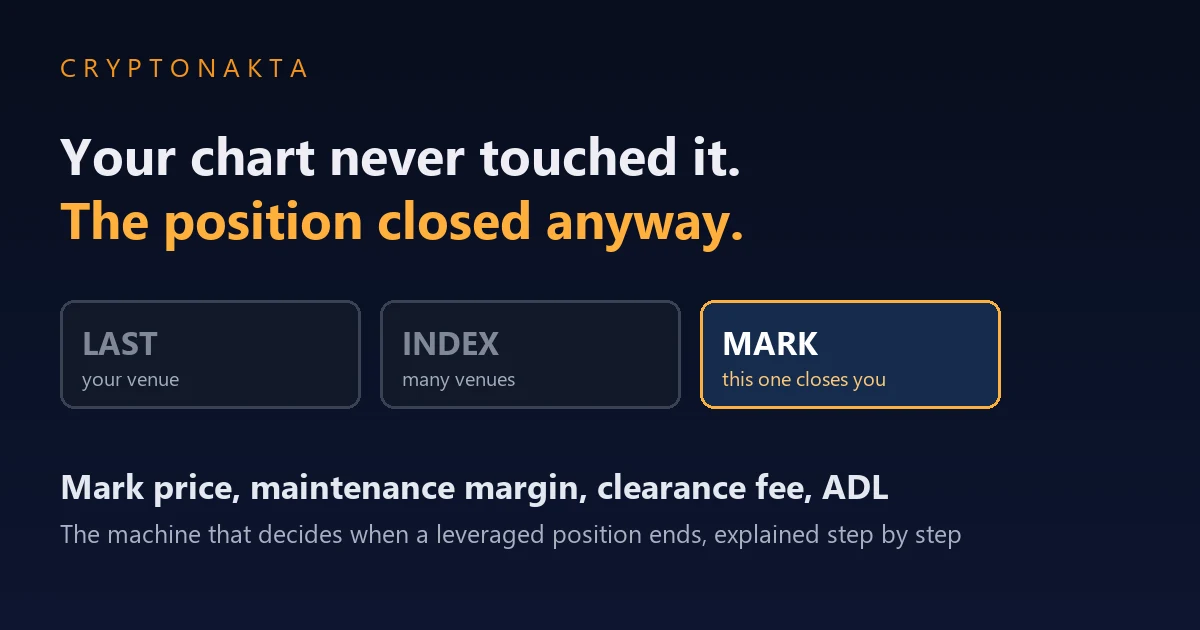
Start with the moment itself, because the details matter. A position is open. The app shows a liquidation price sitting some distance below the current market. The market drops hard for a few minutes, prints a long lower wick, and bounces. When the account is opened again, the position is closed, the margin is gone, and the trade history shows a forced close rather than a normal exit.
Zoom into the candle and the low sits above the liquidation price the app displayed. Two things follow from that, and both are worth stating plainly.
- The chart on your screen is not the input the engine used. Your chart plots trades that happened on the venue you are logged into. The liquidation system reads a different price, and it is built somewhere else.
- The number labelled “liquidation price” was an estimate, not a boundary. It is derived from a condition, and that condition can be met while the displayed number is still a little away.
The mirror image also happens and confuses people just as much. A venue prints a violent wick that plunges straight through a liquidation price, and the position survives. Same rulebook, opposite outcome. Once you know which price the system is reading, both results stop being mysterious and start being predictable, which is the entire point of learning this.
One thing this article deliberately does not do is tell you what multiplier to use, when to enter, or whether to trade derivatives at all. Hedging a holding and taking two-way positions are ordinary uses of these products, and plenty of careful people use them well. The goal here is narrower: describe the machine accurately enough that whatever you decide, you decided it with the rules in view.
2. Three prices behind one chart, and the only one that closes you
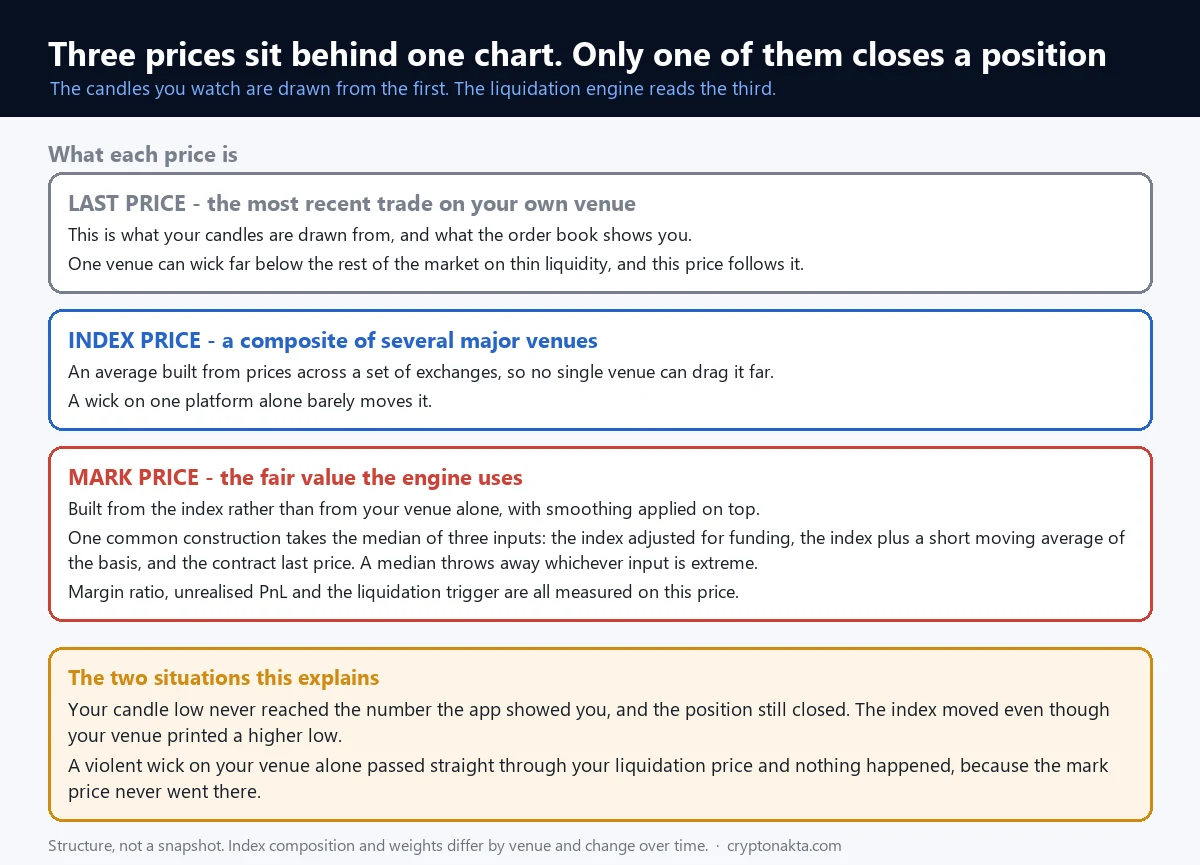
Any perpetual contract has at least three prices attached to it at the same moment, and they are usually a few basis points apart. In quiet markets you can ignore the difference. In the ninety seconds that matter, you cannot.
Last price
This is the most recent trade that actually happened on your exchange. It draws your candles and fills your orders. Because it is a record of local trades only, it can move a long way on its own when the book thins out and a large market order sweeps through. Your stop orders and take-profit orders usually reference this price, which is one reason a stop can trigger during a wick that the rest of the market never saw.
Index price
The index is a composite of the same asset’s price across a set of major exchanges. Because it is averaged across venues, a single platform going haywire barely moves it. If one exchange prints a low that no other exchange prints, the index mostly ignores it. Composition and weighting differ between venues, and some drop a constituent automatically if it drifts too far from the rest.
Mark price
The mark price is the fair value the platform assigns to the contract, and it is what your unrealised profit and loss, your margin ratio and your liquidation are all measured against. It starts from the index rather than from local trades, then smooths further. One widely used construction takes the median of three inputs: the index adjusted by the funding rate scaled to the time remaining until the next funding settlement, the index plus a short moving average of the basis between the contract and the index, and the contract’s own last price. A median discards whichever of the three is extreme, so a single bad input cannot drag the mark far.
That design decision explains both of the confusing outcomes above. If the broader market genuinely moved, the index moved, so the mark moved, and the position closed even though your local candle low printed higher. If only your venue wicked, the mark stayed roughly where the rest of the market was, and nothing happened. Every serious platform publishes its mark price alongside the last price, and most charting interfaces let you overlay it. Doing that once, before you need it, is a five-second habit worth more than any indicator on the screen.
3. The real rule: margin balance against maintenance margin
Now the condition itself. Liquidation is not defined as “price touches a number”. It is defined as a balance falling under a requirement.
Every open position carries a margin balance: the collateral backing it plus the unrealised profit or loss on it, marked at the mark price. Against that sits the maintenance margin, the minimum the venue insists you keep for a position of that size. When the first number falls to the second, the liquidation process starts.
Interfaces express this as a margin ratio, sometimes called the maintenance margin ratio. Different platforms scale and label it differently, so read yours rather than assuming, but the shape is always the same: one number that rises as your buffer is consumed, with a threshold at which the engine takes over. The liquidation price shown next to your position is simply that condition solved for price, using everything the system knows right now. Change any input and the answer changes.
| What the app shows you | What the system is actually testing |
|---|---|
| A liquidation price, in currency units | Whether margin balance has fallen to maintenance margin |
| Distance from the current price to that number | The margin ratio, measured on the mark price |
| A number that looks fixed once you open the trade | An output recalculated as funding, margin and size change |
| One number per position | In cross margin, one shared pool that every position draws from |
This is why experienced traders talk about margin ratio rather than distance to liquidation. Distance is a derived, drifting quantity. The ratio is the thing being tested, and it is the only number that tells you how much room is genuinely left. If you get one habit from this article, make it that one: put the margin ratio somewhere you can see it, and stop measuring your safety in price gaps.
4. Where the maintenance margin comes from, and why it is not your multiplier
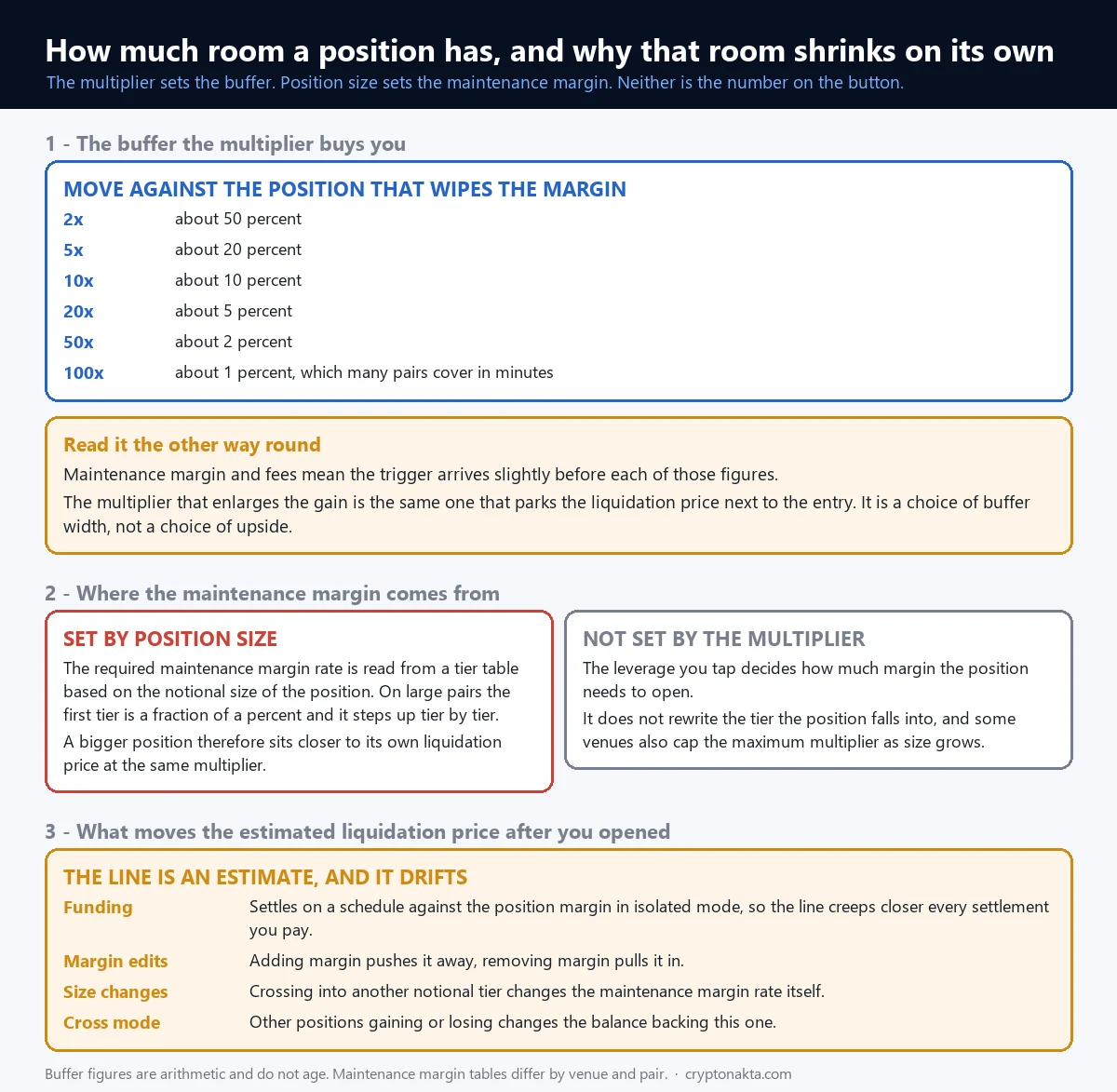
The next question is where the maintenance margin figure comes from, and the answer surprises most people the first time they meet it. It is not derived from the multiplier you tapped.
Venues publish a tier table for every contract. The tiers are defined by the notional value of the position, meaning the full leveraged size, not the collateral you posted. Each tier carries its own maintenance margin rate, and the rate rises as you climb the tiers. On the largest pairs the first tier sits at a fraction of a percent, commonly in the region of 0.4 percent of notional on a major contract, and it steps upward from there. Thinner contracts start higher. The exact tables vary by venue, by pair, and over time, so treat any specific figure you read, including that one, as an example to go and check rather than a constant.
Two consequences follow, and neither is obvious from the trading screen.
| What changes | Effect on the position |
|---|---|
| You increase position size within one tier | Required maintenance margin grows in proportion. The percentage stays put. |
| You cross into a higher tier | The rate itself steps up, so the liquidation price jumps closer to your entry even though the market has not moved. |
| You lower the leverage setting on an existing position | It changes what a new position would require. It does not move the existing position into a different notional tier. |
| Your position grows very large | Many venues cap the maximum multiplier available at that size, so leverage falls as size rises. |
So the multiplier and the maintenance margin are answering two different questions. The multiplier decides how much collateral opening the position requires. The tier decides how thin a cushion the venue will let you run before stepping in. A large position at a modest multiplier can therefore sit closer to trouble than a small position at a punchier one, and traders who scale into a losing trade sometimes push themselves into a higher tier at the exact moment they were trying to buy breathing room.
5. Liquidation price, bankruptcy price, and the fee that eats the leftovers
Two prices govern the close itself, and mixing them up is why the arithmetic afterwards never seems to add up.
The liquidation price is where the process begins. The bankruptcy price is further along: it is the price at which the loss on the position exactly equals the collateral posted, leaving zero. The gap between them exists on purpose. It is the working room the engine has to close the position while something is still left.
Mechanically, the liquidation order is sent with the liquidation price acting as the trigger and the bankruptcy price acting as the limit. If it fills better than the bankruptcy price, there is a residual. If it fills worse, there is a deficit. Neither of those goes back to the trader in the way most people expect, and the reason sits in the next paragraph.
The clearance fee
A forced close is not free. Venues charge a liquidation clearance fee calculated on the notional value of the liquidated position, and it comes out before anything is returned. On large venues this fee is set per symbol in the contract rules and commonly sits somewhere in the region of one and a quarter to two and a half percent of notional, with thinner pairs charging more. On a position running at high leverage, a fee of that size measured against notional can consume a large share of the remaining collateral by itself.
Put those together and you get the honest answer to “why did nothing come back”. At high multipliers the collateral is small relative to notional, the position is already deep in loss by the time the trigger fires, and the clearance fee is charged on the big number rather than the small one. What is left after all three is frequently close to zero. Closing manually one step earlier costs an ordinary taker fee instead, which is a fraction of the clearance fee, and it leaves whatever collateral remains in your account rather than in the venue’s insurance fund. That difference is the strongest practical argument for watching the margin ratio rather than hoping.
None of this makes the venue the villain. The fee funds the mechanism that stops other users being billed for your shortfall, and the same mechanism protects you when someone else blows up on the other side. It does mean the phrase “I got liquidated” describes a transaction with a price tag attached, not simply a position reaching zero.
6. The six rungs of a liquidation, and the two where you still decide
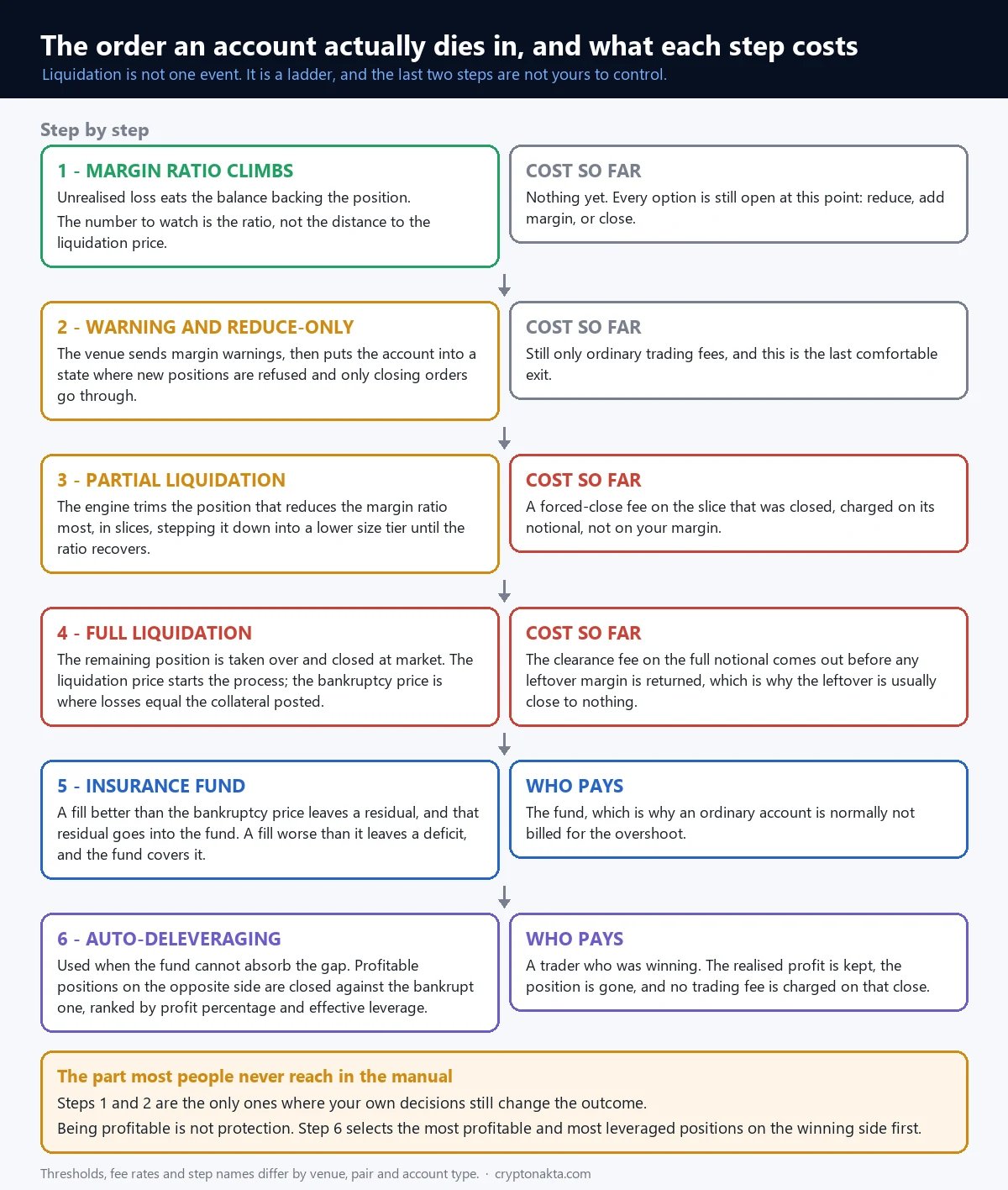
People imagine liquidation as one event. It is a ladder with six rungs, and your decisions only matter on the first two.
- The margin ratio climbs. Unrealised loss eats into the balance backing the position. Nothing has been charged. Reducing, adding collateral and closing are all still available.
- Warnings and reduce-only. Venues send margin alerts as the ratio deteriorates, and many switch the account into a reduce-only state where new positions are refused and only closing orders go through. This is the last exit at ordinary fees.
- Partial liquidation. Rather than wiping everything, the engine trims. One common approach closes, in slices, whichever position improves the margin ratio most, stepping the position down into a lower size tier until the ratio recovers to a safe level. Each slice carries the forced-close fee on its own notional.
- Full liquidation. If trimming cannot fix the ratio, the remaining position is taken over and closed at market, with the clearance fee deducted before any leftover is returned.
- The insurance fund. A fill better than the bankruptcy price leaves a residual that goes into the fund. A fill worse than it leaves a deficit that the fund covers. This is the layer that normally keeps an ordinary account from being billed for the overshoot, alongside the negative-balance protection major venues apply.
- Auto-deleveraging. Used only when the fund cannot absorb the gap. Positions on the winning side are closed against the bankrupt one.
Reading the ladder in that order rearranges what “risk management” means on a leveraged position. Most of the attention in trading content goes to step four, the dramatic one. The steps that decide your outcome are one and two, and they are quiet, ratio-shaped and easy to miss on a phone screen. By the time step three starts, the engine is making the decisions and charging you for them.
The other thing worth internalising: steps five and six are about somebody else’s position as much as your own. That is how a market-wide event reaches into an account that did nothing wrong, which is the subject of the next section.
7. Auto-deleveraging: when a winning position is closed for you
Auto-deleveraging, usually shortened to ADL, is the part of the system almost nobody reads about until it happens to them. It exists because a derivatives venue must stay balanced: every long is matched by a short. When a position goes bankrupt and the insurance fund cannot absorb the shortfall, the system has to close the other side of that trade against someone. It picks profitable traders.
The selection is ranked, not random. Priority is calculated from profit percentage and effective leverage together, so the accounts sitting on the largest gains at the highest leverage are taken first. Most venues display this as a small indicator of about five lights next to the position: more lights lit means higher up the queue. It updates continuously, and it is worth glancing at during violent sessions, because it is the only warning you get.
What actually happens to you in an ADL close is specific and worth stating exactly:
- The position is closed at the bankruptcy price of the counterparty being handled, not at a price you chose.
- You keep the profit realised up to that point. Nothing is confiscated.
- You do not pay a trading fee on that close.
- You lose the position, so any further move in your favour happens without you in it.
That last line is the real cost. Someone positioned correctly for a violent move can be removed from the trade in the middle of it, purely because the other side of the market ran out of money. It is rare on deep pairs in ordinary conditions and clusters exactly where you would expect: thin contracts, extreme volatility, one-sided positioning. If you ever want to see this mechanism in a fully transparent setting, onchain derivatives venues publish their insurance and deleveraging events openly, and the walkthrough in our piece on the onchain perpetuals exchange model shows what that looks like when the whole ledger is public.
8. Isolated or cross: how far one position can reach
Margin mode decides how far a single bad position can reach into the rest of your account, and it is one of the few settings that is genuinely a choice rather than a market outcome. What each mode actually pledges, and the two settings that quietly remove the isolated loss cap, are in isolated versus cross margin.
| Question | Isolated margin | Cross margin |
|---|---|---|
| What backs the position | Only the collateral you assigned to it | The whole futures balance in that account |
| Worst case on one trade | That position’s margin | The account balance backing the pool |
| Liquidation price | One per position, and it moves when you edit that position’s margin | Shared across positions drawing on the same pool |
| Does a winning trade help a losing one | No. They are fenced off from each other | Yes. Unrealised gains support the pool |
| Where funding settles | Against the position margin, so it nudges that position’s liquidation price | Against the balance |
| What it is good at | Making the worst case a number you chose in advance | Keeping hedged or offsetting positions alive without micro-managing each one |
| How it fails | Liquidates sooner on a position that would have recovered | One position can consume collateral you were counting on elsewhere |
Neither mode is safer in the abstract, and anyone who tells you one is has skipped the part where it depends on what else is in the account. Isolated bounds the damage and closes earlier. Cross survives deeper drawdowns on a single position and, in exchange, lets that position reach the rest of the balance. The failure that shows up again and again in real accounts is not choosing cross; it is choosing cross while thinking in isolated terms, so the collateral that was mentally reserved for other trades quietly becomes the fuel keeping one losing position alive.
If you run several positions at once, or you copy someone else’s book through a copy trading product, check which mode the positions are actually opened in rather than assuming, because the answer determines whether one bad trade in that book can reach the rest of your balance.
9. Why your liquidation price moves while you are asleep
A liquidation price is not a line painted on the chart. It is recalculated constantly, and four ordinary things move it while you are asleep.
Funding settlements
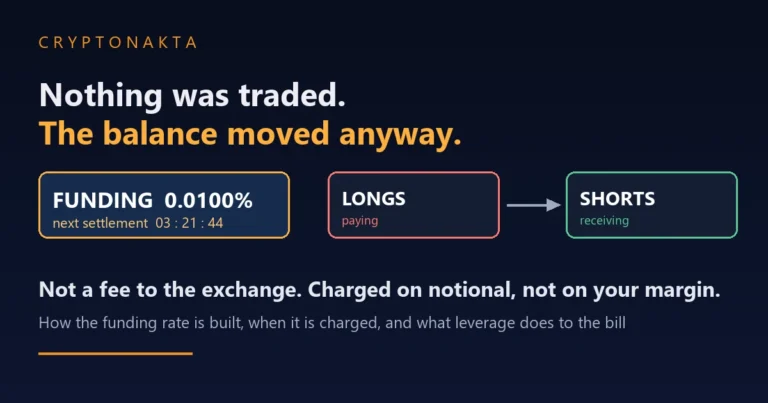
Perpetual contracts have no expiry, and funding is the mechanism that keeps them tethered to spot. Longs and shorts pay each other on a schedule, commonly every eight hours, and the payment is calculated on the notional value of the position. In isolated mode that payment is settled against the position’s own margin, so each settlement you pay reduces the collateral backing the trade and pulls the liquidation price closer. Hold a crowded position through several settlements and the trigger has migrated toward you without the market having done anything at all. The same mechanism, seen from the other side, is what certain yield products are built to harvest, which we cover in the piece on a stablecoin whose yield comes from funding. And since these settlements are the most common reason a liquidation price drifts overnight, the full mechanics are in how funding rates are built and billed.
Margin edits
Adding collateral to an isolated position pushes the liquidation price away. Removing it pulls the price closer. Some venues offer an auto-margin feature that tops a position up automatically from your balance, which quietly converts an isolated position into something that behaves more like a cross one, so it is worth knowing whether yours is switched on.
Size changes and tier crossings
Adding to a position raises the required maintenance margin, and if the addition pushes the notional into a higher tier, the rate itself steps up. Averaging down into a loss can therefore move the trigger toward the current price at the exact moment the trader believed they were building a buffer.
Everything else in a cross account
In cross margin the pool is shared, so a second position moving against you drains the same balance that backs the first. Positions that felt independent are linked through the collateral, and the linkage only becomes visible when the market moves against several of them at once.
Taken together, these are the reason a position can be liquidated on a day when the price barely moved. The trigger came to the price rather than the price going to the trigger. Anyone who checks in once a day should be re-reading the current liquidation price and margin ratio at every check, not the ones they memorised when they opened the trade.
10. Cascades, gaps, and why a stop loss can fail to stop the loss
Two market-structure facts explain why liquidations cluster into violent, short-lived moves, and why protective orders sometimes fail to do their job.
Forced selling is market selling
A liquidation engine does not wait for a good price. It closes with market orders, because its job is to remove risk immediately. Those orders push the price further in the direction it was already going, which pulls the next cluster of liquidation levels into range, which produces more forced market orders. A self-feeding loop of this kind is called a liquidation cascade, and it is why crypto charts show long, thin wicks that retrace almost as fast as they printed. Positions further out get taken along the way, and the further out you were, the more likely your close happened at a price nobody would have traded at voluntarily.
A stop order is a trigger, not a promised price
This is the part that generates the most anger and the most misplaced blame. A stop order says: when the market reaches this level, send an order. What price that order gets depends entirely on what is sitting in the book when it arrives. If the market gaps through the level, the trigger fires late. If the book has thinned out, the resulting order walks down through whatever bids remain. Slippage of several percent is unremarkable inside a cascade, and it is the mechanism by which a stop loss that was set correctly still fails to stop the loss.
There are partial answers. A stop-limit will not fill below your limit, which protects the price at the cost of possibly not filling at all, leaving the position open into worse conditions. Deeper pairs gap less than thin ones. Smaller size takes fewer levels of the book to clear. Overnight and weekend liquidity is thinner almost everywhere, so identical size lands worse at those hours. What does not exist is an order type that guarantees both a fill and a price, and any content promising you one is selling something.
Understanding this changes how you read a liquidation notice. In a cascade, the fill you got was not a personal insult. It was the price at which the book still had a bid, and every account in that queue got the same treatment.
11. The sequence that actually empties accounts
Accounts rarely die from one mistake. They die from a specific sequence, and the sequence is the same often enough to be worth writing down as a pattern rather than a warning.
- A high multiplier is selected because the account is small. The logic feels sound: a small balance needs leverage to produce a meaningful result. The arithmetic goes the other way. At 50x the market only has to move about two percent against the position to consume the margin, and on most pairs that is a normal hour.
- Cross margin is left on by default. It is often the default setting, and it means the whole futures balance is standing behind this one trade, not the amount that was mentally allocated to it.
- No protective order is placed, or it is cancelled. The reasoning is usually that the stop keeps getting hit by wicks. That is a sizing and distance problem, and removing the stop replaces a small scheduled loss with an unscheduled total one.
- Margin is added into the loss. Adding collateral does push the liquidation price away, which is why it feels productive. It also increases the amount at risk, and if the addition pushes the notional into a higher tier, the maintenance margin rate rises and part of the new buffer is eaten on arrival.
- Funding accumulates on the crowded side. Whatever everyone else is doing, you are probably doing too, and the crowded side is usually the paying side. Several settlements later the collateral is smaller and the trigger is nearer.
- One volatile session finishes it. The mark price moves, the ratio hits the threshold, the engine trims, then closes, then charges the clearance fee on notional.
Notice that only step six involves the market doing anything unusual. Steps one through five are settings and habits, all chosen calmly, none of which felt like the fatal one at the time. That is why this sequence survives every market cycle and why the people it happens to are rarely reckless. They are usually just measuring risk with the wrong dial.
The counter-pattern is equally unglamorous: size so that a normal move does not threaten the position, know which margin mode you are in, keep the margin ratio visible, and treat added collateral as a decision about total exposure rather than a way to buy time.
12. What you can still do before the engine takes over
When the ratio is deteriorating, there are exactly three things you can do, and each has a cost that is worth knowing in advance rather than discovering at speed.
| Option | What it does | The honest limitation |
|---|---|---|
| Add margin (isolated) | Pushes the liquidation price away by increasing the collateral behind the position | Increases the money at risk. If it pushes notional into a higher tier, part of the new buffer disappears immediately. |
| Reduce the position | Cuts the required maintenance margin and can drop the position into a lower tier, improving the ratio twice over | Realises part of the loss now, and pays an ordinary trading fee on the part you close. |
| Close it yourself | Ends the exposure at a taker fee instead of a clearance fee, and keeps whatever collateral is left | The loss is final. There is no recovery if the market turns straight afterwards. |
| Do nothing and hope | Nothing | Hands the decision to an engine that closes at market and charges a fee on notional. Statistically the most expensive option in the table. |
Which one is right depends on the trade, and this article is not going to pretend otherwise. What is worth saying is that all three of the real options are only available in steps one and two of the ladder, and the window is often minutes rather than hours. That is an argument for deciding in advance what you will do at a given ratio, while nothing is happening, because the decision is much worse when made under pressure with the number turning red.
The other preparation is structural rather than tactical. Whether the venue holds up under load is part of your risk, since a platform that stalls during a cascade removes your ability to act at the exact moment it matters. That is a due-diligence question, not a trading one, and the checklist in how to tell whether an exchange is legitimate and the review of what happens if a venue fails cover it properly. Fee schedules, including forced-close fees, sit in the exchange fee comparison, and coins you intend to hold rather than trade belong in a wallet you control rather than as collateral on a derivatives account.
Binance

Bybit

Gate.io

Where a derivatives tab appears at all, and in what form, depends on your region and account, so check what your own screen shows. The comparison in our exchange guide covers what each platform does with spot, derivatives and fees.
Affiliate disclosure: some links are partner links. We may earn a commission at no extra cost to you. This is not investment advice.
13. Glossary: the fourteen words this whole system runs on
The vocabulary is small, and knowing it precisely is most of the battle.
- Mark price: the fair value the venue assigns to a contract, built from a cross-exchange index with smoothing. Margin ratio, unrealised profit and loss, and liquidation are all measured on it.
- Index price: the composite spot price across several exchanges that the mark price is built from.
- Last price: the most recent trade on your own venue. It draws your candles and normally triggers your stop orders.
- Notional: the full leveraged size of the position. Fees, funding and maintenance margin tiers are all measured against it, not against your collateral.
- Maintenance margin: the minimum equity the venue requires you to keep behind a position. Its rate is read from a tier table based on notional size.
- Margin ratio: the displayed measure of how close the position is to that requirement. The number the system is actually testing.
- Liquidation price: the estimated price at which the margin ratio hits the threshold. An output that moves, not a fixed line.
- Bankruptcy price: the price at which losses equal the collateral posted, leaving zero. The liquidation order’s limit.
- Clearance fee: the fee charged on notional when the engine closes a position for you, deducted before any leftover margin is returned.
- Insurance fund: the pool that absorbs shortfalls when a liquidation fills worse than the bankruptcy price, funded partly by clearance fees.
- Auto-deleveraging (ADL): the final step, closing profitable positions on the opposite side when the insurance fund cannot cover a bankrupt position. Ranked by profit and effective leverage.
- Isolated and cross margin: whether a position is backed only by collateral assigned to it, or by the whole futures balance.
- Funding rate: the periodic payment between longs and shorts that keeps a perpetual tethered to spot, charged on notional.
- Reduce-only: an account or order state in which positions can be closed but not opened.
If a term in your exchange’s help centre does not match this list, trust the help centre. The concepts are industry-wide; the labels, thresholds and exact formulas belong to each venue, and a five-minute read of the contract rules for the pair you trade is the highest-return reading in derivatives.