Bitcoin Cash (BCH): Two Chains, One Supply Cap, One Changed Rule
What the side that raised the block size limit bought, what it gave up for it, and where that shows on the chain today.
| Question | Short answer |
|---|---|
| What is it? | A separate proof of work chain that carried bitcoin’s ledger forward from block 478,558 under a higher block size limit. |
| What changed at the split? | The block size limit. None of the monetary rules. |
| Where new coins come from | Mining only. The next halving point is block 1,050,000. |
| What the bigger blocks bought | Blocks stay far from full, so the fee to move value stays low and does not climb when activity rises. |
| What they cost | A small share of all SHA-256 mining power secures the chain, and the same machines can point at either chain. |
| Staking | There is no staking on this chain. |
1. Two chains, one supply cap, and one of them is further along
2. The one rule that changed at block 478,558
3. An inherited ledger: no presale, and a shared name with no official relationship
4. What the higher limit bought: room in every block and a fee of a fraction of a cent
5. Bigger blocks were the whole point, and most of that space stays unused
6. One hash function, two chains, and where the machines can point
7. Sending it, receiving it, and the address form most exchanges refuse
8. Why an exchange counts confirmations before it credits your BCH
9. New coins go only to miners, and the halving is a block height
10. Changing the rules by splitting, applied to this chain twice more
11. Rules change in one fixed window a year, and your software has to keep up
12. The yearly script expansion: what activation proves and what it does not
13. What it does, what it does not do, and the claims that break on inspection
14. Every figure that moves, in one dated snapshot
15. Words you will meet on this chain
Two chains carry the same supply cap of 21,000,000 coins, the same halving interval, the same hash function and the same ten minute target. One of them is called Bitcoin Cash, and it exists because a set of miners and businesses raised one limit in August 2017 and kept everything else exactly as it was. That single change is readable today in the fee, in how full the blocks are, and in the share of mining power pointed at the chain. Both networks are still running, each under its own rules.
1. Two chains, one supply cap, and one of them is further along
Bitcoin and Bitcoin Cash stop issuing coins at the same number. Both cut the reward paid for a block every 210,000 blocks, both use SHA-256 as their proof of work function, and both aim for one block every ten minutes. Two ledgers running identical monetary rules ought to sit at the same point in their schedules. They do not. Bitcoin Cash is further into its issuance and higher in block height. The exact figures, with the date they were read, sit in the snapshot table near the end.
The cause is ordinary. After the two chains separated, blocks arrived slightly faster here on average, so the same schedule ran slightly ahead. Nothing about the money differs. The supply cap is the same 21,000,000 coins, the halving interval is the same interval, and the next halving point falls at the same block number on both chains. What differs is pace, and pace comes from mining and from how each chain retunes its difficulty.
Explaining the pace means explaining the split, and the split comes down to one rule. Someone buying BCH is buying a ledger whose entire history is bitcoin’s history up to a single block in August 2017, and which has applied a different limit on how much data fits in a block ever since. Everything else about the money was inherited untouched, down to the last decimal place.
The fee to move value, the share of block space actually used, and the amount of mining power standing behind the chain are where the difference is visible, and all three can be read off a block explorer. If you want the base layer all of this started from, the bitcoin explainer covers it: what bitcoin is and how the chain works.
2. The one rule that changed at block 478,558
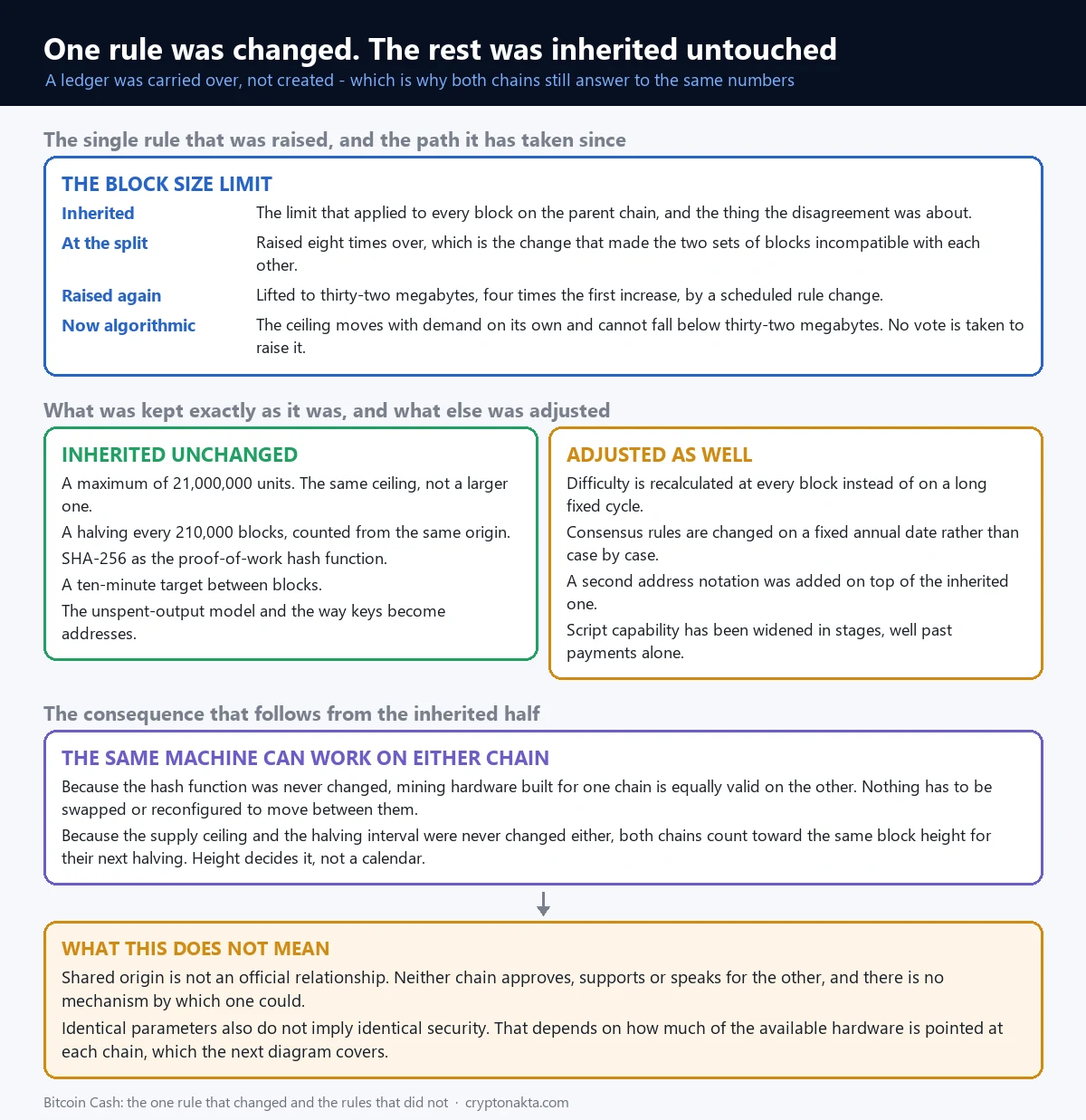
The two chains share every block up to 478,558, mined on 1 August 2017. From the next block onward, miners running software with a raised ceiling built their own sequence. The limit moved from 1MB to 8MB. In technical terms that single parameter is the entire content of the disagreement.
The list of things that stayed the same is longer, and it matters more. Maximum supply: 21,000,000 coins. Issuance schedule: the block reward halves every 210,000 blocks. Proof of work function: SHA-256. Target interval between blocks: ten minutes. Accounting model: unspent transaction outputs, the same structure bitcoin uses to track who holds what. Key handling and address derivation were identical at the moment of the split, so a wallet holding bitcoin at that block also held the same number of coins on the new chain, under the same key.
The ceiling moved again afterwards. In May 2018 it went to 32MB. In May 2024 the chain adopted an adaptive rule, ABLA, which recalculates the ceiling from recent demand and keeps a fixed floor of 32MB. Difficulty control, the mechanism that holds blocks near the ten minute target, was replaced three times: the emergency adjustment used at the split, a 144 block moving window from November 2017, and ASERT from November 2020.
That is why the usual line about a new coin being created in 2017 names the wrong event. A ledger was carried forward. History, balances and monetary rules came along unchanged. The rule about how much data a block may carry did not.
| Item | Bitcoin | Bitcoin Cash |
|---|---|---|
| Maximum supply | 21,000,000 coins | 21,000,000 coins (same) |
| Halving interval | Every 210,000 blocks | Every 210,000 blocks (same) |
| Proof of work function | SHA-256 | SHA-256 (same) |
| Target block interval | Ten minutes | Ten minutes (same) |
| Block size rule | Fixed ceiling measured in weight units | Adaptive ceiling (ABLA) with a fixed floor of 32MB |
| Difficulty adjustment | Every 2,016 blocks | After every block (ASERT) |
| How rules change | Mostly soft forks adopted by broad agreement | Scheduled consensus change on 15 May each year at noon UTC |
| Address notation | One scheme | Two notations, legacy and CashAddr |
3. An inherited ledger: no presale, and a shared name with no official relationship
There was no presale, no token sale, and no allocation set aside for a founding team. On the day of the split the holders of the new coin were the holders of bitcoin, in the same amounts, because the balances were the ones the shared ledger already recorded. The starting distribution was a copy of bitcoin’s distribution at that block and nothing else. That is unusual enough to state plainly, and it describes the starting point only, with no claim about anything that came after it.
The name is a separate matter, and it produces more confusion than anything technical here. Bitcoin Cash is not an official upgrade to bitcoin, not a successor project, and not something released by the same people. No organisation governs both. Two networks run in parallel with their own nodes, their own difficulty, their own developers and their own rules, and a coin on one chain cannot be spent on the other. The only relationship is historical: one shared ledger up to one block.
A comparison with a coin that launched separately makes the difference concrete. Litecoin took bitcoin’s code base and started its own chain from its own genesis block with different parameters, so no address has ever held a balance on both ledgers at the same time. A split is the other case entirely: identical history up to a point, divergent rules after it. That contrast is worked through in the Litecoin explainer, same code base, different choices.
One further consequence of the shared history turns up on deposit screens years later. The address format was inherited too, so a Bitcoin Cash address in its original notation is indistinguishable at a glance from a bitcoin address. That single detail causes most of the accidents described further down, and it is the reason exchanges built a separate rule around this coin.
4. What the higher limit bought: room in every block and a fee of a fraction of a cent
A miner fills the block it is building by taking waiting transactions in order of the fee attached to each one. When more transactions are waiting than the block ceiling has room for, the ones paying more go in first, and anyone who wants the next block has to attach more than they did. When the ceiling sits far above the number of transactions waiting, that ordering stops mattering: a transaction pays close to the minimum a node will relay it for, and it goes into the next block anyway.
Bitcoin Cash sits in the second situation permanently, and that is the direct result of raising the limit. The median fee is a fraction of one US cent, and it does not jump when activity rises for a day, because the room is already there. On a chain whose blocks are full, that same fee moves with demand and can multiply within a week. Both medians, with the date they were read, are in the snapshot table.
Moving value on this chain is cheap, and the cost is predictable from one day to the next. Transfers small enough to be pointless elsewhere are practical here, and so are the token operations described later, which need many small on-chain actions before they make any sense.
A low fee does not shorten confirmation time, since the target is still one block every ten minutes on average. It does not make a transfer private. It says nothing about what a coin is worth. And on its own it is no evidence that people are using the chain, since how full the blocks actually get is a separate measurement.
5. Bigger blocks were the whole point, and most of that space stays unused
The floor for a block on this chain is 32MB, and the adaptive rule can lift the ceiling above that when demand justifies it. Recent blocks use well under one percent of that floor. The ceiling is far above what the blocks actually carry. Counted in transactions rather than bytes, a Bitcoin Cash block carries roughly a hundred where a bitcoin block carries thousands. Both figures, dated, are in the snapshot table.
The case for raising the limit had two halves. The first, that a higher ceiling keeps the fee low, is observable here: the room is there and the fee is a fraction of a cent. The second, that ordinary payment volume would fill that room, got its answer, and the answer was that the volume did not arrive.
So the question of which ceiling was correct got settled by where demand went, and not by a technical proof from anyone. A large ceiling is no promise that anything fills it, and a small ceiling is no proof that the demand never existed.
It also explains where the work went instead. If the case for a chain rests on payment volume that has not arrived, the space exists and stays mostly empty, so the change of direction is to make it able to do more. Every annual rule change since 2023 has gone into what the script system can express, which the sections below work through.
6. One hash function, two chains, and where the machines can point
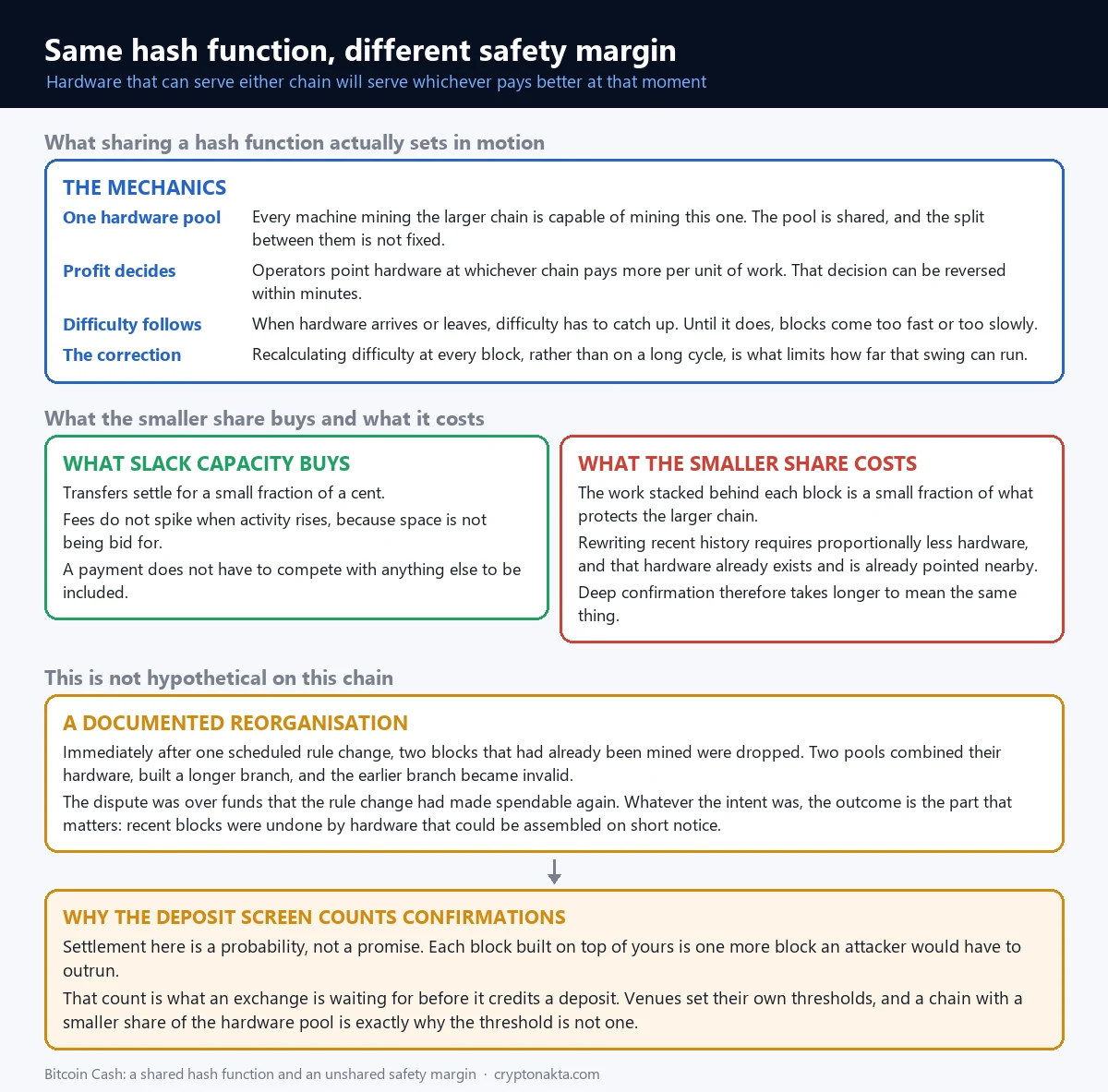
SHA-256 is the function mining hardware computes, over and over, looking for a block that satisfies the current difficulty. Bitcoin uses it and Bitcoin Cash inherited it. The practical consequence is that the machines are interchangeable. A rig built for one chain mines the other after a configuration change, and pools move capacity to whichever chain pays better at that moment.
That mobility is what sets the safety margin. Rewriting recent history on a proof of work chain costs in proportion to the hash power an attacker has to out-compute. Bitcoin Cash is secured by a small share of all SHA-256 hash power in existence, far below bitcoin’s, and the share is not fixed, because capacity can be redirected as soon as the arithmetic changes for a pool operator. The measured share on the snapshot date is in the table at the end of the article.
Fast movement of hash power creates a second effect: block intervals stop being regular. When a large amount of capacity leaves, blocks slow down. When it arrives, they come in bursts. The emergency difficulty adjustment used right after the split reacted so sharply that it produced exactly those swings, and coins came out faster than the ten minute target implies. The 2020 switch to ASERT replaced it with an algorithm that retargets after every block against an exponential schedule, holding the average near the target without over-correcting.
Mining here is only possible with dedicated SHA-256 hardware, so an ordinary computer is irrelevant to it. And there is no staking on this chain, so there is no mechanism for locking coins in exchange for a share of new issuance. How a proof of stake chain differs is set out in the staking explainer.
7. Sending it, receiving it, and the address form most exchanges refuse
Two notations exist for the same address. The original one starts with 1 or 3 and comes from the same key and the same hash construction as a bitcoin address, so the two look identical on screen. CashAddr arrived in January 2018 to remove the ambiguity: it writes the address with a bitcoincash: prefix and a body beginning with q or p, and some wallets display it without showing the prefix. Both notations describe the same destination, and converters translate one into the other.
| Notation | How it looks | Background | At an exchange |
|---|---|---|---|
| Legacy | Starts with 1 or 3 | Identical in appearance to a bitcoin address | Most deposit forms refuse it for BCH |
| CashAddr | bitcoincash: prefix, body starting with q or p | Introduced January 2018; the prefix is hidden in some wallets | The notation deposit screens expect |
Most exchanges accept only CashAddr for a BCH deposit and reject the older notation outright. The chain itself accepts both notations, so refusing the older one is a company policy, and it exists because the older notation invites the mistake this coin is known for: someone copies an address from one screen and sends the wrong asset to it, since both assets accept something that looks the same.
A workable order of operations. Copy the receiving address from the screen that is meant to credit it, not from a message or an email. Check that the network selector on the sending side says Bitcoin Cash. Check the prefix, or the leading character if the wallet hides the prefix. Send a small amount first, wait for the number of confirmations that venue requires, then send the rest. Storing it afterwards is the same decision as for any other coin, covered in the guide to crypto wallets. If value has already gone to the wrong network or the wrong asset, what to do after sending crypto on the wrong network sets out what can and cannot be recovered.
On where it trades there is little to add. BCH has spot pairs on the large global venues, and buying it works the same way as buying anything else listed there, a process already broken down in the guide to buying bitcoin, while the exchange comparison covers the venues themselves. The cards below are partner links to four of them.
Binance

Bybit

Gate.io

KuCoin

8. Why an exchange counts confirmations before it credits your BCH
In May 2019, immediately after that year’s scheduled rule change, two blocks that had already been mined on Bitcoin Cash stopped being part of the chain. A longer sequence built by two large pools took precedence, and the blocks produced by another pool and by an unidentified miner were discarded. The transactions inside them went back to being unconfirmed.
| Item | What happened |
|---|---|
| When | Immediately after the 15 May 2019 rule change |
| What | Two already mined blocks were displaced by a longer chain |
| Who | Blocks from ProHashing and an unidentified miner were dropped, and the chain extended by BTC.top and BTC.com survived |
| Background | Coins made recoverable by that rule change; block 582,705 carried 1,278 transactions and 3,655 BCH |
| What it leaves behind | Two blocks that already carried confirmations stopped being confirmed |
The background involved coins that had been sent into a script type this chain could not spend, which the rule change made recoverable. When an unidentified miner moved to take them, two pools combined hash power and produced the longer chain that removed those blocks. The motive is still argued about.
A confirmation is a probability, and it never reaches certainty. One confirmation means a transaction is in a block. Six confirmations mean it is in a block with five more stacked on top, each of which an attacker would have to out-mine to undo it. On a chain holding a small share of the available hash power, producing a longer alternative sequence costs proportionally less than it would elsewhere.
This is exactly what an exchange deposit screen is doing when it shows your BCH waiting for confirmations. Each company sets its own number from its own risk tolerance, so the count differs between venues and can change without notice. When a transfer sits longer than the stated count, the usual causes are in why a crypto deposit has not been credited yet.
9. New coins go only to miners, and the halving is a block height
New coins on this chain come from one place: the reward paid to whoever mines a block. There is no protocol level yield, no issuance to a treasury or a foundation, and no way to earn coins by holding them. A BCH balance sitting in your own wallet stays exactly the same number forever, and nothing accrues to it while it sits.
The reward follows an inherited rule that has nothing to do with the calendar. Every 210,000 blocks, the amount paid per block is cut in half. Because both chains count from the same genesis block and share their history to 2017, the halving points fall at identical block heights on both. The next one sits at block 1,050,000. Blocks are found at a variable rate, so the height reaches that point when it reaches it, and any date attached to it is an estimate drawn from the current pace.
What pays for security, meaning the money that keeps hardware pointed at this chain, is the block reward plus the fees inside the block. The reward halves on a fixed schedule. Fees, on a chain whose blocks are nearly empty, contribute very little to the total. Both statements are true at the same time. How the balance between them develops is readable on the chain as the height climbs.
Exchanges and lending platforms do offer products that pay a percentage on BCH balances. Those are products a company sells, funded by lending the coins out or by a promotion budget, and they carry that company’s counterparty risk. The chain itself pays nobody except miners. The distinction is spelled out in what crypto earn products actually are.
10. Changing the rules by splitting, applied to this chain twice more
A hard fork is a rule change that older software refuses to accept. If effectively everyone upgrades, the chain carries on as one. If a meaningful part of the miners and the businesses refuses, both rule sets keep receiving blocks and the chain becomes two. Bitcoin Cash exists because of the second outcome, and it has since been on the other side of the same process twice.
| Point | What happened | The disagreement |
|---|---|---|
| 1 August 2017, block 478,558 | Split from bitcoin | Block size limit, 1MB to 8MB |
| 15 November 2018 | Bitcoin SV split off | Introduction of the OP_CHECKDATASIG operation |
| 15 November 2020, block 661,648 | eCash (XEC) split off | Routing 8% of the block reward into development funding; 1 BCH became 1,000,000 XEC on that branch |
In November 2018 a disagreement over a proposed script operation ended with a separate chain, Bitcoin SV, continuing under its own rules. In November 2020 a proposal to route a share of the block reward into development funding was rejected by part of the network, and at block 661,648 the chain divided again. That branch became eCash, which redenominated its units at a million to one, so one coin on the old ledger corresponded to a million units on the new one.
The pattern is what matters here. A chain that changes consensus rules through scheduled hard forks has a built-in mechanism that resolves disagreement by separation. When agreement holds, the change activates and nothing visible happens. When it does not, holders end up with a balance on two chains, wallet software has to pick which one it follows, and every exchange decides on its own whether to support the new branch at all.
For a holder the practical part is about custody and software versions. Coins under your own keys exist on whichever chains descend from the ledger that recorded them, and you need software that speaks to the one you want to use. Coins held at an exchange follow that company’s policy on the matter. Neither situation is theoretical on this chain, since it has already happened twice.
11. Rules change in one fixed window a year, and your software has to keep up
Rule changes here run on a fixed annual schedule instead of being negotiated case by case. The window in force on this chain is 15 May at noon UTC, and a few earlier changes activated in a November window under the same mechanism. Activation is not read from the clock on any single machine: nodes compare the median time past, meaning the median timestamp of the last eleven blocks, against a fixed timestamp written into the software. Once that median passes the mark, the new rules apply from the following block.
Proposals go through a written process well before that point. Each change is described in a document, discussed in public, and implemented in the node software that participates in the network. A node still running an older version keeps enforcing the older rules, and from the activation block onward it is no longer following the chain the rest of the network is building. Anyone operating their own node, or a self-hosted wallet that validates for itself, has to keep that software current for this reason alone.
| Activation | What turned on |
|---|---|
| 15 May 2018 | Re-enabled disabled operators; block size ceiling raised to 32MB |
| 15 May 2019 | Schnorr signatures; recovery of coins sent to segwit style scripts |
| 15 November 2020 | ASERT difficulty adjustment (aserti3-2d) |
| 15 May 2023 | CashTokens; P2SH32 for script based addresses |
| 15 May 2024 | Adaptive block size limit (ABLA) |
| 15 May 2025 | Virtual machine limits; high precision integer arithmetic |
| 15 May 2026 | Pay to Script; bounded loops; function definition and invocation; re-enabled bitwise operations |
The table records changes that are already in effect. What stays useful is the rule underneath it: the chain has one fixed annual window in which consensus can change, and the content of that window is settled in the months before it. That also tells you what to check on your own setup, which is the version your wallet or node reports.
None of this process touches balances or keys. A rule change alters what the network accepts in new blocks. Coins already recorded stay recorded, and an address that worked before a change works after it.

12. The yearly script expansion: what activation proves and what it does not
From 2023 the annual changes stopped being about size. CashTokens activated that year, adding fungible and non-fungible tokens that live inside unspent outputs, which means a token moves in an ordinary transaction and is validated by the same rules as the coin itself, with no separate contract to deploy and no separate fee token to hold. P2SH32 landed in the same window, widening the hash used for script based addresses.
The 2025 window raised the limits inside the virtual machine that executes scripts and added high precision integer arithmetic, removing a limit that had made many calculations impractical to express. The 2026 window added paying directly to a script, bounded loops, defined and callable functions, and re-enabled bitwise operations that had been switched off for years.
Taken together that is a chain widening what its script language can say, on a fixed annual schedule, while keeping the unspent output model underneath. It is a different design direction from an account based smart contract platform, and it is also no longer just a payment ledger. The one line description of Bitcoin Cash as “the payments version of bitcoin” describes where it started and about half of what it is now.
Turning a capability on is a different thing from people using it. Activation is verifiable from the specifications and from the block height at which it took effect, so anyone can check it. Usage is a separate question, readable on a block explorer, and the volume of ordinary transfers on this chain is modest to begin with. Both statements hold at once, and neither of them should be inflated in either direction.
13. What it does, what it does not do, and the claims that break on inspection
| It does | It does not |
|---|---|
| Moves value for a fee that holds steady from one day to the next | Pay anything for holding coins, since there is no staking on this chain |
| Keeps spare room in blocks, so congestion pricing barely appears | Make any promise about what a coin is worth |
| Carries native tokens (CashTokens) inside unspent outputs | Act as an official continuation of bitcoin under any organisation |
| Runs script conditions, widened by the 2025 and 2026 rule changes | Hide anything, since every transaction stays in a public ledger |
The claims that circulate about this coin are a separate matter, and several of them are wrong in a way that costs people money.
| What people say | What is the case |
|---|---|
| It is bitcoin’s official next version | No. It is a separate chain that split from a shared ledger, with no formal relationship to bitcoin |
| It is cheaper than bitcoin, so it has more room to rise | That compares unit counts. The supply cap and the halving interval are identical on both chains |
| Bigger blocks mean it is used more | A large ceiling and heavy use are different things, and the blocks here stay far below the limit the rules allow |
| Same proof of work, therefore the same security | The share of SHA-256 hash power pointed here is small, and the same machines move between chains |
| It is built for payments, so it must be anonymous | No. Amounts and addresses are recorded permanently in a public ledger |
| Staking it pays interest | The chain has no staking. Interest offered by a platform is that company’s product, carrying that company’s risk |
| Its mining is separate, so the algorithm must differ | The function is SHA-256 on both chains, which is how one rig can mine either |
The privacy claim comes up because the chain is used for payments and the name suggests physical money. Every transaction here is recorded in a public ledger with amounts and addresses visible to anyone, permanently, and the same analysis techniques that work on bitcoin work on this chain. Designs that conceal amounts or participants are a separate category of protocol, built for that purpose from the start.
The other one is the unit confusion. The complaint that one BCH costs less than one bitcoin compares unit counts and nothing else, because the cap on units is identical on both chains and each unit divides into a hundred million pieces. What is genuinely cheaper here is the fee to move value, and that comes from the spare room in the blocks, which has nothing to do with the number of units.
14. Every figure that moves, in one dated snapshot
Everything in this article that moves is collected here, with the date it was read. Everything outside this table is fixed by the rules of the chain and does not drift: 21,000,000 coins, a halving every 210,000 blocks, SHA-256, a ten minute target, a 32MB floor on block size, and a consensus change window on 15 May at noon UTC.
| Figure | Bitcoin Cash | For comparison |
|---|---|---|
| Block height | 965,119 | Bitcoin 963,487 |
| Blocks per day | 165 | Bitcoin 136 |
| Transactions per day | 17,681 | Bitcoin 536,199 |
| Transactions per block | About 107 | Bitcoin about 3,942 |
| Average size of recent blocks | About 77.7KB, largest 275KB, smallest 2.8KB | Floor for the limit: 32MB |
| Median fee | About $0.0011 | Bitcoin about $0.2478 |
| Hash power | About 3.79 EH/s | Bitcoin about 862 EH/s, so about 0.44% of it |
| Coins in circulation | About 20,078,734 | Bitcoin about 20,073,368, with a cap of 21,000,000 on both |
| Next halving | Block 1,050,000 | Bitcoin reaches the same block number |
Reading these for yourself takes a minute. A block explorer for Bitcoin Cash shows the current height, recent block sizes, daily transaction counts and the median fee, and the same explorers cover bitcoin, so the comparison is a matter of opening two pages side by side. Hash power figures are estimates derived from difficulty and block timing, so small differences between sources carry no information.
Which figure matters depends on what you are checking. For safety margin, the share of hash power. For actual use, transactions per block and average block size against the floor. For issuance, the current height measured against the next halving point. For the cost of moving value, the median fee.
15. Words you will meet on this chain
These terms recur through the article, and through any explorer or exchange screen you open for this coin.
Hard fork
A consensus rule change that older software rejects. If part of the network keeps running the old rules and keeps getting blocks, the chain becomes two chains.
Reorganisation (reorg)
A longer valid sequence of blocks replacing recent blocks. Transactions in the displaced blocks return to the unconfirmed pool and may or may not be mined again.
Confirmation
One block built on top of the block holding your transaction. More confirmations mean more work an attacker would have to redo, so the count measures how expensive a reversal would be.
UTXO
Unspent transaction output. A balance in this model is the sum of discrete outputs your keys can spend, and no account total is stored anywhere.
CashAddr
The address notation introduced in January 2018, written with a bitcoincash: prefix and a body starting with q or p, created so a Bitcoin Cash address cannot be mistaken for a bitcoin address.
Hash power
The rate at which mining hardware computes SHA-256 candidates, quoted in hashes per second. It stands in for how much work rewriting recent blocks would take.
Difficulty adjustment
The rule that retunes how hard a valid block is to find, holding the average interval near ten minutes. This chain retargets after every block using ASERT.
CashTokens
Native fungible and non-fungible tokens carried inside unspent outputs, activated in the 15 May 2023 window and validated by the ordinary transaction rules.
Coinbase reward
The new coins a miner pays to itself in the first transaction of a block. This is the only source of new supply, and it halves every 210,000 blocks.
Median time past
The median timestamp of the last eleven blocks. Scheduled rule changes activate when this value passes the timestamp set in the software, so no single machine’s clock decides it.