How to Buy USDT: Card, Order Book and P2P Compared, Escrow, Proof of Payment, Network Choice
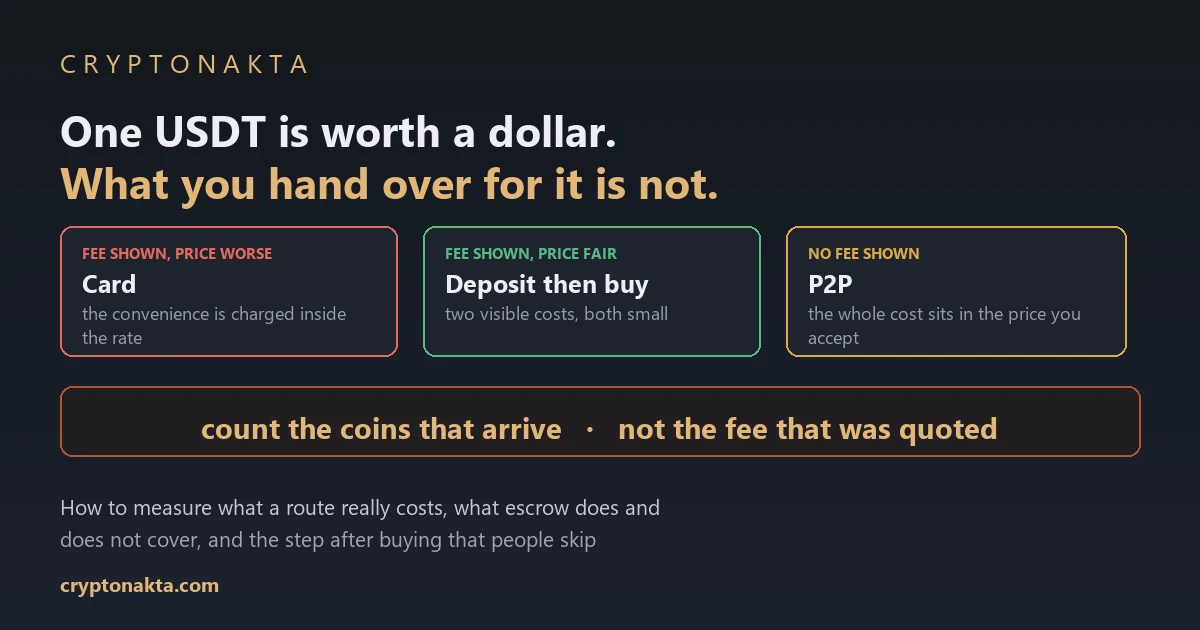
One USDT is worth about a dollar wherever you buy it. What you hand over for it is not, and the difference is never on the fee line.
| Question | Short answer |
|---|---|
| What is USDT? | A coin designed to stay near one dollar. People hold it to have dollars inside a platform, not to wait for it to rise. |
| How many ways are there to buy it? | Three that matter: a card, depositing money and buying on the order book, or paying a person through peer to peer. |
| Which one is cheapest? | It changes. The only reliable test is putting the same amount through two routes and counting what lands. |
| Why not just compare fees? | Because the routes that show no fee are charging you inside the price instead. A zero on the fee line is not a free route. |
| Is peer to peer risky? | The coins are locked by the platform before you pay. The exposure is about proving your payment, not about the coins vanishing. |
| Is buying the end of it? | No. The network, the address and a little of the chain’s own coin for fees still stand between you and a usable balance. |
1. The one measurement that settles the comparison
2. What a card purchase is actually charging for
3. The convert button, and what it quietly costs
4. What escrow holds in a peer to peer trade
5. Reading a peer to peer advert in ten seconds
6. Proof: what to capture and what not to write
7. The mark as paid button moves no money
8. Choosing where to do this
9. Three decisions after the purchase
10. Three limits that stop the same purchase
11. Run a small circuit before a large one
12. The scams that repeat
13. USDT, USDC, and where to keep the balance
14. Seven misconceptions
15. How I decide in practice
This is written for someone who already has an account and money that can reach it. From there, what a purchase costs is decided less by which platform you picked than by which of its screens you buy on. The gap between those screens is wider than any fee schedule suggests, and it does not stay in one place.
1. The one measurement that settles the comparison
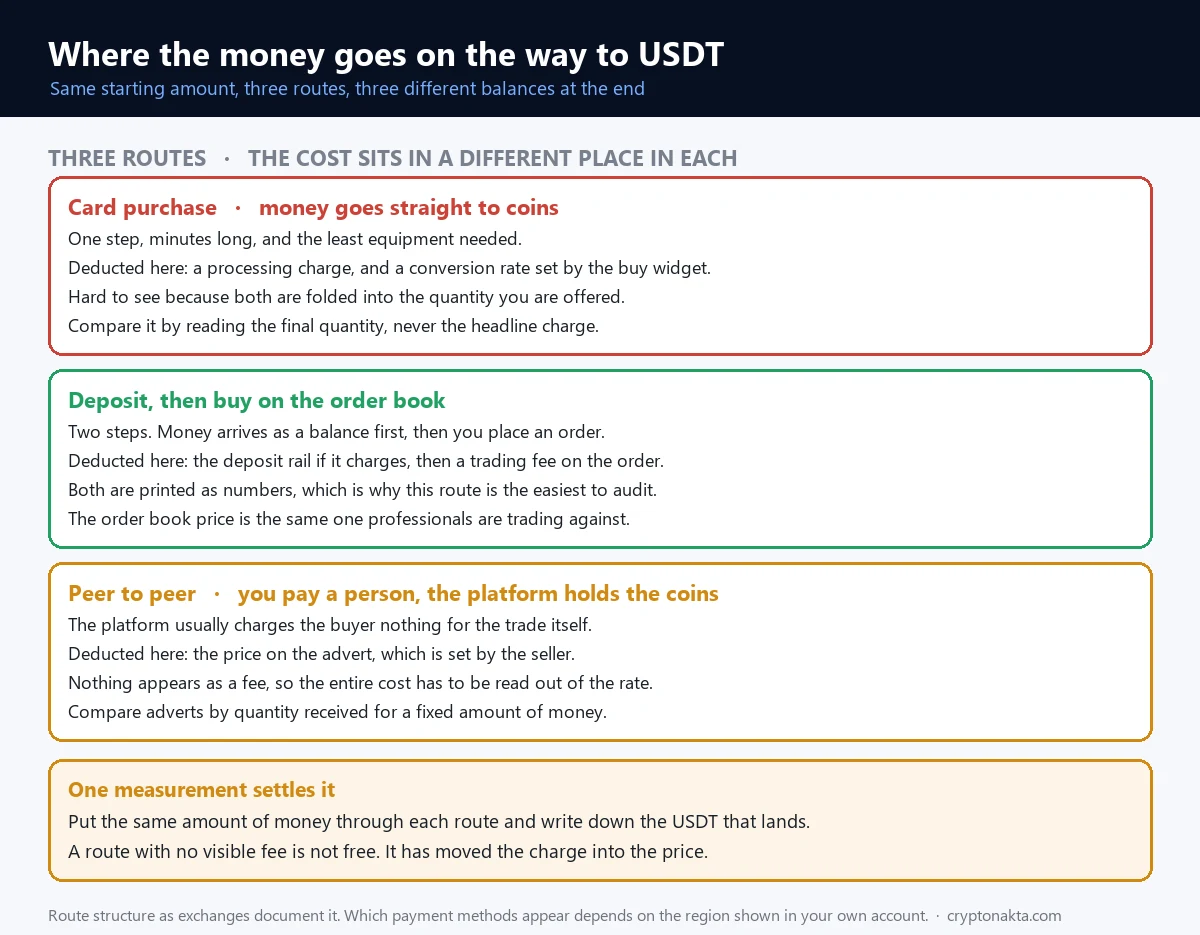
Here is the whole comparison in one line. Put the same amount of money through two routes and write down how many USDT arrive.
That single number contains everything. The fee, the spread, the conversion rate, the rounding. You do not have to understand any of them separately.
Why the fee line misleads
Three of the common routes display no trading fee at all. That is not generosity. The charge has been moved from the fee line into the price you are quoted.
A term worth having: the spread is the gap between the buying price and the selling price. It never appears on a receipt because it is already inside the number.
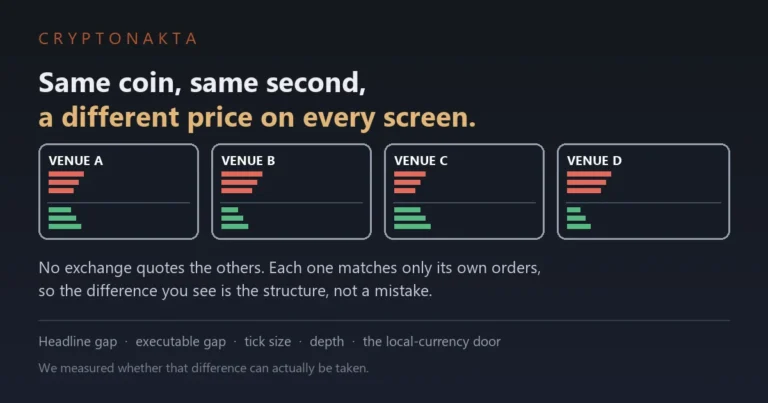
So a route advertising zero fees can leave you with fewer coins than a route charging a visible fee. Both outcomes are common, and neither is predictable from the fee alone.
| Route | Who sets the price | Where the cost sits |
|---|---|---|
| Order book | The market, live | A visible trading fee, printed as a number |
| Quick convert button | The platform | Inside the quantity you are offered |
| Card purchase | The platform and the processor | A processing charge plus a currency conversion |
| Peer to peer | Each seller, in their advert | Entirely in the advertised price |
| Swapping another coin | The trading pair used | The pair’s fee plus its spread |
How to run the test
Pick a small fixed amount. A hundred of your currency is plenty for this.
Send it through the first route and note the balance that appears. Repeat with the second route using the same amount.
Note the time as well. Peer to peer prices move through the day, so a morning measurement and an evening one are not comparable.
If you plan to move the balance somewhere else, subtract the withdrawal charge before you write the number down. That charge is part of the trip.
2. What a card purchase is actually charging for
Card purchases get recommended constantly and criticised constantly, usually without anyone explaining the mechanism. It is worth two minutes.
Two charges, both hidden in the quantity
The first is a processing charge, which covers the card network and the fraud risk the platform takes by accepting a reversible payment method.
The second is a currency conversion, because the card is charged in your currency and the coin is priced in dollars. Someone sets the rate for that step.
Neither of them is shown to you as a separate line most of the time. Both are folded into the quantity of USDT the screen offers before you confirm.
Why reversibility matters here
A card payment can be disputed weeks later. A coin transfer cannot be reversed at all.
Anyone selling coins for card payments is therefore taking a risk that a bank transfer does not carry, and the price reflects that risk.
This is also why card purchases often come with tighter limits and more verification than other routes on the same platform.
When it is still the right choice
Speed has value. If you need the balance in the next few minutes, the extra cost buys you something real.
For a small amount, the difference in absolute money is small too. For a large amount, it stops being small, and that is where the comparison starts to matter.
3. The convert button, and what it quietly costs
The convert button is the route most people actually use, and the reasoning is sound. One screen, no order types, no order book to read.
The platform quotes a quantity and you accept it. Because nothing anywhere says the word fee, the operation feels like it cost nothing.
Where the platform earns
The earning sits in the gap between the quantity offered and what the same money would have bought on the order book at that moment.
Per transaction it is usually small. Someone converting once a month can ignore it entirely and lose nothing worth counting.
Someone converting every week is paying that gap repeatedly, and it compounds into a number that would have been avoidable.
The order book is less intimidating than it looks
You need one order type to start. A limit order says the price you are willing to pay, and it fills when the market reaches it.
A market order fills immediately at whatever is available. It is the closest thing to the convert button, with the fee shown as a number instead of hidden in the quote.
Learning this once removes the gap from every future purchase. It is a fifteen minute investment with a permanent return.
4. What escrow holds in a peer to peer trade
Peer to peer worries people who have not used it, and the worry rests on a misunderstanding about who is holding what.
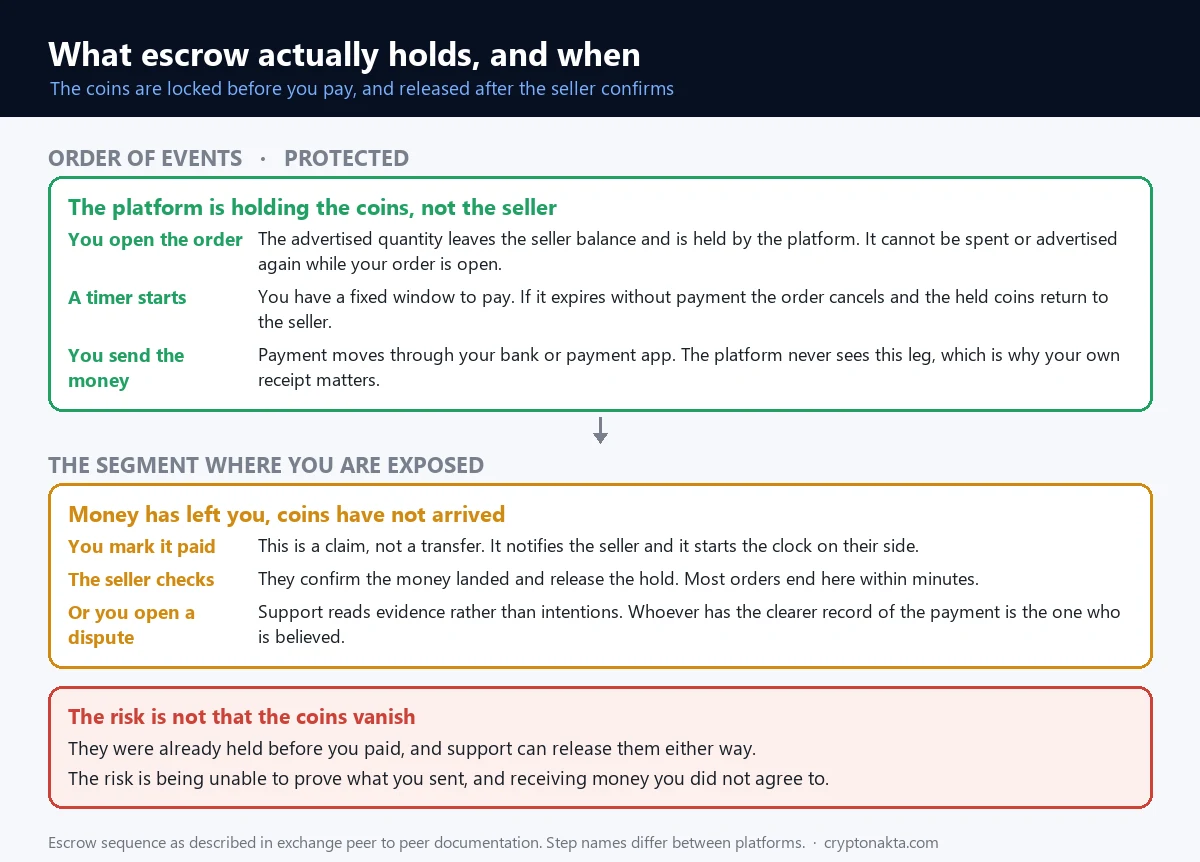
Escrow means the platform holds an asset until a condition is met. In a peer to peer trade, the thing being held is the seller’s USDT.
The coins are locked before you pay
The moment you open the order, the advertised quantity leaves the seller’s balance and sits in a platform hold. They cannot spend it or re-advertise it.
So the coins left their control before you sent any money. The common fear describes a situation that the mechanism has already prevented.
| Moment | Where the coins are | Where you are |
|---|---|---|
| Before the order | Seller’s balance | Nothing has happened yet |
| Order open | Held by the platform | The payment window starts counting |
| Payment sent | Still held | Your money has gone, the coins have not arrived |
| Seller confirms | In your balance | Trade closed |
| Dispute opened | Still held | Decided on whose record is clearer |
Only the third row carries exposure. Everything else in this article exists to make that row short.
The window is part of the design
You get a fixed period to pay. Miss it and the order cancels itself, returning the held coins to the seller.
That protects the seller from having their balance locked indefinitely by someone who never intended to pay. For you it means checking that you can actually send money now.
Bank maintenance windows, daily transfer limits and verification steps all consume that clock while you try to solve them.
5. Reading a peer to peer advert in ten seconds
Choosing an advert looks like choosing a price. There are six fields and reading all of them takes about ten seconds.
| Field | What it means | Why it matters |
|---|---|---|
| Price | What one USDT costs in your currency | This is your entire cost, there is no separate fee |
| Limits | Minimum and maximum per order | Your amount has to fall inside the range |
| Payment methods | What the seller accepts | It has to be something you can actually use |
| Completion rate | Share of orders that finish | A low figure means frequent cancellations or delays |
| Average release time | How long the seller takes to confirm | It sets the length of your exposed window |
| Orders completed | The seller’s track record | A brand new account deserves more caution |
The cheapest advert is often not the best one
The difference between the cheapest advert and a good one is usually small in money terms. A slow seller can hold you for an hour.
When the gap is small, choosing on release time beats choosing on price. You are trading a few units of currency for a shorter exposed window.
Reading the completion rate properly
It is the share of recent orders that reached the end. A low number means many were abandoned partway.
The cancellation could have come from buyers or from the seller not responding. You cannot tell which, so a low figure is reason enough to pick another advert.
Read it next to the order count. A high rate over dozens of trades means something different from a high rate over three.
Three checks before you open the order
That transfers are possible right now, that your daily limit has room, and that your amount fits the advert’s range.
All three take a minute and prevent most cancellations. Cancelling costs no money but it does get recorded against your profile.
6. Proof: what to capture and what not to write
When a dispute is opened, whoever handles it does not listen to two accounts of events. They read records.
The clearer record wins. This has nothing to do with who is right in any moral sense, and everything to do with what can be checked.
What to capture, and when
| What to keep | When to capture it | What it proves |
|---|---|---|
| The successful transfer screen | Immediately after sending | Time and amount in a single frame |
| The entry in your bank history | A few minutes later | That the transfer was actually recorded |
| The order screen | Before you pay | The price and quantity when you opened it |
| The recipient account name | Before you pay | That the money went where the platform said |
| The platform chat | If anything unusual is asked | What the seller requested and when |
The name has to match
The account receiving your money must be in the same name the platform shows as the seller. If it differs, cancel before sending anything.
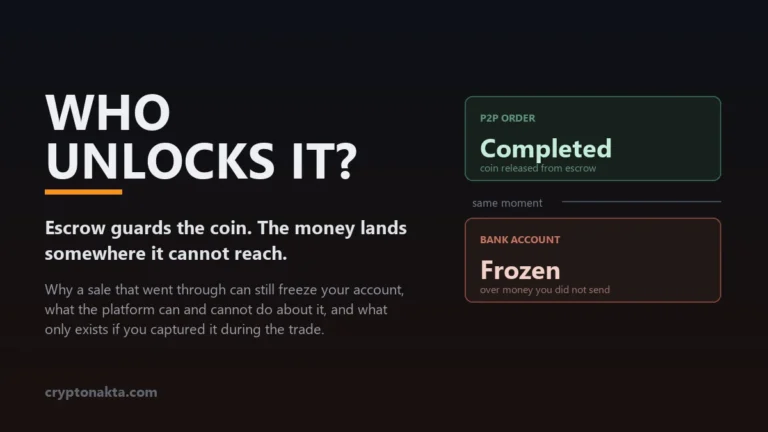
Money routed through a third party’s account creates questions that are difficult to answer later, for both sides. The seller’s version of that problem is described in what happens when a bank account is frozen after a P2P sale.
What to write in the reference field
The order reference the platform gives you, and nothing else. No coin names, no personal messages, no wording about buying digital assets.
The reference is stored and readable by the bank. A vague sentence there can turn into a question months later, long after you have forgotten the trade.
If a seller asks you to write a specific phrase that is not the order reference, that alone is reason enough to cancel.
Why the reference actually helps you
Sellers often run several orders at once, with similar amounts arriving in the same account within minutes of each other.
The reference lets them match your payment to your order instantly, which means they release sooner and your exposed window is shorter.
Without it they have to match by amount and timestamp, which is slower and error prone when two buyers send the same figure.
How long to keep the captures
Keep them for a few months rather than deleting them once the coins arrive. Questions about the source of funds sometimes arrive well after the trade.
A folder on your phone is enough. There is no need for a system.
7. The mark as paid button moves no money
The mark as paid button confuses almost everyone the first time, and the confusion is worth clearing up because it causes real losses.
It does not transfer anything. It is a notification. The platform cannot see your bank account, so it relies on that signal to prompt the seller.
The correct order
Send the actual payment. Capture the screen. Then press the button.
Pressing first is a problem because if the payment then fails, you have declared something that did not happen, and that counts against you in a dispute.
Paying and forgetting the button is worse
The window expires, the order cancels itself and the coins go back to the seller. Meanwhile your money is already in their account.
It gets resolved through support, but slowly. Stay on the screen until the trade closes.
If your banking app errors mid transfer
If the screen fails after the money has left, do not press the button and do not immediately send again.
Check your transaction history first. If the transfer is recorded, only the screen failed and you can confirm normally.
If it is not recorded, then send again. Repeating without checking is the most common way to pay twice for one order, and recovering the extra depends on the seller’s goodwill.
When to open a dispute
Use the average release time on the advert as your reference point. Well past that with no movement, open one.
Opening a dispute costs you nothing. The coins stay held and the seller cannot recover them while the case is open.
There is no need to rush, and no reason to leave it all day either. Attach the captures in order and let the record speak.
8. Choosing where to do this
In peer to peer, the platform is the arbitrator. How it handles disputes is the real difference between one venue and another.
Three things tell you most of what you need. Whether escrow is automatic, whether there is a clear channel to open a dispute and attach evidence, and whether the payment methods you use appear on your own screen.
Volume matters too. Many adverts create price competition. Few adverts mean accepting whatever is there.
If you already use a platform, start with its peer to peer section. Opening a new account makes sense when your payment method is missing or the adverts are too thin.
To assess a venue from scratch, see how to tell whether an exchange is legitimate and the exchange comparison.
Binance

Bybit

OKX

Affiliate disclosure: some links are partner links. We may earn a commission at no extra cost to you. This is not investment advice.
Referral codes can only be entered during signup. They cannot be added afterwards.
9. Three decisions after the purchase
With the USDT bought, three decisions remain. This is where the expensive mistakes happen, and all three are avoidable.
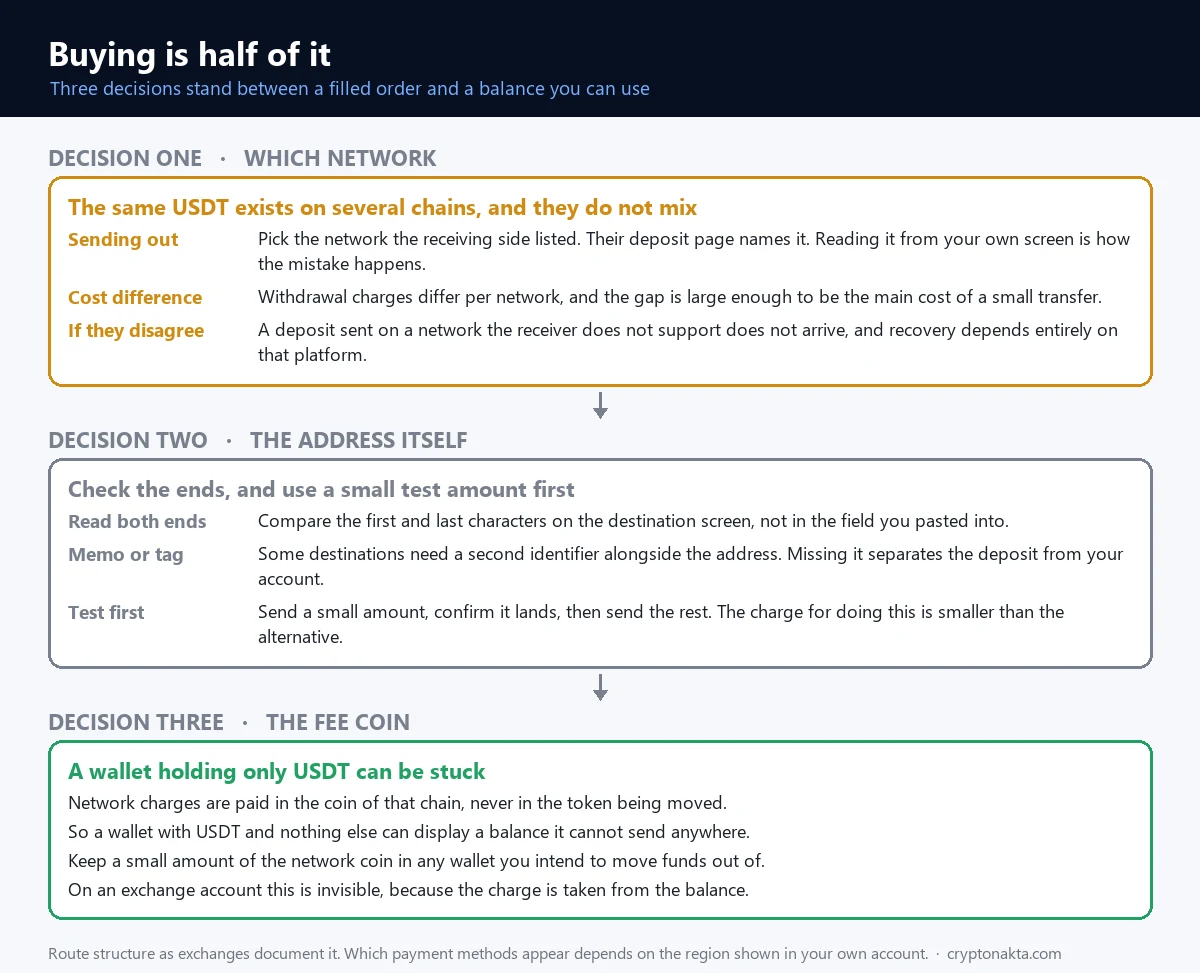
First: which network
A network is the ledger the coin lives on. USDT exists on several networks at once and they do not talk to each other.
USDT on Ethereum and USDT on Tron share a name and nothing else. Sending on the wrong one means it does not arrive.
The criterion is always the receiving side. Open their deposit page and use the network named there, rather than the one that looks convenient on your screen.
Withdrawal charges also differ substantially between networks, and on a small transfer that difference becomes the main cost. The comparison is in USDT on ERC20 or TRC20, and the underlying mechanism is in network fees.
| Situation | Where to look | Common mistake |
|---|---|---|
| Sending to another platform | The recipient’s deposit page | Reading the network from your own screen |
| Sending to your own wallet | The network the wallet is on | The wallet supports several and is on the wrong one |
| Small amount | Withdrawal charge per network | Picking an expensive network for a small transfer |
| Large amount | A network the recipient definitely supports | Picking an unusual network purely on cost |
| New address | The result of a small test send | Sending everything before checking |
There is a safe order for copying an address. Choose the network first, then copy the address that appears afterwards.
Doing it the other way round goes wrong often. The address changes with the network, so copying first leaves you holding an address from a different chain.
Second: the address itself
Do not trust the paste. Compare the first and last characters against the destination screen rather than the field you pasted into.
Malware that swaps addresses in the clipboard exists and is common enough to plan for. Checking visually takes two seconds and catches it.
Some destinations need a second identifier alongside the address. Without it the deposit reaches the platform but is not attached to your account.
Third: the coin that pays the fee
Network charges are paid in the native coin of that chain, never in the token being moved. A token cannot pay for its own transfer.
A wallet holding only USDT will display a balance and refuse to send anything. It needs a little ETH on Ethereum, or a little TRX on Tron, in the same wallet.
10. Three limits that stop the same purchase
Three separate limits can stop the same purchase, and they have nothing to do with each other. Knowing all three in advance saves a lot of cancelled orders.
Your bank’s limit
Accounts have a per transaction cap and a daily cap, and many banks apply a lower one outside business hours or for newly added recipients.
This is a setting on your account rather than anything the platform controls. Discovering it mid order means cancelling, because the payment clock does not pause.
The advert’s limit
Every advert has a minimum and a maximum. If your amount falls outside, the order will not open at all.
Large amounts usually need several adverts. The average price then rises, because the cheapest advert fills first and the remainder moves to more expensive ones.
This is why comparison posts online look so favourable. They quote the price of the first advert rather than the average of the whole purchase.
Your account’s limit
The verification level on your account determines how much you can move in a period. Partially verified accounts have noticeably lower ceilings.
This shows up at withdrawal more often than at purchase. The buy succeeds, and the ceiling only reveals itself when you try to move the balance out.
11. Run a small circuit before a large one
For a first attempt, run a complete circuit with a small amount. Not out of fear, but because there are several screens worth meeting before you meet them in a hurry.
Five steps
Buy a small amount. Here you confirm that your payment method works all the way through on your particular account.
Write down the quantity that arrived. That number becomes your comparison baseline for everything afterwards.
Withdraw a small amount. This is how you meet the address book and the network selector without time pressure.
Confirm arrival and count the minutes. Knowing that figure removes the anxiety the next time something is slow.
Repeat through a different route with the same amount. Now you have two comparable numbers and the decision is made.
Three notes worth keeping
The time to arrival, the withdrawal charge per network, and the menu path. Every platform puts the withdrawal function somewhere slightly different.
With those three noted, later attempts become mechanical.
When to run it again
Repeat the small circuit whenever something material changes. A new platform, a payment method you have not used, or a network you have not withdrawn on before.
The cost of that check is a small charge. The cost of finding the problem with the full amount is a different order of magnitude.
If crypto is new ground, the getting started guide comes before this one. The same cost logic applied to bitcoin is in the cheapest way to buy bitcoin.
12. The scams that repeat
The scams in peer to peer repeat with very little variation. Recognising the shape is most of the defence.
| Situation | Why it is dangerous | What to do |
|---|---|---|
| Suggesting you trade outside the platform | Without escrow nobody is holding the coins | Stay on the platform |
| Account name differs from the seller | Third party money is hard to explain afterwards | Cancel before paying |
| Asking you to mark paid first | A false declaration destroys your own evidence | Press it only after transferring |
| Asking for specific wording in the reference | The reference is stored and can be misread | Write only the order reference |
| An external link with a better price | A screen outside the platform cannot be verified | Ignore it |
| Claiming an overpayment and asking for a refund | It may be money that will be reversed, or that never arrived | Tell support, do not refund it yourself |
The pattern underneath
Every request on that list does the same job. It blurs the record. That is the fastest way to recognise one.
Faced with any request, ask whether it makes the evidence clearer or weaker. If weaker, decline, and there is no need to explain further.
An honest seller does not need the record blurred, because the record protects them too.
When you are unsure
Cancelling before payment costs nothing. Remember that whenever something feels off, because it removes the pressure to continue.
To test an unfamiliar seller, run one trade at the smallest amount their advert allows. A single small order reveals their speed and their manner.
Other scam formats are collected in crypto scams. If withdrawals on your account are being held, see a frozen withdrawal.
13. USDT, USDC, and where to keep the balance
USDT is a stablecoin, meaning a coin designed to stay near one dollar. The mechanism is explained in what a stablecoin is.
What about USDC
USDC also tracks the dollar and is issued by a different company. The question that follows immediately is which one to buy.
The practical criterion is liquidity where you intend to operate. Which one has more adverts, more trading pairs, and a narrower spread on the venue you are using.
On most platforms the answer ends up being USDT, because nearly every altcoin pair is quoted against it. If you specifically need USDC, buying USDT and swapping usually beats hunting for a direct advert.
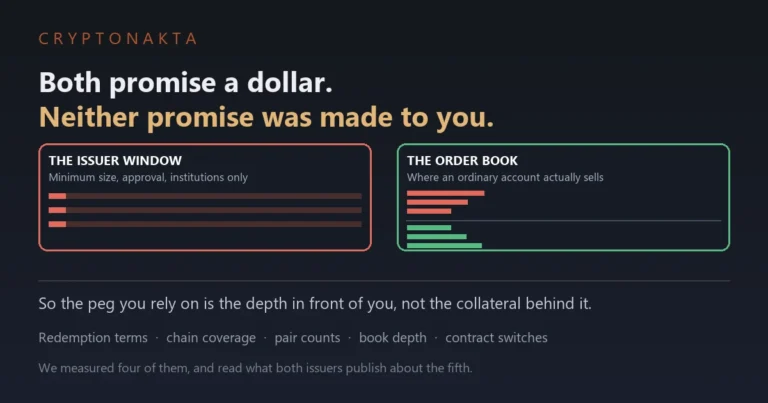
The two issuers differ in how and how often they publish reserve information. Some people weigh that heavily and others weigh convenience. Neither coin is a principal protected product; both are structured around an issuer’s promise to redeem.
Leaving it on the platform or moving it to a wallet
On the platform is simpler. No native coin is needed for fees and you can trade immediately. In exchange, that balance is a claim against a company.
In your own wallet you hold the key. In exchange you take on the network fee and there is nobody to ask when something goes wrong. The types are described in crypto wallets.
| Comparison | Balance on a platform | Your own wallet |
|---|---|---|
| Coin for fees | Not needed, taken from the balance | Requires the chain’s native coin |
| Nature of the balance | A claim against a company | You hold the key |
| If you make a mistake | There is a support process | No reversal exists |
| Trading afterwards | Immediate | Requires sending it back |
Amount matters as well. Small balances tend to stay on a platform simply because each movement carries a network charge that is large relative to the sum.
14. Seven misconceptions
A few misconceptions come up constantly, and each one leads somewhere expensive.
“Peer to peer charges no fee, so it is the cheapest”
Zero on the fee line is not zero cost. The seller put their margin in the price. Measured by quantity received, the route showing a fee wins often enough to check.
“The platform holds my money during a peer to peer trade”
It does not touch your currency at all. Money goes directly from your account to the seller’s. What the platform holds is the coins.
Understanding this tells you where your responsibility lies. The evidence for the payment leg is yours to create, because nobody else can see it.
“USDT is a dollar, so there is no price risk”
Against the dollar the movement is minimal. Against your own currency it is not, because the exchange rate moves and your balance moves with it.
“A seller with many good reviews is a guarantee”
It lowers risk without removing it. The procedure stays the same: check the name, keep the receipt, talk only inside the platform.
“Buying USDT earns interest”
Sitting still it earns nothing. Yield only appears if you put it into a specific product, and that product carries its own risks and lock up terms.
“Cancelling an order costs money”
Cancelling before payment costs nothing. A cancellation rate is recorded on your profile, and that weighs far less than paying into a questionable order.
“The cheapest network is always the best one”
Only if the destination supports it. A cheap network the recipient does not accept is the fastest route to a deposit that never appears.
15. How I decide in practice
The summary is short. Buying USDT is not a question of picking a platform. It is a question of which route the money takes, and the answer changes.
One measurement settles it, and the measurement is counting coins rather than reading fee schedules.
How I decide
Small amount and genuinely in a hurry, card. I pay more and it is done in minutes, and time is a cost like any other.
Ordinary amount with a convenient transfer method, deposit and buy on the order book. Fewest surprises and the easiest route to audit afterwards.
Larger amount, I compare with peer to peer first. If the difference justifies the extra steps I go there, and if it does not I stay on the order book.
First time on any new platform, always the small circuit. Even when I already know the process somewhere else, because the screens and the limits differ.
Where the opposite view holds up
Some people use peer to peer exclusively and argue the average price justifies the work. At volume, with practice, that argument stands.
Others never touch it because they do not want to transfer money to a stranger. That is a reasonable decision too, with a known cost attached.
What I would suggest to either camp is writing down the quantity received. After three or four entries you stop needing anyone else’s opinion, including this one.
One last thing
USDT is not an asset people hold hoping it rises. It is a staging point on the way to something else.
So how cheaply you bought it matters less than whether you got to do the thing you were buying it for. Spending a day to save a fraction of a percent inverts that.