Binance Stocks Explained: bStocks vs Real Shares, Stock Futures, Fees, Dividends
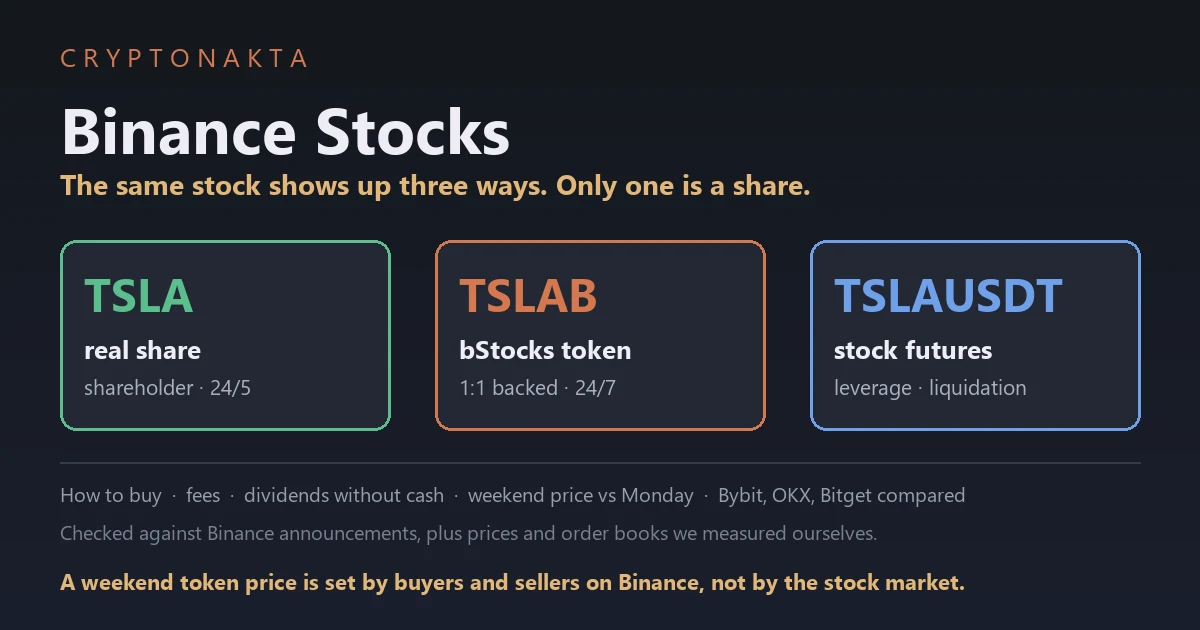
Binance gives you several ways to reach US stock prices, and each one leaves you holding something different. One buys the real share. One is a token backed by a share. One is a futures contract with no share at all. That is why dividends, trading hours and liquidation work differently in each.
People keep asking whether the Tesla they see on Binance is a real stock, and why it moves on weekends. So in October 2026 I read the Binance announcements and FAQs side by side. I also matched bStocks prices with the real share prices, weekends included, and pulled four exchange order books at the same moment. This guide is what I found.
In this article (14)
Does Binance have stocks? Yes, four different productsWhat do you actually own with bStocks, and are tokenized stocks real?How to buy stocks on Binance, from Tesla bStocks to real sharesWhat are the Binance stock trading fees for each product?When can you trade Binance stocks? Hours, weekends and pausesHow close is the bStocks price to the real share during US hours?Do Binance stocks pay dividends? How the bStocks Multiplier worksbStocks vs xStocks, OKX and Bitget: cost at the same momentBinance stock futures (TSLAUSDT): how they differ from bStocksDoes the weekend bStocks price predict Monday’s open?Can you use bStocks as margin collateral?What changes when the Funding Account becomes the Stocks Account?Does the Binance referral code work on stock trades?My take on Binance stocks
Does Binance have stocks? Yes, four different products
Yes. Binance has four products tied to US stock prices, and only one of them makes you a shareholder. Binance Stocks buys the real share for you. bStocks, stock futures and Ondo tokens follow the price in their own ways.
The ticker ending tells you which one you are looking at. For Tesla, TSLA is the real share in Binance Stocks. TSLAB is the bStock on Spot. TSLAUSDT is the perpetual future, and TSLAon is the Ondo token.
bStocks are tokens issued by a Binance group company. Each one is backed by one real share. A tokenized stock is any token built that way, so its price follows a listed share.
If you don’t have a Binance account yet, enter our code CRYPTONAKTA at sign-up, and 10% of the spot fees you pay comes back to you in USDC.
Binance

Affiliate disclosure: some links are partner links. We may earn a commission at no extra cost to you. This is not investment advice.
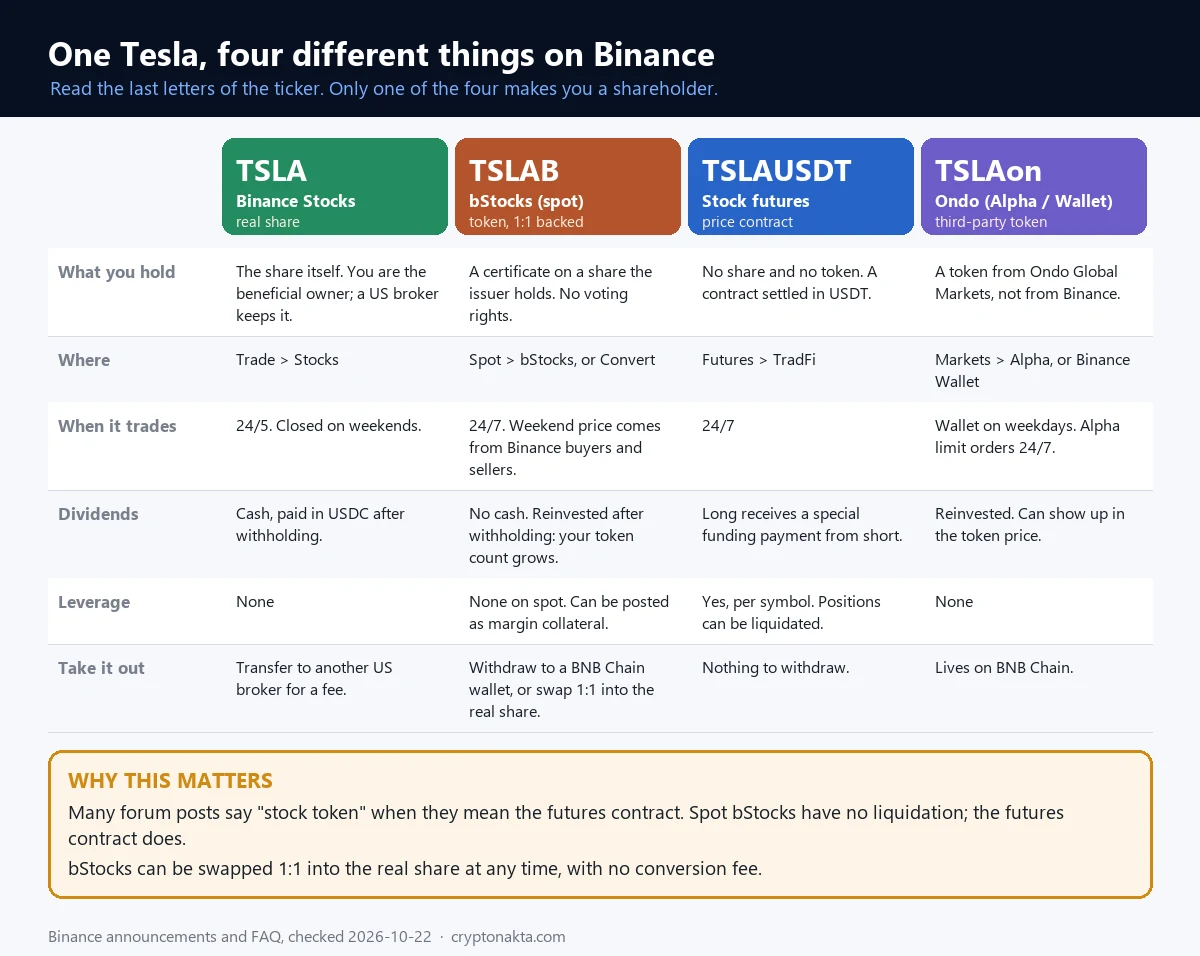
Here is how the four compare. I checked each line against Binance announcements and FAQs on October 22, 2026.
| Tesla on Binance | What you hold | Where to find it | Hours | Dividends | Leverage and liquidation |
|---|---|---|---|---|---|
| TSLA · Binance Stocks | The real share, as beneficial owner | Trade → Stocks | 24/5 | USDC cash after withholding | None |
| TSLAB · bStocks | A token backed 1:1 by a share the issuer holds | Spot → bStocks, or Convert | 24/7 | Reinvested, shown through the Multiplier | None on spot. Can be posted as margin collateral |
| TSLAUSDT · stock futures | A contract settled in USDT. No share, no token | Futures → TradFi | 24/7 | Special funding payment from shorts to longs | Yes, cap set per symbol. Can be liquidated |
| TSLAon · Ondo token | A token from Ondo Global Markets, a third party | Markets → Alpha, or Binance Wallet | Wallet on weekdays. Alpha limit orders 24/7 | Reinvested, can show in the token price | None |
 View full size ↗
The difference that matters most is liquidation. Spot bStocks cannot be liquidated, while a futures position can. Many forum posts say “stock token” when they mean the futures contract. Our spot vs futures guide covers that split.
Binance offered stock tokens once before, in 2021, and wound them down that year. bStocks are a separate product that first listed on June 11, 2026. Stock options, for buying calls and puts, are left out here. Our Binance features overview covers the rest, and your own app shows what your region gets.
What do you actually own with bStocks, and are tokenized stocks real?
With bStocks you hold a token that represents an interest in a US share held by the issuer. You do not own the share directly, and Binance’s FAQ says bStocks give no direct dividend rights.

In short, a bStock is a certificate representing shares the issuer holds, with no voting rights and no SIPC protection. The issuer is the company that creates the tokens and holds the shares behind them. For bStocks that is BTech Holdings Limited, a Binance group affiliate registered in Abu Dhabi Global Market.
Binance Stocks works differently. There you are the beneficial owner, which means the share is yours even though a broker holds it in its own name. The broker is Nest Trading Limited. Alpaca Securities LLC clears and holds the shares, and Binance says it does not hold your securities itself.
The two connect. You can swap a bStock 1:1 into the real share at any time, with no conversion fee. Binance calls this Token Conversion, and it needs a Stock Account. If voting rights matter to you, this is the route Binance itself points to.
How do you check the 1:1 backing? Binance publishes a Proof of Collateral page that updates daily. For each bStock it lists the shares held and the tokens issued. Open the bStocks Proof of Collateral page and compare the two numbers for each stock.
One question stays open. The public bStocks documents do not name the custodian. They only say the shares sit with a regulated custodian, the firm that safekeeps them. Binance calls the issuer bankruptcy-remote, but I could not find the terms for holders if it fails.
Tokenized stocks vs traditional stocks comes down to rights and access. A traditional share gives you a vote and cash dividends. A bStock gives you the price, trading at any hour and on-chain transfers. The 1:1 backing does not promise that the token trades at the same price.
bStocks live on BNB Smart Chain, and you can withdraw them to your own BSC wallet. Transfer limits apply, so tokens sent to an ineligible address can be frozen. Meme coins have also used the name bStocks as a ticker. Our guide to crypto scams shows how look-alike names are used.
How to buy stocks on Binance, from Tesla bStocks to real shares
To buy stocks on Binance as bStocks, open Spot → bStocks, pick a pair such as TSLAB/USDT and place an order from 5 USDT. For the real share, go to Trade → Stocks instead. You can also buy bStocks in Convert, or turn a real-share order into tokens.
The Spot route takes five steps, in the app or on the website.
- Move USDT into your Spot account. If you hold USDC, our USDT vs USDC guide explains the difference.
- Open Spot → bStocks and search the ticker with a B at the end, such as TSLAB or NVDAB.
- Pick a limit or market order.
- Enter the amount. The minimum is 5 USDT, and you can buy in steps of 0.001 token.
- Confirm. The tokens appear in your Spot balance.
A limit order sets the highest price you will pay. A market order takes whatever sellers are offering right now. On a thin order book the two can end up far apart.
For the real share, open Trade → Stocks, search for the stock and set the order type and amount. Purchases settle mainly in USDC. If you pay with BNB, USDT, U or USD1, Binance converts it to USDC when you submit the order.
The minimum is 5 USDC, and some stocks can be bought in fractions. Market orders fill only during regular US hours. You can also switch on Tokenize this order, and the order arrives as bStocks.
Convert is the simplest screen. Search for the bStock and swap into it from USDT or another coin. Binance’s announcement says Convert starts from 0.01 USDC worth.
How to buy Tesla stock on Binance, then, depends on what you want to hold. TSLAB on Spot gives you the token. TSLA under Stocks gives you the share. Nvidia works the same way with NVDAB and NVDA.
Ondo tokens sit under Markets → Alpha → Tokenized Securities, or inside Binance Wallet. Our Binance Wallet guide and Ondo explainer cover those screens. Stock futures live under Futures → TradFi.
What are the Binance stock trading fees for each product?
bStocks on Binance Spot pay the standard spot trading fee, 0.1% for a regular account on maker and taker orders. Issuing, converting and holding bStocks cost nothing. Binance Stocks charges no commission but adds a platform fee or spread. Stock futures have their own rates.
The table shows each product as Binance’s fee pages and FAQs listed it on October 22, 2026. Rates change, so your own order screen has the final word.
| Product | Trading fee (regular account) | Other costs | What to check |
|---|---|---|---|
| bStocks on Spot | Standard spot fee, 0.1% maker and taker | No issuing, conversion or custody fee. BSC withdrawal fee 0 for now | Maker 0% promotion running |
| bStocks through Convert | Described as fee-free | You get the quoted rate | Quotes not measured |
| Token Conversion (1:1) | No conversion fee | Needs a Stock Account | Paused during dividends |
| Binance Stocks (real shares) | No commission | $0.35 platform fee on small orders or 0.10% spread on larger ones ($0.17 or 0.05% on promotion). Transfer out: $150 | Cut-off is $340 or $350 by document. Check the order screen |
| Stock futures | Maker 0.0000%, taker 0.0400% (0.0360% with BNB) until further notice | Funding usually every 8 hours, cap ±2% | Charged on the full position |
| Ondo tokens | Wallet: none. Alpha limit orders: a fee applies | Gas in BNB in the Wallet | Rate on the Alpha page |
I leave out the end date of the bStocks maker 0% promotion because it can change. Binance also discounts spot fees paid in BNB, but I found no direct statement that this covers bStocks. Our Binance fees guide explains maker, taker and BNB discounts.
The fee is not the whole cost. A market order also pays the distance between where it fills and the mid-price. The mid-price sits halfway between the best bid and ask. That order book cost is the slippage, and I measured it on four exchanges further down. Our order book and slippage guide explains it.
Futures add a funding fee, a payment between longs and shorts, usually every eight hours. Our funding rate guide covers how it is set.
When can you trade Binance stocks? Hours, weekends and pauses
bStocks trade 24/7 on Binance Spot, weekends included. Binance Stocks, the real shares, trade 24/5 and close from Friday 8 pm to Sunday 8 pm ET. Stock futures run 24/7, and Ondo tokens follow their own schedule.
The real-share week has four sessions. The pre-market runs from 4:00 to 9:30 ET, before the regular open. After-hours runs until 20:00, and the overnight session fills the gap from 20:00 to 4:00.
| Product | When it trades (ET) | Weekends and US holidays | Pauses |
|---|---|---|---|
| Binance Stocks | Regular 9:30 to 16:00 · pre 4:00 to 9:30 · after 16:00 to 20:00 · overnight 20:00 to 4:00 | Closed Friday 20:00 to Sunday 20:00 | Market orders fill in regular hours only |
| bStocks on Spot | Every hour, every day | Open, priced by Binance buyers and sellers | Stock splits pause trading and transfers |
| Stock futures | Every hour, every day | Open, mark price from the order book | Mark price band ±3% weekends, ±5% weekdays |
| Ondo tokens | Wallet: weekday sessions · Alpha: limit orders any time | Wallet closed | Alpha market orders on weekdays |
Who sets the price when the US market is closed? The weekend bStocks price is set by buyers and sellers on Binance, so it can differ from Monday’s open. Binance’s FAQ adds that it may drift from the last close.
That gap has names. A premium means the token trades above the real share. A discount means it trades below. The issuer says it does not control trading prices.
On weekends, stock futures take their mark price from the futures order book, and it may stray up to 3% from the index, against 5% on weekdays.
How close is the bStocks price to the real share during US hours?
During US regular hours, the bStocks price stayed very close to the real share. Across our 10 symbols the median gap was between 0.019% and 0.069%. I matched 5-minute closes from the Binance public API and Yahoo Finance over the last 60 days of data, pulled on October 22, 2026.
bStocks are priced in USDT, and over the period one dollar cost 0.064% more in USDT. Without that adjustment bStocks look slightly expensive all the time.
| Symbol | Median gap | 99th percentile | Largest gap |
|---|---|---|---|
| TSLA | 0.029% | 0.16% | 0.33% |
| NVDA | 0.026% | 0.14% | 0.28% |
| AAPL | 0.031% | 0.21% | 0.62% |
| MSFT | 0.039% | 0.24% | 0.55% |
| AMZN | 0.048% | 0.3% | 0.61% |
| GOOGL | 0.028% | 0.15% | 0.28% |
| META | 0.05% | 0.24% | 0.43% |
| SPY | 0.019% | 0.13% | 0.29% |
| QQQ | 0.023% | 0.12% | 0.24% |
| PLTR | 0.069% | 0.33% | 0.56% |
Only 0.01% of all 5-minute intervals showed a gap above 0.5%. A regular spot fee of 0.1% is larger than the typical gap. Our guide to price differences between exchanges covers other reasons prices drift apart.
Do Binance stocks pay dividends? How the bStocks Multiplier works
Binance Stocks pays dividends in USDC cash. A bStocks dividend never arrives as cash. Tax is withheld first, and the rest is reinvested so your displayed balance grows. Binance shows that change through a number called the Multiplier.
The Multiplier is a number Binance applies to your token balance. When a dividend is reinvested, it rises a little, and so does your displayed balance. Binance’s own example shows 10 shares turning into 10.05 shares.
Withholding tax is the US tax taken from a dividend before it is paid. For bStocks it is currently 30%. Only the amount left after that is reinvested.
A round example with made-up numbers: a stock pays $1 per share and you hold 10 bStocks. After 30% withholding, $7 is left. That $7 buys more of the same stock for you. Your displayed balance rises a little above 10.
The raw token count does not change. No new tokens are minted and nothing is transferred. bStocks use a BNB Chain standard called Scaled UI Amount, and an outside wallet that does not read it may show only the raw count, without the dividend growth.
Timing follows the record date, the day the company checks who holds the stock. Binance takes a snapshot then and applies the dividend afterward. While it is processed, deposits, withdrawals and 1:1 conversion pause, but Spot trading goes on.
| Product | How the dividend arrives | Where you see it | Good to know |
|---|---|---|---|
| Binance Stocks | USDC cash after withholding (30% by default) | USDC balance, within three business days | The only route that pays cash |
| bStocks | Withholding first, the rest reinvested | Multiplier rises, displayed balance grows | Outside wallets may show only the raw count |
| Ondo tokens | Reinvested | Higher token price or bigger balance | Price drifts from the plain share price |
| Stock futures | Shorts pay longs special funding on the ex-date | Futures funding history | You never hold the share |
Ondo tokens reinvest, so their price slowly drifts away from the plain share price. Stock futures pay no dividend. On the ex-dividend date, shorts pay longs a special funding amount.
bStocks vs xStocks, OKX and Bitget: cost at the same moment
Bybit xStocks, OKX tokenized stocks and Bitget rToken also trade US stock tokens around the clock. On weekends their prices missed Monday’s open by about as much as Binance’s. Where they differed was the order book. In overnight snapshots taken at the same moment, Binance bStocks cost the least for large market orders.
xStocks are tokenized stocks from a third-party issuer. Bybit lists them directly. OKX lists its tokens as “powered by xStocks” and says it does not issue them. Bitget’s rToken comes from an issuer called Reality.
The comparison used 1-hour candles on the same closed periods, against the regular open, with Binance’s figure for those periods in brackets. The weekend section below measures Binance alone in more detail.
| Exchange product | Spot pairs (2026-10-22) | Dividends | Weekend error, median (Binance on the same periods) | Price gap to Binance, median |
|---|---|---|---|---|
| Binance bStocks | 100 | Reinvested, Multiplier | Baseline | Baseline |
| Bybit xStocks | 11 | Balance adjustment, per a search snippet (we could not open the page) | 0.73% (0.66%) | 0.17% |
| OKX tokenized stocks (powered by xStocks) | 166 | Small balance increase. Trading not paused for dividends | 0.63% (0.57%) | 0.049% |
| Bitget rToken | 3,017 | USDT cash, per a Bitget Academy article | 0.68% (0.63%) | 0.18% |
The weekend errors sat close together. Wherever you buy, the weekend price comes from that exchange’s own buyers and sellers. OKX moved almost in step with Binance, with a median gap of 0.049% at the same moment.
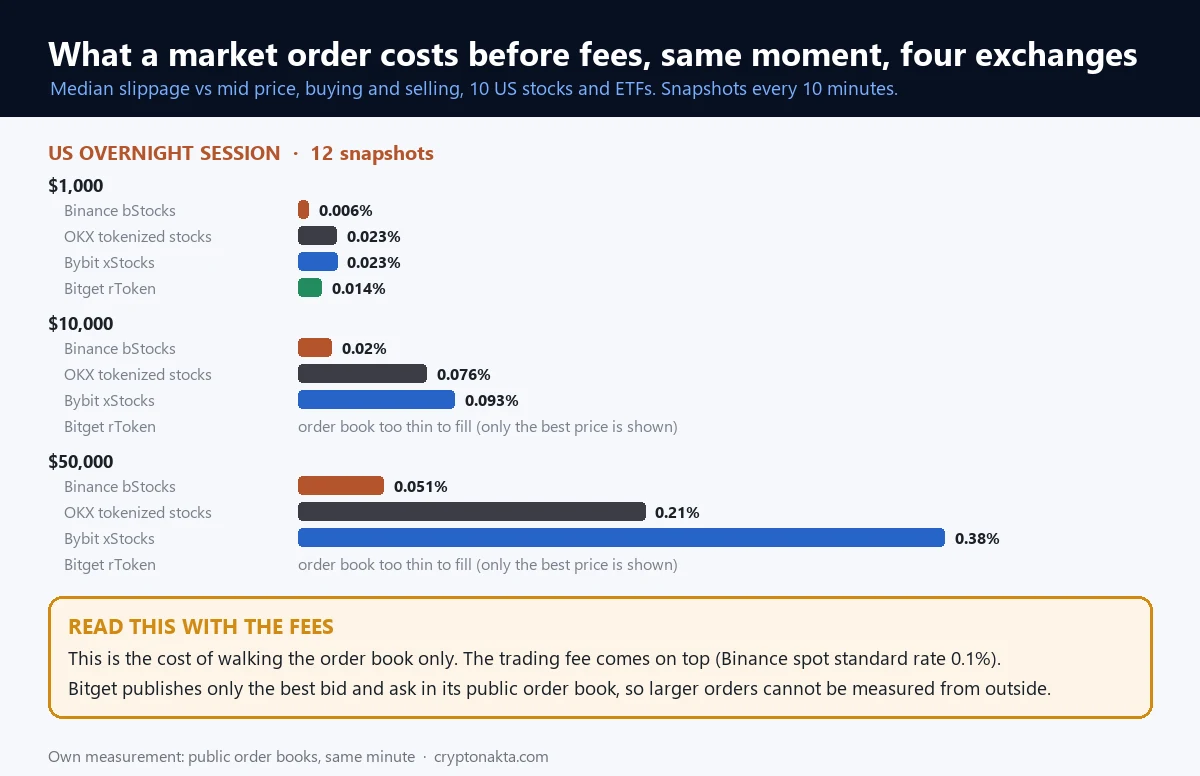
Then the order books. I pulled all four public order books at the same moment, every 10 minutes. For each size I priced a market buy and a market sell against the mid-price and averaged the two. Fees are not included.
| Session | Exchange | $100 | $1,000 | $10,000 | $50,000 | Book too thin at $10,000 |
|---|---|---|---|---|---|---|
| US overnight session, 2026-10-22 03:33 to 05:18 UTC (12 snapshots) | Binance bStocks | 0.003% | 0.006% | 0.02% | 0.051% | 0% |
| US overnight session, 2026-10-22 03:33 to 05:18 UTC (12 snapshots) | Bybit xStocks | 0.019% | 0.023% | 0.093% | 0.38% | 0% |
| US overnight session, 2026-10-22 03:33 to 05:18 UTC (12 snapshots) | OKX tokenized stocks | 0.01% | 0.023% | 0.076% | 0.21% | 0% |
| US overnight session, 2026-10-22 03:33 to 05:18 UTC (12 snapshots) | Bitget rToken | 0.014% | 0.014% | — | — | 76% |
 View full size ↗
The overnight snapshots ran from 2026-10-22 03:33 to 05:18 UTC, 12 in all. Small orders cost little everywhere, and the gap widened with size. A $50,000 order cost 0.051% on Binance, 0.38% on Bybit and 0.21% on OKX.
Bitget publishes only the best bid and ask. At $10,000 that single level was too thin in 76% of snapshots, shown as a dash. These snapshots are a short sample, and the trading fee comes on top. I leave out Bybit and Bitget fees because I could not open their official fee tables for these tokens.
If you plan larger market orders, Binance bStocks cost the least in these overnight snapshots. Sign up there with our code and 10% of the spot fees you pay comes back in USDC.
Binance
Bybit

OKX

Affiliate disclosure: some links are partner links. We may earn a commission at no extra cost to you. This is not investment advice.
Binance stock futures (TSLAUSDT): how they differ from bStocks
Binance stock futures sit under Futures → TradFi with tickers such as TSLAUSDT. They are perpetual contracts settled in USDT and trade 24/7. A stock future gives you no share, only a contract that settles the price difference, and it can be liquidated.
Perpetual futures are contracts with no expiry date. You post margin and the contract follows the stock price. Liquidation is the forced close of your position when your margin no longer covers the loss.
The first one was TSLAUSDT on January 28, 2026, with a 5x cap at launch. By October 22, 2026, the public API listed 187 US stocks and ETFs. Leverage caps differ per symbol, from 10x to 75x. Most sit at 20x. Tesla is capped at 25x, Nvidia and SPY at 50x.
The minimum order is 5 USDT, and fees are in the table above. A liquidation can happen on the weekend mark price before the US market reopens.
If you are weighing leverage, our guide to choosing leverage walks through the arithmetic. Our liquidation guide explains what triggers a forced close.
Does the weekend bStocks price predict Monday’s open?
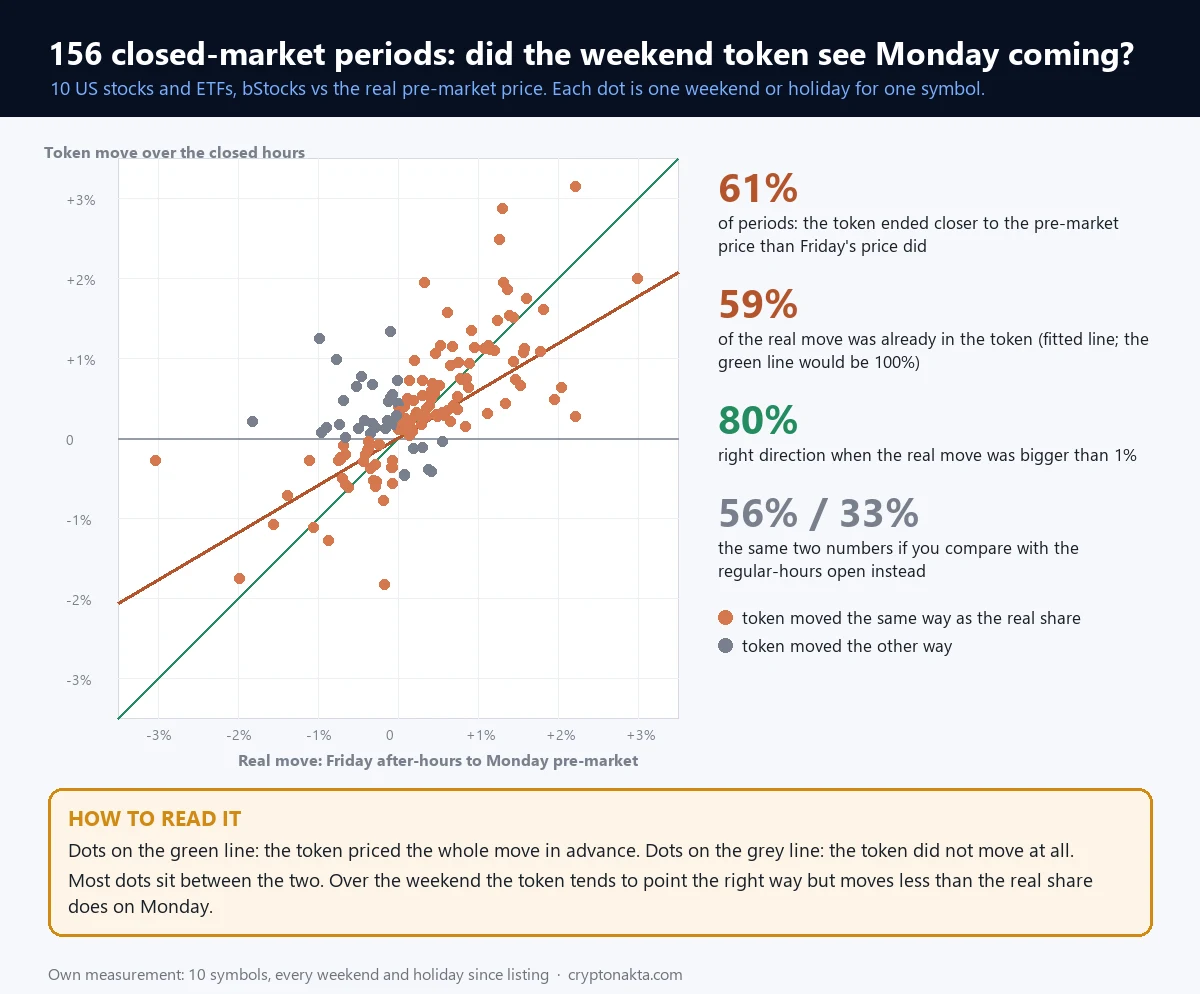
Only partly. Over weekends and holidays, the bStocks price mostly pointed the right way but moved less than the real share did at the reopen. Across 156 closed periods, the token beat Friday’s price 61% of the time against the pre-market first price, and 56% against the regular open.
The 10 symbols were TSLA, NVDA, AAPL, MSFT, AMZN, GOOGL, META, SPY, QQQ, PLTR, from June 11, 2026, when bStocks first listed, to October 21, 2026. A closed period runs from 8 pm ET on the last trading day to 8 pm ET before the reopen, when no US venue is open. The last one reopened on October 19, 2026.
For each period I asked whether the token’s last price was closer to the real reopen than Friday’s after-hours price. I checked two reopen prices, the first pre-market price at 4:00 ET and the regular open at 9:30 ET.
| Compared with | Token at end of closure, median error (90th pct) | Friday price unchanged, median error (90th pct) | Token closer than Friday price | Share of the move already in the token |
|---|---|---|---|---|
| Reopen day pre-market first price (4:00 ET) | 0.33% (1.07%) | 0.48% (1.47%) | 61% | 59% |
| Reopen day regular open (9:30 ET) | 0.6% (1.6%) | 0.67% (1.87%) | 56% | 33% |
The two references tell different stories. Against the pre-market, the token’s median error was 0.33%. Leaving Friday’s price unchanged gave 0.48%. On a fitted line, 59% of the real move was already in the token.
Against the regular open, the token’s median error was 0.6%. Friday’s price unchanged gave 0.67%, and the fitted share fell to 33%. Neither reference is the right one, so I show both.
Direction held up better than size. In 51 periods the real reopen moved more than 1%. The token pointed the right way in 80% of them.
 View full size ↗
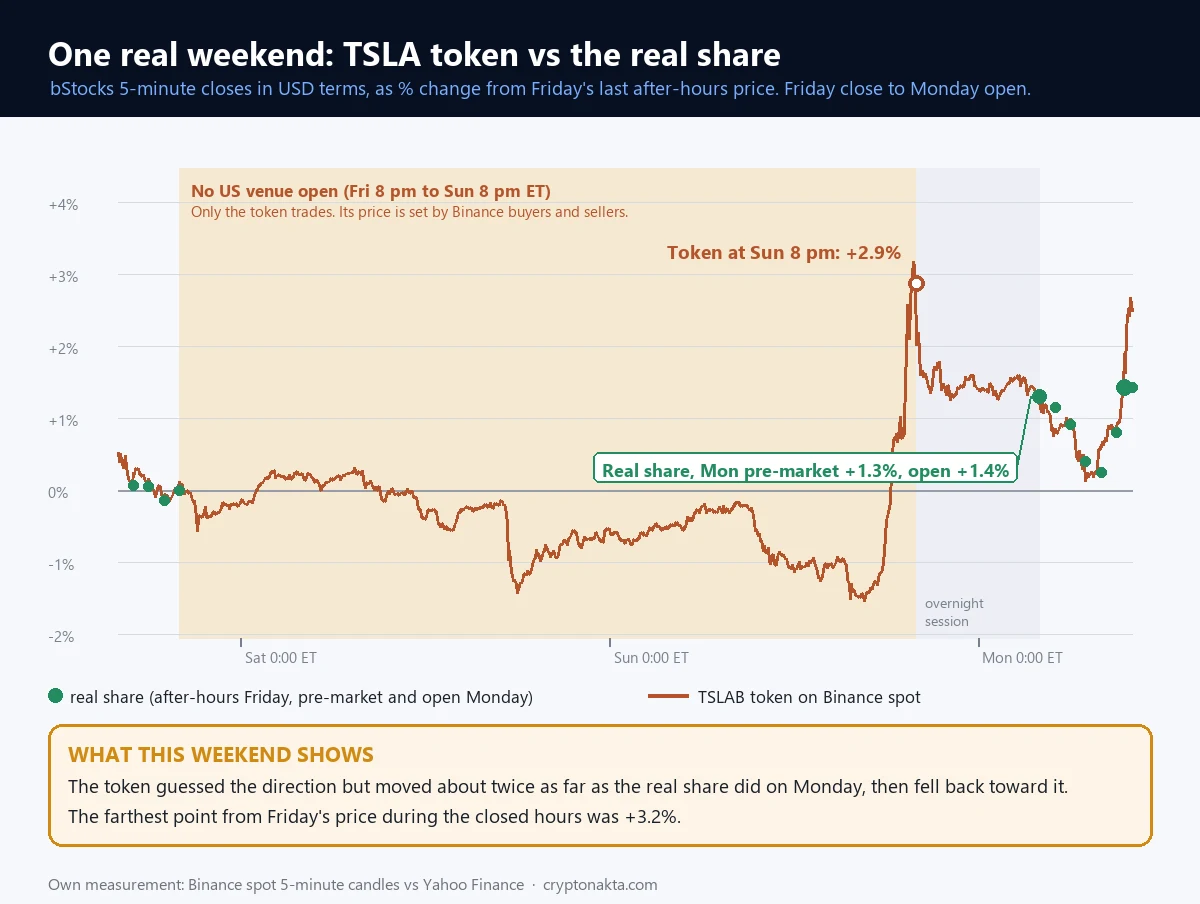
One Tesla weekend shows the pattern. Between Friday, October 16 and Monday, October 19, 2026, the token moved +2.9% by Sunday 8 pm ET, and +3.2% at its farthest. The real share was +1.3% at Monday’s first pre-market price and +1.4% at the open. The token guessed the direction and ran about twice as far.
 View full size ↗
How big do weekend swings get? I took the token’s farthest point from Friday’s price in each period. The median was 0.8%, 90% stayed within 1.7% and the largest was 3.4%. About 35% of periods went past 1%.
Forum posts talk about 5% wicks on Sunday night. My largest, on 5-minute candles, was 3.4%. Other stocks or 1-minute candles could show bigger spikes. Closed-period trading is also thin, with hourly volume about 12 times lower than in regular hours.
Research from the Binance side reported that 92% of Monday’s move was priced in over the weekend. My method did not reproduce that figure. The methods may differ, so I don’t claim either one is wrong.
These are results from a past period, and a different period, stock list or reference price can change the conclusion.
On a weekend, a limit order fixes your price, while a market order on a thin book can fill further away. Spot bStocks have no liquidation. A futures position or a margin loan backed by bStocks does feel the weekend price.
Can you use bStocks as margin collateral?
Yes. Since a September 21, 2026 announcement, bStocks can be posted as collateral in every Cross Margin and Portfolio Margin account on Binance. Regular users and VIP 1 and 2 accounts must pass a suitability quiz first. You can post bStocks, but you cannot borrow them.
A collateral ratio is the share of a token’s value that counts toward your margin. Binance set three levels. SPYB and QQQB count at 70%. Seven tokens, including MUB and SPCXB, count at 60%.
The rest, TSLAB included, count at 50%. By my arithmetic, $1,000 of TSLAB then counts as $500 of collateral.
Binance announced that from October 24, 2026 the collateral value updates on weekends too, and it warns that prices may change significantly at the reopen. So a margin position backed by bStocks can be liquidated even though the token itself is spot. Our isolated vs cross margin guide explains how cross margin pools collateral.
What changes when the Funding Account becomes the Stocks Account?
Binance is renaming the Funding Account to Stocks Account in January 2027, according to its September 23, 2026 announcement. For most users nothing needs doing. Coins have been moving from Funding to Spot since September 29, 2026.
After the change, the Stocks Account holds only US stocks, stock options and six settlement currencies. Those are USD, USDC, USDT, USD1, U and BNB. Proceeds from selling real shares land there in USDC.
You can wait for the automatic move or use the One-Click Migration button in the app. Since September 29 the Funding Account no longer accepts on-chain deposits.
A few setups need redoing on Spot. These are Pay recurring transfers, Convert recurring or limit orders and API setups that used Funding. P2P advertisers move to a new P2P account. bStocks are spot assets, so the rename does not touch them.
Does the Binance referral code work on stock trades?
Partly, as far as official documents go. Sign up with our code CRYPTONAKTA and 10% of the spot fees you pay comes back in USDC. A bStocks market order pays the standard spot fee, and Binance has said bStocks fees earn referral commission at the standard rate.
The rest is not documented. I found nothing on fee-free maker fills or the real-share platform fee. No official Binance document says the referral rebate covers every stock product. On stock futures, as on all futures, our code returns nothing.
The rebate comes out of the fee you actually pay. Binance’s referral FAQ says a trade with no fee produces no commission.
Already signed up without a code? Binance lets you link one within 30 days of sign-up, before your first deposit or trade, if your account meets the conditions. Use the official referral binding page. Our Binance referral code guide walks through it.
CRYPTONAKTA
Binance
Affiliate disclosure: some links are partner links. We may earn a commission at no extra cost to you. This is not investment advice.
My take on Binance stocks
After measuring it, my take on Binance stocks is simple. With the US market open, bStocks track the real share closely. On weekends the token price hints at direction but is not Monday’s open. Large orders showed the biggest cost differences between exchanges.
How right that hint looks depends on the yardstick. Against the pre-market the token clearly beat Friday’s price. Against the regular open it was barely ahead.
If I were starting, I would first decide what I want. Shareholder rights point to Binance Stocks. Trading at any hour points to bStocks. Leverage points to futures, with liquidation attached. Then I would check the fee screen, the order type and how dividends show in the balance.
My biggest doubts are the custodian, which the documents I read do not name, and what holders get if the issuer fails. Most loss stories about “stock tokens” I read were about futures leverage.
The case against is real too. If voting rights or cash dividends matter, real shares or a regular broker fit better. Round-the-clock trading adds little if you have no reason to trade at night or on weekends. If you already have a brokerage account, factor in the cost of moving USDT in and out.
This site uses affiliate links, and we earn a referral commission when you sign up with our code. We set aside part of that commission for you. That is why 10% of the spot fees you pay comes back in USDC.
Binance stocks questions people ask
- Binance Stocks announcement · checked 2026-10-22
- bStocks announcement · checked 2026-10-22
- bStocks FAQ · checked 2026-10-22
- bStocks Proof of Collateral · checked 2026-10-22
- bStocks product page · checked 2026-10-22
- Binance Stocks FAQ · checked 2026-10-22
- TradFi perpetuals fee page · checked 2026-10-22
- Stock futures announcement · checked 2026-10-22
- Stock futures FAQ · checked 2026-10-22
- bStocks margin collateral announcement · checked 2026-10-22
- Stocks Account announcement · checked 2026-10-22
- Ondo tokens FAQ · checked 2026-10-22
- Binance referral FAQ · checked 2026-10-22
- OKX tokenized stocks announcement · checked 2026-10-22
- Binance Spot API market data docs · checked 2026-10-22
This guide explains how Binance stock products work and what our own measurements showed. It is not investment advice. Products, rates and screens change, so go by what your own app shows.
Read next: how to sign up for Binance with our referral code