Crypto-Backed Loan: Binance Loan Interest Rate, Liquidation LTV, How to Repay
Can you borrow against your crypto without selling it? Yes. Binance and the other big exchanges let you lock coins and borrow USDT against them. The next questions are always the same. What does it cost, and how far can the price fall before they sell your coins?
I didn’t want to guess. So I pulled the loan numbers Binance’s own loan page uses and compared them with Bitget, Gate and Bybit. Then I ran every day of past prices since 2017 through the same rules. Every measured number below says when I measured it.
In this article (14)
What is a crypto-backed loan?How does a Binance loan work?What does LTV mean in crypto?Binance’s three LTV lines, and what they mean for one bitcoinHow far can the price drop before a margin call or liquidation?Binance loan interest rate: what 1,000 USDT costsHow to repay a Binance loanGot a margin call? The three things you can doWhat happens when a Binance loan is liquidatedHow often did past loans get liquidated? I tested every start dayBitget, Gate, Bybit, OKX and Aave compared with BinanceCrypto loan without collateral? Telegram USDT offers and flash loansBorrowing against bitcoin to buy more bitcoinMy take: what measuring it myself taught me
 View full size ↗
What is a crypto-backed loan?
A crypto-backed loan lets you borrow money without selling your coins. You lock coins with the lender as collateral. That means they’re held as a guarantee until you pay the loan back. In return you borrow something else, most often USDT or USDC.
Each of these is a stablecoin, a token built to stay worth about one dollar. People borrow them because the amount you owe doesn’t jump around. If stablecoins are new to you, our stablecoin guide explains how they hold their price.
The coins you lock are still yours. If bitcoin goes up while it’s locked, you keep that gain. You just can’t sell or move it until the loan is closed.
So why borrow instead of selling? Usually it’s about timing. You need cash or USDT for a few weeks or months. You also plan to hold your coins for years. Selling now and buying back later could leave you with fewer coins. A loan skips that round trip, as long as the price doesn’t fall too far in the meantime.
That last part is the real risk. The lender wants to be sure it gets paid back. So it checks the value of your collateral all the time. If your coin falls far enough, the lender sells some of it to cover the loan.
Binance is my main example, since “binance loan” is what most people type first. Bitget, Gate, Bybit, OKX and the DeFi app Aave come up further down.
How does a Binance loan work?
The loan most people mean on Binance is the Flexible Rate Loan. That’s the name on the loan page. Binance also runs fixed-rate loans, VIP loans and a newer Lite Loan. Those are built for big accounts or other uses. Everything here is about the flexible one.
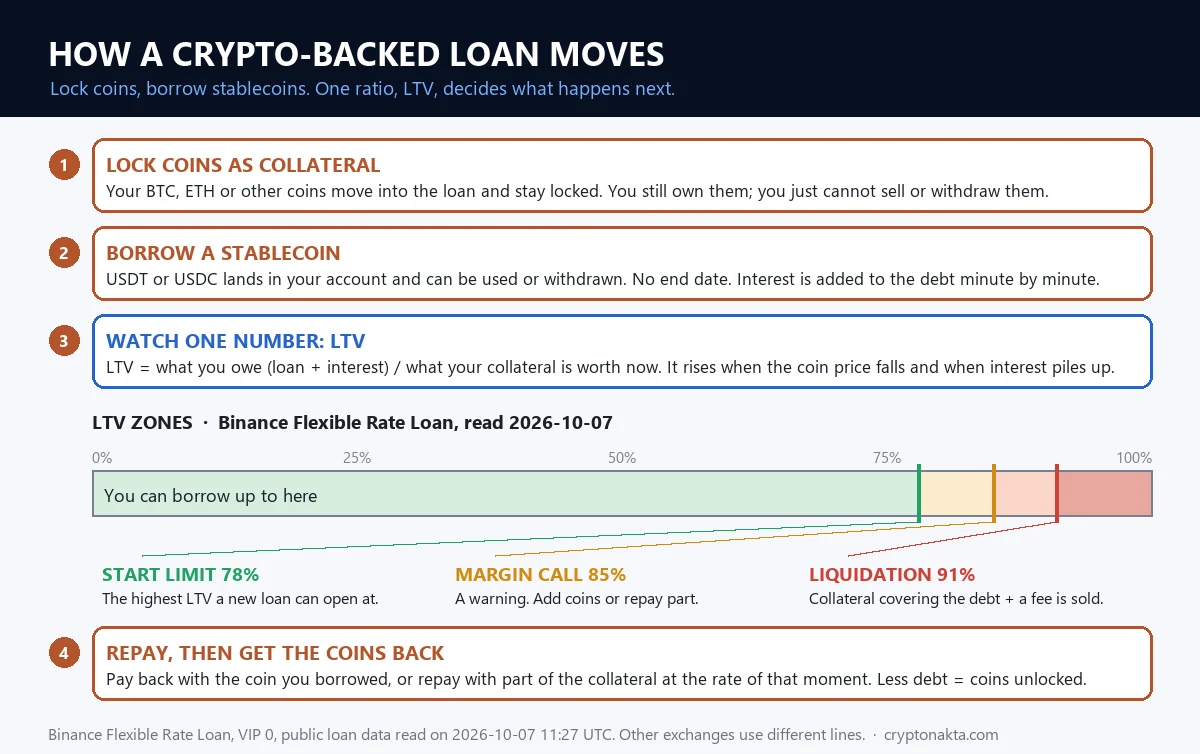
A loan goes through five steps.
- You choose a coin to lock and a coin to borrow. Each pair is its own loan with its own numbers.
- You pick how much to borrow. You can start from as little as $1 worth, and Binance lists no transaction fees.
- The coins you borrow land in your Spot wallet. You can trade them, move them to Earn or withdraw them.
- Interest builds up every minute and gets added to what you owe.
- When you repay, your collateral is released back to you.
There’s no due date. Binance says plainly that there’s no such thing as an overdue loan here. The loan stays open until you repay it or your LTV gets too high.
The interest is a flexible rate. It isn’t locked in when you borrow. It moves with demand for the coin you borrowed, and Binance updates it every minute. You don’t pay it in installments either. It adds to your debt until you repay.
Each loan is kept separate. Say you lock BTC to borrow USDT, and lock ETH to borrow USDC. Those are two loans. A crash in ETH doesn’t touch the BTC loan. Binance calls this an isolated loan.
This is also how a loan differs from margin trading. Money borrowed on margin stays in your margin account, and it’s there to trade with. A Binance loan pays out to Spot, and you can withdraw it. If you’re curious about the margin side, isolated vs. cross margin explains how that borrowing works.
One nice detail. If your collateral comes from Simple Earn Flexible, it keeps earning while it’s locked. Binance says the Simple Earn Flexible rewards keep coming and are added to your collateral. Earn is the other side of the same market, where you lend instead of borrow. How crypto Earn works covers that side.
In your wallet, the loan shows up as a negative balance in the coin you borrowed. That number is your debt so far, interest included.
Do you need identity verification for a Binance loan? Other exchanges say so in their terms. For Binance’s flexible loan I couldn’t find a current official line on it. The loan screen shows what your account needs when you apply. If you don’t have an account yet, our Binance sign-up page walks through it.
What does LTV mean in crypto?
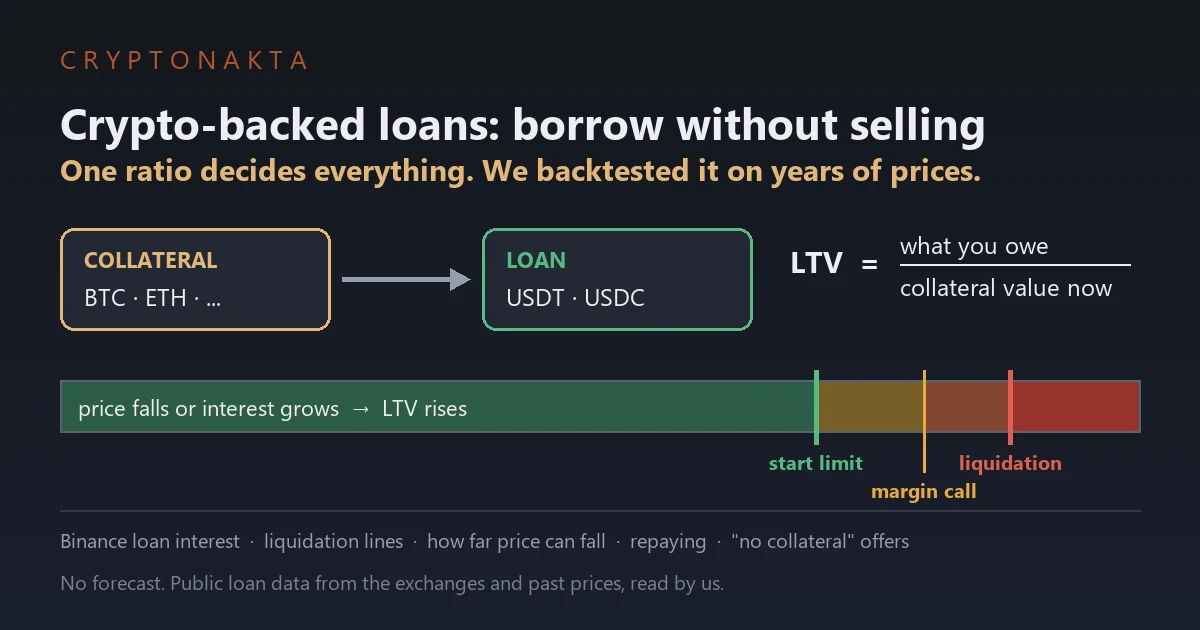
LTV is short for loan-to-value. It’s the one number that runs your whole loan. You take what you owe and divide it by what your collateral is worth right now. Binance’s FAQ writes it as LTV = Loan Value / Collateral Value. What you owe includes the interest that has built up.
Take a simple case. You lock $10,000 of bitcoin and borrow 5,000 USDT. Your LTV is 50%. Now bitcoin falls, and your collateral is worth $8,000. You still owe 5,000 USDT, so your LTV is now 62.5%. Nothing else changed.
LTV rises when the price of your collateral falls. It also rises when interest adds to your debt, even if the price stays flat. Those are the two ways a loan drifts toward trouble. The price way can be fast. The interest way is slow, but it never stops while the loan is open.
The debt side doesn’t move with the market. Your debt is counted in the coin you borrowed. If bitcoin drops by half, you still owe the same number of USDT. Only your collateral shrank.
A Binance loan has three LTV lines. The initial LTV is the highest LTV you can start at. So it caps how much you can borrow against your coins. You don’t have to go that high. Any amount below it is allowed.
The margin call line is a warning. The exchange tells you your cushion is thin and asks you to add collateral or pay some back. The word comes from trading, and it means the same thing here.
The last line is liquidation. That’s where the exchange sells your collateral to pay off the loan itself. You don’t get a say at that point. The coins are sold at whatever the price is.
The index price is the price exchanges use for all this. It’s a price blended from several markets, not the last trade on one chart. Binance uses its own index price for each coin. So your LTV can differ a little from what you work out with the price on your screen.
Binance’s three LTV lines, and what they mean for one bitcoin
I pulled Binance’s loan settings on October 7, 2026, at 11:25 and again at 11:27 UTC. The data came from the public feed that Binance’s own loan page loads, at the standard VIP 0 level. Both pulls matched exactly.
What I didn’t expect was how uniform it was. All 115 coins Binance accepted as collateral used the same three lines. Bitcoin, DOGE and small altcoins all had identical numbers. You could borrow 163 different coins against them. TON wasn’t on the collateral list at all.
| Line | Binance LTV | What happens there |
|---|---|---|
| Initial LTV | 78% | The most you can borrow when you open the loan. Lock $100 of a coin and you can borrow up to $78 of USDT. |
| Margin call | 85% | Binance warns you by in-site message, email and SMS. You can add collateral or repay part of the loan. |
| Liquidation | 91% | Binance uses your collateral to pay off the whole loan and takes a 2% fee on the borrowed amount. |
Binance’s help page gives the 85% margin call line as the current setting. It calls 91% a hard cap for liquidation. It doesn’t print an initial LTV. It only says it differs by coin. So the 78% starting limit is what the live data showed on October 7, 2026, and Binance can change it.
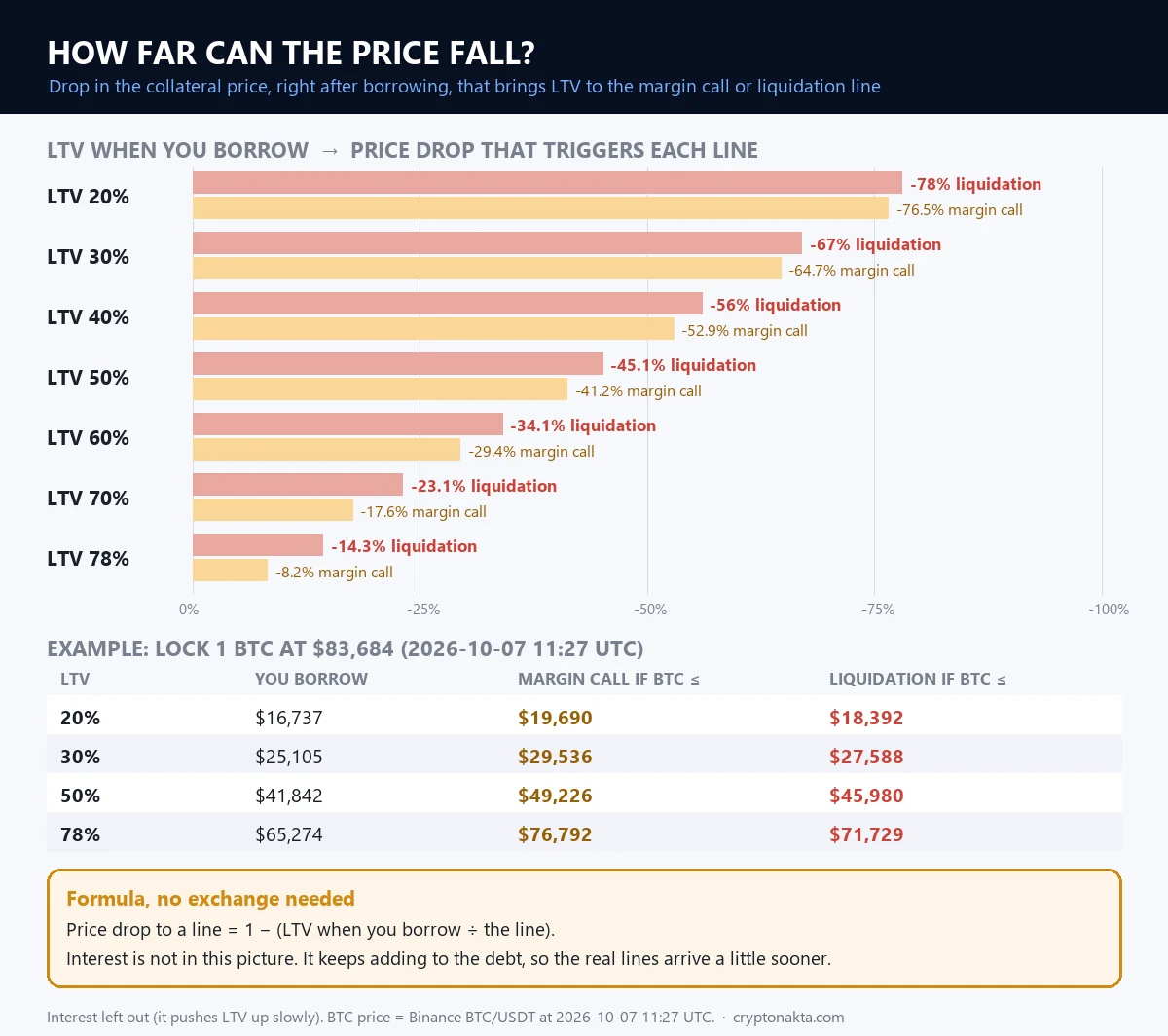
Percentages are hard to feel, so here’s what those lines meant for one bitcoin. At 11:27 UTC on October 7, 2026, BTC was at $83,684. Lock 1 BTC, pick an LTV, and this is what you’d get.
| Starting LTV | You borrow | Margin call (85%) if BTC falls to | Liquidation (91%) if BTC falls to |
|---|---|---|---|
| 20% | $16,737 | $19,690 | $18,392 |
| 30% | $25,105 | $29,536 | $27,588 |
| 50% | $41,842 | $49,226 | $45,980 |
| 78% | $65,274 | $76,792 | $71,729 |
Read the bottom row twice. Borrow the full 78%, and BTC only needs to slip to $76,792 for a margin call. At $71,729 the loan is liquidated. That’s a 14.3% drop from where it started.
Now the top row. At 20% you get far less money. But BTC would have to fall to $18,392 before anything is sold. That’s the trade every borrower makes. More money now means less room later.
The math behind the table is short. Liquidation price = what you owe ÷ (coins locked × 0.91). For the margin call price, use 0.85 instead. That’s the whole “binance loan calculator” people search for. A phone calculator does it.
How far can the price drop before a margin call or liquidation?
Here’s a faster way to find your own line. Divide your starting LTV by the line. Take that from 1. What’s left is how far the price can drop before you hit it.
Drop to liquidation = 1 − (your LTV ÷ 91%)
Drop to margin call = 1 − (your LTV ÷ 85%)
Say you borrow at 50%. The liquidation drop is 1 − 50/91. That’s 45.1%. The margin call comes a bit earlier, after a 41.2% drop. Borrow at Binance’s 78% limit, and those shrink to 8.2% and 14.3%.
The table runs the same formula for common starting points. It uses Binance’s lines from October 7, 2026.
| Starting LTV | Drop to margin call (85%) | Drop to liquidation (91%) |
|---|---|---|
| 10% | −88.2% | −89% |
| 20% | −76.5% | −78% |
| 25% | −70.6% | −72.5% |
| 30% | −64.7% | −67% |
| 40% | −52.9% | −56% |
| 50% | −41.2% | −45.1% |
| 60% | −29.4% | −34.1% |
| 70% | −17.6% | −23.1% |
| 78% | −8.2% | −14.3% |
Two things the table leaves out. The first is interest. It adds to your debt, so the real lines come a little sooner the longer the loan runs. Over a few weeks the effect is tiny. Over a year it adds up.
The second is the price Binance watches. It’s the index price, not one exchange’s chart. A quick wick on one market may not count. A slow slide across all markets will.
Look at the gap between the two lines. From the margin call to liquidation, the price only has to fall another 6.6%. That’s true for any loan at Binance’s current lines, because it only depends on 85 and 91. So the margin call is close to the real deadline.
The coin you borrow matters too. Borrow ETH against BTC, and your debt grows in dollar terms when ETH rises. Then your LTV can climb even if BTC does nothing. Borrowing USDT or USDC keeps the debt side still.
 View full size ↗
Binance loan interest rate: what 1,000 USDT costs
The Binance loan interest rate depends on the coin you borrow. There’s no single rate. Each coin has its own flexible rate, and it moves with demand. Here’s what I saw at 11:27 UTC on October 7, 2026, with the daily rates for the 90 days before.
| Coin you borrow | Rate on October 7, 2026 | 90-day low | 90-day median | 90-day high |
|---|---|---|---|---|
| USDT | 5.01% | 3.69% | 4.74% | 5.65% |
| USDC | 5.26% | 4.53% | 5.62% | 7.19% |
| BTC | 0.5% | 0.5% | 0.51% | 0.54% |
| ETH | 2.35% | 2.27% | 2.39% | 3.03% |
| SOL | 5.72% | I didn’t pull the history | ||
| XRP | 4% | I didn’t pull the history | ||
USDT moved between 3.69% and 5.65% a year in those 90 days. USDC went as high as 7.19%. So the rate you start with isn’t the rate you pay for months. It changes under you.
Borrowing BTC was cheap, at 0.5% a year. But if you want dollars to spend, the USDT and USDC rows are the ones that matter.
So what does it cost in real money? I took 1,000 USDT and the USDT rate from that day.
| How long | Interest you owe |
|---|---|
| 1 day | 0.137 USDT |
| 30 days | 4.12 USDT |
| 90 days | 12.36 USDT |
| 1 year | 50.11 USDT |
| 30 days at the 90-day low rate | 3.03 USDT |
| 30 days at the 90-day high rate | 4.64 USDT |
The math is principal × rate × time. Binance actually adds interest every minute, so interest earns interest. I ran that version too. It barely matters at this size. It came to 4.13 USDT for 30 days instead of 4.12, and 51.38 for a year instead of 50.11.
Interest also pushes your LTV up, slowly. At the USDT rate I measured, with the price frozen, a loan opened at 78% would take about 21 months to reach the 85% margin call on interest alone. A price drop of 8.2% gets it there the same day.
The rate is variable and it changes all the time. Every rate here is what I measured on October 7, 2026. What you pay is the rate on your screen when you borrow. Check it again before you repay, too.
What you see can also differ by region and by account level. My numbers are for VIP 0. I couldn’t confirm whether flexible rates change with VIP level. Check your own loan screen before you borrow.
How to repay a Binance loan
You can repay a Binance loan whenever you want. There’s no end date, so there’s also no early repayment to plan around. Binance’s loan pages don’t mention an early repayment fee.
To repay, open the loan page and go to the Ongoing Orders tab. Find your loan and tap Repay. You then choose one of two ways.
The first is the obvious one. You repay with the coin you borrowed. If you borrowed USDT, you need USDT in your account. If you spent it, you can buy USDT again first. How to buy USDT covers the usual ways.
The second is Repay with Collateral. Binance sells part of your locked coins to pay off the debt. You don’t need any USDT on hand. It’s handy when you’ve spent the money and don’t want to add new funds.
Binance uses the exchange rate at the moment you repay. It warns that this rate can differ from the spot market. When you do it yourself from the app or website, the 2% liquidation fee doesn’t apply. I couldn’t find a separate fee rate for this kind of repayment.
| How you repay | What you need | What happens | Watch for |
|---|---|---|---|
| With the coin you borrowed | Enough of that coin in your account | The debt goes down. Your collateral comes back when it’s paid off. | Interest keeps adding up until the minute you repay. |
| Repay with Collateral | Nothing extra | Binance sells part of your collateral to cover the debt. | The rate is set at that moment and can differ from the spot price. You’ve sold coins. |
| Part of the loan | Some of the borrowed coin | LTV drops right away. | Collateral only comes out if your LTV after that stays under the initial LTV. |
| All of it | The full debt, interest included | The loan closes and the collateral is released. | Use the amount on screen at that moment. It grows by the minute. |
Partial repayment is how you lower LTV without adding coins. Pay some back, and your LTV drops right away. Binance then lets some collateral out, but only if your LTV after that is still under the initial LTV.
There’s also a setting called “Keep the collateral in the order”. With it on, your collateral stays in the loan after a repayment instead of coming back. That’s useful when you want the lower LTV more than the coins.
A note on timing. Interest is counted to the minute. The amount on screen today is a little lower than tomorrow’s. To close the loan for good, repay what the screen shows at that moment.
Got a margin call? The three things you can do
At 85% LTV Binance sends a margin call. It goes out by in-site message, email and SMS. Binance also says delivery isn’t guaranteed. Its FAQ doesn’t mention app push alerts. So a quiet inbox doesn’t mean your loan is fine.
When you’re at the margin call line, you have three moves. The table uses a loan that started at Binance’s 78% limit and drifted up to 85%.
| What you do | What it changes | How much it takes |
|---|---|---|
| Add collateral (Adjust LTV) | More coins back the same debt, so LTV falls. | About 9% more collateral to get back to 78% |
| Repay part of the loan | Less debt on the same coins, so LTV falls. | About 8% of the debt to get back to 78% |
| Do nothing | LTV keeps following the price. | Another 6.6% drop reaches liquidation |
You add collateral from Ongoing Orders, then Adjust LTV. You move more of the same coin into that loan. You need those coins in your account first. Adding collateral lowers your LTV straight away.
Repaying part works like the repayment section above. You pay back some of the borrowed coin. The debt shrinks while the collateral stays the same.
Doing nothing is also a choice. If the price bounces, your LTV falls back by itself. If it falls another 6.6%, the loan is liquidated. Nobody knows ahead of time which one comes.
That gap is the main point. For a loan at the limit, warning and liquidation sit close together. In my backtest, a bitcoin loan opened at 78% reached the margin call line within 30 days on 53.5% of start days.
What happens when a Binance loan is liquidated
At 91% LTV Binance liquidates the whole loan. It doesn’t sell a little and wait. It uses enough of your collateral to repay the entire debt. It also takes a liquidation fee of 2% of the borrowed amount, again from your collateral. Whatever is left stays in your Earn account.
While the liquidation runs, you can’t adjust LTV or repay. There’s no stepping in at the last second.
How much is left? The math is short. At that moment, your debt is 91% of your collateral’s value. The fee adds 2% of that debt. So 91% × 1.02 = 92.8% of your collateral is sold, and 7.2% is left.
Back to the one bitcoin. Borrow $65,274 at the 78% limit, and say BTC falls to $71,729. Binance sells about 0.928 BTC. You keep about 0.072 BTC plus the USDT you borrowed. In effect, you sold almost all your bitcoin at $71,729 and paid a fee on top.
This is the part people regret. If the price recovers afterward, the coins that were sold don’t come back. The loan is closed. You can buy BTC again, but at the new price and with the USDT you have left.
Liquidation on a loan isn’t the same as liquidation on a futures position. A futures position closes when your margin can’t cover losses on a leveraged bet. A loan closes when your debt gets too close to your collateral’s value. Both end with a forced sale. If you got liquidated on futures, why was I liquidated walks through how that works.
How often did past loans get liquidated? I tested every start day
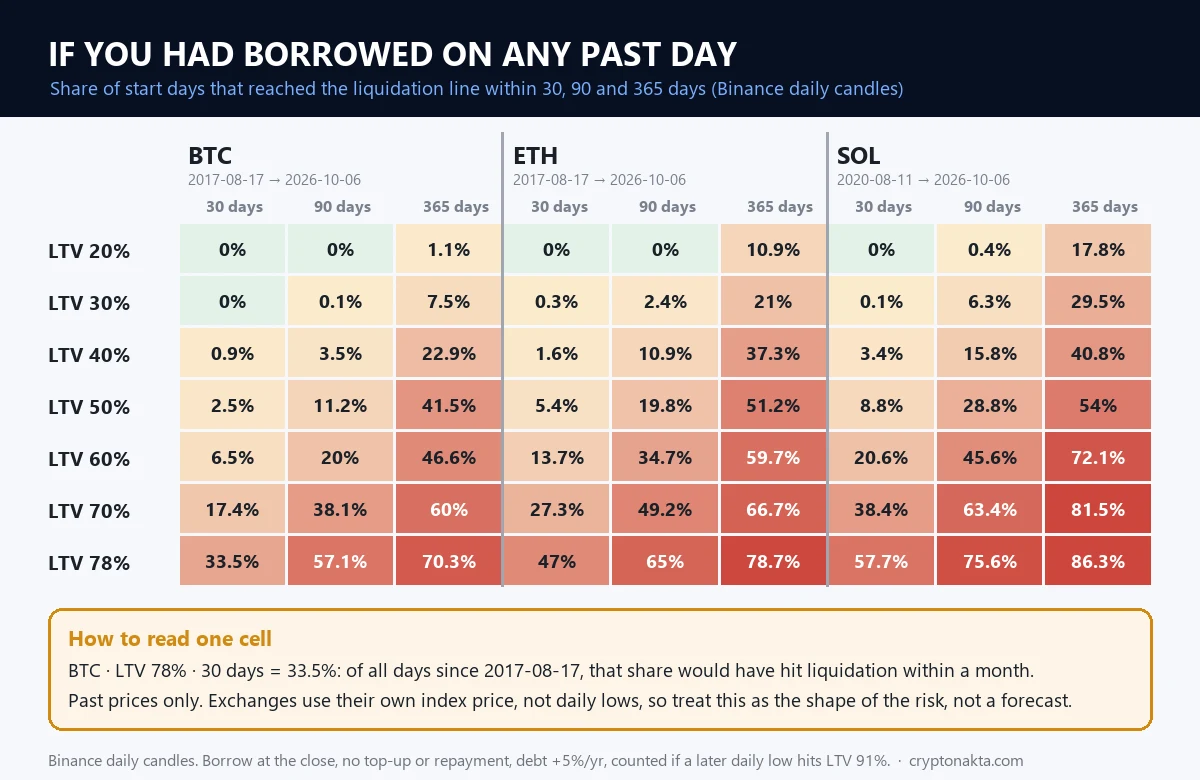
The drop table tells you how far. It doesn’t say how often. So I ran a backtest on Binance’s daily candles for six coins, from the day each was listed up to October 6, 2026. For every single day I asked one question. If you’d borrowed that day, would the loan have reached Binance’s 91% line?
The rules were strict on purpose. The loan starts at that day’s closing price. You never add collateral and never repay. The debt grows at 5% a year, close to the USDT rates I saw. The loan counts as liquidated once a later daily low pushes LTV to 91%.
| Coin | Starting LTV | Within 30 days | Within 90 days | Within 1 year | Median days to hit (1 year) |
|---|---|---|---|---|---|
| BTC | 20% | 0% | 0% | 1.1% | 342 |
| BTC | 30% | 0% | 0.1% | 7.5% | 269 |
| BTC | 50% | 2.5% | 11.2% | 41.5% | 149 |
| BTC | 78% | 33.5% | 57.1% | 70.3% | 33 |
| ETH | 20% | 0% | 0% | 10.9% | 207 |
| ETH | 30% | 0.3% | 2.4% | 21% | 176 |
| ETH | 50% | 5.4% | 19.8% | 51.2% | 125 |
| ETH | 78% | 47% | 65% | 78.7% | 21 |
| SOL | 20% | 0% | 0.4% | 17.8% | 193 |
| SOL | 30% | 0.1% | 6.3% | 29.5% | 126 |
| SOL | 50% | 8.8% | 28.8% | 54% | 86 |
| SOL | 78% | 57.7% | 75.6% | 86.3% | 14 |
Look at the 78% rows first. Borrow against bitcoin at Binance’s limit, and 33.5% of start days hit liquidation within 30 days. That’s about one day in three. In that same month, 53.5% got at least a margin call.
Ether did worse, at 47% liquidated within 30 days. Solana was at 57.7%. The other three coins landed in the same area. BNB was 39.6%, XRP 48.3% and DOGE 51.1%.
Now the low rows. At 30% LTV, a bitcoin loan reached the line within 90 days on 0.1% of start days. Ether was at 2.4% and solana at 6.3%. At 20%, bitcoin and ether didn’t reach it within 90 days on any start day. Solana did on 0.4% of days.
The one-year column is a different story. Hold any loan long enough and a deep crash can catch it. Bitcoin’s worst one-year fall in the data was 83.5%, starting December 16, 2017. Ether’s was 94.1% and solana’s 95.5%. Even at 20% LTV, solana reached the line within a year on 17.8% of start days.
Timing matters as much as odds. When a bitcoin loan opened at 78% did reach the line within a year, it took a median of 33 days. At 50% the median was 149 days. At 30% it was 269. A lower LTV made it rarer, and it also gave more time to react.
Keep the limits of this test in mind. It runs past prices through fixed rules. Past prices don’t promise the same results later. Binance also checks LTV with its index price, not a daily low. So a real loan could have been hit a bit earlier or later than my test shows.
Real people also add collateral or repay along the way. My test assumes nobody did. So the high LTV rows show what happens to a loan nobody watches.
 View full size ↗
Bitget, Gate, Bybit, OKX and Aave compared with Binance
Bitget, Gate, Bybit and OKX all offer crypto loans, and each one shows LTV numbers. It’s tempting to line them up and pick the highest liquidation line. That doesn’t work well, because the numbers aren’t counted the same way.
I pulled Bitget’s and Gate’s public loan settings at the same time as Binance’s, on October 7, 2026. For Bybit and OKX I used their help-center pages. Their loans don’t fit three simple lines, so their own explanations were clearer.
| Exchange | Start / warning / liquidation | How LTV is counted | How liquidation works |
|---|---|---|---|
| Binance | 78 / 85 / 91% | Each loan on its own. Collateral at its index price. | The whole loan is repaid from collateral, plus a 2% fee on the loan. |
| Bitget | BTC 65 / 75 / 91% ETH 65 / 75 / 93% | Lines set per collateral coin. | Sells collateral to repay half the debt, checks LTV, and repeats until it’s back at the initial LTV. |
| Gate | 70 / 80 / 90% | Collateral value is cut by a discount factor for each coin. | Sells in steps, largest loan first, and stops once LTV recovers. |
| Bybit | 80 / 85 / 95%, with a delayed step at 93% | All loans in the account share one LTV. Collateral counted at tiered ratios. | At 93% you get 24 hours to get back to 80%. At 95% it liquidates and charges 2% of the loan. |
| OKX | Up to 80% / 10 points under liquidation / 97–98% | All loans share one LTV. Collateral counted after a discount. | Part or all of the collateral is sold. What’s left comes back to you. |
Three things change what a line like “91%” means. The first is scope. Binance keeps each loan separate. Bybit and OKX add up every loan in your account into one LTV.
The second is how your collateral is valued. Gate, Bybit and OKX count your coins at a discount before they work out LTV. So 95% on Bybit isn’t the same as 95% on Binance. OKX changed how it shows LTV in December 2025, and its numbers now look higher because of the discount.
The third is how the sale happens. Binance closes the whole loan at once. Bitget sells enough to repay half the debt, checks, and repeats. Gate sells in steps. Bybit gives you 24 hours at 93% to get back to its initial level, unless LTV passes 95% first.
So a higher number on another exchange doesn’t automatically mean more room. It might be a different way of counting. A fairer check is how big a drop your own coin can take, worked out on that exchange’s own loan screen.
On cost, Bitget’s USDT loans averaged 3.15% a year over the 30 days to October 7, 2026. Bybit’s flexible USDT rate was 4.35% that day, with a 30-day average of 3.85%. Binance was at 5.01%. All of these move daily.
As for ID checks, Bitget’s terms require full KYC. Bybit asks for at least Standard Identity Verification. OKX requires identity verification for its flexible loan.
These are the four exchanges I’d look at for a loan like this. Each card shows one fact I confirmed about its loan.
Binance

Bitget

Bybit

OKX

Affiliate disclosure: some links are partner links. We may earn a commission at no extra cost to you. This is not investment advice.
Aave works another way
Aave is a DeFi lending app, not an exchange. You lock coins in a smart contract and borrow from a shared pool. Instead of three LTV lines, Aave tracks a health factor. It’s your collateral value times its liquidation threshold, divided by your debt. If it falls below 1, the loan can be liquidated.
Liquidation on Aave is done by outside parties called liquidators. They repay part of your debt and take some of your collateral at a discount. That discount is your loss. Aave usually liquidates part of a loan at a time.
Aave’s variable rate depends on how much of a pool is borrowed. When most of it is lent out, the rate climbs steeply. On Aave, watching the health factor is up to you. What is Aave covers the details, and our DeFi guide explains the wider picture.
Crypto loan without collateral? Telegram USDT offers and flash loans
“Crypto loan without collateral” is a popular search. Here’s what I found. None of the exchange loan products I looked at lend crypto to individuals without collateral. Binance’s loan page presents every loan as backed by crypto you lock. Bitget, Gate, Bybit and OKX work the same way.
The one truly unsecured loan in crypto is the flash loan. Aave offers it. You borrow without collateral, but you must repay the loan plus a fee inside the same transaction. If you don’t, the whole transaction is undone. It’s a tool for smart contracts. Nobody can take a flash loan and walk away with the money.
So what are the Telegram and WhatsApp offers of a “USDT loan without collateral”? They match what the US Federal Trade Commission describes as an advance-fee loan scam. Someone promises a loan. Then they ask for a processing fee, insurance or an application fee first.
They usually want that payment in crypto, by wire or in gift cards. Once you pay, they’re gone. There never was a loan, or a lender.
A newer version runs through fake “investment education” groups. Washington State’s Department of Financial Institutions described it in a 2025 consumer alert. The group sends you to a platform that shows a crypto “loan” in your balance. When you try to withdraw, they ask you to repay the loan or pay other charges with outside money first.
One giveaway in that setup is simple. The loan never shows up on any blockchain. It only exists as a number on their website.
If someone offers to lend you crypto without collateral and asks for a fee, a deposit or a “verification” transfer first, that’s the advance-fee scam pattern. A real exchange loan asks for collateral, not money up front.
Before you send anything for a loan, check this
- Is the loan on an exchange’s own loan page, inside the app you already use?
- Are you asked to pay anything before the loan arrives?
- Can you see the money arrive in your exchange balance or on a block explorer?
- Did the offer come to you through a DM, a group chat or an ad?
If you’ve already paid, keep every message and transaction ID. Can you recover scammed crypto? explains what’s realistic. Our crypto scams guide covers the other common setups.
Borrowing against bitcoin to buy more bitcoin
Lock BTC, borrow USDT, buy more BTC. It’s a common idea, and “borrow against bitcoin to buy more bitcoin” gets searched a lot. Some people do exactly that. The math is worth seeing first.
Take the one bitcoin at 50% LTV from earlier. You borrow $41,842 and buy roughly half a bitcoin with it. You now gain from 1.5 BTC when the price rises. You also lose on 1.5 BTC when it falls.
Say BTC drops 45.1%. The loan hits liquidation, and most of your locked bitcoin is sold. The half bitcoin you bought is down 45.1% too. The same drop has hit you twice. Once through your collateral, and once through the coins you bought.
How often did that kind of drop come in the past? At 50% LTV, bitcoin loans reached liquidation within a year on 41.5% of start days in my backtest. And that count ignores the coins you bought with the loan, which fall at the same time.
Done this way, a loan is just leverage. Futures give you the same kind of exposure in a different form, with their own liquidation rules. Spot vs. futures explains how that side works.
I’m not saying do it or don’t. That’s your call. These are just the numbers that come with it.
My take: what measuring it myself taught me
Four things stood out once I had the numbers in front of me.
The first is that Binance used one set of lines for every coin. All 115 collateral coins had the same 78%, 85% and 91% on October 7, 2026. A large, steady coin and a small, jumpy one got the same limit. So the limit says nothing about how risky your coin is. That part you have to judge yourself.
The second is that borrowing the maximum is where it goes wrong. In the backtest, a third of bitcoin loans at the limit hit liquidation within a month. Bitcoin loans at 20% or 30% almost never reached the line within three months. Ether and solana needed more room than that.
The third is that interest is small next to price. A month on 1,000 USDT cost about 4.12 USDT at the rate I measured. One bad week can move your LTV more than a year of interest.
The fourth is the liquidation math. At Binance’s line, only about 7.2% of the collateral’s value is left. That’s a hard number to see on a loan screen, and it’s worth knowing before you borrow.
Who is a loan like this for? Someone who plans to hold their coins for years and needs cash for a short while. Someone who’d rather not sell and buy back. It’s a worse fit for someone who needs a big sum with no clear plan to repay it.
What do I trust least? Two things. Borrowing to buy more of the same coin, because one drop hits you twice. And any offer to lend without collateral, because that’s the scam pattern above.
There’s a fair case against loans, too. If you need a large amount fast, selling part of your coins is simpler. You have no LTV to watch and no margin call. On the other hand, if you need the money briefly and can repay soon, a loan can beat selling and buying back. You skip two trades and keep your position.
This site uses affiliate links for some exchanges, including the cards in this article. We may earn a commission if you sign up through them. That doesn’t change any number above. They come from the exchanges’ own data and my own backtest.