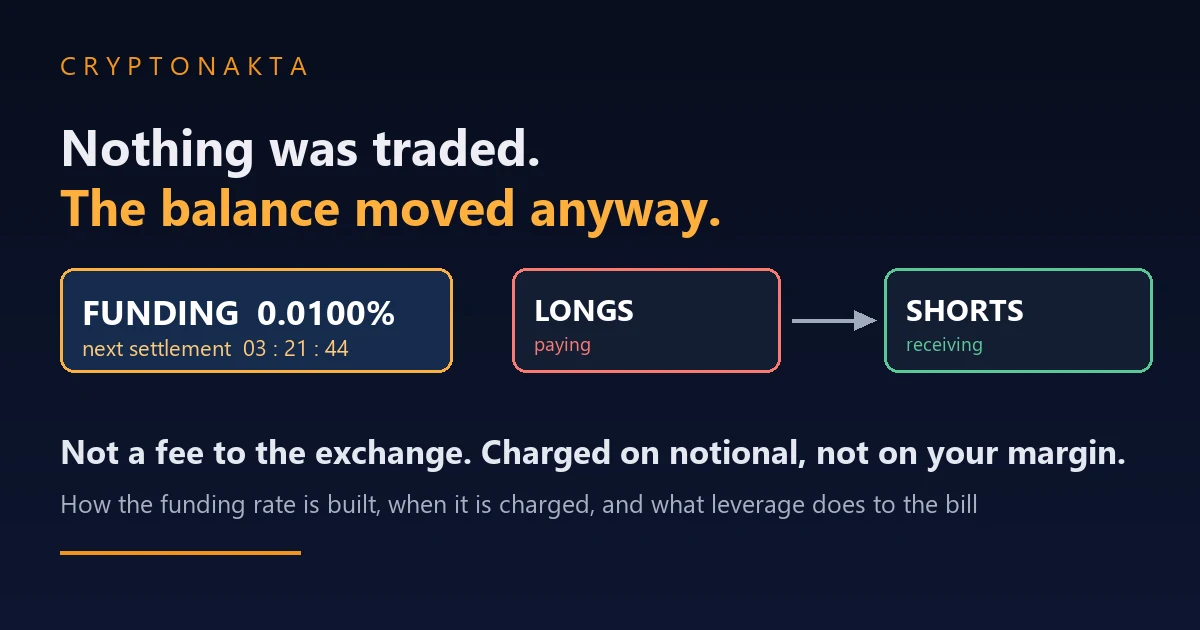
A 0.01% Funding Rate Can Take 0.6% of Your Margin Every Single Day
Who receives the payment, why the snapshot rule ignores how long you held, and what leverage does to a rate with two leading zeros.
Funding is the one cost of a leveraged position that arrives while you are doing nothing at all. This table is the article in miniature, and each row opens into its own section below.
| What people assume | What the mechanism actually does |
|---|---|
| “It is a fee the exchange charges me.” | It is a transfer between traders on opposite sides of the same contract. The major venues state that they take no cut of it. Their revenue is the trading fee, which is a separate line. |
| “I held for hours, so I paid for hours.” | It is a snapshot. Only a position open at the settlement stamp pays or receives, and it pays the full interval whether it has been open for eight hours or for one minute. |
| “0.01 percent is nothing.” | It is charged on notional, so leverage multiplies it against your margin, and it repeats every interval. At an eight-hour interval that rate is about 0.03 percent a day, near 11 percent a year, before any multiplier. |
| “Every venue posts the same number, so I can compare them.” | Only if the interval matches. The same printed rate at an hourly interval is eight times the daily cost of an eight-hour one. |
| “My liquidation price moved on its own overnight.” | In isolated margin the payment comes out of the margin backing that position, so each settlement you pay narrows the buffer and pulls the trigger nearer. |
| “A high funding rate means the top is close.” | It says the crowded side is paying rent to stay. That is positioning information, not a forecast. |
The sentence to carry out of here: funding is rent on a position, billed on its full size, and somebody on the other side of the book is collecting it.
1. The entries in your statement that match no order you placed
2. A contract with no expiry date, and the hole that leaves
3. Who actually receives the money, and how it differs from the exchange’s fee
4. What the rate is built from: a measured premium and a fixed constant
5. The snapshot rule: eight hours or one minute, the same bill
6. Why the countdown matters more than the percentage
7. It is charged on notional, so leverage multiplies it
8. Per interval, per day, per year, and where the ceiling sits
9. Where the payment lands, and how it moves a liquidation price
10. Positive, negative, and what the sign is really telling you
11. Standing on the receiving side, and the four things that break it
12. The four numbers to read before opening a position
13. Glossary: fourteen terms that cover the whole mechanism
Open the transaction history on a futures account and scroll past the entries you recognise. The trades are there, with their fees attached. Then there are other entries, spaced out at regular hours, labelled as funding, that correspond to no order you ever placed. Some are debits. If you were positioned the other way, some are credits. They land whether the position was up or down, and they keep landing for as long as it stays open. This article explains what those entries are, where the money goes, how the number is built, and why a rate that reads like a rounding error can end up as the largest cost of holding a position for a few weeks. It also covers the part almost nobody checks before opening a trade: the settlement interval, which decides whether the percentage on the screen is small or eight times as large. If you are still working out what a perpetual contract even is, the plainer ground in spot versus futures comes first, and the companion piece on what actually triggers a liquidation is the other half of the machinery.
1. The entries in your statement that match no order you placed
Start with the paperwork, because that is where most people meet this for the first time. A futures account keeps a statement, and the statement separates entries by type. Trades sit in one group, each with a commission attached. Transfers between wallets sit in another. Somewhere in the middle, at tidy hours, is a series of entries with their own label, usually some variation of funding fee, and a value that is small relative to the account and stubbornly repetitive.
Three things about those entries confuse people, and they are worth separating before any formula appears.
- They are not attached to a trade. Nothing was bought or sold at that moment. The position was open, the clock reached a certain time, and an amount moved.
- They can go either way. Depending on which side of the contract you were holding, the same event that debits one account credits another. Traders on the receiving side sometimes go a long time before noticing them at all.
- They are unrelated to whether the trade was working. A position deep in profit pays exactly the same amount as an identical position deep in loss, because the calculation never looks at your entry price.
That last point is the one that unsettles people. Everything else on a futures screen responds to the market: unrealised profit moves, the margin ratio moves, the estimated liquidation price moves. Funding responds to something else entirely, which is the gap between the contract and the spot market it is supposed to track, plus a fixed constant baked into the formula. Understanding the whole system is mostly a matter of understanding why that gap needs a price attached to it.
One thing this article does not do is tell you whether to hold positions through settlements, which side to take, or what multiplier to use. Those are your decisions. The aim here is that they are made with the meter in view rather than discovered afterwards in a statement.
2. A contract with no expiry date, and the hole that leaves
A traditional futures contract has a date on it. On that date, it settles, and whatever gap existed between the contract and the underlying asset is closed by the settlement itself. That deadline is the reason a dated contract cannot wander far from spot for long: everybody holding it knows exactly when the difference stops being theoretical.
A perpetual contract removes the date. That is the whole point of the product, and it is why perpetuals dominate crypto derivatives volume: no expiry means no rollover, no calendar to manage, no forced exit at an awkward moment. It also means the natural force that pulls a contract back to spot has been deleted, and something has to replace it.
Funding is the replacement. The venue measures how far the contract is trading from an index built out of spot markets. When the contract is expensive relative to that index, the traders holding the expensive side pay the traders holding the other side, at intervals, for as long as the gap persists. When the contract is cheap relative to the index, the payment runs the other way.
Notice what this does and does not do. It does not push the price. No order is placed, no book is touched, and a large funding payment has never once moved a candle by itself. What it does is change the cost of a position over time. Holding the crowded side stops being free, and the cost grows with how crowded it is. Some holders decide the position is no longer worth the rent and close it, and arbitrage desks with spot inventory find it profitable to take the other side, which is the arbitrage that closes the gap. The contract converges on the index because of what traders do in response to the bill, and the bill is what funding sets.
That is also the reason funding never disappears in a healthy market. Some gap always exists, because the gap is what makes anyone bother to arbitrage it away.
3. Who actually receives the money, and how it differs from the exchange’s fee
Now the question that this article exists to answer clearly, because the majority of explanations get it wrong: the money does not go to the platform.
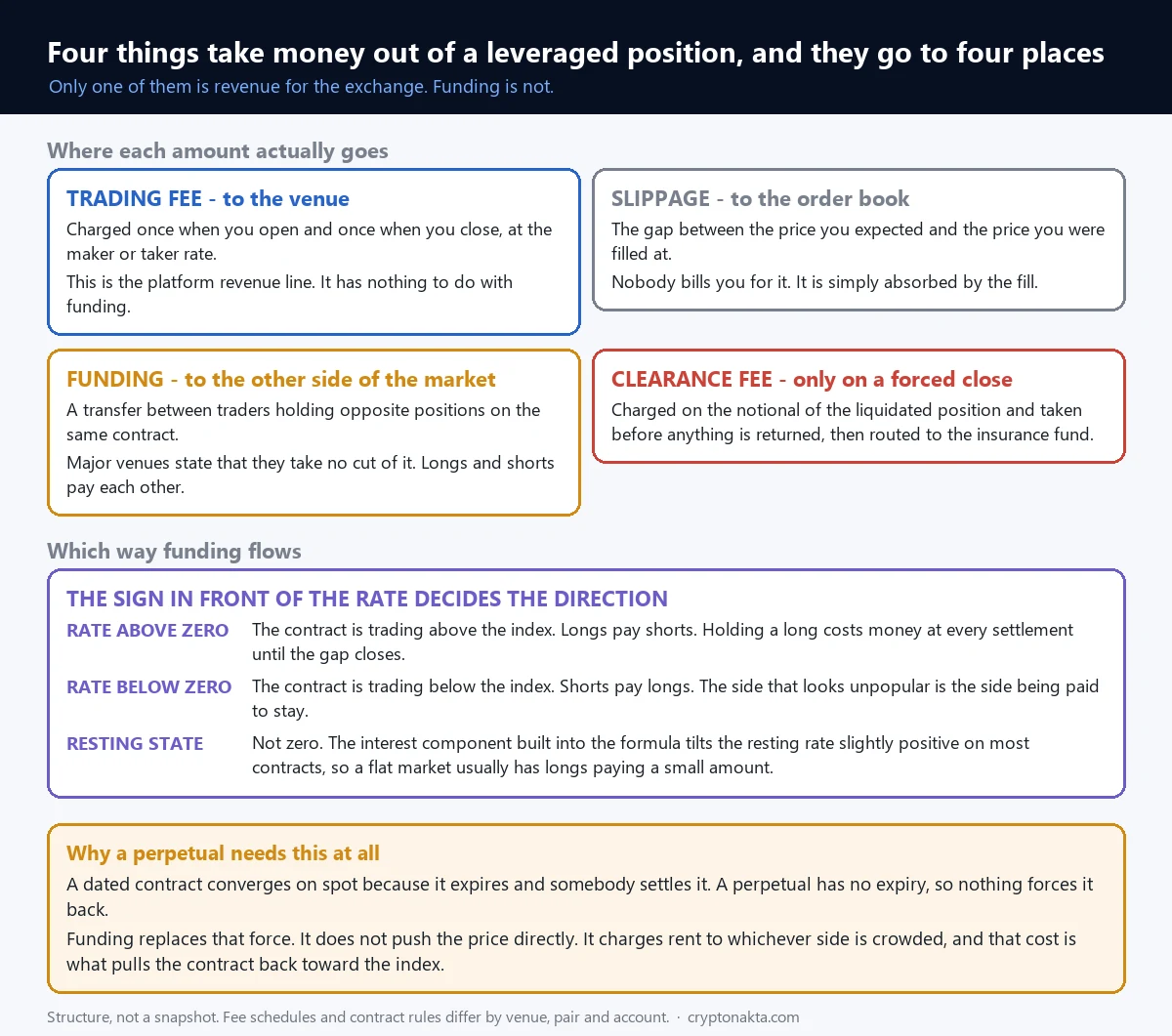
Funding is a transfer between traders holding opposite positions on the same contract. Binance states in its own documentation that it does not charge fees on funding payments and that those payments are transferred directly between traders holding opposing positions. Hyperliquid, built on entirely different infrastructure, says the same thing in its documentation: funding is purely peer to peer and no fees are collected on the payments. Venues differ in plenty of ways, and this is one of the few places where the design is identical everywhere.
So a leveraged position carries several costs, and it helps to see them side by side, because they behave differently and have different recipients.
| Cost | Charged when | Calculated on | Ends up with |
|---|---|---|---|
| Trading fee (maker or taker) | Once on entry, once on exit | Notional traded | The exchange. This is the revenue line. |
| Funding | Every settlement the position is open for | Notional held | Traders on the opposite side of the contract. |
| Slippage | On every fill | Whatever the book gives you | Nobody bills it. It is absorbed in the fill price. |
| Clearance fee | Only if a position is force-closed | Notional liquidated | The insurance fund, deducted before leftovers are returned. |
Two consequences follow. The first is that shopping for the lowest trading fee tells you nothing about what a position will cost to carry; the fee schedule and the funding history are separate pieces of information, and our breakdown of how exchange fee structures work covers only the first of them. The second is more interesting: because funding is a transfer, there is always somebody on the receiving end. Every payment leaving a crowded long position lands in the account of somebody short the same contract, and that fact is the foundation of an entire category of positioning that gets covered further down.
It also explains a small mystery in the statement. If the entries in your history are sometimes positive, nothing has gone wrong. You were on the side that was being paid.
4. What the rate is built from: a measured premium and a fixed constant
The formula varies in its details between venues and gets revised from time to time, so treat what follows as the shape rather than as a specification for any particular platform. The shape is consistent enough that once you can read one venue’s contract rules, you can read all of them.
The premium, measured at depth
The first component measures how far the contract is trading from the index. Crucially it is not measured at the top of the order book, where a single order can sit. It is measured at depth, using what the venue calls impact prices: the average fill you would actually receive for a defined notional size. On one major venue that size is the notional tradable with 200 USDT of margin at the pair’s maximum leverage, which means a pair with a lower maximum leverage gets probed with a larger amount. A small order resting at an unrealistic price therefore does nothing to the premium, and by extension nothing to your funding bill.
The measurement is taken frequently, commonly every few seconds, and the figure used at settlement is an average across the interval rather than the last reading. Some venues weight recent samples more heavily. That averaging is the reason the rate displayed before settlement is described as predicted or estimated: it is a running calculation that keeps changing until the stamp is struck, and a violent last minute does not fully rewrite it.
The fixed component, and the clamp around it
The second component is a constant rather than a market rate. On most contracts it sits at 0.01 percent per eight-hour interval, which is 0.03 percent a day and close to 11 percent a year. It represents the cost difference between holding the quote currency and holding the asset itself. Some contracts, typically those quoted in another crypto asset rather than in a dollar stablecoin, use zero here.
The two components are combined with a clamp, commonly at plus or minus 0.05 percent, which limits how much the fixed component can pull the result away from the measured premium. In practical terms: when the contract is trading close to the index, the constant dominates and the rate settles near it. When the premium is large, the premium dominates and the constant becomes noise.
The interval scaling
Finally the result is scaled to the settlement interval. The published formulas express this as a division by eight over the interval in hours, which is a compact way of saying that a contract settling every hour charges one eighth of what the same conditions would produce over eight hours. The important practical consequence gets its own section below.
One structural point survives every revision of these formulas: the resting state of a perpetual is not zero. With the premium flat and the constant in place, longs pay shorts a small amount all day long. That is why funding on a quiet market is usually slightly positive rather than exactly nothing, and it is a design choice, not a market opinion.
5. The snapshot rule: eight hours or one minute, the same bill
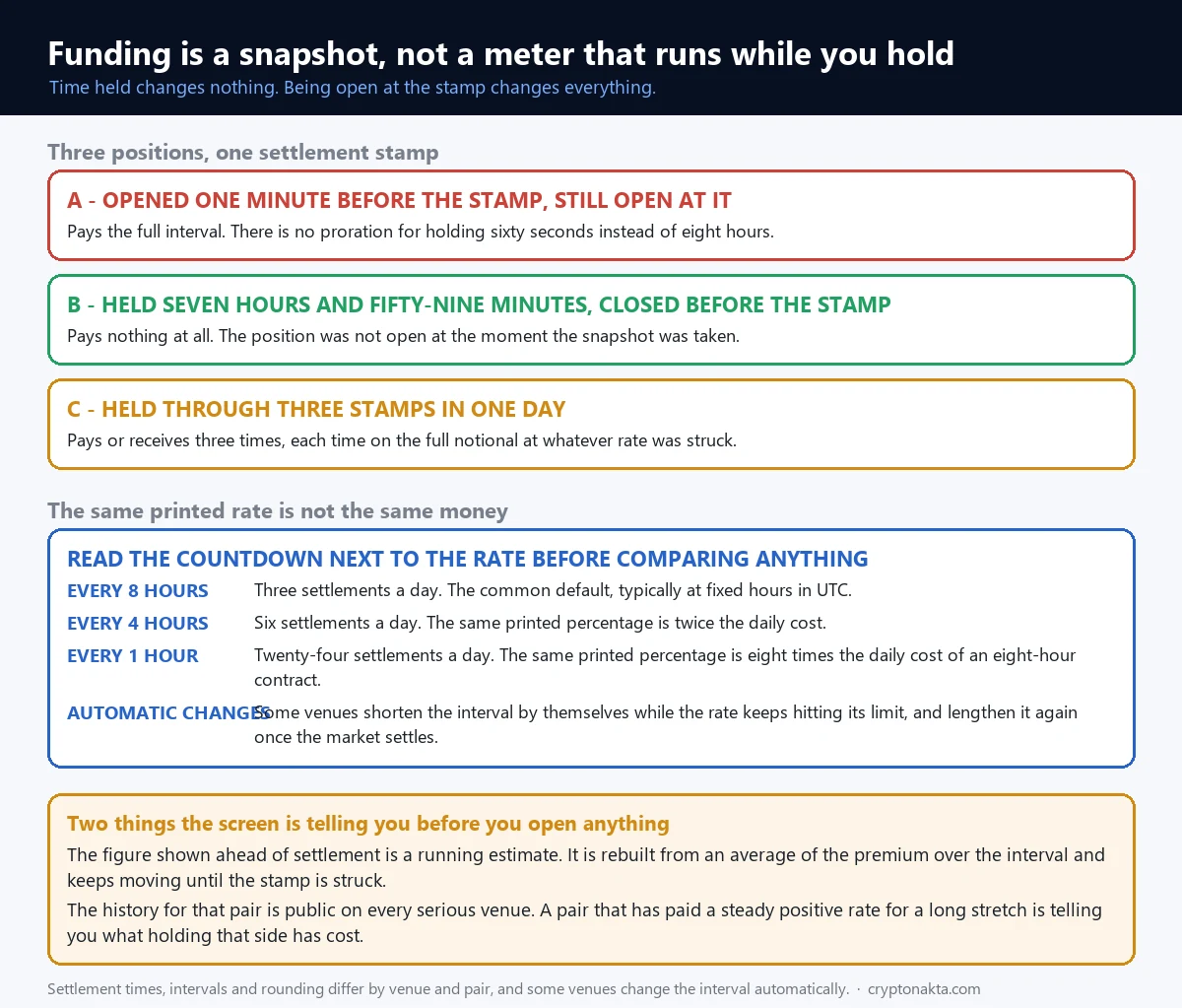
This is the rule that catches people who did everything else right, and it is refreshingly simple. Funding is charged on a snapshot. The system looks at who holds a position at the settlement timestamp and settles between those accounts. Time held before that moment is not part of the calculation.
| Situation | What is charged |
|---|---|
| Position opened one minute before the stamp, still open at it | The full interval. There is no proration for holding sixty seconds. |
| Position held seven hours and fifty-nine minutes, closed just before the stamp | Nothing. No funding at all, in either direction. |
| Position held across three stamps in a day | Three separate settlements, each on the full notional at whatever rate was struck at that moment. |
| Position reduced by half just before the stamp | Charged on the size that exists at the stamp, so half the amount. |
Two behaviours follow from this, and both are visible on any venue if you watch the order flow around settlement times. Traders who do not want to pay close or trim before the stamp. Traders who want to receive open or add before it. The result is a small burst of activity in the minutes either side of each settlement, and it is entirely rational given how the rule is written.
It also means the honest answer to “can I avoid funding entirely?” is yes, mechanically, by never holding a position across a settlement. Whether trading that way makes sense is a separate question this article does not answer, and it comes with its own costs: closing and reopening pays the trading fee twice and eats the spread twice, which for most position sizes is larger than the funding that was avoided.
The mirror version is worth stating with equal care. Deliberately opening just before a stamp to collect a payment puts you in a position for a reason unrelated to what the price is doing, and the premium that produced the attractive rate frequently compresses around settlement precisely because others are doing the same thing. The mechanism is real; treating it as money for nothing is a category error.
6. Why the countdown matters more than the percentage
Eight hours is the common default, with settlements at fixed hours in UTC, and most people absorb that as if it were a law of nature. It is not, and the exceptions matter more than they look.
| Interval | Settlements per day | What the same printed rate costs per day |
|---|---|---|
| Every 8 hours | 3 | The baseline most examples assume. |
| Every 4 hours | 6 | Twice the daily cost of the same number. |
| Every 1 hour | 24 | Eight times the daily cost of the same number. |
Several things drive the variation. Some pairs are simply configured with a shorter interval from the start, usually more volatile ones. Some venues run hourly funding as their standard design across the board, which is common among on-chain perpetual platforms and worth knowing before comparing a rate there against a rate on a large centralised venue; the profile of one such platform is in our piece on how Hyperliquid works. And several venues change the interval automatically: when the rate keeps arriving at its limit settlement after settlement, the frequency steps up, and when the market calms down and rates stay inside a normal band for a stretch, it steps back down.
The practical instruction is short. The interval is displayed next to the rate on every serious venue, usually as a countdown to the next settlement. Read the countdown before you read the number. A rate of 0.01 percent with a three-hour countdown and a rate of 0.01 percent with a forty-minute countdown are not the same cost, and no amount of comparing screenshots across platforms will tell you which is cheaper unless you have checked that field first.
There is one more asymmetry hidden here. Because the interval decides how often the snapshot is taken, a shorter interval also means more opportunities to be caught holding at a stamp. On an hourly contract, avoiding settlements as a strategy stops being practical for anything except very short trades.
7. It is charged on notional, so leverage multiplies it
Here is the arithmetic that turns a rounding error into a real number, and it is the single most useful thing in this article.
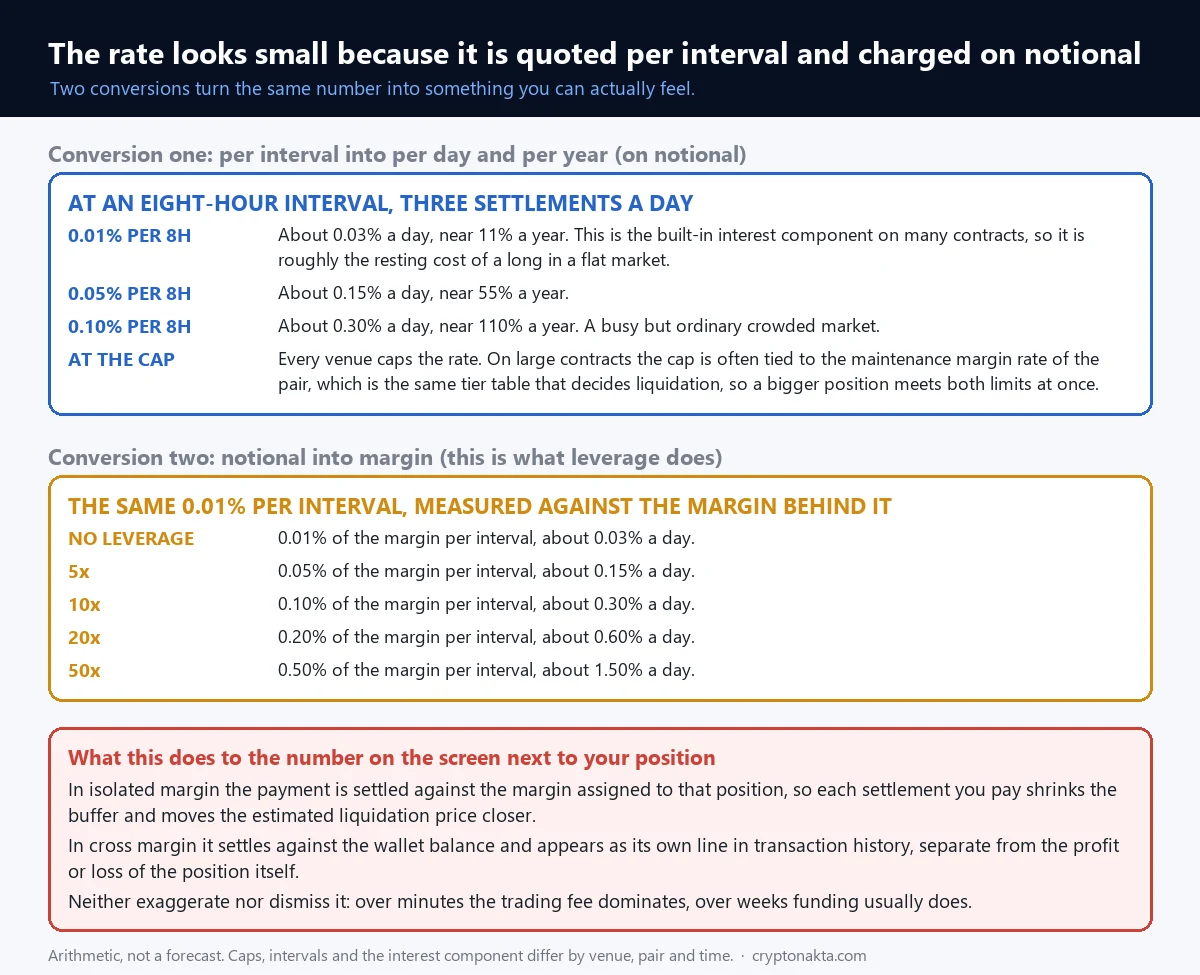
The payment is the notional value of the position multiplied by the rate. Notional is the full size of the contract exposure: on most venues it is computed as the mark price times the contract size, and some platforms use a spot oracle price for the conversion instead. What matters is what is not in that calculation. The margin you posted does not appear anywhere in it.
Since leverage is exactly the ratio between notional and margin, the funding bill measured against your own capital scales with the multiplier, one for one.
| Leverage | Rate of 0.01% on notional equals, against margin | Per day at an 8-hour interval |
|---|---|---|
| 1x (no leverage) | 0.01% | about 0.03% |
| 5x | 0.05% | about 0.15% |
| 10x | 0.10% | about 0.30% |
| 20x | 0.20% | about 0.60% |
| 50x | 0.50% | about 1.50% |
Read the bottom row again with a calendar in mind. At a rate that most traders would describe as calm, a heavily multiplied position gives back a meaningful share of its margin every week to funding alone, without the price having moved at all. The same multiplier that makes a two percent move interesting makes the rent interesting too, and only one of those two shows up in the profit and loss figure people watch.
This is also the cleanest way to answer the question of whether funding “matters”. Over a scalp lasting minutes, it is irrelevant and the trading fee dominates. Over a swing position carried for weeks at a high multiplier, it can exceed everything else you pay. Both statements are true at once, and which one applies to you is decided by holding period and multiplier, not by the size of the percentage on the screen.
8. Per interval, per day, per year, and where the ceiling sits
Rates are quoted per interval, which is honest but flattering. Converting them is a habit worth building, and the arithmetic never goes out of date.
| Rate per 8-hour interval | Per day | Roughly per year |
|---|---|---|
| 0.01% (the common fixed component) | 0.03% | near 11% |
| 0.05% | 0.15% | near 55% |
| 0.10% | 0.30% | near 110% |
| 0.30% | 0.90% | near 330% |
Those yearly figures are simple multiplication rather than compounding, which is the right way to read them for a cost you pay out rather than reinvest. They are also not predictions: a rate that is high today is not a rate you will pay for a year, because the premium that produced it exists precisely because it is being arbitraged away. The point of the conversion is not to forecast anything. It is to stop a number with two leading zeros from feeling like nothing.
Where the ceiling sits
Every venue caps how extreme the rate can get, and in stressed conditions the rate simply sits at the cap. The cap is set per contract. On one major venue the general default is around 2 percent per settlement, while its largest contracts use a cap tied to the pair’s maintenance margin rate, set at 0.75 times that rate, which puts the biggest pair in the region of 0.3 percent per settlement. One on-chain venue caps funding at 4 percent per hour, which sounds enormous until you remember its interval is hourly and its cap is designed for a market with no closing bell. Numbers like these change, so read the contract rules for the pair rather than trusting any article, including this one.
The structural point is the part that lasts: on major contracts the funding cap is anchored to the maintenance margin requirement, which is the same tier table that decides when a position gets liquidated. A larger position sits in a stricter tier for both purposes at once, so the two mechanisms tighten together rather than independently, and the detail of how that tier table works is in the companion article on what actually triggers a liquidation.
9. Where the payment lands, and how it moves a liquidation price
The payment has to come from somewhere, and where it comes from depends on your margin mode.
In isolated margin, the position is backed by collateral assigned specifically to it, and funding settles against that collateral. Every settlement you pay makes the buffer behind the position slightly smaller. Since the estimated liquidation price is derived from how much buffer stands between your position and the maintenance requirement, a smaller buffer means a nearer trigger. Nothing about the market changed; the number moved because the account paid rent.
In cross margin, funding settles against the wallet balance that backs everything. Binance describes the wallet balance as net transfers plus realised profit plus net funding minus commission, which places funding in the same category as a realised trade result rather than as an unrealised fluctuation. It is settled cash. It shows up in transaction history under its own label, it is separate from the profit or loss of the position itself, and it is the line to pull when you are trying to reconcile an account and the numbers do not add up.
This is the mechanical answer to a complaint that turns up constantly: a liquidation price that was comfortable in the evening being uncomfortably close in the morning, with the market roughly where it was left. Funding settlements during the night, in isolated mode, do exactly that. So do margin adjustments and, in cross mode, losses on unrelated positions sharing the same balance. The estimated liquidation price is a derived figure that keeps moving, and treating it as a fixed line drawn on the chart is one of the most common misreadings of a futures screen.
One more detail worth knowing: on contracts margined in the coin itself rather than in a stablecoin, the payment is made and received in that coin. The stream of payments therefore carries price exposure of its own, which is a small complication that only matters if you carry those contracts for long stretches and had assumed the payments were in dollars.
10. Positive, negative, and what the sign is really telling you
The sign in front of the rate is straightforward. Positive means the contract is trading above the index, so longs pay shorts. Negative means the contract is trading below the index, so shorts pay longs. The magnitude tells you how far apart the two markets are, adjusted by the constant discussed earlier.
What the number is describing, then, is positioning. A large positive rate says leveraged buyers are crowded enough that they are willing to pay for the privilege of staying. A negative rate says the opposite, and it happens more often than newcomers expect: extended periods where holding a long position in a perpetual is being subsidised by everyone shorting it.
Here is where the article has to be careful, because a great deal of published commentary is not. Positioning information is not a forecast. A crowded long side is more fragile to a sharp move against it, in the sense that leveraged positions have less room and are closer to forced closes, and that is a real structural observation about the state of the market. It is not a statement about direction, and elevated funding can persist far longer than any individual position can carry the cost of waiting for it to resolve. Anyone who tells you a specific funding level marks a top is selling certainty that the mechanism does not contain.
What the rate genuinely is good for is more prosaic and more useful. It is a price list. Before opening a position on a pair, the funding history for that pair tells you what holding that side has cost recently. A pair that has printed a steady positive rate for a long stretch is telling you something concrete about the carrying cost of being long it, and that goes into the arithmetic of the position alongside the trading fee. Every serious venue publishes the history, and aggregators publish the same data across venues side by side, which is also how differences between platforms become visible.
Those differences are real, incidentally. The same asset can carry different rates on different venues at the same moment, because each venue measures its own book against its own index with its own interval and its own cap. It is one of the reasons market makers are willing to be short on one platform and long on another.
11. Standing on the receiving side, and the four things that break it
If funding is a transfer, somebody is receiving it. The structure that makes that receipt into the entire point of the trade, rather than a side effect, is worth understanding even if you never use it, because it explains a large slice of what happens in crypto markets and it is the engine behind products you have probably seen advertised as yield.
The construction is simple to describe. Hold the asset in spot, and hold a short position of the same size in the perpetual. Whatever the price does, one leg gains what the other loses, so the position has close to no directional exposure. What remains is the funding stream, collected by the short leg whenever the rate is positive. This is the cash-and-carry or basis trade, and it is what synthetic dollar products mean when their documentation describes yield sourced from perpetual funding. Our profile of Ethena’s USDe and the mechanics behind it walks through one implementation in detail.
The honest part of this section is the list of what breaks it, because none of the failure modes are visible in a yield figure.
- The rate goes negative and stays there. The structure that collects when funding is positive pays when it is negative. Extended negative stretches happen, and the position bleeds during them unless it is closed, which has its own costs.
- The short leg still needs margin. It is a real leveraged position with a real liquidation price. Being hedged in spot does not stop the perp leg from being force-closed if its own margin runs out, and that is exactly what happens when a sharp rally arrives and the collateral is not where it needs to be, in the time it needs to be there.
- The legs usually live in different places. Spot on one venue or in self-custody, the perp on another. Moving collateral between them takes time, and the moment you need to move it fastest is the moment networks and platforms are busiest.
- The whole thing depends on withdrawal. Everything about the structure assumes the venue holding your collateral behaves normally. That assumption is exactly what our article on what happens if an exchange fails is about, and it is the risk that no amount of delta-neutral construction removes.
None of that makes the structure illegitimate. It is a genuine mechanism that genuine desks run at scale. It is simply not the placid thing that a single annualised percentage implies, and the gap between those two descriptions is where retail money usually gets hurt. If passive positioning is what you were actually looking for, the plainer options in our guide to exchange earn products are a different set of trade-offs worth reading first.
12. The four numbers to read before opening a position
Everything above collapses into a short pre-flight check, and every item on it is visible before a position is opened rather than after.
| What to read | Where it is | What it tells you |
|---|---|---|
| Current or predicted rate | Next to the contract name, usually with the sign shown | Which side is paying right now, and roughly how much. |
| Countdown to settlement | Beside the rate | The interval. Without it the rate is not comparable to anything. |
| Funding history for the pair | Contract details or the venue’s funding page | What holding each side has actually cost over time, which is far more informative than one print. |
| Contract rules for the pair | Trading rules page | The cap, the interval, the fee schedule, and the tier table that governs both funding limits and liquidation. |
Two habits are worth more than any of the individual numbers. The first is checking the interval every time you trade a new pair, because it is the variable most likely to be different from the one you assumed. The second is exporting funding entries from account history occasionally, since the total is usually larger than people’s mental estimate and it is the only way to find out what your own carrying cost has been. Neither habit requires an opinion about the market.
If you are choosing where to hold derivatives positions at all, the comparison in our exchange guide covers fee structures, security posture and what each platform actually offers, and the tour of one venue’s full product set in the feature walkthrough shows where funding information sits inside a typical interface. Whether a derivatives tab appears on your screen, and in what form, depends on your region and account, so work from what your own screen shows.
Binance

Bybit

Gate.io

Affiliate disclosure: some links are partner links. We may earn a commission at no extra cost to you. This is not investment advice.
13. Glossary: fourteen terms that cover the whole mechanism
A compact vocabulary covers the whole mechanism. Most arguments about funding online are really arguments about one of these words being used loosely.
- Perpetual contract: a futures contract with no expiry date, which is why it needs a tether to spot in the first place.
- Funding rate: the periodic rate applied to the notional of open positions, transferred between the two sides of the contract.
- Funding interval: how often that transfer happens. Commonly eight hours, sometimes four, one, or adjusted automatically by the venue.
- Settlement stamp: the exact moment the snapshot of open positions is taken. Only positions open at that instant participate.
- Premium index: the measured distance between the contract and the index price, taken at book depth rather than at the top of the book.
- Impact price: the average fill a defined notional size would receive, used so that small resting orders cannot distort the premium.
- Index price: the composite spot reference the contract is measured against, built from several markets.
- Mark price: the fair value used for margin, unrealised profit and liquidation. It is also commonly the price used to convert position size into notional for the funding calculation.
- Notional: the full size of the exposure, which is what funding is charged on. Not your margin.
- Predicted funding rate: the running estimate shown before settlement, which keeps updating until the stamp.
- Funding cap: the ceiling on how extreme the rate can be for a given contract, often linked to that contract’s maintenance margin rate.
- Basis: the difference between the contract price and spot. Positive basis and positive funding usually travel together.
- Cash and carry: holding spot against a short perpetual to collect funding while cancelling directional exposure.
- Isolated and cross margin: whether funding settles against collateral assigned to one position or against the balance behind all of them.
Where an exchange’s help centre uses different words for these, trust the help centre. The concepts are industry-wide, the labels and exact parameters belong to each venue, and the contract rules page for the pair you trade is a five-minute read that removes most of the surprises. If copying other people’s positions is how you were planning to trade derivatives, note that the funding on a copied position is charged to you exactly as it would be on your own, which our piece on how copy trading works covers alongside the rest of the cost structure.