Bitcoin Pizza Day: 10,000 BTC, block 57043, four days nobody took it
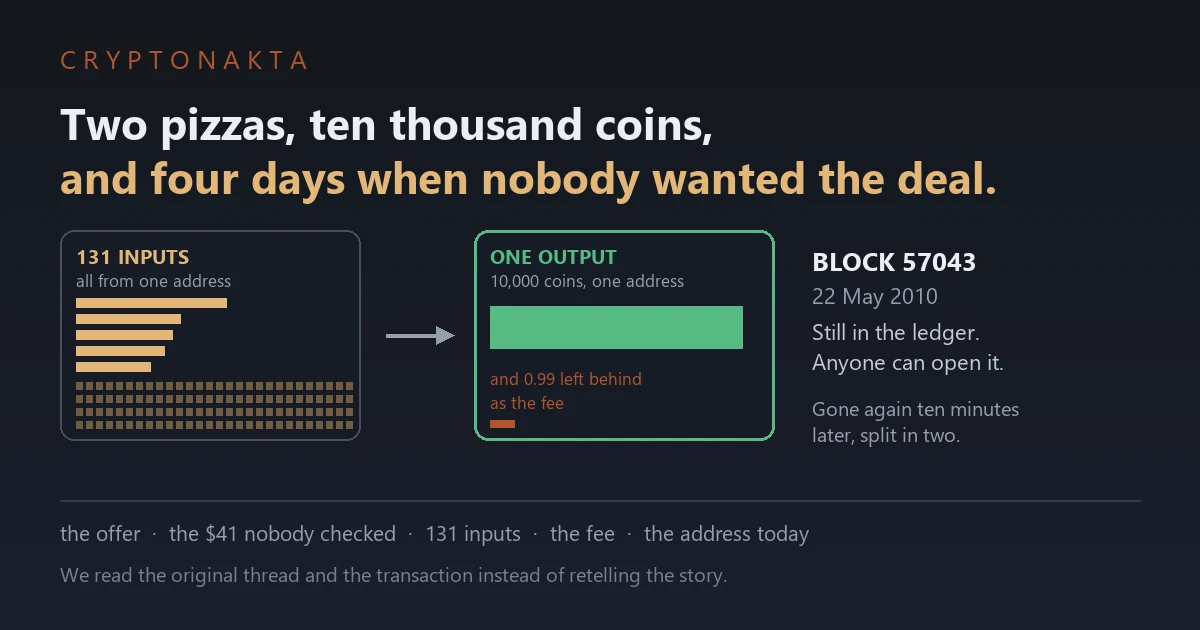
Two pizzas, ten thousand coins, and four days when nobody wanted the deal. The payment is still in the ledger, so this article reads it directly instead of retelling the story.
| Question | Short answer |
|---|---|
| What is Bitcoin Pizza Day? | The day in May 2010 when a man paid ten thousand bitcoins for two pizzas. It gets marked every year because it was the first time the coin was swapped for an ordinary thing. |
| Why does it still get told? | Because the payment is still in the ledger. Anyone can open it and read it sixteen years later, without asking anyone for access. |
| Did he throw away a fortune? | That is hindsight. When he posted the offer nobody took it for four days, and he asked the forum whether he was offering too little. |
| Was it worth $41 back then? | That figure comes from a reply in the same thread rather than from any official rate. Where it came from is explained below. |
| Can I look at the transaction? | Yes. It sits in block 57,043 and the link is further down this page. |
| Is the address still in use? | It is. Money still arrives there, and the dates cluster on one day of the year. |
| Do I need to own any to read it? | No. The ledger is public and reading it costs nothing. |
1. Four days when nobody wanted ten thousand bitcoins
2. Where the $41 actually comes from
3. What the payment looks like in the ledger
4. Ten minutes in the wallet
5. What those coins come to at the price I checked
6. The address is still receiving money
7. How I told tributes apart from dust
8. Four things people get wrong about this story
9. What this leaves you with
Every 22 May people mark the day somebody paid ten thousand bitcoins for two pizzas. It usually gets told as a joke about the most expensive meal ever eaten.
The payment is still in the ledger, and anybody can open it. So rather than retell the story I went and read it: the original forum thread in a web archive, and the transaction itself, queried twice on the same day.
Two things surprised me. Nobody took the offer for four days, and the man making it began to worry he was not offering enough. And the address that received the coins is not dead. People still send money to it, and they do it on the anniversary.
1. Four days when nobody wanted ten thousand bitcoins
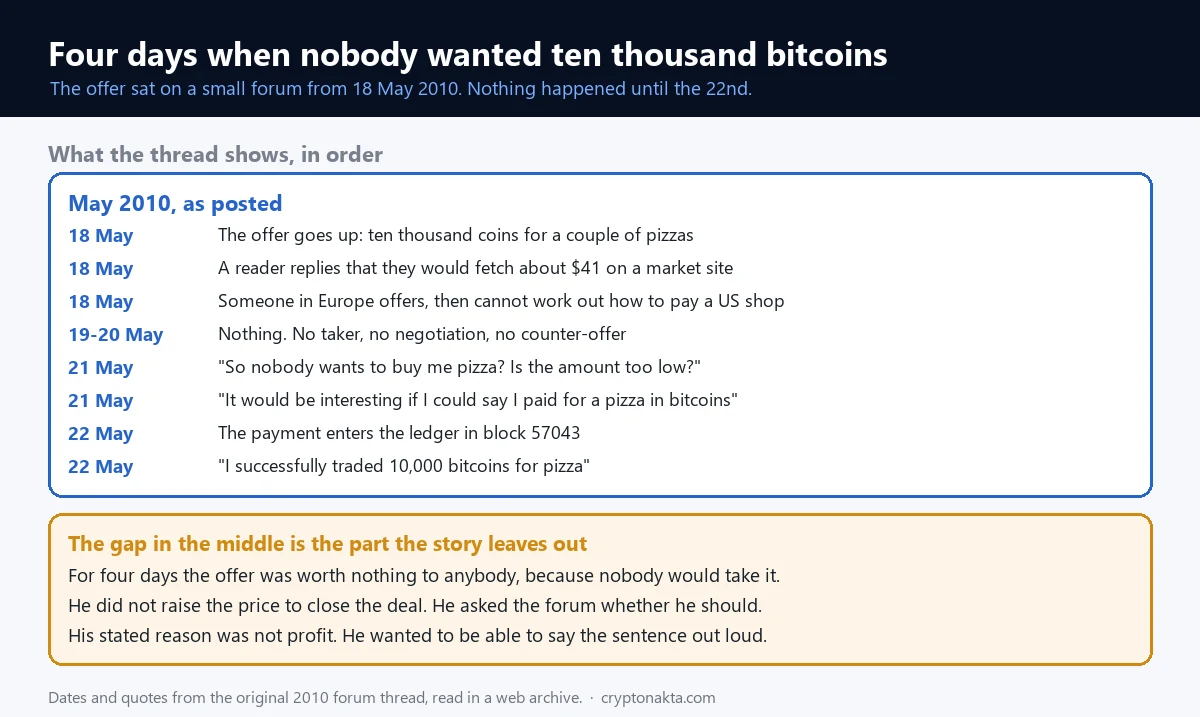
On 18 May 2010 a man in Jacksonville, Florida posted an offer on a small forum where a few hundred people were discussing a new kind of money. He wanted pizza. He had coins.
I’ll pay 10,000 bitcoins for a couple of pizzas.. like maybe 2 large ones so I have some left over for the next day.
He went on about toppings for a while. Onions, peppers, sausage, mushrooms, nothing with fish on it. What he really wanted, he said, was to have food turn up without him having to organise it, the way a hotel brings you breakfast.
Somebody asked which country he lived in. He replied with his city and his zip code, which tells you the size of the room.
Then nothing happened
Four days went by. Nobody brought him a pizza.
Someone in Europe said they would happily buy him a pizza but could not work out how to pay an American shop from abroad. He answered helpfully that plenty of places had online ordering. Someone else posted a one-word joke. That was the entire response to the offer.
On 21 May he came back to his own thread and wrote a sentence that reads very differently now than it did then:
So nobody wants to buy me pizza? Is the bitcoin amount I'm offering too low?
Read it again. He was worried that ten thousand bitcoins were not enough to get anyone interested in ordering him dinner. At the price on my screen as I write this, the offer he was apologising for was worth $762,034,300.
Why he was doing it at all
Two hours later he explained himself, and this is the part that usually gets cut from the retellings:
I just think it would be interesting if I could say that I paid for a pizza in bitcoins
He was not trying to make money and he was not trying to lose any. He wanted to be able to say the sentence out loud. Can this thing buy dinner, yes or no. That is a test, and the only way to run it was to actually do it and see whether a stranger would play along.
22 May
The next evening he posted again. He had traded the coins for pizza, there were photographs, and he thanked the person who had arranged it by their forum name.
I just want to report that I successfully traded 10,000 bitcoins for pizza.
One of the developers replied calling it a milestone. The thread moved on to other things.
The payment itself went into the ledger at 2010-05-22 18:16:31 UTC, in block 57,043. There have been 910,360 blocks since. It has been sitting there the whole time, which is the part we can actually check rather than retell.
2. Where the $41 actually comes from
Almost every version of this story carries a dollar figure for 2010. Usually $41, sometimes $30, sometimes $25. I wanted to know where the number came from, so I read the original thread instead of other articles about it.
It comes from a reply. Hours after the offer went up, another user wrote back. Ten thousand was quite a bit, he said, and you could sell them on a bitcoin market site for $41 right now. He wished him good luck getting his free pizza.
That is the source of the famous number. One person's offhand estimate, posted four days before any pizza arrived, by an account with ten posts to its name. It ends with a small dig about the free lunch.
What the thread does not contain
I searched the whole May 2010 stretch of that thread for currency amounts. There is exactly one dollar figure in it, the one above. The man making the offer never mentions dollars. Nobody negotiates a rate. The phrase "market price" does not appear anywhere.
I also went looking for the rate itself. In 2010 a hand-run service published a rate for the coin and processed trades by email, and its old pages are preserved in a web archive. I opened them. The page is there and the instructions for trading with the owner are there, but the rate table itself did not survive in the copy I could read.
Which leaves this article in an honest position. I am not going to tell you what ten thousand bitcoins were worth in May 2010, because I could not read a primary source that says so. I can tell you what the thread says, which is that one reader guessed $41 and nobody argued with him.
Why the distinction is worth making
This story gets repeated thousands of times a year and each retelling copies the one before it. Numbers harden as they travel. A guess in a forum reply becomes the market price at the time. After enough repetitions it becomes a thing everybody knows.
The ledger does not work like that. What was written into a block is what was written, and you can check it yourself without asking permission. That is where the two halves of this article split. Everything from here on is the half I could verify.
3. What the payment looks like in the ledger
Everything below came from reading the chain directly, through a public service that lets anyone query it without an account. I read it twice on the same day to be sure the values repeated. The transaction is here if you want it open beside you.
Two words first
Every transaction carries its own identifier, a long string of letters and numbers that works like a number plate. Paste it into a block explorer and you see the same screen from any country.
A block is a bundle of transactions. A new bundle is sealed roughly every ten minutes, and once sealed its contents do not change. Block 57,043 is one of the early ones.
One output, and it is a round number
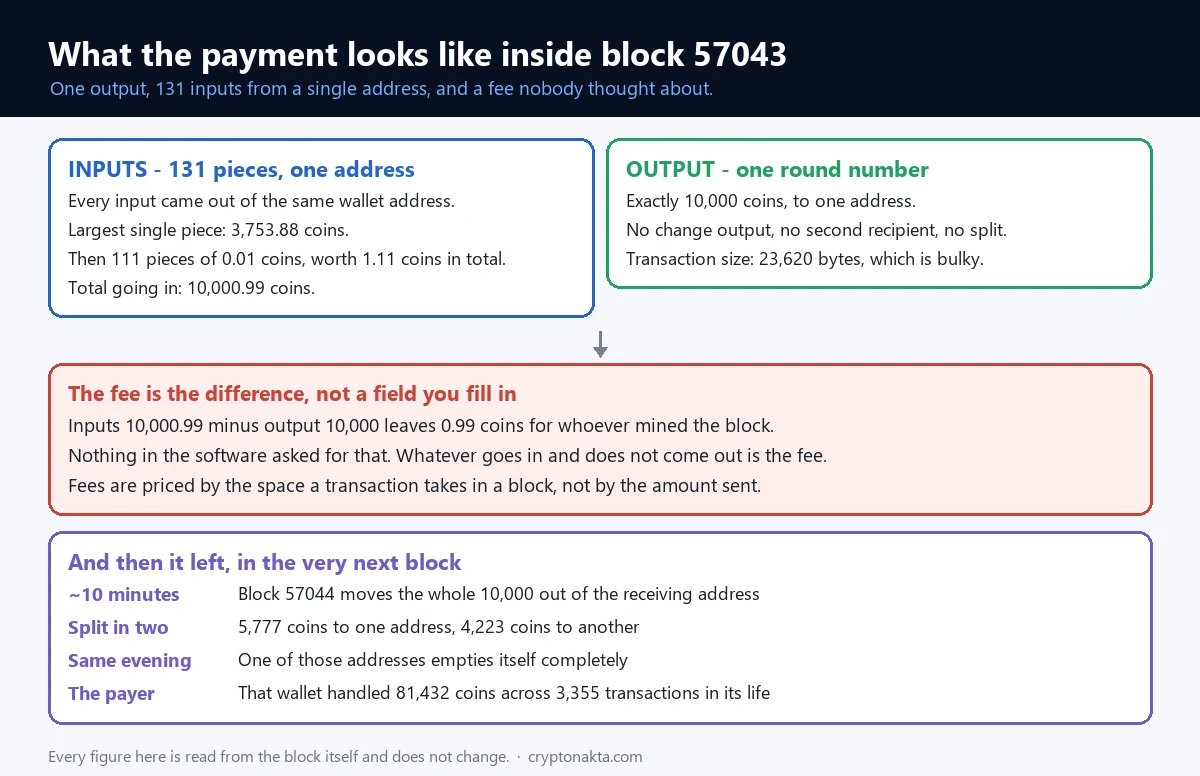
The payment has a single output: exactly 10,000 coins, to one address. No change coming back, no second recipient, no splitting. A round number leaving a wallet in one piece.
131 pieces went in
The input side is where it gets interesting. The payment was assembled out of 131 separate pieces, and every one of them came from the same address.
Coins here are not a balance in an account. A wallet holds a pile of separate chunks, each one left over from some earlier payment. To send an amount you gather up enough chunks to cover it. It is closer to paying with the notes and coins in your pocket than to a bank transfer, and the chunks you hand over are consumed whole.
So the shape of the input side shows you what was in the pocket. The largest single piece was 3,753.88 coins. After that a run of big round pieces, several of them identical. And then 111 pieces of 0.01 coins each, adding up to 1.11 coins in total, scraped in on top.
Those hundred and eleven tiny pieces are the detail I keep coming back to. Somebody went through the corners of a wallet to land on a round number. Whatever else this was, it was not careless.
The fee nobody mentions
Add up the inputs and you get 10,000.99 coins. The output is 10,000. The difference, 0.99 coins, was left on the table for whoever mined the block.
That is how fees work in this system. There is no fee field. Anything you put in and do not send out is the fee. In 2010 the software was relaxed about leftovers, because they were worth nothing to anybody. At the price while I am writing, that leftover is $75,441.
The other thing worth knowing is that the fee has almost nothing to do with the amount being sent. It is priced by how much room the transaction takes up in a block. This one was 23,620 bytes, which is bulky, because 131 inputs take a lot of space to describe.
Sending a fortune in one clean piece can cost less than sending pocket change stitched together from a hundred fragments. That is still true today and it is why network fees behave the way they do.
What the whole thing looks like written down
| Field | What the ledger says |
|---|---|
| Block | 57,043 |
| Time recorded in the block | 2010-05-22 18:16:31 UTC |
| Inputs | 131 pieces, all from one address |
| Largest single piece | 3,753.88 coins |
| Smallest pieces | 111 of 0.01 coins, 1.11 coins together |
| Total going in | 10,000.99 coins |
| Output | 10,000 coins to one address |
| Fee | 0.99 coins |
| Size | 23,620 bytes |
4. Ten minutes in the wallet
Here is the part that changed how I think about the story.
The ten thousand coins landed in that address and then they left. Not weeks later. In the very next block, roughly 9.6 minutes after they arrived.
They went out in two pieces, 5,777 coins and 4,223 coins. One of those pieces went to an address that had been taking in coins two days earlier and emptied itself again the same evening. Whatever was being arranged, it was being arranged quickly.
What that tells you, and what it does not
It does not tell you who anyone was. An address is not a person. The ledger shows that coins moved between addresses, and nothing more. Anyone reading intentions out of it is adding something that is not in the data.
The timing is still worth something though. Nobody treated these coins as a trophy. They arrived, they were broken into working pieces inside ten minutes, and they carried on moving. The point of the exercise was that the coins should behave like a payment, and that is exactly how they behaved.
The wallet on the paying side
The address that funded the payment puts the whole thing in perspective. Over its lifetime it took in 81,432 coins across 3,355 transactions, and today it holds dust.
So this was not somebody's entire holding, carefully set aside. It was a working wallet in heavy use, in a period when nobody treated what was in it as valuable. Its owner still had to gather 131 pieces to make the round number he had promised.
Binance

Bybit

5. What those coins come to at the price I checked
This is the only section of this article with a shelf life. Everything else here is fixed in the ledger and will read the same in ten years. The numbers below were true at the moment I checked them and are already slightly out of date.
Prices were read from 4 public sources at 2026-09-17 11:38 UTC, and the ledger was queried twice the same day to be sure the values repeated.
| What | In coins | At the price when checked |
|---|---|---|
| The payment | 10,000 | $762,034,300 |
| The fee left for the miner | 0.99 | $75,441 |
| The 111 small pieces scraped in | 1.11 | $84,586 |
| Everything sent to the address since | 0.00379983 | $289.56 |
| Smallest amount the network will relay | 0.00000546 | $0.42 |
I took the price from 4 public sources at the same moment. Two of them quote real dollars and two quote a dollar-linked token. They disagreed with each other by 0.096 percent. There is no single official price for this asset, which is a thing worth understanding on its own.
Why I am not doing the "if only" arithmetic
You can work out what those coins would come to today. It is one multiplication and I have just handed you both numbers.
What the arithmetic hides is that the coins were only worth anything later because things like this happened first. In May 2010 there was no price worth the name because there was nothing to buy with it. A currency that cannot buy dinner is a spreadsheet. Somebody had to go first, and going first meant handing over an amount that looks absurd once the thing has a price at all.
The four days of silence measure that better than any chart from the period. Ten thousand coins could not get a pizza delivered. That is what the asset was worth in practice, and nothing states it as plainly as a man asking a forum whether he ought to offer more.
6. The address is still receiving money
I expected the address that received the coins to be a dead end. It is not.
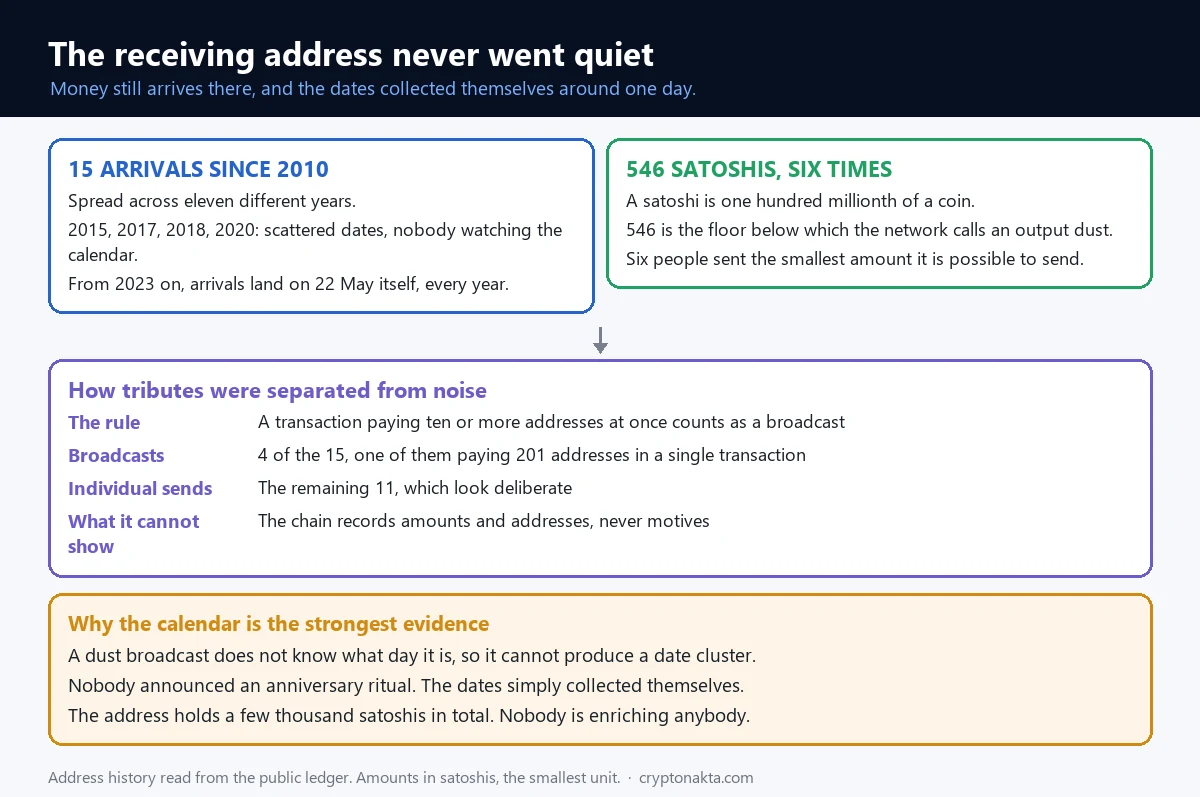
Money has arrived there 15 separate times since that day in 2010. Not much money. 0.00379983 coins in total, which came to $289.56 when I checked. But it keeps arriving, spread across 7 different years, and the calendar is the interesting part.
| Date | Coins | Satoshis | Landed on 22 May | Paid many addresses at once |
|---|---|---|---|---|
| 2015-04-19 | 0.0001 | 10,000 | ||
| 2017-07-04 | 0.001 | 100,000 | ||
| 2018-10-23 | 0.00001111 | 1,111 | ||
| 2020-02-04 | 0.00141482 | 141,482 | ||
| 2023-01-24 | 0.00001 | 1,000 | yes | |
| 2023-05-22 | 0.00000546 | 546 | yes | |
| 2024-05-22 | 0.00000546 | 546 | yes | |
| 2024-05-25 | 0.00000546 | 546 | ||
| 2024-05-25 | 0.00000546 | 546 | ||
| 2024-07-07 | 0.00000546 | 546 | yes | |
| 2024-10-07 | 0.0000101 | 1,010 | ||
| 2024-12-13 | 0.00000546 | 546 | yes | |
| 2026-03-31 | 0.00000571 | 571 | yes | |
| 2026-05-22 | 0.00055097 | 55,097 | yes | |
| 2026-05-22 | 0.00066436 | 66,436 | yes |
4 of those arrivals landed on 22 May, the anniversary of the payment. Two of them came within an hour of each other on the same anniversary, and they are the two largest gifts in the list.
The anniversary habit is recent
Read the table by year and something stands out. The arrivals in 2015, 2017, 2018 and 2020 land on scattered dates: April, July, October, February. People knew about the address back then and sent to it, but nobody was matching the calendar.
Arrivals on 22 May itself start in 2023, and they have turned up on the day every year since. So sending to this address is an old habit, and doing it on the anniversary is a fairly new one. Nobody announced it. The dates simply collected themselves.
546
Look at the satoshi column. 6 of those payments are for exactly 546 satoshis.
A satoshi is the smallest unit the system can express: one hundred millionth of a coin. 546 of them is not a number anybody picks by accident. It is the floor below which the network treats an output as dust and declines to pass it along. Six different people sent the smallest amount it is physically possible to send.
That is $0.42 at the price I checked. Nobody is enriching anybody here. They are signing a guest book. Somebody worked out the smallest gesture the network permits, and made it, at the address where the first real purchase landed.
I find that more interesting than any of the price arithmetic. There is no plaque anywhere. The address is the plaque, and anyone in the world can add their name to it.
7. How I told tributes apart from dust
I have to be honest about one thing in that table, because it would be easy to make the story better than the evidence supports.
Not every arrival at that address is a tribute. Some people send tiny amounts to well-known addresses in bulk, hundreds at a time, for reasons that have nothing to do with sentiment. It is a known nuisance on this network. If I counted those as pilgrims I would be inflating my own story.
The line I drew
So I separated them with a rule I can state plainly: if a transaction paid out to ten or more addresses at once, I treated it as a broadcast rather than a gift.
By that rule 4 of the 15 arrivals were broadcasts. Two of them paid out to more than a hundred addresses in a single transaction, one of them to 201. The remaining 11 look like somebody sending to this address on purpose, and those come to 0.0037732 coins between them.
Where the rule is weak
It is a guess dressed up as arithmetic. Somebody making a sincere gesture might use a wallet that batches payments, and a bulk sender could aim at one address at a time and slip through my filter. The chain records amounts and addresses. It never records motives.
What survives the caveat is the calendar. A dust broadcast does not know what day it is. The concentration of arrivals on 22 May is not something my filter could have manufactured, and it is the strongest thing in the table.
If you want to check any of it, you need neither an account nor any of the asset. Any block explorer takes the transaction id or the address and shows you what I saw.
8. Four things people get wrong about this story
Four things I had to unlearn while working on this.
"It was worth $41 at the time"
Covered above. One reader's estimate in a reply, not a rate anybody traded at. If an article hands you that figure without saying where it came from, the writer did not open the thread.
"They were Papa John's pizzas"
The brand does come up in the thread, from the buyer himself, but in a different context. He was explaining that plenty of pizza places take orders online, and named one his household used. That is not a receipt. I do not know what was delivered and I am not going to write it down as though I do.
"The address in his forum signature is where the coins came from"
It is not. He had a donation address in his signature on every post, and I checked it against the address that actually funded the payment. They are different addresses with different histories. This one is easy to get wrong, because the signature address is the one printed inside the quoted text, so it is the one people copy across.
"The worst trade in history"
This is the framing I like least, and not only because it is unkind. It gets the order of events backwards. The coins did not have a real price that he then squandered. He went and found out whether they could have a price at all, and it took him four days of failing to give them away. Calling the result a blunder requires you to already know the answer to the question he was asking.
9. What this leaves you with
A story is a poor reason to change what you do with your money. Three things in this one are practical though, and they turn up in the first week of anybody's use of this stuff.
You will deal in satoshis whether or not you notice
One coin is one hundred million satoshis. Amounts get quoted in them constantly. The 546 satoshi floor in this article is a real limit, and you walk into it when you try to move a very small leftover. If a tiny balance refuses to move, that floor is usually why, and support cannot lift it for you.
Fees are charged by size, not by amount
The 0.99 coins left behind in 2010 were an accident of software nobody had bothered to tune. The principle underneath has not changed. You pay for the room your transaction takes up in a block. A payment stitched together from many small pieces costs more to send than one large clean one. Worth reading properly before your first withdrawal, and it is also why moving coins between exchanges costs what it does.
The address is the whole of the instruction
Nothing in this system knows what you meant. The 2010 payment went where the address said, within ten minutes, with nobody to call. That is still how it works, which is why sending to the wrong address or the wrong network is the mistake worth being paranoid about.
How I read this story now
I used to file it under expensive mistakes. After reading the thread and the ledger I file it under experiments, and it changed the question I ask about any coin I come across.
The question is not what it is worth. It is what it can do, and who accepted it doing that thing recently. In May 2010 the honest answer for bitcoin was almost nothing, and one man proved it could do exactly one thing, once, with a stranger, for dinner. Everything after that is a footnote to somebody being willing to look silly for four days.
If you are starting out, the dull parts matter more than the story does. Start with how to actually buy the thing, where it lives once you own it, and when a dedicated device is worth the trouble.
OKX

Affiliate disclosure: some links are partner links. We may earn a commission at no extra cost to you. This is not investment advice.