
Frozen USDT Wallet | Can Tether Freeze USDT, Blacklist Check, How to Unfreeze
Yes, Tether can freeze the USDT in your own wallet. It works one address at a time, and there’s no promise of a warning first. A frozen address can’t send USDT, but it can still receive it. Most USDT that won’t send isn’t frozen at all. So rule out the usual causes first.
We read the contract code and counted every freeze and unfreeze on the TRON and Ethereum blacklists. We also tested what a frozen address can still do. There’s also a checker below that asks the contract directly.
In this guide (13)
Can Tether freeze USDT in your own wallet?Why is my USDT frozen? The reasons Tether givesUSDT frozen meaning: what stops and what still worksTether blacklist checker: how to check if USDT is frozenUSDT won’t send? Energy, exchange limits, fake tokens and seed phrase walletsI received USDT from a blacklisted address. Can my USDT be frozen too?Can frozen USDT be unfrozen? How a Tether unfreeze request worksCan USDT be seized? How Tether burns and reissues frozen USDTPaying someone to unfreeze USDT is a scamCan Circle freeze USDC like Tether freezes USDT?Can USDT on TRON or ERC-20 be frozen?My take on frozen USDT, and what I’d check firstWhat we counted on the TRON and Ethereum blacklists
Can Tether freeze USDT in your own wallet?
Yes. Tether can freeze the USDT in a self-custody wallet, one address at a time, and its terms don’t promise to warn you first. A frozen address can’t send USDT, yet it can still receive it. You can check any address in about a second.
The rule sits in Tether’s terms of service. They let Tether freeze tokens “in any Tether Tokens Wallet or other User Wallet”. A User Wallet is any wallet holding USDT, including one you set up yourself. An issuer freeze like this is set by the company behind the token, here Tether.
USDT itself is a smart contract, a program on the blockchain that keeps every balance. Inside it sits a blacklist, a list of addresses that aren’t allowed to send. Tether adds an address with addBlackList and removes it with removeBlackList.
Your wallet address is the T… or 0x… string you share to get paid, and the freeze is tied to it. Trust Wallet, MetaMask and a hardware wallet all read the same contract. So USDT can be frozen on Trust Wallet too, and “it’s my own wallet” doesn’t change that.
USDT is also easy to trace, because every transfer sits on a public ledger. That’s one way investigators find the addresses they ask Tether to freeze.
Why is my USDT frozen? The reasons Tether gives
Tether freezes USDT when a court orders it or when law enforcement asks. It also freezes stolen funds it spots itself. Addresses on sanctions lists get frozen too. Its terms also keep a broad right to act at its own discretion.
In Tether’s own words, it “freezes in response to legal orders, in proactive collaboration with law enforcement”. For stolen money it acts alone, “mainly to return stolen funds”. Sanctions-list addresses are frozen in self-custody wallets as well, under a later policy.
Tether also watches transfers itself through the T3 Financial Crime Unit, a team it runs with TRON and an analysis firm. The frozen address doesn’t have to belong to a Tether customer. After one case, Tether said the frozen wallets were “not associated with Tether’s customers.”
So does Tether freeze for no reason? The listed reasons are specific, but the terms also say “in its sole discretion”. Tether doesn’t publish a reason for each address. If yours is listed, only Tether or the agency behind the request can tell you why.
USDT frozen meaning: what stops and what still works
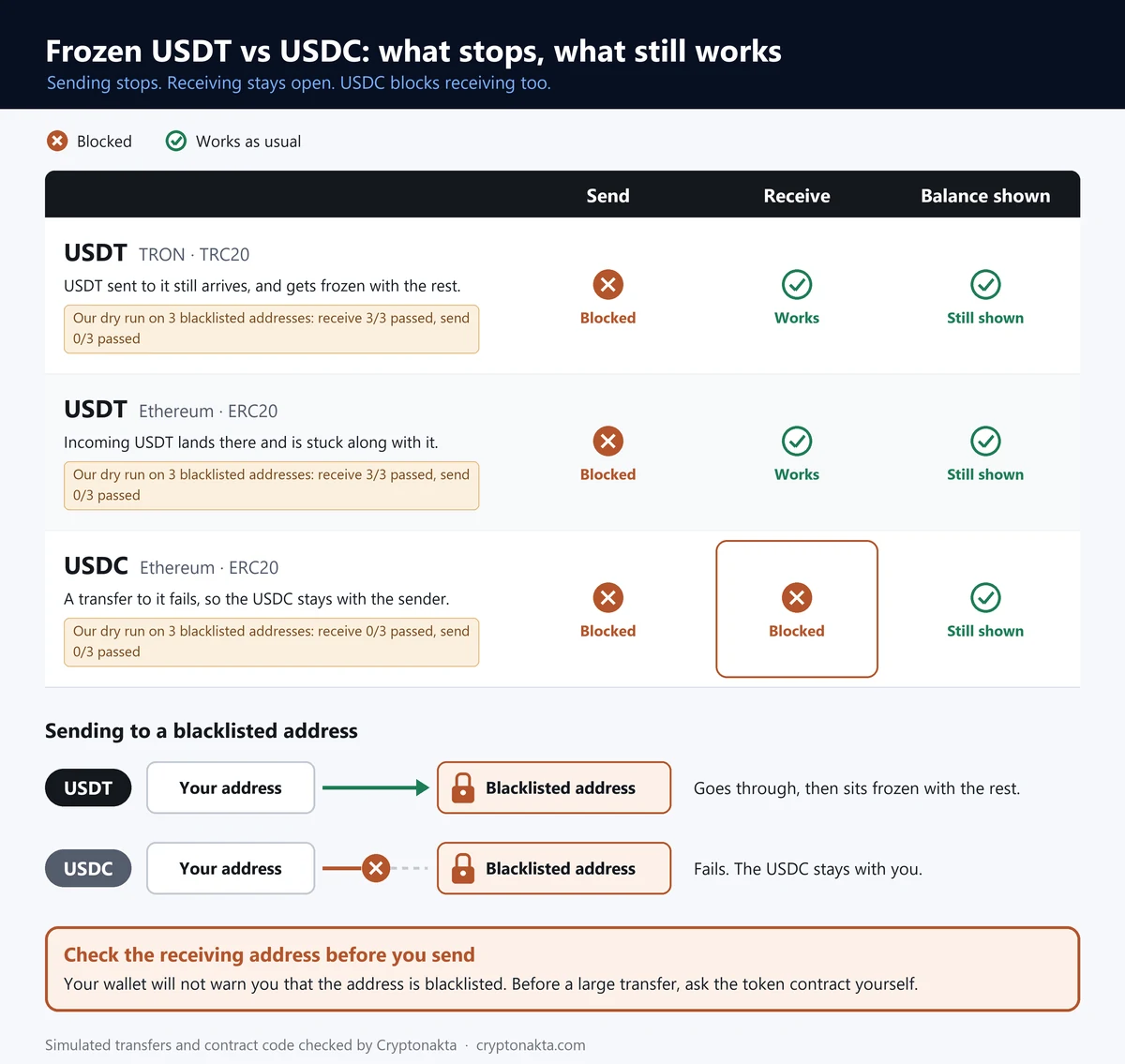
When Tether freezes a USDT address, sending stops and receiving keeps working. The balance stays visible in your wallet and on the explorer. TRX or ETH on the same address still moves as usual. USDC is stricter, because a frozen USDC address can’t receive either.
 View full size ↗
| Token on a frozen address | Send out | Receive | Balance | Based on |
|---|---|---|---|---|
| TRON USDT (TRC-20) | ✗ blocked | ○ works | ○ shows | Our dry run on 3 frozen addresses (M) + contract function list (A) |
| Ethereum USDT (ERC-20) | ✗ blocked | ○ works | ○ shows | Our dry run on 3 frozen addresses (M) + verified contract code (A) |
| Ethereum USDC | ✗ blocked | ✗ blocked | ○ shows | Our dry run on 3 frozen addresses (M) + verified contract code (A) |
| TRX or ETH on the same address | ○ works | ○ works | ○ shows | The blacklist lives only inside the token contract (A) |
✗: blocked. ○: works. M = we measured it. A = we read the contract code or its function list ourselves.
USDT checks only the sender. Anyone can still send USDT to a frozen address, and it gets stuck there too.
USDC checks both sides. A transfer to a frozen USDC address fails and does not go through.
Dry run means we asked a public node whether the transfer would pass. No coins moved.
The reason is in the code. Ethereum USDT’s transfer runs one check, require(!isBlackListed[msg.sender]). It only asks whether the sender is frozen. Nothing looks at the receiver.
We confirmed it with a dry run, which asks a public node whether a transfer would pass without moving coins. On 3 frozen TRON and 3 frozen Ethereum USDT addresses, every transfer in passed. Every transfer out failed.
A frozen USDT address can still receive USDT, and whatever arrives is frozen with the rest. Send to one by mistake and your coins get stuck. Some analysis articles say frozen addresses can’t receive. The code and our test say otherwise.
USDC is different. Circle’s contract checks both sides. Our dry run on 3 frozen USDC addresses failed in both directions with “Blacklistable: account is blacklisted”.
Who can change the list? Only the owner address Tether controls. On Ethereum that owner is itself a contract that looks like a multi-signature wallet, and we can’t see who signs.
Tether blacklist checker: how to check if USDT is frozen
To check if USDT is frozen, ask the USDT contract whether your address is on its blacklist. Paste a TRON address (it starts with T) or an Ethereum address (it starts with 0x) into the checker below. It reads the answer straight from the contract.
It shows the blacklist value (true or false) and the USDT balance. For a 0x address it checks USDC too. Your browser asks a public node directly, so the address never reaches our server. It can’t show an exchange account limit or an AML risk score, a separate estimate made by analysis companies.
To do it by hand, open the USDT contract on a block explorer such as Etherscan or Tronscan. Go to Contract and then Read Contract, the free tab for querying a contract.
| Step | Ethereum (Etherscan or Blockscout) | TRON (Tronscan) |
|---|---|---|
| Open the token contract | USDT contract 0xdAC1…1ec7 · USDC contract 0xA0b8…eB48 | USDT contract TR7NHq…Lj6t |
| Find the read tab | Contract → Read Contract | Contract → Read Contract |
| Pick the function | USDT: isBlackListed (or getBlackListStatus) · USDC: isBlacklisted | isBlackListed |
| Paste the address | Your 0x… address | Your T… address |
| Read the answer | true = on the blacklist · false = not on it | true = on the blacklist · false = not on it |
Reading a contract is not a transaction, so it costs nothing. Menu names can change when an explorer redesigns its pages.
Each chain keeps its own list. Check every chain where you hold USDT.
Function names come from the verified contract (A). Menu paths are how the explorers looked when we checked (B).
Pick isBlackListed, the USDT function that answers one question. Is this address on the list? Paste the address. True means frozen. For USDC the function is isBlacklisted. Reading costs nothing. Each chain keeps its own list, so check every chain you use.
USDT won’t send? Energy, exchange limits, fake tokens and seed phrase wallets
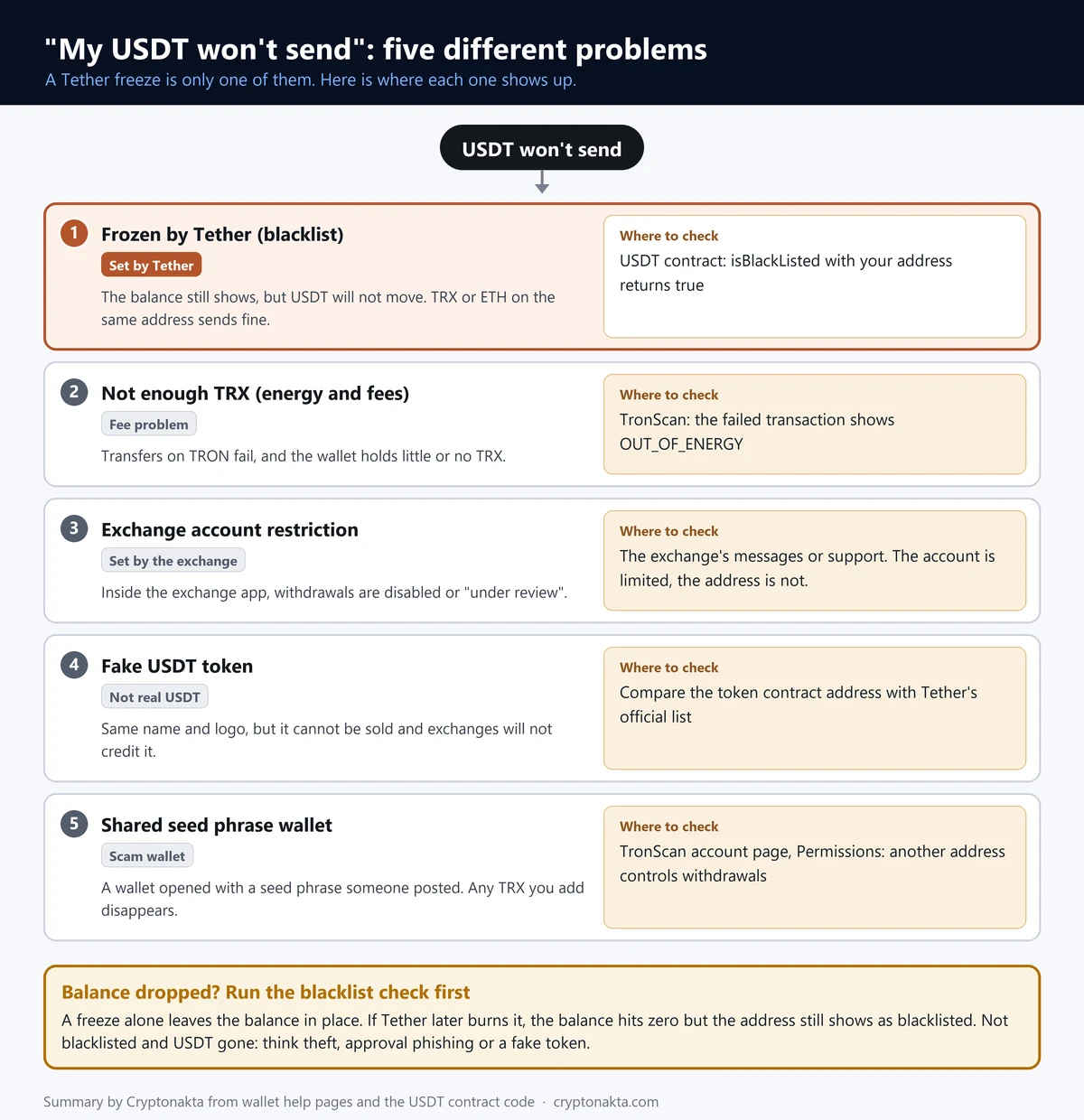
Most USDT that won’t send is not frozen by Tether. On TRON the usual cause is a missing fee. Other causes are an exchange limit, a fake token or a honeypot wallet. Each one shows up in a different place, so you can tell them apart in minutes.
 View full size ↗
| What it really is | What you see | Where to check | What to do next |
|---|---|---|---|
| Issuer freeze (Tether or Circle blacklist) | Balance shows, every USDT send fails, TRX or ETH on the same address still moves | Read Contract tab: isBlackListed = true, or the checker in this guide | Do not pay any “unfreeze” service. Write to Tether support with your transaction records |
| Not enough TRX for the fee (energy and bandwidth) | The transfer fails with OUT_OF_ENERGY, or the wallet asks for more TRX | The transaction result on Tronscan, the TRX balance on the same address | Add a little TRX for the fee and send again |
| Exchange account restriction | The withdraw button is greyed out, or a review notice shows inside the exchange app | Exchange messages and support tickets, not the blockchain | Follow the exchange review steps (separate guide) |
| Fake USDT token | A “USDT” balance that no one accepts and that has no market price | The token contract address against the official list on tether.to | Treat it as worthless and do not pay “fees” to release it |
| Honeypot wallet with a shared seed phrase | A stranger’s seed phrase opens a wallet full of USDT, but any TRX you add disappears | Account permissions on Tronscan (multi-signature owner) | Send nothing to it. It is built to take your TRX |
Freezing TRX in a wallet app is staking: you lock your own TRX to get energy. It has nothing to do with an issuer freeze.
A freeze alone leaves the balance in place. If it dropped and the blacklist check says not frozen, look at theft or a token approval.
Start with the fee. TRON transfers use energy, a network resource paid for in TRX. When the TRX runs short, the transfer fails with OUT_OF_ENERGY. Add a little TRX and retry, as Trust Wallet’s help page also says. Our TRON guide explains energy.
The word “freeze” muddles things too. Wallet apps let you freeze TRX to get energy, which is TRX staking. So “unfreeze TRX” in a wallet app means ending your own TRX staking, not a Tether release.
A greyed-out withdraw button on an exchange is the exchange’s call about your account. Our guide to a frozen exchange account covers it. A fake USDT token copies the name and logo but runs on a different contract. Compare its address with Tether’s official list.
A honeypot wallet is one whose seed phrase a scammer posts online on purpose. You import it and see USDT you can’t move, because another address controls it. Any TRX you add for fees is swept out. See our guide to an exposed seed phrase.
Wallet apps can’t freeze or unfreeze USDT. Trust Wallet says it “cannot remove or override a blacklist”. If the balance is gone and the address isn’t blacklisted, think theft, often through a token approval. Learn how to revoke token approvals.
I received USDT from a blacklisted address. Can my USDT be frozen too?
Receiving USDT from an address that is frozen now does not freeze your address automatically. The blacklist is set one address at a time, and coins carry no mark of where they came from.
A frozen address can’t send, so anything you got from it left before the freeze. Tether can still blacklist a receiver on purpose. When stolen money was split across many wallets, Tether has listed the receiving wallets together.
The more common snag is an exchange deposit. OKX tells users to switch deposit addresses when one is flagged as high risk. A deposit can also be locked for review. That’s the exchange’s own process. See our guide on a deposit that hasn’t arrived.
An AML risk score is a different thing from the blacklist. The score is an analysis company’s estimate, while the blacklist is a fact in the contract. People call coins with a bad history “dirty USDT”, but that isn’t a technical term.
If your bank froze your account after a P2P sale, that’s a separate problem. Our guide on a bank account frozen after a P2P sale covers it. The bigger risk runs the other way. Coins you send to a frozen address get stuck there, so check the receiving address before a large payment.
Can frozen USDT be unfrozen? How a Tether unfreeze request works
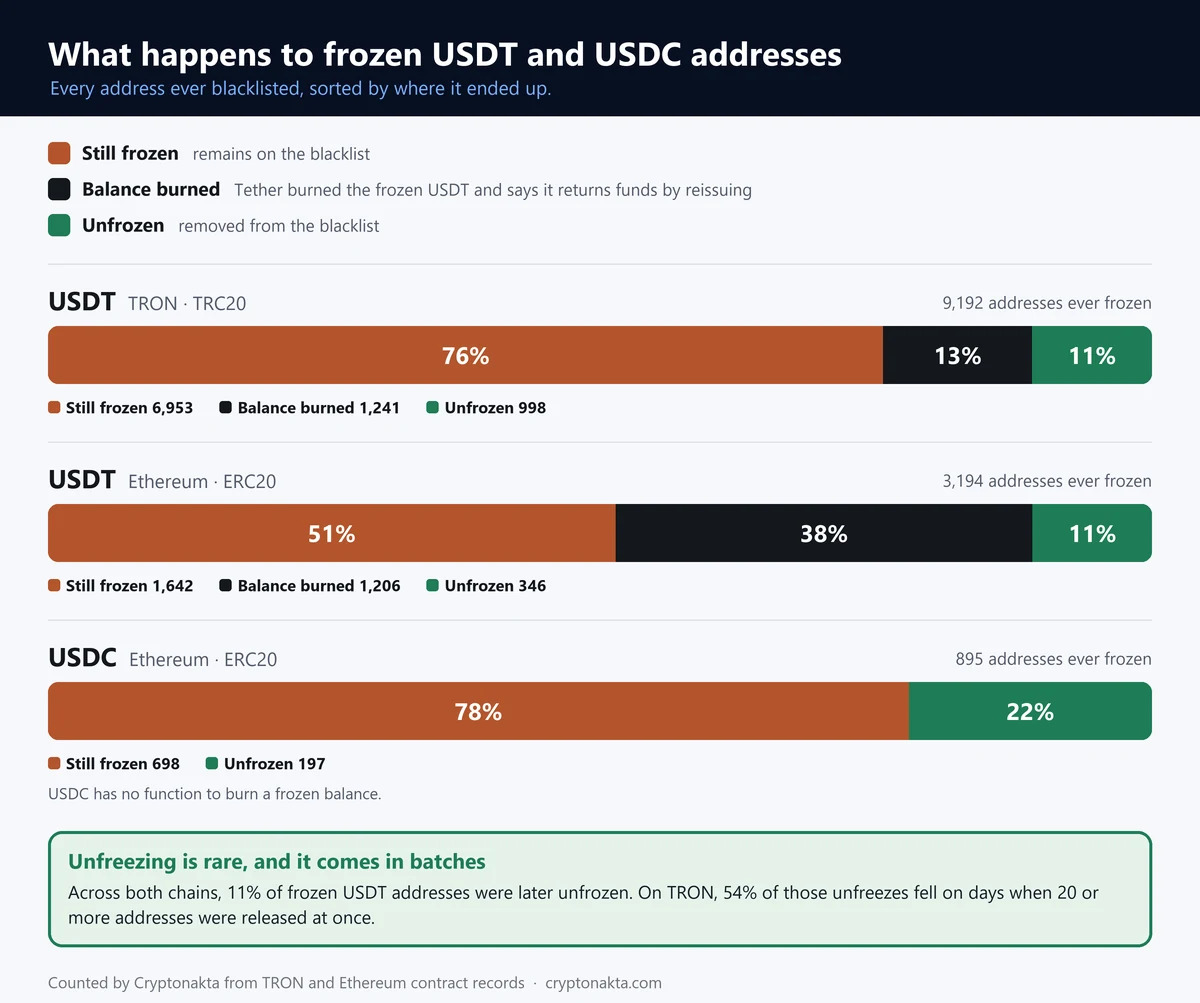
Frozen USDT can be unfrozen, but it rarely happens. Across TRON and Ethereum, 11% of all addresses ever frozen for USDT were later taken off the blacklist. A release goes through Tether, often with law enforcement involved, and there is no paid route to an unfreeze.
 View full size ↗
| Chain | Addresses unfrozen | Freeze to unfreeze | Unfrozen within a week | Share that came on busy days |
|---|---|---|---|---|
| TRON USDT (TRC-20) | 998 (11%) | median 49 days (half fall between 40 and 85) | 77 cases | 54% (days with 20 or more: 5) |
| Ethereum USDT (ERC-20) | 346 (11%) | median 381 days (half fall between 51 and 471) | 16 cases | 58% (days with 20 or more: 4) |
| Ethereum USDC | 197 (22%) | median 66 days (half fall between 18 and 862) | 47 cases | 72% (days with 20 or more: 3) |
Counted from each address’s first freeze to its unfreeze in the contract records. This is what happened before, not a promise for any address.
Unfreezes cluster on a few days. The records show the dates, not the reasons, so we do not guess them.
Unfreezes come in batches. On TRON, 54% of them landed on days when 20 or more addresses were released together. The biggest day freed 447 addresses. The records show dates, not reasons.
On TRON the median wait from freeze to release was 49 days. On Ethereum USDT it was 381 days. These are past records, not a promise for any address.
To unfreeze USDT on Trust Wallet or any other app, you go through Tether. The app itself can’t do it. Wallet companies point to Tether support at cs.tether.to. TokenPocket says to send the frozen address and transaction records, and you may be asked for ID or proof of funds. If the freeze is tied to an investigation, the agency on the case is involved too.
Keep the TxIDs that brought the USDT in, and note who paid you and why. Those are the records you’ll be asked for.
Can USDT be seized? How Tether burns and reissues frozen USDT
Yes, in effect. Tether can wipe the balance of a frozen address with a function called destroyBlackFunds, which burns the frozen USDT. Tether says it has returned stolen funds to their owners and to law enforcement by issuing new USDT.
The function works only on a blacklisted address. It zeroes the balance and cuts the total supply. There’s no public step-by-step process for the reissue, and it isn’t something you can apply for.
| Chain | Addresses ever frozen | Still frozen, not burned | Balance burned | Unfrozen |
|---|---|---|---|---|
| TRON USDT (TRC-20) | 9,192 | 6,953 (76%) | 1,241 (13%) | 998 (11%) |
| Ethereum USDT (ERC-20) | 3,194 | 1,642 (51%) | 1,206 (38%) | 346 (11%) |
| Ethereum USDC | 895 | 698 (78%) | 0 (no way to burn a frozen balance) | 197 (22%) |
Counted by address, last known state. Burned addresses mostly stay on the blacklist, so we count them separately.
Only the contract records on TRON and Ethereum. Tether’s own totals are its own tally over a range it does not break down, so the two do not match.
On TRON, 1,241 of 9,192 frozen addresses had their balance burned. On Ethereum it was 1,206 of 3,194. 277 TRON burns and 555 Ethereum burns came within a day of the freeze. The median wait was 151 days on TRON and 45 days on Ethereum.
Burned balances total $1.48 billion across both chains. That isn’t the amount victims got back, since some reissued USDT goes to law enforcement. USDC has no burn function at all.
Paying someone to unfreeze USDT is a scam
Anyone who offers to unfreeze USDT for a fee is running a scam. Only the owner address that Tether controls can change the USDT blacklist. Wallet companies can’t do it, and no outside service has that access.
The pitch follows a script. A “recovery agent” or a fake Tether support account finds you after you post about a frozen wallet. They ask for an unfreeze fee, then for more. Fake USDT tokens with a “release fee” and honeypot wallets work the same way.
We found no official way for a victim to apply to Tether directly. The published routes run through courts and law enforcement. So report it to the police first and keep every TxID. Then read whether scammed crypto can be recovered and our list of crypto scams.
Can Circle freeze USDC like Tether freezes USDT?
Yes, Circle can freeze USDC, and a frozen USDC address can’t send or receive. Circle’s published policy says it blocks an address only in three kinds of cases. When it does, the block applies on every blockchain where USDC is issued.
Circle’s policy starts from no. It “will not deny access to individual addresses” outside those cases. The three are a security breach such as leaked minting keys, a law or court order, and an urgent law enforcement request. Circle can lift the block once the authority confirms the order no longer applies.
The USDC terms for Circle account holders are wider and say “in its sole discretion”. Those cover accounts, while the policy covers addresses.
| What the rules say | USDT (Tether) | USDC (Circle) |
|---|---|---|
| Rule document | Tether terms of service (A) | Circle stablecoin access denial policy (A) |
| When they freeze | Legal orders, law enforcement requests, stolen funds, addresses on sanctions lists, Tether’s own monitoring (A) | Only three exceptions: a security breach, a law or court order, an urgent law enforcement request (A) |
| Can a frozen address receive? | Yes, and what arrives is stuck too (A, our dry run) | No, it cannot receive or send (A, our dry run) |
| Burn and reissue | Can burn the frozen balance (destroyBlackFunds); Tether says it returns funds by issuing new USDT (A) | No function to burn a frozen balance (A) |
| How a freeze is lifted | Through law enforcement and Tether support (A) | When the authority confirms the order no longer applies (A) |
| Which chains | Set separately on each chain (B) | Every chain where USDC is issued (A) |
| Will they tell you? | The terms allow reporting without telling you; no promise of advance notice (A) | No notice rule found in the policy (C) |
USDT rules come from Tether’s terms; USDC rules come from Circle’s published policy. The two documents are written very differently.
Evidence: A = official document or verified code we read. B = reports, wallet help pages, analyses. C = not found. M = our own measurement.
Far fewer USDC addresses get frozen. We found 895 on Ethereum against 3,194 for USDT on the same chain. Of those USDC addresses, 22% were later released. Fewer freezes doesn’t mean USDC can’t be frozen. Our USDT vs USDC comparison covers the rest.
Can USDT on TRON or ERC-20 be frozen?
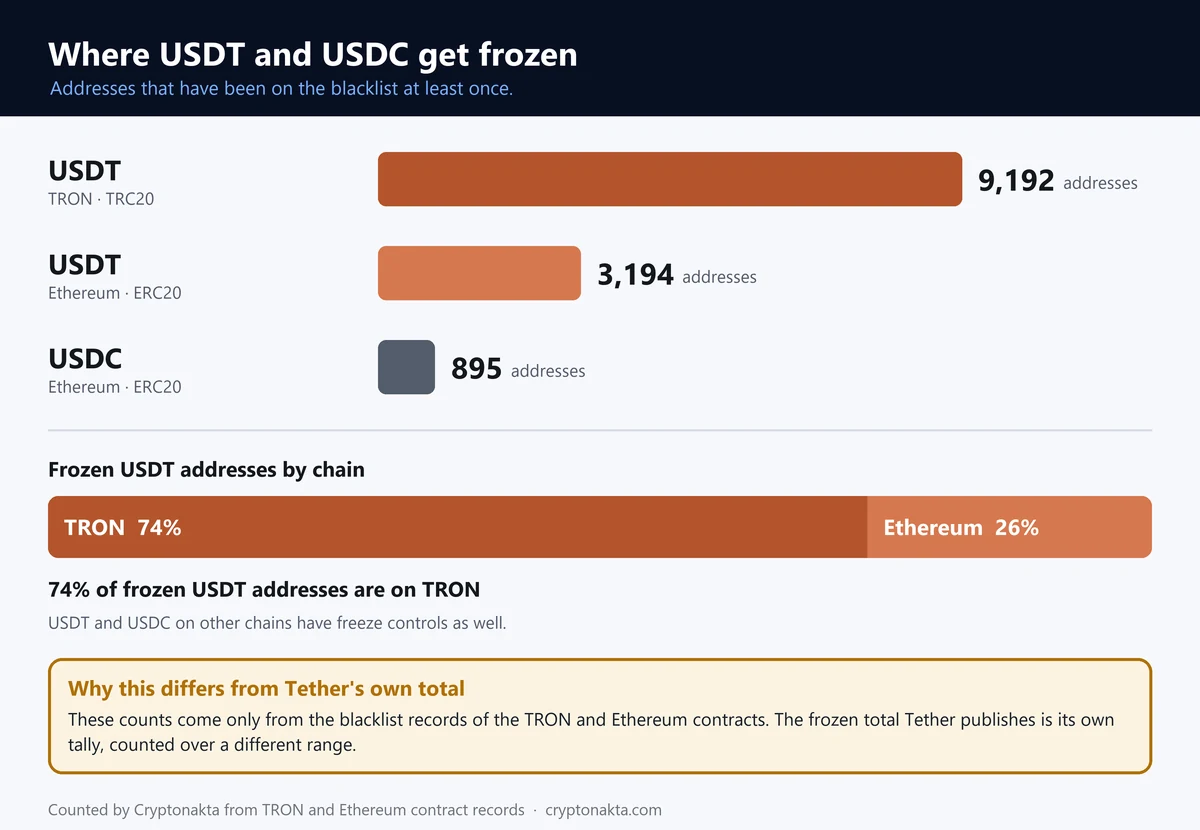
Yes, USDT can be frozen on TRON (TRC-20) and on Ethereum (ERC-20), and the TRON list is much longer. Of all USDT addresses frozen at least once on these two chains, 74% are on TRON. Moving to another chain doesn’t take USDT out of the issuer’s reach.
 View full size ↗
| Chain | Addresses ever frozen | Frozen now | Share of frozen USDT addresses | Freeze tool in the contract |
|---|---|---|---|---|
| TRON USDT (TRC-20) | 9,192 | 8,207 | 74% | addBlackList · destroyBlackFunds (A) |
| Ethereum USDT (ERC-20) | 3,194 | 2,851 | 26% | addBlackList · destroyBlackFunds (A) |
| Ethereum USDC | 895 | 698 | separate token | blacklist · unBlacklist (A) |
| Solana USDT and USDC | not counted | not counted | not counted | Freeze authority on the token mint (B) |
| TON USDT | not counted | not counted | not counted | Admin controls in the token contract (A/B) |
Moving USDT to another chain does not take it out of the issuer’s reach. The Solana and TON versions have their own freeze tools.
A freeze on TRON does not freeze the same owner’s Ethereum address by itself. Each contract keeps its own list.
We counted TRON and Ethereum only.
On TRON, 9,192 addresses have been frozen at least once. On Ethereum the count is 3,194. We counted where freezes happen. We didn’t measure why TRON leads.
Each contract keeps its own list, so a TRON freeze doesn’t touch your Ethereum address. Other chains have controls too. Solana USDT and USDC have a freeze authority, which Solana’s token docs say can make an account unusable. TON USDT has admin controls. Our ERC-20 vs TRC-20 guide compares TRON and Ethereum.
My take on frozen USDT, and what I’d check first
Check the other address before any large USDT payment, whichever way the money moves. Counting the freezes ourselves is what convinced me that this one-second step matters more than which wallet or chain you pick.
A frozen USDT address still takes incoming coins, so a careless payment can get stuck for good. Only about one frozen address in ten was ever released, and about half of those releases fell on a handful of days. And three out of four frozen USDT addresses are on TRON, where many people send USDT.
When USDT won’t send, I’d check the fee and network first. Next come the exchange and the token contract. Only after that would I run the blacklist check. If it says true, I’d collect the TxIDs and write to Tether support. I’d also ignore anyone selling a shortcut.
What I trust least are the confident claims. “Pay a fee and we’ll unfreeze it” is false. “A clean AML score means it can’t be frozen” mixes up two different things. “Move it to Solana and nobody can freeze it” is wrong too.
There’s a fair point on the other side. Many people dislike that an issuer can freeze coins in a self-custody wallet at all. Others note that the same tool has returned stolen money to victims. You can weigh that yourself.
If you need USDT, I’d rather buy it on an exchange than from a stranger in a P2P or OTC deal. Exchange USDT is the same token and can be frozen like any other, but you know who you got it from. And before you accept a large amount from anyone, check their address. Our guide on how to buy USDT covers the steps.
One disclosure. We use exchange referral codes, and if you sign up with ours we earn a commission. On Binance, our code also returns 10% of the spot trading fees you pay, paid in USDC.
Binance

Affiliate disclosure: some links are partner links. We may earn a commission at no extra cost to you. This is not investment advice.
CRYPTONAKTA
What we counted on the TRON and Ethereum blacklists
We pulled every blacklist event from the TRON USDT, Ethereum USDT and Ethereum USDC contracts ourselves. Across TRON and Ethereum, 12,386 addresses have been frozen for USDT at least once. The collection ran on November 8, 2026, 04:42 UTC.
| What we counted | TRON USDT | Ethereum USDT | Ethereum USDC |
|---|---|---|---|
| First and last freeze in the records | June 26, 2020 ~ November 7, 2026 | November 28, 2017 ~ November 6, 2026 | June 16, 2020 ~ November 6, 2026 |
| Freeze events | 9,231 | 3,207 | 949 |
| Unfreeze events | 999 | 347 | 227 |
| Burn events | 1,285 | 1,300 | 0 |
| Amount burned | $618.5 million | $861.6 million | $0 |
| Burned within a day of the freeze | 277 cases · $16.8 million | 555 cases · $73.2 million | 0 cases |
| Busiest freeze day | July 12, 2025 · 790 cases | December 9, 2023 · 161 cases | July 1, 2026 · 131 cases |
| Balance left on addresses frozen now | $3.86 billion | $2.33 billion | $955 million |
| Frozen addresses that still hold a balance | 5,277 / 8,207 | 1,461 / 2,851 | 178 / 698 |
| Frozen addresses holding $1 million or more | 580 | 192 | 25 |
| New freezes in 2017 | — | 1 | — |
| New freezes in 2018 | — | 8 | — |
| New freezes in 2019 | — | 7 | — |
| New freezes in 2020 | 14 | 231 | 1 |
| New freezes in 2021 | 24 | 312 | 24 |
| New freezes in 2022 | 315 | 250 | 126 |
| New freezes in 2023 | 275 | 440 | 60 |
| New freezes in 2024 | 1,225 | 755 | 54 |
| New freezes in 2025 | 3,509 | 657 | 215 |
| New freezes in 2026 | 3,869 | 546 | 469 |
Collected November 8, 2026, 04:42 UTC from public contract event logs with no API key: every blacklist event on these three contracts.
Balances checked November 8, 2026, 04:43 UTC.
2026 counts only up to the collection day.
Tether’s own running total is its own tally over a different range, so the two cannot be compared.
The data came from public endpoints that need no API key, the TronGrid event API and Blockscout logs. We counted every freeze, unfreeze and burn event. The dry run of transfers ran on November 8, 2026, 05:02 UTC.
We also read the balance of every address still frozen, on November 8, 2026, 04:43 UTC. Frozen TRON addresses hold $3.86 billion in USDT. Frozen Ethereum addresses hold $2.33 billion in USDT and $955 million in USDC.
Those totals are lopsided, so they don’t show a normal level. 59% of the frozen Ethereum USDT balance sits on addresses first frozen on October 29, 2026. For USDC the share from that day is 87%. Those addresses were frozen right after the exchange hack below. On TRON the biggest single day holds 10%, so the balance is spread out.
We didn’t count Solana or TON, and freezes inside exchange accounts never show up on-chain. We couldn’t read the TRON contract’s source, so we relied on its function list and the dry run. Tether’s support form didn’t open for us.
Tether keeps its own total. In an announcement on November 2, 2026, it said it had frozen more than 7 billion USD₮ in secondary-market addresses. It said about 1.2 billion USD₮ had been returned, partly through reissuance. Our numbers come only from the TRON and Ethereum contract records, so they cover a different range than Tether’s total.
Bitquery’s blacklist audit runs through August 2026 and makes a good cross-check. It found 1,303 unfreezes and about $1.43 billion burned. We counted 1,344 unfreezes and $1.48 billion burned. Ours are a little higher and cover a few more months.
In late October 2026, right after a large hack at Binance, Tether said it froze more than $1.5 billion in USDT. Reports give different totals, up to about $1.77 billion, so we don’t pick one. Our Binance hack guide covers what happened to withdrawals.
The earliest Ethereum USDT freeze in the records is from November 28, 2017. The first TRON freeze is from June 26, 2020. Tether extended sanctions-list freezes to self-custody addresses in December 2023, and the T3 unit started in August 2024. The biggest single unfreeze day on TRON was May 14, 2026. The terms we quote were last updated on February 26, 2026.
Frozen USDT questions people ask
- Tether · Terms of Sale and Service · checked 2026-11-08
- Tether · Supported protocols (official contract addresses) · checked 2026-11-08
- Tether · Customer support · checked 2026-11-08
- Tether announcement (2023-12) · wallet freezing policy for the secondary market · checked 2026-11-08
- Tether announcement (2023-11-20) · voluntary freeze of stolen USDT · checked 2026-11-08
- Tether · how and why Tether freezes (2024-09-18) · checked 2026-11-08
- Tether · T3 Financial Crime Unit (2025-01-02) · checked 2026-11-08
- Tether announcement (2026-11-02) · checked 2026-11-08
- Circle · Stablecoin Access Denial Policy (PDF) · checked 2026-11-08
- Circle · USDC Terms · checked 2026-11-08
- Circle stablecoin-evm source · FiatTokenV1.sol · checked 2026-11-08
- Blockscout · Ethereum USDT verified contract · checked 2026-11-08
- Tronscan API · TRON USDT contract functions · checked 2026-11-08
- Solana Program Library · Token program (freeze authority) · checked 2026-11-08
- TON docs · USDT processing · checked 2026-11-08
- Trust Wallet Help · Why can’t I transfer USDT on TRON · checked 2026-11-08
- TokenPocket Help · USDT on TRON · checked 2026-11-08
- OKX Help · Deposits (high-risk deposit address) · checked 2026-11-08
- OKX Help · Why is my deposit locked · checked 2026-11-08
- Bitquery · Tether blacklist audit (analysis) · checked 2026-11-08
Not investment or legal advice. Explorer and wallet screens change, so check the official page before you act.
Next: what to do when an exchange freezes your account or withdrawals