How to Read an Order Book: Depth, Spread and Slippage Explained

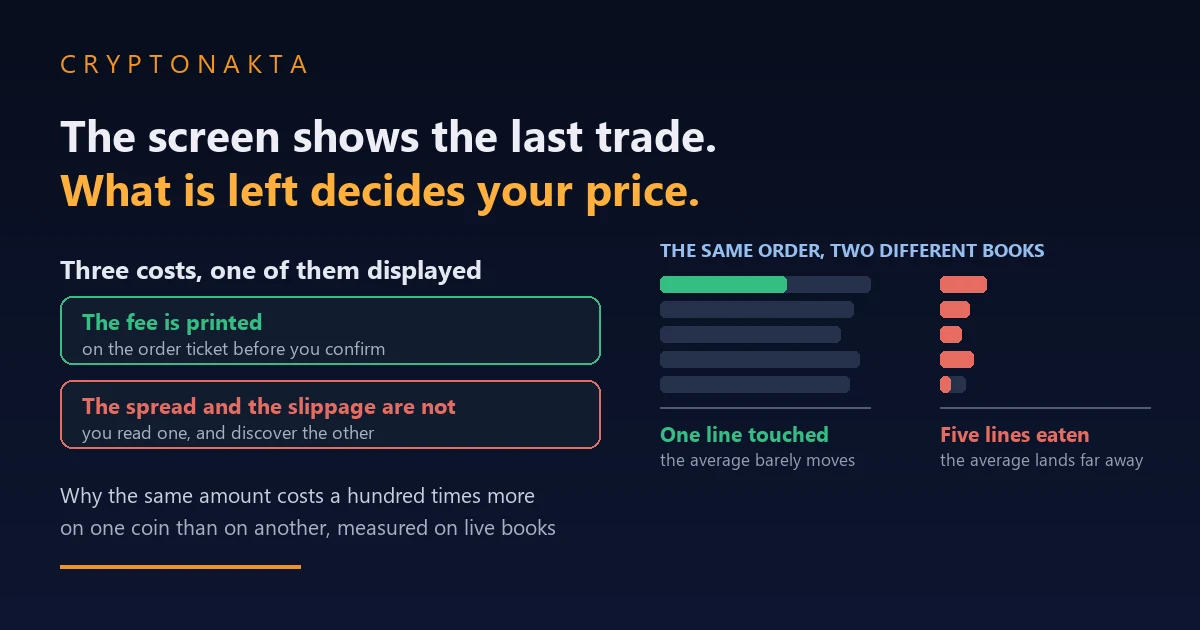
Cover image for a guide to order books, market depth and slippage on crypto exchanges. On the right two miniature order books stand side by side under the heading that the same order meets two different books: in the first, thick bars of resting quantity mean only one line is touched and the average price barely moves, while in the second, thin bars mean five lines are eaten and the average lands far away. On the left two cards separate the three costs of a trade, noting that the fee is printed on the order ticket before the trade is confirmed while the spread and the slippage are not, one being read off the book and the other discovered afterwards. The headline reads that the screen shows the last completed trade and that what is left resting decides the price a buyer actually gets, with lines below explaining that the article shows why the same amount of money can cost a hundred times more on one coin than on another, measured on live order books - Cryptonakta

How to Read an Order Book: Depth, Spread and Slippage Explained We read public order books line by line and added up the sell orders from the cheapest price upward. The coin decided the difference. Order book measurements taken 2 September 2026, 04:44 to 04:46 UTC The short version What people ask The short answer … Read more
You set a stop loss, it triggered, and nothing was sold

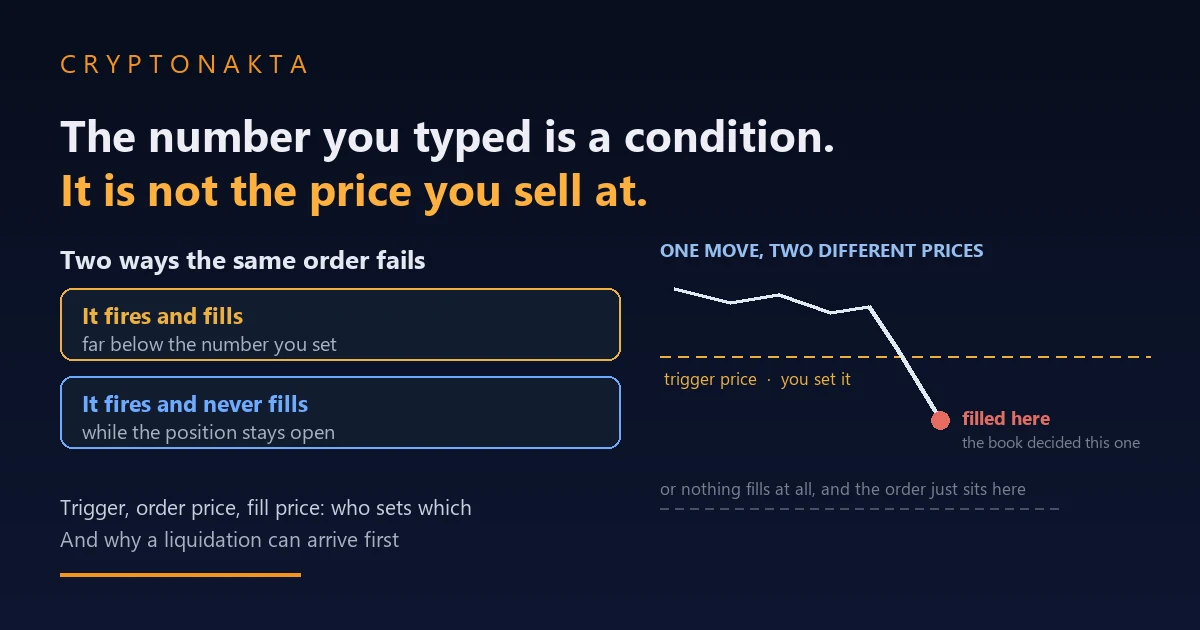
Cover image for a guide to stop loss orders on crypto exchanges. On the right a price line falls through a dashed horizontal line labelled as the trigger price that the trader sets, and a marked point well below it is labelled as the place the order was actually filled, with a note that the order book decided that second price. A further dashed line underneath carries the caption that in the other case nothing filled at all and the order is still sitting there. On the left two cards describe the two ways the same order fails, firing and filling far below the number that was set, or firing and never filling while the position stays open. The headline reads that the number typed into a stop order is a condition and not the price at which anything is sold, with lines below introducing the trigger price, the order price and the fill price and who decides each, and noting that a liquidation can arrive before the stop does - Cryptonakta

You set a stop loss, it triggered, and nothing was sold The number you type into a stop order is a condition for sending an order. The price you receive is decided somewhere else. Updated August 2026 The short version The question people arrive with What actually decides it Did my stop fire? The reference … Read more

Cross vs Isolated Margin: Which Is Better, Liquidation Rules, Switching Modes on Binance

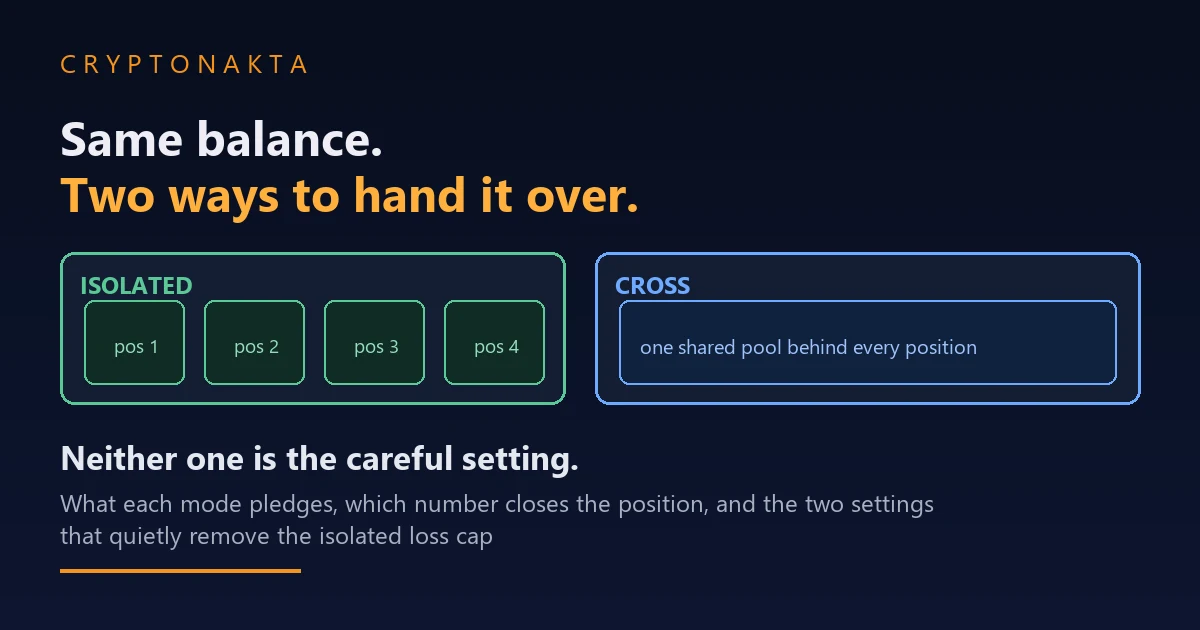
Cover image for a guide to isolated and cross margin on crypto derivatives. The same balance is drawn twice: on the left an isolated panel splits it into four separate compartments, one per position, and on the right a cross panel shows a single shared pool standing behind every position. The headline reads that the balance is the same and there are two ways to hand it over, with a line stating that neither one is the careful setting, and a subtitle promising what each mode pledges, which number closes the position, and the two settings that quietly remove the isolated loss cap - Cryptonakta

Cross vs Isolated Margin: Which Is Better, Liquidation Rules, Switching Modes on Binance Isolated and cross margin decide which balance stands behind a position, which number the engine watches, and how far the damage is allowed to reach. Neither one is the careful setting. Plain-English guide to margin modes on crypto derivatives The short version … Read more

Your Stop Order Triggered, Sold Nothing, and Worked Exactly as Designed

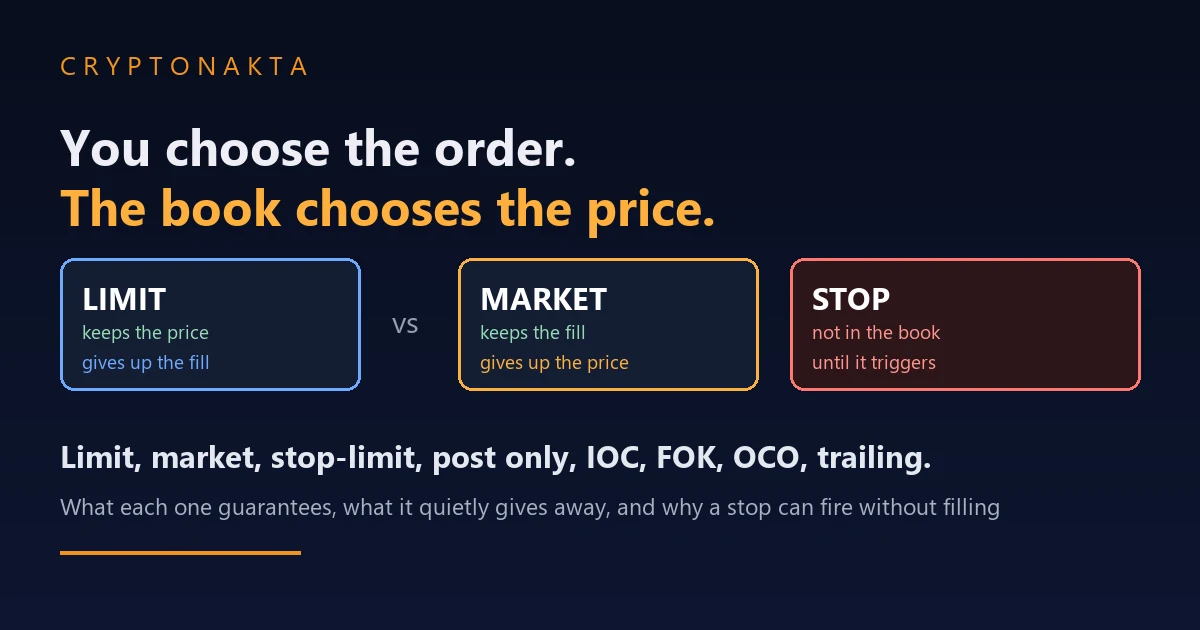
Cover image for a guide to crypto exchange order types. A limit box marked as keeping the price and giving up the fill sits beside a market box marked as keeping the fill and giving up the price, with a third box explaining that a stop order is not in the book until it triggers, under the line that you choose the order and the book chooses the price, and a subtitle listing limit, market, stop-limit, post only, immediate-or-cancel, fill-or-kill, OCO and trailing orders - Cryptonakta

Your Stop Order Triggered, Sold Nothing, and Worked Exactly as Designed Limit, market, stop-limit, post only, IOC, FOK, OCO and trailing: what each one guarantees, what it quietly gives away, and why the book decides the price no matter which you press. Plain-English guide to exchange order types The short version Six sentences that people … Read more

A 0.01% Funding Rate Can Take 0.6% of Your Margin Every Single Day

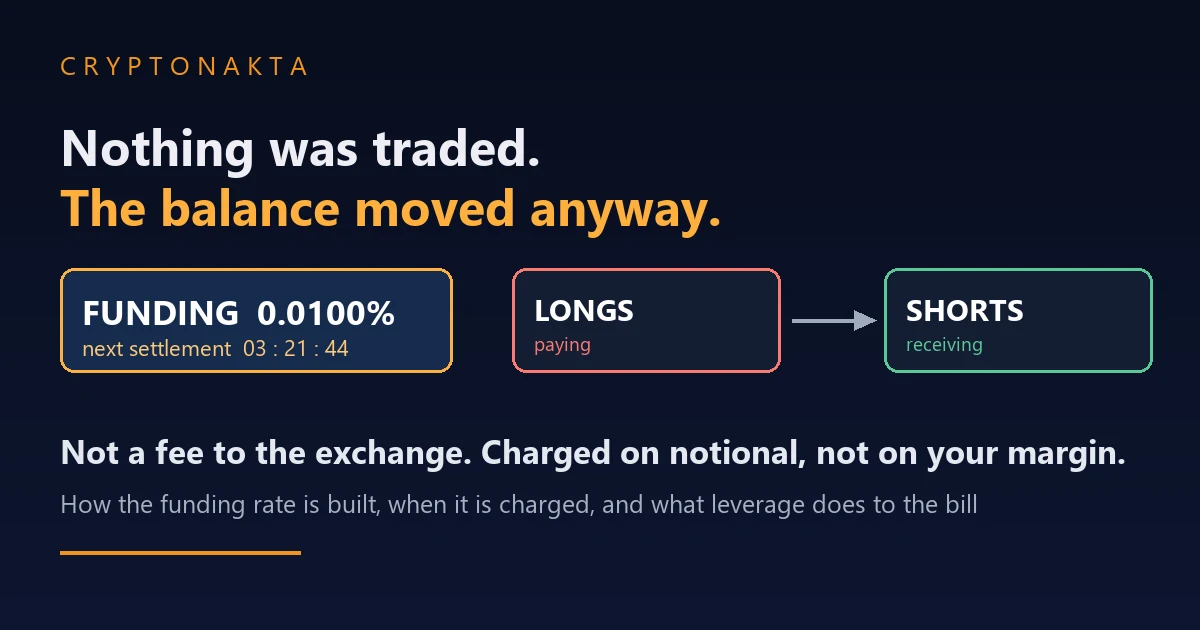
Cover image for a guide to perpetual futures funding rates. A funding rate chip reading 0.0100 percent sits beside a countdown to the next settlement, with an arrow running from a longs box marked paying to a shorts box marked receiving, under the line that nothing was traded and the balance moved anyway, and a subtitle explaining that funding is not a fee to the exchange and is charged on notional rather than on margin - Cryptonakta

A 0.01% Funding Rate Can Take 0.6% of Your Margin Every Single Day Who receives the payment, why the snapshot rule ignores how long you held, and what leverage does to a rate with two leading zeros. Plain-English guide to perpetual funding The short version Funding is the one cost of a leveraged position that … Read more

Your Liquidation Price Was Never the Trigger. The Margin Ratio Is.

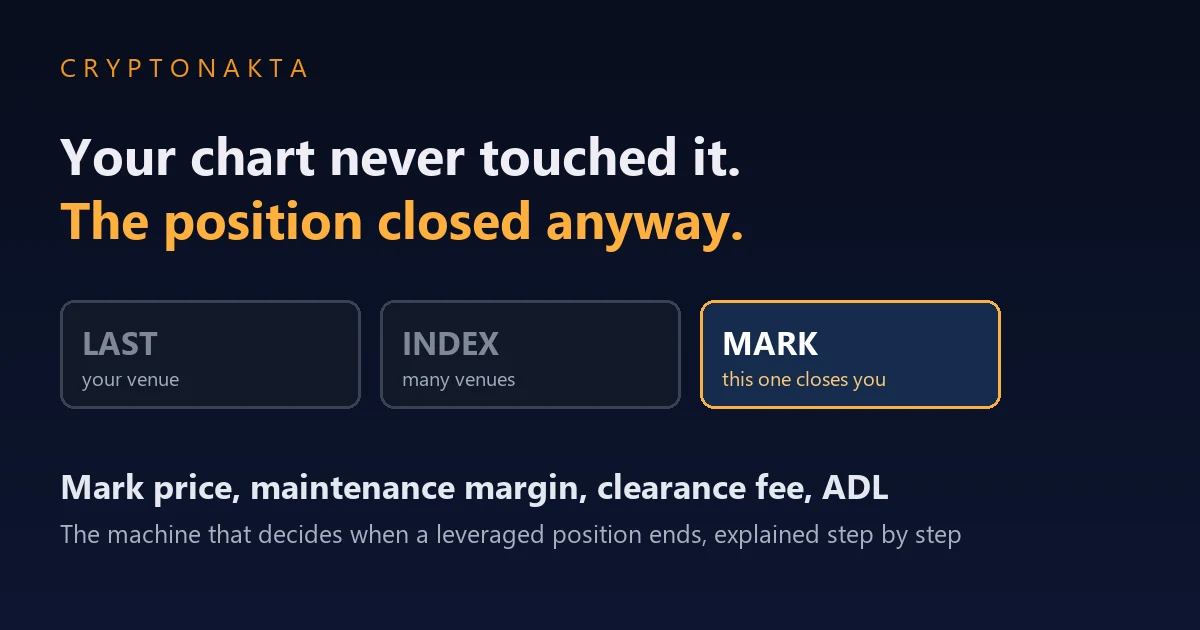
Crypto futures liquidation explained. Three price chips labelled last price on your own venue, index price across many venues, and mark price highlighted as the one that closes the position, under the line that your chart never touched it and the position closed anyway - Cryptonakta

Your Liquidation Price Was Never the Trigger. The Margin Ratio Is. Mark price, maintenance margin tiers, the clearance fee, and the two steps past the point where your decisions stop mattering. Plain-English guide to how forced closes work The short version Three separate numbers decide when a leveraged position ends, and none of them is … Read more

Editorial standardsIndependent crypto editorial · honest, no hype · not investment advice.
🌐 English