Not the gap you see: crypto arbitrage, exchange price differences, spread, fees
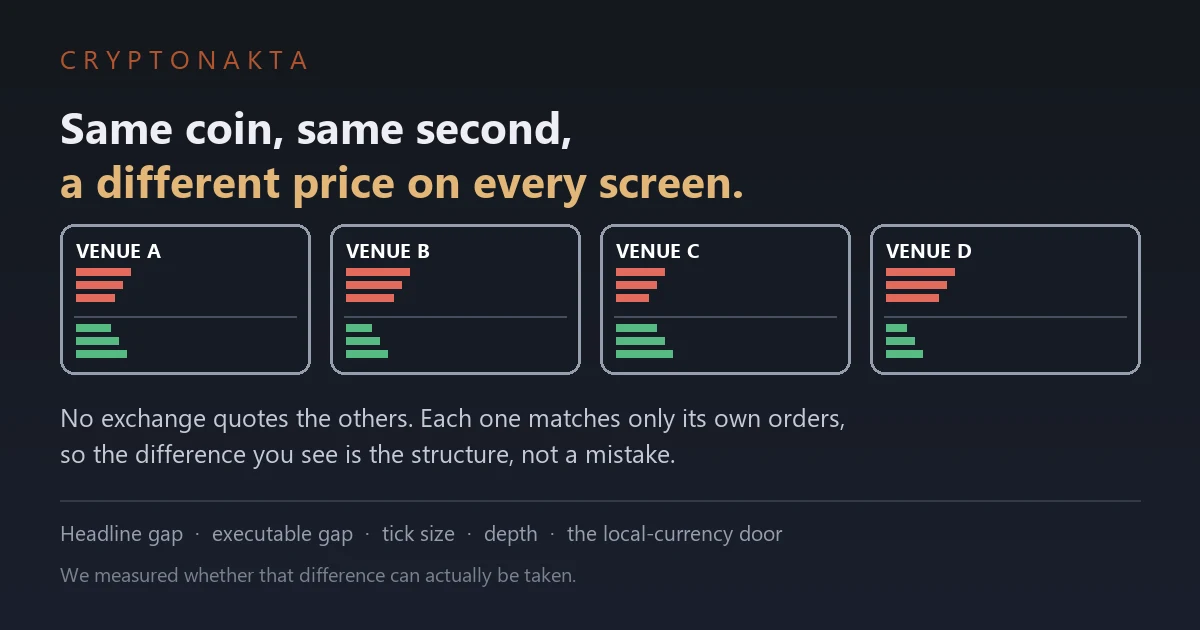
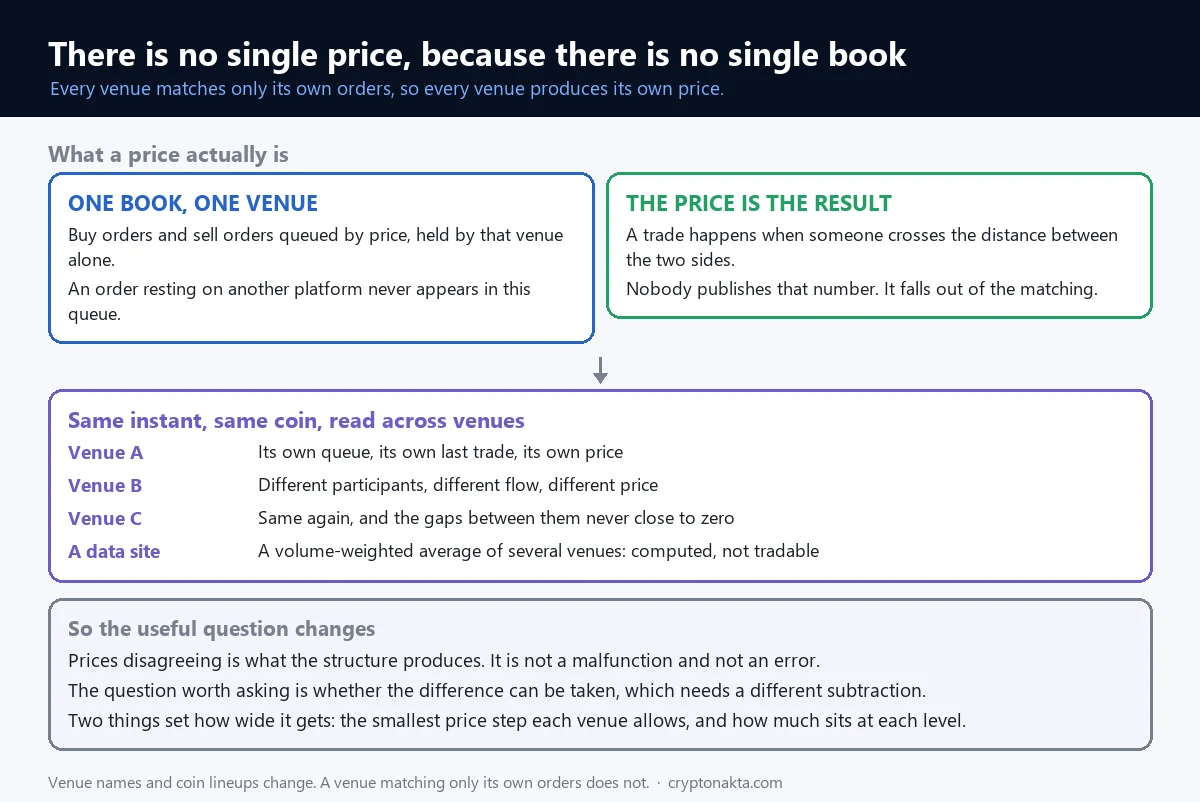
There is no official quote, so each venue makes its own price in its own book. The gap on a comparison screen and the gap you can execute are two different numbers.
| Question | Short answer |
|---|---|
| Why does every exchange show a different price? | There is no official quote. Each exchange runs its own order book and the price is made inside it. |
| Can that difference be taken? | The gap you see and the gap you can execute are two different numbers. Measured with the buy price and the sell price, it mostly disappears. |
| How big is it? | On the large coins, a few ten-thousandths. Round-trip trading fees are an order of magnitude bigger. |
| Then where does the difference come from? | The smallest price step differs by exchange, and so does the quantity stacked at each level. |
| Where is the gap actually large? | When you pay in local currency. And there the premium is not on the coin. |
| Which exchange is cheapest? | It changes every few minutes. So this article names no winner and shows you how to measure instead. |
1. The same coin with two different prices
2. What that number on your screen actually is
3. The gap measured the way it would be traded
4. The smallest price step is not the same everywhere
5. Size changes the price and flips the ranking
6. The cheapest venue changes every few minutes
7. What it costs to take a gap
8. How far the price moves while the transfer is in flight
9. Where the gap is large: paying in local currency
10. The premium is on the dollar, not on the coin
11. When you buy from a board of ads
12. How to measure it yourself
13. How I read a price now
You open two apps, look at the same coin, and the prices do not match. Look a little longer and the next question is whether that difference can be taken.
We pulled the bid and ask from six exchanges and measured the gap two ways. One is the number a comparison screen shows. The other is what is left when you use the price you actually pay and the price you actually receive. Then we take the cost apart, item by item. At the end we measure the one place where the gap really is large, which is when you pay in local currency.
1. The same coin with two different prices
You open two apps, look at the same coin, and the prices do not match. You refresh and they still do not match.
Neither one is wrong. There is simply no number they are supposed to match.
Five terms first
An order book is the list of buy and sell orders sorted by price. Every exchange runs its own. Orders placed on another venue never appear in it.
The best bid is the highest price someone is willing to pay right now. If you sell this second, that is what you get.
The best ask is the lowest price someone is willing to sell at right now. If you buy this second, that is what you pay.
The spread is the distance between those two. Buy and immediately sell back and you lose that distance even if the market does not move at all.
The last traded price is the value of the trade that just closed. It is the big number on a quote screen. It is not what you can pay now, it is what somebody paid a moment ago.
One unit shows up throughout this article: bps, or basis points. One bps is 0.01%. The differences are small enough that writing them as percentages fills the line with zeros.
What “no official price” actually means
A share trades on one exchange. Every order goes to the same place, so a single price comes out the other side.
Crypto does not work that way. The same coin trades on dozens of venues at once. Each one matches only its own orders, and the price is whatever comes out of that matching.
Disagreement is the normal state
We read six exchanges at the same instant, over and over. All eight coins we tracked returned six different prices. Not once did they all agree.
The interesting part is not that a difference exists. That follows directly from the structure. The question worth asking is whether that difference can be taken, and that is what this article measures.
2. What that number on your screen actually is
There are screens that put several exchange prices side by side. The differences there look substantial. On some coins they look enormous.
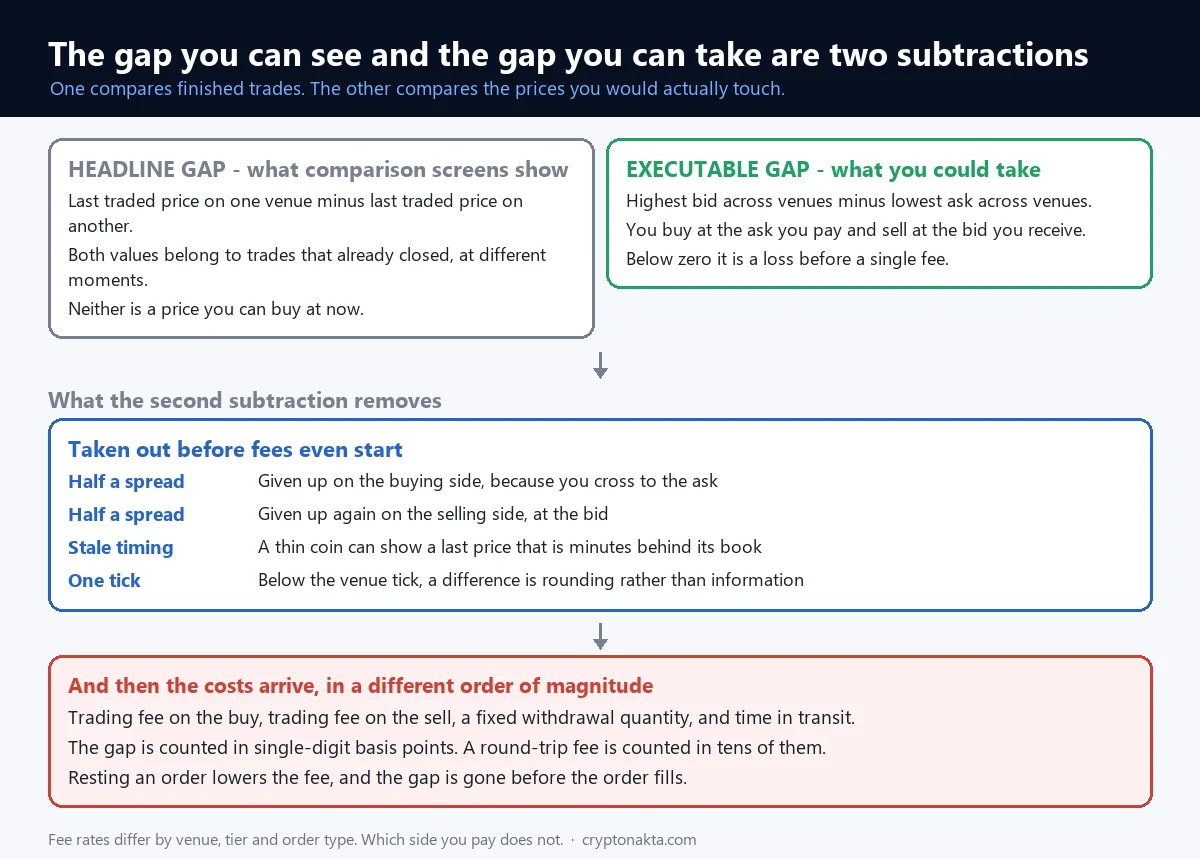
That number is almost always the last traded price. And you cannot buy at it.
The last price already happened
It belongs to a trade that has closed. With that trade, the order sitting at that level left the book.
If the coin trades thinly, that price may be minutes old. On screen it looks like a current figure. Underneath it is stale.
It also matters which side the trade closed on. If someone bought by hitting the ask, that number sits on the expensive side. If someone sold by hitting the bid, it sits on the cheap side. Two identical markets can display different numbers for that reason alone.
Why those screens use that particular number
Every exchange publishes its data a little differently. The one figure they all hand over in the same shape, and that weighs almost nothing, is the last traded price.
Pulling a full order book means a different request format at each venue and far more data. Anyone refreshing thousands of coins across dozens of exchanges takes the light path.
So the number is not wrong. It measures something else. It answers where and at what price the last trade closed, not what you would pay.
The subtraction that does work
You buy on the cheap venue. Buying, you pay that venue’s best ask. You sell on the expensive one. Selling, you receive that venue’s best bid.
So the gap that can be taken is:
highest best bid − lowest best ask
That number has to be greater than zero for the gap to exist at all. Fees come after. If it comes out negative, you are behind before paying a cent in fees.
Two names for two calculations
This article calls the first one the headline gap and the second the executable gap. One is what comparison screens show. The other is what you could actually take.
How far apart those two numbers are is half of this article. The other half is everything you would have to pay. If you want the mechanics of how each order type enters a book first, that is in market orders and limit orders.
3. The gap measured the way it would be traded
We read the best bid and the best ask of six exchanges at the same instant, repeating on a fixed interval. From that we calculated the gap both ways.
| Coin | Headline gap median | Headline gap max | Executable gap median | Executable gap max | Rounds above round-trip fee |
|---|---|---|---|---|---|
| BTC | 1.34 | 4.03 | 1.33 | 4.01 | 0% |
| ETH | 1.35 | 5.71 | 1.31 | 5.66 | 0% |
| SOL | 2.01 | 13.08 | 1.00 | 12.07 | 0% |
| XRP | 2.19 | 8.10 | 1.54 | 7.68 | 0% |
| DOGE | 2.47 | 6.17 | 1.23 | 4.93 | 0% |
| ADA | 2.55 | 7.89 | -1.02 | 4.61 | 0% |
| TRX | 2.98 | 5.96 | 1.49 | 3.87 | 0% |
| LINK | 2.70 | 17.51 | 1.71 | 15.27 | 0% |
Unit is bps. One bps is 0.01%. Measured 2026-09-17 04:44 UTC · 6 exchanges · 96 rounds over 97 minutes
Compare the first two columns with the middle two
The executable gap is smaller than the headline gap. Depending on the coin it falls to half or less.
The reason is direct. The headline gap subtracts the midpoints of two venues. The executable gap subtracts from the side you actually pay and the side you actually receive. You hand over half a spread at each end before you have done anything.
Some coins come out negative
A negative executable gap means buying on the cheapest venue and selling instantly on the dearest one still loses money.
It loses with no fee paid, nothing transferred and no time elapsed. And it happens on coins whose headline gap looked respectable.
The last column is the conclusion of the table
We assumed a round-trip trading fee of 0.2%, meaning 0.1% to buy and 0.1% to sell. That is an assumption. Real rates depend on the venue, the account tier and the order type.
Under that assumption we counted the rounds where the executable gap cleared the fee. Across every round we collected, on all eight coins, it never did.
The orders of magnitude explain why. The gap is counted in single-digit bps. The round-trip fee is counted in tens. The gap would need to multiply by a hundred to reach it.
Fees can be reduced, and it still does not close
They can. Resting an order in the book costs less than crossing into what is already posted, and tiers lower it further.
But while an order rests, the gap has already changed. Compare the median and the maximum in the same row and you can see how quickly that number moves.
4. The smallest price step is not the same everywhere
If almost nothing survives, why are the prices not identical in the first place? There is a mechanical reason that comes before any explanation about markets.
An exchange cannot write any number it likes. There is a smallest price step, and that step is not the same everywhere.
What the tick is
When you place an order, the available prices are fixed in advance. One venue accepts steps of 0.01 on a coin where another accepts 0.0001.
Each exchange sets this, and sets it coin by coin. The usual pattern is a coarse step on high-priced coins and a fine one on low-priced coins.
What matters is dividing that step by the price of the coin. Only then does it become a proportion you can compare against the gap.
| Coin | Coarsest tick | Finest tick | Largest headline gap observed |
|---|---|---|---|
| BTC | 0.01 | 0.00 | 4.03 |
| ETH | 0.04 | 0.04 | 5.71 |
| SOL | 1.00 | 1.00 | 13.08 |
| XRP | 0.77 | 0.08 | 8.10 |
| DOGE | 1.24 | 1.24 | 6.17 |
| ADA | 5.09 | 0.51 | 7.89 |
| TRX | 2.98 | 0.30 | 5.96 |
| LINK | 0.90 | 0.09 | 17.51 |
Tick sizes read from the public instrument data of the six exchanges, then divided by each coin’s price. Measured 2026-09-17 04:44 UTC · 6 exchanges · 96 rounds over 97 minutes
Compare the last column against the first two
On several coins the largest gap we observed fits inside a single tick at the coarsest venue. That gap is not information. It is rounding.
Two venues can be looking at exactly the same market. One rounds up, the other rounds down, and a difference appears on screen that corresponds to no disagreement at all.
The tick is also the floor of the spread
The distance between the best bid and the best ask cannot be narrower than one tick. No amount of order flow pushes it below that.
That is why on some coins the spread at five or six venues stops at exactly the same value. All of them are one tick wide. It is not a coincidence of liquidity, it is the same tick.
The reverse holds too. A venue using a tick ten times finer can show a far narrower spread on the same coin. Not because it is busier, but because it can write the price in more detail.
The practical takeaway
The lower the price of a coin, the more one tick weighs in proportion. On those coins a cross-exchange gap looks large very easily.
Before treating that as an opportunity, look at how many decimal places the price field accepts on each venue. The answer is often right there.
5. Size changes the price and flips the ranking
Everything so far came from the first line of the book: the best ask, the row at the top.
There is less quantity sitting on that row than people assume. A slightly larger order eats it and climbs to the next row, which is more expensive.
Same instant, different sizes
We pulled the full order book from all six venues and calculated the average price a purchase of each size would actually fill at. The calculation walks the book row by row until the amount is filled.
We set the average of the six venues to zero and recorded how much more expensive buying is at each one. A negative value means buying below that average.
| Exchange | Top of book | $1,000 | $10,000 | $100,000 | $1,000,000 |
|---|---|---|---|---|---|
| OKX | -1.29 | -1.29 | -0.90 | 0.06 | 2.30 |
| Bybit | -0.84 | -0.84 | -0.84 | 1.23 | 5.28 |
| Binance | -0.15 | -0.15 | -0.15 | -0.15 | 0.89 |
| Bitget | 0.12 | 0.12 | 0.12 | 0.98 | 3.18 |
| KuCoin | 0.82 | 0.82 | 0.82 | 0.84 | beyond the range we read |
| Gate | 1.36 | 1.36 | 1.57 | 3.84 | 16.04 |
Calculated on bitcoin. The number of levels each venue publishes differs, so cells that could not be filled within that range are marked. It does not mean the venue lacks depth, it means the list we pulled ended there. Measured 2026-09-17 04:44 UTC · 6 exchanges · 96 rounds over 97 minutes
The ranking inverts
Looking only at the top row, one venue is cheapest. Raise the size and that same venue can become the most expensive in the table.
We repeated this measurement 12 times across two coins, and the cheapest venue at the top of the book differed from the cheapest at the largest size in 9 of them.
Which is why the question needs a size attached
Asking which exchange is cheaper without saying how much you intend to buy leaves the question half-finished. The answer you get is the answer for a small order.
Thin coins break far earlier
Large coins absorb a hundred thousand dollars almost without moving. Small-cap coins separate at ten thousand and multiply at a hundred thousand.
How a book is built and why a large order pushes the price is covered separately in order books and slippage. Here one idea is enough: size changes the price.
6. The cheapest venue changes every few minutes
You could simply pick the venue that tends to be cheapest and stay there. We measured that too.
In every round we recorded which of the six had the lowest ask, meaning where you could buy most cheaply at that instant.
The result
Across 96 rounds, first place changed hands 62 times. The share of rounds each venue held it:
KuCoin 35% · Gate 21% · OKX 19% · Bybit 15% · Binance 8% · Bitget 2%
Measured 2026-09-17 04:44 UTC · 6 exchanges · 96 rounds over 97 minutes
Does anything survive the averaging?
Even with first place rotating, a small tilt could remain on average. We calculated that as well: set the six-venue average to zero and measure, every round, how far above or below each venue sat.
KuCoin -0.300 · Bybit -0.106 · OKX -0.057 · Gate +0.048 · Binance +0.202 · Bitget +0.202
On bitcoin, in bps. A negative value means having sat on the cheap side. Measured 2026-09-17 04:44 UTC · 6 exchanges · 96 rounds over 97 minutes
A tilt exists. Look at the size of it: a fraction of one bps. Set against a round-trip fee, it changes nothing.
Why it rotates that fast
Orders on the top row arrive and leave constantly. Someone buys, the row empties, the next one becomes the top. A new order arrives and fills it again.
That happens at all six venues independently. Whoever leads at a given instant depends on where a row happened to empty a moment ago. It comes from the last few seconds of order flow, not from the exchange itself.
What actually decides what you pay
Not the quote, but your fee rate and your order type. The cross-venue gap is counted in single-digit bps and fees in tens.
And something more basic sits in front of both: whether that venue lets you deposit and withdraw the way you need to. More people get stuck there than on price. The selection criteria are in how to choose an exchange and the cost side in how to pay less in fees.
7. What it costs to take a gap
The price side is done. Now everything that leaves your account in an attempt to take a gap, item by item.
| Item | When it is paid | How it is set |
|---|---|---|
| Buy-side trading fee | Buying on the cheap venue | A percentage of the order. Depends on account tier and order type |
| Sell-side trading fee | Selling on the expensive venue | The same percentage again, at the other end |
| Spread | Crossing the book at each end | You buy at the ask and sell at the bid |
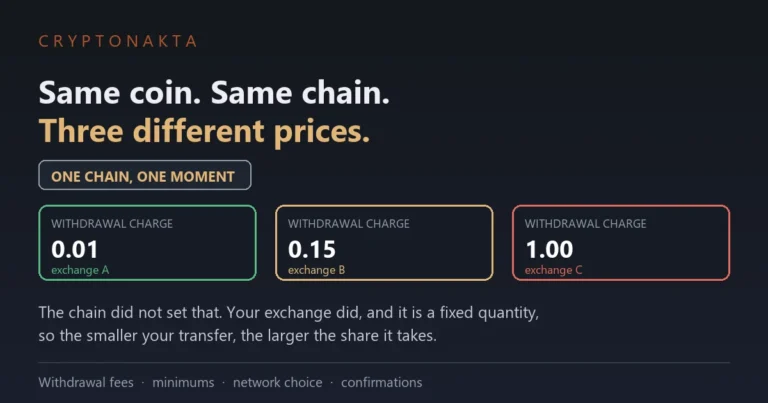
| Withdrawal fee | Moving balance between venues | A fixed quantity of coin, set by the exchange |
| Time | Throughout the transfer | Never shows up as a charge. It is the largest item |
The trading fee lands twice
Taking a gap requires at least two fills: buy on one side, sell on the other. The fee is charged both times.
The spread sits on top of that. Cross the book to get in and cross it again to get out, and you pay that distance at both ends.
The withdrawal fee is a quantity, not a percentage
On withdrawal the exchange deducts a fixed amount of coin. Move a thousand dollars or a hundred and the same amount comes off.
So its weight as a percentage grows as the amount shrinks. The same deduction can be 0.05% at one size and 0.5% at another.
And it is not uniform. On the same coin over the same network, each venue charges differently. We compared the public data of several venues in what it costs to move crypto between exchanges. How the network fee itself is formed is in gas fees.
Keeping balances on both sides
You can hold balances at both venues and skip the transfer. That is the usual suggestion.
The cost changes shape rather than disappearing. That money sits idle in two places and stays in someone else’s custody for longer, which is a separate decision covered in wallets.
There is a detail that gets skipped. Repeating the operation unbalances the two ends: cash runs out where you buy and coin runs out where you sell. Getting back to the starting position requires a transfer anyway. The time was not removed, it was deferred.
8. How far the price moves while the transfer is in flight
Saying a transfer takes time stays abstract. We measured it in the same unit as the gap so the two can be set side by side.
From the price series we collected, we calculated how far bitcoin moved after each interval. We took the magnitude of the move and ignored its direction.
| Elapsed | Median move | Top decile | Maximum |
|---|---|---|---|
| 10 min | 6.3 | 13.5 | 22.7 |
| 20 min | 11.0 | 20.2 | 25.4 |
| 30 min | 13.0 | 28.4 | 32.8 |
| 60 min | 23.1 | 36.2 | 44.8 |
In bps, the same unit as the gap table, so the two compare directly. Measured 2026-09-17 04:44 UTC · 6 exchanges · 96 rounds over 97 minutes
Put it next to the gap
The executable gap was counted in single-digit bps. Price movement over half an hour is considerably larger.
So while the transfer is in flight, the price moves further than the gap you were trying to capture. The gap does not merely shrink. It can invert.
This is not bad luck. The two amounts are different sizes. The one you are trying to capture is small. The one you sit through is large.
It can move in your favour
How long it actually takes
Three segments add up. The sending exchange processes the withdrawal, the network confirms the transaction, and the receiving exchange decides when to treat it as credited.
The third varies most. On the same network, each venue requires a different number of confirmations. The same coin over the same network arrives at different times depending on where you send it.
Why a withdrawal sits in a pending state is in withdrawal stuck pending, and why a deposit has not appeared is in deposit not credited.
Automation is faster
A program sends orders faster than a person. That is true, and it removes none of the items above. The fee is identical and the transfer takes as long as it takes.
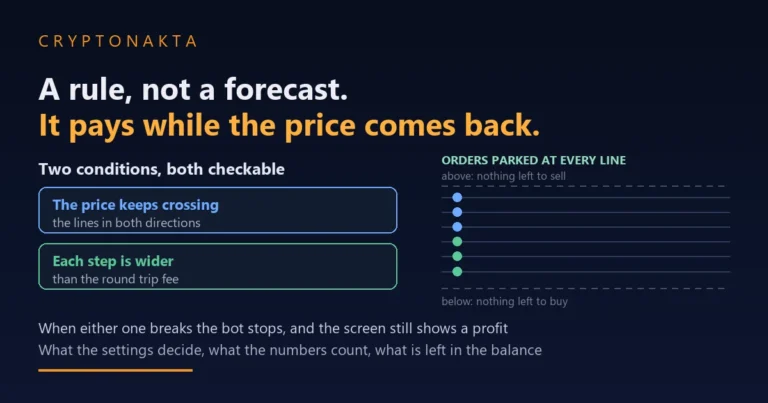
What a bot does and does not change is in trading bots. This article stops at measuring.
9. Where the gap is large: paying in local currency
Between exchanges, almost nothing survived. The place where the gap really is large is a different place.
It is the moment you pay in your local currency instead of dollars.
That is a separate book
When you buy paying in local currency, your order enters a book where the circulating money is that currency. When someone buys paying in dollars, they enter a different book.
Those two books cannot see each other. If one receives a flood of orders, the other does not know. The only thing connecting them is people moving balance from one side to the other.
Which is why the distance between them can stay open for a while. Nothing closes it automatically.
We measured several markets at once
The method: take the price of bitcoin in the local currency, the price of the dollar-pegged token in that same currency, and a reference exchange rate. Then calculate the premium two ways.
| Currency | Coin premium measured against the dollar token | Coin premium measured against the reference rate | Premium on the dollar token itself against the reference rate |
|---|---|---|---|
| KRW | -0.01% | +0.65% | +0.66% |
| MXN | -0.04% | +0.41% | +0.45% |
| ARS | +0.02% | +5.96% | +5.93% |
| BRL | -0.01% | +0.35% | +0.35% |
| TWD | -0.02% | +0.50% | +0.52% |
The reference rate is the average of several independent sources. Measured 2026-09-17 04:44 UTC · 6 exchanges · 96 rounds over 97 minutes
Read the table left to right
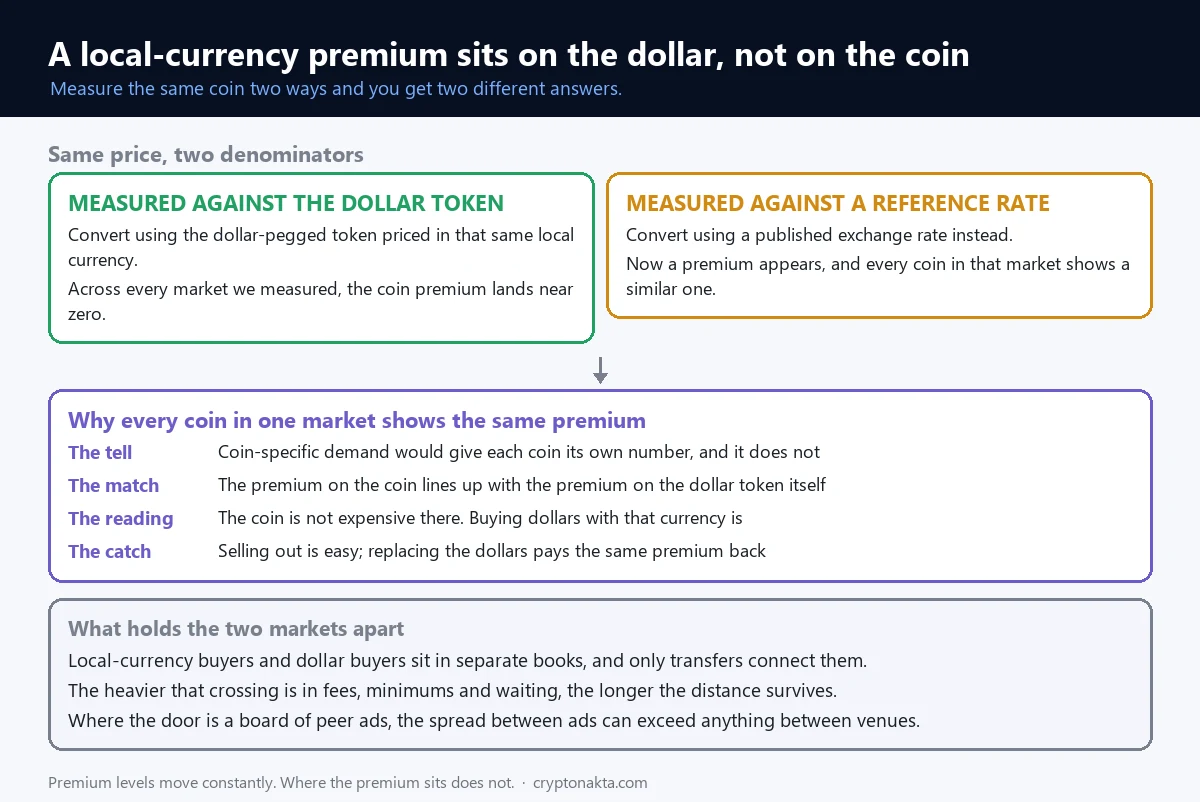
The first column of numbers is close to zero in every market. Measured against the dollar token you can buy in that same currency, the coin is not expensive.
The second column does show a premium, and in one market it runs to several percentage points. Same coin, same instant, a completely different number.
The third column explains the second. It is the premium on the dollar token itself against the reference rate, and it lines up almost exactly with the premium that appeared on the coin.
10. The premium is on the dollar, not on the coin
The agreement in that table is not a coincidence. It repeats across five markets with very different currencies, including one where the premium is large.
There is one conclusion: the premium is not on the coin, it is on the price of buying dollars with local currency.
What that changes in practice
When someone sees bitcoin quoted higher in their own currency than abroad, most people read that as crypto being expensive there. The numbers say otherwise.
The coin follows the price of the dollar in that market. If the dollar token trades several percent above the reference rate, everything quoted in dollars appears that much more expensive once converted. It is not a crypto phenomenon. It is the price of the dollar.
Notice also that within a single market, every coin shows a similar premium. If this were demand for one specific coin, each would carry its own number.
And that is why the premium is hard to take
Selling the coin and holding local currency is the easy part.
Coming back is the problem. Replacing the dollars means buying them at the same price that carries the premium. What you gained when you sold, you pay back when you buy. So the premium is not profit sitting there. It is what it costs to switch between the two currencies.
The other route is converting outside, at the reference rate. That route has its own steps and its own timing, and it is not instant.
What keeps the distance open
The distance closes when many people move balance between the two sides. It stays open when moving balance is expensive, slow or awkward.
Every item from the cost breakdown reappears here: fees, withdrawals, confirmations and time. The heavier the crossing, the further apart the two prices can sit with nothing pushing them together.
What the dollar token is and what holds its price is covered in stablecoins. How to buy one, and what you actually pay, is in how to buy USDT.
11. When you buy from a board of ads
In several markets you do not buy from an order book at all. You buy from a board of ads posted by individuals, and each one sets its own price and its own accepted payment methods.
There the question about price changes shape. There is no market price, there is a list of prices offered at the same moment.
| Currency | Ads read | Cheapest vs reference rate | Dearest vs reference rate | Distance from first to last |
|---|---|---|---|---|
| VND | 20 | -0.72% | -0.60% | 0.11% |
| EGP | 20 | +1.07% | +1.80% | 0.72% |
| AED | 20 | +0.07% | +0.59% | 0.52% |
Buy-side ads for the dollar token, read from the first page and sorted by price. The reference rate is the average of several independent sources. Measured 2026-09-17 04:44 UTC · 6 exchanges · 96 rounds over 97 minutes
What this table shows
Between the cheapest and the dearest ad on the same page there is a distance. In some markets it is larger than everything we found between exchanges combined.
Which means that in those places, picking the right ad matters more than picking the venue. The useful question is not which exchange is cheapest but which ad, and with which payment method.
Why the prices spread out so far
Each ad accepts different payment methods and sets different conditions. One that accepts a faster or more convenient method usually charges more. One that demands a high minimum usually offers a better price.
How long each side is willing to wait matters too. A better price tends to come with more steps or more waiting.
None of those prices is the true price. They are different offers for different situations, which is why it pays to read the whole list before taking the first one.
What to look at besides the number
This kind of trade runs on two separate rails: the platform on one side, and the payment method you used on the other. The price only decides half the outcome.
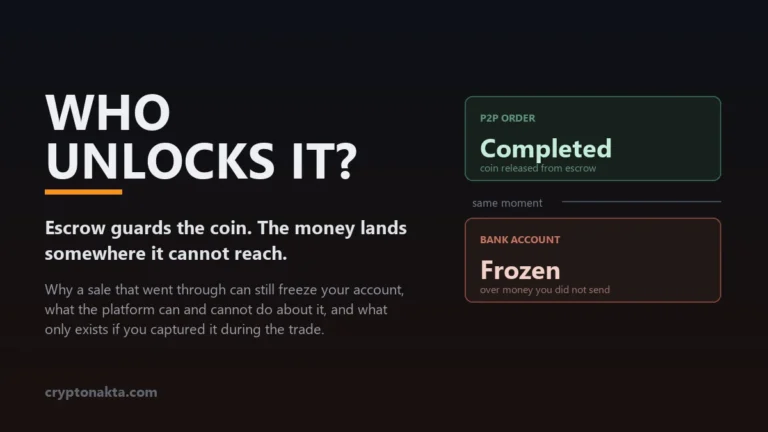
What can go wrong on the payment side, and what is worth keeping a record of, is in bank account frozen after a peer-to-peer sale.
12. How to measure it yourself
What remains is the part you do on your own screen. The procedure is the same at any venue.
| Step | What to look at | Why |
|---|---|---|
| 1 | Open the order book, not the quote | The big number already happened |
| 2 | Write down the best bid and best ask separately | These are the two prices you will touch |
| 3 | Divide the distance between them by the price | Puts the spread into proportion |
| 4 | Add up the levels until your amount is filled | Shows how far your order reaches |
| 5 | Find your real rate on the fee page | It changes with tier and order type |
| 6 | Repeat at the other venue at the same moment | Without simultaneity there is no comparison |
Step three is the one most often skipped
In money terms the spread looks negligible. Only after dividing by the price can it be compared against the fee and against the gap, both of which are already proportions.
Leaving the spread in currency and the fee in percent underestimates the spread every single time.
Step four matters more the smaller the coin
On large coins, the amount an ordinary person deals in does not move the book. On small ones it moves it quickly.
No complicated calculation is needed: just see how many levels your amount reaches. If it fits in the first, there is no displacement. If it needs several, your average fill price rises.
Step six is harder than it sounds
Between reading one screen and opening the other, the price has moved. Looking back at the movement table, a few minutes are enough to exceed the gap you were looking for.
Comparing two screenshots taken at different moments measures nothing. Both screens have to be open and read at the same instant.
If you are choosing a first exchange
You do not need to choose on price. We have already seen that the difference is smaller than the fee.
It is worth more to check whether you can deposit and withdraw the way you need, and what your real fee rate is. The order to start in is in how to buy bitcoin step by step.
Where we read the numbers from
Every figure in this article came from the public endpoints of these venues, queried without any credentials. What each card notes below is something we measured ourselves.
Binance

OKX

KuCoin

Gate.io

Affiliate disclosure: some links are partner links. We may earn a commission at no extra cost to you. This is not investment advice.
13. How I read a price now
After reading these six venues over and over, the order in which I look at a price changed. I will close with that.
Three checks before I take a gap seriously
First, whether it fits inside one tick. If it does there is nothing to analyse, it is rounding. The tick shows up in how many decimals the price field accepts.
Second, I recalculate it with the bid and the ask. A number built from midpoints I discard.
Third, I rest my own size against the book. If it fits in the first level the gap still holds. If it needs several, it has already changed.
I stopped asking which venue is cheapest
I watched first place change hands repeatedly during the measurement. That answer lives for minutes.
Now I look at my own fee rate and at whether I am crossing the book or resting an order. Those two decide far more money than any difference in quotes.
What surprised me most
The local-currency table. I expected each market to produce its own number and they all lined up with the premium on the dollar token instead.
Seeing the same pattern in a market with a half-point premium and in one with several points is what settled the question for me. The coin is not expensive in any row of that table. What changes is the price of a dollar in each place.
Where this article stops
The measuring ends here. What to do with it is each reader’s call.
To continue on the book side, go to order books and slippage. For the cost of moving balance between venues, see what it costs to move crypto between exchanges.