What Leverage Should I Use in Crypto: Leverage Calculator, Liquidation Odds by Multiplier, Changing It on Binance
The leverage you pick decides how much margin backs a position and how far the price can move before you’re liquidated. How much money you can make or lose depends on the size of the position, and you choose that separately.
I wanted numbers, not rules of thumb. So in October 2026 I compared the help pages and public data of seven exchanges on the same day. Then I ran a year of Bybit mark prices through a test that opened a long and a short every hour at each leverage level. What each multiplier actually did is below, along with a calculator and the steps for changing leverage on Binance.
In this article (13)
What leverage should I use for a $100 account?What does 10x leverage mean in crypto futures?Does higher leverage make you more money?How far away is your liquidation price at 10x, 20x, 50x and 100x?How often does 100x leverage get liquidated? I tested a year of BTC, ETH and SOLLeverage calculator: how to work out your liquidation priceWhy was I liquidated when the chart never hit my price?Cross vs isolated margin: what does the leverage number change?What’s the max leverage on Binance, Bybit and OKX, and when can you change it?How to change leverage on Binance, and why it sometimes won’t let youDoes leverage increase trading fees and funding?Can you lose more than your margin?My take after running the numbers
 View full size ↗
What leverage should I use for a $100 account?
With a $100 account, the leverage number decides how much of that $100 is locked up as margin and how close your liquidation price sits. How much you can win or lose comes from the position size you open. So pick the size first and let the leverage follow.
Here’s the simple version. Say you want a Bitcoin position worth 1,000 USDT. At 10x, the exchange sets aside 100 USDT as initial margin, the money that backs the position. That’s your whole account. At 100x it sets aside only 10 USDT, and the other 90 stays free.
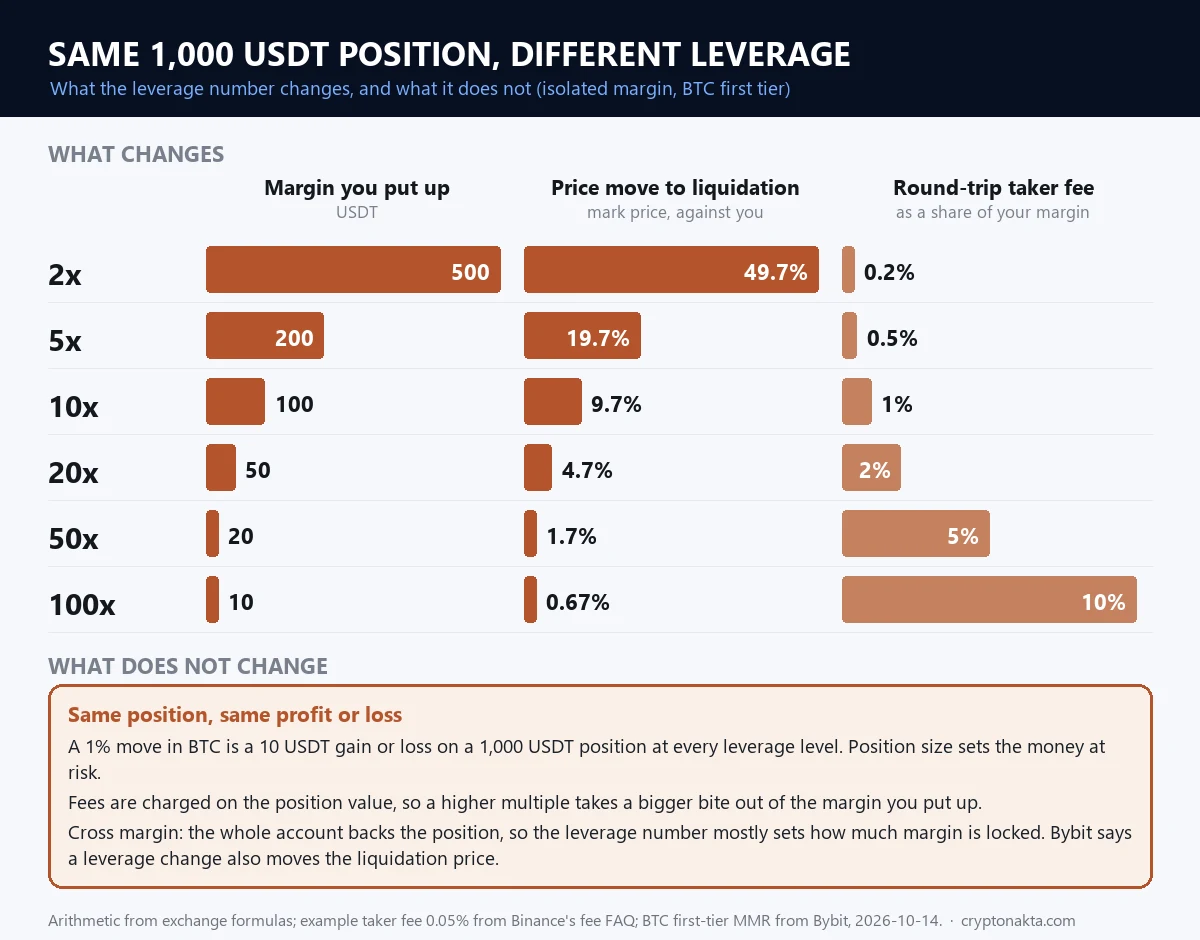
Either way, a 1% move in Bitcoin makes or loses 10 USDT. That’s 1% of 1,000, and the leverage number doesn’t touch it. What changes is the liquidation price, the price where the exchange closes your position because the margin is nearly used up.
| Leverage | Margin needed | Fits a $100 account? | BTC move to liquidation | Profit or loss per 1% move |
|---|---|---|---|---|
| 2x | 500 USDT | No, needs 500 USDT | 49.7% | 10 USDT |
| 5x | 200 USDT | No, needs 200 USDT | 19.7% | 10 USDT |
| 10x | 100 USDT | Yes, all of it | 9.7% | 10 USDT |
| 20x | 50 USDT | Yes, 50 USDT left free | 4.7% | 10 USDT |
| 50x | 20 USDT | Yes, 80 USDT left free | 1.7% | 10 USDT |
| 100x | 10 USDT | Yes, 90 USDT left free | 0.67% | 10 USDT |
The dollars per 1% are the same in every row. The distance to liquidation shrinks from 49.7% at 2x to 0.67% at 100x. Those distances use Bybit’s maintenance margin for small BTC positions, as my backtest did.
So a $100 account really asks two questions. How big a position do I want? And how much room do I want between my entry and my liquidation price? Once you’ve answered both, leverage is just the position value divided by the margin you put up.
Small accounts pull people toward the top of the leverage slider, because 100x turns $100 into a $10,000 position. That’s a size decision, though. At $10,000, a 1% move is worth $100, the whole account. In practice the position closes before that, at about 0.67% against you.
What does 10x leverage mean in crypto futures?
In crypto futures, 10x leverage means your position is worth ten times the margin you put up. With 100 USDT of margin at 10x you control a 1,000 USDT position. At 100x the same 100 USDT would control 10,000 USDT.
Leverage is just that ratio. Position value divided by margin. The position value is also called notional value, and it’s the coin amount times the price. A 0.1 BTC position at 60,000 USDT has a notional value of 6,000 USDT, whatever leverage you choose.
“The Initial Margin is determined by the leverage you select,” as Binance puts it. Bybit writes Initial Margin = Position Value ÷ Leverage. OKX gives the initial margin rate as 1 / Leverage.
You’ll see the same multiplier written three ways. 10x, 1:10 and 10:1 all describe a position ten times your margin. Crypto exchanges show the “x” version on the order form. The ratio style comes from forex brokers.
Futures leverage isn’t a loan you pay back. Nobody hands you the other 900 USDT in that 10x example. The exchange lets your margin back a bigger contract and settles your profit or loss against that margin. Spot margin trading is a different product where you really do borrow coins. Our spot vs futures guide covers the difference.
So a leverage number is a ratio, and on its own it doesn’t say how many dollars are at stake. Two traders can both use 20x. One opens a 200 USDT position and the other opens 200,000 USDT. Their dollar risk is a thousand times apart.
Does higher leverage make you more money?
No. Higher leverage doesn’t make a trade earn more. On the same position size, the profit or loss in dollars is identical at 2x and at 100x. Leverage only lets the same margin open a bigger position, and the bigger position is what earns or loses more.
“Adjusting leverage does not affect realized or unrealized PnL,” says Gate’s help center. Change the multiplier on an open position and the position stays the same size. Only the margin it needs goes up or down.
The size of the position sets your risk, not the leverage number. Leverage decides how you pay for that size and how much room the position gets before liquidation.
Where people get confused is the percentage on screen. Futures apps usually show profit as a share of your margin. A 0.5% move on a 100x position shows up as 50% of the margin. On a 10x position the same move shows 5%. The dollars are the same in both cases. Only the number you divide by has changed.
Here’s a quick example with three traders, each holding 1,000 USDT. Anna opens a 1,000 USDT position at 10x, so 100 USDT is margin. Ben opens a 10,000 USDT position at 10x, so 1,000 USDT is margin. Chris opens a 1,000 USDT position at 100x, with only 10 USDT as margin.
Anna and Chris gain or lose the same 10 USDT per 1% move. Ben gains or loses 100 USDT, ten times more, with the same 10x as Anna. Chris carries Anna’s dollar risk, but on BTC his liquidation price sits 0.67% from entry, against 9.7% for Anna.
How far away is your liquidation price at 10x, 20x, 50x and 100x?
In isolated margin, the price only has to move about 1 divided by your leverage, minus the maintenance margin rate, before you’re liquidated. For small Bitcoin positions on Bybit that was 9.7% at 10x, 4.7% at 20x, 1.7% at 50x and 0.67% at 100x.
The maintenance margin is the minimum margin an exchange needs to keep your position open. It’s a small percentage of the position value, called the maintenance margin rate or MMR. When your margin falls to that level, the exchange closes the position. That’s liquidation.
Binance says the maintenance margin comes from the size of the position, whatever leverage you pick. So the MMR is the same at 5x and at 100x. At 10x your margin is 10% of the position. The exchange steps in a little before that’s gone, so the real distance is 10% minus the 0.33% MMR.
| Price move to liquidation | BTC | ETH | SOL |
|---|---|---|---|
| 2x | 49.7% | 49.7% | 49.5% |
| 5x | 19.7% | 19.7% | 19.5% |
| 10x | 9.7% | 9.7% | 9.5% |
| 20x | 4.7% | 4.7% | 4.5% |
| 25x | 3.7% | 3.7% | 3.5% |
| 50x | 1.7% | 1.7% | 1.5% |
| 75x | 1% | 1% | 0.83% |
| 100x | 0.67% | 0.67% | 0.5% |
| 125x | 0.47% | 0.47% | n/a |
| Typical day (median high-to-low range) | 3.1% | 4% | 4.5% |
| Quiet day (bottom 10%) | 1.4% | 2% | 2.3% |
| Busy day (top 10%) | 5.8% | 8.5% | 9.3% |
| Biggest day of the year | 18.7% | 22.1% | 28.5% |
The bottom rows come from the same year of Bybit mark prices, measured on October 14, 2026. Each day is the UTC high minus the low, divided by the open. A typical Bitcoin day swung 3.1%. At 100x the liquidation price sat 0.67% away, so a normal day covered that distance about 4.6 times over.
Even a quiet day in the bottom 10% moved 1.4% for BTC. That’s more than double the 100x distance, and close to the 1.7% you get at 50x. ETH and SOL move more, so their quiet days are wider still.
At 20x the BTC distance is 4.7%. That’s wider than a typical day. A busy day in the top 10% moved 5.8%, though, and BTC’s range topped 5% on 16.2% of days. That’s about one day in six.
A day’s range isn’t the same as a move against you. Price can swing both ways and close where it opened. My backtest checked whether it actually reached each liquidation price.
How often does 100x leverage get liquidated? I tested a year of BTC, ETH and SOL
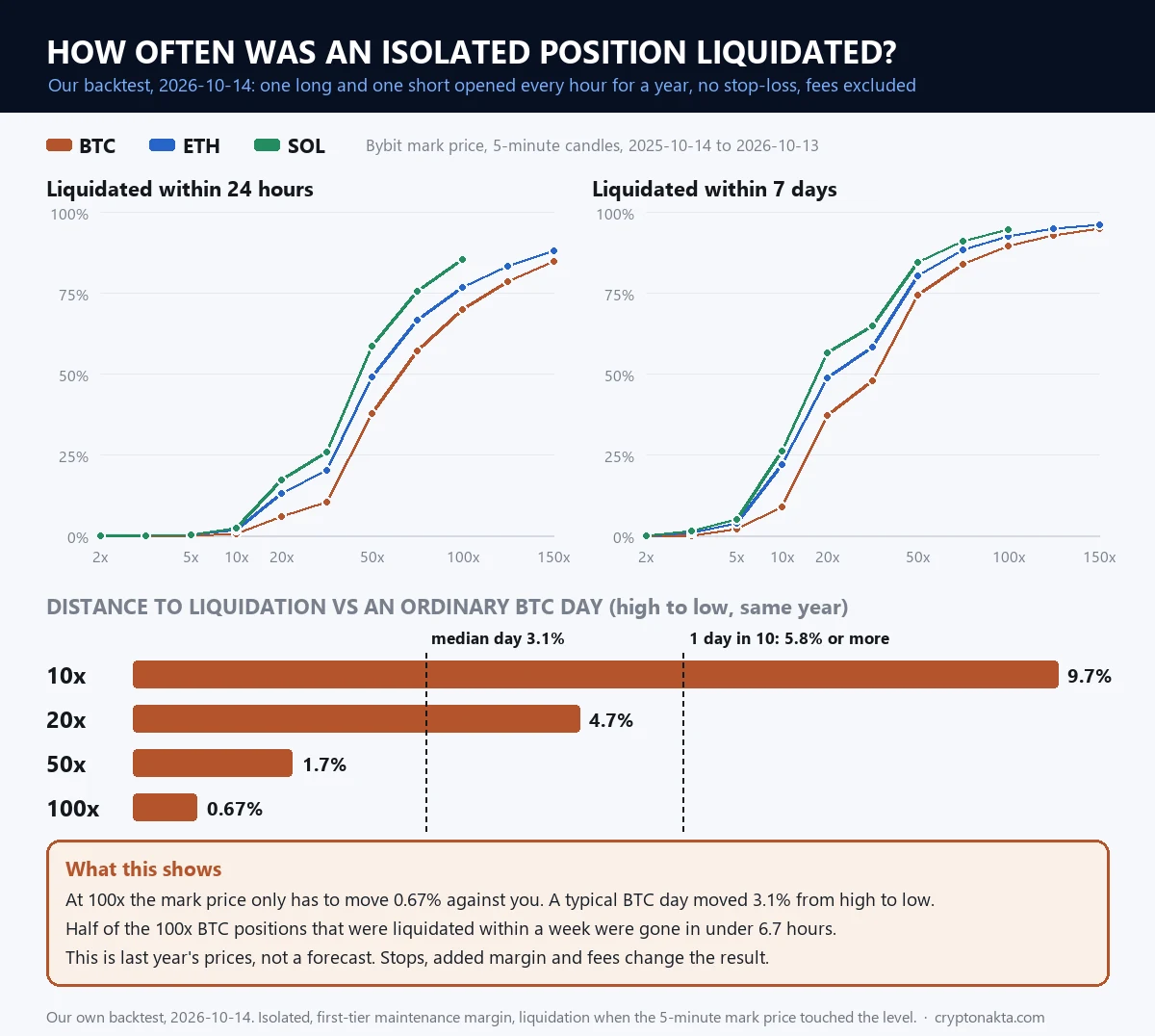
In my backtest of the past year, 100x Bitcoin positions were liquidated within 24 hours 69.7% of the time. At 10x, 8.9% were liquidated within seven days. At 20x it was 37%. These are results from one past year of prices.
Here’s exactly what I did. On October 14, 2026 I downloaded Bybit’s 5-minute mark price candles for the BTC, ETH and SOL USDT perpetuals. They cover October 14, 2025 to October 13, 2026. Every hour on the hour, the test opened one isolated long and one isolated short at the candle’s open. That gave 8,592 entry times per coin and leverage level.
Each position got a liquidation price of entry × (1 − 1/leverage + MMR) for longs, and the mirror image for shorts. The MMR was Bybit’s first tier, 0.33% for BTC and ETH and 0.5% for SOL. If a candle’s low or high touched that price, I counted a liquidation. The rates combine longs and shorts.
The test leaves out fees, funding, stop-losses and added margin. It only sees each candle’s high and low, so it may undercount very slightly. It shows how often price reached each distance.
Share of test positions liquidated, measured October 14, 2026 on Bybit mark prices:
| Leverage | BTC 24h | BTC 7 days | ETH 24h | ETH 7 days | SOL 24h | SOL 7 days |
|---|---|---|---|---|---|---|
| 2x | 0% | 0% | 0% | 0% | 0% | 0% |
| 3x | 0% | 0% | 0% | 0.83% | 0% | 1.3% |
| 5x | 0% | 1.9% | 0.1% | 3.8% | 0.1% | 5% |
| 10x | 0.42% | 8.9% | 1.5% | 21.7% | 2.2% | 25.9% |
| 20x | 5.8% | 37% | 12.9% | 48.5% | 17.2% | 56.3% |
| 25x | 10.2% | 47.9% | 20% | 58.1% | 25.7% | 64.8% |
| 50x | 37.7% | 74.4% | 48.8% | 80.2% | 58.5% | 84.3% |
| 75x | 57% | 83.8% | 66.5% | 88.2% | 75.4% | 90.9% |
| 100x | 69.7% | 89.3% | 76.7% | 92.4% | 85.2% | 94.5% |
| 125x | 78.3% | 92.6% | 83.3% | 94.7% | n/a | n/a |
| 150x | 84.5% | 94.8% | 88% | 96.1% | n/a | n/a |
At 2x and 3x, BTC was never liquidated inside seven days. At 5x it happened 1.9% of the time. By 50x, 37.7% of BTC positions were gone within a day.
The waiting time shrinks too. Among BTC positions liquidated within a week, the median one lasted 94.5 hours at 10x and 66.2 hours at 20x. At 50x it was 23.5 hours. At 100x it was 6.7 hours, and for ETH and SOL at 100x it was 4.2 and 1.9 hours.
ETH and SOL were hit more often at every level, because their daily ranges are wider. At 10x, 21.7% of ETH positions and 25.9% of SOL positions were liquidated within a week, against 8.9% for BTC.
These are backtest numbers from the past year, not odds for the future. A calmer or wilder year would give different results. They’re also numbers for positions with no exit plan. A position with a stop-loss order would usually close before liquidation, at a smaller loss.
 View full size ↗
Leverage calculator: how to work out your liquidation price
For an isolated long, a simple estimate is liquidation price ≈ entry price × (1 − 1/leverage + MMR). For a short it’s entry × (1 + 1/leverage − MMR). Exchanges add fee and extra-margin terms, so treat it as an estimate.
Here’s an example with round, made-up numbers. You buy 0.1 BTC at 60,000 USDT, so the position is worth 6,000 USDT. Assume an MMR of 0.5%. These are example figures, not current prices.
At 10x your margin is 6,000 ÷ 10 = 600 USDT. The long’s liquidation price is 60,000 × (1 − 0.1 + 0.005) = 54,300 USDT. That’s 9.5% below entry. A 10x short would liquidate at 60,000 × (1 + 0.1 − 0.005) = 65,700.
Now try 50x on the same position. Margin drops to 120 USDT and the long liquidates at 59,100. That’s only 1.5% away. Your profit or loss for each 100 USDT move in Bitcoin is still 10 USDT in both cases, because you hold 0.1 BTC.
| Leverage | Margin | Long liquidates at | Short liquidates at | Distance from entry |
|---|---|---|---|---|
| 5x | 1,200 USDT | 48,300 | 71,700 | 19.5% |
| 10x | 600 USDT | 54,300 | 65,700 | 9.5% |
| 20x | 300 USDT | 57,300 | 62,700 | 4.5% |
| 50x | 120 USDT | 59,100 | 60,900 | 1.5% |
| 100x | 60 USDT | 59,700 | 60,300 | 0.5% |
Real exchange formulas add a few terms. Bybit’s isolated formula includes extra margin you added, the taker fee rate and a maintenance margin deduction. In its help page example, a 1 BTC long at 40,000 USDT with 50x, 3,000 USDT added, a 0.5% MMR and a 0.055% taker fee liquidates at 36,380.25 USDT.
Without the added 3,000, the simple formula gives 40,000 × (1 − 0.02 + 0.005) = 39,400. The extra margin is what pushed that example’s price so much lower. Binance, OKX, Gate, Bitget and MEXC publish their own formulas as well.
Put your own numbers into the calculator below. It uses the simple isolated formula with Bybit’s first-tier MMR. It also shows how often the same leverage was liquidated in my one-year test.
Enter the position value you plan to hold, not your account balance. Then compare the distance with the daily ranges further up. In cross margin the result is only a rough guide, because your whole balance backs the position.
Why was I liquidated when the chart never hit my price?
Futures exchanges trigger liquidation with the mark price, and the chart you watch usually shows the last traded price. Liquidation happens “when the Mark Price hits the liquidation price of a position,” Binance writes. So a candle can stay above your liquidation price while the mark price touches it.
The mark price is a separate price the exchange works out for each contract to judge margin. Binance uses it “to avoid unnecessary liquidations and to combat market manipulation,” in its own words. Most of the time it sits close to the last price, so few people notice it.
It works the other way too. A sharp wick on the last-price chart may cross your liquidation price while the mark price stays clear. Then you aren’t liquidated. Most futures screens can show a mark price chart, and my backtest used Bybit’s mark price candles for this reason.
Cross margin has a different trigger. Bybit liquidates isolated positions when the mark price reaches the liquidation price. Cross positions go when the account’s maintenance margin rate hits 100%, so the cross liquidation price is an estimate.
A stop-loss can also fill past your price when the order book is thin. Our order book and slippage guide shows how. To trace a liquidation step by step, see our guide to why positions get liquidated.
Cross vs isolated margin: what does the leverage number change?
In isolated margin the leverage sets the liquidation price. In cross margin your whole account balance sets it, and the leverage number mostly decides how much margin is reserved. Bybit is the exception. It says leverage affects the liquidation price in any margin mode.
Isolated margin gives each position its own pot of margin. If that pot runs out, only that position closes. Cross margin shares your futures balance across all open positions. The whole available balance backs each one.
OKX states that “simply adjusting the leverage will not change the estimated liquidation price” in cross. It only changes the occupied margin and the available balance. Binance, Gate and Bitget publish cross formulas with no leverage term at all.
| Exchange | What the official docs say about leverage in cross margin |
|---|---|
| Binance | Its cross liquidation formula has no leverage term. A 2022 Binance blog post says changing cross leverage leaves the liquidation price alone as long as you don’t remove available balance. |
| Bybit | The exception. Its help page says your liquidation price will be affected if you change leverage, in any margin mode. |
| OKX | Adjusting leverage alone won’t change the estimated liquidation price. It changes the occupied margin and the available balance. |
| MEXC | In cross, leverage changes the margin needed. It doesn’t set the liquidation price directly. |
| Gate | Its cross liquidation formula has no leverage term. |
| Bitget | Its cross liquidation formula has no leverage term. |
| KuCoin | Cross positions liquidate only when the risk rate reaches 100%. The liquidation price is for reference. |
Bybit says that changing leverage moves your liquidation price in any margin mode. The reason sits in its maintenance margin formula, which adds a fee-to-close term that includes 1 ± 1/leverage. My reading is that the effect is small. Still, “leverage doesn’t matter in cross” isn’t true on every exchange.
Effective leverage is the ratio you’re really running. It’s position value divided by the collateral actually behind it. Binance defines it as position notional divided by account balance plus unrealized profit.
Here’s why that matters. Say you have 1,000 USDT in a cross account and open a 2,000 USDT position at 20x. The screen says 20x. Your effective leverage is 2,000 ÷ 1,000 = 2x, because the whole balance backs it. Put the same trade in isolated with 100 USDT of margin and you really are at 20x.
So in cross, look past the setting. Your real exposure is total position value against total balance. Our cross vs isolated margin guide covers when each mode fits.
What’s the max leverage on Binance, Bybit and OKX, and when can you change it?
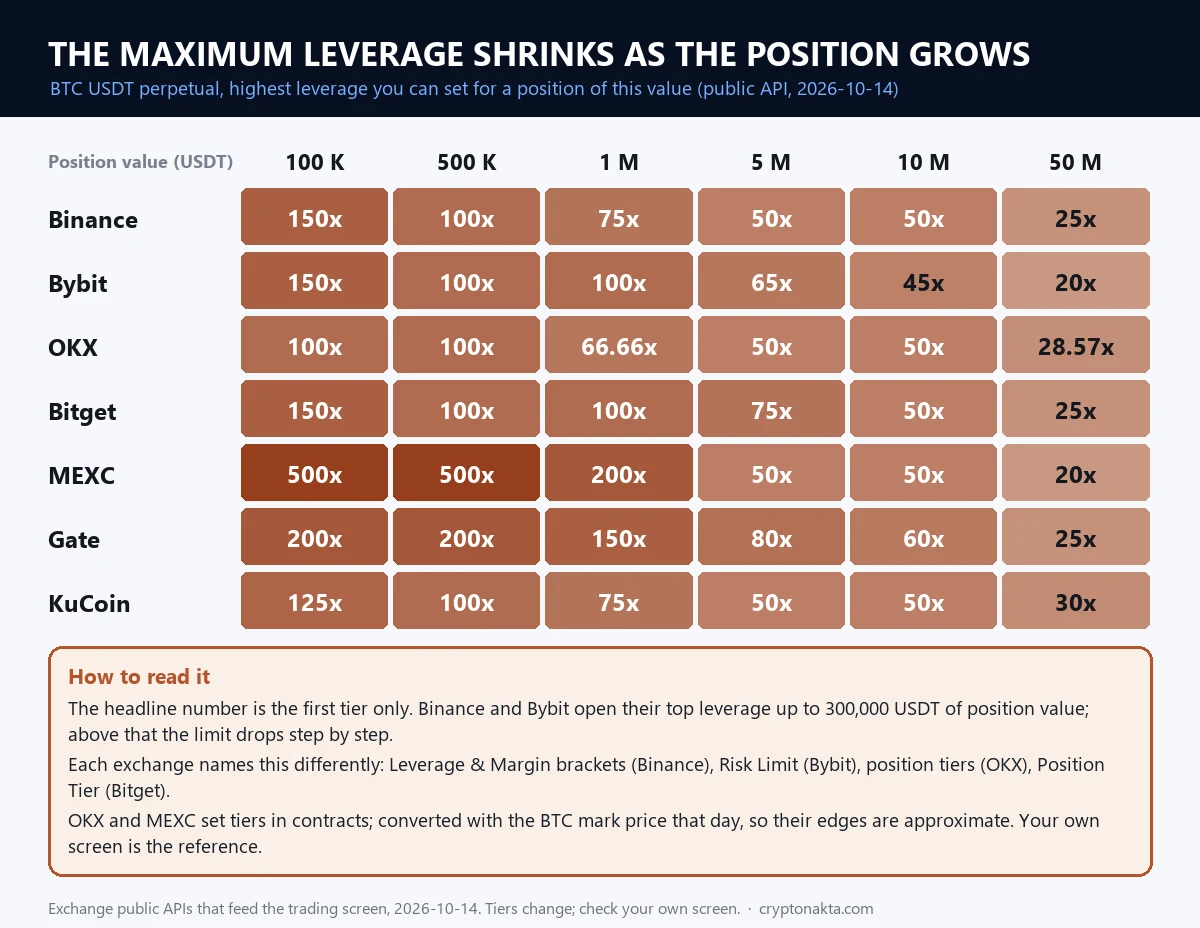
On October 14, 2026, the BTC/USDT perpetual allowed up to 150x on Binance and Bybit, 100x on OKX and 500x on MEXC. Once a position grows past the first tier, the highest leverage you can pick goes down.
The headline maximum leverage only applies to the first, smallest tier of position size. In Binance’s words, “larger positions allow for lower leverage.” Binance calls these leverage brackets. OKX says position tiers.
Bybit calls it a risk limit. That’s a cap on position value. Each step up in size comes with a lower maximum leverage and a higher maintenance margin rate. I pulled the BTC/USDT tiers from each exchange’s public API on October 14, 2026. OKX and MEXC count contracts, so I converted at that day’s mark price.
| Exchange | Max leverage | First tier covers positions up to | Next tier | Tier after that | Name in the docs |
|---|---|---|---|---|---|
| Binance | 150x | 300,000 USDT | 100x | 75x | Leverage brackets |
| Bybit | 150x | 300,000 USDT | 100x | 90x | Risk limit |
| OKX | 100x | 830,000 USDT (approx.) | 66.66x | 50x | Position tiers |
| Bitget | 150x | 200,000 USDT | 100x | 75x | Position Tier |
| MEXC | 500x | 990,000 USDT (approx.) | 200x | 100x | Risk limit |
| Gate | 200x | 500,000 USDT | 150x | 125x | Risk limit |
| KuCoin | 125x | 250,000 USDT | 100x | 75x | Risk limit |
For a small account, the first tier is plenty. It runs to 300,000 USDT on Bybit. The tiers matter when you raise leverage, because a higher setting shrinks the biggest position you can open. In Bybit’s own example, going above 2.6 million USDT means cutting leverage to 80x or less. KuCoin’s cross mode has no tiered risk limit at all.
The rules for changing leverage differ by exchange too.
| Exchange | Change it with a position open? | What can block or undo it |
|---|---|---|
| Binance | Cross: up or down with [Adjust Leverage]. Isolated: up only. | New futures accounts can’t go above 20x for the first 30 days. |
| Bybit | Yes, in both modes. | Lowering needs enough available margin. You can’t raise it to a level that would liquidate you at once. In isolated, extra margin you added is removed. |
| OKX | Yes. | Raising must stay within your current tier. Lowering needs available balance. Open TP/SL or limit orders can block it. |
| Bitget | Yes, with no fee for the change. | Blocking conditions aren’t documented. |
| MEXC | Yes. Advanced mode sets long and short separately. | “Apply to all futures” skips pairs that have open orders or positions. |
| Gate | Yes, before or during a position. You can switch cross and isolated too. | Blocking conditions aren’t documented. |
| KuCoin | Yes. | Isolated: raising doesn’t release margin already in. Lowering pulls margin from the cross account and fails if that balance is short. |
Here are the four exchanges this guide links to, with one leverage rule each.
Binance

Bybit

OKX

KuCoin

Affiliate disclosure: some links are partner links. We may earn a commission at no extra cost to you. This is not investment advice.
 View full size ↗
How to change leverage on Binance, and why it sometimes won’t let you
On Binance Futures you set leverage before opening a position. With an open cross position, Binance’s help page says to click [Adjust Leverage] to raise or lower it. With an open isolated position you can raise leverage, and you can’t lower it.
“You should first select your leverage (and meet the Initial Margin requirement) before opening a position,” Binance’s FAQ says. In isolated mode it says you “cannot reduce the leverage” once a position is open, so a lower setting means closing the position and opening a new one.
Binance also sets a default leverage for each pair, based on the trading experience you picked when you opened the futures account. It applies once you visit that pair’s trading page. It doesn’t apply if you already have a position or open orders there.
New accounts have a ceiling. Since December 7, 2025, Binance hasn’t allowed more than 20x in a futures account’s first 30 days. A position already above 20x can stay open, but you can’t raise it. After 30 days the limit lifts in stages.
Binance’s API error list names two reasons a change gets refused. The position may be too big for the new leverage (“Exceeded the maximum allowable position at current leverage”). Or there isn’t enough margin for a lower setting. Our Binance sign-up and referral code guide covers opening an account.
Bybit works a little differently. New orders start in cross margin at 10x in one-way mode. You can lower leverage only when you have enough available margin. You can’t raise it to a level that would liquidate the position right away. In isolated mode, changing leverage removes any extra margin you’d added. Our Bybit sign-up guide covers that exchange.
A few things I couldn’t confirm. OKX, Bitget, MEXC and KuCoin don’t publish a default leverage number. I found no new-account cap in Bybit’s documents.
Does leverage increase trading fees and funding?
Leverage doesn’t change the fee rate. It does make fees a bigger share of your margin. Fees are charged on the position value, not on your margin. So a round trip at a 0.05% taker fee costs 10% of your margin at 100x, against 1% at 10x.
Binance’s fee page gives the formula Trading Fee = Position Value × trading fee. OKX’s example is a 20,000 USDT position opened at 10x with 2,000 USDT of margin, and the fee is charged on the full 20,000.
The arithmetic is short. Margin is position ÷ leverage. Fee is position × rate. Divide the fee by the margin and you get rate × leverage. Count it twice, to open and to close, using Binance’s 0.05% example taker rate.
| Leverage | Margin on a 1,000 USDT position | Round-trip taker fee | Fee as a share of margin | Round trips until fees equal your margin |
|---|---|---|---|---|
| 2x | 500 USDT | 1 USDT | 0.2% | 500 |
| 5x | 200 USDT | 1 USDT | 0.5% | 200 |
| 10x | 100 USDT | 1 USDT | 1% | 100 |
| 20x | 50 USDT | 1 USDT | 2% | 50 |
| 50x | 20 USDT | 1 USDT | 5% | 20 |
| 100x | 10 USDT | 1 USDT | 10% | 10 |
The last column surprised me most. At 100x, 10 round trips of taker fees add up to your whole margin, even if every trade breaks even. At 5x it takes 200. Your fee tier and maker orders change the numbers, but the pattern holds.
A 2021 Binance blog post made the same point. It said “the higher your leverage, the higher your transaction cost as a percentage of your trading capital.”
Funding works the same way. The funding rate is applied to the position value, so its cost against your margin grows with leverage too. Our funding rate guide explains how it’s calculated. Fee rates vary by exchange and tier, and our exchange fee comparison lists them. The order types guide shows which orders pay the lower maker rate.
Can you lose more than your margin?
Usually a liquidation costs you the margin behind that position, because the exchange closes it before the margin runs out. If the price jumps past that point, Binance’s insurance fund takes the extra loss first. If the fund can’t, ADL kicks in. No rule promises you can never end up owing money.
In isolated margin, the margin at risk is the pot behind that one position. In cross margin, the same process draws on your whole futures balance.
The insurance fund is money the exchange keeps aside to cover positions that close at a loss bigger than their margin. In Binance’s rules, the fund “will bear the losses arising from the Bankrupt Position.”
ADL, short for auto-deleveraging, is the next step. It closes part of profitable positions on the other side when the insurance fund can’t absorb a loss. If it hits you, a winning position gets closed early.
“Even 1x leverage can be liquidated under extreme market conditions,” OKX notes. Lower leverage widens the distance. It doesn’t remove it. At 5x the BTC distance was 19.7%, and the past year’s biggest BTC day swung 18.7%.
My take after running the numbers
My take: the leverage number decides how much room a position has, and the position size decides how much money is on the line. After a year of price data, keeping those two apart was the most useful thing I found.
The distances surprised me. At 100x, BTC’s liquidation price sat 0.67% away while a typical day moved 3.1%. An ordinary day’s swing was often enough to reach it, and the median liquidated 100x position lasted 6.7 hours. The other surprise was the tiers. The big maximum on the slider is a small-position number.
Before touching the slider, I’d go in this order. Decide the position value first. Then decide where you’d want out, and how far beyond that point the liquidation price should sit. The leverage is whatever number gives that distance with the margin you’re putting up. I won’t give you a multiplier, because the calculator does that job with your own numbers.
What I trust least is the “turn $100 into thousands with 100x” pitch. It shows up in ads and in signal groups. In my backtest, a 100x BTC position was usually gone within a day. I’m also wary of order screens that open at a high default or put the maximum leverage up front.
There’s a fair case on the other side. In cross margin with a large balance, the leverage setting matters less than it looks, because effective leverage is what counts. A stop-loss also cuts losses well before liquidation.
One disclosure. This site uses affiliate links, including the exchange cards above, and we may earn a commission. That doesn’t change any number in this article.
Leverage questions people ask
- Binance: Leverage and margin of USDⓈ-M futures, checked 2026-10-14
- Binance: How to adjust contract leverage, checked 2026-10-14
- Binance: How to calculate liquidation price, checked 2026-10-14
- Binance: Liquidation protocols, checked 2026-10-14
- Binance: Auto-deleveraging (ADL), checked 2026-10-14
- Binance: Futures fee structure, checked 2026-10-14
- Binance API: USDⓈ-M futures error codes, checked 2026-10-14
- Binance Blog (2021): Does lower leverage make better sense?, checked 2026-10-14
- Binance Blog (2022): Three misconceptions about liquidations, checked 2026-10-14
- Bybit: Getting started with futures trading, checked 2026-10-14
- Bybit: Leverage and liquidation price, checked 2026-10-14
- Bybit: The new margin calculation, checked 2026-10-14
- Bybit: UTA trading rules (liquidation formula), checked 2026-10-14
- Bybit: Risk limit, checked 2026-10-14
- OKX: How do I adjust leverage levels, checked 2026-10-14
- OKX: Forced liquidation FAQ, checked 2026-10-14
- OKX: Trading fee rules, checked 2026-10-14
- Gate: Leverage and margin, checked 2026-10-14
- Gate: How to adjust contract leverage, checked 2026-10-14
- Bitget: Leverage FAQ, checked 2026-10-14
- MEXC Learn: Liquidation FAQ, checked 2026-10-14
- MEXC: Adjusting leverage, checked 2026-10-14
- KuCoin: Cross margin and risk limits, checked 2026-10-14
- KuCoin: Adjusting isolated leverage, checked 2026-10-14
This guide explains how futures leverage works and what our own backtest measured. It is not financial advice. Exchange rules change, so go by your own screen.