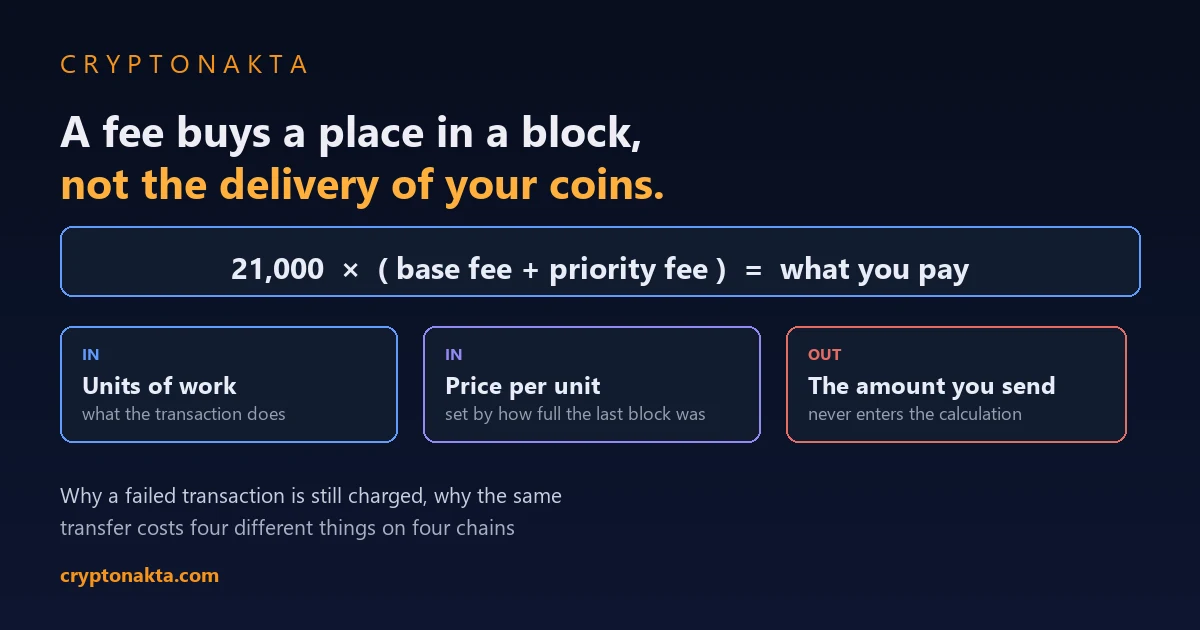
Two Numbers Decide Your Gas Fee, and Neither One Is the Amount You Send
A network fee buys space inside a block. Here is the arithmetic that sets the price, and why a failed transaction is still charged for it.
| Question | Short answer |
|---|---|
| What is the fee actually for? | A place inside a block. Space is limited and the fee decides who gets it. |
| What sets the size of it? | How heavy your transaction is, multiplied by a unit price set by how full the last block was. |
| Does the amount I send matter? | No. It appears nowhere in the calculation on Ethereum or on Bitcoin. |
| Do I pay when it fails? | Yes, if it reached a block. A revert charges only what ran; running out of gas consumes the lot. |
| Which coin pays it? | The chain’s own coin. Sending USDT on Ethereum still requires ETH sitting in the wallet. |
| Is the exchange withdrawal fee the network fee? | No. The exchange sets that number and the exchange keeps it. |
1. The amount you are sending never enters the calculation
2. Gas measures work, and the price of that work is a separate number
3. The previous block sets the price of the next one
4. Most of what you paid was destroyed, and the validator never saw it
5. Your wallet shows a ceiling, not a bill
6. Failing costs money, and not every failure costs the same
7. Bitcoin charges for the size of the transaction, not the size of the payment
8. Four chains, four different things being counted
9. The token you are sending cannot pay for its own transfer
10. Approving a token costs a fee before the swap costs one
11. A layer 2 splits the bill, and half of it stays on Ethereum
12. The fee on the withdrawal screen is not the network fee
13. What gets repeated about fees, and what the rules actually say
14. Where I land after putting the four rulebooks side by side
Every fee question eventually reduces to one calculation, and the calculation is short enough to read in a single line. What makes it worth reading is not the arithmetic itself but what is missing from it. The sum you are sending is not one of the inputs, on Ethereum or on Bitcoin. Once that is clear, a whole category of confusion resolves. Why a tiny transfer can cost the same as an enormous one. Why the deduction is sometimes smaller than the estimate. Why a transaction that achieved nothing still took money. Every figure below comes from protocol documentation or an exchange’s own help pages.
1. The amount you are sending never enters the calculation
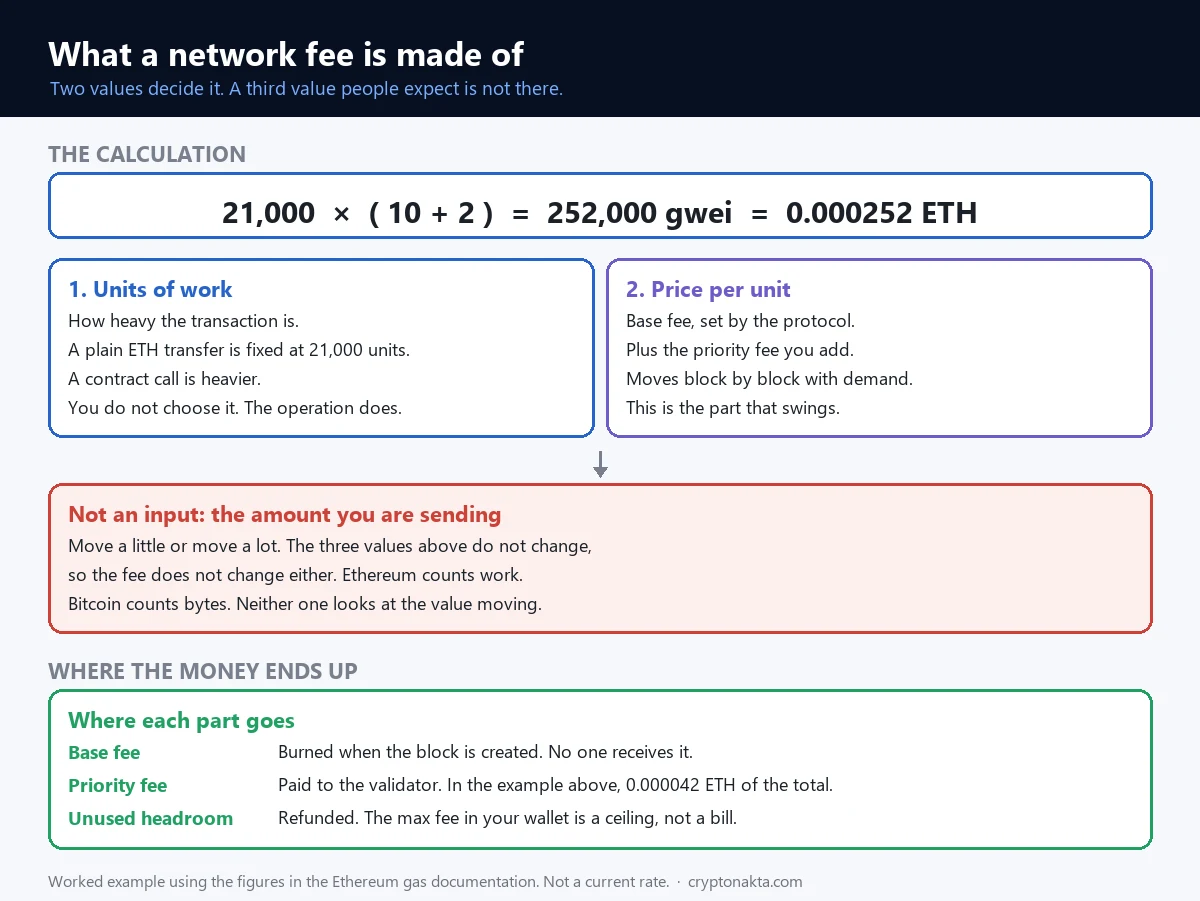
Here is the calculation that decides an Ethereum fee, straight out of the protocol documentation: units of gas used, multiplied by the sum of the base fee and the priority fee. Put the standard numbers in and it reads 21,000 × (10 + 2) = 252,000 gwei, which comes to 0.000252 ETH. A gwei is one billionth of an ETH, so these are small fractions written in a unit that keeps them readable.
Now look at what is absent. There is no field for how much you are sending. Move a rounding error or move a fortune, and the same three inputs produce the same answer. That single absence explains most of the confusion around fees, because people arrive expecting something proportional, like a bank transfer charge or a card surcharge, and the chain is not doing that at all.
What the three inputs actually are
The first input, 21,000, is fixed for a plain transfer of ETH. It is a count of work, not a price. The second, the base fee, is set by the network itself and moves block by block. The third, the priority fee, is the part you control, and it is what a validator earns for putting your transaction in ahead of somebody else’s.
So the honest one-line description of a network fee is that you are paying for room inside the next block, and the price of that room depends on how many other people want the same room right now. Everything below is that sentence, taken apart.
2. Gas measures work, and the price of that work is a separate number
The word gas covers a unit of measurement, and the Ethereum documentation defines it as the unit that measures the amount of computational effort required to execute an operation. Sending ETH from one address to another is a small, completely standardised job, so the protocol prices it at 21,000 units every time. Calling a contract is a bigger job and carries a bigger count.
Two separate numbers hide behind the phrase “gas fee”, and merging them causes real mistakes. One is how much work your transaction does. The other is what one unit of that work costs at this moment. You cannot change the first by paying more, and you cannot change the second by asking for less work.
The gas limit is a cap, not a speed setting
The gas limit in a wallet is the maximum number of units the transaction may consume. Raising it does not make anything faster, because the network charges for units actually used and returns nothing extra for a generous ceiling. Setting it too low has a real consequence: the documentation notes that giving a standard transfer a limit of 20,000 causes the transaction to fail during the validation phase, since the job needs 21,000.
| Value | Who sets it | Where it goes | Can you change it? |
|---|---|---|---|
| Gas used | The work the transaction does | Not applicable | No, the operation decides |
| Base fee | The protocol, from the previous block | Destroyed | No |
| Priority fee | You | The validator | Yes |
| Max fee per gas | You | Excess is refunded | Yes, it is only a ceiling |
| Gas limit | You or your wallet | Only what is used is charged | Yes, and too low fails |
If the idea of a block having limited room is new, the plain explanation of how a blockchain works covers why the space is finite in the first place.
3. The previous block sets the price of the next one
Nobody publishes a rate card. The base fee is calculated by the protocol from one input: how full the previous block was compared with its target. Each block has a target size of half the current gas limit, and a block is allowed to reach twice that target. Come in above target and the base fee for the next block goes up. Come in below and it comes down.
The movement is capped. The documentation gives the range as a maximum of 12.5% per block, running from minus 12.5% for an empty block, through zero at exactly the target size, up to plus 12.5% for a block that reaches the limit. Blocks arrive every few seconds, so the price responds to demand within a minute or two in either direction.
This is why there is no cheap hour
A popular belief holds that fees follow a weekly rhythm, so a weekend or an early morning is the moment to move funds. The mechanism does not contain a clock. It contains one measurement of the block that just closed. When demand drops, the price falls a few blocks later, whatever the day happens to be, and when a popular mint or a liquidation cascade fills blocks to the limit, the price climbs at the same speed on a quiet Sunday.
An estimate is a forecast, not a promise
Wallets and explorers publish suggested rates, and those suggestions are readings of a queue that keeps changing. Mempool.space, which produces some of the most widely used Bitcoin estimates, states plainly that its suggestions do not guarantee confirmation within any period of time. Treating a suggested rate as a contract is the reason people are surprised when a transaction sits unconfirmed, and it is worth knowing that congested nodes also stop accepting new transactions below a certain rate entirely.
4. Most of what you paid was destroyed, and the validator never saw it
Something unusual happens to the larger half of an Ethereum fee. The base fee is burned when the block is created. It is not revenue for anyone. It leaves circulation, and no validator, company or foundation receives it.
The validator’s income from your transaction is the priority fee alone. In the standard example, the whole fee comes to 0.000252 ETH and the validator receives 0.000042 ETH of it. The rest is destroyed.
Why this changes how you read a busy day
When people describe high fees as miners or validators getting rich, the arithmetic does not support it for the base portion. A congested chain destroys more ETH and pays out only the tips. That is a design choice: the fee that responds to congestion is deliberately not paid to the party who chooses what goes into the block, which removes the incentive to manufacture congestion.
Solana splits its fee differently and states the split openly. The base fee of 5,000 lamports per signature is divided 50% burned and 50% to the validator, while any prioritisation fee goes entirely to the validator. The Solana overview covers what that chain does with the rest of its design.
5. Your wallet shows a ceiling, not a bill
The number a wallet shows before you confirm is usually the maximum, and a maximum is not a bill. The two fields being sent are the max fee per gas and the max priority fee per gas. For the transaction to execute, the max fee has to exceed the base fee plus the tip, and the sender is refunded the difference between the max fee and the sum of the base fee and the tip.
This is why the deducted amount is frequently smaller than the figure on the confirmation screen. Nothing went wrong. The ceiling was set high enough to survive a rise in the base fee while the transaction waited, the rise did not happen, and the unused portion came back.
What the ceiling is protecting against
Between the moment of signing and the moment of inclusion, the base fee can move. A ceiling with no headroom means a transaction that stops being valid the instant the base fee ticks up, and then it waits. A ceiling with headroom absorbs that movement, and the headroom costs nothing when it goes unused.
The practical reading is that the confirmation screen shows a worst case. If the deduction later looks smaller than expected, compare it with the base fee at the block your transaction landed in rather than with the estimate you were shown beforehand.
6. Failing costs money, and not every failure costs the same
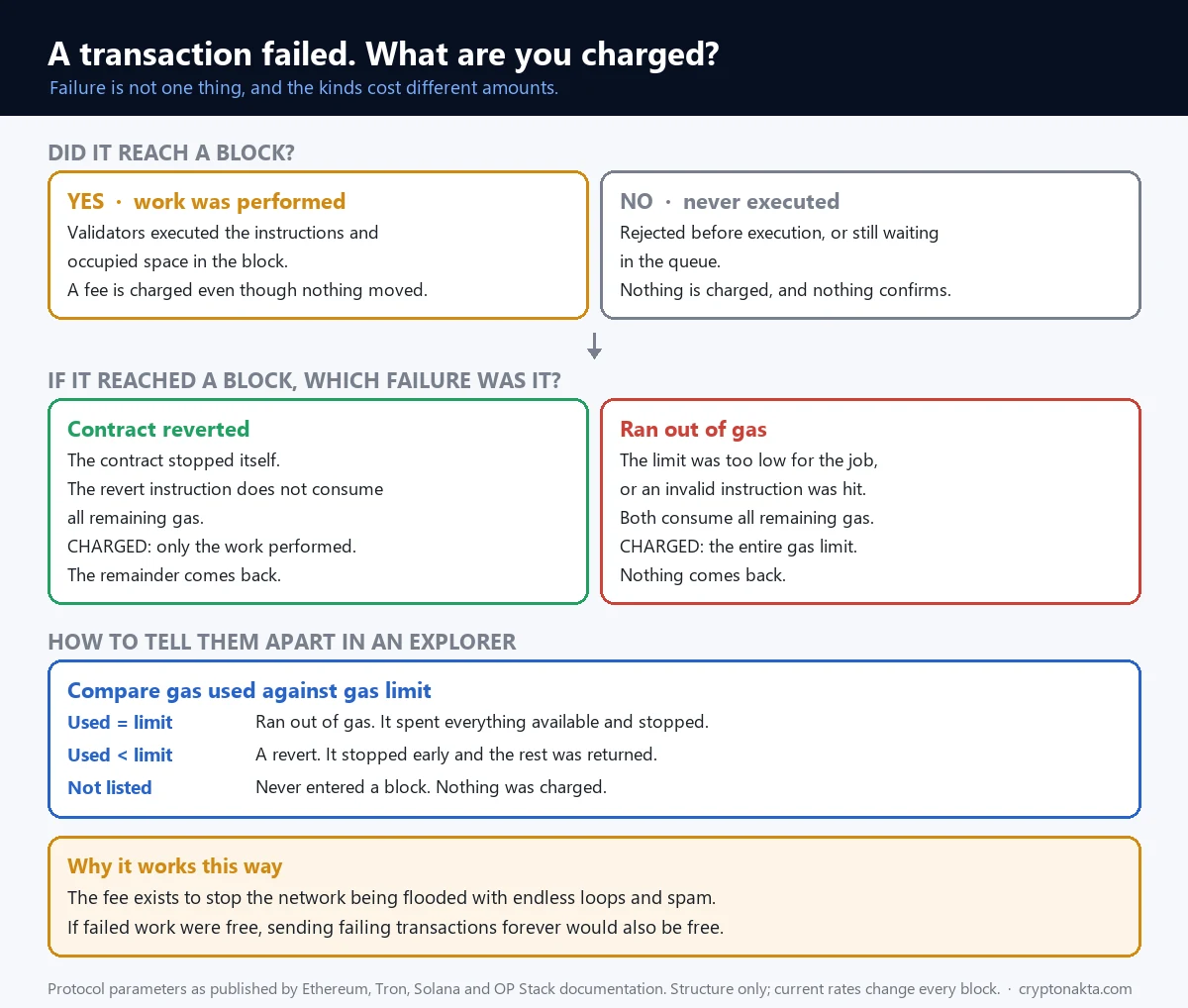
A failed transaction that reached a block still costs money. The reason is uncomfortable but consistent: the network performed the work. Validators executed your instructions, used real computation, and discovered partway through that the result could not stand. The space was occupied and the effort was spent, so the fee is still charged.
What surprises people is that failure comes in kinds, and the kinds cost different amounts.
A revert returns the unused portion
When a contract stops itself deliberately, it uses the REVERT instruction. The specification for that instruction states that the rollback does not consume all gas. It was introduced for exactly this reason: the two older ways to abort, running out of gas and executing an invalid instruction, both consume all remaining gas. So a clean revert charges for the work performed up to the stopping point and gives the rest back.
Running out of gas does not
Set a limit too low for what the operation needs, and execution halts partway with nothing to return. The whole limit is consumed and the state change never happens. This is the expensive failure, and it is the one behind most stories of a large fee paid for nothing.
| Kind of failure | Did it reach a block? | What is charged |
|---|---|---|
| Contract reverts deliberately | Yes | Only the work performed; the remainder returns |
| Ran out of gas mid-execution | Yes | The entire gas limit |
| Hit an invalid instruction | Yes | The entire gas limit |
| Limit below 21,000 on a plain transfer | No | Nothing; it fails validation first |
| Rate too low, still waiting | No | Nothing, and no confirmation either |
Solana handles the question at a different point in the sequence. Its fee is deducted from the fee payer before execution begins, so a transaction that fails during execution has already paid. If a transfer of yours has gone quiet rather than failed, the guide on deposits that have not appeared walks through where it can be.
7. Bitcoin charges for the size of the transaction, not the size of the payment
Bitcoin reaches the same conclusion about your payment amount by a completely different route. It does not measure computational work, because there is very little to measure. It measures the size of the transaction as a piece of data, in virtual bytes, and charges a rate per virtual byte.
Total fee equals size in virtual bytes multiplied by the rate in satoshis per virtual byte. The size depends on how many inputs the wallet had to gather, how many outputs the transaction creates, and which address format is in use. It does not depend on the value moving.
The fee is a remainder, not a field
There is no line inside a Bitcoin transaction that says “fee”. The fee is whatever is left when the outputs are subtracted from the inputs, and miners collect that leftover. This is a genuinely different accounting idea from Ethereum’s, and it produces one famous category of accident, where a badly constructed transaction omits the change output and hands the entire remainder over as a fee.
Why a wallet full of small pieces costs more
Coins arrive as separate pieces, and spending gathers up as many pieces as the payment requires. A wallet that received many small amounts carries many pieces, each one adding bytes when spent. Two people sending an identical amount on the same day can pay noticeably different fees purely because of how their balances were assembled. The Bitcoin explainer covers the underlying structure that makes this true.
8. Four chains, four different things being counted
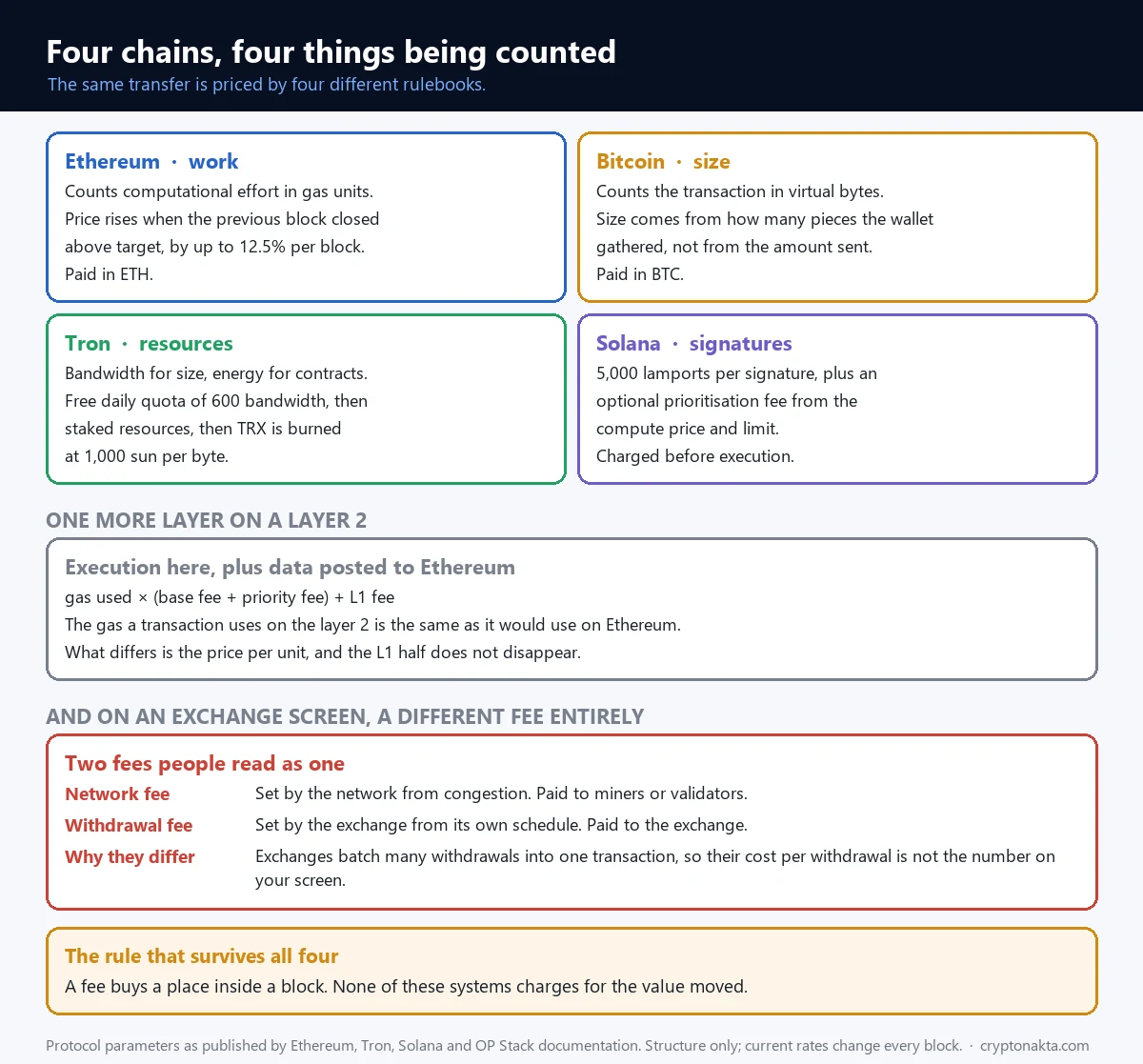
Once you have seen two chains price the same action by two different measurements, the sensible next question is what each chain is actually counting. Four answers cover most of what people use.
| Chain | What it measures | What pushes the price up | Paid in |
|---|---|---|---|
| Ethereum | Computational work, in gas units | The previous block closing above target | ETH |
| Bitcoin | Transaction size, in virtual bytes | A crowded queue of waiting transactions | BTC |
| Tron | Bandwidth for size, energy for contract execution | Exhausting the free and staked allowances | TRX, by burning it |
| Solana | Signatures, plus requested compute | Competition for the same accounts | SOL |
| OP-style layer 2 | Execution on the layer 2, plus data posted to Ethereum | The cost of Ethereum data | ETH on that layer 2 |
Tron gives resources away first and bills afterwards
Tron runs a resource system rather than a straight fee. Every account receives a free daily quota of 600 bandwidth, and there is no free energy quota. Bandwidth is drawn from staked bandwidth first, then the free 600, and only then by burning TRX at 1,000 sun per byte, which is 0.001 TRX. Energy is drawn from staked energy, then from whatever share the contract deployer agreed to cover, then by burning TRX at 100 sun per energy.
The official documentation gives a worked case: a 270-byte TRX transfer with no bandwidth available burns 270 × 1,000 = 270,000 sun, which is 0.27 TRX. Moving a token such as USDT is a contract call, so it consumes energy as well, and that is the part people feel. The Tron overview has more on why so much stablecoin activity settles there.
Solana counts signatures and compute
Solana charges 5,000 lamports per signature as its base. On top of that sits an optional prioritisation fee. It is calculated as the compute unit price multiplied by the compute unit limit, divided by one million and rounded up. A single instruction defaults to 200,000 compute units, and a whole transaction is capped at 1,400,000.
9. The token you are sending cannot pay for its own transfer
This is the single most common practical problem, and the rule behind it is short. You pay the fee in the chain’s own coin, never in the token being moved. A wallet holding a stablecoin and nothing else cannot move that stablecoin.
| What you are sending | What the wallet also needs | What happens without it |
|---|---|---|
| USDT on Ethereum | ETH | The transfer cannot be broadcast at all |
| USDT on Tron | TRX, or staked energy and bandwidth | TRX burns instead, or the transfer stops |
| USDC on Solana | SOL | No signature fee can be paid, so it fails |
| A token on BNB Chain | BNB | Same pattern |
| A token on a layer 2 | ETH on that same layer 2 | Balances on Ethereum itself do not help |
The last row causes more trouble than the rest combined. Holding ETH on Ethereum does nothing for a transaction on a layer 2, because that balance lives on a different ledger. Each network needs its own small reserve.
The version of this that costs real money
Choosing the network is a separate decision from choosing the coin, and the same stablecoin exists on several networks with completely different cost structures. The comparison in USDT on Ethereum versus USDT on Tron lays out what changes between them. Picking the wrong one is recoverable in some situations and not in others, which the guide on transfers sent over the wrong network covers case by case, and exchange deposits additionally need the memo or tag where one is required.
The habit that prevents all of it is keeping a small amount of each chain’s own coin in the wallet you use, so that a transfer is never blocked by an empty fee balance.
10. Approving a token costs a fee before the swap costs one
Trading a token for the first time on a decentralised exchange produces two charges, and people who expect one write in to ask what the extra one was. Nothing went wrong. Letting a contract move your tokens requires a separate transaction, called an approval, and the swap itself is a second transaction.
Both are real transactions. Both occupy block space. Both are charged at the rate in force when they run. The approval generally costs less than the swap, since it does less work, but it is not free and it cannot be skipped for a token the contract has never been permitted to touch.
The part that outlives the trade
An approval does not expire when the swap finishes. It remains recorded, and many interfaces request permission for an unlimited amount so that later trades avoid repeating the step. That convenience is also the exposure: a permission granted months ago is still a permission today, and it is one of the routes by which wallets are emptied. Reviewing and removing the ones you no longer use is covered in the guide to revoking token approvals, and the broader picture of what these contracts do is in the DeFi explainer.
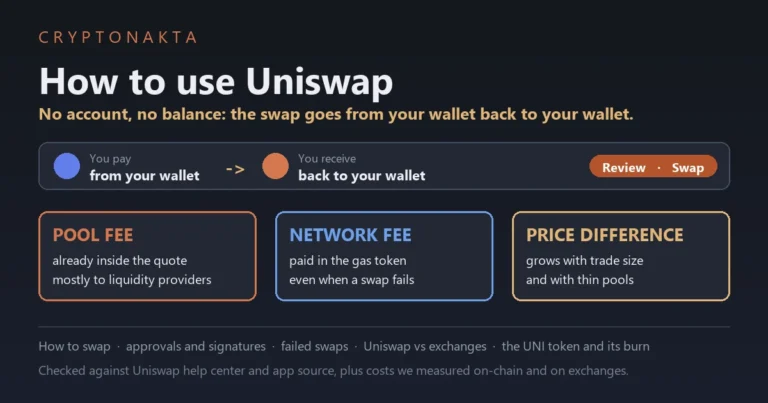
Reading a swap quote alongside this article is worth doing, because the fee is only one of the costs in that quote. The piece on order books and slippage deals with the ones that never appear as a line item.
11. A layer 2 splits the bill, and half of it stays on Ethereum
Layer 2 networks are cheaper for a structural reason rather than a promotional one, and the structure is visible in their own formula. On an OP-style chain the total is gas used, multiplied by the sum of the base fee and priority fee, plus an L1 fee.
The first part is execution on the layer 2 itself. The second part, the L1 fee, pays to publish the transaction data to Ethereum, which is what makes the layer 2 verifiable rather than a private ledger. That second part does not disappear at any volume.
The same work, a different price for it
The documentation makes a precise point that gets lost in marketing: the gas used by a transaction on the layer 2 is exactly the same as the gas used by the identical transaction on Ethereum. The work has not shrunk. What differs is the price attached to each unit, and the fact that the data cost is shared across everything in a batch.
Chains that publish their data using blobs, the storage type introduced for this purpose, have their L1 fee largely determined by the blob data price on Ethereum. So a layer 2 fee has a component that tracks conditions on a chain you are not transacting on, which is why these fees sometimes move for no locally visible reason. The Ethereum overview explains what the base layer is doing underneath.
12. The fee on the withdrawal screen is not the network fee
Withdraw from an exchange and the screen shows a fee. It is easy to read that number as the network’s price, and it is not. Two different fees exist, set by two different parties, going to two different places.
| Network fee | Exchange withdrawal fee | |
|---|---|---|
| Who sets it | The network, from congestion | The exchange, from its own schedule |
| Who receives it | Miners or validators | The exchange |
| How it moves | Block by block | Often held at a fixed number |
| Relation to the amount | None | Usually none; fixed per coin and network |
| What you control | The rate, in a self-custody wallet | Only the network you pick |
Binance.US states the distinction in its own help pages: network fees are determined by the network rather than by the exchange and are paid to miners or validators, while exchange fees are set by the exchange, paid to the exchange, and follow its published schedule. Both come out of the amount before it reaches the destination.
Why the two numbers have no reason to match
Exchanges do not send withdrawals one at a time. Several are combined into a single transaction. On a size-priced chain such as Bitcoin that is meaningfully lighter than building a separate transaction for each recipient, because one more output costs far less than one more transaction carrying its own inputs and change. What each side of that arrangement works out to is not published. So the accurate statement is a narrow one: the number on the withdrawal screen is set by the exchange, and it is not a receipt for what the network charged.
The practical consequence is that the same coin can carry very different withdrawal costs at different venues, which is part of the comparison in the exchange guide and in the breakdown of where the costs hide between buying and holding. If a withdrawal has been accepted but has not arrived, why a withdrawal sits pending covers the stages it passes through.
These are the venues whose withdrawal screens and network lists are worth comparing before moving anything. The codes below are our referral codes.
Binance

Bybit

OKX

Gate.io

KuCoin

Affiliate disclosure: some links are partner links. We may earn a commission at no extra cost to you. This is not investment advice.
13. What gets repeated about fees, and what the rules actually say
| What gets repeated | What the rules say |
|---|---|
| Fees are cheaper at night or on weekends | The base fee responds to how full the previous block was. There is no schedule in the mechanism. |
| The withdrawal fee is what the network charged | Different party sets it, different party receives it. |
| Sending more costs more | The amount is not an input on Ethereum or on Bitcoin. |
| A failed transaction costs nothing | If it reached a block, the work is charged. Running out of gas consumes the full limit. |
| Raising the gas limit speeds things up | The limit is a ceiling. The priority fee is what affects ordering. |
| Layer 2 transactions are free | Execution on the layer 2, plus the cost of posting data to Ethereum. |
A short glossary
Gas. A unit measuring computational effort, not a currency.
Gwei. One billionth of an ETH, the unit gas prices are quoted in.
Base fee. The per-unit price set by the protocol from the previous block, then destroyed.
Priority fee. The per-unit amount you add for the validator, which is what affects ordering.
Gas limit. The maximum units a transaction may consume before it halts.
Virtual byte. Bitcoin’s unit of transaction size, which its fee rate is quoted against.
Mempool. The holding area of transactions waiting to be included in a block.
Burn. Removal of coins from circulation, which is what happens to Ethereum’s base fee.
14. Where I land after putting the four rulebooks side by side
Reading four fee systems next to each other, the thing that stands out is how consistently they refuse to charge for value. Ethereum counts work. Bitcoin counts bytes. Tron counts resources. Solana counts signatures and compute. Not one of them looks at the sum being moved. Yet almost every question that arrives about fees assumes the opposite, which suggests the mental model people bring from banking survives contact with the interface unchallenged.
The two beliefs that cost people the most
The first is proportionality. It leads to small transfers being abandoned as “not worth the fee” while identical large ones are sent without a thought. The cost is the same either way. The variable that actually moved was how many pieces the wallet had to gather, or what the block looked like at that moment.
The second is that failure implies a refund. It does not, and the distinction between a revert and running out of gas is where the money goes. I find this is the point where the underlying logic finally lands for most people, because it forces the realisation that the payment was never for delivery. It was for the attempt.
What I would argue with
The weakest part of my own summary is the exchange comparison. The public documentation establishes who sets each fee and who receives it, and it does not establish what any exchange’s true cost per withdrawal is. Batching clearly reduces that cost on size-priced chains, and by how much is not disclosed. So treat the section above as a statement about structure rather than about margins, and if better data on the second question exists, it belongs in that section.
The reading that holds up across all four systems is the one at the top. A fee buys a place in a block. Everything else is a detail of how each chain decides what a place is worth.
Frequently asked questions
Read next: how exchanges compare on fees, networks and account rules